You are here

IWW timber workers

In The Middle of Run Away History: Judi Bari, Earth First! Organizer – Mississippi Summer in the California Redwoods

Interviewed by Beth Bosk – New Settler Interview, Issue #49, May 1990

Judi Bari: Tomorrow I’m going to Oregon. There’s an Environmental Law conference up there. I was invited to speak on a panel about labor and the environment.

Last week, I received a call at my home, at night, from a nasty­sounding man who identified himself by name and said he was from the Western Council of Industrial Workers, which is the AF of L union which represents mill workers up there.

He warned me that I better not set foot in Oregon. And he said that if any of his union members talked to me they’d be out of a job—and various other vague threats.

He also called the conferences organizers and the university, telling them I shouldn’t be allowed to speak there. This panel, on labor and the environment, is made up of me—I somehow got on it—a university professor of physics, and the owner of a company who makes fancy yuppie houses out of old growth wood and doesn’t want the old growth eliminated. This is their idea of a “Labor” panel.

I gave the organizers the name of a rank-and-file mill worker one hour from them, but they never contacted him. He called them, and they wouldn’t let him be on the panel. And this is a union man who has spoken out in public for the spotted owl and against the yellow ribbon campaign in Oregon.

I’m going to Oregon to cede my spot on this panel to this courageous man. The panel is called “Labor and the Environment: Bridging the Gap.” Yet they can’t even bridge the gap enough to let a single rank and file worker speak on the panel, so I’m going to cede my spot to him.

IWW Defends Millworkers

By Judi Bari and Darryl Cherney - Industrial Worker, March 1990

“You better not think that you can come to Oregon because you won’t find a welcome,” warned Paul Moorehead of the Western Council of Industrial Workers (WCIC). Moorehead made his threat against IWW Local #1 organizer Judi Bari upon learning that she had been invited to participate in a Labor and the Environment workshop at a Public Interest Law Conference in Eugene, Oregon. In recent months rank and file mill workers (at Georgia Pacific’s mill in Fort Bragg) have expressed an increasing reluctance to listen to their union bosses when they tell them that wage cuts are OK, or that clearcutting the forests and destroying the earth is in workers’ best interests. No doubt Moorhead and his buddies intend to spread the word about “outside agitators” who are disturbing the profitable arrangement that the WCIC, In-ternational Woodcutters of America (IWA) and other business unions have worked out with the timber companies. “If any member of my union talks to you they’ll be out of a job,” Moorhead told Bari.

Yet Moorhead’s union, the WCIC, no longer represents workers in Mendocino County, California. The union was busted there in 1986, and now only 560 of the counties’ 3,000 workers have any union “representation” at all. Most of the 560 are “represented” by IWA Local #3-469. Despite Moorhead’s general disdain for his workers, he (and others, including the IWA, and many environmentalists) have been effective stooges in the lumber companies’ manufactured conflict between the workers and environmentalists. As a result most of the timber companies’ public support comes from the union itself.

However, not all of the workers have been fooled. With the help of the IWW, mill workers are starting to talk to each other and are coming to realize that they don’t need union bureaucrats to speak for them, and that only they can defend their jobs. “People came to the IWW because their union wasn’t representing them,” said Bari.

IWW Local 1 Letters to OSHA on behalf of the IWA Rank and File Millworkers

First Letter to Judge Sidney Goldstein - January 27, 1990

Re: OSRC Docket No. 89-2713.

Dear Judge Goldstein: We the undersigned, affected employees in the PCB spill at the Georgia Pacific mill in Fort Bragg, CA, (OSHRC Docket No. 89-2719) strongly urge you not to approve the settlement made by G-P and OSHA regarding this case. We believe this agreement was made without considering pertinent information, and we believe it will jeopardize the safety of workers at the G-P mill.

The settlement that was reached involved dropping the “willful” citation to “serious” and re-ducing the fine from $14,000 to $3,000. We were told by OSHA attorney Leslie Campbell that this was necessary because the toxicity of PCBs has not been established. Yet the record shows that mill-wrights Ron Atkinison and Leroy Pearl were ordered to weld in the spill area without protective clothing during two 10-hour shifts. They stood in PCB oil and welded machinery that was wet with PCBs. The welding vaporized the PCBs at high temperatures, creating dioxin, one of the most toxic substances known to man, and the fumes were inhaled by the millwrights as they worked.

We also feel that the case for toxicity of PCBs has recently been enhanced by a November 24, 1989 decision of the Ninth U.S, Circuit Court of Appeals in San Francisco. This case involved workers at a Crown-Zellerbach lumber mill in Oregon, whose exposure to PCBs was significantly less than ours. Yet the court ruled that “A jury could conclude that coming into contact with PCBs at a strength sufficient to produce a body level of PCBs six to ten times higher than normal, and to trigger serious health concerns constituted an injury.” G-P lead millwright Frank Murray swallowed PCBs when they were dumped on his head, and four months later had a bodily PCB level well over 100 times the EPA standard, We are concerned that the leniency of the settlement reached by G-P and OSHA in this case will not restrain G-P from continuing to subject the workers to unsafe conditions in the mill. As recently as last month, G-P ordered Ron Atkinson and other millwrights and electricians to do maintenance work on moving, high-speed machinery. The computerized green-chain had malfunctioned and could not be locked out without causing a long downtime while the computer was reset. Only by calling CAL-OSHA were the employees able to force the company to provide instructions for lock-out procedures to maintenance employees working on the green-chain. Even after OSHA’s intervention and inspection, another employee had three fingers severed in an accident on the same machine.

IWA Rank-and-File Union Millworkers Reply: Victims of G-P’s Fort Bragg Mill PCP Spill Speak Out

Written by Ron Atkinson, Cheryl Jones, Joe Valdao, Julie Wiles, and Treva VandenBosch
Edited by Judi Bari - Anderson Valley Advertiser, December 13, 1989, Mendocino Commentary, December 14, 1989 and the Industrial Worker, January 1990.

Web Editor's Note: all of these workers authorized Judi Bari and the IWW to represent them before OSHA hearings that soon followed.

Judi Bari’s Introduction: Unionism was hard won in the Pacific Northwest. In the early 1900’s, the IWW stepped in where the AFL feared to tread, and broke the stranglehold of the timber barons on the loggers and mill workers. The companies and the government fought back with terror and bru-tality eventually crushing the IWW and settling instead for the more cooperative “Business Unions”.

Today these unions have stood by and watched the erosion of the gains the people fought so hard to win. The following statement from five workers at the Georgia-Pacific mill in our area shows the situation timber workers are in today, both from the companies and the “Business Unions”.

Minutes of the founding meeting of IWW Local #1

Recorded by Judi Bari, x332349, November 19, 1989

The Mendocino-Humboldt General Membership Branch of the IWW held our first meeting on Sunday November 19, 1989. Fourteen (out of 24) members came.

Structure

We set up our basic structure as follows: Judi Bari was elected Corresponding Secretary and Anna Marie Stenberg was elected Financial Secretary. They were instructed to open a bank account and keep track of dues and other paperwork. Other than these utilitarian positions, we will have no officers. Decisions will be made by the members at the meetings. If events occur between meetings that require action, temporary decisions (subject to ratification at the next meeting) will be made by the Entertainment Committee. Membership on the Entertainment Committee is voluntary, and the people who volunteered were Mike Koepf, Treva VandenBosch, Judi Bari, Anna Marie Stenberg, Pete Kayes, and Bob Cooper.

Work So Far

The work of Our Branch was described: We are a General Membership Branch (GMB) and will take on whatever issues the members want, especially issues related to our workplaces. But so far our activities have been centered around providing support for timber workers who are fighting their employers’ destruction of forests, jobs, and working conditions. We hope to be a bridge between environmentalists and timber workers and help bring about community understanding of the workers’ problems.

Pete Kayes, employee of Pacific Lumber Company (PALCO), in Scotia , talked about the failed attempt by workers to form an Employee Stock Ownership Plan (ESOP) and buy the company back from corporate raider Charles Hurwitz. Pete also gave out copies of the rank-and-file newsletter Timberlyin’ that he and others produce and distribute at the Scotia mill.

Treva VandenBosch, recently retired employee of Georgia Pacific (G-P) Corporation in Fort Bragg, told about being doused with PCBs in the G-P mill and receiving no help from the company or union (IWA Local #3-469, AFL-CIO). She walked off the job and single-handedly picketed the plant, eventually hooking up with Anna Marie and Mike (now also IWW members), who helped get the story out. The plant was finally closed for three days for clean-up, and OSHA fined G-P $14,000 for willful exposure of workers to PCB’s. G-P is appealing that decision, and the hearing will be on February 1, 1990 in San Fran-cisco. You must sign up in advance to be allowed to attend the hearing. We are asking all Wobs to sign up, even if you don’t expect to come, to demonstrate public interest. See enclosed forms.

Anna Marie told about Fort Bragg millworker Julie Wiles being arrested and led away in handcuffs for distributing a leaflet calling for fellow IWA Local #3-469 members to vote “no” on a proposed union dues increase. IWA shop stewards distributing pro-dues increase leaflets were not interfered with by the company. The IWA has not provided Julie with any support on her arrest and charges. We are asking all Wobs to come to Julie’s trial, and we have been helping her with her defense. Ten people showed up to support Julie at her arraignment.

Timberlyin' (newsletter, 1989-90)

Introduction by x344543, August 31, 2013:

In her descriptions of the various efforts by Earth First! - IWW Local #1 to build alliances with timber workers on northwestern California's redwood coast, Judi Bari occasionally refers to an underground news letter called Timberlyin' published by a group of dissident Pacific Lumber workers, first in the article Timber Wars, published in the Industrial Worker in October 1989...

Pacific Lumber is another of the "big three" timber companies in the area. Until recently, it was a locally based, family-run operation paying good wages and amazing benefits. Pacific Lumber also treated the forest better than most and, because of its conservative logging and avoidance of clearcutting, has ended up owning most of the privately-owned old growth redwood that's left in the world.

But in 1986, Pacific Lumber was taken over in a leveraged buyout by MAXXAM Corporation, a high-finance holding company owned by Charles Hurwitz. Hurwitz financed the takeover with junk bonds, and is now liquidating the assets of the company to pay off the debt. But in this case, the assets of the company are the last of the ancient redwoods. Hurwitz has tripled the cut, instituting clearcutting. gutted the pension plan, and started working people overtime.

Employees reacted by attempting to organize an ESOP, or Employee Stock Ownership Plan, so that they could buy the company back and protect their jobs and community. As many as 300 people came to an ESOP meeting at its height. But Hurwitz, of course, refused to sell, and the ESOP plan died. MAXXAM expected everyone to just shut up and go back to work at that point. Instead some of the workers started publishing an underground paper called Timberlyin' (as opposed to the company's paper, Timberline), which lampoons management and, while rejecting the misleadership of both the ESOP and the AFL unions, calls on the workers to organize for self-protection.

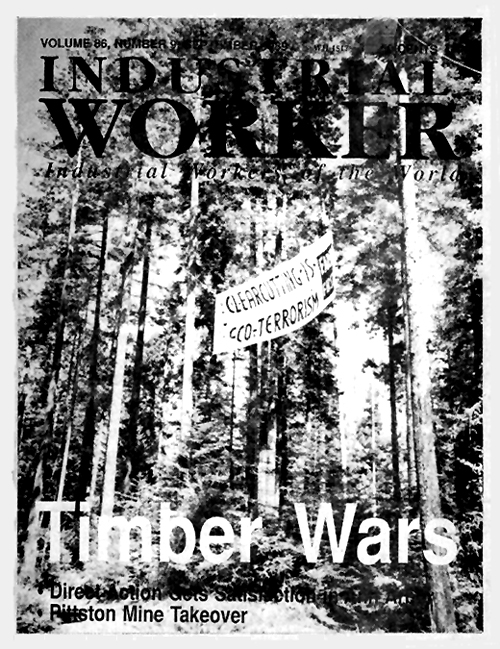
Timber Wars: Footloose Wobs Urgently Needed

By Judi Bari, Industrial Worker, October 1989; Reprinted in Timber Wars, © 1994 Common Courage Press.

"You fucking commie hippies, I'll kill you all!" A shotgun blast goes off and the Earth First!ers scatter. What started as a peaceful logging road blockade had turned violent when a logger sped his truck through our picket line and swerved it towards the demonstrators. The loggers also grabbed and smashed an Earth First!er's camera and, for no apparent reason, punched a 50-year old protester in the face, breaking her nose.

The environmental battle in the Pacific Northwest has reached such a level of intensity that the press now refers to it as the Timber Wars. At stake is the survival of one of the nation's last great forest ecosystems. Our adversaries are giant corporations--Louisiana Pacific, Georgia Pacific, and MAXXAM in northern California, where I live, joined by Boise Cascade and Weyerhauser in Oregon and Washington.

These companies are dropping trees at a furious pace, clogging our roads no less than 18 hours a day, with a virtual swarm of logging trucks. Even old timers are shocked at the pace and scope of today's strip-logging, ranging from 1000-year old redwoods, one tree trunk filling an entire logging truck, to six-inch diameter baby trees that are chipped up for the pulp-mills and particleboard plants.

One-hundred-forty years ago the county I live in was primeval redwood forest. At the current rate of logging, there will be no marketable trees left here in 22 years. Louisiana Pacific chairman Harry Merlo put it this way in a recent newspaper interview: "It always annoys me to leave anything lying on the ground. We don't log to a 10-inch top, we don't log to an 8-inch top or a 6-inch top. We log to infinity. It's out there, it's ours, and we want it all. Now."

So the battle lines are drawn. On one side are the environmentalists, ranging from the big-money groups like Wilderness Society and Sierra Club to the radical Earth First!ers and local mountain people fighting the front line battles in the woods. Tactics being used include tree-sitting, logging road blockading, and bulldozer dismantling, as well as the more traditional lawsuits and lobbying.

On the other side are the big corporations and the local kulaks who do their bidding. Tactics used by them have included falling trees into demonstrators, suing protesters for punitive damages (and winning), buying politicians, and even attempting to ban the teaching at a local elementary school of a Dr. Suess book, The Lorax, which the timber companies say portrays logging in a bad light.

Lumberjack (Tom Scribbner)

By Tom Scribbner - IWW, 1966

Image (right): statue of Tom Scribbner with his musical saw, located in downtown Santa Cruz, California.

Web Editor's Introduction: this book is included primarily for historical accounts as well as entertainment.

Tom Scribner was a timber industry worker and a union organizer his entire life. He joined the IWW in 1914 and was a part of the LWIU's fight for the eight-hour day. He participated in the formation of the once radical International Woodworkers of America (IWA) of the CIO (now merged with the International Association of Machinists (IAM) in the AFL-CIO). He was an unabashed member of the American Communist Party during its heyday in he 1930s. He founded two newspapers, Lumberjack News and Redwood Ripsaw. He was a radical all his life, and wrote a great deal. Much of his best work, he self-published in Lumberjack.

This website includes a complete, unabridged copy of Tom Scribner's self-published book, Lumberjack, originally published in 1966. Between 1990-94, the members of Santa Cruz General Membership Branch of the IWW reproduced several hundred copies of Lumberjack, however they made a conscious decision not to make any alterations to Scribner's original work. This meant that no corrections were made to spelling, grammatical, or punctuation errors. Furthermore, it meant that they made no annotations or clarifications where Scribner's politics differed from their own, even though the work was circulated and sold as unofficial IWW literature. As a result, there are several potential problems that we found it necessary to address.

It is most appropriate to leave unaltered numerous grammatical errors made by Scribner, as he was a timber worker his entire life and not a scholar. Scribner himself apologizes in his own introduction for "bloopers on the Kings English". Members of the Santa Cruz IWW believed, as do we, that to change these would be to ruin the character of the writing and the tenor of the work. however, where we part company with our Fellow Workers' concerns spelling and punctuation errors. We have cleaned these up, as we found it necessary to do so, because retention of spelling errors could cause unsuspecting visitors to this website to regard us as dolts and radicals on the left are always subject to much greater criticism then just about anybody else. Furthermore, corrections of such errors make the writing easier to understand. We feel nothing has been lost in the translation and transcription.

We have also made some additions, notably the assignment of "chapter numbers" to allow for easy reference (even though Scribner didn't even include a table of contents). Furthermore, we have made an occasional annotation (in the form of footnotes) to clarify points that might be obscure to most readers. A few footnotes note, admittedly ideological difference that we have with Scribner. Most of these concern his position on Communism. Scribner was an unapologetic pro-Soviet Communist, i.e. he believed that the Soviet Union represented a step forward for the Working Class (it is not clear whether or not Scribner was a Stalinist. He has nothing to say about Mao or Trotsky in any of the writings featured here, nor does he offer any criticism of Stalin for that matter). History has, in our opinion, proven Scribner quite wrong. Furthermore, the IWW Constitution and the theories that most Wobblies have about industrial unionism differ very sharply from Scribner's concept of Proletarian Revolution.

The IWW believes that the only way that we can achieve true, maximum individual freedom for everyone as well as a world in which we can all live sustainably, is through industrial organization. Direct action at the point of production, and organization in the workplace (or at the community level). Political parties (not to be confused with political action which is any action that involves political issues, be they labor, environmental, or social justice) and seizure of state power are a tactical and strategic cul-de-sac that will only result in the continued oppression of he working class. Scribner did not hold the same views and because of this, he quit the IWW after the organization suffered a damaging split in 1924.

Why include his writings then, if he was no longer a complete believer in the industrial unionism of the IWW? The answer is simple. He was a member of the IWW (at least for ten years) and a timber worker all of his life. Despite his ideological disagreements with the IWW, he rightfully points out that the IWW did more for timber workers in North America than any other organization. Furthermore, he describes aspects of the timber industry that can be found nowhere else. Finally, he was a union organizer, whatever his politics, and the IWW believes that organizing the unorganized is essential to abolishing wage slavery.

Chapter 13: The Communist Era

I wrote this and published it in the Redwood Ripsaw of Davenport, California last year (1965).

The Bolshevik Revolution in "Mother Russia" in November 1917 came like the thunder clap of the Atom Bomb. It caught the workers of all the world by complete surprise-and it dumfounded the master class as well.

Chapter 2: Era of the IWW

The Working Class and the Employing Class have nothing in common. There can be no peace so long as hunger and want are found among the millions of working people, and the few, who make up the Employing Class, have all the good things of life.

Between these two classes a struggle must go on until the workers of the world organize as a class, take possession of the earth and the machinery of production, and abolish the wage system. . . .It is the historic mission of the working class to do away with capitalism.

Pages

The Fine Print I:

Disclaimer: The views expressed on this site are not the official position of the IWW (or even the IWW’s EUC) unless otherwise indicated and do not necessarily represent the views of anyone but the author’s, nor should it be assumed that any of these authors automatically support the IWW or endorse any of its positions.

Further: the inclusion of a link on our site (other than the link to the main IWW site) does not imply endorsement by or an alliance with the IWW. These sites have been chosen by our members due to their perceived relevance to the IWW EUC and are included here for informational purposes only. If you have any suggestions or comments on any of the links included (or not included) above, please contact us.

The Fine Print II:

Fair Use Notice: The material on this site is provided for educational and informational purposes. It may contain copyrighted material the use of which has not always been specifically authorized by the copyright owner. It is being made available in an effort to advance the understanding of scientific, environmental, economic, social justice and human rights issues etc.

It is believed that this constitutes a 'fair use' of any such copyrighted material as provided for in section 107 of the US Copyright Law. In accordance with Title 17 U.S.C. Section 107, the material on this site is distributed without profit to those who have an interest in using the included information for research and educational purposes. If you wish to use copyrighted material from this site for purposes of your own that go beyond 'fair use', you must obtain permission from the copyright owner. The information on this site does not constitute legal or technical advice.