You are here

Donald Trump

The power of the movements facing Trump

By Michael Hardt and Sandro Mezzadra - ROARMag, November 16, 2016

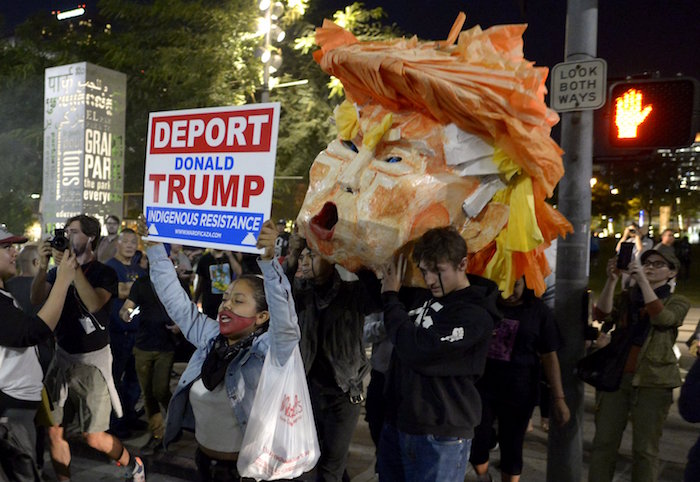
It is much too early to say to what extent President Trump will enact his campaign promises as government policy and, indeed, how much he will actually be able to do in office. But every day since his election demonstrations have sprung up throughout the United States to express outrage, apprehension and dismay.

Moreover, there is no doubt that once in office Trump and his administration will continually do and say things that will inspire protest. For at least the next four years people in the US will rally and march against his government, regularly and in large numbers. Protesting against threats to the environment will undoubtedly be urgent, as will be the generalized atmosphere of violence against people of color, women, LGBTQ populations, migrants, Muslims, workers of various sorts, the poor — and the list goes on.

One of the potential pitfalls for social movements, however, is that activism goes no further than protest. Protest, of course, can bring a city to a halt, can block temporarily the action of the government, and can even play the crucial role of opening up spaces for political alternatives. But on its own, protest is never enough to create lasting social transformation.

The significance of the Trump presidency and, moreover, the keys to developing protest against it become clearer, we think, when posed in a global context. Before coming back to the questions for social movements, then, let us frame some of the basic aspects of the global context into which Trump’s government will enter.

To Escape Trump’s America, We Need to Bring the Militant Labor Tactics of 1946 Back to the Future

By Admin - Life Long Wobbly, November 12, 2016

Back to the Future, Part 1:

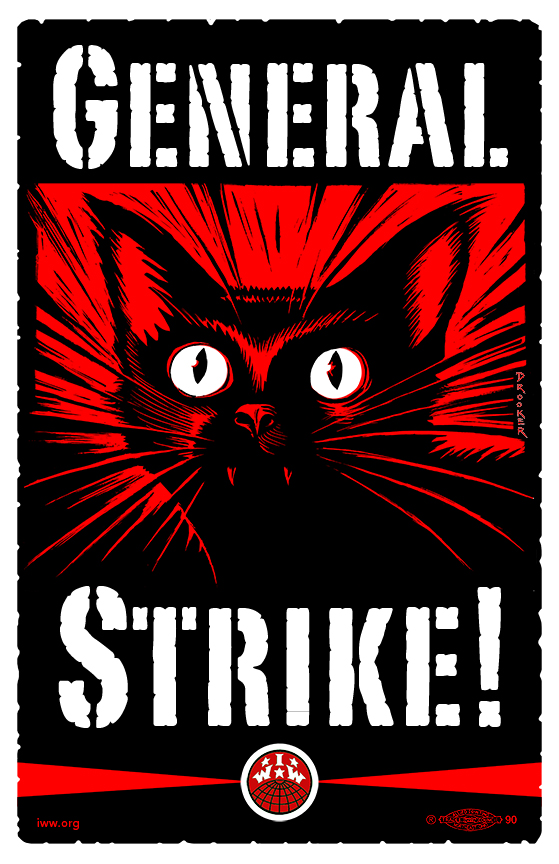
The last general strike in the US was in Oakland in 1946. That year there were 6 city-wide general strikes, plus nationwide strikes in steel, coal, and rail transport. More than 5 million workers struck in the biggest strike wave of US history. So what happened? Why haven’t we ever gone out like that again? Congress amended US labor law in 1947, adding massive penalties for the very tactics that had allowed strikes to spread and be successful – and the business unions accepted the new laws. In fact, they even went beyond them by voluntarily adding “no-strike clauses” to every union contract for the last 70 years, and agreeing that when they do strike in between contracts it will only be for their own wages and working conditions, not to support anybody else or to apply pressure about things happening in the broader society. When we allowed ourselves to lose our most important weapons 70 years ago, we took the first step towards Trump’s America. We’re stuck in the wrong timeline – if we want to get out, we have to bring the militant labor tactics of 1946 back to the future!

Election of Trump clarifies the struggle for climate justice

By Nicolas Haeringer and Tadzio Müller - New Internationalist, November 11, 2016
Until Donald Trump’s electoral success, there was at least some reason to believe that the momentum was finally on the side of climate justice. After a cycle of failures and defeats, our mobilizations were finally proving to have an impact – from actions targeting infrastructures to the divestment movement, there were important successes, amplifying what seems to be the irresistible rise of a 100 per cent renewable future.

The climate summit in Paris was not Copenhagen. COP21 enabled the climate movement to enter a new stage with clearer strategic perspectives building stronger alliances among very diverse actors. COP21 (and the momentum it created) has not only changed the political landscape from a movement’s perspective. It has had an impact on the institutional sphere too. As such, this is no guarantee that world leaders will finally opt for bold climate action. But it enables us not only to demand actions but also to hold public actors accountable for decisions they’ve made. It makes our demands stronger: they’re not ‘only’ about climate anymore, but are demands for democracy, and leave us the space to defend the idea of a ‘climate state of necessity’.

Of course, these successes and progresses came with issues, doubts and debates within the movement. But we had this strong feeling that we were beginning to win: after an action this May in the East German lignite region of Lusatia, a thousand people in a circus tent shouted ‘we are unstoppable, another world is possible!’ – and meant it!

It is pretty easy, after Wednesday’s US presidential election result, to give up on hope – and consider Trump’s victory a serious setback. It is only going to be a setback if we let it be so. In that perspective, his victory ironically comes with a clarification, and a major simplification of the climate math. If Trump is to do what he said he was going to do (i.e. drill, drill and drill), it concretely means that the carbon budget for the rest of the world has in fact dropped to zero on election night.

That fact shouldn’t scare us. It is actually a very powerful and simple tool, which shows us what the next steps for the climate movement should be: if the UNFCCC process isn’t going to stop climate chaos, and if the US is being run by a madman – then the movements need to stop it themselves, and those outside of the US have to step up their game to impose fossil-fuel phase-outs everywhere. It also shows us what our solidarity with the communities at the frontline of the fight against climate change and fossil fuel extraction in the US should look like: the best way to build and show that solidarity is by freezing fossil fuel infrastructures everywhere.

To be sure: in a world where someone who claims that climate change is a ‘hoax cooked up by the Chinese’ has just been elected to what is perceived to be the most powerful office on the planet, it is not enough to simply claim that science, truth and reason now dictate how we step up our fight against the fossil fuel industry. After all, Trump’s success rested to a significant extent on the fact that he ignored established ‘truths’, and that his supporters frequently did not care that he was lying, or making utterly absurd statements about building walls and ‘making Mexico pay’ for them.

If Trump’s success is also the success of a ‘post-truth politics’, what does that mean for climate justice politics? It means that we need to leave the intellectually easy certainty of science and of ‘carbon budgets’ behind to a certain extent – science has played a huge role in shaping our movement and our successes, and there is no reason for it to cease. But the laws of physics don’t care about politics, and last night the former proved to be more powerful than the latter. In a trumped-down world, we might respond that the laws of politics don’t care about physics, that ‘truth’ as we traditionally understand it plays less and less of a role.

Trump won because his political discourse resonated with people on an affective level, that is to say: it made them feel understood and it made them feel powerful. Politics in the liberal/leftist tradition too often concerns itself with interests and truths (and then we often wonder why people vote ‘against their interests’, implying, rather arrogantly, that they have been duped by something we like to call a ‘hegemonic ideology’). But in the words of philosopher Baruch Spinoza, since people ‘are led more by passion than by reason, it naturally follows that a multitude will unite and consent to be guided as if by one mind not at reason’s prompting but through some common affect’.

If this is true – and we believe it is, all the more so in an age where neoliberal and centre-left elites have for decades used seemingly inescapable truths (‘There Is No Alternative’) as a battering ram against the historical achievements of working class movements, and where social media are producing multiple-truth-echo-chambers – then climate (justice) politics has to leave the high ground of science.

It has to recreate itself as a politics that makes people feel empowered, that starts not from carbon budgets per se, but from the struggles of those frontline communities most negatively affected, and that, quite simply put, is appealing enough to fight the racist, sexist, nativist juggernaut currently remaking the global North.

In short: we need less COP23, and more Ende Gelände; less potentially doomed fights for carbon taxes in Congress, and more effective, powerful and inclusive struggles like those against the Keystone XL or the Dakota Access pipelines – or rather, we need to embrace them and build them into one movement. Which means more organizing, more peaceful civil disobedience and less time in the political halls of the UN.

Not because the latter are wrong or bad or necessarily ineffective (though unfortunately they often are) – but because in a world where Trump is president of the US, if climate politics remain tied to reason and truth, and to global elite jamborees, it will necessarily fail.

Only a climate justice politics that exceeds the affective attractiveness of the jargon of the other side can win the fights we need to win. This is what many groups are already doing – those who are on the frontline.

Without empathy for Trump voters, movements can’t succeed

By George Lakey - Waging NonViolence, November 10, 2016

This was a highly emotional election, and we need time to feel our feelings and sort out what it means for us and for the country. Donald Trump is a con man; his game is to manipulate emotions and activists can be as vulnerable as anyone else. Knowing that, we can give ourselves some space to breathe rather than hype each other’s fear. We can also begin to ask, what does his victory mean for social activists on the left?

First, and most obviously, Bernie Sanders was not Trump’s opponent. Many Trump voters liked Sanders for the same reason they supported Trump: He was an outlier who was an alternative to the establishment that has for decades been implementing what billionaire Warren Buffett calls the economic elite’s “class war.”

We activists on the left, even with some disagreements with Sanders, could reasonably regard him as a standard-bearer for us, but that’s not the choice voters made this November. I voted for Hillary without believing for a minute that she was putting forth my politics — or that my politics even got attention in the general election.

What we learn from the vote against Hillary is that many people who are losing the class war don’t like losing, and took it out on a pillar of the establishment. In 2008 and 2012, many white working-class people in the North gave their support to Barack Obama because he was the most credible hope for change, running in each election against a pillar of the establishment. By wide margins they didn’t let the color of his skin prevent them from voting for the chance of a pause in the battering they’d been getting.

For people interested in learning how to make major change in the United States, the electoral arena is only a tiny peephole covered with gauze. Voter participation is low in the United States compared with, say, Scandinavia, and that was true this year, too. Because the election only involves part of the citizenry and is mostly about money, celebrity and manipulation, it tells us little and invites us to make up stories laced with our own fears.

Nevertheless, combing the electoral data can tell us something. Exit polls, for example, tell us that one in five voters who pulled the lever for Trump do not believe he is qualified to be president.

Why vote for someone so unqualified? One answer is because that voter feels certain they know what a second Clinton presidency would bring: unjust policies that further degrade the lives of the oppressed. Here’s the chance for activist empathy, crucial for our having any chance of success in the future: When people so desire change that they will vote for someone they believe unqualified, they are desperate. Activists are used to calling people who are rendered desperate by unjust polices “the oppressed.” If using that name helps us stop othering working-class Trump voters, let’s use that name.

The white working class reading of recent American history may be more accurate than that of many activists. Bill Clinton betrayed the Democratic Party’s traditional working-class base through the North American Free Trade Agreement, destruction of “welfare as we know it,” and subsidizing corporations’ moving industrial jobs overseas. Even when the presidency and both houses of Congress were in the hands of the Democrats, a union movement that worked night and day to get Democratic politicians elected could not get its priorities enacted.

Many in a social class that once believed the Democratic Party was its ally were bound to notice, sooner or later, that the party’s allegiance is elsewhere. I’ve often heard middle-class liberals complain about working-class people voting against their interests, but I’m not hearing them complain that tens of millions of middle-class people vote against their interests – something they do routinely, and did so again by voting for Trump. In fact, the middle class reportedly provided Trump’s most reliable funding during the primary season.

Don’t Mourn, Organize!

By Anne Petermann, Executive Director - Global Justice Ecology Project, November 9, 2016

Dear GJEP Friends and Family,

While surprised by the turn of the election last night, I was not shocked.  Horrified, but not shocked.

The pundits had all but declared Hillary the winner in the days leading up to the election, but a lot of people who have been crushed by the system over the years stood up to be counted. They fell for the hateful, booming rhetoric of a billionaire businessman and TV star with no political experience-because he promised to stand up for them. He promised “change.”

According to exit polls by CNN, however, more than half of people polled are worried about what will happen in the coming years under a Trump Presidency. Over a third are more than worried, they are scared. The atmosphere is thick with sadness, rage, disbelief, fear.

After the filth of this election campaign, many will want to circle the wagons. To wait for the worst to blow over.

But that is not an option. And the fact is, no matter who won the election, we were on a collective course toward the edge of a cliff. Under Obama-the supposed face of progressive “change”-there has been no real action to address climate change. Activists at Standing Rock are being brutalized by the police for trying to stop a pipeline and protect their sacred water and land. Unarmed black people are being killed by police. Drones are dropping bombs on children in far away lands.

The system is broken, no matter who is at the helm.

Donald Trump and the new Republican held Congress will be nasty. There is no question about that.

But the one possible positive outcome of this spectacular disaster is that there is no such thing as complacency any more. You either organize or you let Trump’s agenda of hate run rampant. There have been galvanizing moments in United States history when injustice was so potent, so undeniable that people came out in droves to be part of the force for change. I believe this can become one of those moments.

There is no political party that will do this for us. It is up to us. It is time to acknowledge that the system doesn’t work and start talking about what we do next. Time to mobilize. Time to take action for real systemic change.

That is our commitment here at Global Justice Ecology Project.  GJEP was founded to address the intertwined root causes of social injustice, economic domination and ecological destruction.  That is our mission. And we will keep organizing and building to strengthen the global movement toward the fundamental, transformational, bottom up change necessary to achieve a sane future on this planet.

I hope you will join us.

Onward!

A Just Transition for Fossil Fuels Workers is Possible

Robert Pollin interviewed by Sharmini Peries - The Real News Network, October 24, 2016

Movements, Not Presidents: The Nationwide Fight Against Neoliberalism

By Jake Johnson - Common Dreams, Spetember 29, 2016

Just months after becoming president of the United States, Barack Obama met with some of the world's most powerful executives.

It was a time of crisis: The economy was wavering dangerously in the aftermath of the housing bubble's great burst, and many of the nation's largest financial institutions had just been yanked from the brink of collapse.

Though the effects of the most severe economic downturn since the Great Depression were disastrous for countless Americans, the executives with whom the president spoke on that day in March of 2009 were doing just fine. In fact, many were doing better than ever.

While millions faced the prospect of losing their homes, their jobs, and their life savings, the same CEOs that helped spark the crash were paying themselves and their employees lavish bonuses.

The executives reportedly "offered several explanations" for their salaries, but the president quickly reminded them, "The public isn't buying that."

"My administration," Obama famously added, "is the only thing between you and the pitchforks."

It was a striking, even prescient, remark. Having ascended to the White House on a wave of grassroots support, the president was expected to take a stand for the public—it was expected that those guilty of wrongdoing would be held to account, that those harmed by Wall Street's rampant fraud would receive the full support of the administration.

But such high hopes were quickly dashed.

Or perhaps they were, from the start, misplaced. While President Obama did indeed ride a wave of grassroots support into the White House, that wave, it must be remembered, was generously bolstered by Wall Street cash.

And while the hopes of the millions who voted for change they could believe in may have, in the last analysis, been ill-advised, Wall Street certainly got its money's worth.

"Obama had a clear mandate to rein in Wall Street," Matt Taibbi noted in 2009. "What he did instead was ship even his most marginally progressive campaign advisers off to various bureaucratic Siberias, while packing the key economic positions in his White House with the very people who caused the crisis in the first place."

The Obama administration quickly downplayed such concerns, attempting to foster a genial relationship between the winners and losers of the crisis.

"The President emphasized that Wall Street needs Main Street, and Main Street needs Wall Street," Robert Gibbs, Obama's press secretary, said after the high-profile meeting.

Thankfully, the public didn't buy that either.

Capital Blight News #122

Compiled by x344543 - IWW Environmental Unionism Caucus, September 20, 2016

A supplement to Eco Unionist News:

Lead Stories:

The Man Behind the Curtain:

Green is the New Red:

Capital Blight News #118

Compiled by x344543 - IWW Environmental Unionism Caucus, August 24, 2016

A supplement to Eco Unionist News:

Lead Stories:

The Man Behind the Curtain:

Green is the New Red:

Capital Blight News #114

Compiled by x344543 - IWW Environmental Unionism Caucus, July 27, 2016

A supplement to Eco Unionist News:

Lead Stories:

The Man Behind the Curtain:

Green is the New Red:

Pages

The Fine Print I:

Disclaimer: The views expressed on this site are not the official position of the IWW (or even the IWW’s EUC) unless otherwise indicated and do not necessarily represent the views of anyone but the author’s, nor should it be assumed that any of these authors automatically support the IWW or endorse any of its positions.

Further: the inclusion of a link on our site (other than the link to the main IWW site) does not imply endorsement by or an alliance with the IWW. These sites have been chosen by our members due to their perceived relevance to the IWW EUC and are included here for informational purposes only. If you have any suggestions or comments on any of the links included (or not included) above, please contact us.

The Fine Print II:

Fair Use Notice: The material on this site is provided for educational and informational purposes. It may contain copyrighted material the use of which has not always been specifically authorized by the copyright owner. It is being made available in an effort to advance the understanding of scientific, environmental, economic, social justice and human rights issues etc.

It is believed that this constitutes a 'fair use' of any such copyrighted material as provided for in section 107 of the US Copyright Law. In accordance with Title 17 U.S.C. Section 107, the material on this site is distributed without profit to those who have an interest in using the included information for research and educational purposes. If you wish to use copyrighted material from this site for purposes of your own that go beyond 'fair use', you must obtain permission from the copyright owner. The information on this site does not constitute legal or technical advice.