

You are here

coal

Building Worker and Community-focused Economic Transitions in Coal Country

Miners Deserve Protection from Black Lung Disease

Labor Board judge blasts Warrior Met in long-running dispute with Mine Workers

By press associates - People's World, August 2, 2023

A National Labor Relations Board administrative law judge has strongly blasted the Warrior Met coal company in its long-running dispute over a new contract with the United Mine Workers—a dispute which led bosses to lock out the firm’s 1,100 miners for more than a year and a half. The judge formally ruled the firm’s unfair labor practices provoked the conflict.
In an 88-page ruling, ALJ Melissa Olivero came down particularly hard on company officials for claiming they couldn’t afford the union’s demands for raises in each year of a new contract, and the union’s tries at reclaiming the givebacks the workers had to yield to keep the firm going when it was the old, and bankrupt, Jim Walter mine.

Even as the firm gave out big bonuses to its corporate honchos, in a poor area of rural Alabama, and shoveled out millions of dollars in stock options and dividends to its Wall Street investors, it was claiming poverty and saying paying the miners would force it to close, Olivero said. It denied making the closure threat, but Olivero found its denials were not credible.

Such claims, Olivero noted, entitled the Mine Workers (UMWA) to review the mine’s books, but the mine bosses refused to turn them over, and that broke labor law, too, Olivero said. That led UMWA to declare the strike was about Warrior Met labor law-breaking, formally called unfair labor practices.

That made the strike, and Warrior Met’s lockout of the workers, an unfair labor practices strike, Olivero ruled. Warrior Met appealed her decision to the full board, which has called for briefs from both sides by late August.

Warrior Met also was hiring subcontractors to work alongside the miners, Olivero noted—another bone of contention in the bargaining between the two sides.

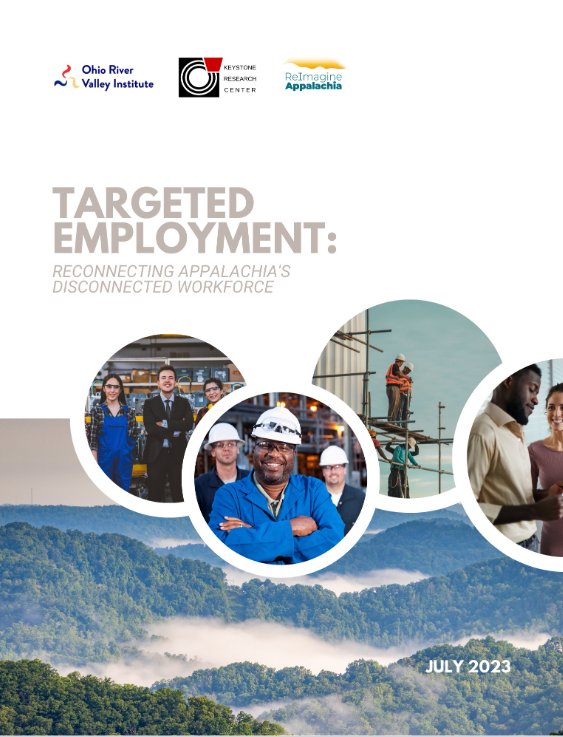
Targeted Employment: Reconnecting Appalachia’s Disconnected Workforce

By Claire Kovach, Stephen Herzenberg, Amanda Woodrum, and Ted Boettner - ReImagine Institute, Keystone Research Center, Ohio River Valley Institute, July 25, 2023

The Appalachian region has long suffered from not having enough good paying jobs. Even when the unemployment rate is low, too many Appalachians are disconnected from the workforce entirely due to a myriad of factors. The result has been a long-term structural unemployment problem that has persisted for decades, with too many Appalachian adults out of the workforce entirely and unable to secure a decent paying job where they live.

A federal job subsidy program that is targeted at breaking down barriers to employment – such as improving the skills and experience of potential workers to meet current employer demands in their local labor market – and connecting them with a job could not only boost incomes and improve the livelihood of thousands of Appalachians but also give people self-esteem, a source of identity, and feel more connected to their community.

This report examines the economic conditions of Appalachia with a particular focus on the Appalachian counties of four states—Kentucky, Ohio, Pennsylvania, and West Virginia—that comprise the footprint of ReImagine Appalachia and the Ohio River Valley Institute. This includes describing how Appalachia has been a “region apart” from the rest of America, including its history of resource extraction and exploitation, the collapse of the steel industry, and now coal, that has led to large employment losses in the area, and how the region’s uneven development has led to chronically low rates of employment, disenfranchisement from the labor market and even loss of hope underpinning the opioid epidemic from which the Appalachian region was particularly hard hit.

Download a copy of this publication here (PDF).

NLRB SLAMS Warrior Met for ILLEGAL BARGAINING PRACTICES

Building alliances between Labour and the Climate Justice movements

Changing the Trade Winds: Aligning OECD Export Finance for energy with climate goals

By Nina Pušić and Claire O’Manique - Oil Change International, May 23, 2023

This new Oil Change International report shows that Organisation for Economic Co-operation and Development (OECD) countries supported fossil fuel exports by an average of USD 41 billion from 2018 to 2020, almost five times more than clean energy exports. This directly contradicts internationally agreed climate goals, including the Paris Agreement objective to align financial flows with the low-carbon energy transition.

A majority of international public finance for fossil fuels is provided by OECD governed Export Credit Agencies (ECAs), with 71 percent of export financing for energy going to oil and gas.

OECD ECAs play a particularly influential role in getting large fossil infrastructure projects built. They invested in 56 percent of new hazardous liquified gas (LNG) export terminal capacity built in the last decade (providing at least USD 81 billion), helping drive the global fossil gas boom by getting these large keystone projects built. Overall, about 42 percent of all fossil fuel finance from ECAs under the OECD supported midstream infrastructure activities, such as pipelines, LNG ports, and shipping.

This new report recommends that OECD countries present an ambitious proposal to prohibit financing all oil and fossil gas projects in order to align with a 1.5ºC warming limit.

Authors of the report recommend that:

  • Australia, Norway, Turkey, Korea, and Japan, urgently sign onto the Clean Energy Transition Partnership (CETP);
  • OECD members that have already signed onto the CEPT, including the United Kingdom and Canada, fulfill their commitment to “driv[e] multilateral negotiations in international bodies, in particular in the OECD” to align with the Paris Agreement goals and present a proposal for an OECD oil and gas export finance prohibition;
  • OECD members close the existing coal loopholes, to extend the coal-fired power prohibition to cover coal mining, transport, and associated infrastructure;
  • OECD members ensure that under the Climate Change Sector Understanding (CCSU) no favorable investment conditions are offered to any project or technology derived from fossil gas, including but not limited to blue, gray, and black hydrogen and ammonia, or projects that extend the lifetime of fossil fuel assets.

Download a copy of this publication here (PDF).

The Young Miners Dying of “An Old Man’s Disease”

By Kim Kelly - In These Times, May 17, 2023

Black lung is completely preventable. And it’s on the rise again.

“Is that the wind you hear howlin’ through the holler?
Or the ghost of a widow that cries?
For every man that died for a coal company dollar
A lung full of dust and a heart full of lies”
—“It’s About Blood,” Steve Earle (2020)

Adaptation is a way of life for John Moore. He’s worked construction, run a wig shop and now promotes concerts. The wig shop idea came to him because his middle daughter was having trouble styling her thick, curly hair. He didn’t know much about wigs, or hair in general, so he learned and started turning a profit soon after the grand opening. That’s the kind of man he is — someone who’s always looking out for the next opportunity, the next chance to make it.

When we meet, Moore is wearing a black puffer jacket, a black durag, work boots and a cautious smile. He’s soft-spoken but firm, and he lights up when he talks about his wife and three kids. At a glance, he seems strong, the kind of person who can win an arm-wrestling contest or help you move — like a man with a lot of living left to do.

But instead, Moore, at only 42, is dying of black lung disease.

You see, Moore’s résumé also includes a few lines familiar to many people in Central Appalachia. He spent about 11 years running coal and clearing debris in the mines of Southern West Virginia. During that time, a cruel disease took up residence inside his chest cavity. Now, it is slowly destroying him from the inside.

He’s not alone. Across Central Appalachia — and specifically Kentucky, Virginia and West Virginia — coal miners are struggling to breathe. Many of them aren’t much older than Moore — and many are much younger. Journalist Howard Berkes investigated the spike in a series for NPR in 2012, and multiple studies before and after have shown black lung (known more formally as coal workers’ pneumoconiosis, or CWP) has been on the rise for the past decade.

The Richmond Coal Dust Study: Coal Trains Pollute!

Stop the Cumbria Coal Mine: XRTU at The Big One

Pages

The Fine Print I:

Disclaimer: The views expressed on this site are not the official position of the IWW (or even the IWW’s EUC) unless otherwise indicated and do not necessarily represent the views of anyone but the author’s, nor should it be assumed that any of these authors automatically support the IWW or endorse any of its positions.

Further: the inclusion of a link on our site (other than the link to the main IWW site) does not imply endorsement by or an alliance with the IWW. These sites have been chosen by our members due to their perceived relevance to the IWW EUC and are included here for informational purposes only. If you have any suggestions or comments on any of the links included (or not included) above, please contact us.

The Fine Print II:

Fair Use Notice: The material on this site is provided for educational and informational purposes. It may contain copyrighted material the use of which has not always been specifically authorized by the copyright owner. It is being made available in an effort to advance the understanding of scientific, environmental, economic, social justice and human rights issues etc.

It is believed that this constitutes a 'fair use' of any such copyrighted material as provided for in section 107 of the US Copyright Law. In accordance with Title 17 U.S.C. Section 107, the material on this site is distributed without profit to those who have an interest in using the included information for research and educational purposes. If you wish to use copyrighted material from this site for purposes of your own that go beyond 'fair use', you must obtain permission from the copyright owner. The information on this site does not constitute legal or technical advice.
