

You are here

public transit workers

Media Moves On, But Railroad STRIKE Negotiations Are Heating Up

Biden's Railroad Worker Agreement DOOMED? Union Organizer Calls Proposal 'DISINGENUOUS'

Enough Is Enough! 125,000 Railworkers Want A Life: Report By Gabe Christenson Co-chair RWU

What Casey Jones Tells Us about the Past and Present of America's Railroad Workers

By Scott Huffard - History News Network, September 18, 2022

With a potential railroad strike in the news, Americans are learning quite a bit about the poor working conditions on the freight railroads that keep this country running. Railroad workers threatening to strike have complained about poor pay, dangerous working conditions, and punitive attendance policies. If Americans think about the stereotypical railroad engineer, perhaps Casey Jones comes to mind. Casey Jones, who crashes to his doom in a famous song from the Grateful Dead, a folk ballad, vaudeville hit, and countless parodies, has become the almost universal stand-in for a railroad worker in American culture. Yet despite a haze of mythology, there was a real Casey jones, and his work life tells us much about railroad work in the past and present.
As Casey Jones songs spread around the nation, engineers and their friends from across the country claimed to be the “real” Casey Jones, a fact that tells us just how universal his experience was. But most folklorists find John Luther Jones, an Illinois Central engineer who died in a 1900 train wreck near Vaughan, Mississippi, to be the most credible of these claims. While we do not know all that much about his life, we do know what it was like to be an engineer for the Illinois Central, and the story of the real Casey Jones reminds us that there is nothing new about the grievances of modern rail workers.

Global Climate Jobs Conference: Strategic Orientation

“30 Years in the Making”: U.S. Rail Strike Averted by Tentative Deal as Workers Decry Grueling Conditions

The Looming Rail Strike Was Years in the Making

By Noah Lanard - Mother Jones, September 14, 2022

Workers are fed up with the cost-cutting and layoffs that have left them unable to care for themselves and their families.

Rail workers across the country may be on the verge of going on strike for the first time in three decades—a decision that would immediately cripple supply chains and cause billions in economic losses per day. Workers could walk off the job, or companies could lock them out, as soon as Friday if a deal isn’t reached. 

The dispute is not about pay, but the day-to-day indignities of working in the industry. Rail workers often don’t have weekends, get no sick days, and say that taking the time to care for themselves and their families can lead to being fired. As engineer Ross Grooters puts it, workers are “just fighting for the basic right to be able to be people outside of the railroad.”

The White House has been scrambling to try to avoid a strike that would upend the country’s economy in the lead-up to the midterm elections, and President Joe Biden has been in touch with unions and railroad companies, Politico reports. A shutdown could disrupt shipments of everything from coal and lumber to food and the chlorine used to treat wastewater. Amtrak trains that rely on freight carriers’ tracks are already being canceled.

Failing to reach a deal by Friday does not guarantee a strike, since both sides could agree to extend negotiations. But administration officials are developing contingency plans to try to keep essential goods moving in the event of a shutdown, an outcome that White House press secretary Karine Jean-Pierre has said is “not acceptable.”

Unionized workers and rail companies have been in contract negotiations for more than two years. In July, Biden established a Presidential Emergency Board tasked with providing recommendations on how to end the dispute. Last month, the board proposed pay increases of 24 percent over five years, additional bonuses, and one extra personal day a year. It also called for lifting a cap on workers’ health care premiums, and did not back workers’ calls for sick days and less-punitive attendance policies.

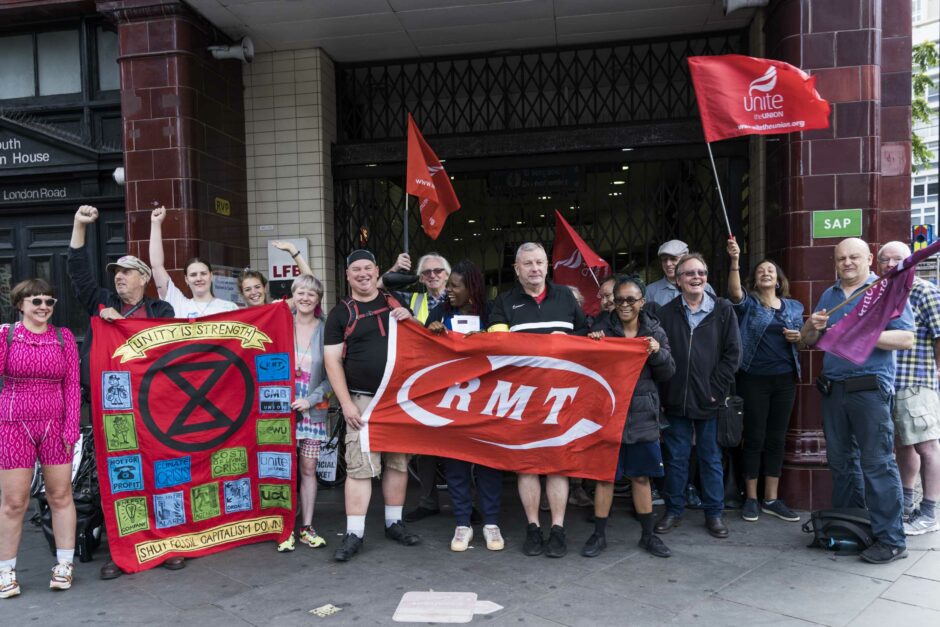
XR UK position on Strike Action

By staff - Extinction Rebellion UK, August 25, 2022

The cost of living crisis is escalating week on week, the movement to refuse to pay energy bills is gaining momentum and workers from an increasing range of industries are voting to take strike action for livable wages and secure jobs. Railway and tube staff, bus drivers, communications workers, warehouse workers and postal workers are among those striking or staging protests in recent weeks. 

At the same time the UK just recorded it’s hottest ever temperature and Extinction Rebellion is seeing a spike in interest from people who have decided now is the time to step-up and take action – over 1000 people registered for our last Open Call and the ‘Welcome to XR’ sessions have seen a significant increase in attendees. 

In this context we need to speak clearly about the common interests of striking workers and the environmental movement.

Support for rail strikes from Just Transition Partnership

By staff - Just Transition Partnership, August 18, 2022

The Just Transition Partnership sends solidarity to RMT, TSSA and ASLEF members taking industrial action to protect their pay, jobs and working conditions, and in the wider fight for a sustainable public transport system run for people and the planet, not private greed. Billions are being cut from our transport system at a time when increasing investment is vital to ensure a fully public, affordable, integrated and sustainable transport system.

Our railways are already being impacted by the effects of climate change, putting additional demands on a stretched workforce providing an essential public service. We need a well-paid transport workforce with secure conditions and it is indefensible to expect transport and other workers to take an effective pay cut as inflation and the costs of energy rise, especially while the profits of oil companies soar.

The UK government is failing on the climate crisis and the cost of living crisis. It has no integrated transport plans, favouring private companies which make vast profits rather than making transport affordable and our air breathable; in Scotland as well as the rest of the UK train and bus services are being cut. These actions are symptomatic of disregard for the concerns of climate, environment and workers.

The solutions to these crises have the same foundations – public investment into decarbonised and high-quality services using both taxation and legal duties on private companies; all delivered by a well-paid, skilled and secure workforce. These things won’t happen without workers in their trade unions organising to defend their wages, their jobs, their future and their rights through the power of collective bargaining. The workers movement and the climate justice movement need to build our collective power if we are to defend our future, that is why we send our solidarity to the workers on strike.

Mick Lynch on the Rail Strikes and Climate Crisis

Pages

The Fine Print I:

Disclaimer: The views expressed on this site are not the official position of the IWW (or even the IWW’s EUC) unless otherwise indicated and do not necessarily represent the views of anyone but the author’s, nor should it be assumed that any of these authors automatically support the IWW or endorse any of its positions.

Further: the inclusion of a link on our site (other than the link to the main IWW site) does not imply endorsement by or an alliance with the IWW. These sites have been chosen by our members due to their perceived relevance to the IWW EUC and are included here for informational purposes only. If you have any suggestions or comments on any of the links included (or not included) above, please contact us.

The Fine Print II:

Fair Use Notice: The material on this site is provided for educational and informational purposes. It may contain copyrighted material the use of which has not always been specifically authorized by the copyright owner. It is being made available in an effort to advance the understanding of scientific, environmental, economic, social justice and human rights issues etc.

It is believed that this constitutes a 'fair use' of any such copyrighted material as provided for in section 107 of the US Copyright Law. In accordance with Title 17 U.S.C. Section 107, the material on this site is distributed without profit to those who have an interest in using the included information for research and educational purposes. If you wish to use copyrighted material from this site for purposes of your own that go beyond 'fair use', you must obtain permission from the copyright owner. The information on this site does not constitute legal or technical advice.
