You are here

disaster collectivism

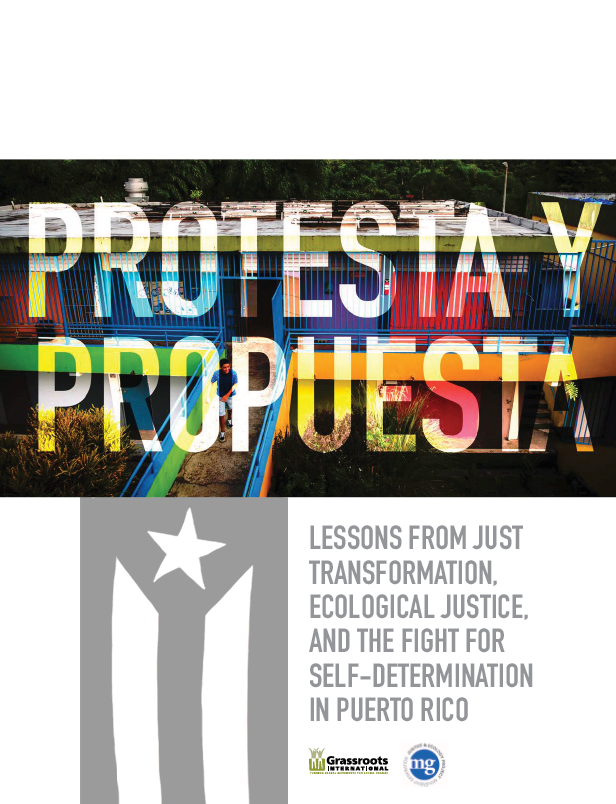
Protesta Y Propuesta: Lessons from Just Transformation, Ecological Justice, and the Fight for Self-Determination in Puerto Rico

By Brooke Anderson and Jovanna García Soto - Grassroots International and Movement Generation, February 2020

“De la Protesta a la Propuesta” (“From protest to proposal”). That’s the slogan that watershed protectors used when they successfully stopped open pit mining in the heart of Puerto Rico’s mountains then brought those same lands under community control. For those of us looking to build just transformation in place, we have much to learn from Puerto Rico’s social movements which are at once both visionary and oppositional, centering sovereignty and self-governance.

Just transformation, or just transition, is the work “to transition whole communities toward thriving economies that provide dignified, productive, and ecologically sustainable livelihoods that are governed directly by workers and communities.”

In the U.S., the term just transition was originally used by the labor movement to demand that with the phaseout of polluting industries, workers would be retrained and adequately compensated rather than bear yet another cost from working in that industry. Environmental justice communities on the fenceline of these polluting industries then built common cause with workers for a just transition that would not put the environmental or economic burden on workers or communities. In the U.S., the term has since further evolved to capture systemic transformation of the whole economy. While U.S. frontline groups often use the term just transition, some Puerto Rican social movements use the term just transformation—especially as a way to capture the necessity of achieving decolonization and sovereignty as part of any transition. As such, we’ll be using just transformation in this report, as well as other concepts such as self-determination and ecological justice.

Read the report (Link).

Regenerative & Just 100% Policy Building Blocks Released by Experts from Impacted Communities

By Aiko Schaefer - 100% Network, January 21, 2020

The 100% Network launched a new effort to bring forward and coalesce the expertise from frontline communities into the Comprehensive Building Blocks for a Regenerative and Just 100% Policy. This groundbreaking and extensive document lays out the components of an 100% policy that centers equity and justice. Read the full report here.

Last year 100% Network members who are leading experts from and accountable to black, indigenous, people of color (BIPOC) and frontline communities embarked on a collective effort to detail the components of an ideal 100% policy. The creation of this 90-page document was an opportunity to bring the expertise of their communities together.

The Building Blocks document was designed primarily for frontline organizations looking to develop and implement their own local policies with a justice framework. Secondly, is to build alignment with environmental organizations and intermediary groups that are engaged in developing and advocating for 100% policies. The overall goals of the project are to:

  • Build the capacity of BIPOC frontline public policy advocates, so that impacted community groups who are leading, working to shape or just getting started on 100% policy discussions have information on what should be included to make a policy more equitable, inclusive and just
  • Align around frontline, community-led solutions and leadership, and create a shared analysis and understanding of what it will take to meet our vision for 100% just, equitable renewable energy.
  • Create a resource to help ensure equity-based policy components are both integrated and prioritized within renewable energy/energy efficiency policies. 
  • Build relationships across the movement between frontline, green, and intermediary organizations to create space for the discourse and trust-building necessary to move collaboration forward on 100% equitable, renewable energy policies. 

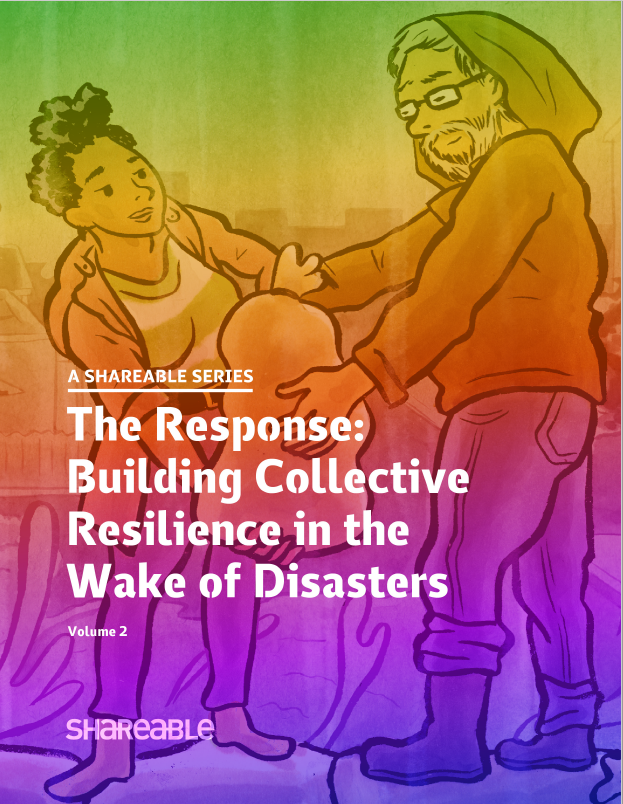
The Response: Building Cllective Resilience in the Wake of Disasters (Shareable)

By various - Sharable, 2019

When disasters occur, the majority of news coverage teeters on the edge of “disaster porn” at best, emphasizing the sheer mass of destruction in the affected area while celebrating a few token “heroes.” At its worst, the media perpetuates harmful stereotypes, casting survivors as looters and justifying the extrajudicial murder of people of color by the police and mostly white vigilantes, like what occurred during Hurricane Katrina.

But in both scenarios, news reporting routinely underplays how local communities come together to recover from the immediate devastation and collectively rebuild the community, often on a new foundation of sustainability and justice. It’s a good thing that people collaborate instead of competing during a crisis because all signs point towards an increase in climate change-fueled disasters in the coming years.

This kind of collective response is worth celebrating, but there’s no better way to respond to disasters than to anticipate them happening and prepare before they strike. And there’s no better time than right now to build resilience together. While a little preparation today can save a lot of trouble tomorrow, it can also create immediate benefits like stronger community ties, increased civic capacity, and the joy that comes from accomplishing things together.

Read the report (PDF).

Staying Above Water-Migration as adaptation in the face of the climate crisis

By staff - Rising Tide, March 18, 2019

More than 30 years ago leading scientists from NASA began warning policymakers that global temperatures were warming as a result of the emissions of carbon and other greenhouse gasses. By the early 1990s, there was a broad and growing consensus within the global scientific community that human emissions of greenhouse gasses were causing significant changes to the global climate.

In the following decades, fossil fuel companies and corporate interests would continue to deny the mounting evidence and even the policymakers who recognized the potentially devastating impacts of global climate change would fail to take decisive action to curb the emissions of greenhouse gasses. At the same time, super storms like hurricanes Katrina and Sandy and Typhoon Haiyan would devastate entire regions, killing thousands and causing hundreds of billions of dollars in damages, providing dramatic examples of the gravity of the risks caused by climate change. Slower onset consequences including multi-year droughts in Somalia, the Sudan and Syria would destabilize entire regions fueling civil conflicts that displaced millions.

After decades of inaction and neglect, the climate crisis is here. Already the rapid warming of the earth is causing changes in weather patterns, increases in both the frequency and occurrence of extreme weather events, sea level rise, floods, droughts, wildfires, and increasing desertification of farmlands [1].

Together, all of these environmental changes are contributing to localized food shortages and conflict over increasingly scarce resources. Around the world, people are being forced to adapt to the changing environment, fortifying homes to withstand superstorms, changing crop patterns and seeking new sources of food and water. As the effects of catastrophic climate change continue to emerge, it is clear that some of the places that people are currently living will become uninhabitable and others will not be able to support current population levels. In the face of the climate crisis, tens of millions of people will likely use migration as a strategy for adapting to climate change, seeking shelter and sustenance in other parts of the world.[2]

Navigating Hope Through Crisis: Disaster and a Politics of Possibility

By Raven Cretney - Resilience, March 14, 2019

It has been over eight years since the devastating earthquakes that affected the city of Ōtautahi Christchurch in Aotearoa New Zealand. Initially triggered by a 7.1 magnitude quake in September 2010 and followed by the fatal 6.3 magnitude earthquake on the 22nd of February 2011, the disaster wrought large scale destruction on residential and urban areas.

Yet as the old and damaged has been dismantled, the new has slowly and hesitantly emerged. Over these years the physical and political landscape has continued to shift and change throughout the amorphous phases of response and recovery.

Since the earthquakes I have been involved in research on the community level response and recovery to disaster and the potential for social and environmental change to emerge from these times of crisis. As we face an increasingly uncertain future we can learn much from the long-term recovery efforts at the grassroots scale.

Every year the frequency and scale of so called ‘natural disasters’ grow as the climate shifts and an increasing number of people populate urban areas in geologically active regions. In September 2018, a terrifying satellite image emerged of seven ‘super storms’ lining the equator. This stark representation of our changing climate is becoming more common as we continue to increase emissions and avoid the necessary changes to our society and economy.

We can, and should, theorise the broader politics of disaster. However, everyday stories of post-disaster action and resistance shed light on the small-scale, experimental grassroots interventions that bring forward hope in the midst of crisis. With the growing phenomenon of climate grief and despair, it would seem crucial to maintain some hopeful sense of the alternatives we can still create for ourselves. Either that, or we become paralysed into despondency.

Viewpoint: What’s Good for the Country? New Owners for GM

By Toni Gilpin - Labor Notes, December 13, 2018

Move over, Mr. Grinch: the executives at General Motors have you beat.

Just after Thanksgiving, GM declared that in 2019 it will close three major assembly and two smaller transmission facilities in North America. The bombshell announcement, which came despite GM’s recent robust profit reports, ensures unhappy holidays for some 6,000 production employees and their families, along with the communities where the assembly plants are located: Detroit-Hamtramck; Lordstown, Ohio; and Oshawa, Ontario.

The Grinch only threatened to ruin one day for a tiny town. GM’s decision devastates the future for thousands of workers across North America.

“We’ve done so much for this company,” Nanette Senters, a 20-year veteran at the Lordstown plant, told a Vox reporter. Like the other blue-collar workers affected by the shutdowns, Senters is a union member—the U.S. facilities are represented by the United Auto Workers, the Canadian plant by Unifor—and so earns good wages on the GM assembly line.

If you think decent compensation constitutes a big burden for GM, keep this in mind: labor costs make up less than 10 percent of the average vehicle.

Facing a grim New Year, the 55-year-old Senters sobbed quietly. “It’s a very depressed area; this factory has the best jobs here,” she said about Lordstown. “This is such an inhumane way to treat people.”

But employee pain is just collateral damage to General Motors CEO Mary Barra, whose top priority is “increasing shareholder value.”

After all, Barra, who pulled in $22 million from GM in 2017, most of it in stock awards and options, must know what she’s doing. Forbes hails her as among GM’s greatest CEOs, while Business Insider says she’s assembled “the best management team” the company has ever seen.

Barra’s shutdown announcement wowed Wall Street, sending GM stock soaring. And establishment voices were quick to attest that everyone benefits when the decision-making is left to bosses like Barra. “The old business adage is true,” the Chicago Tribune intoned. “What’s good for General Motors is good for the country.”

Puerto Rico’s Power Union Denounces Governor’s Decision to “Sell the Assets” of the Public Power Utility (PREPA)

By Angel Figueroa Jaramillo - Trade Unions for Energy Democracy, January 23, 2018

UTIER DENOUNCES GOVERNOR’S ANNOUNCEMENT OF THE PRIVATIZATION OF THE PUBLIC POWER UTILITY (AEE, OR PREPA)*

San Juan, Puerto Rico, January 23rd, 2018

The Union of Workers of the Electric and Irrigation Industry (UTIER) denounces Governor Ricardo Rossellá’s announcement to privatize the Puerto Rico Electric Power Authority (PREPA). The announcement demonstrates the insensitivity of this government and leaves clear that the welfare of the people is not among the interests of the current Governor.

UTIER has been consistent in denouncing the privatization plans of various government administrations and also the recent intentional slowness in the process of restoring the electrical system.

The Governor is taking advantage of the pain of thousands of people who are currently without electric power. Given the insensitivity of Governor Ricardo Rosellá of announcing the privatization of PREPA in the midst of the suffering of almost half a million Puerto Ricans who still do not have electricity, UTIER once again raises its voice in favor of the people. We have tried through our brigades to restore electric power as soon as possible, despite all the obstacles that the government, the Engineers brigade, the Board of Fiscal Control, and the upper management of PREPA have erected to try to prevent us achieving that goal.

For decades we have warned how various administrations have undermined workers and intentionally damaged the infrastructure of PREPA. This was intended to provoke the people’s discontent with the service in order to privatize our first industry, “the jewel in the crown”, to strip us—the people—of what is ours. “Because PREPA is a public good that belongs to the people and not to the politicians,” said the president of the UTIER, Angel Figueroa Jaramillo.

Figueroa Jaramillo explained how, since the 1970s, governments of the two main parties have tried to privatize PREPA. In each of these attempts, UTIER has reacted immediately, warning the people what this would mean for the country.

“We asked, how come it was possible that, facing so much devastation left by the hurricanes, that we would prioritize hiring a company such as Whitefish, which did not have the staff or experience to handle an emergency like the one we had gone through? Then we met the endless irregularities in the awarding of the contract that was signed with Whitefish and the powerful political links it has with the current US administration. Everything we said was proven to be correct and has been so in every complaint we have made over decades”, said Figueroa Jaramillo.

The President of UTIER insisted, “The position of UTIER is that electricity is a human right and not a commodity. That is what our people have realized after the ravages of hurricanes Irma and Maria, after having run out of electricity and suffering so many hardships and the loss of family members, either because they have died or had to leave the country. That is why we strongly oppose privatization in any of its expressions, whether through the transfer of assets or the transfer of management to private companies. We ask the people the following question so that they think clearly about it: If PREPA was not profitable and able to generate profits, would there be a company that wanted to acquire it?”

The president of the UTIER urged people to also remember the declarations of the Board of Fiscal Control (JCF) a year ago in which it presented the privatization of PREPA as one of its goals. “We cannot leave the heritage that belongs to us–-the people—in private hands. And one of them is PREPA. Because if at some point we face another atmospheric phenomenon such as the ones to which we are exposed every year during hurricane season, we already know how the private generators AES and Ecoelectrica will react: turning off their machinery in order not to lose their investment. That’s what they did on this occasion. They are not worried about the suffering of the people. That situation cannot be repeated and if PREPA is privatized, that is what’s in store for us. Furthermore, we must not be deceived: privatization increases the electric bill and makes us more vulnerable as the people. Let’s not allow the main industry for the development of our country to be stolen from us. Let’s not wait for it to happen”, added Figueroa Jaramillo.

Puerto Rico Braces for Wave of School Privatization

By Jeff Bryant - Common Dreams, February 8, 2018

The warnings came right after the storm: Hurricane Maria’s devastation of Puerto Rico would be used as an opportunity to transfer management of the island’s schools to private operators of charter schools, and introduce voucher programs that would redirect public education funds to private schools.

Sure enough, with nearly a third of Puerto Rico’s 1,100 schools still without power and hundreds more plagued with crumbling walls, leaky rooves, and spotty Internet, Governor Ricardo Rosselló recently announced he will propose to create charter schools and voucher programs as a recovery strategy for the island’s education system.

That announcement followed shortly after a new fiscal plan from Rosselló that included closing over 300 of schools.

Mutual Aid Disaster Relief Marks End of Convergence Center

By Mutual Aid Disaster Relief - It's Going Down, February 4, 2018

This following report from Mutual Aid Disaster Relief marks the closing of their autonomous space in Florida. To hear more about the community center and free clinic that they organized in the wake of hurricane Irma, check out our podcast interview with them here.

Last week marked the end of our Tampa Mutual Aid Disaster Relief Post-Irma Convergence Center, the space was generously offered to us by St. Paul Lutheran Church. This space was artful, accessible, warm and creative. Like larger social experiments where collectives have free reign to create, projects zipped in and out, ideas flourished and plans were encouraged to fruition.

From prisoner letter writing nights, to documentary screenings, to food prep, to the hundreds of care packages sent out from on site, to reportbacks, to workshops, to skillshares, to group meetings, to open mics, to radical caroling practice, and of course, the launching of relief teams doing disaster mutual aid to Puerto Rico, Immokalee, the Keys, Apopka, Jacksonville, and even refugee solidarity work in Belgium and France. We used those four walls to break down other walls and it worked. The space was opened for houseless friends to shower, do laundry and even for a houseless couple to have a romantic anniversary dinner.

We shared the space with Tampa Food Not Bombs, Love Has No Borders, Tampa Bay DSA, Restorative Justice Coalition, Black Lives Matter Tampa, Tampa Anarchist Black Cross and other liberatory movements. The space held a free clinic, a free library, a children’s playroom, a community kitchen, and an open space for people to share art and literature. The walls held revolutionary Zapatista quotes, portrait-stories, other messages of support and solidarity, and photos in memory of Andrew Joseph III, Meg Perry and Alonso Guillen – people we have lost along the way. The clinic treated emotional and physical trauma, provided acupuncture, reiki, massage, herbal teas and tinctures, diabetes care, treated dehydration and launched many, many mobile clinics.

Hakim Bey, the originator of the term temporary autonomous zone says they are “like an uprising which does not engage directly with the state, a guerrilla operation which liberates an area (of land, of time, of imagination) and then dissolves itself, to re-form elsewhere/else when, before the state can crush it.” The goal of these zones is not permanence or confrontation, and its lapse is not defeat, but a seed planted that will be carried to another time and place to be recreated again.

The aim is to spread these autonomous zones far and wide, so that everywhere and every-when, not just in disasters, people share goods and services freely, connect deeply and authentically with one another, have agency, self-determination and meaning in their chosen work, live in the moment, and are free to imagine with minds, but also with hands and feet, the better world we know is possible. These moments, when our bodies are sung electric by the possibilities taking wing inside and all around us, need not be fleeting. Most of human history has been spent in communities whose foundation was mutual aid, and our future can be likewise if we have the strength and courage to follow our vision through to where it leads.

Another example of temporary autonomous zones are the 12 Centros de Apoyo Mutuo (CAMs) located throughout Puerto Rico. These constitute an intricate web of people-powered, locally rooted recovery efforts that are proving revolutionary self-governance is not a utopian dream, but can actually be a natural response to the absence of authoritarian, statist means of control. We are currently raising funds to get the CAM in Caguas its own micro-grid solar photovoltaic system – an autonomous alternative to the bankrupt and perhaps, soon to be privatized, Puerto Rico Electric Power Authority. You can donate to this project here.

Some of us are still in Puerto Rico assisting with projects whenever and wherever we are needed and plan to continue doing so for the forseeable future. Some of us are busy preparing for a multi-state tour. And look forward to seeing many of you in person over the coming weeks and months and strategizing on how to build the movement for mutual aid together. To check out locations, visit our website. If we aren’t making it to your town yet, we apologize and thank you in advance for your patience. We have had far too many requests to meet them all at once, but we will continue booking spots for the Fall.

Dandelions lose their minds in the wind, and spread their seeds in a thousand directions. We are a result of one of those seeds. And we know that every end is a beginning. Wherever you go, may you carry a piece of a liberated zone with you. Wherever you stand, may you be the heart and soul of that place.

Until next time.

Don't privatize Puerto Rico's electric power

By MST - Socialist Worker, January 30, 2018

In late January, Puerto Rican Gov. Ricardo Rosselló announced plans to privatize the Puerto Rican Electric Power Authority (PREPA, by its initials in English; AEE by its Spanish initials). It is a terrible, but not unexpected, stage in a still-disastrous situation, where as many as one-third of residents remain without power four months after Hurricanes Maria and Irma.

Rosselló, whose promise to have 95 percent of power restored by Christmas went by the board, said his government "will sell shares in AEE to firms that will transform the power generation system." His televised address was filled with the well-worn buzzwords used to justify previous schemes for privatizing other public services, like health care, telecommunications and the island's main airport. The new system, Rosselló said, will be "modernized and less costly" and "consumer-centered...where you will have choices."

At a press conference after Rosselló's January 23 address, Ángel Figueroa Jaramillo, president of the electrical workers union (UTIER, in its Spanish initials), brushed off the governor's claims, saying "We will never fall for the government' game of using the people's suffering [to push through its agenda]."

In the face of these developments, the socialist newspaper Bandera Roja, published by the Movimiento Socialista de Trabajadores y Trabajadoras (MST, or Socialist Workers Movement), published the following statement denouncing the long history of corruption and mismanagement of the power authority under the island's two main parties, the Popular Democratic Party (PPD) and Rosselló's New Progressive Party (PNP). The statement also notes how the years of austerity under PREPA's restructuring officer, the corporate "turnaround" specialist Lisa Donahue, weakened the power grid further.

Pages

The Fine Print I:

Disclaimer: The views expressed on this site are not the official position of the IWW (or even the IWW’s EUC) unless otherwise indicated and do not necessarily represent the views of anyone but the author’s, nor should it be assumed that any of these authors automatically support the IWW or endorse any of its positions.

Further: the inclusion of a link on our site (other than the link to the main IWW site) does not imply endorsement by or an alliance with the IWW. These sites have been chosen by our members due to their perceived relevance to the IWW EUC and are included here for informational purposes only. If you have any suggestions or comments on any of the links included (or not included) above, please contact us.

The Fine Print II:

Fair Use Notice: The material on this site is provided for educational and informational purposes. It may contain copyrighted material the use of which has not always been specifically authorized by the copyright owner. It is being made available in an effort to advance the understanding of scientific, environmental, economic, social justice and human rights issues etc.

It is believed that this constitutes a 'fair use' of any such copyrighted material as provided for in section 107 of the US Copyright Law. In accordance with Title 17 U.S.C. Section 107, the material on this site is distributed without profit to those who have an interest in using the included information for research and educational purposes. If you wish to use copyrighted material from this site for purposes of your own that go beyond 'fair use', you must obtain permission from the copyright owner. The information on this site does not constitute legal or technical advice.