You are here

Sunrise Movement

The Green New Deal: The Current State of Play

By Jeremy Brecher - Labor Network for Sustainability, February 2023

For the past year I have been researching and writing about initiatives around the country to implement the core ideas of the Green New Deal at a community, state, and local level – what I call the “Green New Deal from Below.” I have discovered hundreds of projects, policies, programs, and new laws that embody the principles of the Green New Deal at a sub-national level. But as I begin to tell people about what I am finding, I often get a response that I could paraphrase as “The Green New Deal – isn’t that just last-decade’s fad?” That is often followed with the question, “What’s left of the Green New Deal?” That’s the question I address in this Commentary.

Green New Deal – the Backstory

The Green New Deal is a visionary program to protect the earth’s climate while creating good jobs, reducing injustice, and eliminating poverty. Its core principle is to use the necessity for climate protection as a basis for realizing full employment and social justice. It became an overnight sensation with a 2018 occupation of Nancy Pelosi’s office by the youth climate movement Sunrise supporting a congressional resolution by newly elected Rep. Alexandria Ocasio-Cortez calling for a Green New Deal. A poll released December 14, 2018 by the Yale Program on Climate Change Communication found that 40% of registered voters “strongly support” and 41% “somewhat support” the general concepts behind a Green New Deal.[1]

Soon after the occupation of Pelosi’s office, a wide swath of public interest organizations endorsed the Green New Deal, which also instantly became a prime whipping boy for the Right. Its core ideas were embodied in legislation by Alexandria Ocasio-Cortez and Sen. Edwin Markey, which divided the Democratic Party into pro- and anti-Green New Deal factions. Democratic presidential candidate Joe Biden convened a Unity Task Force that included Bernie Sanders, AOC, and the head of Sunrise, which came up with a plan incorporating many elements of the Green New Deal but eschewing the name. Biden called his program Build Back Better, and after the 2020 elections this became the nomenclature of Democratic Party and allied climate, jobs, and justice programs. A broad coalition of organizations called the Green New Deal Network, for example, developed and promoted an extensive legislative program, described on its website as “in line with the Green New Deal vision,” which it dubbed the THRIVE Agenda.[2] Supported by more than 100 members of Congress and 280 organizations, the THRIVE Act was introduced in Congress in the fall of 2020.

Sunrise Movement and CWA Announce “Visionary” Union Contract for Climate Workers

By Brett Wilkins - Common Dreams, September 7, 2022

The youth-led Sunrise Movement and the Communications Workers of America union announced Wednesday that they have reached a "visionary, one-of-its-kind collective bargaining agreement" for professional climate campaigners.

"As workers across the country are realizing their power and forming unions, Sunrise Movement management and staff are proud to have reached an innovative and rigorous bargaining agreement with the CWA," the two groups said in a joint statement.

"We are thankful for all of the workers and bargaining members whose vision and drive in these last nine months have made this a reality," they continued. "Strong unions are a core pillar of the Green New Deal. Our commitment to the labor movement and the dignity of all workers is crucial in our fight. We all benefit from a strong, pro-worker contract."

Sunrise and CWA added: "We are especially proud that this contract is one of the most progressive agreements reached by CWA. In particular, our revolutionary nondiscrimination article, voluntary recognition and neutrality details, and our time-off and leave provisions are some of the first of their kind."

Sunrise Movement executive director Varshini Prakash said that "I am so damn proud of this visionary collective bargaining agreement that gives our staff dignified and healthy working conditions."

The UK Government's Nuclear Scam

Are Refinery Workers Climate Enemies? - Part 2

By That Green Union Guy - IWW Environmental Union Caucus, May 25, 2022

For context and background, see part one, here. Unlike the first installment, this second response has ommitted the comments that preciptated it, for the sake of clarity, as well as the fact that the author tried to echo the rebutted points in the response. It should be noted that only one individual has expressed outright opposition to showing solidarity with striking refinery workers. It's a foregone conclusion that the overwhelming majority of the IWW does not share this one individual's view.

First of all, let me be clear: my position is that humanity must collectively phase out burning fossil fuels for energy, transportation, and locomotion as rapidly as possible.

That said, nobody seriously believes we can collectively cease burning fossil fuels in a single day, so the likelihood is that the burning of them will continue for some time (I aim to make that as little time as possible).

Regardless of how long it takes, no oil refinery is going to simply shut down just because large masses of people, even 3.5% of the population demand it. It’s not even technically possible, let alone economically or politically possible. Most of the Environmental Justice and Climate Justice organizations (other than a few ultra-sectarian extremists) get this, and they’ve crafted their demands accordingly.

While there’s a degree of variation among the various organizing, most of them call for the following:

  1. No new extraction of new fossil fuel sources;
  2. Rapid phase out of existing fossil fuel sources;
  3. Managed decline of the existing fossil fuel supply chain;
  4. Just transition for any and all affected workers in the entire fossil fuel supply chain;
  5. Repurposing of equipment for non fossil fuel burning purposes;
  6. Bioremediation of damaged ecosystems across the extraction supply chain;
  7. Reparations for the affected communities and tribes.

Supporting refinery workers involved in a strike is not in any way contradictory to the above demands.

Are Refinery Workers Climate Enemies?

By an anonymous ex-member of the IWW (with a response by That Green Union Guy) - ecology.iww.org, April 28, 2022

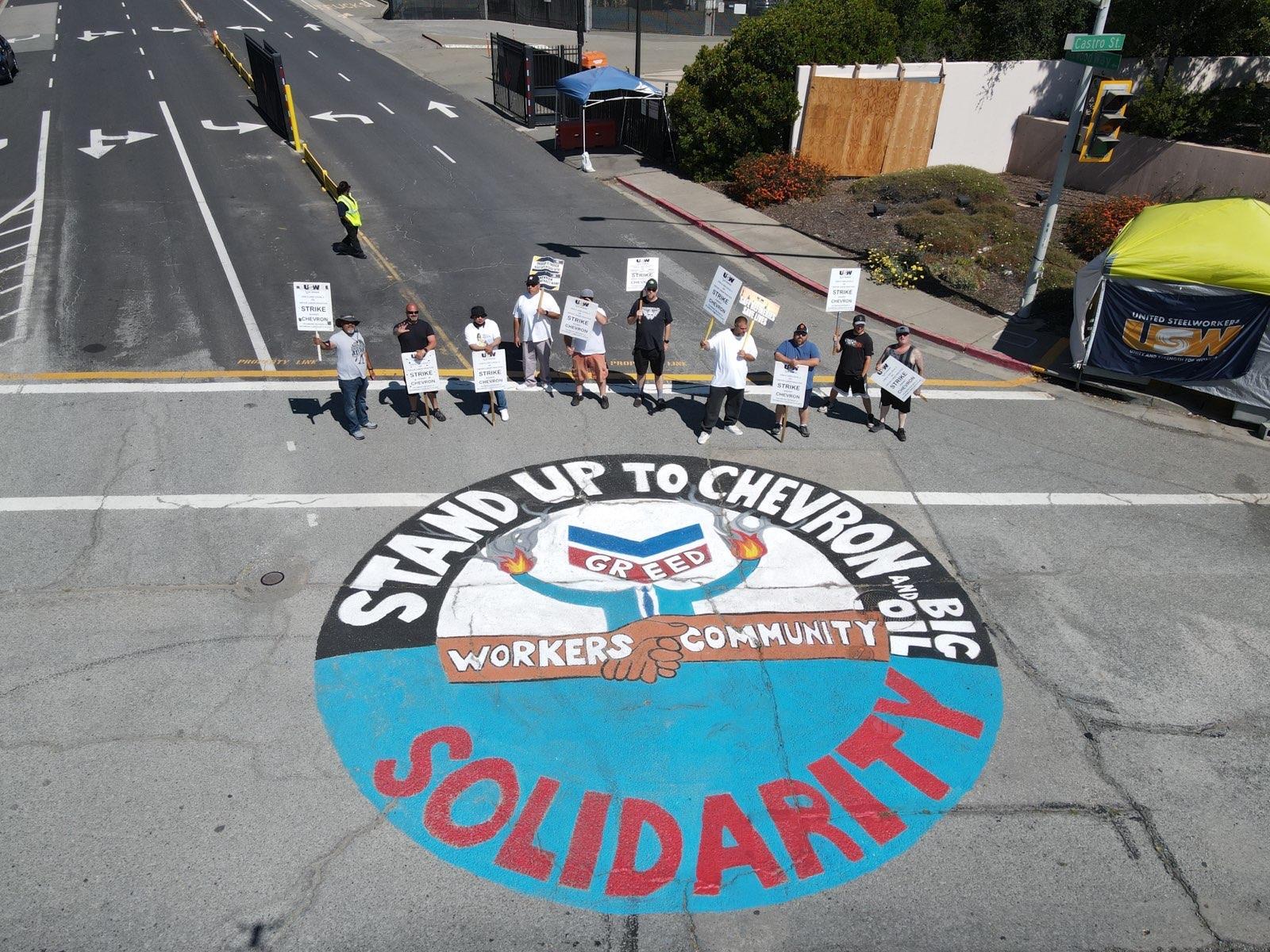
Editor's Note: Since Monday, March 21, 2022, the workers at the Chevron oil refinery in Richmond, California, members of the United Steelworkers Local 5 have been on strike and picketing the facility after voting down the company’s latest contract offer, which workers say contained insufficient wage increases and demanded cuts in union staffing that focused on health and safety in the refinery. The bosses have responded by bringing in scabs (including managers from other Chevron facilities). Meanwhile, USW Local 5 members have been picketing the refinery 24-7, and have been, at times, joined by members of the local BIPOC and/or environmental justice community. After IWW EUC cofounder and long-time Bay Area IWW General Membership Branch member, x344543, brought a call for solidarity with the striking workers to the April branch meeeting, a disgruntled member (who has since resigned from the organization), sent the following letter to the branch (name deleted for privacy reasons).

Message from a Disgruntled (former) Member:

I’m sorry to say how disappointed I am in the IWW. I’m a relatively new wobbly and although I believe in standing in solidarity with fellow workers it seems at some point lines must be drawn.

As I’ve read through these last emails about the USW Local 5 and the call to action for us to stand with them as they strike, many questions come to mind. The first one is what if fellow climate activists, many of whom are wobblies were to implement a protest blockade to stall production of this refinery in defense of the environment? I wonder if those refinery workers with whom we are picketing would come outside and join our protest line? I also wonder if they would be interested in the invitation to join the 2022 Global Climate Strike that you forwarded to us? In both cases I assume it is reasonable to conclude they would not.

As wobblies, where do we draw the line? What if oil pipeline workers go to strike for hazard pay because a tribal nation, whose land the pipeline is planned to cross blocks safe access to thier jobsite in protest of the poisoning of thier waterways? Would the IWW Environmental Caucus also put a call out to picket with those Union workers? We draw the line when it comes to police unions who’s membership is hellbent on beating and imprisoning people protesting civil injustices. Why are we supporting refinery workers? This makes no sense. Iunderstand that just about every industry is to some degree tainted with These workers primary job is to process and prepare for market the product that’s catapulted us into the current global warming apocalyptic meltdown!

Green Unionism on the Chevron Richmond Refinery Workers Picket Line

By That Green Union Guy - IWW Environmental Union Caucus, April 15, 2022

Since Monday, March 21, 2022, the workers at the Chevron oil refinery in Richmond, California, members of the United Steelworkers Local 5 have been on strike and picketing the facility after voting down the company’s latest contract offer, which workers say contained insufficient wage increases. The bosses have responded by bringing in scabs (including managers from other Chevron facilities). The strike has gotten a good deal of media coverage:

However, the capitalist (and progressive) media have mostly missed some important details.

First of all, the striking refinery workers and their elected union leaders continue to emphasize that their issues extend beyond narrow bread and butter issues, such as wages and benefits. A major concern that they continue to articulate is that Chevron continues to try and cut unionized safety jobs and refuses to hire sufficient workers to safely and adequately staff the facility. Workers have complained of 12-hour days and six-day workweeks. All of these deficiencies not only risk the health and safety of the workers, but the surrounding, mostly BIPOC communities as well. Worse still, they have adverse environmental effects, a problem that hasn't been lost on the striking workers. As stated by USW Local 5 representative, B.K White:

“If we had more people and could get a better pay rate, maybe our members wouldn’t feel obligated to come in and work as many as 70 hours a week to make ends meet. We don’t believe that is safe. (that and the use of replacement workers) is at the detriment of the city of Richmond and the environment.”

Even less noticed by the media has been the presence of environmental justice activists (including, but not limited to, the Asian Pacific Environmental Network, Communities for a Better Environment, Extinction Rebellion, Fossil Free California, Richmond Progressive Alliance, Sierra Club, Sunflower Alliance, Sunrise Movement, and 350), various socialist organizations (including DSA in particular), and members from the nearby front-line BIPOC communities, who have joined the pickets in solidarity with the workers, something the workers have also not hesitated to point out. Indeed, in spite of the fact that many environmental justice activists and community members are harshly critical of Chevron's role in turning the city of Richmond into a capital blight infested sacrifice zone, they recognize that the workers are not their enemies nor are the latter responsible for the damage done by the company. On the contrary, many recognize that the unionized workforce is one of the best mitigations against far worse capital blight (it bears mentioning that there has also been a good deal of support and picket line presence from rank and file workers and union officials from many other unions, including the AFSCME, IBEW, IWW, ILWU, SEIU, UFCW, and the Contra Costa County Central Labor Council).

Such seemingly unlikely bonds of solidarity, though delicate and, at times, fragile didn't arise out of thin air, but, in fact, have resulted from years of painstaking grassroots organizing.

Can a Just Energy Transition Occur Under Capitalism?

Understanding Sunrise, Part 2: Organizing Methods

By Dyanna Jaye and William Lawrence - Convergence, March 24, 2022

Sunrise melded mass protest, electoral work, and distributed organizing to great effect, but 2020 upended its plans and forced a reassessment.

Sunrise Movement grew from a labor of love by 12 young people, including the two of us, into the most prominent climate justice organization in the country. We put the Green New Deal on the map, strengthened the Left insurgency in the Democratic Party, and helped drive youth turnout to defeat Trump in 2020. Climate change became a political priority for the Democratic Party, and Sunrise directly influenced Biden’s Build Back Better agenda.

In the last year, though, despite a few impactful protests demanding ambition and urgency from Congress, Sunrise members and observers alike have noted a loss of strategic clarity and organizing power compared to 2017 through 2020. And it’s not just Sunrise: the entire Left has struggled to make the jump from punching upwards in the Trump era to winning material reforms in the Biden era.

In this essay, we’ll pull back the layers of Sunrise’s organizing model: how we actually recruited young people and united them in a structure for collective action. We’ll first discuss the major influences on Sunrise’s organizing and run through how it all played out in practice, the good and the bad.

We share a diagnosis that a central shortcoming in Sunrise’s organizing model was the absence of a sustained method of mass organizing at a local level, which left us nowhere to go once we could no longer rely on the fast-but-shallow growth of distributed organizing methods. We’re proud of the movement’s accomplishments while humble about its shortcomings. We offer our reflection in the practice of learning together in public; we hope our transparency can empower the next generation of movement builders—in Sunrise and across movements—to lead transformative organizing for the next era.

Another Silent Spring: Strategies for the Climate Struggle

By Paul Fleckenstein - Tempest, March 15, 2022

After the worst year yet of climate disruption, 2021 closed with another failure of international negotiations at COP26 and the slow death of President Biden’s meager legislative climate agenda.

North America faced heightened levels of drought, heat, fire, flooding, wind, climate-enhanced migration, and crop failures. Yet the climate movement’s support and campaigning for Biden and Democratic Party achieved little. Expectations are even lower for the next three years.

To respond to this impasse the climate movement, particularly the predominant organizations in the U.S., needs to reorient away from the over-emphasis on electoral politics, and toward protest and struggle as the priority strategy.

Fortunately, there are some glimpses at how to expand this potential, but the central question remains, what socialists and the Left, in general, can do now to best catalyze more disruptive, sustained, and mass-based climate action.

Understanding Sunrise, Part 1: Strategy

By William Lawrence - Convergence, March 14, 2022

Sunrise Movement made climate change a key political issue, but new conditions require new theory and strategy.

The state of Sunrise Movement, one of the more successful and visible U.S. Left organizations to emerge in the last five years, reflects trends in the broader Left. We hit a high-water mark with Sen. Bernie Sanders’ February 2020 victory in the Nevada caucus. Shortly after, the revenge of the Democratic establishment and the COVID pandemic halted all momentum and put Sunrise into a rear-guard attempt to salvage what could be won in a Biden administration. The underwhelming first year of that administration has left us floundering.

Today, a private and public reckoning is well underway. A new generation of leaders is taking account of Sunrise’s successes and failures, and working to design the next life of the movement. Early Sunrise leaders—of which I am one—are in the process of moving on, and handing over leadership of this youth organization to a more youthful cohort.

As a leader in Sunrise’s development from its founding in 2017 through early 2021, I feel obliged to offer an evaluation of our strategy and methods. My aim is to offer a detailed account of Sunrise’s aims and influences, in order that the next generation of strategist-organizers both inside and outside Sunrise may learn from what we did well, while overcoming our limitations.

You can consider just about every word of this essay as a self-critique and a practice of learning in public. As ever, I write with deep appreciation for all the climate justice fighters who find a place to place their hope amidst the looming dread of this crisis.

Part 1 of this essay, which you are reading now, focuses on Sunrise’s strategy, including our demands, rhetoric, and relation to the US party system. Part 2 will look at Sunrise’s methods of organizing.

I hope these essays not only illuminate our specific choices and why we made them, but demonstrate how the theoretical concepts on which we build our organizations actually shape their development. Sunrise’s successes owe much to the theories underpinning our strategy and methods, and our failures reveal much about where these theories fall short. I hope my reflections on these recent experiences may aid in developing better theory to face the challenges of the 21st century.

Pages

The Fine Print I:

Disclaimer: The views expressed on this site are not the official position of the IWW (or even the IWW’s EUC) unless otherwise indicated and do not necessarily represent the views of anyone but the author’s, nor should it be assumed that any of these authors automatically support the IWW or endorse any of its positions.

Further: the inclusion of a link on our site (other than the link to the main IWW site) does not imply endorsement by or an alliance with the IWW. These sites have been chosen by our members due to their perceived relevance to the IWW EUC and are included here for informational purposes only. If you have any suggestions or comments on any of the links included (or not included) above, please contact us.

The Fine Print II:

Fair Use Notice: The material on this site is provided for educational and informational purposes. It may contain copyrighted material the use of which has not always been specifically authorized by the copyright owner. It is being made available in an effort to advance the understanding of scientific, environmental, economic, social justice and human rights issues etc.

It is believed that this constitutes a 'fair use' of any such copyrighted material as provided for in section 107 of the US Copyright Law. In accordance with Title 17 U.S.C. Section 107, the material on this site is distributed without profit to those who have an interest in using the included information for research and educational purposes. If you wish to use copyrighted material from this site for purposes of your own that go beyond 'fair use', you must obtain permission from the copyright owner. The information on this site does not constitute legal or technical advice.