






You are here
municipalization
 In TUED Working Paper 14, Beyond Disruption: How Reclaimed Utilities Can Help Cities Meet Their Climate Goals, Sean Sweeney and John Treat showcase how the energy transition that was promised has yet to come to fruition. They argue specifically the arguments around cities leading the transition have not been fully accurate and provide a sober analysis of where we stand.
 The intersecting crises of income and wealth inequality and climate change, driven by systemic white supremacy and gender inequality, has exposed the frailty of the U.S. economy and democracy. This document was prepared during the COVID-19 pandemic which exacerbated these existing crises and underlying conditions. Democratic processes have been undermined at the expense of people’s jobs, health, safety, and dignity. Moreover, government support has disproportionately expanded and boosted the private sector through policies, including bailouts, that serve an extractive economy and not the public’s interest. Our elected leaders have chosen not to invest in deep, anti-racist democratic processes. They have chosen not to uphold public values, such as fairness and equity, not to protect human rights and the vital life cycles of nature and ecosystems. Rather, our elected leaders have chosen extraction and corporate control at the expense of the majority of the people and the well-being and rights of Mother Earth. Transforming our economy is not just about swapping out elected leaders. We also need a shift in popular consciousness.
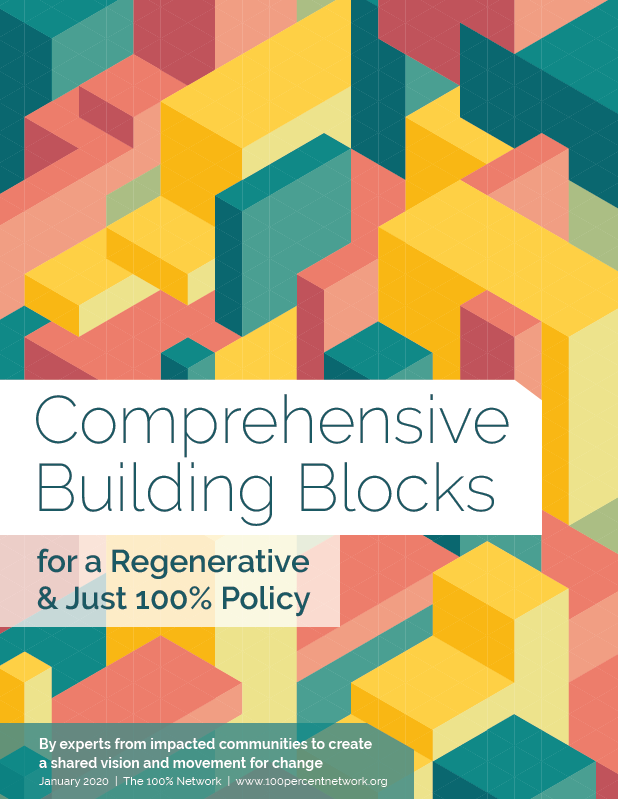 The 100% Network launched a new effort to bring forward and coalesce the expertise from frontline communities into the Comprehensive Building Blocks for a Regenerative and Just 100% Policy. This groundbreaking and extensive document lays out the components of an 100% policy that centers equity and justice.
  The devastation wrought in recent years by preventable wildfires, targeted power shutoffs, and exorbitant rate hikes—with their hefty cost to life, health, and livelihoods—has made it clear that the for-profit model of electric utility provision has definitively failed. However, alternatives to this broken system have not only been proposed, but are gaining substantial traction. In the past few years, we’ve witnessed an eruption of support for taking back public control over electric utilities from absentee investors. With the public in charge, we can provide cheaper services—across the board,
  You would be forgiven, especially if you live in Europe, to think that public services are by nature expensive, inefficient, maybe even somewhat outdated, and that reforming them to adapt to new challenges is difficult. It would seem natural to assume – because this is what most politicians, media and so-called experts tell us continuously – that we, as citizens and users, should resign ourselves to paying ever higher tariffs for services of an ever lower standard, and that service workers have no choice but to accept ever more degraded conditions. It would seem that private companies will inevitably play an ever larger role in the provision of public services, because everything has a price, because politicians have lost sight of the common good and citizens are only interested in their own individual pursuits.
The Fine Print I:
Disclaimer: The views expressed on this site are not the official position of the IWW (or even the IWW’s EUC) unless otherwise indicated and do not necessarily represent the views of anyone but the author’s, nor should it be assumed that any of these authors automatically support the IWW or endorse any of its positions.
Further: the inclusion of a link on our site (other than the link to the main IWW site) does not imply endorsement by or an alliance with the IWW. These sites have been chosen by our members due to their perceived relevance to the IWW EUC and are included here for informational purposes only. If you have any suggestions or comments on any of the links included (or not included) above, please contact us.
The Fine Print II:
Fair Use Notice: The material on this site is provided for educational and informational purposes. It may contain copyrighted material the use of which has not always been specifically authorized by the copyright owner. It is being made available in an effort to advance the understanding of scientific, environmental, economic, social justice and human rights issues etc.
It is believed that this constitutes a 'fair use' of any such copyrighted material as provided for in section 107 of the US Copyright Law. In accordance with Title 17 U.S.C. Section 107, the material on this site is distributed without profit to those who have an interest in using the included information for research and educational purposes. If you wish to use copyrighted material from this site for purposes of your own that go beyond 'fair use', you must obtain permission from the copyright owner. The information on this site does not constitute legal or technical advice.
 This site is not the official webpage of the Industrial Workers of the World.