By SN Nappalos - Recomposition, December 11, 2015
 Recomposition Introduction: Approximately 5 years ago work began on something called the intermediate analysis. A few members of the Recomposition editorial group contributed pieces, worked in groups, and tried to shape their work around the issues raised in the analysis. Between 2010 and today stand a lot of changes and a different landscape for radical action. The maturing of the world financial crisis, series of popular protest movements, and conservative responses have shifted the field from where we stood just a short time ago. Today we present a piece by Scott Nicholas Nappalos exploring what was useful and harmful in the intermediate analysis, and what lessons can be drawn for revolutionary unionists in North America specifically and for the libertarian left more generally.
The intermediate level first confronted me after the 2004 bicoastal wildcat strike where the Industrial Workers of the World (IWW) had attempted to organize a national coordination of the various autonomous local groups of truckers who have come together. That followed a series of debates within the Portland IWW branch, where I was a member, over the role of revolutionaries in building a union. I began a draft on the intermediate analysis during the period of 2004-2006, but returned to it more seriously a few years later in Miami when things had calmed down and in dialogue with other comrades there. In 2010-2011, I contributed to a series of pieces on the intermediate level as part of group discussions within Miami Autonomy & Solidarity, an anarchist communist political organization I was a member of. These reflections came out of years of rumblings, discussions, and experiments by anarchists trying to find ways to apply their ideas to workplace and community organizing in the North American . Nearly as soon as the words hit the page a series of struggles began to test our ideas; first the Madison protests, then Occupy, and later others.
The three or so years that followed the publishing of pieces on the intermediate level led to more discussion and distribution than anyone likely imagined. In a couple cases other groups consciously adopted the terminology and the debate spread outside North American circles through libertarian networks. In today’s environment of unstable quietness, many are looking around, taking stock, and picking up old debates to help sort out the events of the past years beginning with the crisis in 2008. It’s obvious that there’s been a spate of protests that set the decade apart from the past 30 years, though they’ve remained short-lived and largely localized so far. Vast changes are afoot with sections of the public more open to our politics than any time in recent history, though that hasn’t yet translated into any real sustained advances. Some years and modest experiments behind us, it is a good opportunity to re-evaluate the strategy and analysis.
There is no need to beat the drum and reiterate the arguments bit by bit here, but instead interested folks can look to pieces I wrote: Defining Practice: the intermediate level of organization and struggle[1], the three-part piece called Towards a Theory of Political Organization for our Time[2], and also somewhat related the co-authored article with Adam Weaver Fighting for the Future: The necessity and possibility of national political organization for our time.[3] The quick summary is that there are two frames to the analysis. The first, the intermediate level, is a tool for looking at the social world and categorizing different types of activity to understand them better. The mass level is an idealized space where all the struggles of all the social actors take place like giant unions or community organizations that encompass entire classes. The political level takes place where specific ideologies, strategies, and politics are coordinated in that larger field. The intermediate level is where people come together based on shared strategy and experiences to coordinate their activity within struggles; more broad than the ideological unity of the political level, and more narrow than the mass level it is working within.
The second framing of the analysis deals specifically with intermediate organizations, which is to say organizations that occupied the space roughly between unions and political parties/organizations. Intermediate organizations are ones constructed with distinct tasks from mass or political ones, and unlike the first aspect of the analysis are physically and actively separate. In the first we are talking about activities that can co-exist alongside others in a variety of formats, the second is specific organizations that imperfectly reflect those activities.
The simplest examples of intermediate organizations are tendencies within social movements. These groups organize militants around a shared platform of various sorts to take action within an organization such as a union or community group. This spans from relatively ideologically broad such as Soldiers of Solidarity[4] in the UAW, to groups for action with broader political orientation such as the communist party’s Trade Union Education League and later Trade Union Unity League’s unions[5] or the Unemployed Councils of the Great Depression[6], and overtly political tendencies such as the Federacion Estudiantil Libertaria[7] in Chile today which organizes anarchists on specific proposals for action and demands within the student unions. Many organizing projects however tend to act as intermediate organizations of militants without having another overarching social organization they work within.
Controversially I’d argue that projects of the anarcho-syndicalist variety in fact act like intermediate organizations. Really there’s two ways to look at it: our concept of unions is too narrow, or revolutionary unions/projects represent something altogether different from parties and unions. One way to come at the intermediate level is to question all of this, and say the idea of non-political mass organizations is utopian, they’re inherently involving all levels of activity: political, mass, and intermediate. In one sense the dominant idea of what unions and organizing projects are (for left thinkers anyway) has become incredibly narrow; essentially apolitical groups that try to win demands for the whole of the class or some section of the class.
This scenario is far from universal in fact, because historically it was rarely if ever the case. It has been common for unions to fight around a range of issues from housing, immigration, and the oppression of ethnicities and women with examples in the IWW, FORA, CNT, and FAU but also reformist unions.[8] The meaning of union is interpreted as about the workplace narrowly defined. However in South America, to take an example, unions came out of resistance societies which were unions of workers and proletarians organized around a variety of different collective needs and projects. Resistance societies were a militant off shoot of mutual aid networks that included things like women’s issues, housing, workplace, and political issues that affected the class like militarism, anti-clericalism, immigration, and health. [9][10] This was perhaps always the norm for revolutionary unions, but not unheard of for reformist unions growing out of the environment of working class communities of past generations. Lately SEIU and other recuperative unions have started funding non-workplace organizing with non-members often with the goal of electoral victories, begging the question.
The focus of unions only narrowed in the US with their institutionalization after the NLRA when they became more fully integrated into capitalism. Political and social struggles overlapped with workplace activities, and unions were often grouped around political outlook. Outside the US, most of the world has a parliamentary system for unions where workers choose between them based on their political ideology. Moreover American unions and non-profits are largely ideological organs of the Democratic Party in terms of their activity, funding, and vision. So even today the idea of neutral mass organizations is a bit utopian.
Another way to think about these projects is that certain groups play a special role. They are different from run-of-the-mill unions, community groups, etc. While it’s true all groups are political in some sense, anarcho-syndicalist unions, revolutionary community groups, and solidarity networks have a unique relationship between their ideas and practices. They all use activity to build movement and have a connection between their goals, ideals, and actions in a way that political organizations and more broad unions don’t. In this way maybe they don’t fit neatly into any of the levels and occupy space between them all. Whether we widen the concept of mass organization, or we alter how we understand groups like the IWW, CNT, Solidarity Networks, or other such projects, the outcome is the same in practice. Intermediate organization tried to capture some of that nuance.






 Humanity finds itself at an inflexion point. On the one hand, global capitalism is producing and aggravating a series of existential crises that may well undermine the very preconditions for a dignified human life—or any form of human life—on this planet. On the other, the only political force that could possibly do something to counter this inexorable drive towards catastrophe—the international left—has long since been run into the ground by a four-decade neoliberal offensive, leaving its social base fragmented and atomized, its organizational structures in tatters.
 Lately, I have been having endlessly frustrating debates with people who call themselves “anarcho-capitalists” or “ancaps” and who seem to be stuck in the McCarthy Era as they still view socialism as some kind of “Red Terror.” Ironically, these people are about as fervent in their support of capitalism and their hatred of socialism as the very government they supposedly want to destroy. These debates generally devolve into ad hominem attacks as the people arguing for capitalism tend to lose their cool rather quickly, and like most people they do not want to hear opposing opinions, especially ones supported by facts. I strongly believe in anarchism and autonomy as I believe they are the only foundations for a truly free society, so I have joined many anarchist groups, but it seems like many of the them (in America anyway) are overrun by so-called “ancaps,” which is why I end up having these silly arguments, and it is sad because they don’t understand “anarcho-capitalism” is an oxymoron or a contradiction of terms that are diametrically opposed. People who believe in this contradiction of terms do not understand what anarchism or capitalism is, and so I hope they read this explanation and do their own research, (and read authors that do not just reinforce their own opinions) instead of reacting defensively or reflexively.
 Occupy Wall Street highlighted class inequality in the USA through its talk about the concentration of income and wealth in the hands of “the 1 percent.” This does put a bullseye on the ruling class in our society. But much of the talk about class in recent times has focused on income inequality. The idea is that “the 1 percent” are at the top because they have the highest incomes. But this fails to get to the heart of the matter. The existence of different income levels doesn’t explain why there are classes at all. After all, what explains why there are such huge differences in income?
 This study is based on the premise that any profound social transformation in our era of globalized capitalism would have to take place on a planetary scale. History has shown that revolutionary movements, when geographically isolated, are inevitably either crushed or assimilated into the capitalist world system. This internationalist conclusion first became apparent to working people during the 19th century as capitalism and the Industrial Revolution spread across Europe, and it was first elaborated theoretically by Karl Marx and Friedrich Engels in their 1848 Manifesto of the Communist League with its ringing conclusion: “Workers of the world, unite!”
 Recently, a member of the IWW EUC posted a link to a May 27, 2015 editorial by four anonymous members of the Common Cause anarchist-communist federation, titled,
  Libertarianism is a socialist political philosophy which has its roots in the socialist workers’ movements of the 1800s and 1900s. It is especially associated with ideas that came out of the First International (IWA – 1864-1876), especially those of Joseph Proudhon, Karl Marx and Mikhail Bakunin. It was upon these ideas, as well as some of those which came later like those of Peter Kropotkin, that the libertarian syndicalists in Spain formed the CNT union in the early 1900s, with the goal of creating a libertarian (socialist) and workers’ self-managed society. What this means is they wanted emancipation of the working class, recognizing that class struggle comes as a result of resistance to management power over workers, because business owners’ aims are profit-based. This means that managers will submit workers to rigid control in the workplace, cut corners and compensation, heap stress on them, etc., in order to maximize profit.
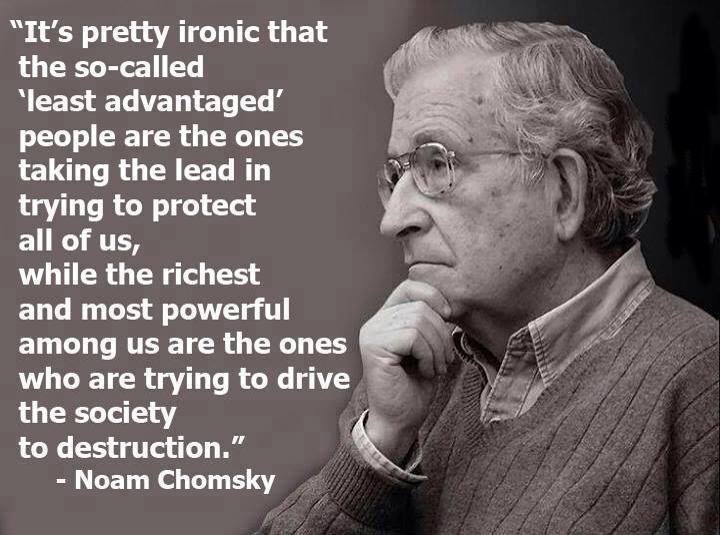 So many things have been written about, and discussed by, Professor Chomsky, it was a challenge to think of anything new to ask him: like the grandparent you can’t think of what to get for Christmas because they already have everything.
 I have been closely following the debate between various members of the International Socialist Organization (ISO) and Tom Wetzel (a syndicalist based in the San Francisco Bay Area) which began with Tim Goulet's
  In order for the Anarchist movement to mature in this country, we must address a particularly troubling dilemma. Are we to continue our historical struggle within the working class or do we evolve into a professional class of labor organizers and bureaucrats?? Addressing this question isn’t only about disagreements in methods but in affirming an anarchist conception of organization from the base. Whether in garment factories and ports or in hotels and retail, our focus on the rank and file has always been obvious–without the revolutionary self organization of the workers, we will never overthrow this unjust system of economic and political domination.
 This site is not the official webpage of the Industrial Workers of the World.