You are here

Appalachia

UBS Backs Away From Mountaintop Removal Coal Mining - Victory for Grassroots Organizing, Campaigners Say More Action Still Needed from UBS

By Ricki Draper - Hands off Appalachia, August 13, 2014

Disclaimer: The views expressed here are not the official position of the IWW (or even the IWW’s EUC) and do not necessarily represent the views of anyone but the author’s.

Knoxville, TN — UBS, the world's third top funder of mountaintop removal in 2011, has taken steps demonstrating its commitment to significantly reduce financing of the mining practice. Last month, the bank confirmed to environmental campaigners that it will continue backing away from mountaintop removal financing. Moreover, UBS has declined to participate in the most recent transactions with its former clients Alpha Natural Resources and Arch Coal, which were among the top producers of mountaintop removal coal in 2013.

"UBS' statement is a step in the right direction on mountaintop removal, but it’s the bank's actions that show they’re following through," said Ricki Draper of Hands off Appalachia. "We have seen that grassroots organizing can make a difference in stopping the financing of this deadly form of mining that poisons coalfield communities and contributes to the destruction of Appalachia’s culture and heritage."

The victory comes after three years of grassroots organizing by Hands Off Appalachia and Mountain Justice targeting the financing of mountaintop removal. Starting in Knoxville, TN, the Hands off Appalachia campaign has organized dozens of actions and protests at local UBS offices across Appalachia and the southeast. In the summer of 2013, members of the campaign were arrested during a protest at UBS's Knoxville, TN office. Shortly afterwards, four members of the Connecticut-based group Capitalism vs. the Climate blocked the entrance to UBS's North American headquarters in Stamford, CT and were arrested.

On November 25, 2014, members of Hands off Appalachia, Radical Action for Mountain People's Survival, and Capitalism vs. the Climate took action in Stamford, sitting-in at the UBS office and hanging a banner from a nearby 20-story construction crane. Police arrested 14 activists in connection to the protest.

The Religion of Coal

By Nick Mullins - The Thoughtful Coal Miner, July 14, 2014

Disclaimer: The views expressed here are not the official position of the IWW (or even the IWW’s EUC) and do not necessarily represent the views of anyone but the author’s.

I usually avoid religion in my posts since it is such an inflammatory subject. At the same time, I cannot help but be disappointed in those who appropriate coal mining as somehow being Christian, or that coal itself was put here by God for us to use.

“If God didn’t want us to use coal, he wouldn’t have put it there!” a lady says to a gathering of environmentalists. But what if it wasn’t? How could a loving God who spent so much time creating life place something here that would cause so much harm?

In the early days of coal mining thousands of men and boys lost their lives every year in the darkness of a mountain. The owners of the coal mines were ruthless and full of greed, paying as little salary as possible and turning coal miners into slaves through company script and hiring mercenaries to maintain the status quo. The coal was shipped off where it would be put to use making steel in massive mills polluting entire cities and causing children to suffocate with asthma. The steel mill owners, like the coal company owners, were full of tempestuous greed, treating their workers in much the same ways as in the mountain coal camps. The steel made by coal and the electricity that came later gave rise to even more massive cities where people's hearts become hardened, where people fall further and further from the teachings of Christ. Coal was even used to build thousands of war ships, tanks, guns, and other instruments of evil wielded for greed,  spilling the blood of the poor and innocent the world over.

Even today the economic systems of modern convenience built upon coal disconnects us. Cell phones replace handshakes and friendly conversations. Televisions numb us and even entertain us with violence, taking place of evening chats on the front porch with neighbors and building a love for them.

The world coal created is one of immense wealth inequalities, casting billions into extreme poverty and starvation as the industrialized and wealthy nations build even larger cities and wage war for more resources, more wealth. The people living in these wealthy nations drive their cars to churches erected with steel and powered by coal to hear about the salvation of God, the learn how to save their own souls. They concern themselves with their own comfort, their own bank accounts, voting to wage war against countries without knowing the facts, believing what the people on television tell them.

Today production is preached in the coal fields, "more" is the new gospel. Blind eyes are turned to the places that coal is extracted, cleaned, and used--places where thousands succumb to  sickness. Places where God’s true creation is destroyed.

Ohio Farmers and Residents Block Driveway to Frack Waste Disposal Site

From Appalachia Resist - February 1, 2014

Disclaimer: The views expressed here are not the official position of the IWW (or even the IWW’s EUC) and do not necessarily represent the views of anyone but the author’s

[Sunday, February 2 Update from Appalachia Resist: "Support Rally at the Athens County Courthouse Monday 2/3/14 at 9:15 AM at the arraignment of the eight farmers and local business leaders who were arrested for blocking frack waste trucks from entering an injection well disposal site operated by K&H Partners of West Virginia on Saturday. Those arrested include: Kip Rondy, owner of Green Edge Farms; Michelle Ajamian, owner of Shagbark Seed and Mill; Christine Hughes, owner of the Village Bakery; Liz Florentino, Smiles Welch, and Sean Pavlac."]

[7 pm Update from Appalachia Resist facebook: " After stopping frack trucks from coming to the K&H site for hours, the banner carriers are being taken to the sheriff's office for processing. Other demonstrators are leaving -- we will let you know as soon as we can what the charges are, how to support the banner carriers and their families, and what you can do to end fracking and ban injection wells in Ohio."]

Eight farmers and local business leaders have blocked the driveway leading to a fracking waste disposal site operated by K&H Partners of West Virginia. Holding a banner that reads “Our Water, Our Lives! Their Poison, Their Lies!” these Athens County residents are stopping frack waste trucks from entering the site and will refuse law enforcement orders to leave.  They want K&H and the ODNR revoke a recent injection well permit and are calling for a ban on injection wells in Ohio and in Athens County specifically.

The blockade is supported by a rally of more than 150 Torch, Coolville, and Athens residents.

Appalachia Rising

By Grant Mincy - Counterpunch, January 17-19, 2014

Disclaimer: The views expressed here are not the official position of the IWW (or even the IWW’s EUC) and do not necessarily represent the views of anyone but the author’s.

On Thursday, January 9 a dangerous toxin, 4-methylcyclohexane methanol, leaked from a busted tank and into the Elk River in West Virginia. It is believed that nearly 7,500 gallons of the toxin made its way from the 40,000-gallon tank into the river. It’s unclear how much actually entered the public water supply.
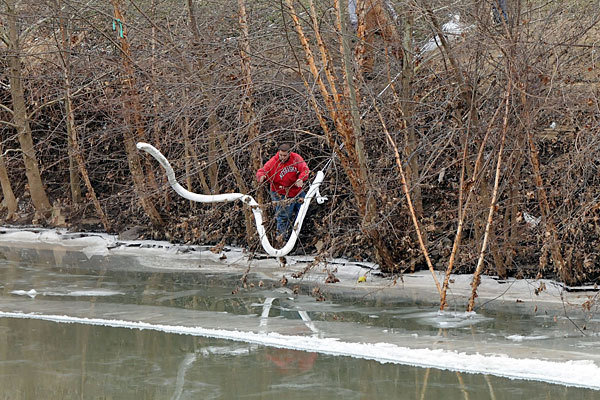
The busted tank is owned by Freedom Industries, which uses the chemical for coal processing. Some 300,000 people have been directly impacted by the disaster, forced to wait in long lines at fire stations to receive potable water. There’s been a constant run on stores for the precious resource as well.

This is a story to often told in Appalachia. The Massey Energy coal slurry spill in Martin County, Kentucky (where 306,000,000 gallons of toxic slurry hit the town) and the TVA coal ash disaster in Kingston, Tennessee, are also part of the history of industrial disaster in the region. This history is wrought with class struggle, environmental degradation and corporatism. From the expulsion of Native Americans to the rise of King Coal, the Hawks Nest incident, the labor struggle, the Battle of Blair Mountain and the wholesale destruction of mountain ecosystems via Mountaintop Removal, Appalachia is on the front lines of the war with the politically connected.

The coalfields of Appalachia have long been home to impoverished people, overlooked by the affluent in the United States. Still, the “War on Poverty” has made its way into the Appalachian hills several times. Most famously, US president Lyndon Johnson singled out the region for his “Great Society” programs, and presidents 42, 43 and 44 have all tried to help the region as well. Instead of offering a new way forward, their programs further damage the area.

Much of the “War On Poverty” has been fought via economic engineering, centralizing the economies of West Virginia and Eastern Kentucky (along with parts of Tennessee and Virginia) into the hands of extractive fossil resource industries — notably coal and natural gas. The mechanization of these industries, however, has reduced the labor force. Specialized labor moving to the region has caused short-term booms and long-term busts. Once an extractive resource is exploited and gone,  communities are left to deal with mono economies and irreversible ecological destruction.

They Poisoned the River for a “Clean Coal” Lie

By Trish Kahle - Socialist Worker, January 13, 2014

Disclaimer: The views expressed here are not the official position of the IWW (or even the IWW’s EUC) and do not necessarily represent the views of anyone but the author’s.

IMAGINE YOURSELF in the rugged countryside of the Appalachian Mountains, where you and your neighbors have lived with a history of poverty and lack of economic development–and you learn that the water piped into your home has been poisoned and can’t be used, even after it is boiled, until further notice.

Imagine trying to run a hospital when the city’s water is unusable–even for hand washing. Imagine having to ration drinking water to school-age children in the fourth most water-rich country on earth.

All of these nightmares and more came true in West Virginia on January 9 after residents reported that their tap water tasted like licorice. The contaminant turned out to be 4-methylcyclohexane methanol, or MCMH–a chemical used to produce misleadingly named “clean coal” through a froth flotation process that “scrubs” the coal prior to burning it in power plants.

The chemical spilled into the Elk River from a 48,000-gallon tank owned by Freedom Industries. The full extent of the leak remained unclear over the weekend. West Virginia Gov. Earl Ray Tomblin claimed the spill didn’t exceed 5,000 gallons, but Freedom Industries President Gary Southern could only say for certain that less than 35,000 gallons leaked out.

Tom Aluise of the West Virginia Environmental Protection Association noted that MCMH cannot be removed from the water–and residents will simply have to wait for thousands of miles of pipelines to be flushed before water safety can be reassessed. “This material pretty much floats on the water, and it’s floating downstream, and eventually it will dissipate, but you can’t actually get in there and remove it,” Aluise said.

That begs the question of why a hazardous chemical that is impossible to clean up if spilled was being stored near a river only one mile upstream from a treatment plant providing water to West Virginia’s capital of Charleston and nine counties that span the surrounding area.

Jobs Beyond Coal

By Jeremy Brecher - Labor Network for Sustainability, 2012

This manual is intended for anyone—communities, unions, environmentalists, native tribes, public officials, and others—involved with or affected by the retirement of coal-fired power plants. It is designed as a guide for those who wish to make the transition away from coal in a way that is most beneficial and least threatening to ordinary workers, consumers, and community members.

In the past decade, a broad-based campaign has formed to move America beyond coal and power the nation with clean energy. The movement includes people from all walks of life—medical professionals, faith leaders, environmentalists, business people, workers, decision makers, and local residents—who are working to address the serious pollution problems caused by coal and to seize the economic opportunity offered by clean, safe, renewable energy.

This campaign has been remarkably successful, preventing the construction of more than 165 new coal-fired power plants, and thereby keeping energy markets open for clean energy. In state after state, as newcoal proposals have stalled, advocates have launched campaigns to retire existing coal plants and replace them with clean energy, securing the retirement of more than 110 existing coal plants to date.The coal industry and their allies regularly claim that jobs, workers, and unions benefit from coal plants and that transitioning away from coal will harm them. Industry claims about creating or protecting jobs have often proved fallacious or hugely exaggerated. Still, this message resonates powerfully in tough economic times and presents a real challenge to coal retirement efforts.

Several recent campaigns have demonstrated that coal retirements can be structured in ways that take care of affected workers and the area economy, and even win the support of organized labor and local decision makers. As the case studies described in this manual show, addressing these economic challenges is most effective when the concerns of workers and the local economy are built into the campaign objectives, messaging, proposals, action, and interventions in policy arenas.

Read the report (PDF).

Pages

The Fine Print I:

Disclaimer: The views expressed on this site are not the official position of the IWW (or even the IWW’s EUC) unless otherwise indicated and do not necessarily represent the views of anyone but the author’s, nor should it be assumed that any of these authors automatically support the IWW or endorse any of its positions.

Further: the inclusion of a link on our site (other than the link to the main IWW site) does not imply endorsement by or an alliance with the IWW. These sites have been chosen by our members due to their perceived relevance to the IWW EUC and are included here for informational purposes only. If you have any suggestions or comments on any of the links included (or not included) above, please contact us.

The Fine Print II:

Fair Use Notice: The material on this site is provided for educational and informational purposes. It may contain copyrighted material the use of which has not always been specifically authorized by the copyright owner. It is being made available in an effort to advance the understanding of scientific, environmental, economic, social justice and human rights issues etc.

It is believed that this constitutes a 'fair use' of any such copyrighted material as provided for in section 107 of the US Copyright Law. In accordance with Title 17 U.S.C. Section 107, the material on this site is distributed without profit to those who have an interest in using the included information for research and educational purposes. If you wish to use copyrighted material from this site for purposes of your own that go beyond 'fair use', you must obtain permission from the copyright owner. The information on this site does not constitute legal or technical advice.