You are here

publications

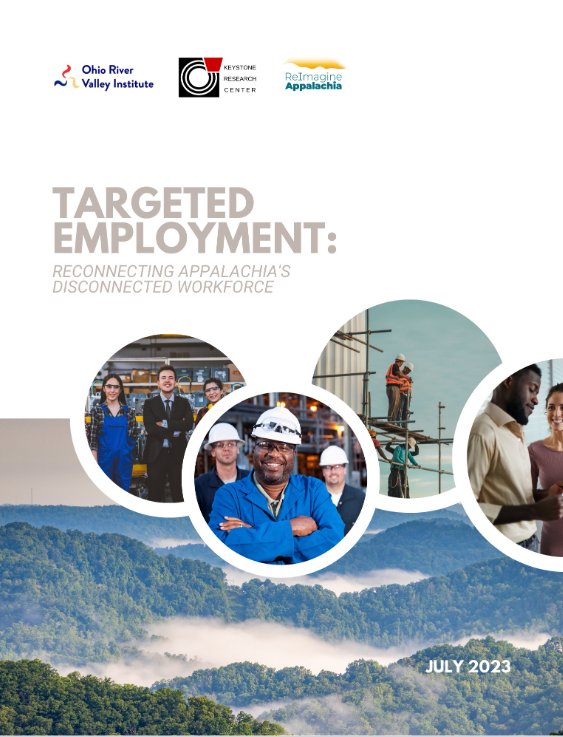
Targeted Employment: Reconnecting Appalachia’s Disconnected Workforce

By Claire Kovach, Stephen Herzenberg, Amanda Woodrum, and Ted Boettner - ReImagine Institute, Keystone Research Center, Ohio River Valley Institute, July 25, 2023

The Appalachian region has long suffered from not having enough good paying jobs. Even when the unemployment rate is low, too many Appalachians are disconnected from the workforce entirely due to a myriad of factors. The result has been a long-term structural unemployment problem that has persisted for decades, with too many Appalachian adults out of the workforce entirely and unable to secure a decent paying job where they live.

A federal job subsidy program that is targeted at breaking down barriers to employment – such as improving the skills and experience of potential workers to meet current employer demands in their local labor market – and connecting them with a job could not only boost incomes and improve the livelihood of thousands of Appalachians but also give people self-esteem, a source of identity, and feel more connected to their community.

This report examines the economic conditions of Appalachia with a particular focus on the Appalachian counties of four states—Kentucky, Ohio, Pennsylvania, and West Virginia—that comprise the footprint of ReImagine Appalachia and the Ohio River Valley Institute. This includes describing how Appalachia has been a “region apart” from the rest of America, including its history of resource extraction and exploitation, the collapse of the steel industry, and now coal, that has led to large employment losses in the area, and how the region’s uneven development has led to chronically low rates of employment, disenfranchisement from the labor market and even loss of hope underpinning the opioid epidemic from which the Appalachian region was particularly hard hit.

Download a copy of this publication here (PDF).

Losing altitude: The economics of air transport in Great Britain

By Alex Chapman - New Economics Foundation, July 17, 2023

The environmental downsides of growth in flight numbers are significant. The sector has no short-term technological solution to its greenhouse gas emissions; over the medium to long term, much uncertainty remains as to the pace of emissions reduction achievable. All scenarios published by stakeholders such as the Climate Change Committee, the Department for Transport (DfT), and air transport sector bodies, suggest that future air traffic growth would necessitate the use of costly, and unproven, carbon capture technologies.

Despite these risks, the government continues to provide conditional support to air capacity growth on the (often tacit) basis that the economic upsides outweigh the negative impacts and future risks. But, the economic assumptions that underpin this position favouring growth are dated and have not been reviewed for some years. Given the urgent and sizeable nature of the climate risk, it is imperative that the evidence, and relative balance, of the economic and environmental impacts of air transport growth are kept up to date and under constant review.

This report shows that since the government’s last comprehensive review of the economic impacts of air transport in 2012, trends in the British air transport sector have changed dramatically. Contrary to expectations, growth in business passenger numbers has effectively ceased and new passengers now derive exclusively from the leisure market. In particular, passenger growth has been driven by wealthy British residents rather than foreign tourists or those on lower incomes. Early evidence suggests the pandemic has accelerated this trend. This report reviews the current evidence on the impact of air transport growth across four core economic domains: welfare, jobs and wages, tourism, and wider facets of economic growth, business productivity, and trade.

Download a copy of this publication here (PDF).

Biological hazards in the working environment

By staff - International Labour Organization, July 13, 2023

The ILO released a report Biological Hazards in the Working Environment in 2022. The report contains a survey which calls on governments to respond and to ensure that employers and trade unions in their countries also respond. The ILO is now circulating the survey directly to trade unions and employers to ensure that it gets more response.

The promotion of safe and healthy working environments has been a constant objective of the International Labour Organization (ILO) since it was founded in 1919. The ILO has adopted a significant body of international instruments and guidance documents to promote the safety and health of workers and assist constituents in strengthening their capacities to prevent and manage workplace hazards and risks.

An important step forward in this respect was taken during the 110th Session (2022) of the International Labour Conference when the Occupational Safety and Health Convention, 1981 (No. 155), and the Promotional Framework for Occupational Safety and Health Convention, 2006 (No. 187), were recognized as fundamental Conventions within the meaning of the ILO Declaration on Fundamental Principles and Rights at Work. 1 Accordingly, all ILO Members, even if they have not ratified the Conventions in question, have now an obligation, arising from the very fact of membership in the Organization, to respect, to promote and to realize, in good faith and in accordance with the Constitution, the principles concerning the fundamental rights which are the subject of those Conventions.

Download a copy of this publication here (link).

Debt, Migration, and Exploitation: The Seasonal Worker Visa and the Degradation of Working Conditions in UK Horticulture

By Catherine McAndrew, Oliver Fisher, Clark McAllister, and Christian Jaccarini - Landworkers Alliance, et. al., July 10, 2023

The report ‘Debt, Migration and Exploitation: The Seasonal Worker Visa and the Degradation of Working Conditions in UK Horticulture’ has been written in collaboration with the Joint Council for the Welfare of Immigrants, New Economics Foundation, Focus on Labour Exploitation, Sustain and a farmer solidarity network of former migrant seasonal workers.

Seasonal work plays a significant role in UK agriculture. The government estimates that between 50,000 and 60,000 seasonal workers are needed annually to bring in the wider harvest across the UK, and these workers are almost entirely recruited from outside the UK.

Many of these workers are recruited via the new Seasonal Worker Visa scheme, a temporary migration programme introduced in 2019 to alleviate post-Brexit labour shortages, but a series of recent media exposés have revealed that visa holders are facing mounting issues including low wages, wage theft, excessive hours, debt bondage, and abuse by supervisors.

Our new report adds to this mounting body of evidence, and lays bare the legal and economic structures that facilitate the exploitation of farmworkers by the industrial food system, giving a platform for farmworkers to share their own account of life on the UK’s farms and develop solutions to the abuses they have faced.

The report also includes a supply chain analysis carried out by the New Economics Foundation, which reveals that migrant seasonal workers picking soft fruit retain on average just 7.6% of the total retail price of the produce.

Furthermore, the report outlines how workers who have to pay illegal broker fees (money paid by migrant workers to recruitment agencies in their home countries) can result in negative earnings. This means that after accommodation, subsistence and travel costs, some workers are essentially left out of pocket and end up paying more to come to the UK and work, than they keep as retained income to take home.

Another chapter in the report features an extended testimony from a former migrant seasonal worker from Nepal, in which they describe the exploitation of recruitment agencies, the debt associated with taking out loans to pay for agency fees and the need for the UK Government to design a more safe and secure seasonal visa scheme.

In response to issues raised in previous chapters relating to the supply chain, workers’ rights violations, and lack of redress, the final section of the report explores alternative approaches to labour rights, based on worker-led social responsibility (WSR), using the experience of the Coalition of Immokalee Workers (CIW) and Fair Food Program (FFP) in Florida as a case study.

Download a copy of this publication here (PDF).

A Turning Point: The Critical Raw Material Act’s needs for a Social and Just Green Transition

By staff - European Environmental Bureau, July 10, 2023

The 21st century demands global efforts that provide solutions to multiple social and environmental crises that negatively impact economies. Many solutions are available to us, and demand a political will to advance on some existing tools (such as product ecodesign legislation or product bans), and a political discourse to develop new tools (such as energy production limits) that will all potentially result in societal transformation that brings humanity comfortably back within planetary boundaries in an equitable way.

Most of the converging social and environmental crises we are facing are a result of the over-consumption of resources due to unsustainable production and consumption patterns in increasingly unequal societies regardless of the level of development of any given country.

This Position Paper (download file here) delves into the main issues that arise within this context in regard to the Critical Raw Materials Act, and has been written by a multitude of civil society organisations.

The version in other languages:

Download a copy of this publication here (PDF).

Extreme Heat Costs North Carolina Workers and Employers

By National Resources Defense Council (NRDC) - Clean Technica, July 9, 2023

North Carolina Workers, Employers would Benefit from State Heat Standards

RALEIGH, NC — According to a new report, North Carolina employers may be paying higher workers compensation claim costs in years with more hot weather. The Excessive Heat in North Carolina report found a link between extreme heat exposure in four major industries and avoidable costs to employers, including increased worker compensation for missed wages. The report was prepared by Milliman and commissioned by NRDC (Natural Resources Defense Council).

The report’s key findings include:

  • When all four industries (agriculture, construction/erection, cartage/trucking, and commercial enterprises) were considered together, there was a positive correlation between the annual number of hours with a heat index above 90°F and workers compensation claim costs for lost wages. In other words, employers paid employees more during hot years for missed work days due to illness or injury from any cause.
  • The strongest relationships between heat and workers compensation costs for lost wages were in the cartage/trucking industry (such as package delivery and ambulance service workers) and commercial enterprises (such as warehouse workers and gas station attendants). The positive correlation between hot years and the severity of lost wage claims (i.e. the cost per claim) was notably strong in cartage/trucking.
  • Based on the available sample data, cartage/trucking was the only industry to show a significant positive correlation between heat and workers compensation claims for medical costs.
  • Outside the workers compensation system, heat was correlated with healthcare use by the general population immediately after extreme heat events and for up to three months later. However, the observed relationship depended on a complex interaction between heat, an individual’s other health conditions, and socioeconomic factors such as living conditions and access to healthcare.

“Workers are protected from all kinds of hazards, such as ladder falls and electric shocks. But federally and in most states—including in North Carolina—there are no such standards protecting workers from heat. That needs to be fixed, and fast, especially as climate change makes heat season ever more brutal in the Southeast and across the country,” said Juanita Constible, Senior Advocate for Climate & Health at NRDC (Natural Resources Defense Council). “The report makes clear that the avoidable costs of workplace heat exposure, such as missed work time and emergency room visits, are considerable in four of the most heat-exposed industries in North Carolina.”

“Everyone has the right to a safe and healthy workplace. We should be doing everything we can to avoid preventable injuries at work like those caused by exposure to high temperatures,” said Clermont Fraser Ripley, Workers’ Rights Project Co-Director at the North Carolina Justice Center. “We should be doing everything we can to avoid preventable injuries at work like those caused by exposure to high temperatures.”

AB 525 Port Readiness Plan

By Brooklyn Fox and Sarah Lehman - California State Lands Commission, July 7, 2023

Assembly Bill (AB) 525 (Chiu, Chapter 231, Statutes of 2021) was signed by the Governor in 2021 and requires the Californica Energy Commission (CEC), in coordination with the California Coastal Commission, Ocean Protection Council, State Lands Commission (CSLC), Office of Planning and Research, Department of Fish and Wildlife, Governor’s Office of Business and Economic Development, Independent System Operator, and Public Utilities Commission (and other relevant federal, state, and local agencies as needed) to develop a strategic plan (AB 525 Strategic Plan) for offshore wind development in federal waters by June 30, 2023.

On August 1, 2022, the CEC established a planning goal of 2 to 5 GW of offshore wind energy by 2030 and 25 GW by 2045 (Flint 2022). To meet these goals, the AB 525 Strategic Plan shall include, at a minimum, the following five chapters:

  1. Identification of sea space, including the findings and recommendations resulting from activities undertaken pursuant to Section 25991.2 of AB 525.
  2. Waterfront facilities improvements plan, including facilities that could support construction and staging of foundations, manufacturing of components, final assembly, and long-term operations and maintenance, pursuant to Section 25991.3 of AB 525. Economic and workforce development and identification of port space and infrastructure, including the plan developed pursuant to Section 25991.3 of AB 525.
  3. Transmission planning, including the findings resulting from activities undertaken pursuant to Section 25991.4 of AB 525.
  4. Permitting, including the findings resulting from activities undertaken pursuant to Section 25991.5 of AB 525.
  5. Potential impacts on coastal resources, fisheries, Native American and Indigenous peoples, and national defense, and strategies for addressing those potential impacts.

Per Section 25991.3 of AB 525, based on the sea spaces identified pursuant to Section 25991.2 of AB 525, the CEC, in coordination with relevant state and local agencies, must develop a plan to improve waterfront facilities that could support a range of floating offshore wind energy development activities, including construction and staging of foundations, manufacturing of components, final assembly, and long-term operations and maintenance facilities. The purpose of this AB 525 Port Readiness Plan is to perform a detailed assessment of the necessary investments in California ports to support offshore wind energy activities, including construction, assembly, and operations and maintenance. This report will inform the AB 525 Strategic Plan.

For more details, see: AB 525 Reports: Offshore Renewable Energy

Download a copy of this publication here (PDF).

Trial Run for California's Offshore Wind Workforce

By Robert Collier, et. al - IBEW Local 1245, et. al., July 5, 2023

California’s offshore wind industry can fill its workforce training needs largely through negotiating labor contracts with unions, thus providing access to the state’s well-honed apprenticeship system. But some workforce gaps exist in the offshore marine services, caused mainly by legal and regulatory hurdles. These are some of the key findings of a new, state-funded report issued by an alliance of industry, labor and academia. Unlike many other desktop research reports issued in recent years about California offshore wind, this report was based on empirical, hands-on planning for California’s first offshore wind project: CADEMO in northern Santa Barbara County.

The new report was produced by the Offshore Wind High Road Training Partnership (HRTP), funded by the California Workforce Development Board. The HRTP members include: Floventis, CADEMO’s owner and developer; the State Building and Construction Trades Council; electrical union IBEW 1245; San Luis Obispo County Office of Education; SLO Partners; and Cal Poly San Luis Obispo.

CADEMO is a demonstration project comprising four full-size, 15-MW floating turbines in state waters off the coast of Vandenberg Space Force Base. It is expected to be operational in late 2027, years before the first larger-scale projects planned in federal waters.

Chemicals and climate change in the world of work: Impacts for occupational safety and health

By staff - International Labour Organization, July 5, 2023

Climate change has profound impacts on, and synergies with the world of work, especially regarding the sound management of chemicals. Many chemicals that are produced and utilized in the workplace can have impacts on the environment and climate, with climate change in turn impacting the ability to safely store, transport and use chemicals.Appropriate climate change adaptation and mitigation measures are needed as a matter of urgency.

The inclusion of a ‘safe and healthy working environment’ as an ILO fundamental principle and right atwork (FPRW) provides a framework for action to tackle emerging risks to workers from climate change,through a systems approach to managing occupational safety and health (OSH). Addressing harmful chemical exposures in the working environment through effective OSH policies and practices are a top priority for advancing climate change agendas and ensuring decent working conditions.

Download a copy of this publication here (link).

Loading the DICE against pension funds Flawed economic thinking on climate has put your pension at risk

By Steve Keen - Carbon Tracker, July 2023

Pension funds are risking the retirement savings of millions of people by relying on economic research that ignores critical scientific evidence about the financial risks embedded within a warming climate.

This report reveals that many pension funds use investment models that predict global warming of 2 to 4.3°C will have only a minimal impact on member portfolios, relying on economists flawed estimates of damages from climate change, which predicts that even with 5 to 7°C of global warming, economic growth will continue. The report underscores that such economic studies cannot be reconciled with warnings from climate scientists that global warming on this scale would be “an existential threat to human civilisation.”

Loading the DICE against pension funds is a call to action for investment professionals to look at the compelling evidence we see in the climate science literature, and to implement investment strategies, particularly a rapid wind down of the fossil fuel system, based on a ‘no regrets’ precautionary approach. Behaving cautiously now and acting to avoid a 1.5°C increase (let alone the 4°C outcome featured in this report) will enable future generations to secure the prosperity and quality of life that comes from a healthy planet.

Pages

The Fine Print I:

Disclaimer: The views expressed on this site are not the official position of the IWW (or even the IWW’s EUC) unless otherwise indicated and do not necessarily represent the views of anyone but the author’s, nor should it be assumed that any of these authors automatically support the IWW or endorse any of its positions.

Further: the inclusion of a link on our site (other than the link to the main IWW site) does not imply endorsement by or an alliance with the IWW. These sites have been chosen by our members due to their perceived relevance to the IWW EUC and are included here for informational purposes only. If you have any suggestions or comments on any of the links included (or not included) above, please contact us.

The Fine Print II:

Fair Use Notice: The material on this site is provided for educational and informational purposes. It may contain copyrighted material the use of which has not always been specifically authorized by the copyright owner. It is being made available in an effort to advance the understanding of scientific, environmental, economic, social justice and human rights issues etc.

It is believed that this constitutes a 'fair use' of any such copyrighted material as provided for in section 107 of the US Copyright Law. In accordance with Title 17 U.S.C. Section 107, the material on this site is distributed without profit to those who have an interest in using the included information for research and educational purposes. If you wish to use copyrighted material from this site for purposes of your own that go beyond 'fair use', you must obtain permission from the copyright owner. The information on this site does not constitute legal or technical advice.