You are here

System Change not Climate Change (SCnCC)

Patrick Bond: Climate justice movements need to hit Trump where it hurts most

By Ethemcan Turhan and Cem İskender Aydın - Entitle Blog, July 7, 2017

ecology.iww.org web editor's disclaimer: The IWW does not pursue the strategy of capturing state power, through elections, or other means, but instead advocates rendering state power irrelevant through the organizing by workers, by industry, at the point of production. Nevertheless, the following proposal does include other goals upon which many IWW members would agree and advocate:

Political economist and climate justice expert Patrick Bond comments on the prospects for a progressive anti-capitalist agenda in the face of increasing alt-right populism, xenophobia, climate denialism and economic-political exceptionalism. 

So we are back to square one: Trump’s withdrawal from Paris Agreement in early June 2017 has raised – quite understandably – many eyebrows around the world. This anticipated, but not entirely expected, move by the Trump administration calls us to question not only the viability of the Paris Agreement in the medium/long-term or the feasibility of commitments from non-state actors bridging the ambition gap, but also the tactics and strategies of global climate justice movements in the face of increasing alt-right populism, xenophobia, climate denialism and economic-political exceptionalism.

So where do we go next? Or better said, what are the prospects for a progressive anti-capitalist political agenda in a world where even the lowest common denominator like the Paris Agreement can’t hold? Can techno-fixes and allegedly apolitical sustainability governance approaches save capitalism from itself in its new authoritarian, post-truth disguise?

We caught up with Patrick Bond, who is in the advisory board of the ISSC-funded Acknowl-EJ project (Academic-activist co-produced knowledge for environmental justice) during a project meeting in Beirut, Lebanon.

Patrick Bond is professor of political economy at the Wits School of Governance, University of the Witwatersrand. He was formerly associated with the University of KwaZulu-Natal, where he directed the Centre for Civil Society from 2004 to 2016. He held visiting positions in various institutions including Johns Hopkins University and the University of California, Berkeley.

As a leading activist-academic figure, Bond is a familiar face in global climate justice circles. Some of his recent works include BRICS: An Anticapitalist Critique (edited with Ana Garcia, 2015, Haymarket Books), Elite Transition: From Apartheid to Neoliberalism in South Africa (Revised and Expanded Edition, 2014, Pluto Press), South Africa – The Present as History (with John Saul, 2014, Boydell & Brewer) and Politics of Climate Justice: Paralysis above, Movement below (2012, University of KwaZulu-Natal Press).

For a Sustainable Future: The Centrality of Public Goods

By Nancy Holmstrom - Socialist Register, Spring 2020

The most recent report of the UN’s Intergovernmental Panel on Climate Change (IPCC) makes it absolutely clear that ways of living in the twenty-first century must be premised on the existential threat to our survival posed by multiple ecological crises. Indeed it could all be over before the end of the century. If we do not radically suppress global CO2 emissions, global warming will rise to the point where it cannot be stopped. While not long ago the word ‘catastrophe’ seemed hyperbolic to many, today few could deny it is fitting. Melting glaciers, rising sea level, drought, fires, and flooding all over the world and the resulting migration are catastrophes for those who suffer them – and give us a taste of far worse catastrophes to come. Already the World Health Organization (WHO) estimates that there are 150,000 excess deaths per year due to climate change, likely to double by 2030.

After the 9-11 attack on the World Trade Center we heard the word ‘security’ incessantly, almost always invoked as intentional threats to our safety and well-being, which of course means they are threats by people, whether they be individuals, groups, or nations. Global warming, on the other hand, is a threat from nature that is an unintended result of human action – not what is usually intended by a ‘security’ threat, and it does not grip our imagination and fears in any way proportional to its severity. But it is not only intentional acts that can threaten our safety and well-being. Once threats to our security are conceived more broadly, consider the greater dangers from unclean air and water and contagious diseases, whatever the mix of intentional and unintentional acts that created the problem.

Download (PDF).

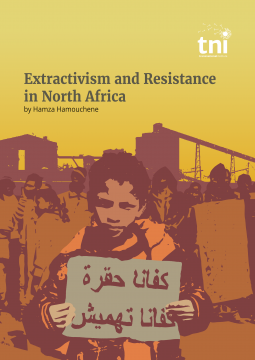
Extractivism and Resistance in North Africa

By Hamza Hamouchene - Transnational Institute, October 2019

Extractivism as a mode of accumulation and appropriation in North Africa was structured through colonialism in the 19th century to respond to the demands of the metropolitan centres. This accumulation and appropriation pattern is based on commodification of nature and privatisation of natural resources, which resulted in serious environmental depredation. Accumulation by dispossession has reaffirmed the role of Northern African countries as exporters of nature and suppliers of natural resources – such as oil and gas- and primary commodities heavily dependent on water and land, such as agricultural commodities. This role entrenches North Africa’s subordinate insertion into the global capitalist economy, maintaining relations of imperialist domination and neo-colonial hierarchies.

The neo-colonial character of North African extractivism reflects the international division of labour and the international division of nature. It is revealed in largescale oil and gas extraction in Algeria and Tunisia; phosphate mining in Tunisia and Morocco; precious ore mining - silver, gold, and manganese - in Morocco; and water-intensive agribusiness farming paired with tourism in Morocco and Tunisia. This plays an important role in the ecological crisis in North Africa, which finds its clear expression in acute environmental degradation, land exhaustion and loss of soil fertility, water poverty, overexploitation of natural resources, pollution and disease, as well as effects of global warming such as desertification, recurrent heat waves, droughts and rising sea levels.

Concurrent with this dynamic of dispossession of land and resources, new forms of dependency and domination are created. The (re)-primarisation of the economy (the deepened reliance on the export of primary commodities) is often accompanied by a loss of food sovereignty as a rentier system reinforces food dependency by relying on food imports, as in the case of Algeria; and/or as land, water and other resources are increasingly mobilised in the service of export-led cash crop agribusiness, as in Tunisia and Morocco. Extractivism finds itself mired in serious tensions, which generates protests and resistance. This paper documents some of these tensions and struggles by analysing activist grassroots work, including the participation in alternative regional conferences and ‘International Solidarity Caravans’ where representative of grassroots organisations, social movements and peasant communities met and travelled together to sites of socio-environmental injustices, providing a space to strategise together and offer effective solidarity to their respective struggles.

The rural working poor and the unemployed in Northern Africa are the most impacted by the multidimensional crisis. Comprising small-scale farmers, near-landless rural workers, fisherfolks and the unemployed, the movements emerging in the five case studies presented here are resisting the looting of their subsoil resources, the despoliation of their lands, pervasive environmental destruction and the loss of livelihoods. The paper asks the following questions: should we see these protests, uprisings and movements as mainly environmental, or are these fundamentally anti-systemic – anti-capitalist, antiimperialist, decolonial and counter-hegemonic protests? Are these circumstantial episodes of resistance, or do they rather represent the latest development in the historical trajectory of class struggle against the latest capitalist offensive in North Africa? The paper presents an assessment of the nature of these movements which grapple with tensions and contradictions that face them.

Read the report (PDF).

The Future Is Already Here

By Larry Gambone - special to IWW Environmental Unionism Caucus, July 2, 2019

Many people do not realize that everything we need for an environmentally sane, egalitarian and authentically democratic society exists NOW.[1] The fact that these exist already is grounds for hope. Neither are most of these new developments in their embryonic form – many – thought still a minority aspect – are quite well established.

The best known of these is the relatively clean generation of electricity.[2] Solar and wind generation is at or near the tipping point for cost compared with fossil fuel power generation. Energy specialists think the tipping point could be 2025 or sooner. Some say we are there already. Countries like Costa Rica and Holland already produce or are near to producing all their electricity through renewables. Less well known, but working examples do exist of geothermal and tidal power.

The other aspect is using less electricity or other energy sources. A massive amount of energy is consumed heating and cooling buildings. Fifty percent of energy expended in the EU has to do with heating and cooling. Passive houses reduce the cost of heating and cooling to almost nothing. Houses can be oriented and constructed in such a fashion that they cool themselves naturally.[3] Trees – no yard or street should be without them, not only do they use CO2 but they also have a cooling effect. Smaller dwellings should be a priority- well designed they should be as convenient for the occupants as any McMansion. These designs already exist. There is no reason other than assuaging one's ego, that the tiny families of today need a 4000 sq. foot house. A smaller house or apartment requires less energy consumption than a large one.

Twenty-five percent of energy expended globally has to do with transport, 20% of that is trucks, 12% ships and 45% cars according to statistics in the Maritime Executive site. Energy is wasted in unnecessary driving. If you could walk to most of the shops, schools or recreation centres you would not need to drive. We need to restore the village with facilities located in a nearby 'down town' that can be easily reached on foot. Combine this with an efficient public transit system – like they have in much of Europe – and better yet make it "free" like in Luxemburg - and less people will have cars. This means, of course, less energy consumed. For many, car ownership will be a thing of the past and the existing car coops and car share companies will predominate in the urban areas.

Energy is wasted in the unnecessary traffic in goods. No non perishables ought to be shipped by truck that can go by rail and thus save energy. A carbon tax ought to be levied upon all products that can be produced locally, yet are imported from afar due to a false sense of economy. This will encourage local production – once again less energy consuming – and reduce the amount of trucking and shipping.

Agribusiness consumes a lot of energy on machinery, petroleum, pesticides and fertilizers. While I would not suggest growing wheat organically on a small scale, many other food items can be grown in this manner. Small but intensive organic horticulture can produce an enormous amount of food from a small area. Paris used to feed itself in that manner and Havana does today. No pesticides or artificial fertilizers, but the organic waste of the city. Working with tools that last a generation and not expensive, short-lived machines that require petrol. Of course, food prices will need to increase to make such small farming viable – but this could be off set by keeping rents and mortgages low through an intelligent housing policy, like the one that exists in Germany.

One of the biggest consumers of energy is the military and a good way to reduce energy consumption would be peace. They are called "Defense Departments" but few countries other than Switzerland really have a defensive policy. Most countries are geared for offense – against other countries – or their own people. Bombers, missiles, drones, air craft carriers, nuke carrying subs, are not weapons of defense – they are for attacking. Ironically, we have no enemies other than a handful of home made bomb and small arm toting maniacs against whom such offensive weapons are useless. Using the model of Switzerland, we could have a cheap – and therefore less energy consuming – military. A military trained in guerrilla warfare using small arms, RPGs and SAMs – cheap stuff.

The future that is now, is more than energy efficiency, it is also about equality and freedom. Freer, more democratic and more egalitarian institutions exist already and are more widespread than you might think.

Public Finance for the Future We Want (Lavinia Steinfort and Satoko Kishimoto)

By Lavinia Steinfort and Satoko Kishimoto (editors) - Transnational Institute, June 2019

Do you wish to see regenerative, equitable and democratic economies, built with collective power? We believe it is not only necessary but also very possible.Today’s economic system, fueled by an extractivist logic and prone to crises, has reignited and enflamed old monsters of racism, misogyny and other forms of fear and hate. Economic alternatives are needed now more than ever.

This book is about financial alternatives, drawn from real-world examples. It highlights the kinds of models that could become the new normal, building the basis for a democratically organized and life-sustaining future.Before the 2008 global financial crisis, the mantra was ‘there is no alter-native’ to the extractive economic model that has fostered excessive inequality and ecological destruction. Post-crisis, big banks were rescued and the blame misdirected to public spending.

This justified evermore harsh austerity measures, reinforcing the story that the public sector must rely on private finance to solve these ‘collaterals’.More than 10 years later, we know that private finance has not only failed to address these problems, it has intensified them. Civil society needs to unite behind systemic solutions before another financial bubble bursts.

Read the report (PDF).

Internationalising the Green New Deal: Strategies for Pan-European Coordination

By Daniel Aldana Cohen, Kate Aronoff, Alyssa Battistoni, and Thea Riofrancos - Common Wealth, 2019

Climate politics are today bursting to life like never before. For four decades, market fundamentalists in the United States and United Kingdom have blocked ambitious efforts to deal with the climate crisis. But now, the neoliberal hegemony is crumbling, while popular climate mobilisations grow stronger every month. There has never been a better moment to transform politics and attack the climate emergency.

When the climate crisis first emerged into public consciousness in the 1980s, Margaret Thatcher and Ronald Reagan were consolidating a neoliberal doctrine that banished the most powerful tools to confront global heating— public investment and collective action.

Instead, neoliberals sought to free markets from democratically imposed constraints and the power of mass mobilisation. Thatcher insisted that there was no alternative to letting corporations run roughshod over people and planet alike in the name of profit. Soon, New Democrats and New Labour agreed. While the leaders of the third way spoke often of climate change, their actual policies let fossil capital keep drilling and burning. Afraid to intervene aggressively in markets, they did far too little to build a clean energy alternative.

Then the financial crisis of 2008 and the left revival that exploded in its wake laid bare the failures of the neoliberal project. An alternative political economic project is now emerging—and not a moment too soon. As the Intergovernmental Panel on Climate Change put it, keeping global warming below catastrophic levels will require “rapid, far-reaching and unprecedented changes in all aspects of society.” In other words: public investment and collective action.

Fortunately, movements on both sides of the Atlantic have been building strength to mount this kind of alternative to market fundamentalism. On the heels of Occupy Wall Street and Black Lives Matter, Bernie Sanders’s 2016 Democratic primary campaign breathed new life into the American left and its electoral prospects. Jeremy Corbyn’s election as leader of the Labour Party, spurred by a vibrant grassroots mobilisation, gives those of us in the U.S. hope: if New Labour could give way to Corbynism, surely Clintonism can give way to the left wing of the Democratic party. In the U.K., drawing on tactics from the Sanders campaign, Momentum has developed a new model of mass mobilisation to transform a fossilised political party. It’s restoring the dream that formal politics can be a means for genuinely democratic political organising. In turn, U.S. leftists are learning from Momentum’s innovations.

The vision of the Green New Deal that has taken shape in the United States in the past few months is in many ways a culmination of the U.S. left’s revival. The Green New Deal’s modest ambition is to do all that this moment requires: decarbonise the economy as quickly as humanly possible by investing massively to electrify everything, while bringing prodigious amounts of renewable power online; all this would be done in a way that dismantles inequalities of race, class and gender. The Green New Deal would transform the energy and food systems and the broader political economy of which they are a part.

Read the report (PDF).

Plan, Mood, Battlefield - Reflections on the Green New Deal

By Thea Riofrancos - Viewpoint Magazine, May 16, 2019

Climate scientists are beginning to sound like radicals.

The 2018 IPCC report concluded that “unprecedented changes across all aspects of society” would be needed to limit warming to 1.5 degrees Celsius. In its devastating report on the dire state of the planet’s ecosystems, the UN’s panel on Biodiversity and Ecosystem Services likewise called for, in the words of its chairperson, “fundamental, system-wide reorganization across technological, economic and social factors, including paradigms, goals and values.”

The first, and thus far only, U.S. policy initiative that addresses the severity of the crisis before us is the Green New Deal, introduced as a congressional joint resolution this past February. The resolution proposes, among other goals, decarbonizing the economy, investing in infrastructure, and creating dignified jobs for millions. And while this resolution is, from a planetary perspective, obviously limited by its domestic scale, transforming the U.S. along these lines would surely have global reverberations, for at least two reasons: the U.S. is a major impediment to global coöperation on climate, and political parties elsewhere in the world (e.g., the UK’s Labour Party and Spain’s Socialist Party) have already begun to adopt the Green New Deal as the frame for their own domestic policies.

After a few months of swirling discourse, we can begin to identify an emergent set of positions in the debate around the Green New Deal. The right-wing has resorted to classic red-baiting, decrying the nonbinding resolution as a “socialist monster,” a road to the serfdom of state planning, rationing, and compulsory veganism. The vanishing center is clinging tightly to its cozy attachment to a politics of triangulation: the Green New Deal is a childlike dream; serious adults know that the only option is to hew to the path of bipartisanship and incrementalism. The left, of course, knows that in the context of already-unfolding climate crisis, resurgent xenophobia, and the weakening hold on legitimacy of the neoliberal consensus, the real delusions are “market-driven” solutions and nostalgic paeans to American “norms and institutions.”

But on the left, too, there are criticisms, and outright rejections, of the Green New Deal (see here, here, here, and here). There is the charge that the Green New Deal, like the old New Deal, amounts to the state, qua executive committee of the bourgeoisie, rescuing capitalism from the planetary crisis it has created. In this rendering, rather than empowering “frontline and vulnerable” communities, as the resolution claims, the policy framework will amount to a corporate welfare windfall of investment opportunities lubricated with tax breaks and subsidies; public-private partnerships; infrastructure outlays that will stimulate real estate development; and, a jobs guarantee that will stimulate consumption—a win-win for the state and capital, but, by leaving the underlying, growth-addicted, model of accumulation untouched, a loss for the planet and the communities most vulnerable to climate crisis and eco-apartheid. There’s another twist. As sometimes the same analyses point out, this win-win-lose-lose scenario is itself based on a false understanding of contemporary capitalism. In a world of secular stagnation—declining profit rates, speculative bubbles, financialization, rentier-like behavior, and accumulation-by-upward-redistribution—the vampire-like quality of capital has never been more apparent. The notion that capital might, with a little inducement, suddenly overcome these tendencies and invest in productive activities is its own nostalgic fantasy.

Extinction Rebellion Must Evolve to Tackle Our Systemic Climate Crisis

By Steve Rushton - Occupy.Com, May 9, 2019

The movement known as Extinction Rebellion (XR) has pushed climate change firmly into the British consciousness, clearing the political hangover left by the never-ending Brexit fog. But there are constructive critiques to this monumental, London-centred climate activism that bear mentioning. Namely, what does this movement need to do to gather enough popular support and halt the ongoing climate meltdown.

XR takes over London

For 10 days in April, Extinction Rebellion created headline disruption, taking over prominent sites across London, including Parliament Square. They demanded that the UK government "tell the truth" about the scale of the climate crisis; enact legally binding policies to reduce carbon emissions to net zero by 2025; and do both through a Citizens Assembly (more on citizens assemblies here).

People last month participated in the tens of thousands, and many of then were new to activism. Holding these sites created space for public assemblies and direct action. When police arrested activists – more than 1,000 in total – more came forward until jail cells were full. Actions went far beyond London, from road blocks in Brussels to stopping a coal train in Australia, and die-ins as well as other actions from India to South Africa to Seattle.

Pressure from XR made Labour table a motion in Parliament to declare a climate emergency. The Welsh assembly did the same just days before. Now, as XR expands its effective activism globally, it is worth asking: what does this movement need to do to stop the climate catastrophe?

Capitalists fear the Green New Deal...and for good reason

By Kai Heron - ROAR, May 8, 2019

What’s green on the outside and red on the inside? A watermelon. And, if you believe conservative pundits, the Green New Deal (GND). Speaking at the Conservative Political Action Conference in February, the former Deputy Assistant to Donald Trump, Sebastian Gorka, announced that the GND is “green on the outside” and “deep, deep communist [red] on the inside.”

What came next was an absurd piece of red-baiting: “They want to take away your pickup truck, they want to rebuild your home, they want to take away your hamburgers. This is what Stalin dreamed about but never achieved. You are on the frontlines of the war against communism coming back to America under the guise of Democratic Centralism, which is just the PC term for communism.” We should be so lucky.

Gorka’s formulations may be more bombastic than most but he is hardly alone. Writing for Public Seminar, Jake Davis explains that “looking at the recently proposed Green New Deal (GND), Representative Ocasio-Cortez’s solution to climate change, it becomes painfully obvious that the end state is not environmental protection; its [sic] socialism.” Or, as Kimberly Guilfoyle wrote in The Hill, “what is most shocking about the Green New Deal is a number of socialist wish-list items that have nothing to do with climate change. Don’t want to work but still want to live a cushy lifestyle? No problem.” Or, as Jarrett Stepman wrote for the Foundation for Economic Education, the GND is “not very democratic but it is socialistic — an American version of a Soviet-style five-year plan focus[ed] on command-and-control economic solutions that have proven to fail the world over.” Or, finally, as Jason Pye put it succinctly in Real Clear Markets, “The Green New Deal is Communist Manifesto, 21st Century.” Again, we should be so lucky.

Of course, red-baiting is not a new phenomenon on the right. In 1933, Herbert Hoover accused Roosevelt’s New Deal of using the 1929 depression “as an excuse for imposing socialism under new euphemistic phrases.” In 2012, Obama was branded a Marxist-Leninist for suggesting that the top 1 percent of income earners could perhaps pay slightly higher taxes. And in February 2019, Fox News accused Alexandria Ocasio-Cortez of “socialism and communism” because she committed to paying her staff a living wage.

Despite this trope’s frequency, there is something new and important about its use in recent assaults on the GND. What we are witnessing is capital’s first line of defense against the fact that environmentalism is increasingly becoming — but in fact always has been — a space of class struggle. What the capitalist class has yet to realize, however, is that the GND might be the least of their worries.

Statement by IWW Secretary, Russ Spring - Union calls for an end to the growing economy and the transformation of industry

Statement by IWW DEC Secretary, Russ Spring - Bristol IWW EUC, April 22, 2019

Statement delivered to Bristol IWW EUC, to be announced in solidarity with the Earth Strike climate protest on April 27th, 2019: https://www.facebook.com/events/777567979287005/

Regarding the passing of the IWW’s new environmental policy, calling for an end to the growing economy and the transformation of harmful industry.

“The threat of extinction is a very loud wake up call. Not just a wake up call to the needs of the planet but also a wake up call to the need for system change. Urgent and seismic action is needed for the immediate future and the long term survival of our planet.

The changes that are required are so substantial that capitalism cannot deliver them. System change not climate change is one of the placards and chants of the schools strikes.

That is largely due to the fact that it is a world driven by greed, self interest in the pursuit of private wealth, profit and privilege, that has brought us to the brink of extinction.

The best that a green capitalism can offer is a temporary truce in its war on the planet, before its insatiable appetite for more will push us again to the edge of catastrophe.

The terms of struggle have changed from the desire for a fairer world to the necessity of a fairer world and one that puts ecology before economy.

We are living at the most important time in human history. It is the time when the reality and consequences of human activity is laid bear like never before.

And whilst we are staring oblivion full in the face it is also a great time of possibility. A time for us to have the most radical shake up of our economics our culture and our relationships with each other and of course our planet.

BUT it is our last chance... screw this up and ...well it doesn't bear thinking about.

The climate change emergency is creating a vacuum throwing old politics to the sides and it is important that progressive ideas and actions fill that vacuum.

The small minded bigots of the right wing are already talking about the need to curb populations in Africa and Asia and pointing to other world economies such as China as the problem. We can expect to see climate change being used more and more to fuel racism, xenophobia and nationalism and the ideas of green fascism.

The school strikes, the XR occupations in London and events like this are a start but we must dramatically increase our efforts.

We must start to frame a clear vision of the future that we and the planet demand.

Sadly many on the left have dismissed ecological concerns in the past. Seeing environmental degradation as an inevitable consequence of the sacred cow of progress and the creation of jobs...at any cost.

All political parties, both mainstream and those on the fringes, are locked into the growing economy, standards of living and the right to consumption. The trade union movement following suit.

Quality of life, community and ecology have long been shoved off the agenda.

The question is does the left have the ability to heed the wake up call and adapt or are they due for extinction.

So the IWW, has since the 80s had in its constitution, sadly somewhat neglected, a line that says that we aim to build a world in which we can live in harmony with the planet.

We have now given new life to that desire by passing a long overdue environmental policy that calls for; an end to the growing economy and the transformation of harmful industries.

I think we will be the first trade union to do so. But we also commit that the IWW should seek to be a radical influence in politics and environmental debate and in particular the trade union movement which can be very protective of the most damaging industries.

So we aim to try and influence the trade unions that still have over 6million members.

We also acknowledge that this is not a time for political dogma. It is a time of political pragmatism.

So whilst we will keep our revolutionary aims we will work to bring about reforms to slow down climate change ….. by any means necessary.

The battle is on, and time is short. We need to be bold and draw on all our creative energies to bring about change in our individual lives but most importantly system change.

The time for squabbling among ourselves is over.

Lets get angry lets get passionate and direct it at those that are responsible.

Pages

The Fine Print I:

Disclaimer: The views expressed on this site are not the official position of the IWW (or even the IWW’s EUC) unless otherwise indicated and do not necessarily represent the views of anyone but the author’s, nor should it be assumed that any of these authors automatically support the IWW or endorse any of its positions.

Further: the inclusion of a link on our site (other than the link to the main IWW site) does not imply endorsement by or an alliance with the IWW. These sites have been chosen by our members due to their perceived relevance to the IWW EUC and are included here for informational purposes only. If you have any suggestions or comments on any of the links included (or not included) above, please contact us.

The Fine Print II:

Fair Use Notice: The material on this site is provided for educational and informational purposes. It may contain copyrighted material the use of which has not always been specifically authorized by the copyright owner. It is being made available in an effort to advance the understanding of scientific, environmental, economic, social justice and human rights issues etc.

It is believed that this constitutes a 'fair use' of any such copyrighted material as provided for in section 107 of the US Copyright Law. In accordance with Title 17 U.S.C. Section 107, the material on this site is distributed without profit to those who have an interest in using the included information for research and educational purposes. If you wish to use copyrighted material from this site for purposes of your own that go beyond 'fair use', you must obtain permission from the copyright owner. The information on this site does not constitute legal or technical advice.