You are here

whistleblowers

EcoUnionist News #88

Compiled by x344543 - IWW Environmental Unionism Caucus, January 26, 2016

The following news items feature issues, discussions, campaigns, or information potentially relevant to green unionists:

Lead Stories:

Ongoing Mobilizations:

The Thin Green Line:

Bread and Roses:

An Injury to One is an Injury to All:

Whistleblowers:

Greenwashers:

EcoUnionist #87 - Carbon Bubble Bursting Edition

Compiled by x344543 - IWW Environmental Unionism Caucus, January 18, 2016

The following news items feature issues, discussions, campaigns, or information potentially relevant to green unionists:

Lead Stories:

Ongoing Mobilizations:

The Thin Green Line:

Bread and Roses:

An Injury to One is an Injury to All:

Former inspectors allege safety issues with Spectra pipeline project

By Steve Ahlquist - RI Future, November 30, 2015

Two safety inspectors who worked on Spectra Energy’s proposed methane gas pipeline that will cut through Burrillville, RI, say the company cut corners when it came to project, worker and environmental safety.

“Right now, what they’re hoping to do, is they’re hoping to slam all this through, and then at the end ask for forgiveness,” said one of the former inspectors. “Oops, sorry about that, I didn’t know, let me write you a check. Because once this thing’s turning meter, they’re going to be making millions of dollars a day. It doesn’t matter what your problems are…”

The other added, “We were told to shut the fuck up or quit.”

Both men, who spoke on the condition of anonymity, were subcontracted by Spectra and both were terminated from the project this summer. I was introduced to them through FANG (Fighting Against Natural Gas), an environmental group that opposes the project, and have spent time talking with both men by phone as well as reviewing audio interviews and emails provided by FANG.

“Like every other company, Spectra gives a tremendous presentation about their commitment to safety, but their actions lack any kind of resolve. No one ever says, ‘Safety’s #2 here,’” said the first inspector. “At every turn when I made a safety suggestion, I was met with monumental resistance from the company on every level.”

Perhaps suspecting their days are numbered, fossil fuel companies are rushing to build the infrastructure required to keep us dependent on methane or “natural” gas for the next 50 years or more, even as evidence mounts that methane is a major contributor to climate change. This gives lie to the claim that methane will serve as a bridge fuel, something to ease the transition from fossil fuels to green energy sources, as the infrastructure investments being made are long term and permanent. Companies are investing billions laying pipelines, building compressor stations, and constructing energy plants and other infrastructure ahead of industry-wide extinction.

In their rush to build, safety and environmental concerns are being brushed aside, suspect many experts. A recent “Pipeline Safety Trust analysis of federal data,” shows that, “new pipelines are failing at a rate on par with gas transmission lines installed before the 1940s.”  Sarah Smith writes that Carl Weimer, director of the Pipeline Safety Trust, told attendees at a National Association of Pipeline Safety Representatives annual meeting in Tempe, AZ that, “The new pipelines are failing even worse than the oldest pipelines.”
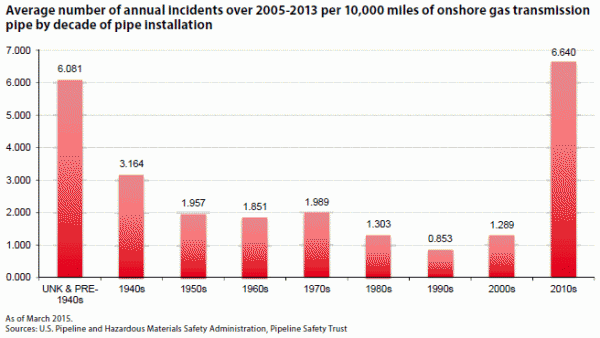
Pipeline Incidents

Though some of the problems may be related to workers learning how to implement the latest technologies, Weimar says, “there’s also some suggestions that we’re trying to put so many new miles of pipeline in the ground so fast that people aren’t doing construction … the way they ought to.”

In the same piece Smith quotes Robert Hall, of the National Transportation Safety Board Office of Railroad, Pipeline and Hazardous Materials Investigations, who agreed that, “the rapid construction of pipelines in the U.S. is likely a contributing factor to ‘people … out there possibly taking shortcuts or not being as diligent’ as they would be if the pace of construction were less fervent.”

Coming forward to confirm these observations are two former Spectra contractors I’m calling Inspector One and Inspector Two. Both wish to remain anonymous for this piece for personal and professional reasons, though they know that their former bosses may be able to identify them.

More ESA "protection" for the Klamath Basin's Irrigation Elite

By Felice Pace - KlamBlog, July 22, 2015

Disclaimer: The views expressed here are not the official position of the IWW (or even the IWW’s EUC) and do not necessarily represent the views of anyone but the author’s.

The Klamath Falls Herald and News got the headline just right: House passes Walden’s plan to help protect Klamath Project water users (emphasis added). The article goes on to report that "the proposal would confer applicant status on those irrigators, ensuring that they are included in Endangered Species Act consultations that could affect operations of the water project they rely upon." Republican Congressman Greg Walden was able to add the provision to the "Western Water and American Food Security Act" which passed the House with "bipartisan support". The legislation now goes to the U.S. Senate.

Walden's effort to "protect" federal irrigators from the Endangered Species Act implements one of the main objectives of the KBRA Water Deal: to provide "relief" to Klamath Project Irrigators from requirements of the federal Endangered Species Act. That relief will also come in the form of wink-and-nod approval of Habitat Conservation Plans that KlamBlog predicts will remove ESA constraints on irrigation within the sprawling federal irrigation project. KlamBlog has previously written in depth about what we call the KBRA's "wink-and-nod" approach to implementing the ESA. The newer Upper Basin Comprehensive Agreement extends the same ESA "relief" to irrigation interests above Upper Klamath Lake.   

In the news report Walden states that the provision he championed formalizes what is already the practice: the US Bureau of Reclamation  routinely involved organizations representing irrigators in consultations with the US Fish & Wildlife and National Matrine Fisheries Services. Those consultations focus on impacts the 200,000 acre irrigation project has on Kuptu, Tsuam and Achvuun (Shortnose and Lost River Suckers and Coho salmon).

Walden's move may be in response to an investigation being conducted by the Department of Interior.  A former employee has alleged that Reclamation misspent funds which were appropriated to benefit fish and wildlife in order to pay for private growers to pump groundwater for irrigation. Involving a private entity in agency-to-agency government consultations may violate rules designed to protect such consultations from private interest influence. That may be why Walden is pushing the provision now, that is, to legalize what is otherwise an illegal practice. Whether it is legal or not, commercial interests should not be part of ESA consultations which by law are supposed to be based on the best available science and the scientific opinions of expert agencies.

Of course Reclamation does not include all those to whom it supplies water in those ESA consultations. Instead, the Klamath Water Users Association (KWUA), which is controlled by a handful of large and powerful growers, is given a seat at the table while smaller irrigators are left outside.

And what about the tribes, fishermen and others who have a vital interest in how Klamath River water is managed? Why doesn't Mr. Walden want to give them a seat at the ESA consultation table too? With so many of us dependent on Klamath River water, why is just one interest singled out for special treatment with respect to those ESA consultations?

Environmental Justice Becoming Just a Platitude at EPA; New “Action Plan” Neuters Enforceable Protection for Overburdened Communities

By Kirsten Stade - Public Employees for Environmental Responsibility, July 14, 2015

Disclaimer: The views expressed here are not the official position of the IWW (or even the IWW’s EUC) and do not necessarily represent the views of anyone but the author’s.

Washington, DC — The proposed new U.S. Environmental Protection Agency “Action Agenda” for environmental justice contains precious little action and continues to marginalize disadvantaged communities beset by disproportionate pollution burdens, according to comments filed today by Public Employees for Environmental Responsibility (PEER). The EPA plan focuses on symbolic steps that will do little to lift the pollution burden off the poor.

Public comment closes today on EPA’s draft “EJ [Environmental Justice] 2020 Action Agenda framework” which would guide agency efforts over the next five years to make “a visible difference in environmentally overburdened, underserved, and economically distressed communities,” according to the agency website. PEER faults this new iteration for, among other reasons, its –

  • Divorce of environmental justice from its underlying basis in the Civil Rights Act of 1964. This separation has reduced environmental justice to a largely voluntary program;
  • Absence of any guidance for state and local recipients of EPA funds, leaving the program as an intellectual exercise for EPA staff with little practical consequence; and
  • Lack of any enforceable regulation or even a plan to promulgate any.

“At EPA, environmental justice has devolved into aspirational window-dressing,” stated PEER Executive Director Jeff Ruch, noting that the agency has yet to take promised steps to enable communities to defend themselves. “EPA’s ongoing failure to put some teeth into this program only perpetuates environmental injustice.”

The PEER comments urge EPA to adopt best practices from other agencies. For example, the Federal Highway Administration commits itself to “identify and address” undue pollution impacts in communities. By contrast, the EPA plan seeks to “build partnerships” to negotiate away problems.

“In the face of environmental racism, the EPA stance is that of a passive cheerleader,” added Ruch, pointing out that despite its muddled approach EPA is charged with coordinating environmental justice efforts among all federal agencies. “EPA has not even been able to develop guidance to implement the civil rights requirements underlying its environmental justice policies in the hundreds of state and local programs it funds, in the very communities bearing the brunt of pollution-driven insults to public health.”

The PEER comments also describe the fragmented and conflicted cross-currents within EPA that have caused various internal reform efforts to be stillborn. In addition, the agency has a history of civil rights complaints inside its own workforce. “Since EPA has not addressed the civil rights issues within its ranks, it is ill equipped to remedy those same problems outside its hallways,” Ruch concluded.

Feds Find Gaping Holes in CALOSHA Safety Net; Serious Enforcement and Inspection Failures Put California Workers at Risk

By Kirsten Stade - Public Employees for Environmental Responsibility, July 1, 2015

Disclaimer: The views expressed here are not the official position of the IWW (or even the IWW’s EUC) and do not necessarily represent the views of anyone but the author’s.

Washington, DC — The, U.S. Occupational Safety & Health Administration (OSHA) has cited the worker health and safety program in California for falling below minimum performance standards in response to a complaint filed by Public Employees for Environmental Responsibility (PEER). As a result, the state
Division of Occupational Safety & Health (Cal/OSHA) must upgrade its enforcement and inspection programs or face a variety of federal sanctions.

In a letter to PEER dated June 26, 2015, OSHA Area Director David Shiraishi upheld the bulk of the “Complaint about State Program Administration” that PEER filed in February 2014. In its review, OSHA found that Cal/OSHA:

  • Fails to conduct an adequate number of inspections in dangerous workplaces and fails to follow its own policy of doing follow-up inspections on serious violators;
  • Does not issue citations in a timely manner, thus delaying hazard abatement and prolonging dangerous conditions. OSHA found the “amount of time Cal/OSHA takes to issue citations is 69% longer than OSHA for safety inspections and 33% longer for health inspections”; and
  • Takes too long to respond to worker complaints of unsafe or unhealthy conditions. Cal/OSHA “averaged almost working four days to initiate investigations for complaints alleging serious hazards” with one serious complaint sitting 106 days. For non-serious complaints, Cal/OSHA averaged more than two weeks before inspecting with one case sitting 300 days.

The OSHA letter contains recommendations for how Cal/OSHA can remedy the identified failures while concluding that “the State Plan is required to remedy these deficiencies.” Like California, nearly half the states are funded by OSHA to operate their own state plans which, by law, must be at least as effective as the federal program. This finding means that California is not meeting that minimum threshold.

Coup Détat and Purge Befalls Chemical Safety Board; Senior Staff Marched Out Under Armed Guard and Banned from Building

By Kirsten Stade - Public Employees for Environmental Responsibility, June 18, 2015

Disclaimer: The views expressed here are not the official position of the IWW (or even the IWW’s EUC) and do not necessarily represent the views of anyone but the author’s.

Washington, DC — Strife within the U.S. Chemical Safety and Hazard Investigation Board (CSB) has burst into the open again with one board member seizing control and ordering immediate suspension of the agency’s entire executive staff, according to documents posted today by Public Employees for Environmental Responsibility (PEER). In less than a week, the CSB will be left with only two board members who cannot agree on governance of the small agency.

The U.S. Chemical Safety and Hazard Investigation Board (CSB) is an independent federal agency charged with investigating industrial chemical accidents in refineries, factories, and other fixed facilities. It is supposed to have five members but is currently operating with only three, after the White House pressured its own appointed CSB chair, Rafael Moure-Eraso, to resign in March before his nominated successor was confirmed. That left the CSB leaderless, since the White House is declining to designate an interim chair among the remaining three members.

On Friday June 12th, one of the board members Rick Engler circulated an email in which he claimed “the Board voted to designate me the Board Member Delegated Interim Executive and Administrative Authority.” However, there had been no CSB vote. Instead, acting without a quorum, Engler and outgoing Board member Mark Griffon, whose term ends on June 24th, made the designation by email. Their action came over the vehement objection of the third Board member, Manuel "Manny" Ehrlich. But Engler rebuffed Ehrlich’s overture that they act cooperatively to run the CSB until a chair could be confirmed.

This Tuesday June 16th, Engler summarily placed the CSB’s executive staff, Managing Director
Daniel Horowitz and General Counsel Richard Loeb, on administrative leave, forbade them from re-entering the building or talking to any CSB staff. Armed Federal Protective Service agents placed the two in custody and escorted them off the premises.

The stated basis for Engler’s action was that he had ordered an internal investigation into “possible misconduct” identified months earlier by a House Committee and the EPA Inspector General in reports that targeted the former board chair. The reports covered topics ranging from Moure-Eraso’s supposedly “autocratic” approach, use of private email, and staff complaints of a “toxic work environment.”

“In charge for less than a week, Engler has presided over the escalation from a toxic work environment to thermonuclear war,” stated PEER Executive Director Jeff Ruch. “These stale and frankly trivial matters do not merit Egyptian-style martial-law retribution meted out here.”

Ironically, it was Engler who was an outspoken critic of the “lack of transparency” and collegiality under Moure-Eraso. Yet, his actions make those of the prior chair pale in comparison.

OSHAgate

By Steve Zeltser - The Daily Censored, February 16, 2015

Disclaimer: The views expressed here are not the official position of the IWW (or even the IWW’s EUC) and do not necessarily represent the views of anyone but the author’s.

The epidemic of refinery explosions and derailments  leading to massive explosions seem to increase by the week. Behind this collapse of health and safety protection according to advocates is the failure to protect health and safety whistleblowers. The fear of workers to complain about serious health and safety problems is a key part of this failure. Now a Federal lawyer at OSHA Darrell Whitman has charged along with health and safety whistleblowers that the agency management and the DOL have not been enforcing the law to protect not only the whistleblowers but the health and safety of all Americans.

In an explosive document sent to Secretary of Labor Thomas Perez in May 2014, Federal OSHA attorney Darrell Whitman, charged that there is systemic corruption in the agency that is preventing the protection of health and safety whistleblowers. As a result of making these charges with extensive documentation, Whitman has himself become a target of workplace bullying and moves to terminate him from the agency. In fact according to Whipple his supervisor Joshua Paul who is also an attorney at the agency ordered him to falsify federal documents  which is a criminal felony. On February 21, 2015 the agency sent a mover to his house and took his documents and badge preventing him from doing his work.
Whitman has a lot of years under his belt. He has been working over 10 years for state and Federal agencies so he knows a bit about how the Federal government operates.

His latest job was as an investigator in the OSHA program that investigates health and safety complaints by workers in industries from oil, rail, trucking and other companies in OSHA region 9 which covers nearly 40 million workers in the West.
As one of the 6 OSHA staff in this unit, there have been only three that actually doing investigations. Whitman investigates whether OSHA complaints by workers are valid and then makes a determination of whether or not their complaints are serious enough to gain a merit status. Under Federal law this merit status provides full back pay and can provide punitive damages to workers who are terminated for making their health and safety complaints.

Labor Movement Malpractice: Relinquishing the Fight for Workplace Health and Safety

By Garrett Brown - Portside, January 28, 2015

Disclaimer: The views expressed here are not the official position of the IWW (or even the IWW’s EUC) and do not necessarily represent the views of anyone but the author’s.

An underlying theme of California's most prominent union organizing campaigns in recent years-among warehouse workers east of Los Angeles, carwasheros in Los Angeles proper, and recycling workers in Oakland and southern California-has been worker concerns about unsafe and unhealthy conditions at work.  As labor visionaries like Tony Mazzocchi predicted, workers are deeply concerned about and can be successfully organized around workplace health and safety issues.  Rank-and-file concerns about health and safety, however, have not been taken up by union officials or lobbyists who view health and safety as a lower priority than labor legislation or gubernatorial appointees.

As a result, labor officials in California have passively watched as Democratic Governor Jerry Brown put California's state workplace health and safety agency-Cal/OSHA or DOSH-on a starvation diet. Since 2011, the agency has employed fewer field inspectors and has counted on lesser enforcement resources than under Republican Governor Arnold Schwarzenegger. The unions also stood quietly by (with a couple of notable exceptions) when Ellen Widess, appointed as chief of Cal/OSHA in April 2011, was forced to resign in September 2013 following an intense employer campaign against her.

Cal/OSHA under Widess worked with Warehouse Workers United to identify the many hazards facing warehouse workers (heat, forklifts, falls) and to cite both the warehouse operators and the temporary staffing agencies as the workers' employers.  Cal/OSHA seriously investigated hotel workers' ergonomic complaints (UNITE HERE); health care workers' concerns about workplace violence and assaults (SEIU and CNA); and recycling workers' exposure to chemicals, biological, and mechanical hazards in the "green" industry (Longshore and Teamsters unions).  Yet the state's labor officials' and lobbyists' strategy of maintaining access and friendly relations with Brown and his appointees-at all costs-has undermined the resources at Cal/OSHA and led to the weakening of enforcement and worker protections.

EcoUnionist News #26

Compiled by x344543 - IWW Environmental Unionism Caucus, February 1, 2015

Disclaimer: The views expressed here are not the official position of the IWW (or even the IWW’s EUC) and do not necessarily represent the views of anyone but the author’s.

The following news items feature issues, discussions, campaigns, or information potentially relevant to green unionists:

Lead Stories:

Crude by Rail:

Carbon Bubble:

Green Jobs and Just Transition:

Other News of Interest:

For more green news, please visit our news feeds section on ecology.iww.org; Twitter #IWWEUC

Pages

The Fine Print I:

Disclaimer: The views expressed on this site are not the official position of the IWW (or even the IWW’s EUC) unless otherwise indicated and do not necessarily represent the views of anyone but the author’s, nor should it be assumed that any of these authors automatically support the IWW or endorse any of its positions.

Further: the inclusion of a link on our site (other than the link to the main IWW site) does not imply endorsement by or an alliance with the IWW. These sites have been chosen by our members due to their perceived relevance to the IWW EUC and are included here for informational purposes only. If you have any suggestions or comments on any of the links included (or not included) above, please contact us.

The Fine Print II:

Fair Use Notice: The material on this site is provided for educational and informational purposes. It may contain copyrighted material the use of which has not always been specifically authorized by the copyright owner. It is being made available in an effort to advance the understanding of scientific, environmental, economic, social justice and human rights issues etc.

It is believed that this constitutes a 'fair use' of any such copyrighted material as provided for in section 107 of the US Copyright Law. In accordance with Title 17 U.S.C. Section 107, the material on this site is distributed without profit to those who have an interest in using the included information for research and educational purposes. If you wish to use copyrighted material from this site for purposes of your own that go beyond 'fair use', you must obtain permission from the copyright owner. The information on this site does not constitute legal or technical advice.


