You are here

capital blight

Capital Blight - Oil Town Rebellion

By x344543 - March 22, 2014

Disclaimer: The views expressed here are not the official position of the IWW (or even the IWW’s EUC) and do not necessarily represent the views of anyone but the author’s.

For years, the communities of Western and Northwestern Contra Coast County and southwestern Solano County, located on the San Pablo and Suisun Bays, northwest of the San Francisco Bay have been dominated by the fossil fuel industry (and to some extent--until 1993--by the US Military Industrial Complex), and the capitalists running that industry have run each of these communities essentially like company towns.

Under these conditions, all official institutions, including elected city, county, and regional governments, most other businesses, and even the unions that supposedly "represent" the workers in these facilities are beholden to the dominant capitalist interests. Dissident residents or workers--if there are any--often find themselves isolated and alone if they can even find the courage to speak out at all. Complaints about working conditions, corrupt union officials, bought politicians, environmental racism, toxic pollution, and capital blight often fall on deaf ears and are usually dismissed as the product of "outside agitators", even "unwashed-out-of-town-jobless-hippies-on-drugs" or some such thing.

In this northwestern Bay Area region, there are four corporate refineries that dominate the towns of Avon and Pacheco (Tesoro), Benicia (Valero), Martinez (Shell), Richmond (Chevron), and Rodeo and Crockett (Conoco-Phillips), and--as one would expect--dissenters have indeed had a difficult, almost impossible time being heard.

Chevron in particular has run Richmond as a virtual company town as long as it has existed (indeed, the refinery predates the town's founding).  For years, the people of the nearby residential neighborhoods have complained of toxic pollution and political double standards that favor the corporation--allegations that are supported by mountains if evidence. Until recently, the local politicians were entirely loyal to the company.

The environmental struggles of these communities--mostly composed of African-Americans, Asian, Latino, and working class White people--have often been ignored by mainstream environmental NGOs. Locally based environmental groups, including the West County Toxics Coalition and Communities for a Better Environment (CBE), have had to do the vast majority of the work of bringing attention to the plight of their residents. On occasion, Greenpeace and Earth First! have given attention to them, but for the most part, it's been locals--most of whom are not typically activist oriented--who've borne the brunt of the struggles.

Many of these refineries are unionized--mostly by the United Steelworkers Union, with a minority of the workers instead belonging to IBEW Local 180. Naturally, the leadership of these unions has oriented themselves towards capitalist interests, who have on numerous occasions tripped over themselves to voluntarily speak on behalf of their capitalist masters.

For example, in 1999, after four refinery workers were killed in a fire, at the Tosco (now Tesoro) facility in nearby Avon, CBE spoke up on behalf of the deceased and called for stricter regulations of refineries (to protect both workers and the environment). Tosco, of course, opposed the proposed regulatory changes, instead calling for more watered down oversight which--CBE argued--left the foxes guarding the hen-house. Rather than support CBE, Jim Payne of the PACE union local that "represented" the workers at the time excoriated the environmentalists, declaring,

"It absolutely infuriates me that those damned tree-huggers would place this regulation in jeopardy,"

Certain residents of the nearby communities of Avon and Clyde were not especially welcoming of CBE either because--naturally--Tesoro used their substantial economic and political leverage to convince these people that CBE were "outside agitators", perhaps even "unwashed-out-of-town-jobless-hippies-on-drugs" (imagine that!).

This incident was very similar to the PCB spill in Georgia Pacific's lumber mill in Fort Bragg, California, that took place a decade earlier, in which the union leadership of IWA Local 3-469 (one Don Nelson) essentially took the company's side, leaving the rank and file workers to seek outside help from Earth First! and the IWW. Those efforts were led by Anna Marie Stenberg and (you guessed it), Judi Bari.

In spite of years of frustration and the corporations' seemingly iron rule, aided in large parts by their attempts to divide and conquer workers and environmentalists, the political winds in these northwestern Bay Area refinery towns appears to be shifting. Dissidents are gaining traction within their communities, no longer finding themselves isolated from their fellow residents. Workers employed by these industries are speaking out and even making alliances with environmentalists, the communities are finding that they can elect politicians willing to chart a course independent of the dominate corporate forces, and regulatory agencies—who usually provide official cover for the capitalists they’re ostensibly charged with regulating—are actually showing signs of actually demanding accountability from the powers that be.

This Bay Area Town is Taking on Big Oil’s Expansion Plans - And Winning

By Ethan Bucker, US Organizer - Forest Ethics, January 24, 2014

Disclaimer: The views expressed here are not the official position of the IWW (or even the IWW’s EUC) and do not necessarily represent the views of anyone but the author’s

Just over the golden hills of Martinez, the descent into Pittsburg on California's Highway 4 opens a view of the Carquinez Strait. The strait is a narrow segment of the tidal estuary that accepts the rushing waters of the Sacramento and San Joaquin rivers as they empty into the San Francisco Bay. The vista paints a portrait of the transition to a clean energy economy: on the northern side of the strait, enormous turbines of the Shiloh Wind Power Plant revolve gracefully. Along the southern waterfront, an aging former PG&E power plant casts a shadow over massive, decaying fuel tanks next to Pittsburg’s newly revitalized downtown.

This is the stage of the Bay Area’s latest and biggest energy battle, between residents of Pittsburg and energy infrastructure company WesPac.

WesPac Energy wants to transform the PG&E site into a mega crude-by-rail facility, marine oil terminal, and refurbished tank farm. With plans to handle 242,000 barrels per day, the terminal would process one-fifth of all crude coming through California. The facility would deliver Bakken crude and tar sands to all five of the Bay Area’s refineries via new and expanded pipelines. In simple terms, WesPac is looking to turn Pittsburg into the crude hub of Northern California.

WesPac had been developing its proposal with the Pittsburg planning department for two years, but it wasn’t until a sunny Sunday in August 2013 that anyone really knew about it.

On this particular Sunday, longtime Pittsburg resident Lyana Monterrey happened upon a tiny notice in the Contra Costa Times for a public hearing on an environmental impact report. Alarmed at the tremendous risks and dangers posed by the project, Lyana knocked on her neighbor Kalli Graham’s door to tell her about the story she had read. Kalli and Lyana immediately started going door-to-door to alert their neighbors of WesPac’s plans. Neither of them had participated in community organizing before. They attended the city hearing the following day, met a few other concerned residents, and decided to take action.

“I just could not sit still. I could not do nothing about this,” Lyana recalled.

What started as a few neighbors raising their voices quickly grew into a tidal wave of community-led activism that’s swept the town of Pittsburg into the regional and national spotlight. 2013 has been tainted by a half dozen oil train derailments and explosions, including a deadly disaster in Lac Megantic, Quebec that leveled a small town and killed 47 people. So, the prospect of “bombs-on-wheels” (as one community resident put it) rolling through Pittsburg on the daily has set the community ablaze with fierce opposition to WesPac.

Two diverse community led groups--the Pittsburg Defense Council and the Pittsburg Ethics Council--have emerged within the last six months to lead the campaign against the WesPac project, alongside ForestEthics and other NGO allies. Together, we’ve gathered over 4,000 petition signatures, organized a riveting Toxic Tour of the city’s heavy industrial sites, and conducted a bucket brigade air monitoring project that reveals striking levels of pollution in the community. We’ve flooded downtown Pittsburg with lawn signs, mobilized a January 11 march and rally that brought out over 300 residents, and organized a rally that packed Tuesday’s City Council meeting. Community leaders are meeting with city officials, training and empowering volunteers, and generating dozens of media hits. We’re gearing up to come out in full force as the Pittsburg Planning Commission and City Council vote on the project in coming months.

Coal Miners and the Green Agenda

By Robert Pollin - New Labor Forum, Winter 2014

From 2014...

In June 2012, President Obama announced his “Climate Action Plan.” This is his administration’s major second-term initiative to re-energize its agenda around fighting climate change and supporting major new investments in clean energy.

The primary focus of the Action Plan is the administration’s program to dramatically reduce carbon emissions from the country’s electricity utility plants. These emissions result primarily from burning coal, but also natural gas, to produce electricity. Carbon emissions from electricity generation represent about one-third of all greenhouse gas emissions produced by all sources within the U.S. economy today. It is evident that these emissions need to be cut dramatically if we are going to stop playing Russian roulette with the environment.

New Regulations and Technologies Are Not Enough

The administration’s strategy for achieving these emissions cuts is to begin strictly enforc-ing the existing air pollution regulations estab-lished as part of the 1990 Clean Air Act.

The administration is taking this approach because it allows them to avoid asking Congress to either spend more money or pass new regulations.The administration expects that the utility companies can achieve the needed emissions reductions through a technological fix: the introduction of carbon capture and sequestra-tion (CCS) processes, through which, they believe, coal and natural gas could burn cleanly. This is how the phrase “clean coal” has begun to emerge on billboards and TV commercials. CCS encompasses several specific technolo-gies that aim to capture carbon emissions from power plants and other industrial facilities. The captured carbon is then transported, usually through pipelines, to locations where it is then stored permanently—that is, for all time—in subsurface geological formations.

Opponents of the administration’s Action Plan claim that CCS remains unproven and, even if it becomes technically feasible, would impose heavy new costs on utilities.

In this instance, the administration’s critics have the weight of evidence on their side. As such, the Action Plan faces two fundamental problems. First, as there is no proven technol-ogy for delivering clean coal—or, for that mat- ter, clean oil or natural gas—the only viable path for dramatically reducing carbon emis-sions is to sharply reduce fossil fuel consump-tion. This, in turn, means that workers and communities dependent on the fossil fuel indus-tries will face job losses and retrenchment. It is therefore no surprise that even Democratic pol-iticians representing the affected communities are actively opposing Obama’s initiative.

Read the report (PDF).

Appalachia Rising

By Grant Mincy - Counterpunch, January 17-19, 2014

Disclaimer: The views expressed here are not the official position of the IWW (or even the IWW’s EUC) and do not necessarily represent the views of anyone but the author’s.

On Thursday, January 9 a dangerous toxin, 4-methylcyclohexane methanol, leaked from a busted tank and into the Elk River in West Virginia. It is believed that nearly 7,500 gallons of the toxin made its way from the 40,000-gallon tank into the river. It’s unclear how much actually entered the public water supply.
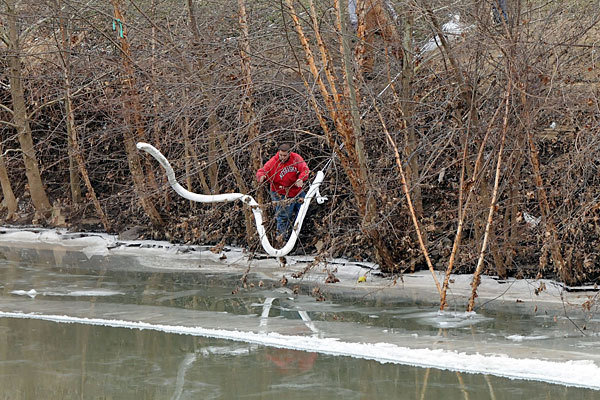
The busted tank is owned by Freedom Industries, which uses the chemical for coal processing. Some 300,000 people have been directly impacted by the disaster, forced to wait in long lines at fire stations to receive potable water. There’s been a constant run on stores for the precious resource as well.

This is a story to often told in Appalachia. The Massey Energy coal slurry spill in Martin County, Kentucky (where 306,000,000 gallons of toxic slurry hit the town) and the TVA coal ash disaster in Kingston, Tennessee, are also part of the history of industrial disaster in the region. This history is wrought with class struggle, environmental degradation and corporatism. From the expulsion of Native Americans to the rise of King Coal, the Hawks Nest incident, the labor struggle, the Battle of Blair Mountain and the wholesale destruction of mountain ecosystems via Mountaintop Removal, Appalachia is on the front lines of the war with the politically connected.

The coalfields of Appalachia have long been home to impoverished people, overlooked by the affluent in the United States. Still, the “War on Poverty” has made its way into the Appalachian hills several times. Most famously, US president Lyndon Johnson singled out the region for his “Great Society” programs, and presidents 42, 43 and 44 have all tried to help the region as well. Instead of offering a new way forward, their programs further damage the area.

Much of the “War On Poverty” has been fought via economic engineering, centralizing the economies of West Virginia and Eastern Kentucky (along with parts of Tennessee and Virginia) into the hands of extractive fossil resource industries — notably coal and natural gas. The mechanization of these industries, however, has reduced the labor force. Specialized labor moving to the region has caused short-term booms and long-term busts. Once an extractive resource is exploited and gone,  communities are left to deal with mono economies and irreversible ecological destruction.

They Poisoned the River for a “Clean Coal” Lie

By Trish Kahle - Socialist Worker, January 13, 2014

Disclaimer: The views expressed here are not the official position of the IWW (or even the IWW’s EUC) and do not necessarily represent the views of anyone but the author’s.

IMAGINE YOURSELF in the rugged countryside of the Appalachian Mountains, where you and your neighbors have lived with a history of poverty and lack of economic development–and you learn that the water piped into your home has been poisoned and can’t be used, even after it is boiled, until further notice.

Imagine trying to run a hospital when the city’s water is unusable–even for hand washing. Imagine having to ration drinking water to school-age children in the fourth most water-rich country on earth.

All of these nightmares and more came true in West Virginia on January 9 after residents reported that their tap water tasted like licorice. The contaminant turned out to be 4-methylcyclohexane methanol, or MCMH–a chemical used to produce misleadingly named “clean coal” through a froth flotation process that “scrubs” the coal prior to burning it in power plants.

The chemical spilled into the Elk River from a 48,000-gallon tank owned by Freedom Industries. The full extent of the leak remained unclear over the weekend. West Virginia Gov. Earl Ray Tomblin claimed the spill didn’t exceed 5,000 gallons, but Freedom Industries President Gary Southern could only say for certain that less than 35,000 gallons leaked out.

Tom Aluise of the West Virginia Environmental Protection Association noted that MCMH cannot be removed from the water–and residents will simply have to wait for thousands of miles of pipelines to be flushed before water safety can be reassessed. “This material pretty much floats on the water, and it’s floating downstream, and eventually it will dissipate, but you can’t actually get in there and remove it,” Aluise said.

That begs the question of why a hazardous chemical that is impossible to clean up if spilled was being stored near a river only one mile upstream from a treatment plant providing water to West Virginia’s capital of Charleston and nine counties that span the surrounding area.

Capital Blight - Grist's Ben Adler Throws the Working Class Under the Bus.

By x344543 - January 12, 2014

Disclaimer: The views expressed here are not the official position of the IWW (or even the IWW’s EUC) and do not necessarily represent the views of anyone but the author’s.

Recently grist.org climate writer Ben Adler wrote an article, Hey, protester, leave those Google buses alone, excoriating anti-gentrification protesters for organizing a blockade of a private charter bus, contracted by Google, in protest of that company's contribution to the ongoing gentrification of the precious few remaining working class neighborhoods in San Francisco.

In the article, Adler made the rather glib argument that the protesters were ignoring the needs of the Earth, "because", he argued,

Driving in one’s own private car is far more elitist than sharing a bus with one’s coworkers. It is also vastly worse for the environment. The buses take cars off the road. Fewer cars mean less traffic, and less idling in traffic, which is especially polluting.

I'm sorry, but this has to be one of the most asinine articles Grist ever published, and it's wrong on so many levels.

First of all, to accuse those residents who are protesting very real economic threats to their ability to keep living in San Francisco with "class antagonism" is the height of accusing the victims with commuting the crimes. Capitalist economics, by nature, are institutionalized class antagonism of the working class by the employing class, and this is no different. If this were the mid 1850s, the author may very well have been accusing the abolitionists with stirring up "race hatred".

Secondly, it's highly ironic that Grist would be now defending Google, when they, themselves have rightfully called them out for organizing a fundraiser for climate change denying Senator Jim Inhofe (R, Oklahoma).

Thirdly, Adler makes a nonsensical argument that gentrification is "good for the environment", an argument which is contradicted by Adler's own previously published article, Pushing Poor People to the Suburbs is Bad for the Environment.

Indeed it is. Gentrification is a form of capitalist oppression which not only does not deliver on its own promises, it harms workers, people of color, and the environment. In fact, Gentrification is another form of colonialism.

Another Oil Train Derailment – Rail Crews Call Them “Bomb Trains”

From the blog Railroaded - January 6, 2014 (used by permission)

Disclaimer: The views expressed here are not the official position of the IWW (or even the IWW’s EUC) and do not necessarily represent the views of anyone but the author’s.

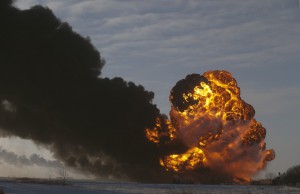
Twenty-one cars and 2 locomotives of a mile-long Burlington Northern Santa Fe (BNSF) Railway train derailed December 30, 2013, near Casselton, North Dakota, overturning oil tanker cars that exploded and burned for more than 24 hours (Star TelegramAsbury Park PressAssociated PressDuluth News TribuneValleynewslive.comAssociated Press 2McClatchy Interactive).

Another BNSF mile-long train carrying grain derailed first (13 cars) and some of the grain cars fell onto an adjacent track carrying the BNSF oil train. About a minute after the grain train derailed, the oil train struck one of the derailed cars filled with soybeans, causing the oil train to fall off the tracks. 20 crude oil tank cars derailed, of which 18 were punctured. Subsequent explosions and fires lasted for hours. One observer noted at least 6 separate explosions in the 2 hours following the derailments, which sent huge fireballs and clouds of hazardous toxic black smoke into the air. The fire burned so hot emergency crews didn’t even attempt to put out the blaze.

475,000 gallons of oil were spilled in the derailment, some of it burning off and some of it leaking into the soil. Investigators estimate that at least 7,300 tons of dirt contaminated with oil must be removed from the site.

Most of Casselton’s 2,400 residents followed a call from the Cass County Sheriff’s Office to evacuate the town due to health concerns about exposure to the toxic burning crude which can cause shortness of breath, coughing and itching, watery eyes. North Dakota Governor Jack Dalrymple visited Casselton and called it a “major catastrophe” that would prompt concern no matter where it happened.

A preliminary investigation by the U.S. National Transportation Safety Board (NTSB) suggests the derailment occurred at a mechanical switching point between 2 tracks. The oil tanker cars that derailed and exploded and burned were the older-model DOT-111 cars which have been known for years to rupture easily in derailments and other accidents. The NTSB, Transportation Safety Board (TSB) of Canada and most rail safety experts have been recommending for many years that the DOT-111 model cars be replaced or upgraded. Unfortunately, railway companies and shippers have been inordinately slow, and in some cases unwilling, to replace this antiquated model with sturdier built and safer models.

Why Environmentalists Must Support Workers’ Struggles

By Stephanie McMillan - December 18, 2013

This is to specifically address class struggle as it relates to the ecological crisis. It will not address all the other (many!) reasons that working class struggle must be waged and supported.

First, we must recognize the fact that global capitalism is driving ecocide.

The problem reaches much farther back than capitalism itself. The combination of an early gendered division of labor with the adoption of agriculture and corresponding formation of permanent settlements set the stage for class divisions and the private accumulation of surplus wealth. Maintaining this arrangement required the development of states with armies, social oppression and repression to weaken internal opposition, and ideologies to make it all seem normal and pre-ordained. And as land was degraded and resources used up faster than they naturally replenished themselves, expansion became imperative, leading to conquest and forced unequal trade.

These intertwined and matured over time into an ever-more complex tangle, culminating in late-stage capitalism: the all-encompassing, all-devouring, spectacular horror that is our current global social living arrangement. The environmental crisis, specifically climate change, is the most urgent problem we collectively face. It is a simple fact that if our planet no longer supports life, then all human pursuits, including social justice, will also come to a screaming halt.

But attempts to solve the environmental crisis head-on, without addressing the underlying structural causes, will ultimately fail. Approaching it directly (for example by blocking a pipeline to prevent tar sands oil from reaching a refinery) can not overturn the socio-economic system that makes resource extraction a non-negotiable necessity. Capital is relentless, and will flow around any obstacle—or smash through it. Throughout history, it has demonstrated the willingness and capacity to wipe out anyone—including entire populations—who attempt to resist.

Historically only one class has been able to challenge capital and offer an alternative to it: the working class. This is not because of any sort of moral superiority, nor is it a matter of suffering the most. In fact, there are many others who are deprived of any means of survival altogether, which is an even worse situation than being exploited as a worker.

The reason that the working class has this capacity is that it is strategically placed. Workers have the most direct relationship with capital: they produce it. Even capitalists themselves merely manage and accumulate it, which they accomplish through the exploitation of workers in the production of commodities. Commodities embody surplus value in the form of unpaid labor, combined with natural materials (which capitalists simply claim ownership of through legal or other violent means). This surplus value, when it’s realized as profit and re-invested, becomes new capital.

Capitalism runs on exploitation, by paying the aggregate of workers less than the total value of their products (the rest becomes profit). So in order to sell all the surplus commodities that can’t be profitably consumed within a social formation, capitalism is structurally required to “expand or die.” The problem with this economic model on a finite planet is obvious.

Capital Blight: a Green-Syndicalist Responds to David Walters "Socialist" Defense of Nuclear Energy

By x344543 - November 22, 2013

Disclaimer: The views expressed here are not the official position of the IWW (or even the IWW’s EUC) and do not necessarily represent the views of anyone but the author’s.

I read with interest David Walters's recent article, "A Socialist Defends Nuclear Energy, wondering what I would find. I soon discovered there was very little credible "defense" and for that matter, not much "socialism" (other than the citation of various Marxist quotations that Marx and Engels would have bristled at given their context here) in it. In fact, it read to me as a typical capitalist defense of its standard operations wrapped in a rather threadbare and tattered red flag.

Michael Friedman has thoroughly debunked Walters's claims about the "safety" of (conventional) nuclear (fission) energy and the "ease" at dealing with the nuclear waste in his own piece so there is no utility in elaborating further on that matter. It is my intention to address the issues that Friedman didn't cover.

To begin with, if David Walters is so willing to overlook peer reviewed science and factual evidence that clearly shows that conventional nuclear fission energy is unsafe and the problem of nuclear waste not easily handled, he may as well also argue in favor of thorium based breeder reactors, nuclear fusion power, fracking, tar sands, "clean" coal, or even hydrogen fuel cells which are equally questionable technologies (and please note that I am not arguing in favor of any of these things here, though I think hydrogen fuel cells are worth a look at least).

Additionally, Walters lumps in all greens into a single, monolithic group, dominated by primitivism and Malthusianism. This is as inaccurate as arguing that all communists take their marching orders from Stalin. This is the rhetoric one expects to hear from the most reactionary elements of the capitalist class's punditocracy rather than an informed anti-capitalist. To me this is a clear indication that his entire argument is mere propaganda and has very little substance.

Capital Blight - What is it?

By x344543 - November 19, 2013

Disclaimer: The views expressed here are not the official position of the IWW (or even the IWW’s EUC) and do not necessarily represent the views of anyone but the author’s.

I suppose I should explain why I chose the name "Capital Blight" for my column-blog-thingy.

To begin with it's a play on words, a sort of send up if the term "capital flight" which is the process by which capitalists withdraw their capital (equipment, physical plants, investments, etc.) in a particular community or region. Their reasons for doing so include the quest for cheaper labor, lower taxes and tariffs, and more lax regulations. Sometimes capital flight occurs after the extraction of locally available resources peak or become depleted. Other times advances in technology make hitherto impractical relocations in production more feasible.

Regardless of the cause, the results of capital flight tend to negatively impact the communities which have been abandoned by the capitalists, particularly in the loss of jobs (both direct and residual) and tax revenue. It also shakes up political and social relations in such places, as much of these are influenced by the suddenly missing elephant in the room.

The less diverse and resilient the economy of said community, the more devastating the short term damage can be. While capital flight can literally spell doom for small rural hamlets, even big cities can be broken by it. This partially explains the desperation experienced throughout what is known as America's "rust belt ".

Pages

The Fine Print I:

Disclaimer: The views expressed on this site are not the official position of the IWW (or even the IWW’s EUC) unless otherwise indicated and do not necessarily represent the views of anyone but the author’s, nor should it be assumed that any of these authors automatically support the IWW or endorse any of its positions.

Further: the inclusion of a link on our site (other than the link to the main IWW site) does not imply endorsement by or an alliance with the IWW. These sites have been chosen by our members due to their perceived relevance to the IWW EUC and are included here for informational purposes only. If you have any suggestions or comments on any of the links included (or not included) above, please contact us.

The Fine Print II:

Fair Use Notice: The material on this site is provided for educational and informational purposes. It may contain copyrighted material the use of which has not always been specifically authorized by the copyright owner. It is being made available in an effort to advance the understanding of scientific, environmental, economic, social justice and human rights issues etc.

It is believed that this constitutes a 'fair use' of any such copyrighted material as provided for in section 107 of the US Copyright Law. In accordance with Title 17 U.S.C. Section 107, the material on this site is distributed without profit to those who have an interest in using the included information for research and educational purposes. If you wish to use copyrighted material from this site for purposes of your own that go beyond 'fair use', you must obtain permission from the copyright owner. The information on this site does not constitute legal or technical advice.