You are here

capital blight

The Impact of Tar Sands Pipeline Spills on Employment and the Economy

By Lara Skinner and Sean Sweeney - Cornell University Global Labor Institute, March 2012
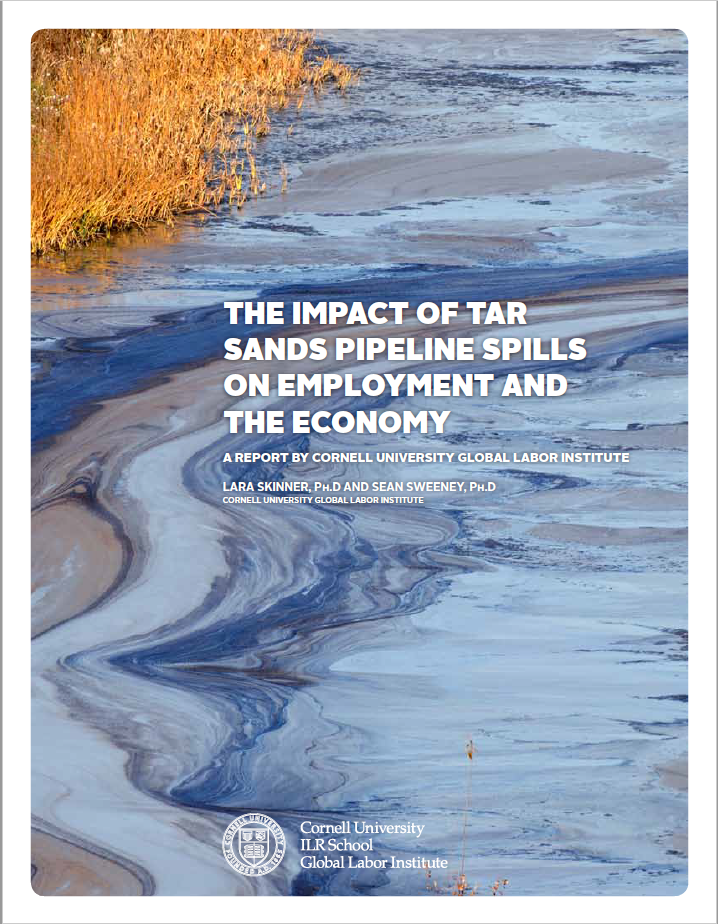
In debates over proposed tar sands pipelines such as the TransCanada corporation’s Keystone XL, little attention has been given to the potentially negative impacts of pipeline spills on employment and the economy. The proposed route for the 1,700-mile Keystone XL pipeline cuts through America’s agricultural heartland, where farming, ranching, and tourism are major employers and economic engines. Ground or surface water contamination from a tar sands oil spill in this region could inflict significant economic damage, causing workers to lose jobs, businesses to close, and residents to relocate. Such a spill could also negatively impact the health of residents and their communities.

A Closer Look at Keystone XL’s Threat to Existing Jobs and Economic Sectors:

» The negative impacts on employment and the economy of tar sands pipelines like the Keystone XL have largely been ignored. To date, a comprehensive risk assessment for the proposed Keystone XL pipeline oil spill has not been conducted. Such an assessment would provide an independent review of the risk of spills and their economic consequences. Since the first Keystone pipeline began operation in June 2010, at least 35 spills have occurred in the U.S. and Canada. In its first year, the spill frequency for Keystone’s U.S. segment was 100 times higher than TransCanada forecast.

» The Keystone XL pipeline would cut through America’s breadbasket. Agricultural land and rangeland comprise 79 percent of the land that would be affected by the proposed Keystone XL pipeline. It would cross more than 1,700 bodies of water, including the Missouri and Yellowstone rivers and the Ogallala and Carrizo-Wilcox aquifers. The Ogallala Aquifer alone supplies 30 percent of the groundwater used for irrigation in the U.S. It also supplies two million people with drinking water.

» Farming, ranching, and tourism are major sources of employment along the Keystone XL pipeline’s proposed route. Water contamination resulting from a Keystone XL spill, or the cumulative effect of spills over the lifetime of the pipeline, would have significant economic costs and could result in job loss in these sectors. Approximately 571,000 workers are directly employed in the agricultural sector in the six states along the Keystone XL corridor. Total agricultural output for these states is about $76 billion annually.

» Many of the land areas and bodies of water that Keystone XL will cross provide recreational opportunities vital to the tourism industry. Keystone XL would traverse 90.5 miles of recreation and special interest areas, including federal public lands, state
parks and forests, and national historic trails. About 780,000 workers are employed in the tourism sector in the states along the Keystone XL pipeline. Tourism spending in these states totaled more than $67 billion in 2009.

» Recent experience has demonstrated that tar sands spills pose additional dangers to the public and present special challenges in terms of clean up. There is strong evidence that tar sands pipeline spills occur more frequently than spills from pipelines carrying conventional crude oil because of the diluted bitumen’s toxic, corrosive, and heavy composition. Tar sands oil spills have the potential to be more damaging than conventional crude oil spills because they are more difficult and more costly to clean up, and because they have the potential to pose more serious health risks. Therefore both the frequency and particular nature of the spills have negative economic implications.

» The Kalamazoo River tar sands spill affected the health of hundreds of residents, displaced residents, hurt businesses, and caused a loss of jobs. The largest tar sands oil spill in the U.S. occurred on the Kalamazoo River in Michigan in 2010. This spill is the most expensive tar sands pipeline oil spill in U.S. history, with overall costs estimated at $725 million.

» The public debate around Keystone XL has focused almost exclusively on job creation from the project, yet existing jobs and economic sectors could suffer significantly from one or more spills from Keystone XL. According to the U.S. State Department, the six states along the pipeline route are expected to gain a total of 20 permanent pipeline operation jobs. Meanwhile, the agricultural and tourism sectors are already a major employer in these states. Potential job losses to these sectors resulting from one or more spills from Keystone XL could be considerable.

» Renewable energy provides a safer route to creating new jobs and a sustainable environment. The U.S. is leading the world in renewable energy investments, and employment in this sector has expanded in recent years. For every $1 million invested in renewable and clean energy, 16.7 jobs are created. By contrast, $1 million invested in fossil fuels generates 5.3 jobs.

Read the report (PDF).

Environmentalism and Gentrification

By Lizzy P - 2012

Sometimes movements for environmental justice fall into the trap of promoting gentrification. This text looks at how green consumerism, middle-class activist spaces, and even improved public transport can push poor people out of their homes, and how environmental activists can work against it. Written in an Australian context, print format:

PDF File

Recovered from zinelibrary.info

Pipe dreams? Jobs Gained, Jobs Lost by the Construction of Keystone XL a report by Cornell University Global Labor Institute

By Ian Goodman and Brigid Rowan - Cornell University Global Labor Institute, September 2011

The purpose of this briefing paper is to examine claims made by TransCanada Corporation and the American Petroleum Institute that, if constructed, TransCanada’s proposed Keystone XL (KXL) pipeline will generate enough employment to kick-start important sections of the US economy through the creation of tens of thousands—perhaps even hundreds of thousands—of good, well-paying jobs for American workers.

This briefing paper raises a number of questions regarding the jobs claims promoted by the industry, questions that are serious enough to generate a high level of skepticism regarding the value of KXL as an important source of American jobs. With national unemployment levels presently (September 2011) around 9%, and the real unemployment figures considerably higher, jobs are desperately needed both to sustain families and to help the broader economy. However, it is our assessment—based on the publicly available data—that the construction of KXL will create far fewer jobs in the US than its proponents have claimed and may actually destroy more jobs than it generates.

The results presented below should also cast doubt on the recent claim made by American Petroleum Institute that the oil industry could create more than a million jobs over the next decade—if the US government would open public lands, beaches, oceans, to unlimited oil drilling. If the industry’s jobs estimates made in the context of KXL are any indication, then this broader claim should be scrutinized very carefully indeed.

Read the report (PDF).

Crisis in California: Everything Touched by Capital Turns Toxic

By Gifford Hartman - January 2010

In California toxic capitalist social relations demonstrated their full irrationality in May 2009 when banks bulldozed brand-new, but unsold, McMansions in the exurbs of Southern California.

Across the United States an eviction occurs every thirteen seconds and there are at the moment at least five empty homes for every homeless person. The newly homeless are finding beds unavailable as shelters are stretched well beyond capacity. Saint John’s Shelter for Women and Children in Sacramento regularly turns away 350 people a night. Many of these people end up in the burgeoning tent cities that are often located in the same places as the ‘Hoovervilles’—similar structures, named after then President Herbert Hoover—of the Great Depression of the 1930s.

Read More - Download the PDF version of this document.

Capitalism, Right Libertarianism and the problem of “externalities?”

By Gary Elkin - December 3, 2009 [date uncertain] [PDF File Available]

Ecology.IWW.ORG web editor's note: "right-libertarian" is more or less synonymous with "anarcho-capitalism", although the latter is the most extreme expression of the former. Essentially, that economic theory and political ideology is championed by the Austrian School of Economics whose adherents include Ludwig Von Mises, F. A. Hayek, Henry Hazlitt, Robert Nozick, and Murray Rothbard. Their ideas have been vulgarized by "libertarian" dogmatist and novelist, Ayn Rand, and were revived in the 1980s by Milton Friedman, Margaret Thatcher, and Ronald Reagan after being discredited following the Great Depression of the 1920s and 30s in the United States and Europe. That being said, essentially the following rules really apply to ALL forms of capitalism, even the Keynesian social democracy so vehemently despised by the aforementioned laissez-faire ideologues:

Right libertarians have great difficulty in dealing with the problem of “externalities”: that is, harmful environmental effects (e.g. pollution, global warming, ozone depletion, destruction of wildlife habitat) not counted as “costs of production” in standard methods of accounting. Such costs must be born by everyone in the society who is affected by them, and not only by the capitalists who produce them; hence it is possible for capitalist to ignore such effects when planning future production. But this means that such effects will be ignored, since competition forces firms to cut as many costs as possible and concentrate on short-term profits.

Right libertarians typically address the problem of externalities by calling for public education which will raise people’s awareness of ecological problems to the point where there will be enough demand for environment-friendly technologies and products that they will be profitable.

This argument, however, ignores two crucially important facts: (1) that environment-friendly technologies and products by themselves are not enough to avert ecological disaster so long as capitalism retains its need for high growth rates (which it will retain because this need is inherent in the system); and (2) that in a right-libertarian world in which private property is protected by a “night-watchman State” or private security forces, a wealthy capitalist elite will still control education, as it does now — and this because education is an essential indoctrination tool of the capitalist elite, needed to promote capitalist values and train a large population of future wage-slaves in proper habits of obedience to authority. For this reason, capitalists cannot afford to lose control of the educational system, no matter how much it costs them to maintain competitive schools. And this means that such schools will not teach students what is really necessary to avoid ecological disaster: namely, the dismantling of capitalism itself.

Another ecological problem that right libertarians cannot deal with satisfactorily is that capitalist firms must be committed to short-term profitability rather than long-term environmental responsibility in order to survive economically in the competitive market .

Coal’s Assault on Human Health

By Alan H Lockwood, Kristen Welker-Hood, Molly Rauch, and Barbara Gottlieb - Physicians for Social Responsibility, November 2009

Coal pollutants affect all major body organ systems and contribute to four of the five leading causes of mortality in the U.S.: heart disease, cancer, stroke, and chronic lower respiratory diseases. This conclusion emerges from our reassessment of the widely recognized health threats from coal. Each step of the coal lifecycle—mining, transportation, washing, combustion, and disposing of postcombustion wastes—impacts human health. Coal combustion in particular contributes to diseases affecting large portions of the U.S. population, including asthma, lung cancer, heart disease, and stroke, compounding the major public health challenges of our time. It interferes with lung development, increases the risk of heart attacks, and compromises intellectual capacity.
Oxidative stress and inflammation are indicated as possible mechanisms in the exacerbation and development of many of the diseases under review. In addition, the report addresses another, less widely recognized health threat from coal: the contribution of coal combustion to global warming, and the current and predicted health effects of global warming.

Read the report (PDF).

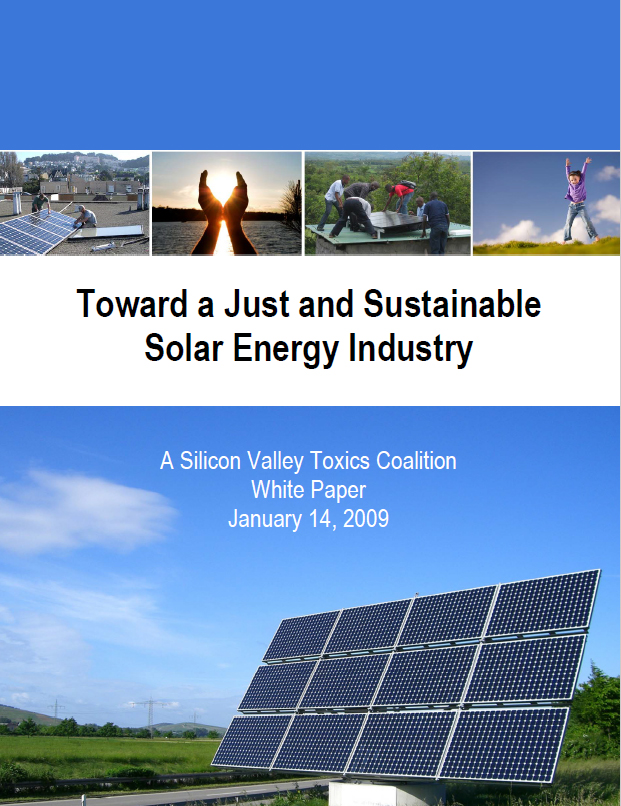
Towards a Just and Sustainable Solar Energy Industry

Towards a Just and Sustainable Solar Energy Industry - A Silicon Valley Toxics Coalition White Paper, January 14, 2009.

Every hour, enough solar energy reaches the Earth to meet human energy needs for an entire year. Solar photovoltaic (PV) technology is widely seen as a “win-win” solution that can harness this “free energy” to address global warming, reduce U.S. dependence on energy imports, create “green jobs,” and help revitalize the U.S. economy.

Solar energy will play an essential role in meeting these challenges, but as the solar PV sector expands, little attention is being paid to the potential environmental and health costs of that rapid expansion. The most widely used solar PV panels are based on materials and processes from the microelectronics industry and have the potential to create a huge new wave of electronic waste (e-waste) at the end of their useful lives, which is estimated to be 20 to 25 years. New solar PV technologies are increasing cell efficiency and lowering costs, but many of these use extremely toxic materials or materials with unknown health and environmental risks (including new nanomaterials and processes).

With the solar PV sector still emerging, we have a limited window of opportunity to ensure that this extremely important industry is truly “clean and green,” from its supply chains through product manufacturing, use, and end-of-life disposal. The solar industry has taken a leadership role in addressing the world’s pressing energy and environmental challenges and will serve as a model for how other innovative “green” industries address the lifecycle impacts of their products.

In this white paper, the Silicon Valley Toxics Coalition (SVTC) provides an overview of the health and safety issues faced by the solar PV industry, including the toxic materials used in manufacturing and the potential end-of-life disposal hazards of solar PV products. The report also lays out recommendations to immediately address these problems to build a safe, sustainable, and just solar energy industry. These recommendations include:

  • Reduce and eventually eliminate the use of toxic materials and develop environmentally sustainable practices.
  • Ensure that solar PV manufacturers are responsible for the lifecycle impacts of their products through Extended
    Producer Responsibility (EPR).
  • Ensure proper testing of new and emerging materials and processes based on a precautionary approach.
  • Expand recycling technology and design products for easy recycling.
  • Promote high-quality “green jobs” that protect worker health and safety and provide a living wage throughout the
    global PV industry, including supply chains and end-of-life recycling.
  • Protect community health and safety throughout the global PV industry, including supply chains and recycling.

Read the report (PDF)

Syndicalism, Ecology and Feminism: Judi Bari’s Vision

By Jeff Shantz - January 12, 2001 [PDF File Available]

According to the late Wobbly organizer and Earth Firster, Judi Bari, a truly biocentric perspective must really challenge the system of industrial capitalism which is founded upon the ‘ownership’ of the earth. Industrial capitalism cannot be reformed since it is founded upon the destruction of nature. The profit drive of capitalism insists that more be taken out than is put back (be it labour or land). Bari extended the Marxist discussion of surplus value to include the elements of nature. She argued that a portion of the profit derived from any capitalist product results from the unilateral (under)valuing, by capital, of resources extracted from nature.

Because of her analysis of the rootedness of ecological destruction in capitalist relations Bari turned her attentions to the everyday activities of working people. Workers would be a potentially crucial ally of environmentalists, she realized, but such an alliance could only come about if environmentalists were willing to educate themselves about workplace concerns. Bari held no naïve notions of workers as privileged historical agents. She simply stressed her belief that for ecology to confront capitalist relations effectively and in a non-authoritarian manner requires the active participation of workers. Likewise, if workers were to assist environmentalists it was reasonable to accept some mutual aid in return from ecology activists.

In her view the power which manifests itself as resource extraction in the countryside manifests itself as racism and exploitation in the city. An effective radical ecology movement (one which could begin to be considered revolutionary) must organize among poor and working people. Only through workers’ control of production and distribution can the machinery of ecological destruction be shut down.

Ecological crises become possible only within the context of social relations which engender a weakening of people’s capacities to fight an organized defence of the planet’s ecological communities. Bari understood that the restriction of participation in decision-making processes within ordered hierarchies, prerequisite to accumulation, has been a crucial impediment to ecological organizing.[1] This convinced her that radical ecology must now include demands for workers’ control and a decentralization of industries in ways which are harmonious with nature. It also meant rejecting ecological moralizing and developing some sensitivity to workers’ anxieties and concerns.

To critics this emphasis on the concerns of workers and the need to overcome capitalist social relations signified a turn towards workerist analysis which, in their view, undermined her ecology. Criticisms of workers and ‘leftist ecology’ have come not only from deep ecologists, as discussed above, but from social ecologists, such as Murray Bookchin and Janet Biehl, who otherwise oppose deep ecology. Social ecology guru Bookchin has been especially hostile to any idea of the workplace as an important site of social and political activity or of workers as significant radical actors. Bookchin repeats recent talk about the disappearance of the working class [2], although he is confused about whether the working class is ‘numerically diminishing’ or just ‘being integrated’. Bookchin sees the ‘counterculture’ (roughly the new social movements like ecology) as a new privileged social actor, and in place of workers turns to a populist ‘the people’ and the ascendancy of community. Underlying Bookchin’s critique of labour organizing, however, is a low opinion of workers which he views contemptuously as ‘mere objects’ without any active presence within communities.[3]

The Mutants are Coming

By Steve Hastings - June 29, 1999

The development of the technology of Genetic Modification (G.M.) stretches back decades but most people have started to become aware of its implications during the 90’s.First in the mid 90’s Monsanto introduced rB.S.T. a G.M. growth hormone designed to increase milk yields in the U.S. After some controversy the E.U. decided to ban its import into Europe, a decision which is likely to be overturned by the World Trade Organisation (W.T.O.) soon. Then in 1996 shipments of soyabeans genetically modified to be resistant to Monsanto’s herbicide Roundup started to arrive in this country prompting the first major signs of public disquiet. More recently the sacking of Dr Puzstai from the Rowett Institute for claiming that consuming G.M. potatoes harmed rats provoked quite a food scare frenzy in the capitalist media. Pictures of a green faced Tony Blair with bolts through his neck under the headline "The Prime Monster" probably made all but the hardest of us chuckle but the whole "Frankenstein Foods" paranoia tended to obscure the environmental and social disasters which will follow if the corporations carry out their plans to introduce G.M. on a large scale.

"LET THEM EAT OIL".

G.M. is only the latest stage in the the industrialisation of food production which has been going on throughout the whole post war period under the control of the petro-chemical-pharmaceutical multinationals that have come to dominate the global economy. More powerful than many nation states (in 1995 of the 100 most powerful ‘economies’ in the world 48 were multinational corporations) they, along with the international financial institutions (IMF, World Bank, W.T.O. etc) constitute the economic side of the New World Order with N.A.T.O. taking on the role of political centralisation.

The process of industrialising food production which they have been imposing on us over the last few decades consists of destroying subsistence and organic farming and replacing it with a system based on:

  • Massive inputs of petro-chemicals in the form of fuel for machinery, artificial fertilisers and biocides (herbicides and pesticides).
  • Production for a global market rather than for direct consumption (subsistence) or local markets.
  • More dependence on animal products and the intensification of animal exploitation (factory farming).
  • The concentration of land ownership into fewer hands.
  • Dependence on multinational corporations for seed. Major chemical, pharmaceutical and oil multinationals have taken over more than 120 seed companies since the 60,s. The top 5 seed producers now control 75% of the world market. Hybrid, so-called ‘High Yielding Varieties’, have yields 20-40% lower in the second generation if replanted and are hence economically sterile’.
  • The replacement of mixed cropping systems suitable to local conditions with monocultures.

The results of this process (sometimes known as the ‘Green Revolution’) have been landlessness, poverty & starvation for many in the so-called ‘Third World’ as well as massive degradation of the natural world through chemical pollution and loss of biodiversity.

Charles Hurwitz Strikes Again

By Judi Bari - Anderson Valley Advertiser, February 13, 1993

Charles Hurwitz, the King of Sleaze, is about to pull another fast one. After six years of looting Pacific Lumber, he has just filed a plan to refinance his junk bonds by splitting the remains of the company into two new companies, Pacific Lumber and Scotia Pacific, and borrowing on each of them. The new loans witch total $579 million, and will be paid off at the expense of both the forest and timber community of Humboldt County. And to show that Hurwitz has absolutely no shame, making an obscenely rich man obscenely richer.

The way it works is this. The new Pacific Lumber will keep the most valuable assets of the old company - 8,000 acres of old-growth redwood including Headwaters Forest, the sawmills, the cogeneration plant, and the town of Scotia. Charles Hurwitz himself will be Chairman of the Board, replacing John Sidel, who has resigned.

Split off from Pacific Lumber will be the new Scotia Pacific Holding Company. Scotia Pacific gets the leftovers - 179,000 acres of cut-over land, featuring mostly young growth trees with some residual old growth and decent second growth mixed in. Although Scotia Pacific has by far the larger acreage, it has the lower valued timberlands. Scotia Pacific will be a subsidiary company of Pacific Lumber.

Against the assets of the new Pacific Lumber Company, Hurwitz will float a bond of $215 million. Although this bond is not directly tied to the sale of Headwaters Forest, it was definitely used as an enticement. Financiers have been promised that if the state or federal government purchases Headwaters, the money will first go towards paying off the debt. Since the sale price of Headwaters will likely be around $500 million and the debt is only $215 million, that will still leave a hefty profit margin for Hurwitz, as usual.

Against the assets of Scotia Pacific, Hurwitz will float a $364 million bond, to be paid off over a 20-year period. This bond will be guaranteed by cutting the timber at a projected rate of 5% of their acreage per year. They need to cut 3% per year just to service the debt, and the other 2% will go to operating costs and profit, which would go back to Scotia Pacific's parent company, Pacific Lumber, and once again find its way into Charles Hurwitz' pocket.

It doesn't take an Einstein to figure out if you cut 5% per year, you will have cut 100% in 20 years. In other words, Hurwitz' new financing plan is based on a rate of cut that would liquidate the forest in one generation. Of course, just because they're cutting every acre doesn't mean they're taking every tree. But the timber harvest plans being submitted up there now are averaging about 80% of the trees on each site. At that rate, in 20 years Humboldt County will look about like Mendocino looks now.

Pages

The Fine Print I:

Disclaimer: The views expressed on this site are not the official position of the IWW (or even the IWW’s EUC) unless otherwise indicated and do not necessarily represent the views of anyone but the author’s, nor should it be assumed that any of these authors automatically support the IWW or endorse any of its positions.

Further: the inclusion of a link on our site (other than the link to the main IWW site) does not imply endorsement by or an alliance with the IWW. These sites have been chosen by our members due to their perceived relevance to the IWW EUC and are included here for informational purposes only. If you have any suggestions or comments on any of the links included (or not included) above, please contact us.

The Fine Print II:

Fair Use Notice: The material on this site is provided for educational and informational purposes. It may contain copyrighted material the use of which has not always been specifically authorized by the copyright owner. It is being made available in an effort to advance the understanding of scientific, environmental, economic, social justice and human rights issues etc.

It is believed that this constitutes a 'fair use' of any such copyrighted material as provided for in section 107 of the US Copyright Law. In accordance with Title 17 U.S.C. Section 107, the material on this site is distributed without profit to those who have an interest in using the included information for research and educational purposes. If you wish to use copyrighted material from this site for purposes of your own that go beyond 'fair use', you must obtain permission from the copyright owner. The information on this site does not constitute legal or technical advice.

