






You are here
Reducing Emissions from Deforestation and forest Degradation (REDD)
 Web editors' note: In this document, the Canadian foresty workers' union, Unifor, is proposing to accept (limited, "strongly regulated") "Cap & Trade", "REDD+", and "Market Based Solutions" (policies that front line communities and First nations generally oppose, because they allow capitalists to continue to profit by "trading" carbon "credits", much like the "Catholic Indulgences" of the Middle Ages, at the expense of the affected communities) whereas the IWW argues that capitalism cannot be reformed, but having said that, some of the other ideas presented within are a good foundation for a workers' based forestry, so we are presenting it here with that in mind.
 From 26 to 28 May 2017, a meeting took place in Xapuri, in the state of Acre, Brazil. The meeting brought together Apurinã, Huni Kui, Jaminawa, Manchineri and Shawadawa indigenous peoples, representatives of traditional communities, rubber tappers, academics and supporting organisations. The meeting’s theme was, “The effects of environmental / climatic policies on traditional populations”.
 On January 12, California Assemblymembers Autumn R. Burke, Jim Cooper, Evan Low, and Blanca Rubio introduced legislation,
  Climate change is often chalked up to “market failure.” We’re told that, despite prevailing assumptions that prices accurately transmit “signals” about the costs of goods and services, emitters like power plants, refineries, automobiles, and households simply do not pay the full ecological costs of their emissions. Hence, the market has failed.
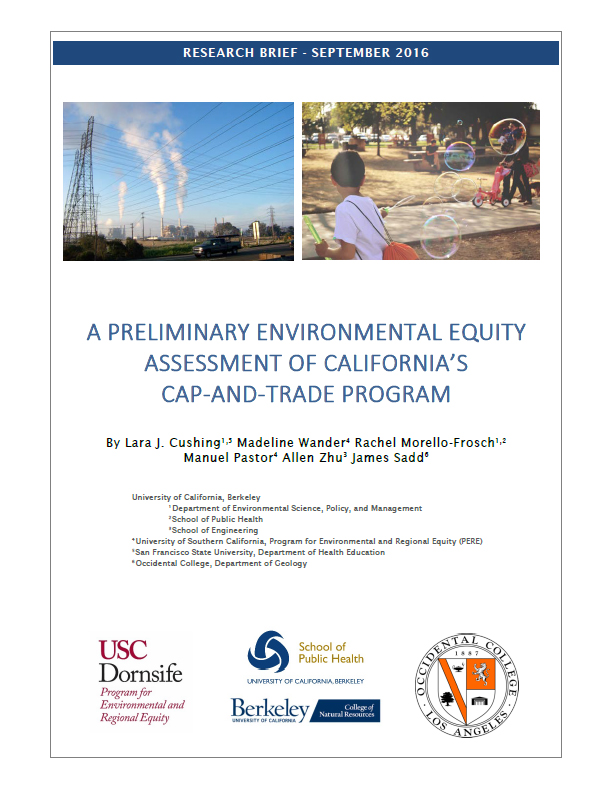 California’s cap-and-trade program is a key strategy for achieving reductions in greenhouse gas (GHG) emissions under AB32, the California Global Warming Solutions Act. For residents living near large industrial facilities, AB32 offered the possibility that along with reductions in GHGs, emissions of other harmful pollutants would also be decreased in their neighborhoods. Carbon dioxide (CO2), the primary GHG, indirectly impacts health by causing climate change but is not directly harmful to health in the communities where it is emitted. However, GHG emissions are usually accompanied by releases of other pollutants such as particulate matter (PM10) and air toxics that can directly harm the health of nearby residents.
 The Paris Climate Agreement of December 2015 is a dangerous distraction that threatens all of us. Marked by the heavy influence of the fossil fuel industry, the deal reached at the United Nations Framework Convention on Climate Change (UNFCCC) never mentions the need to curb extractive energy, and sets goals far below those needed to avert a global catastrophe. The agreement signed by 196 countries does acknowledge the global urgency of the climate crisis, and reflects the strength of the climate movement. But the accord ignores the roots of the crisis, and the very people who have the experience and determination to solve it.
 What do rigged corporate trade agreements like the Trans-Pacific Partnership and the Paris Treaty, an international climate agreement to be signed in 2015, have in common? They are both tools being pushed by the power elite to rip away our hopes for democracy and to commodify all things to monetize them for profit.
 Between 2000 and 2010, a total of
 The Fine Print I:
Disclaimer: The views expressed on this site are not the official position of the IWW (or even the IWW’s EUC) unless otherwise indicated and do not necessarily represent the views of anyone but the author’s, nor should it be assumed that any of these authors automatically support the IWW or endorse any of its positions.
Further: the inclusion of a link on our site (other than the link to the main IWW site) does not imply endorsement by or an alliance with the IWW. These sites have been chosen by our members due to their perceived relevance to the IWW EUC and are included here for informational purposes only. If you have any suggestions or comments on any of the links included (or not included) above, please contact us.
The Fine Print II:
Fair Use Notice: The material on this site is provided for educational and informational purposes. It may contain copyrighted material the use of which has not always been specifically authorized by the copyright owner. It is being made available in an effort to advance the understanding of scientific, environmental, economic, social justice and human rights issues etc.
It is believed that this constitutes a 'fair use' of any such copyrighted material as provided for in section 107 of the US Copyright Law. In accordance with Title 17 U.S.C. Section 107, the material on this site is distributed without profit to those who have an interest in using the included information for research and educational purposes. If you wish to use copyrighted material from this site for purposes of your own that go beyond 'fair use', you must obtain permission from the copyright owner. The information on this site does not constitute legal or technical advice.
 This site is not the official webpage of the Industrial Workers of the World.