

You are here

mining

Warrior Met BANS 41 Strikers from Returning to Work

The Democratic Party Failed Striking Warrior Met Coal Miners in Alabama

By Hamilton Nolan - In These Times, February 20, 2023

Web editor's note: the author repeats the debatable claim that working class voters have gravitated towards Trumpism and the Republican Party, but in actual fact, it's white, rural, (mostly male) residents who earn less than $70,000 US annually without college degrees that have made this shift, but such voters do not represent the majority of the working class, and many of them are not actualy working class at all, so this shift is vastly overstated. That said, the condemnation of the Democratic Party us well deserved anyway:

Political strategists seem content to cede red states to Republicans, and thereby confirm for the working people living in those states that their belief that Democrats don't really care about them is justified.

After almost two years on the picket line, the hundreds of United Mine Workers of America members who have been on strike at Warrior Met Coal in Alabama have offered to go back to work. They still do not have the fair contract they have sacrificed so much for. Their negotiations will continue, but they did not win this strike—and that is tragic. The company and its private equity owners bear the most direct responsibility for precipitating this heartless, inhuman struggle. But if you are looking for a meaningful place to focus your rage over the way that this strike has turned out, look directly at the Democratic Party.

Imagine, hypothetically, that we were living in a period of history in which inequality has soared for a half-century, thanks in large part to the decline of unions and working-class bargaining power; in which the American Dream has been hollowed out, and decades of economic gains have flowed almost exclusively to the rich; in which poorly designed free trade policies supported by Democrats have sucked middle America dry of once-abundant blue-collar jobs; in which the obvious failures of neoliberalism to rectify this situation have soured millions of once-reliable blue voters on the Democratic Party, and tempted them into a Republican Party that offers easy scapegoats for systemic problems; in which this toxic lack of opportunity paved the way for a xenophobic, lying narcissist to spend four years in the White House on the strength of racist fables about making America great again. Imagine, further, that after those dark four years, Democrats were back in power; that they had a leader who proclaimed himself the most pro-union president of our lifetimes; and that he led a party that fretted continuously about how to win back working-class voters from the clutches of Trumpism.

Then imagine that there was a long, grinding strike. By coal miners. In Alabama. Who were fighting against the predations of the sort of ultra-insulated capitalist financiers who are accelerating the inequality crisis. Imagine that walkout became the longest major strike in America, dragging on well past the point when most people would have given up, with the strikers assaulted by oppressive police and court rulings. And yet, for month after month, these workers persevered, held the line, and sacrificed greatly in order to fight for dignity and the fundamental ability for working people to be treated fairly by the faceless forces of capital.

How To Combat The Cumbria Coalmine and Other Retrograde Energy Projects

An EV in Every Driveway Is an Environmental Disaster

By Alissa Walker - Curbed, January 25, 2023

“There is always a huge climate benefit — and, I would argue, a safety benefit — to ensuring people have access to excellent public transit,” Transportation Secretary Pete Buttigieg said earlier this month at the Transportation Research Board’s annual meeting. “Even if we weren’t aggressively working to decarbonize existing modes of transportation, that alone is one of the biggest and the best things we can do from a climate perspective.” This is the closest thing to a mic drop that exists at such an event, so the assembled transportation academics, urban planners, and civil engineers erupted into applause. Buttigieg had to pause, letting the hoots fade out before he could finish his remarks. He was onstage with Energy Secretary Jennifer Granholm to announce the first blueprint to decarbonize U.S. transportation by 2050, an unprecedented collaboration between the Departments of Transportation, Energy, and Housing and Urban Development and the Environmental Protection Agency to move the country away from using fossil fuels when, well, moving around.

Despite its many strengths, the blueprint is largely built around two things that have very little to do with what got Buttigieg the most applause from transit professionals: It’s heavily reliant on developing technologies that don’t exist yet and the Biden administration’s goal to have half of the new vehicles sold in 2030 to be electric (a figure closely negotiated with automakers). The latter point is perhaps why the slow but steadily growing number of electric vehicles, or EVs, sold in this country each year has become its own kind of shorthand for the decarbonization revolution. (“Electric Vehicles Keep Defying Almost Everyone’s Predictions,” “Electric Vehicle Sales Hit a Tipping Point in 2022,” “Electric Vehicles = 10% Of New Vehicle Sales Globally!”) A green future, the story goes, looks a lot like today — it’s just that the cars on the road make pit stops at charging stations instead of gas stations. But a one-for-one swap like that — an EV to take the place of your gas guzzler — is a disaster of its own making: a resource-intensive, slow crawl toward a future of sustained high traffic deaths, fractured neighborhoods, and infrastructural choices that prioritize roads over virtually everything else. And considering what it would take to produce that many cars, the vision being sold by the Biden administration about an EV in every driveway is more than just a fantasy — it’s an environmental nightmare.

A zero emissions future without the mining boom: A new report finds that the U.S. can reduce lithium demand by up to 90 percent

By Blanca Begert and Lylla Younes - Grist, January 24, 2023

The effort to shift the U.S. economy off fossil fuels and avoid the most disastrous impacts of climate change hinges on the third element of the periodic table. Lithium, the soft, silvery-white metal used in electric car batteries, was endowed by nature with miraculous properties. At around half a gram per cubic centimeter, it’s the lightest metal on Earth and is extremely energy-dense, making it ideal for manufacturing batteries with a long life. 

The problem is, lithium comes with its own set of troubles: Mining the metal is often devastating for the environment and the people who live nearby, since it’s water intensive and risks permanently damaging the land. The industry also has an outsized impact on Native Americans, with three-quarters of all known U.S. deposits located near tribal land. 

Demand for lithium is expected to skyrocket in the coming decades (up to 4,000 percent according to one estimate), which will require many new mines to meet it (more than 70 by 2025). These estimates assume the number of cars on the road will remain constant, so lithium demand will rise as gas guzzlers get replaced by electric vehicles. But what if the United States could design a policy that eliminates carbon emissions from the transportation sector without as much mining? 

A new report from the Climate and Community Project, a progressive climate policy think tank, offers a fix. In a paper out on Tuesday, the researchers estimated that the U.S. could decrease lithium demand up to 90 percent by 2050 by expanding public transportation infrastructure, shrinking the size of electric vehicle batteries and maximizing lithium recycling. They claim that this report is the first to consider multiple pathways for getting the country’s cars and buses running on electricity and suppressing U.S. lithium demand at the same time. 

'Groundbreaking' Report Shows Promise of Greener Jobs for Former Fossil Fuel Workers

By Julia Conley - Common Dreams, January 3, 2023

New analysis shows how California "can achieve a just and equitable transition away from fossil fuels for oil and gas workers."

A new analysis out Tuesday shows how a just transition towards a green economy in California—one in which workers in the state's fossil fuel industry would be able to find new employment and receive assistance if they're displaced from their jobs—will be "both affordable and achievable," contrary to claims from oil and gas giants and anti-climate lawmakers.

The study published by the Gender Equity Policy Institute (GEPI) notes that a majority of workers in the oil and gas sectors will have numerous new job opportunities as California pushes to become carbon neutral by 2045 with a vow to construct a 100% clean electricity grid and massively reduce oil consumption and production.

"The state will need to modernize its electrical grid and build storage capacity to meet increased demand for electricity," reads the report. "Carbon management techniques, plugging orphan wells, and the development of new energy sources such as geothermal will all come into play, providing economic opportunities to workers and businesses alike."

GEPI analyzed the most recent public labor data, showing that the oil and gas industries in California employed approximately 59,200 people as of 2021 across jobs in production, sales, transportation, legal, and executive departments, among others.

The group examined potential job opportunities for fossil fuel workers "in all growing occupations, not solely in clean energy or green jobs," and found that about two-thirds of employees are likely to find promising opportunities outside of fossil fuel-related work.

"Our findings show that a sizable majority (56%) of current oil and gas workers are highly likely to find jobs in California in another industry in their current occupation, given demand in the broader California economy for workers with their existing skills," the report says.

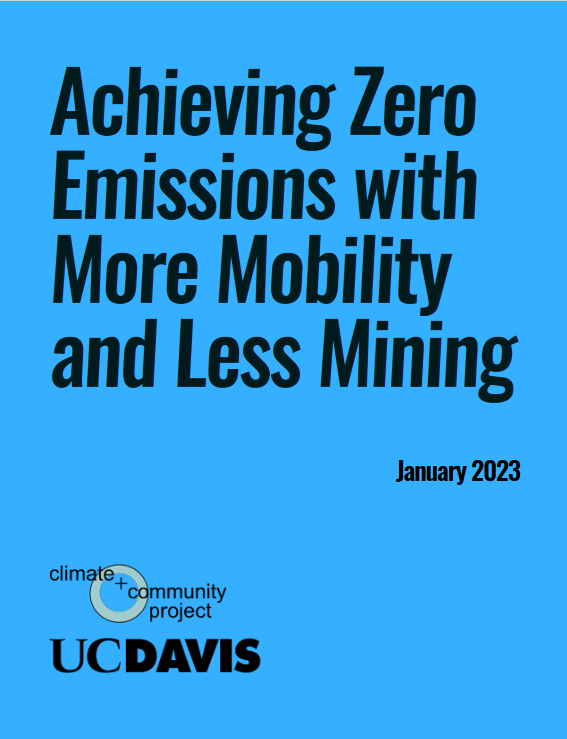
Achieving Zero Emissions with More Mobility and Less Mining

By Thea Riofrancos, Alissa Kendall, Kristi K. Dayemo, Matthew Haugen, Kira McDonald, Batul Hassan, and Margaret Slattery in partnership with the University of California, Davis - Climate and Community Project, January 2023

Transportation is the number one source of carbon emissions in the United States– making the sector crucial to decarbonize quickly to limit the climate crisis. States like New York and California banned the sale of gas cars by 2035 and the 2022 Inflation Reduction Act made major federal investments in electrifying transportation. As a result, US consumers are embracing electric vehicles (EVs), with over half of the nation’s car sales predicted to be electric by 2030. This is a critical juncture. Decisions made now will affect the speed of decarbonization and the mobility of millions. Zero emissions transportation will also see the transformation of global supply chains, with implications for climate, environmental, and Indigenous justice beyond US borders.

A crucial aspect of electrified transportation is new demand for metals, and specifically the most non-replaceable metal for EV batteries– lithium. If today's demand for EVs is projected to 2050, the lithium requirements of the US EV market alone in 2050 would require triple the amount of lithium currently produced for the entire global market. This boom in demand would be met by the expansion of mining. 

Large-scale mining entails social and environmental harm, in many cases irreversibly damaging landscapes without the consent of affected communities. As societies undertake the urgent and transformative task of building new, zero-emissions energy systems, some level of mining is necessary. But the volume of extraction is not a given. Neither is where mining takes place, who bears the social and environmental burdens, or how mining is governed. 

This report finds that the United States can achieve zero emissions transportation while limiting the amount of lithium mining necessary by reducing the car dependence of the transportation system, decreasing the size of electric vehicle batteries, and maximizing lithium recycling. Reordering the US transportation system through policy and spending shifts to prioritize public and active transit while reducing car dependency can also ensure transit equity, protect ecosystems, respect Indigenous rights, and meet the demands of global justice. 

Read the rest of the summary here.

Read the report (Link).

Carbon Removal Is Coming to Fossil Fuel Country. Can It Bring Jobs and Climate Action?

By Nicholas Kusnetz - Inside Climate News, December 4, 2022

Scientists have debated whether a new technology is a critical climate solution or would carry unacceptable risks. A project in Wyoming’s coal region could begin to provide answers.

ROCK SPRINGS, Wyo.—In early fall, residents of this desolate corner of southwestern Wyoming opened their mailboxes to find a glossy flyer. On the front, a truck barreled down a four-lane desert highway with a solar farm on one side and what looked like rows of shipping containers on the other. On the back was an invitation.

“CarbonCapture Inc. is launching Project Bison,” it read, announcing a “direct air capture facility” set to begin operations here next year. “Join us at our town hall event to learn more.”

Few had heard about the proposal before receiving the flyer, let alone had any idea what a direct air capture facility was. So the following week, about 150 people packed into a large classroom at Western Wyoming Community College in Rock Springs to find out.

“We are a company that takes CO2 out of the air and stores it underground,” said Patricia Loria, CarbonCapture’s vice president of business development, in opening the meeting.

Loria described a plan to deploy a series of units—the shipping container-like boxes pictured on the flyer—that would filter carbon dioxide from the air and then compress the greenhouse gas for injection underground, where it would remain permanently.

2022 Oil Change International Supporter Briefing

After 18 Months, Striking Warrior Met Miners and Families Hold the Line

By Ericka Wills - Labor Notes, October 7, 2022

A somber bell toll broke the silence outside the West Brookwood Church in Tuscaloosa County, Alabama. The white-gloved hand of Larry Spencer, International Vice President of Mine Workers (UMWA) District 20, solemnly struck the Miners’ Memorial bell as the names of victims of mine-related deaths were read aloud.

“As we gather this evening for our service, it is appropriate that we remember in the past twelve months over 2021 and 2022 there has been tremendous heartache as the result of mining accidents across this country,” Thomas Wilson, a retired UMWA staff representative, announced from the podium. “Twelve coal miners’ lives have been snuffed out—also, 19 metal and non-metal miners—for a total of 31 fallen miners since we last gathered.”

The annual Miners’ Memorial Service commemorates not only those who left for work in the mines over the past year never to come home again; it also honors the 13 men who died in a series of explosions in Jim Walter Resources Mine No. 5 in Brookwood on September 23, 2001. Standing on the front lawn of the church in the shadows of mine tipples, families reminisced about gathering at the same location on that fateful day in September when they anxiously waited to hear if their loved ones had survived the blasts.

In 2001, the No. 5 mine was owned by Walter Energy. Today it is part of Warrior Met Coal, the company at the center of the UMWA’s 550-day strike, the longest and largest ongoing strike in the United States. As strikers, families, and community members gathered to remember the fallen miners, all were reminded that what is at stake in the Warrior Met strike is, literally, life and death.

Pages

The Fine Print I:

Disclaimer: The views expressed on this site are not the official position of the IWW (or even the IWW’s EUC) unless otherwise indicated and do not necessarily represent the views of anyone but the author’s, nor should it be assumed that any of these authors automatically support the IWW or endorse any of its positions.

Further: the inclusion of a link on our site (other than the link to the main IWW site) does not imply endorsement by or an alliance with the IWW. These sites have been chosen by our members due to their perceived relevance to the IWW EUC and are included here for informational purposes only. If you have any suggestions or comments on any of the links included (or not included) above, please contact us.

The Fine Print II:

Fair Use Notice: The material on this site is provided for educational and informational purposes. It may contain copyrighted material the use of which has not always been specifically authorized by the copyright owner. It is being made available in an effort to advance the understanding of scientific, environmental, economic, social justice and human rights issues etc.

It is believed that this constitutes a 'fair use' of any such copyrighted material as provided for in section 107 of the US Copyright Law. In accordance with Title 17 U.S.C. Section 107, the material on this site is distributed without profit to those who have an interest in using the included information for research and educational purposes. If you wish to use copyrighted material from this site for purposes of your own that go beyond 'fair use', you must obtain permission from the copyright owner. The information on this site does not constitute legal or technical advice.
