You are here

capitalism, colonialism, and fascism

A Turning Point: The Critical Raw Material Act’s needs for a Social and Just Green Transition

By staff - European Environmental Bureau, July 10, 2023

The 21st century demands global efforts that provide solutions to multiple social and environmental crises that negatively impact economies. Many solutions are available to us, and demand a political will to advance on some existing tools (such as product ecodesign legislation or product bans), and a political discourse to develop new tools (such as energy production limits) that will all potentially result in societal transformation that brings humanity comfortably back within planetary boundaries in an equitable way.

Most of the converging social and environmental crises we are facing are a result of the over-consumption of resources due to unsustainable production and consumption patterns in increasingly unequal societies regardless of the level of development of any given country.

This Position Paper (download file here) delves into the main issues that arise within this context in regard to the Critical Raw Materials Act, and has been written by a multitude of civil society organisations.

The version in other languages:

Download a copy of this publication here (PDF).

UNDROP Alive and Kicking: Zainal Arafin Fuad - SPI - Indonesia

UNDROP Alive and Kicking: Ramona Dominiciou - Ecoruralis - Romania

UNDROP Alive and Kicking: Jessie MacInnis – NFU – Canada

UNDROP Alive and Kicking: David Otieno - Kenyan Peasants League - Kenya

UNDROP Alive and Kicking: Pramesh Pokharel - All Nepal Peasant's Federation - Nepal

UNDROP Alive and Kicking: Alberto Silva - Uniterre – Switzerland

Our Green Transition May Leave Black People Behind

By Rhiana Gunn-Wright - Hammer & Hope, Summer 2023

I’m an architect of the Green New Deal, and I’m worried the racism in the biggest climate law endangers our ability to get off fossil fuels.

This summer, the earth raged. Fires in Maui and Canada, floods in Delhi and Beijing, heat everywhere — this is the beginning of the climate impacts scientists have long predicted, and the U.S. is unprepared in terms of everything from infrastructure to public health. And if I’m honest, I raged, too. Never in my life have I wished more to be a cyclone, blowing away everything in my path, or an earthquake, shaking everyone to their core until they take seriously the concerns of Black and Indigenous frontline communities.

August marked a year since the Inflation Reduction Act passed, arguably the most significant climate legislation in U.S. history. But the racist compromises and the marginalization of Black people and their demands that facilitated the bill’s passage have seeped into the climate movement, sowing division and narrowing discourse in ways that not only threaten to keep Black people at the bottom of a new green economy but also undermine efforts to address thornier issues, such as who owns energy resources or how to navigate conflicts about resource distribution and land use, questions that money alone cannot answer.

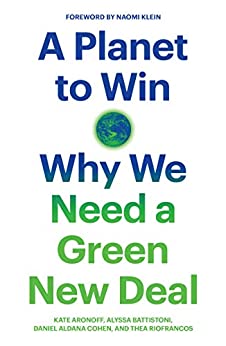
Review - A Planet to Win:Why We Need a Green New Deal

By x344543 - IWW Environmental Union Caucus, May 11, 2023

In spite of this book's straightforward sounding title, A Planet to Win, Why We Need a Green New Deal (Verso, 2019), by Kate Aronoff, Alyssa Battistoni, Daniel Aldana Cohen, and The Riofrancos, this relatively short and concise book would be much more accurately titled, "Why we think our version of the Green New Deal is the best one of the lot," because there isn't a single "Green New Deal", but several, as we have noted here on ecology.iww.org. This, however, is not necessarily a negative aspect of this book.

The authors, all of them ecosocialists with a transformative approach, are quick to explain that the particular Green New Deal they seek is one that addresses most critiques of the Green New Deal in general. 

  • Would the Green New Deal repeat the mistakes of the original New Deal and exclude BIPOC people? Not the authors' version.
  • Would the Green New Deal rely heavily on social democratic Keynesian state intervention? Not the author's version!
  • Would the Green New Deal perpetuate endless growth in hubristic ignorance of the natural limits to growth, not if these authors have any say in the matter;
  • Would the Green New Deal further the continued exploitation by the Global North of the Global South? Not if the authors have anything to do with it!
  • Would the Green New Deal merely be a case of the capitalists saving themselves, with a putatively green branding? Absolutely not, the authors say.

Certainly, if given the choice, that sounds quite good to me. Clearly these authors aren't content with a naive faith that just because something is called a "Green New Deal" it will actually be a good deal.

Bulletin 133: Chilean Labour Voices on the National Lithium Strategy

By Staff - Trade Unions for Energy Democracy, May 9, 2023

Last week, we looked at the Boric administration’s launch of the National Lithium Strategy, the creation of a National Lithium Company, and some initial responses by trade unions. In this bulletin, we’ll highlight clips of interviews from diverse trade union perspectives on the role of the labour movement in the lithium sector. 

Pages

The Fine Print I:

Disclaimer: The views expressed on this site are not the official position of the IWW (or even the IWW’s EUC) unless otherwise indicated and do not necessarily represent the views of anyone but the author’s, nor should it be assumed that any of these authors automatically support the IWW or endorse any of its positions.

Further: the inclusion of a link on our site (other than the link to the main IWW site) does not imply endorsement by or an alliance with the IWW. These sites have been chosen by our members due to their perceived relevance to the IWW EUC and are included here for informational purposes only. If you have any suggestions or comments on any of the links included (or not included) above, please contact us.

The Fine Print II:

Fair Use Notice: The material on this site is provided for educational and informational purposes. It may contain copyrighted material the use of which has not always been specifically authorized by the copyright owner. It is being made available in an effort to advance the understanding of scientific, environmental, economic, social justice and human rights issues etc.

It is believed that this constitutes a 'fair use' of any such copyrighted material as provided for in section 107 of the US Copyright Law. In accordance with Title 17 U.S.C. Section 107, the material on this site is distributed without profit to those who have an interest in using the included information for research and educational purposes. If you wish to use copyrighted material from this site for purposes of your own that go beyond 'fair use', you must obtain permission from the copyright owner. The information on this site does not constitute legal or technical advice.