You are here

fossil fuel capitalism

Pennsylvania’s Bad Bet: Why Shell Didn't Save Appalachia with Plastics

By Nick Messenger, Kathy Hipple, and Anne Keller - Ohio River Valley Institute, January 25, 2024

In November 2022, over ten years after Shell’s first public announcement of site selection for the project, and after five years of construction, Shell Chemical Appalachia Polymers opened its ethane cracker plant in Beaver County, Pennsylvania. The plant, which refines ethane, a natural gas liquid, into plastic pellets used to produce single-use plastics, was heralded as the beginning of a plastics industry renaissance in Appalachia. At least one local economic development organization estimated it would support nearly 600 direct employees and could generate 11,000 jobs in the Pittsburgh area.

Now, just over one year since production officially began, the plant has been mired in problems. The facility exceeded its allotted pollution limits within months of operating and repeated flaring has deepened air quality and health concerns of Beaver County residents. Furthermore, the plant seems to have fallen short so far in generating the economic benefits promised to residents, as Beaver County continues to trail the state across most economic metrics. This poor economic and environmental performance comes despite Shell receiving billions of dollars in state and local tax exemptions that carry an opportunity cost for taxpayers—namely, that alternative uses of the funds could have been used to grow the regional economy in more direct ways, such as to support small businesses, improve workforce development, or develop projects within industries that already have a strong history, complete with supply chains, in the region.

Download a copy of this publication here (PDF).

Workers and the World Unite: Labor in an Ecosocialist Green New Deal

NASA Scientist on how we beat Climate Change "Physics doesn't care about your politics"

DOE’s Regional Hydrogen Hubs: Climate Solution, or Climate Disaster?

Jeremy Brecher on How Labor and Climate Movements Build Power from Below

By Bob Buzzcanco, Scott Parkin, and Jeremey Brecher - Labor Network for Sustainability, January 14, 2023

In the latest Green and Red Podcast, Bob and Scott talk with author, labor historian and activist Jeremy Brecher who’s been engaged at the intersection of labor, the environment, and the climate for decades. Over 50 years ago, Jeremy authored “Strike,” a labor history classic. And then more recently he’s worked at the intersection of the labor and climate movements. We talk with Jeremy about strikes, unions, and union leadership since he first published “Strike;” the recent “Hot Labor Summer” of 2023; the labor-climate movements and much more.

Jeremy Brecher is a writer, historian, and activist who is the author of more than a dozen books on labor and social movements. His works include the labor history classic “Strike” and “Against Doom: A Climate Insurgency Manual.” Jeremy is also a Senior Advisor for the Labor Network for Sustainability.

Big Oil's Dark Money Ad Campaign Exposed

By Staff - Center for Biological Diversity, January 8, 2024

This is an ongoing pillar of the fossil fuel industry’s playbook in California: front groups organized and funded by the oil companies masquerade as “broad coalitions” of concerned citizens and business representatives but are functionally opaque entities with a single mission: furthering the oil and gas industry’s agenda in the state.

Usually organized as 501(c)(4) nonprofits (“social welfare organizations”), such groups are referred to as “dark money” because they’re able to spend money on certain types of campaigns without revealing their donors. Under California law, these types of groups are legally permitted to spend funds on “issue advocacy” campaigns without revealing their donors.

Because these “issue advocacy” campaigns don’t explicitly advocate for or against ballot measures or referenda, millions of dollars can be spent to subtly influence voters without disclosing the true funders behind the messaging campaign. Because of the lack of donor disclosure, we refer to these groups as “dark money groups.”

This report profiles three such groups that have been actively pushing an oil industry ad campaign to promote anti-SB1137 talking points (higher gas prices, losing good jobs, foreign oil); all three track back to the California Independent Petroleum Association (CIPA) and to the Western States Petroleum Association (WSPA), the top lobbyist for the oil industry in the western United States.

Download a copy of this publication here (link).

How Green New Deal from Below Programs Integrate Climate, Jobs, and Justice

By Jeremy Brecher - Labor Network for Sustainability, January 3, 2024

The appeal of the Green New Deal lies in its drawing together the varied needs of diverse constituencies into a common program that realizes them all. Here’s how that works at the sub-national level.

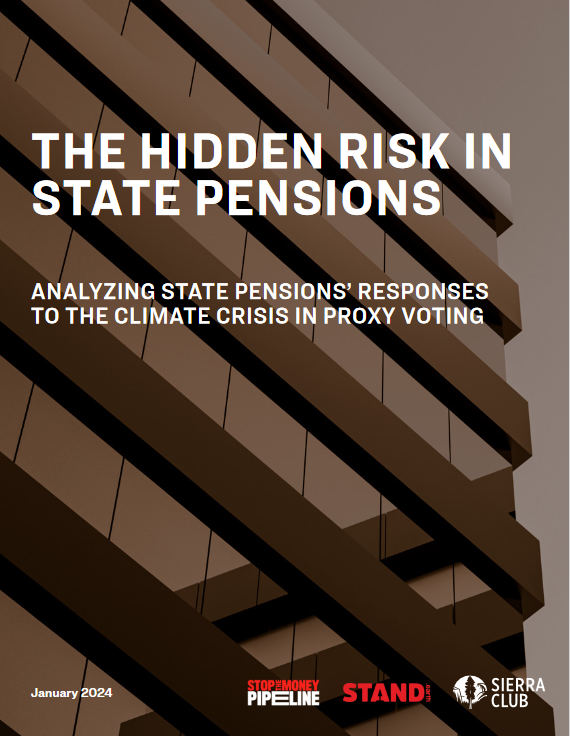
The Hidden Risk in State Pensions: Analyzing state pensions’ responses to the climate crisis in proxy voting

By Jessye Waxman, et. al - Sierra Club, et. al., January 2024

Climate-driven heat waves, droughts, floods, hurricanes, and wildfires are already causing suffering for hundreds of millions of people worldwide. Climate-driven impacts on the economy are already significant: according to one recent peer-reviewed study, the climate crisis inflicted a global economic toll of $16 million an hour in extreme weather damages between 2000 and 2019. Given that these impacts are occurring at only 1.2°C of warming, it’s no wonder that economists, financial institutions, and financial regulators are increasingly worried about the risk that the climate crisis poses to our shared economic prosperity.

“The financial impacts that result from the economic effects of climate change and the transition to a lower carbon economy pose an emerging risk to the safety and soundness of financial institutions and the financial stability of the United States,” concluded the Board of Governors of the Federal Reserve System, the Federal Deposit Insurance Corporation, and the Office of the Comptroller of the Currency in a recent report, making it clear that climate-related financial risks are faced by all financial institutions and the broader economy. As long-term fiduciaries, pension funds should be among the investors most alarmed about the economic risk associated with the climate crisis. Some have taken public strides forward, such as announcing net-zero pledges, investing in climate solutions, or defending the right to invest responsibly. These are critical steps forward. However, as this report shows, the institutions responsible for stewarding trillions of dollars on behalf of the American people are failing to address climate-related financial risk in their proxy voting strategies, a key tool investors have to encourage responsible corporate governance and corporate behavior.

This report analyzes the nineteen state pensions in states where a state financial officer — such as the state treasurer, comptroller, or auditor — has indicated it is a priority issue to advocate for more sustainable, just, and inclusive firms and markets, and protect against climate risk. In addition to the nineteen state pensions, the report includes the five systems managed by the New York City Comptroller, who has also indicated these issues are priorities. These funds included collectively represent over $2 trillion in assets under management (AUM).

Download a copy of this publication here (PDF).

Dying in the Fields as Temperatures Soar

By Liza Gross and Peter Aldhous - Inside Climate News, December 31, 2023

Scores of California farmworkers are dying in the heat in regions with chronically bad air, even in a state with one of the toughest heat standards in the nation.

For most of July 2019, stifling heat hung over the agricultural fields of California’s Central Valley, as farmworkers like William Salas Jiminez labored under the sun’s searing rays. Temperatures had dipped from 99 to 95 degrees Fahrenheit the last day of the month, when the 56-year-old Puerto Rico native was installing irrigation tubing in an almond orchard near Arvin, at the valley’s southern edge. 

Around 1:30 that afternoon Salas sat down to rest. When he stood up to go back to work, he suddenly collapsed. An hour and a half later, he was dead. Reports filed with the U.S. Department of Occupational Health and Safety, or OSHA, say Salas died of a heart attack.

Salas’ death certificate lists atherosclerotic heart disease as the immediate cause of death. But it also lists “extreme heat exposure” and obesity as significant contributors. Both heart disease and obesity increase the risk of fatal heatstroke.

VIIIth International Conference, La Via Campesina: Bogotá Declaration

By staff - La Via Campesina, December 9, 2023

More than 400 delegates of La Via Campesina, representing 185 organizations and movements in 83 countries, together with allies, are gathered in Bogotá, Colombia to celebrate our 8th International Conference from the 1st to the 8th of December of 2023.

We, the peasants, rural workers, landless, indigenous peoples, pastoralists, artisanal fisherfolk, forest dwellers, rural women, youth and diversities and other peoples who work in the countryside around the world and united within La Via Campesina, declare that “Faced with global crises, we build food sovereignty to ensure a future for humanity!” towards a just and decent food system for all, recognizing peoples’ needs, respecting nature, putting people before profit and resisting corporate capture.

The 8th Conference is happening at a time when the Colombian social movements are celebrating a major political victory, the creation of an agrarian jurisdiction, and the constitutional recognition of peasants as political subjects with rights. Our participation in the monitoring and follow-up of the peace agreement in Colombia inspires us as peasants to continue building peace worldwide.

Pages

The Fine Print I:

Disclaimer: The views expressed on this site are not the official position of the IWW (or even the IWW’s EUC) unless otherwise indicated and do not necessarily represent the views of anyone but the author’s, nor should it be assumed that any of these authors automatically support the IWW or endorse any of its positions.

Further: the inclusion of a link on our site (other than the link to the main IWW site) does not imply endorsement by or an alliance with the IWW. These sites have been chosen by our members due to their perceived relevance to the IWW EUC and are included here for informational purposes only. If you have any suggestions or comments on any of the links included (or not included) above, please contact us.

The Fine Print II:

Fair Use Notice: The material on this site is provided for educational and informational purposes. It may contain copyrighted material the use of which has not always been specifically authorized by the copyright owner. It is being made available in an effort to advance the understanding of scientific, environmental, economic, social justice and human rights issues etc.

It is believed that this constitutes a 'fair use' of any such copyrighted material as provided for in section 107 of the US Copyright Law. In accordance with Title 17 U.S.C. Section 107, the material on this site is distributed without profit to those who have an interest in using the included information for research and educational purposes. If you wish to use copyrighted material from this site for purposes of your own that go beyond 'fair use', you must obtain permission from the copyright owner. The information on this site does not constitute legal or technical advice.