You are here
News Feeds
Pokopia, cosy games and the problem of escapism
'Cosy games' have grown in popularity in recent years but can they be more than mere escapism? Dr Stephanie Farnsworth investigates
The post Pokopia, cosy games and the problem of escapism appeared first on Red Pepper.
Friday’s Headlines Slow Down
- Not only is speeding wasteful and dangerous, it only saves the average driver less than a minute off their commute. (Yahoo!)
- The U.S. DOT has removed bike lanes and speed cameras from its list of best practices that have been shown to reduce crashes and save lives. (NPR)
- A long article in tech magazine Noema argues that driverless cars save lives even if most people don’t perceive them as safe.
- People who work from home one day a week drive more than full-time commuters, while those who work from home at least three days a week drive less. (Science Direct)
- A Democratic bill would provide $205 billion over five years for high-speed rail projects. (Streetsblog USA)
- Distracted driving declined 14 percent after Iowa passed a law banning the use of mobile devices while driving. (Government Technology)
- A new depot is essential to the success of Austin’s light rail line. (Metro Magazine)
- Video of police stopping a Black Pennsylvania teen for jaywalking went viral. (Patriot-News)
- The last streetcar bridge in Washington, D.C. will be torn down, allowing the National Park Service to reopen a trail that’s been closed due to falling debris. (WTOP)
- Miami-Dade Mayor Daniella Levine Cava wants to slash bus service and future transit projects to close a budget cap. (Herald; paywall)
- The Milwaukee County Transit System is facing 25 percent bus service cuts. (Urban Milwaukee)
- Bike traffic in Paris increased by 240 percent between 2018 and 2023. (Momentum Mag)
- Some Southeast Asian cities are organized around rivers rather than roads. (Arch Daily)
- Toronto is integrating bikeshare and public transit. (Cities Today)
Investing in Resilience Will Help Farmers Weather the Super El Niño
Meteorologists warn that this year’s El Niño may be one of the strongest on record. As communities around the world brace for more extreme weather events, the International Fund for Agricultural Development (IFAD) is helping farmers build resilience.
Every two to seven years, El Niño causes widespread disruptions around the world, from drought to heavy rains. Past ones “have left economies devastated,” Sara Mbago-Bhunu, Director of East and Southern Africa Division at IFAD, tells Food Tank.
The U.N. agency works with governments and development partners to put prevention measures in place before a crisis hits. Seasonal climate forecasts and early warning systems can inform planning, identify vulnerable areas, and establish preparedness measures.
“All regions really should be willing to prepare for this,” Mbago-Bhunu says. Because El Niño will look different across geographies, mapping helps IFAD understand the likely impacts and how to adapt accordingly.
Ethiopia, northern Uganda, Zambia, and Mozambique, for example, are likely to see less rain during their main growing season. In these regions, water capture technologies must be scaled up. Meanwhile in Tanzania and coastal Kenya—likely to experience higher-than-average rainfall—flood-resistant roads, warehouses, and markets are needed.
Mbago-Bhunu says that governments across the continent understand the importance of building more resilient systems, not only to respond to El Niño, but also to the broader effects of the climate crisis.
“They understand if they don’t invest in their water tables, in their water towers, they will not be able to have productive capacities to feed their populations in the future,” she tells Food Tank. “They also understand that supporting soil fertility might not see immediate gains, but will definitely have future returns.”
But funding for climate adaptation in Africa remains inadequate. “We get a fraction of global funding as it is,” Mbago-Bhunu says. “So [governments] have to mobilize cheaper sources of financing domestically and then…channel those into longer term solutions.”
This approach pays off, Mbago-Bhunu argues. She points to the last El Niño in 2023, which affected more than 1 million Zambian households. Around US$900 was required to provide life-saving aid and early recovery assistance—far more than the cost of preventative measures.
“Investing in resilience is cheaper than responding to disaster.”
Listen to the full conversation with Sara Mbago-Bhunu to hear about the unique vulnerabilities women and girls face from extreme weather events, how IFAD leverages resources from its projects to respond to urgent needs, and what the private sector can do to support farmers and governments.
Articles like the one you just read are made possible through the generosity of Food Tank members. Can we please count on you to be part of our growing movement? Become a member today by clicking here.
Photo courtesy of Richard Nyoni, Unsplash
The post Investing in Resilience Will Help Farmers Weather the Super El Niño appeared first on Food Tank.
Egdon losses rise – annual accounts
The company behind gas plans in North Yorkshire announced losses of more than £4 million in its annual accounts.
Egdon Resources, which has interests in proposals at Burniston, Foxholes and Ebberston South, reported a loss for 2025 after taxation of £4.34m, up from a loss of £3.76m in 2024.
Current assets were down slightly at £26.63m and current liabilities rose from £0.79m in 2024 to £2.57m in 2025.
Egdon is now privately-owned by the Texas-based Heyco Group. The accounts were published by Companies House this week (15 July 2026).
According to the accounts, Egdon paid its directors a total of £455,267. The highest paid received £247,635.
Site newsThe accounts revealed that Egdon had written off £2.105m of value at Biscathorpe in Lincolnshire (PEDL253) after deciding to withdraw from an appeal against refusal of planning permission.
The company also impaired £178,000 of the value of the Keddington oil field in Lincolnshire because plans for the Keddington-6 well were “not an immediate priority for investment”. The net present value of the site had assumed no further action for improvement, the accounts said.
Egdon impaired another £448,000 off the value of the Kirkleatham gas field. It said a low carbon greenhouse was planned next to the Kirkleatham wellsite. If, constructed, Egdon would have to relinquish its easement for a gas pipeline. Based on this, the pre-tax value for the Kirkleatham wellsite was assessed at £0.975m, the accounts said.
The oil and gas licence, PEDL118, which contains the Dukes Wood oil field in Nottinghamshire, had been relinquished during 2025 and the value fully impaired in the accounts.
Egdon also revealed that operations had begun at Avington in Hampshire (PEDL070) to plug and abandon two wells. The value of Egdon’s interest was fully impaired at the end of the financial year (31 December 2025).
Key figuresYear ending 31 December 2025
Loss for the year after taxation: £4.344m (2024: £3.764m)
Turnover: £2.455m (2024: £3.168m)
Admin expenses: £0.875m (2024: £1.082m)
Other operating income: £132,461 (2024: £95,081)
Operating loss: £4.467m (2024: £3.956m)
Current assets: £25.634 (2024: 25.966m)
Current liabilities: £2.574 (2024: £0.794m)
Net assets: £20.615m (2024: 24.959m)
Employees: 9 (2024: 10)
Directors’ remuneration: £455,267 (2024: £521,417)
Highest paid director (excluding employer’s NI and pension contributions): £247,635 (2024: £245,395)
Book value of unconventional assets: £13.5m (2024: £13.2m)
energy B investors back Horse Hill purchase
Shareholders in energy B have approved the company’s plans to acquire the majority stake in the Horse Hill oil site in Surrey.
Horse Hill oil site in Surrey. Source: Google Earth image uploaded 13/05/2026energy B announced last month (12 June 2026) that it had entered into a share purchase agreement with UK Oil & Gas plc (UKOG).
Under the £1m deal, energy B would acquire UKOG’s 77.9% shareholding in Horse Hill Developments Ltd, the Horse Hill operator.
energy B would also buy all of UKOG’s wholly-owned subsidiary UKOG (137/246) Ltd, which has a stake in the Horse Hill licence.
energy B said in a statement that shareholders had approved the acquisition at a general meeting this week (15 June 2026). It said:
“the Company will now continue to work towards satisfying the various conditions precedent to the Acquisition.”
The meeting also approved share subscriptions and the grant of options for three directors. The executive chair, David Lenigas, chief executive Neil Ritson, and director Jonathan Colville will now be able to subscribe for a total of 529,133 new ordinary shares and be granted 4 million options over shares.
NSW community rallies at IPC hearing for state's biggest ever coal proposal
More than 100 Hunter community members rallied as the Independent Planning Commission (IPC) NSW kicked off public hearings on the Hunter Valley Operations (HVO) Continuation Project, the largest coal project ever proposed in New South Wales.
Food Tank Explains: Food Loss and Waste
This article is part of Food Tank’s primer series, “Food Tank Explains.” Each installment unpacks the ideas, innovations, and challenges shaping today’s food and agriculture systems, offering clear insights into complex topics. To explore more articles in the series, click here.
One-third of food produced for human consumption is lost or wasted, according to the World Food Programme (WFP). Food loss occurs when food is damaged or spoiled before it reaches retailers or eaters; food waste refers to edible food that retailers or consumers discard.
Food loss and waste (FLW) undermines food security, generates substantial greenhouse gas (GHG) emissions, deplete land, water, and other natural resources, and impose significant costs on the global economy.
But certain researchers, governments, food waste nonprofits, and international organizations agree that much of FLW is interconnected and preventable, making FLW reduction a key strategy for addressing environmental, economic, and food security challenges simultaneously.
Food loss typically occurs before food reaches the retail stage—during harvesting, processing, and transportation. Limited access to storage facilities, refrigeration, and infrastructure can increase rates of food loss. Sometimes food loss is also a symptom of deeper political challenges tied to global trade says Moses Kansanga, Associate Professor of Geography and International Affairs at George Washington University.
Food waste occurs after food reaches retailers and consumers. It typically refers to food that is suitable for consumption but discarded, because of overproduction, cosmetic standards, over-purchasing, improper storage, or confusion over expiration labels.
According to the U.N. Food and Agriculture Organization (FAO), 13 percent of food produced globally is lost between harvest and retail. The United Nations Environment Programme (UNEP) estimates that an additional 19 percent of food is wasted at the retail, food service, and household levels.
High income countries generally waste more food per capita. The U.S. Food and Drug Administration estimates that 30 to 40 percent of the nation’s food supply is wasted. ReFED estimates that U.S. retailers generated 4.6 million tons of surplus food in one year, nearly one-third of which went to landfills or incinerators despite donation and recycling efforts.
And tragically, food loss and waste persist alongside global hunger. In 2022, 783 million people experienced hunger while more than 1 billion tons of food was wasted.
WWF estimates that the food lost and wasted each year could feed the world’s undernourished population nearly four times over. “Food waste is a global tragedy,” says Inger Andersen, Executive Director of UNEP. “Millions will go hungry today as food is wasted across the world.”
Luiz Beling, CEO of Apeel, emphasizes that FLW is a major contributor to global GHG emissions. Producing of food that is never eaten causes 8 to 10 percent of annual GHG emissions, nearly five times the emissions produced by the global airline sector. It uses one-third of the world’s arable land and one-quarter of agricultural water, placing unnecessary pressure on soils, forests, grasslands, and biodiversity.
Discarded food continues to affect the climate after it is thrown away. According to the U.S. Environmental Protection Agency, food contributes to nearly 60 percent of landfill methane emissions.
And, the United Nations Framework Convention on Climate Change estimates that food loss and waste cost the global economy approximately US$1 trillion annually.
Organizations and experts increasingly see FLW reduction as a powerful solution to multiple interconnected problems. Project Drawdown has described FLW reduction as a massive lever for change. According to the organization, reducing FLW can improve food security and conserve natural resources while reducing emissions and lowering costs.
Hongpeng Lei, Chief of the Mitigation Branch in the Climate Change Division at UNEP, explains, “Reducing food waste is a fast, cost-effective way to cut GHG emissions while boosting food security, saving households and businesses money, and easing pressure on land and water.” Dana Gunders, President of ReFED, describes reducing food waste as “like a Swiss Army knife.”
Because food loss and food waste occur at different stages of the food supply chain, they require different solutions. Reducing food loss often depends on investments in harvesting, storage, refrigeration, transportation, and food processing. WFP has helped reduce post-harvest grain losses by supporting the use of hermetic storage bags, moisture meters, and improved drying systems.
Reducing food waste often focuses on improving inventory management, expanding food donation programs, strengthening demand forecasting, helping consumers interpret food date labels, and encouraging meal planning, proper food storage, and the use of leftovers.
While improvements in infrastructure and technology are welcome, technical solutions alone cannot eliminate food loss, Kansanga says. He argues that reducing post-harvest losses also requires addressing the political and structural conditions that shape agricultural markets, including inequitable trade relationships that can undermine local producers.
Efforts to reduce food loss and waste are gaining momentum around the world. The United Nations established a global target to reduce FLW through Sustainable Development Goal 12.3, while UNEP and FAO now publish standardized indices that allow countries to measure food waste and food loss over time. In the United States, ReFED estimates that total surplus food fell by 2.2 percent between 2023 and 2024, driven in part by a 950,000-ton reduction in residential food waste.
Articles like the one you just read are made possible through the generosity of Food Tank members. Can we please count on you to be part of our growing movement? Become a member today by clicking here.
Photo courtesy of Wikimedia
The post Food Tank Explains: Food Loss and Waste appeared first on Food Tank.
NSW approves 11th coal project in a row ahead of decision on state’s largest ever coal proposal
The NSW government has approved its 11th coal project since the 2023 election, ignoring warnings from its independent advisory body that further coal projects are incompatible with a safe climate.
Flood-impacted North Brisbane residents deliver climate damage bill to BHP
Residents from the flood-impacted Northern Brisbane suburbs delivered a giant climate damage bill to BHP today, after a community survey showed overwhelming support for major polluters to help pay the costs of climate-fuelled disasters.
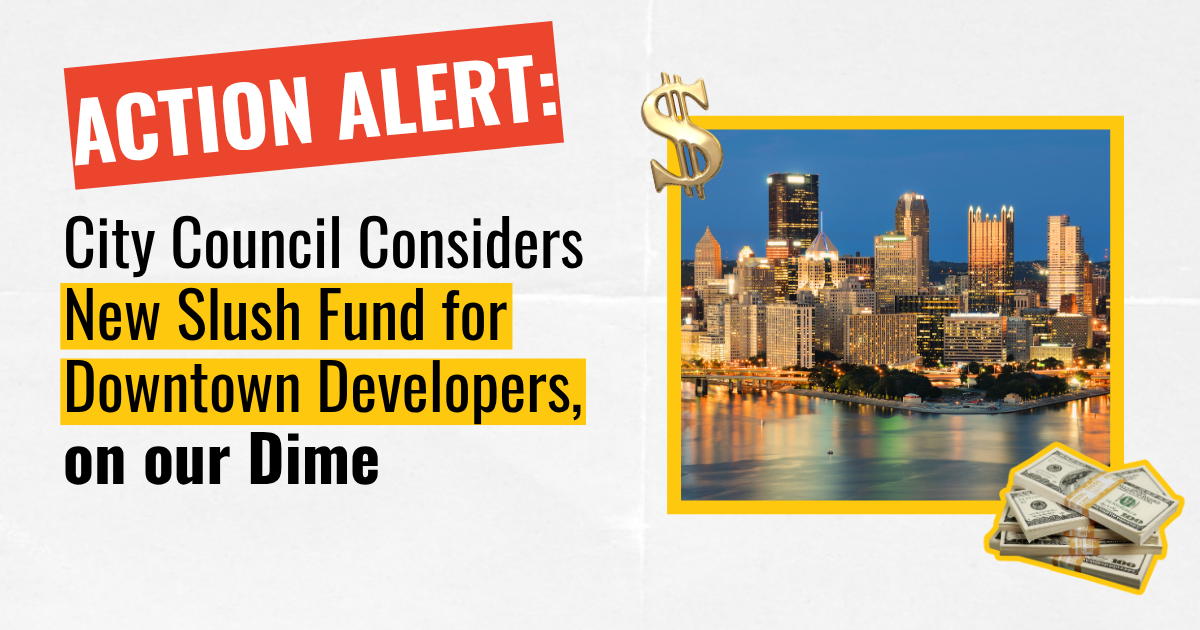
ACTION ALERT: Pittsburgh City Council Considers New Slush Fund for Downtown Developers—on our Dime
Developers are asking Pittsburgh City Council to vote on another major tax giveaway scheme – giving up to $200 million dollars to a handful of Downtown private real estate companies, without any requirements around public benefit. This vote to implement the Downtown Transit Revitalization Improvement District (TRID) will divert tax revenue from the Strip District, Downtown and the North Shore for the next 40 (!) years into the coffers of private corporations.
Right now, when working people and our public agencies are struggling to make ends meet, Pittsburgh City Council is being asked (via the Urban Redevelopment Authority) to hand the Golden Triangle yet another golden ticket.
Take Action: Tell Council to fund neighborhoods, not developers What is the TRID proposal?A TRID is a type of legislation intended to fund transit improvements—but this one won’t do that. Instead, here’s how this proposal would work:
- The City (i.e., taxpayers) would initially borrow $50 million to invest exclusively in the TRID area: the Strip District, parts of the North Shore, and Downtown. This money would effectively be a grant paid to wealthy developers, with the City gambling on future tax revenue to pay down the debt.
- Many Downtown developers are concurrently challenging their commercial property assessments, so that they could pay lower taxes in the future.
- Many Downtown developers are concurrently challenging their commercial property assessments, so that they could pay lower taxes in the future.
- Only 20% of this money would be invested in public infrastructure—but they’ve not named any particular public projects that would benefit. By contrast, the remaining 80% has been earmarked for specific, private, for-profit real estate developers.
- All future public tax dollars from Downtown, the Strip District, and the North Shore for the next 40 years would be diverted to a “Golden Triangle Reinvestment Fund”, exclusively financing development in a small pocket of Downtown. This fund would be controlled by the non-elected Urban Redevelopment Agency (URA)—not City Council, a public body that is accountable to the public.
Members of Pittsburgh City Council and the Mayor’s administration have said that we are facing a massive City budget crisis. So why are they fast-tracking a $200 million handout to Downtown developers, with almost no public process?
What’s at stakeWe have already given almost a billion dollars to Downtown developers in tax breaks over the past 5 years. Enough is enough.
Our communities deserve so much more: public transit infrastructure, affordable housing, local food initiatives, street and sidewalk repairs, childcare programs and more. These are critical investments for the well-being of our City—and we cannot fund them if our City Councilmembers signs away millions in tax dollars to private developers for the next four decades.
Transit riders must tell our elected officials to vote NO on implementing the Downtown Transit Revitalization Investment District (TRID). Public dollars – whether borrowed or generated from tax revenue – should be invested across all communities – from Fairywood to Fineview, Brookline to Bloomfield. Our resources should be allocated through the annual City budgeting process, with robust public input to ensure that our tax resources are distributed equitably and address the needs of the moment.
We say: no more handouts to Downtown corporations until our neighborhoods, our small businesses, our workers and our students are given their fair share!
Take Action NowAfter you send a letter, CALL your City Councilmember to urge them to vote NO (find your councilmember here):
- District 1 (Northside, Strip District, Parts of Downtown):
Bobby Wilson (412) 255-2135 - District 2 (West End, Sheraden, Elliott, Banksville):
Kim Salinetro (412) 255-8963 - District 3 (Oakland, Southside, Arlington, Allentown):
Bob Charland (412) 255-2130 - District 4 (Beechview, Brookline, Carrick, Overbrook):
Anthony Coghill (412) 255-2131 - District 5 (Greenfield, Hazelwood, Lincoln Pl, Swisshelm Park):
Barb Warwick (412) 255-8965 - District 6 (Manchester, Downtown, The Hill, Uptown, Perry Hilltop):
Danielle Lavelle (412) 255-2134 - District 7 (Bloomfield, Lawrenceville, Polish Hill, Stanton Heights) :
Deb Gross (412) 255-2140 - District 8 (Squirrel Hill, Shadyside, Oakland):
Erika Strassburger (412) 255-2133 - District 9 (East Liberty, Larimer, Homewood, Garfield):
Khari Mosley (412) 255-2137
The post ACTION ALERT: Pittsburgh City Council Considers New Slush Fund for Downtown Developers—on our Dime appeared first on Pittsburghers for Public Transit.
NSW government’s delay on transition bill leaves coal workers exposed
A Hunter Valley community group is calling on the NSW Government to expedite its own draft legislation to impose workforce support obligations on the owners of closing coal mines, as 300 workers at the Ashton mine this week learned they will lose their jobs in the next 18 months.
Queenslanders could be left to pay for mine clean-up if Crisafulli weakens safeguards
Queenslanders could be left to pay for mine clean-ups if the Queensland government uses its review of the Financial Provisioning Scheme to weaken safeguards that ensure mines pay for rehabilitation.
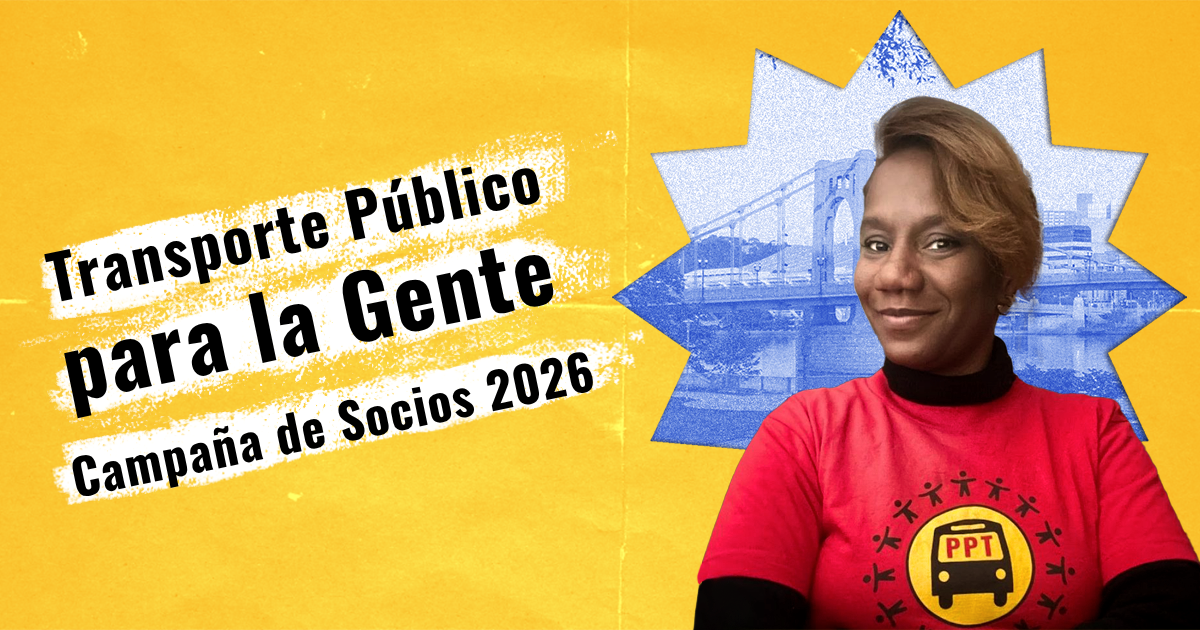
Transporte Público para la Gente: Únete a la campaña de Socios 2026
Me llamo Evelyn Ulysse Alcántara. Uso el transporte público a diario para ir al trabajo, al médico, actividades de ocio, reuniones, llevar a mi hijo al colegio— para todo.
Soy latina y mi inglés no es perfecto, así que cuando me mudé a Pittsburgh me costó usar el transporte público porque había muy poca información disponible en español. Por eso me ofrecí de voluntaria para ayudar como embajadora en los Recorridos de tránsito de PPT. Fue muy frustrante y aislante intentar aprender a usar el sistema de transporte público por mi cuenta. Sabía que si podía hacer algo para apoyar el aprendizaje de mi comunidad, ¡tenía que hacerlo!
Ser miembro de PPT no solo ha mejorado mis propias necesidades de transporte. Me abrió la puerta para ayudarme a marcar la diferencia.
Cuando hubo recortes en el transporte público en Beechview, hubo ocasiones en que el autobús o el Tren no venían—y no sabía la razón, porque los cambios sólo se comunicaban en inglés. Pero hoy, si vas a Steel Plaza o Wood Street Station, ¡escucharás anuncios en español! Y hay instrucciones paso a paso en español en la web de PRT. Esto se debe a que PPT y Casa San José se unieron para dar voz a mi comunidad, para que PRT pudiera entender el verdadero impacto que esto estaba teniendo en nosotros.
Este es el verdadero poder de PPT: realmente escuchan a la gente.
Cuando descubrí que PPT, me pedían testimonios sobre el papel que tiene el transporte público en la vida de las personas, para mostrar lo importante que sería un programa de media tarifa. Sabía que tenía que dar mi testimonio, porque necesitábamos actuar para mejorar el acceso. En aquel entonces solo era una idea y un proyecto, pero hoy es una realidad que lleva el servicio de transporte a la gente.
Me encanta el PPT porque sé de primera mano lo que podemos lograr juntos.
Solo en 2026:
- Llevamos a 120 miembros a Harrisburg para arrojar luz sobre la brecha presupuestaria de 80 millones de dólares y enfatizar la importancia de los servicios para tránsito y viajes compartidos para nuestros representantes.
- Compartimos habilidades y construimos poder con 170 personas de todo el país, compartimos habilidades y construyeron poder en nuestro Entrenamiento de Primavera 2026.
- Formamos a 13 becarios de organización comunitaria en toda la colina del barrio de PGH, y las regiones de Lancaster y Lehigh Valley en Pensilvania.
Por eso quería preguntar: ¿apoyarán el trabajo urgente de PPT haciéndote miembro que paga cuotas hoy?
Puedes apuntarte por solo 2,75 $, ¡el precio actual del billete de autobús del PRT! Ese dinero va directamente a la defensa de un presupuesto de transporte que mueve a TODOS los habitantes de Pensilvania. Todo el mundo merece acceso al transporte público.
¿Nos ayudarás a hacer realidad ese sueño?
The post Transporte Público para la Gente: Únete a la campaña de Socios 2026 appeared first on Pittsburghers for Public Transit.
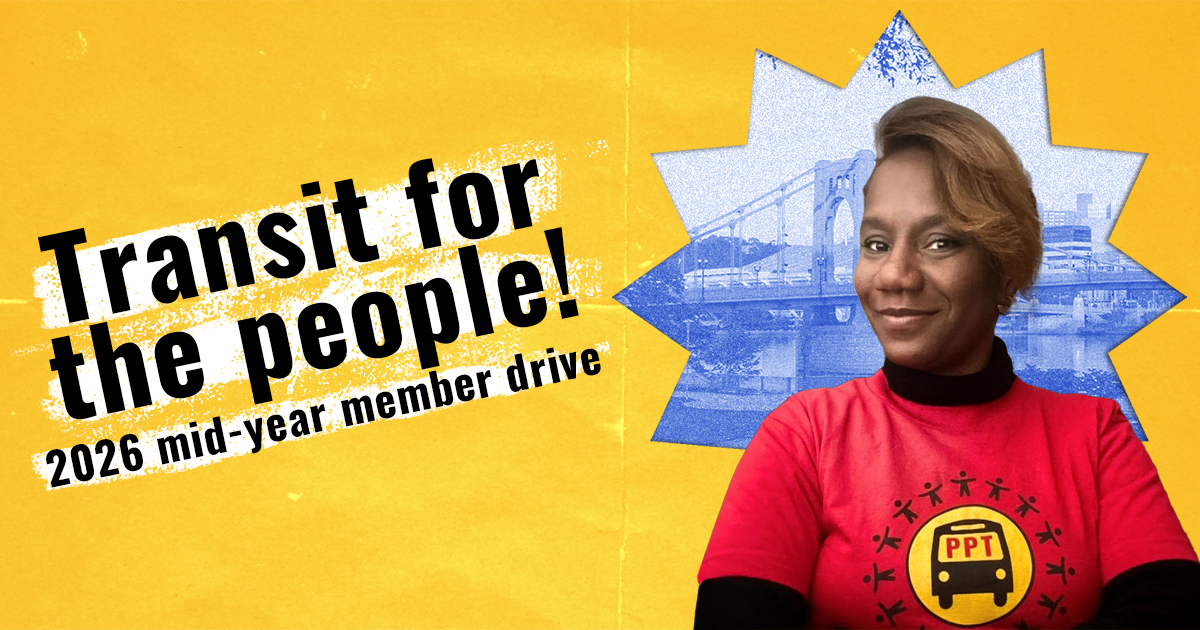
Transit for the People: Join the 2026 Member Drive
Image Description: Evelyn Ulysse Alcantara, a dark-skinned woman in a red PPT shirt, smiles in front of a collaged picture of Pittsburgh
I’m a mother and member of the Latino community fighting with PPT for a transit system that truly serves everyone. Will you join me by becoming a dues-paying member? Donate to become a PPT member!My name is Evelyn Ulysse Alcantara. I use public transportation daily for going to work, the doctor, leisure activities, meetings, bringing my son to school—everything.
I’m Latina and my English isn’t perfect, so when I first moved to Pittsburgh I struggled to use public transportation because there was so little information available in Spanish. This is why I volunteered to help be an ambassador for PPT’s Transit Tours. It was so frustrating and isolating to try and learn how to use the system by myself. I knew that if I could do something to support my community’s learning, I had to do it!
Being a PPT member hasn’t just improved my own transit needs. It opened the door to help me make a difference.
When there were cuts to transit in Beechview, there were times the bus or T didn’t come—and I didn’t know why because the changes were only communicated in English. But today, if you go to Steel Plaza or Wood Street Station, you’ll hear announcements in Spanish! And there are step by step instructions in Spanish on PRT’s website. This is because PPT and Casa San Jose came together to uplift my community’s voice, so that PRT could understand the true impact this was having on us.
This is PPT’s real power: they truly listen to the people.
When I first found out about PPT, they were asking for testimonies about the role transit has in people’s lives, to show how important a half-fare program would be. I knew I had to give my testimony, because we needed to take action to improve access. Back then it was just an idea, but today it’s a reality that brings transit service to the people!
I love PPT because I know firsthand what we can accomplish together.
In 2026 alone, we have:
- We brought 120 members to Harrisburg to shed light on the $80 million dollar transit budget gap, and emphasise the importance of paratransit and shared ride services to our representatives.
- We trained 13 community organizing fellows across the Hilltop neighborhood of PGH, and the Lancaster and Lehigh Valley regions of PA.
- Shared skills and built power with 170 people from across the country at our 2026 Spring Training.
That’s why I wanted to ask: will you support PPT’s urgent work by becoming a dues-paying member today?
You can join for just $2.75—the current cost of a PRT bus fare! That money goes directly towards advocacy for a transit budget that moves ALL Pennsylvanians. Everyone deserves access to public transportation. Will you help us make that dream a reality?
Donate now to join Evelyn as a member—and build transit for the people!The post Transit for the People: Join the 2026 Member Drive appeared first on Pittsburghers for Public Transit.
Breaking down how much Congress cut AML funds by state
In January Congress passed a “minibus” bill that raided $500 million in previously appropriated coal mine cleanup funds to pay for other federal programs. We’re now seeing the first results of that bill: $45.5 million less in mine cleanup funding every year for the next 11 years. Combined with growing inflation, this means fewer jobs will be supported cleaning up mines and more hazardous coal mining damage won’t be reclaimed in Appalachia and across the country.
When it passed in 2021, the Bipartisan Infrastructure Law provided about $10.9 billion for the reclamation of Abandoned Mine Land (AML) sites across the country in fifteen annual grants to states and tribes. The first four years’ worth of grants were awarded between 2022-2025. The minibus bill cuts $500 million from the total AML funding provided under the Bipartisan Infrastructure Law – but it was unclear at the time of passage if the $500 million would be cut entirely from the last (fifteenth) year of AML grants or equally across the remaining 11 years worth of annual funding. Now we have our answer.
The 2026 AML grants for states and tribes were announced in May and the cuts are here. According to the Office of Surface Mining Reclamation and Enforcement, the $500 million cut “will be applied equally to the remaining 11 grant distribution years, approximately $45.45 million per year.” The figure below shows the annual reduction in funds for each state and tribe, as well as the total cuts that will play out over the next 11 years. Pennsylvania and West Virginia have the largest cuts (by absolute value), at about $15 million and $9 million per year, respectively.
(function(){function e(){window.addEventListener(`message`,function(e){if(e.data[`datawrapper-height`]!==void 0){var t=document.querySelectorAll(`iframe`);for(var n in e.data[`datawrapper-height`])for(var r=0,i;i=t[r];r++)if(i.contentWindow===e.source){var a=e.data[`datawrapper-height`][n]+`px`;i.style.height=a}}})}e()})();
The cuts are reducing the amount of damage states and tribes can reclaim. Inflation – especially recent rises in fuel costs that can drive up the cost of operating construction equipment – is also lowering the spending power of reclamation dollars even from last year, further reducing the amount of reclamation states and tribes can accomplish in 2026.
States and tribes have a five-year window to spend their FY2026 AML grant, and those agencies will now begin planning for fewer dollars by taking steps like selecting fewer reclamation projects or reducing the scope of projects. In Pennsylvania, for example, the cuts are equivalent to the cost of two large abandoned mine drainage treatment systems.
As we explained in a previous post, the extent of AML damage that needs to be cleaned up is likely twice as large as the existing $10.9 billion in funding– even before $500 million was cut.
This is damage to land and water that has lingered since at least the 1970s, and now residents will have to wait even longer for cleanup. If this cut hadn’t occurred, $45 million per year in more mine cleanup would be put to use across the country in the next few years, removing hazards to the local population and supporting more jobs, such as in construction, doing reclamation work primarily in rural areas. Congress should reverse the $500 million reduction, and should protect the program from similar cuts in the future.
The post Breaking down how much Congress cut AML funds by state appeared first on Ohio River Valley Institute.
June 6, 2026 Read new San Francisco Gate story: US Navy finds radiological material in unauthorized storage in San Francisco
June 6, 2026
Read new San Francisco Gate story:
“US Navy finds radiological material in unauthorized storage in San Francisco”
June 2026: Bayview Hunters Point Community Call to Action and Demands issued by Greenaction and the Marie Harrison Community Foundation, Inc.
June 2026:
Bayview Hunters Point Community Call to Action and Demands issued by Greenaction and the Marie Harrison Community Foundation, Inc.
June 24th noon rally at San Francisco City Hall to support community demands for health, justice, and full cleanup of all contamination at the Hunters Point Naval Shipyard Superfund Site.
Statement on ACT NOW Clean Tech Initiative
FOR IMMEDIATE RELEASE
June 4, 2026
Statement on ACT NOW Clean Tech Initiative
ALLEGHENY COUNTY, Pa. — On June 4, Allegheny County Executive Sara Innamorato signed the Advancing Clean Technology for Neighborhood and Next-Generation Opportunity and Workforce (ACT NOW) Executive Order. In response, Ohio River Valley Institute Industrial Decarbonization Program Manager Justine Hackimer issued the following statement:
Clean technology and advanced manufacturing present a generational opportunity to strengthen Allegheny County’s economy, create high-quality jobs, and build on our region’s long history of industrial innovation.
For generations, southwestern Pennsylvania’s workers, manufacturers, and research institutions helped power economic growth across the country. As global markets increasingly demand cleaner technologies, our region is well-positioned to compete for the industries that will shape the next generation of manufacturing.
But realizing that opportunity requires more than individual projects. It takes coordination and smart policy like ACT NOW to ensure workers and local communities directly benefit from investments. We applaud County Executive Sara Innamorato’s leadership in shaping a clean tech future that works for all Pennsylvanians.
By investing in the industries of tomorrow while strengthening the systems that support workers and communities, the region can build a more diverse, resilient economy that creates opportunities for generations to come.
###
The post Statement on ACT NOW Clean Tech Initiative appeared first on Ohio River Valley Institute.
It’s Time for a Progressive Policy to Protect Agricultural Supply Chains
From remunicipalisation to the democracy of the commons
By Vanessa Mascia Turri
Naples became one of Europe’s most ambitious experiments in democratic water governance after Italy’s 2011 referendum against water privatisation. Yet bringing water back into public hands did not necessarily redistribute power over how water itself would be governed.
In 2011, after the Italian referendum against water privatisation, Naples became one of the most ambitious experiments in remunicipalised water governance in Europe. The city transformed its water utility into ABC Napoli (Acqua Bene Comune Napoli), a publicly owned entity presented not simply as a return to public management, but as an attempt to implement the “democracy of the commons” theorised by the Italian Forum of Water Movements.
Within this perspective, water was understood not only as a public service, but as a common good whose governance should involve the direct participation of citizens and social movements.
Over the following decade, Naples became a testing ground for a broader political question that has emerged across many remunicipalisation struggles: what happens when the language and practices of the commons enter public institutions? The Neapolitan experience shows that bringing water back into public hands does not automatically democratise its governance. Instead, participation became continuously negotiated and reshaped through political conflict, financial pressures and struggles over who should control public resources.
From water struggles to the democracy of the commonsSince the early 2000s, struggles against water privatisation have connected local mobilisations to broader debates around the commons. Struggles against water privatisation in Europe have often gone beyond opposition to market reforms and increasingly connected demands for public ownership with broader claims around the commons and direct democracy, as explored throughout the Reimagining, remembering and reclaiming water series. In many countries, water movements have challenged not only privatisation, but also the idea that essential services should be governed through technocratic and top-down forms of management, increasingly linking water struggles to broader claims around the commons and direct democracy, as discussed in Transforming capitalism? The role of the commons and direct democracy in struggles against water privatisation in Europe.
In Italy, these debates converged in the Italian Forum of Water Movements, one of the broadest water movements in Europe. As broader discussions around the commons in Italy have shown, these debates extended well beyond water itself and raised wider questions about collective resources, democracy and institutional change. Under the slogan “si scrive acqua, si legge democrazia” (“it is written water, it is read democracy”), the movement argued that remunicipalisation should involve not only public ownership, but also direct civic participation in water governance.
Naples became the most ambitious attempt to translate this political vision into institutional practice.
Poster from the 2011 Italian referendum campaign against water privatization reading “Water is not for sale.” Image courtesy of the Forum Italiano dei Movimenti per l’Acqua.
Naples became the most ambitious attempt to translate this political vision into institutional practice.
Yet public and academic debates on remunicipalisation have often focused on privatisation conflicts and legal transitions, paying far less attention to what happens afterwards. How are participatory mechanisms actually organised inside remunicipalised utilities? How much power are institutions willing to share with social movements and citizens once remunicipalisation has taken place?
My article From theory to practice: evaluating civic participation in Naples’ remunicipalised water service examines these questions through the case of ABC Napoli, reconstructing how participation was progressively organised, contested and reshaped during the decade following remunicipalisation.
Participation and the limits of the commonsAt the moment of remunicipalisation, Naples faced deteriorated infrastructures, chronic underinvestment and a massive municipal public debt. For many activists of the Neapolitan water movement, remunicipalisation was therefore not only about public ownership, but also about transforming the priorities of water governance through ecological restoration, infrastructural investment and more equitable access to water.
Over the following decade, ABC Napoli experimented with different forms of civic participation. Initially, the municipal government opened the board of directors to representatives linked to the Italian Forum of Water Movements and to environmental associations. Yet local activists who had led the mobilisation against privatisation were largely excluded from these arrangements, generating immediate tensions over who had the legitimacy to participate in the governance of the utility.
The most ambitious participatory experiment emerged with the creation of the Civic Council, a public assembly open to citizens, activists and ABC workers. Meetings were held directly inside the company and addressed issues such as tariffs, infrastructure maintenance, hiring policies and investment priorities. Delegates from the assemblies also participated in discussions with the board of directors, creating one of the most advanced attempts in Europe to institutionalise direct civic participation inside a remunicipalised water utility.
However, participation became far more conflictual once these assemblies started intervening in concrete political and economic questions. Members of the Civic Council promoted long-term infrastructural investments and the recruitment of specialised personnel while defending the financial stability of the utility. According to several interviewees, these priorities increasingly clashed with those of the municipal government, which was more focused on short-term employment policies and the management of public-sector jobs within a broader context marked by debt, unemployment and political pressures surrounding public employment.
These tensions ultimately led to the removal of the board of directors and to the progressive weakening of participatory governance. In the following years, participation increasingly shifted towards weak consultative mechanisms with limited influence over decision-making processes. Many activists gradually distanced themselves from the experiment, while severe financial constraints continued to limit investments in infrastructures and ecological renewal.
Rather than evolving towards deeper forms of democratic governance, the Neapolitan experience progressively revealed the difficulties of institutionalising the “democracy of the commons” within existing municipal structures and political priorities.
Remunicipalisation without democratisation?Poster from the Italian public water movement following the 2011 referendum campaign, emphasising water as a public right rather than a source of profit. Image courtesy of the Forum Italiano dei Movimenti per l’Acqua.
The experience of ABC Napoli complicates many celebratory narratives surrounding remunicipalisation. Bringing water back into public hands did not automatically redistribute power inside public governance. On the contrary, the Neapolitan case shows how quickly the language of the commons can become absorbed into existing institutional structures once participation starts challenging concrete political and economic interests.
The weakening of participatory governance inside ABC Napoli did not result from a lack of civic mobilisation or technical expertise. Quite the opposite: activists involved in the water movement developed increasingly detailed proposals on tariffs, infrastructures and long-term investments, becoming capable of intervening directly in the governance of the utility. Participation became problematic precisely when it stopped being symbolic and started questioning how public resources, infrastructures and employment should be managed.
In Naples, these tensions unfolded within a broader context marked by public debt, deteriorated infrastructures, unemployment and long-standing systems of political mediation surrounding public-sector employment. Under these conditions, the “democracy of the commons” increasingly collided with the political and administrative logics shaping municipal governance.
More broadly, the Neapolitan experience suggests that remunicipalisation alone cannot democratise essential services without a real willingness from public institutions to share decision-making power. Commons become politically difficult when they move beyond participation as consultation and start demanding participation as co-governance.
Rather than offering a linear model of democratic transformation, Naples reveals the unresolved tensions that emerge when social movements attempt to institutionalise the commons inside existing state structures. The question, then, is not simply whether remunicipalisation is possible, but whether public institutions are truly willing to democratise the power through which public resources are governed.
—
Featured image: Protest sign reading “Public water, public management. Clear?” during a demonstration of the Italian water movement. Photo courtesy of the Forum Italiano dei Movimenti per l’Acqua (acquabenecomune.org).
The post From remunicipalisation to the democracy of the commons appeared first on Undisciplined Environments.
Pages
The Fine Print I:
Disclaimer: The views expressed on this site are not the official position of the IWW (or even the IWW’s EUC) unless otherwise indicated and do not necessarily represent the views of anyone but the author’s, nor should it be assumed that any of these authors automatically support the IWW or endorse any of its positions.
Further: the inclusion of a link on our site (other than the link to the main IWW site) does not imply endorsement by or an alliance with the IWW. These sites have been chosen by our members due to their perceived relevance to the IWW EUC and are included here for informational purposes only. If you have any suggestions or comments on any of the links included (or not included) above, please contact us.
The Fine Print II:
Fair Use Notice: The material on this site is provided for educational and informational purposes. It may contain copyrighted material the use of which has not always been specifically authorized by the copyright owner. It is being made available in an effort to advance the understanding of scientific, environmental, economic, social justice and human rights issues etc.
It is believed that this constitutes a 'fair use' of any such copyrighted material as provided for in section 107 of the US Copyright Law. In accordance with Title 17 U.S.C. Section 107, the material on this site is distributed without profit to those who have an interest in using the included information for research and educational purposes. If you wish to use copyrighted material from this site for purposes of your own that go beyond 'fair use', you must obtain permission from the copyright owner. The information on this site does not constitute legal or technical advice.
 This site is not the official webpage of the Industrial Workers of the World.