You are here

Pete Kayes

Earth First! in Northern California – Interview with Judi Bari

By Douglas Bevington, Summer 1993 – reprinted in The Struggle for Ecological Democracy

Douglas Bevington: Please describe the region in which you are organizing and that region’s key players. How far do your activities and influence extend?

Judi Bari: The area is the northern California redwood region, which at this point is mostly Mendocino and Humboldt counties. It’s a big, sprawling area, rugged and sparsely populated. There are only 80,000 people in Mendocino County, where I live, and there are no large towns, no urban centers. Humboldt is a little different because they have a university, Humboldt State, and a large town, Eureka. Both counties are rural impoverished areas. Our county governments are broke. They are closing down libraries and cutting back on police. Because of this, and because of the lack of urban influence, there is kind of a “wild West” mentality. There are some towns—Whitethorn and Covelo come to mind—that are virtually lawless areas, over two hours’ drive from the nearest sheriff’s deputy.

There are three main corporations in the redwood region. Louisiana Pacific (L-P) is the biggest redwood landowner, with 500,000 acres spread over the entire area. Tied for second are Georgia-Pacific (G-P), which owns 200,000 acres in Mendocino County, and MAXXAM, which owns 200,000 acres in Humboldt.
L-P has been around since 1975, and they’ve been liquidating ever since they’ve been here. Last year, they even admitted that 90 percent of their marketable trees in this county have already been cut. They are a cut-and-run company and they are almost done. G-P has been here a little longer. G-P has just one big sawmill and it’s still running. But most of their timberlands have been clearcut. They are about 70 percent done, so it’s just a matter of time.

MAXXAM is probably the best known of the three companies, mostly because of its outrageous financial practices. The 200,000 acres now owned by MAXXAM used to be owned by Pacific Lumber Co. (PALCO), a 120-year-old locally owned company, one of the oldest in the area. PALCO didn’t clearcut, and they had the closest thing to sustainable logging practices around. Because of this, they have the most old growth left. They have the best of what is left in the world. But in 1986, MAXXAM Chairman Charles Hurwitz, a corporate raider from Texas, took over PALCO in a forced junk bond buyout scheme and then tripled the cut of old-growth redwood to pay off their junk bonds. This area has had pretty much a singular economy based on timber. Many of the logging families here go back five generations. Everybody knows each other, everybody grew up together and often are related to each other. It’s hard to understand the phenomenon of the company town until you live in one. King Timber controls all aspects of the society—the jobs, the schools, the hospital, the newspaper, and the police.

This singular economy and isolated rural culture got interrupted around 1970, when the back-to-the-land hippies moved in with their politically sophisticated, radical urban culture. What the hippies do for a living is grow the best marijuana in the world. In the mid-1980s, they actually included marijuana in the agricultural report of Mendocino County and found that it was the biggest cash crop, bigger than timber. This gives people a way to live in this area without being economically dependent on timber. Because timber is such a fluctuating market of booms and busts, during the low periods it is the marijuana money that keeps the towns going. Garberville, in southern Humboldt County, is probably the best-known local town built up with marijuana money. Many early growers used their money to open “legitimate” businesses. As the hippies gained economic influence, they also gained political influence, including passing voter referendums on local issues and electing candidates to the Board of Supervisors.

So, we basically have a bipolar social situation, with the hippies and the loggers. Of course, there are other social/cultural groups in our community, including Mexicans, Indians, fishermen, etc. But the main players in the Timber Wars are the hippies, the loggers, and, of course, the big timber corporations.

Minutes of the founding meeting of IWW Local #1

Recorded by Judi Bari, x332349, November 19, 1989

The Mendocino-Humboldt General Membership Branch of the IWW held our first meeting on Sunday November 19, 1989. Fourteen (out of 24) members came.

Structure

We set up our basic structure as follows: Judi Bari was elected Corresponding Secretary and Anna Marie Stenberg was elected Financial Secretary. They were instructed to open a bank account and keep track of dues and other paperwork. Other than these utilitarian positions, we will have no officers. Decisions will be made by the members at the meetings. If events occur between meetings that require action, temporary decisions (subject to ratification at the next meeting) will be made by the Entertainment Committee. Membership on the Entertainment Committee is voluntary, and the people who volunteered were Mike Koepf, Treva VandenBosch, Judi Bari, Anna Marie Stenberg, Pete Kayes, and Bob Cooper.

Work So Far

The work of Our Branch was described: We are a General Membership Branch (GMB) and will take on whatever issues the members want, especially issues related to our workplaces. But so far our activities have been centered around providing support for timber workers who are fighting their employers’ destruction of forests, jobs, and working conditions. We hope to be a bridge between environmentalists and timber workers and help bring about community understanding of the workers’ problems.

Pete Kayes, employee of Pacific Lumber Company (PALCO), in Scotia , talked about the failed attempt by workers to form an Employee Stock Ownership Plan (ESOP) and buy the company back from corporate raider Charles Hurwitz. Pete also gave out copies of the rank-and-file newsletter Timberlyin’ that he and others produce and distribute at the Scotia mill.

Treva VandenBosch, recently retired employee of Georgia Pacific (G-P) Corporation in Fort Bragg, told about being doused with PCBs in the G-P mill and receiving no help from the company or union (IWA Local #3-469, AFL-CIO). She walked off the job and single-handedly picketed the plant, eventually hooking up with Anna Marie and Mike (now also IWW members), who helped get the story out. The plant was finally closed for three days for clean-up, and OSHA fined G-P $14,000 for willful exposure of workers to PCB’s. G-P is appealing that decision, and the hearing will be on February 1, 1990 in San Fran-cisco. You must sign up in advance to be allowed to attend the hearing. We are asking all Wobs to sign up, even if you don’t expect to come, to demonstrate public interest. See enclosed forms.

Anna Marie told about Fort Bragg millworker Julie Wiles being arrested and led away in handcuffs for distributing a leaflet calling for fellow IWA Local #3-469 members to vote “no” on a proposed union dues increase. IWA shop stewards distributing pro-dues increase leaflets were not interfered with by the company. The IWA has not provided Julie with any support on her arrest and charges. We are asking all Wobs to come to Julie’s trial, and we have been helping her with her defense. Ten people showed up to support Julie at her arraignment.

Timberlyin' (newsletter, 1989-90)

Introduction by x344543, August 31, 2013:

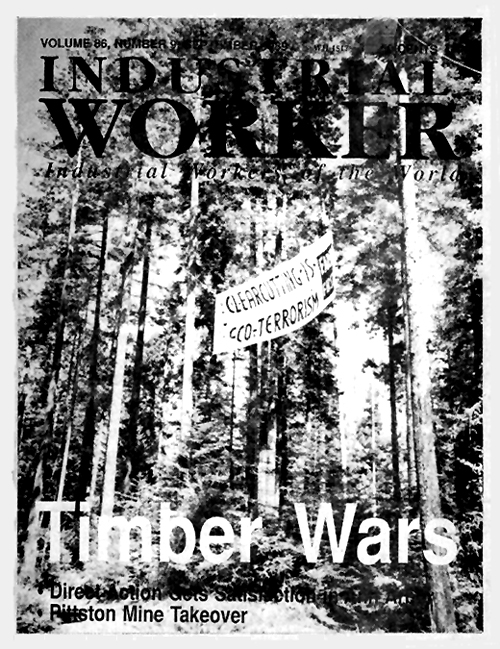
In her descriptions of the various efforts by Earth First! - IWW Local #1 to build alliances with timber workers on northwestern California's redwood coast, Judi Bari occasionally refers to an underground news letter called Timberlyin' published by a group of dissident Pacific Lumber workers, first in the article Timber Wars, published in the Industrial Worker in October 1989...

Pacific Lumber is another of the "big three" timber companies in the area. Until recently, it was a locally based, family-run operation paying good wages and amazing benefits. Pacific Lumber also treated the forest better than most and, because of its conservative logging and avoidance of clearcutting, has ended up owning most of the privately-owned old growth redwood that's left in the world.
But in 1986, Pacific Lumber was taken over in a leveraged buyout by MAXXAM Corporation, a high-finance holding company owned by Charles Hurwitz. Hurwitz financed the takeover with junk bonds, and is now liquidating the assets of the company to pay off the debt. But in this case, the assets of the company are the last of the ancient redwoods. Hurwitz has tripled the cut, instituting clearcutting. gutted the pension plan, and started working people overtime.

Employees reacted by attempting to organize an ESOP, or Employee Stock Ownership Plan, so that they could buy the company back and protect their jobs and community. As many as 300 people came to an ESOP meeting at its height. But Hurwitz, of course, refused to sell, and the ESOP plan died. MAXXAM expected everyone to just shut up and go back to work at that point. Instead some of the workers started publishing an underground paper called Timberlyin' (as opposed to the company's paper, Timberline), which lampoons management and, while rejecting the misleadership of both the ESOP and the AFL unions, calls on the workers to organize for self-protection.

Timber Wars: Footloose Wobs Urgently Needed

By Judi Bari, Industrial Worker, October 1989; Reprinted in Timber Wars, © 1994 Common Courage Press.

"You fucking commie hippies, I'll kill you all!" A shotgun blast goes off and the Earth First!ers scatter. What started as a peaceful logging road blockade had turned violent when a logger sped his truck through our picket line and swerved it towards the demonstrators. The loggers also grabbed and smashed an Earth First!er's camera and, for no apparent reason, punched a 50-year old protester in the face, breaking her nose.

The environmental battle in the Pacific Northwest has reached such a level of intensity that the press now refers to it as the Timber Wars. At stake is the survival of one of the nation's last great forest ecosystems. Our adversaries are giant corporations--Louisiana Pacific, Georgia Pacific, and MAXXAM in northern California, where I live, joined by Boise Cascade and Weyerhauser in Oregon and Washington.

These companies are dropping trees at a furious pace, clogging our roads no less than 18 hours a day, with a virtual swarm of logging trucks. Even old timers are shocked at the pace and scope of today's strip-logging, ranging from 1000-year old redwoods, one tree trunk filling an entire logging truck, to six-inch diameter baby trees that are chipped up for the pulp-mills and particleboard plants.

One-hundred-forty years ago the county I live in was primeval redwood forest. At the current rate of logging, there will be no marketable trees left here in 22 years. Louisiana Pacific chairman Harry Merlo put it this way in a recent newspaper interview: "It always annoys me to leave anything lying on the ground. We don't log to a 10-inch top, we don't log to an 8-inch top or a 6-inch top. We log to infinity. It's out there, it's ours, and we want it all. Now."

So the battle lines are drawn. On one side are the environmentalists, ranging from the big-money groups like Wilderness Society and Sierra Club to the radical Earth First!ers and local mountain people fighting the front line battles in the woods. Tactics being used include tree-sitting, logging road blockading, and bulldozer dismantling, as well as the more traditional lawsuits and lobbying.

On the other side are the big corporations and the local kulaks who do their bidding. Tactics used by them have included falling trees into demonstrators, suing protesters for punitive damages (and winning), buying politicians, and even attempting to ban the teaching at a local elementary school of a Dr. Suess book, The Lorax, which the timber companies say portrays logging in a bad light.

Pages

The Fine Print I:

Disclaimer: The views expressed on this site are not the official position of the IWW (or even the IWW’s EUC) unless otherwise indicated and do not necessarily represent the views of anyone but the author’s, nor should it be assumed that any of these authors automatically support the IWW or endorse any of its positions.

Further: the inclusion of a link on our site (other than the link to the main IWW site) does not imply endorsement by or an alliance with the IWW. These sites have been chosen by our members due to their perceived relevance to the IWW EUC and are included here for informational purposes only. If you have any suggestions or comments on any of the links included (or not included) above, please contact us.

The Fine Print II:

Fair Use Notice: The material on this site is provided for educational and informational purposes. It may contain copyrighted material the use of which has not always been specifically authorized by the copyright owner. It is being made available in an effort to advance the understanding of scientific, environmental, economic, social justice and human rights issues etc.

It is believed that this constitutes a 'fair use' of any such copyrighted material as provided for in section 107 of the US Copyright Law. In accordance with Title 17 U.S.C. Section 107, the material on this site is distributed without profit to those who have an interest in using the included information for research and educational purposes. If you wish to use copyrighted material from this site for purposes of your own that go beyond 'fair use', you must obtain permission from the copyright owner. The information on this site does not constitute legal or technical advice.

