You are here
News Feeds
Trump is trying to kill a carbon tax on global shipping. He may not succeed.
Ninety percent of global trade is conducted by giant ships that crisscross the globe, delivering containers of jet fuel, electronics, clothing, and many other goods every day of the week. Seafaring trade on this scale has brought the cost of many products down dramatically, but those ships have historically run on a very dirty fuel — essentially the sludge left over from refining crude oil — causing the shipping sector to contribute about 3 percent of total carbon emissions worldwide.
Last year, the International Maritime Organization, or IMO, the United Nations agency overseeing global shipping, was poised to adopt a plan to bring that down to zero. But that was before the Trump administration stepped in, threatening countries with visa restrictions, tariffs, and port fees if they supported the effort. As a result, the ambitious plan to decarbonize global shipping has been on the rocks for months. Alternate proposals that dispense with the core function of the original Net-Zero Framework, or NZF — a per-ton fee on greenhouse gas emissions above a certain threshold — seemed to be gaining traction, threatening climate progress in the sector.
But at a meeting of U.N. member countries last week, none of those watered-down proposals received much attention. Instead, a slim majority of countries expressed vocal support for the NZF, indicating that a narrow path to adopting the framework as originally intended still exists.
“A genuine spirit of collaboration and optimism pervaded the negotiations,” said Em Fenton, a senior director at the U.K.-based climate group Opportunity Green, who attended the meeting in London. “There were people who did not want to see progress, but a vast majority of delegates in the room were working together.”
The Trump administration opposes the NZF on the grounds that it would burden American consumers and businesses. In public documents submitted to the IMO, the administration has drawn a hard line at penalizing carbon-intensive fuel types and the inclusion of an “economic element,” such as a tax or levy, in the framework.
“The United States submits that the most appropriate path forward is to end consideration of the IMO Net-Zero Framework entirely,” it noted.
But supporters of the weaker alternative proposals — which were submitted by Japan, Liberia, Argentina, Panama, and others — did not entirely derail the majority’s push to advance the original NZF. The path to adopting the net-zero plan is a long one — and there’s still time for talks to fall apart. Opponents of the framework can tank it by gathering support from one-third of member countries, or from a smaller group of countries if that group controls half of the world’s shipping tonnage, per IMO rules.
Just four countries — Liberia, Panama, Bahamas, and the Marshall Islands — account for roughly half of the world’s registered ships. Ships can be owned by a company in one country, operated by another, and registered — or “flagged” — in a third, much like offshore banking for tax purposes. As a result, these so-called flag countries have extraordinary leverage during IMO negotiations. Since some of these flag states have already voiced their opposition to the NZF, Eveylne Williams, a research associate with the Center on Global Energy Policy at Columbia University, said that “you’re kind of already in that neighborhood of the 50 percent blocking threshold.”
However, “cautious optimism is reasonable” at this stage, she added. “[The NZF] hasn’t been abandoned, but it’s kind of sobering to look at the blocking arithmetic still available.”
While key countries oppose the Net-Zero Framework, the shipping industry itself — the companies that actually own and operate the ships and make their profits from the delivery of goods — has largely backed the effort in the hopes that a single uniform global tax will put every company on the same footing, no matter where they operate. Shippers are already navigating European carbon regulations and want to avoid a patchwork of rules by different countries.
“Our industry needs the IMO as our global regulator,” said David Loosley, CEO and secretary general of BIMCO, a trade organization representing shippers, on LinkedIn after the meeting last week ended. “To arrive at implementable regulations at a global level, we need the backing of all member states. Without consensus, global regulations will be ineffective and will fail to provide a level playing field for a truly global industry.”
At the meeting last week, U.S. delegates distributed leaflets laying out their projections of the country-by-country economic effects of the Net-Zero Framework. One handout, summarizing the effects on Peru, led to nearly $800 million in compliance costs. But experts who examined the figures said the analysis was misleading and utilized outdated assumptions.
“The data is a clear effort being made by a country acting in strong self-interest and using misinformation and exaggeration to the detriment of other countries’ interests,” said Fenton.
A spokesperson for the U.S. State Department did not respond to Grist’s request for comment.
Fenton expects countries to continue engaging in bilateral negotiations and technical discussions in the coming months. Several finer points — such as the distribution of funds collected as a result of the framework’s fee — are yet to be decided. After the U.S. intervention last year, a vote to adopt the framework was delayed by a year. As a result, the earliest countries can vote to adopt the framework is November. Talks are scheduled for that month to get the framework — or an alternate proposal — over the finish line.
This story was originally published by Grist with the headline Trump is trying to kill a carbon tax on global shipping. He may not succeed. on May 8, 2026.
Feminist Agrarian Reform: Transforming Society and Relations for All Humanity
Perla Álvarez, from CLOC–La Via Campesina, and Raya Radwan, from the World March of Women Palestine, speak about the struggle for land and food sovereignty
The post Feminist Agrarian Reform: Transforming Society and Relations for All Humanity appeared first on La Via Campesina - EN.
Theatre and political transformations in Brazil
Luke Lewin Davies and Jenny Futuro speak to São Paulo-based playwright Filipe Pereira on the challenges of left theatre-making in Brazil’s evolving political landscape
The post Theatre and political transformations in Brazil appeared first on Red Pepper.
Five Migratory Birds That Depend on Built-Up Areas
Aden: a city in the crater
Landholder-led 4-hour big battery gets federal environmental all-clear in just over four weeks
A big battery project being proposed for construction by a group of farming landholders and a local renewables developer has been waved through EPBC approvals.
The post Landholder-led 4-hour big battery gets federal environmental all-clear in just over four weeks appeared first on Renew Economy.
Operation Trust Me Bro: Let Them Drink Ka$h Bourbon
With no grown-ups in sight, a feckless war lurches and whipsaws on, run by a regime full of clowns, drunks, losers, grifters, all steadfastly defying the will of the people. Trump rants, Hegseth lies, Rubio punts, and shameless, "bad paranoid mess" Ka$h Patel, who actually likes to spell his name that way, is gifting bottles of personally branded bourbon - "KASH PATEL, FBI Director," boasting "strong notes of insecurity" - on all sides. Nothing to see here.
The dizzying pivots on Iran go on, with Dear Leader "paralyzed" by what he started and can't for the life of him figure out how to end. The military blockade of Iran's ports is "the greatest military maneuver in history"; also, if Iran doesn't give in to his demands, they will be "blown off the face of the earth." The "already legendary Epic Fury" is almost over, and the Hormuz Strait will be "OPEN TO ALL" if Iran just agrees to the 14-point US plan they dismiss as "a wish-list." One day, Project Freedom is "a gift to the world" that will get all 2,000 stranded ships through the Strait; the next day, with two ships through and Navy commanders resisting, he pulls the plug in the name of an almost-here "complete and final agreement" that doesn't exist. It turns out he veered away because the Saudis, angry and mistrustful, wouldn't let him use their bases or air space; NATO countries are also increasingly.barring the US from their bases. Iran's chief negotiator: "Operation Trust Me Bro failed.”
There’s more bad if unsurprising news: Pete and Donnie "lied through their teeth" about how the war's gone: Iranian airstrikes did far more damage to US military sites - hitting or destroying at least 228 hangars, barracks, fuel depots, aircraft, key radar, defense, communication systems - than they've acknowledged, and Iran's military might is far from "obliterated." The lies flew through, in part, because they “requested” that several large satellite imagery providers withhold images of the war to tightly control a bogus “winning” narrative. The result, critics say: “Not since Vietnam has there been a more systematic effort by an administration to lie about the costs, consequences, and results of a war.” Meanwhile, NATO is increasingly moving on without the US - who can blame them - and even Australia is pissed at the economic chaos: “Interest Rates Rise Because Some (Emotionally-Stunted) Fuckwit in America Wasn’t Hugged Enough As A Child."
Amidst the carnage, a “once-in-a-lifetime stupid“ Trump posts bonkers AI memes - Biden as ”COWARD," Obama as ”TRAITOR" - and proof the Iran war is shorter than Afghanistan: "Wow! Study this chart!“ His clowns flail. Todd Blanche wants SCOTUS to let the DOJ trash E. Jean Carroll's $83.3 million win. Howard Lutnick told the House his relationship with Epstein was "inexplicable.” Hegseth still inexplicably pursues Mark Kelly for obeying the law though multiple judges tell him to stop; Pete also posted a cringe video of "performative dipshittery wrapped in fictional jingoism," insisting a proposed $1.5 trillion military budget is “putting the American taxpayer first.” Also: "Arsenal for freedom" WTF? GOP tax cuts for the rich and slashing of Obamacare tax credits will see millions lose health care and food stamps, which they call cutting fraud: "Let them eat ballrooms." ICE promises, "Mass deportations are coming." America wants none of this shit.
They also likely don't want much of what Trump's FBI - which boasts, "Law and order is back," complete with vows to hunt down "bad guys" at the World Cup - is selling. Especially given its alleged director, fresh off drunken drunken revels celebrating with his hockey "friends" in Milan and reportedly, perennially panicking about being fired after a series of scandals, is now facing yet more bad press thanks toThe Atlantic's Sarah Fitzpatrick, who's been lauded as "a fearless badass" for staying on his sketchy trail. Her first story, on April 17, cited two dozen FBI sources "alarmed" by Patel's erratic behavior, "conspicuous inebriation and unexplained absences" after nights of boozing. Patel responded with a sputtering, typo-riddled, $250-million lawsuit charging Fitzpatrick and The Atlantic with an elaborate, organized-crime-like conspiracy. The FBI also reportedly launched a criminal leak investigation, usually reserved for "insider threats" involving classified documents, into who told Fitzpatrick what.
This week, Fitzpatrick followed up with another boozy story: Patel travels with a stash of personalized, bespoke, presumably taxpayer-funded Ka$h Patel bourbon he regularly hands out wherever he goes, including on official FBI business. The bottles bear the label, “KASH PATEL FBI DIRECTOR” with the rendering of an FBI shield; around it, text reads, with his preferred spelling, Director Ka$h Patel. An eagle holds the shield in its talons; sometimes the 750-milliliter bottles bear Patel’s signature. They also bear the imprint of Kentucky distillery Woodford Reserve, who have helped out MAGA before. In 2025, they gifted bottles to attendees of the 2025 inauguration luncheon, part of the swag arranged by Mitch McConnell's team. They also created a commemorative "Trump Presidential Woodford Reserve Whiskey, part of their Spirited Gifts line. It's unclear to what extent they've been impacted by or spared from Trump's infamous tariffs.
Patel is already known to have "a great affection" for swag: "He is known as being very merch forward." The Ka$h-branded crap on his website - “Choose Freedom. Shop Based" - has included t-shirts, beanies, faux-camo Fight with Kash hoodies, Fight With Kash Punisher scarf, “Justice for All” #J6PC tees to support Jan, 6 rioters, “government gangsters” playing cards, tacky juvenile "Steel Wall Art," and his children's book The Plot Against the King, about a heroic wizard, Kash the Distinguished Discoverer, who helps "King Donald" uncover conspiracies and crush his enemies. Profits supposedly go to a non-profit Kash Patel Foundation that “supports whistleblowers, education, defamation cases, etc." Patel was also already a bourbon fan during Trump's first term; he reportedly kept a barrel of bourbon at the National Security Council which was regularly brought out to celebrate successes.
In her account, Fitzpatrick lists places and occasions, including FBI events, where Patel has given out bottles of his bourbon. She reports that, when a bottle went missing during a March FBI "training seminar" with Ultimate Fighting Championship athletes in Quantico, Virginia, the incident caused Patel to "lose his mind"; he was so angry he threatened to make his staff take polygraph tests and face prosecution if they were found to have been involved. The FBI did not deny Patel gives out the whiskey; they defended the gifts as "routine" within the FBI, where Bureau officials "exchange commemorative items in formal gift settings consistent with ethics rules." A spokesperson "declined to clarify which ethical rules he is following, or which past directors also did it. When Fitzpatrick asked a former longtime senior official if he'd ever seen personally branded booze gifted, "He burst out laughing."
Several current and former FBI leaders said the action was "unheard-of," noting, "The FBI has traditionally had a zero-tolerance approach to unauthorized use of alcohol on the job or its misuse off duty.” Said one, "Handing out bottles of liquor at our premier law-enforcement agency - it makes me frightened for the country." Others called it "weird," "uncomfortable," "a "shitshow," "a misunderstanding of the Bureau's culture of quiet professionalism," “demoralizing because it suggests one set of standards for the director and another for the rest of the Bureau." Then again, said one, "If you make allegations against Patel, you're screwed." "The Kash Patel bourbon has strong notes of insecurity, narcissism, incompetence and alcohol-fueled national security risk,” wrote Dem lawmakers online. "Pairs well with taxpayer-funded getaways and the occasional SWAT-assisted wake-up call.”
"I knew one day I'd have to watch powerful men burn the world down. I just didn't expect them to be such losers." - Rebecca Shaw in The Guardian
Ka$h Patel, FBI Director and MoonshinerPhoto from The Atlantic
“I thought this was impossible:” Fortescue green grid rides through transmission failure with no fossil fuels
Fortescue's green grid rides through bushfire-caused transmission failure with just solar and batteries and no spinning machines - defying conventional thinking.
The post “I thought this was impossible:” Fortescue green grid rides through transmission failure with no fossil fuels appeared first on Renew Economy.
Fund nears financial close for wind and storage projects, with Victoria Big Battery extension first to go
Listed fund hopes to press go on its first big wind and storage projects soon, with an extension to the Victoria Big Battery likely first to go.
The post Fund nears financial close for wind and storage projects, with Victoria Big Battery extension first to go appeared first on Renew Economy.
Vote Yes on Measure B: Keep SMART Moving for the Next 30 Years
This June, residents of Marin and Sonoma Counties face a choice: keep the SMART train running, or watch one of the region’s most important climate investments unravel.
The Sonoma-Marin Area Rail Transit (SMART) train carries over 4,000 riders each weekday, offering a proven alternative to car travel that eases Highway 101 congestion and cuts greenhouse gas emissions. But without renewed funding, SMART cannot sustain current operations, let alone grow.
That’s why Measure B — a continuation of the existing quarter-cent sales tax for SMART train service and the adjacent multi-use pathway — will appear on the June ballot in Marin and Sonoma counties. Measure B doesn’t create a new tax. It keeps your existing investments alive — securing the next 30 years of service.
Greenbelt Alliance proudly endorses Measure B and encourages voters across Marin and Sonoma counties to vote YES on the June ballot.
Why It MattersSMART is more than a train. Every trip taken on SMART means fewer cars on the road, less pollution in the air, and a cleaner commute for thousands of North Bay residents. For an environmentally motivated community, Marin and Sonoma’s housing and transportation systems still depend heavily on single-occupancy vehicles. This measure represents a needed investment in public transportation.
Without Measure B, SMART will not be able to maintain today’s service levels. That means fewer trains, fewer riders, and more cars on 101. It means an incomplete pathway system. And it means abandoning an investment that voters in Marin and Sonoma counties have already made in their shared future.
Protecting and Growing a Regional InvestmentOver the past decade, SMART has extended its reach across the North Bay, and the 24 mile pathway running alongside the tracks has become a beloved active transportation corridor for cyclists and pedestrians alike. Measure B protects that progress and opens the door to more: expanded service hours, greater geographic reach, and a pathway system that’s finally complete.
A YES vote on Measure B directly funds:
- Continued daily SMART train service connecting Sonoma and Marin counties
- A reliable, low-emissions alternative to Highway 101
- Expansion of service hours and geographic reach across the North Bay
- Completion and maintenance of the SMART pathway for cyclists and pedestrians
- Reduced greenhouse gas emissions from the region’s transportation sector. People who ride SMART reduced greenhouse gas emissions by 33% compared to completing the same trip in a car.
At Greenbelt Alliance, we believe that resilient communities require both healthy lands and healthy transportation systems — the kind that give people real alternatives to driving, reduce emissions, and keep our region connected even as climate pressures intensify.
The quarter-cent sales tax that funds SMART is already in place. Measure B simply continues it. The cost of not renewing this funding — degraded service, stranded riders, and backsliding on our climate commitments — is far greater than the cost of saying yes.
Thirty years from now, the North Bay can be a place where hopping on a train is as natural as getting in a car – where our transportation choices match our values. That future starts this June. Vote YES on Measure B.
The post Vote Yes on Measure B: Keep SMART Moving for the Next 30 Years appeared first on Greenbelt Alliance.
“Definitely not good policy:” Experts skewer LNP plan to pause major transmission upgrades
Opposition plan to review state transmission roadmap and pause major network upgrades has been called out as "wedge" politics and could lead to blackouts, state energy minister warns.
The post “Definitely not good policy:” Experts skewer LNP plan to pause major transmission upgrades appeared first on Renew Economy.
“Completely overwhelmed” Attenborough feted on 100th birthday, new wasp species named after him
A new species of wasp has been named after Sir David Attenborough as the naturalist celebrates his 100th birthday.
The post “Completely overwhelmed” Attenborough feted on 100th birthday, new wasp species named after him appeared first on Renew Economy.
Federal green bank backs contentious state transmission project, to “significantly lower costs to consumers”
Clean Energy Finance Corporation will underwrite a transmission project crucial to the connection of Marinus Link, in a move it says will slash costs to consumers.
The post Federal green bank backs contentious state transmission project, to “significantly lower costs to consumers” appeared first on Renew Economy.
Friday Video: What Your Refrigerator Can Teach You About Saving Lives on the Roads
What does a protected bike lane have in common with a hot glue gun, a lawn mower and a refrigerator?
That’s not the set-up to a bad joke — it’s a powerful lesson in safe systems.
For this week’s Friday Video, we check in on one of our favorite TikTokers Jon Jon Wesolowski — aka “The Happy Urbanist” — who just posted an explainer on “forcing functions,” or design features that force better behavior and prevent bad things from happening.
And whether that’s an automatic kill switch on a household appliance or a barrier that separates a driver from cyclist, these features should be a no-brainer — if we can stop playing the blame game and start getting to the root causes of why people get hurt.
Check it out:
View this post on InstagramE-Bikes And Scooters Are Getting Even Safer In Europe: Data
Injury rates for e-bike and scooter users are plummeting in Europe even as the use of those devices has exploded since 2021, according to a new study that debunks the myth that roadways are getting less safe as a result of the micromobility boom.
Between 2024 and 2025, total bike and scooter mileage of the four mobility companies in the report grew by 14 percent, while the risk of injury declined by a little more than 1 percent. Bike safety seems even greater: e-bike trips increased by 72 percent in the same period yet injuries per million trips fell by around 18 percent compared to 2024.
The data was analyzed by Micro-Mobility for Europe, an industry group comprising the European operations of Bolt, Dott, Lime and Voi. The 2025 data is based on more than 353 million shared e-scooter trips and 136 million shared e-bike rides in the 27 European Union member states, plus Norway, Switzerland, the UK and Israel.
The companies collaborated to form Micro-Mobility for Europe to push back on the notion that e-bikes and scooters are a threat to safety. Its mission calls for joint effort to “develop a framework that ensures micro-mobility solutions flourish in cities in full respect of all road users and to revolutionize urban transportation toward a shared, electric, and carbon-free future.”
One expert said the preliminary findings show that micromobility only gets safer as the devices reach broader use.
“This indicates that with technological advancements, responsible operation, and better urban infrastructure, safety can be boosted even as micromobility network expands,” said George Yannis, a professor at National Technical University of Athens, which is working with the coalition to further study safety outcomes. “Continued monitoring and increased availability of micromobility data as well as evidence-based policies by both the [companies] and [local officials] will be essential to sustain this positive trend and further support Europe’s Vision Zero ambition of reducing road fatalities.”
And in the long term, risks continue to trend downward even as use continues to grow. Between 2021 and 2025, the injury risk per million km for shared e-scooters decreased by around 20 percent. And for bikes, overall injuries per million kilometers fell by almost 6 percent between 2024 and 2025, even as the number of trips increased by around 72 percent in 2025, evidence that the sector is getting safer as it scales.
The short report attributes the decrease in injury risk to an increase in safety features, like speed caps, on devices, geofencing in busy pedestrian areas, and regular maintenance of bikes and scooters.
“A 24-percent reduction in the risk of shared e-scooter injuries per million trips since 2021 shows that safer vehicle technology, rider education, sensibilisation [sic] measures by operators and continued investments in infrastructure are delivering measurable results,” said Micro-Mobility for Europe Co-Chair Marc Naether, who is also head of public policy at Bolt.
Friday’s Headlines Slow-Play Their Transit Hand
- During President Trump’s first term, the administration dragged its feet on distributing transit funds approved by Congress. The problem has gotten worse in his second term the U.S. DOT has not funded a transit project in more than a year, using new strategies to stonewall projects as the U.S. falls further and further behind the rest of the world. (Transportation for America)
- Not including children, at least 30 percent of Americans are non-drivers, according to a study out of Washington state. By far their biggest barrier to travel is a lack of fixed-route transit service. (Cities)
- An Atlanta City Council member wants to put a bike lane on the crowded Beltline to reduce conflicts between cyclists and scooters on one hand, and walkers and joggers on the other. (Atlanta News First)
- Colorado Gov. Jared Polis signed a bill making it illegal to block a bike lane. (Denver Gazette)
- The Pittsburgh Department of Mobility and Infrastructure is asking residents to fill out a survey about street safety. (Pittsburgh Magazine)
- Detroit is spending $8 million to repair 5,400 sidewalks. (Free Press)
- Cincinnati bikeshare Red Bike is now integrated into the city’s transit app. (CityBeat)
- Amtrak canceled a controversial third vent to save money on a West Baltimore rail tunnel. (Banner)
- Charlotte is planning on expanding its regional light rail system, but doesn’t have enough skilled construction workers to build all the projects. (Observer)
- Northwest Arkansas is planning its regional growth around the 40-mile Razorback Greenway. (CNU Public Square)
- The Kansas City streetcar turned 10 years old on Wednesday. (Axios)
- Observer names seven scenic Amtrak trips that are worth taking the time.
Energy Insiders Podcast: The man who saved solar and helped kill coal
Smart Energy Council's John Grimes on the death of coal power in Australia, panel by panel, home battery by home battery. He joins to discuss what's next. Plus: Twiggy's green grid, W.A.'s renewables rush, and other news.
The post Energy Insiders Podcast: The man who saved solar and helped kill coal appeared first on Renew Economy.
Building Better Habitat, One Songbird at a Time
Every Day is Earth Day
New D Line Subway Will Change How Angelenos Get Around
Metro’s new D Line subway extension will open tomorrow. The transit riding public can get on “the D” starting at 12:30 p.m. on Friday, May 8. The entire Metro rail/bus/bike-share system is free from Friday through Sunday. Read more about tomorrow’s opening celebrations.
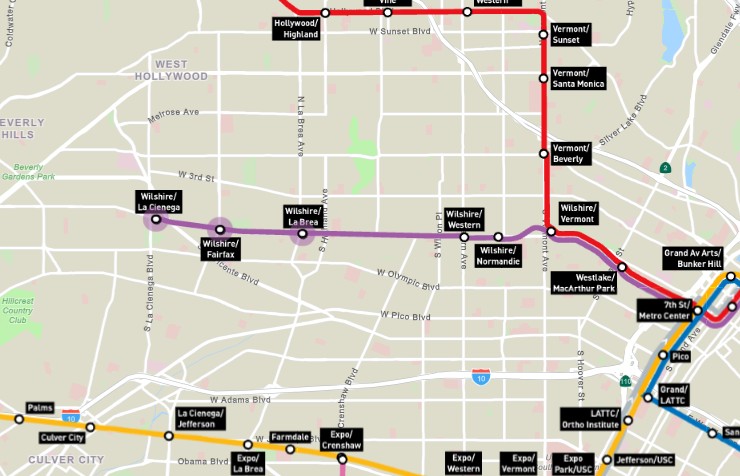
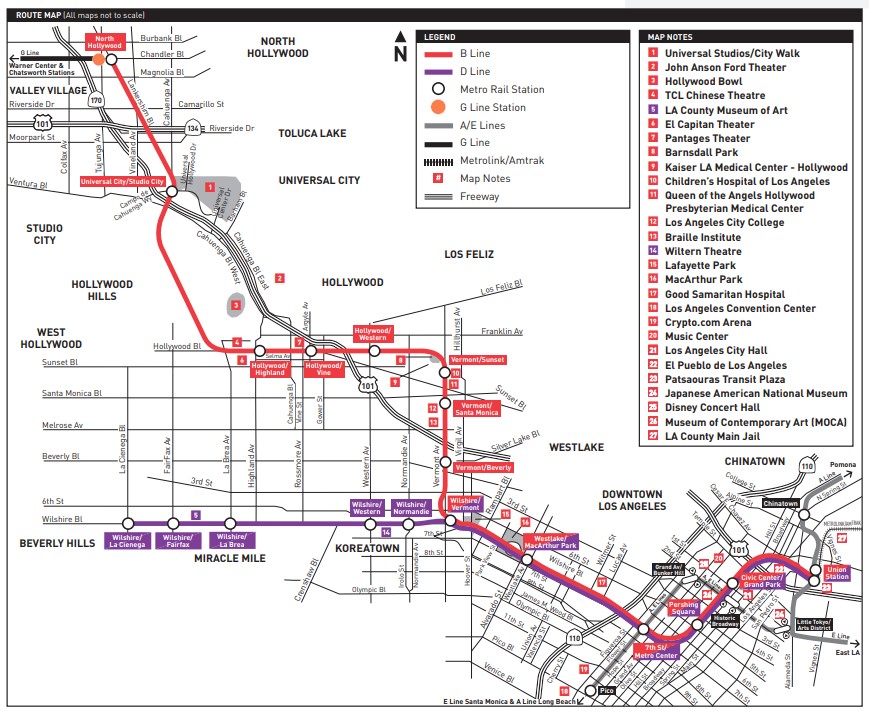
The $3.5 billion four-mile D Line Extension Section 1 will travel from Wilshire/Western in L.A.’s Koreatown all the way to La Cienega/Wilshire in the city of Beverly Hills. The project includes three new stations: Wilshire/La Brea, Wilshire/Fairfax, and Wilshire/La Cienega.
The 4-mile D Line extension (mapped in purple) runs below Wilshire Boulevard with stations at La Cienega, Fairfax, and La Brea Map of Metro B and D Line heavy rail subway – from Metro timetable. The B and D Lines form a Y; they share tracks in downtown and MacArthur Park, and split up at Wilshire/Vermont in KoreatownWhen Metro broke ground on what was then called the “Westside Purple Line” at a ceremony at the L.A. County Art Museum, section 1 was expected to be completed in 2023. Among several obstacles causing delays, Metro encountered and overcame challenging tunneling conditions.
View this post on InstagramStreetsblog has been covering the progress of the D Line for more than a decade. Below are a couple of D Line facts that you may or may not already know.
It will be fastIn L.A. County, most rail trips are not faster than driving. Metro buses and light and heavy rail move fairly fast. Every day, transit gets a million Angelenos where they need to be. There are exceptions, but when comparing trip times today, driving is almost always faster than transit.
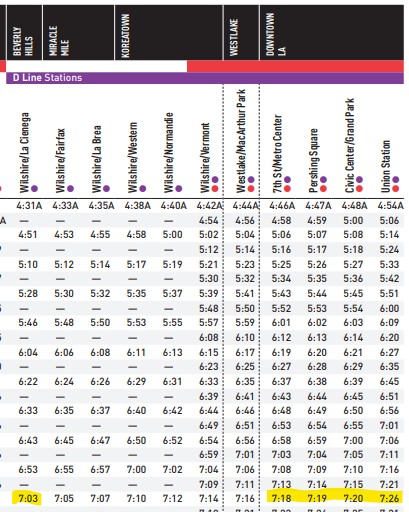
Detail of Metro D Line timetable – click to enlargeThere are great reasons to take Metro transit – driving stress, parking, gas prices, health, environment – but comparative travel time typically is not where Metro comes out ahead.
The D Line is different.
Metro has already posted the new timetable for the D Line and it’s so fast it seems almost unimaginable for Angelenos.
Riding the D Line from the L.A. County Museum of Art (LACMA) to City Hall will take just 15 minutes. The nine-mile trip from one end of the D to the other – from La Cienega to Union Station – will take just 23 minutes.
At less congested times of day, those same trips might run 30-40 minutes in a car. At rush hour, you’d probably want to budget an hour to be safe.
There are lots of factors that influence overall trip time for various modes – e.g. congestion, parking, reliability, transit frequency, first/last mile walk/bike facilities, etc.
The D Line is remarkably fast; for many trips, fast enough to compete favorably with driving.
It will improve the lives of transit ridersIf you read comments sections, you will find some people complaining that there’s no point in providing a subway to Beverly Hills, because rich people live there and rich people won’t ride transit. The residents of Beverly Hills, which long ago (meaning until ~2018) bitterly fought the D Line, likely do ride transit less often than folks living in less tony areas.
True as that may be, Beverly Hills is also destination. For workers who often struggle with expensive and/or time-consuming commutes. For visitors who want to have the full experience of Los Angeles. And for other Angelenos who might otherwise not be able to access a community that has made a point of making itself less accessible – including by opposing effective transit, and by targeting of Black and Latino drivers and pedestrians.
A lot of people who are not wealthy enough to live in Beverly Hills work there: domestic workers, restaurant workers, janitors, teachers, etc.
Even if wealthy folks in Beverly Hills ride infrequently, plenty of working class folks already take transit to commute to their Beverly Hills jobs. Even if the D Line never attracts a new rider, when it cuts a 40-60 minute bus commute down to 20-30 minutes, it will give workers more time to spend with their loved ones. It will get transit riders more places more punctually and more reliably. It will improve transit rider access to more places – more jobs and other destinations.
It’s in the right placeWilshire Boulevard is one of the best places to improve Southern California transit – because of its existing concentration of population and jobs. Author/scholar Ethan Elkind notes (including in D Line coverage at the L.A. Times today) that Wilshire is the most densely populated corridor west of the Mississippi River.
Transit agencies often get political pressure to invest in high quality transit that serves less dense parts of the region. No Metro rail line is empty, but some Metro rail has been built in relatively low population density areas, where it struggles to attract large numbers of riders. Transit riders are already plentiful on Wilshire, which sees 30,000+ weekday daily boardings on Metro 20 and 720 buses.
The D Line is Metro is greatly improving service exactly where it is most needed.
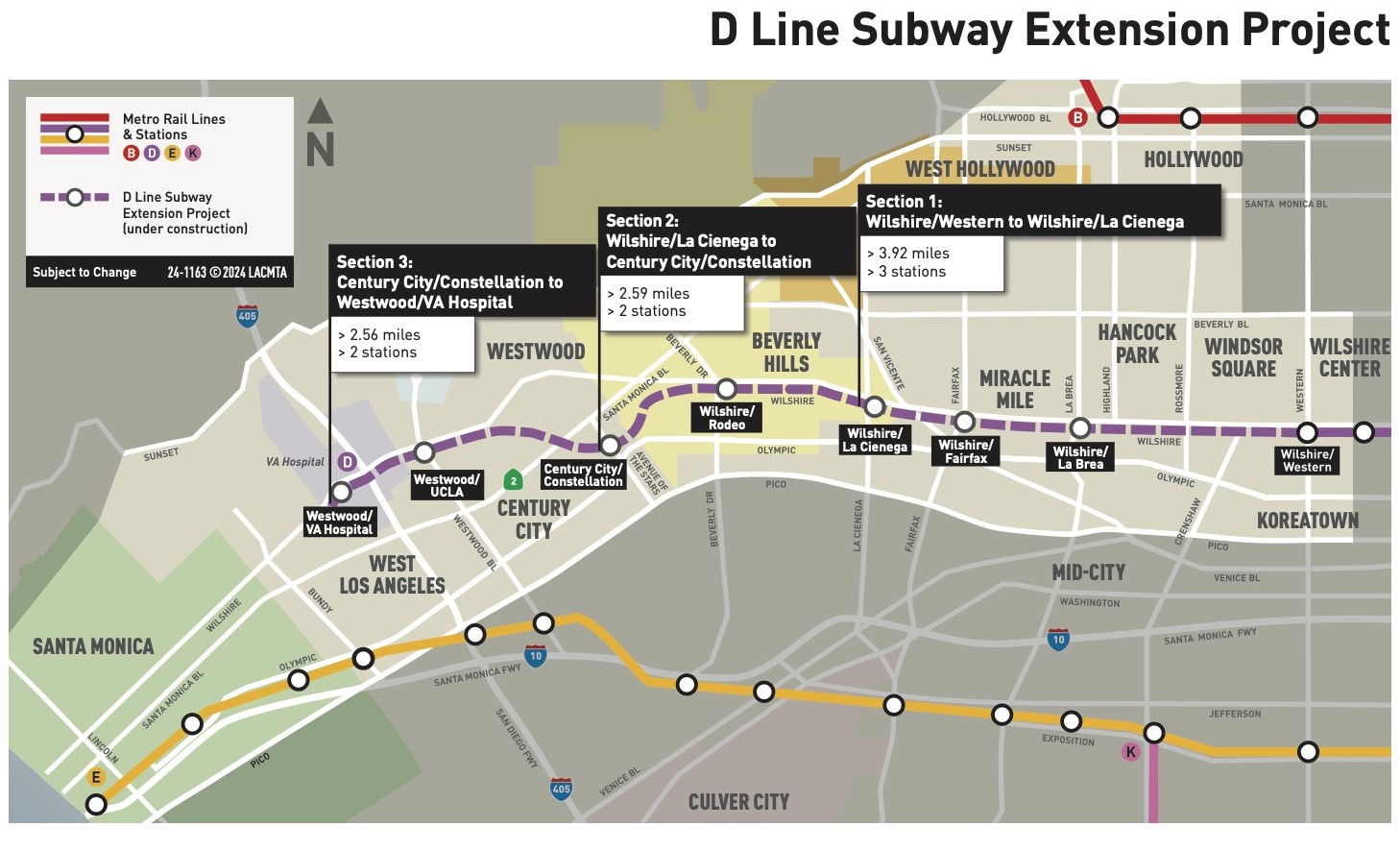
Even more D Line Subway in the near futureThis week’s opening is the first of three new D Line segments, all under construction and expected to be open by 2028.
Metro map of three-section nine-mile Metro D Line extension projectVery soon, the D Line will extend about 14 miles – from Westwood to Union Station. Take a peek at the next section’s new stations nearing completion.
Read more more about the D at Metro’s The Source, LAist, L.A. Times, and the Beverly Press.
SBLA will be putting the D Line to the test later this month. On May 19, Streetsblog will host a commuter race: the D Line Dash. The event pits three racers – a transit rider, a cyclist, and a driver – getting from Beverly Hills to Downtown Los Angeles.
View this post on InstagramTune in to Streetsblog, especially SBLA social media, to follow the great race! Contact Streetsblog if you’re interested in sponsoring and/or volunteering.
Pages
The Fine Print I:
Disclaimer: The views expressed on this site are not the official position of the IWW (or even the IWW’s EUC) unless otherwise indicated and do not necessarily represent the views of anyone but the author’s, nor should it be assumed that any of these authors automatically support the IWW or endorse any of its positions.
Further: the inclusion of a link on our site (other than the link to the main IWW site) does not imply endorsement by or an alliance with the IWW. These sites have been chosen by our members due to their perceived relevance to the IWW EUC and are included here for informational purposes only. If you have any suggestions or comments on any of the links included (or not included) above, please contact us.
The Fine Print II:
Fair Use Notice: The material on this site is provided for educational and informational purposes. It may contain copyrighted material the use of which has not always been specifically authorized by the copyright owner. It is being made available in an effort to advance the understanding of scientific, environmental, economic, social justice and human rights issues etc.
It is believed that this constitutes a 'fair use' of any such copyrighted material as provided for in section 107 of the US Copyright Law. In accordance with Title 17 U.S.C. Section 107, the material on this site is distributed without profit to those who have an interest in using the included information for research and educational purposes. If you wish to use copyrighted material from this site for purposes of your own that go beyond 'fair use', you must obtain permission from the copyright owner. The information on this site does not constitute legal or technical advice.
 This site is not the official webpage of the Industrial Workers of the World.