You are here
News Feeds
UK government faces legal challenge over deep sea mining permits to “opaque” firm
The UK government may have broken the law by approving the transfer of two deep-sea mining licences for exploration of mineral-rich seabed in the Pacific Ocean to an “opaque” company with ties to a US lobby group, according to Greenpeace.
The campaign group has taken the first step to kick-start a legal challenge over the government’s decision to facilitate the transfer of the permits it sponsors in the Clarion Clipperton Zone to Glomar Minerals following the bankruptcy of their previous holder, a Norwegian firm called Loke Marine Minerals.
The licences, overseen by the International Seabed Authority (ISA), a UN body, grant exclusive rights to explore an area of the ocean larger than England for potato-sized polymetallic nodules. These nodules contain minerals such as copper, cobalt and nickel, which are used in both clean energy technologies and defence applications.
No extraction can take place in the Clarion Clipperton Zone until countries agree on a mining code under drawn-out and increasingly contentious ISA negotiations.
Polarised debateThe debate over the nascent industry has grown increasingly polarised since US President Donald Trump issued an executive order to fast-track deep sea mining, including in international waters – a move widely seen as an unilateral measure aimed at circumventing the ISA’s authority.
Marine scientists argue that mining the seabed could cause severe, and likely irreversible, damage to ecosystems by destroying habitats, releasing toxic plumes and creating noise pollution. Over a dozen countries, including the UK, have called for a moratorium on deep sea mining until there is enough scientific evidence to assess its impact.
A Parapagurus crab makes its way across a densely packed field of ferromanganese nodules in the Gosnold Seamount. Photo: NOAA Ocean Exploration A Parapagurus crab makes its way across a densely packed field of ferromanganese nodules in the Gosnold Seamount. Photo: NOAA Ocean ExplorationGreenpeace said the UK government’s sponsorship of the exploration licences now held by Glomar Minerals “flies in the face” of its public position on the practice.
In a letter warning Britain’s business secretary of upcoming legal action if its decision is not reviewed, the environmental group said the government had acted unlawfully by failing to consider cancelling the licences. It argued that Glomar Minerals is effectively controlled by foreign states or nationals, which it claims breaches ISA rules.
The ISA regulations say activities in a license area should be carried out by people or companies that possess the nationality of the country sponsoring the contract, or are effectively controlled by them or their nationals, without giving more specific details. If entities from different states are involved, then each state needs to sponsor the license, according to the rules.
Ties to DC lobby groupGlomar Minerals assumed control of the licences last year after acquiring Loke’s British subsidiary, UK Seabed Resources, which first secured the contracts in 2013 when it was owned by US weapons manufacturer Lockheed Martin.
Although Glomar Minerals is headquartered in the UK, the company appears to be largely managed by executives and investors based overseas. Its chief executive is Walter Sognnes, a Norwegian energy executive who also led Loke at the time the company filed for bankruptcy.
One of Glomar’s listed directors and principal controllers is Washington-based Raphael Diamond, the founder and executive chairman of Securing America’s Future Energy (SAFE), a US lobby group that brings together military and business leaders. SAFE advocates reducing reliance on foreign supply chains, including for critical minerals, on national security grounds.
In April 2025, SAFE publicly welcomed Trump’s executive order on deep sea mining, saying “we must make sure we don’t cede access [of seabed nodules] to our adversaries”. In a recent report, the group argued that “the United States should out-compete China to be the first nation in the world to commercialise deep-seabed minerals”.
The US is not a full member of the ISA as it never ratified the UN convention that underpins it and therefore cannot directly sponsor ISA contracts.
“Opaque” ownershipGreenpeace has raised concerns about what it describes as Glomar’s “opaque” corporate structure and funding arrangements. Incorporation documents list the company’s majority shareholder as a firm based in Delaware, a US state known for corporate secrecy laws that do not require public disclosure of owners or directors.
Company filings show that in June last year, Glomar entered into a loan agreement for an undisclosed sum with another Delaware-registered entity, MHG Funding. Under the terms of the agreement, the lender could gain sweeping control of Glomar’s assets, including “all licences”, in the event of a default.
The lender is listed as Louis Mayberg, an American financial investor and philanthropist. A donor to the Democratic Party, Mayberg funded SAFE and served on the group’s board until at least the end of 2024, according to the most recent available records.
Climate Home News had not received a response to questions sent to Glomar, SAFE and Louis Mayberg at the time of publication.
In a December press release announcing the UK government’s decision, Glomar said its priority “remains closing knowledge gaps and contributing to a robust scientific understanding of the deep sea environment”.
US permitting process fast-trackedAs governments vie to secure access to critical minerals, the race to mine the ocean seabed has been heating up, spurred on by the Trump administration and efforts by countries to break their dependence on China.
Japan said this week it had conducted the first test mission to lift seabed mud that is rich in rare earths to a scientific ship within its national waters, soon after China cut off exports to its Asian rival amid a diplomatic row.
Last month, The Metals Company (TMC) – another deep-sea mining hopeful that holds exploration licences under the ISA, which it obtained via Nauru – became the first company to seek approval to collect nodules in the Clarion Clipperton Zone from the US authorities under an accelerated process run by the National Oceanic and Atmospheric Administration (NOAA).
The company’s CEO Gerard Barron told Reuters he hopes to obtain the permit by the end of the year.
The ISA has repeatedly said it has an exclusive mandate to oversee activities in the Pacific Ocean area and any unilateral action would violate international law and undermine ocean governance.
Greenpeace worries that licences ending up in “the wrong hands” could open the door to “destructive deep sea mining that could harm marine wildlife”.
Erica Finnie, oceans campaigner at Greenpeace UK, said the “opaque structure” of Glomar makes it hard for the UK government to have full oversight of the exploration licences and the individuals involved.
“The licences should be held by independent scientific bodies with a genuine interest in doing research, as they are in other countries, instead of companies seeking to profit from mining the seabed,” she added.
A spokesperson for the UK’s Department for Business and Trade said it would not comment on ongoing legal proceedings.
The post UK government faces legal challenge over deep sea mining permits to “opaque” firm appeared first on Climate Home News.
University of Texas spinout targets US gallium and scandium supply gaps
The University of Texas at Austin has spun out Supra Elemental Recovery, a company focused on recovering high-purity gallium, scandium and other critical minerals from domestic waste streams, amid growing concern over fragile critical mineral supply chains in the United States.
The US is 100% import-dependent on gallium and scandium, elements essential to semiconductors, aerospace, energy, defence and communications. China dominates global supply through capital-intensive and environmentally hazardous refining methods, leaving billions of dollars’ worth of critical minerals locked in US industrial byproducts, mine tailings and electronic waste each year.
Supra says its proprietary platform combines the advantages of traditional solvent extraction and ion exchange into a non-toxic process that delivers up to 100× greater selectivity and speed, lowering costs while improving performance. The company is initially focused on semiconductor supply chains, with validation underway for other elements including cobalt and lithium used in batteries, magnets and electronics.
“Every year, billions of dollars’ worth of critical minerals are trapped in domestic waste streams, from industrial byproducts and mine tailings to electronic waste,” Co-founder and chief executive Katie Ullmann Durham said in a statement. “By profitably recovering these elements, we can secure the inputs needed for America’s advanced manufacturing future.”
Co-founder and chief operating officer Jordan Sessler said separating critical minerals at high purity is known to be difficult. He said that by refining multiple elements from multiple sources, Supra is positioned to deliver much-needed supply chain resilience.
The technology builds on federally supported research at UT Austin, a leading US centre for materials science and engineering. Mark Arnold, associate vice-president of Discovery to Impact and managing director of Longhorn Ventures at UT Austin, said the company reflects the university’s focus on translating research into market-ready solutions that strengthen US industrial leadership.
FundingAlongside its launch, Supra closed an oversubscribed $2 million pre-seed round led by Crucible Capital, with participation from the UT Seed Fund, Climate Capital, Portmanteau Ventures and Pew Protection Trust.
“The bottleneck between domestic resources and secure supply is refining capacity,” Meltem Demirors, founder and general partner at Crucible Capital, said. “Supra is building that capability with a proprietary new approach to producing critical materials in the US.”
The funding will support further development and preparation for commercial pilots expected in 2026.
Skeena clears final permit for Eskay Creek mine restart
Skeena Gold & Silver (TSX: SKE) shares rose nearly 10% in pre-market trading Tuesday after the company secured its final regulatory approval to advance the Eskay Creek gold-silver project in British Columbia, Canada.
The miner received an Environmental Management Act permit from provincial authorities, completing the permitting process and clearing the way for commercial development. The approval was issued jointly with the Tahltan Central Government and follows the BC Mines Act permit granted on Jan. 27 as part of a coordinated application.
Mining operations at Eskay Creek are targeted to restart in the second quarter of 2027.
“We are deeply grateful to our employees, the Tahltan Nation and the regulatory authorities for their ongoing support throughout this process,” Skeena CEO Randy Reichert said in the statement. He added the company is now positioned to move toward construction and long-term value creation.
Eskay Creek, a former Barrick Mining asset in BC’s Golden Triangle, was once considered the world’s highest-grade gold mine. A 2023 feasibility study outlined an estimated 12-year mine life with average annual production of 320,000 oz. of gold-equivalent, including 455,000 oz. of gold over the first five years.
The project is expected to generate about 1,000 jobs during peak construction and more than 770 jobs at peak operations, with projected capital spending of C$713 million and approximately C$1.2 billion in provincial revenues.
Under the project’s environmental assessment certificate, substantial construction must begin by 2036.
Zimbabwe court rules Impala Platinum not liable for royalty
Zimbabwe’s High court said Impala Platinum Holdings Ltd.’s local unit is not liable to pay mining royalties of $7.1 million on exports matte and concentrates.
The court ruled in favor of Zimplats after the Zimbabwe Revenue Authority determined the company owed royalties for the period between June 2018 and December 2021. The court said that no royalty rate had been set for such products over that period.
“It is therefore my considered view that matte and concentrate, as mineral-bearing products, cannot attract the same royalties as minerals that have gone through the refinery process,” High Court Judge Rodgers Manyangadze said in his ruling.
Zimbabwe has the world’s third-largest platinum reserves after South Africa and Russia and generates more than half of its revenues from mineral exports. Besides Impala, Sibanye Stillwater Ltd. and Valterra Platinum Ltd. also have platinum interests in the southern African country.
(By Godfrey Marawanyika)
China to See Solar Capacity Outstrip Coal Capacity This Year
This year China will see its solar capacity outstrip its coal capacity for the first time, according to an industry group.
Serabi Gold keeps mines running after fatal accidents
Brazil-focused Serabi Gold (AIM:SRB, TSX:SBI) said mining and milling continue as usual at its Palito Complex and Coringa mine despite two fatal underground accidents last week.
The company said a worker died on Jan. 30 in a mining-related traffic accident at the Palito underground operation, with no other injuries reported. A week earlier, another employee was killed at the Coringa underground mine in an accident at the production face.
Serabi said it has notified Brazilian authorities, who are conducting formal investigations, and has launched an immediate review of operational effectiveness and safety procedures, signalling tighter oversight and a sharper focus on workforce safety.
The company’s focus is on the Tapajós region in Pará State in northern Brazil, where the Palito Complex has consistently produced between 30,000 and 40,000 ounces of gold a year.
Serabi plans to double output in the coming years through construction of the Coringa mine and recently reported a copper-gold porphyry discovery on its extensive exploration licence.
The miner is headquartered in the UK and maintains a secondary office in Toronto, Canada.
West Africa’s first lithium mine awaits go-ahead as Ghana seeks better deal
Lawmakers in Ghana are weighing up whether to greenlight one of Africa’s largest lithium mines after civil society groups urged them to do more to ensure that the project benefits the country and supports green development.
Ghana granted Australian miner Atlantic Lithium a lease to open the country’s first lithium mine in the hope of capitalising on the EV-driven boom for the silvery metal, which is used to manufacture batteries for electric cars and other clean tech products.
But as the deal awaited ratification by parliament in December, the government withdrew the agreement after campaigners and analysts in Ghana warned that the terms risked shortchanging the West African nation at a time when it is seeking to benefit from the scramble for battery minerals.
Atlantic Lithium, which had earlier raised concerns that falling lithium prices were affecting the viability of the project, has since put forward a revised agreement. This new deal would see it pay higher royalties to the government when lithium prices rise, as they have since the start of this year. Lawmakers are expected to review the new terms of the contract for the much-delayed project this month.
Like other resource-rich African nations, Ghana, the continent’s largest gold producer, is seeking a bigger share of mining revenues to spur development and benefit local people.
Experts told Climate Home News the negotiations with Atlantic Lithium highlighted the difficulties for governments to negotiate preferential terms with mining companies, on which they depend for revenues and expertise.
“Lithium is Ghana’s first green mineral and will set the benchmark for future critical mineral agreements,” opposition lawmaker Kwaku Ampratwum-Sarpong, a member of the committee on lands and natural resources, told local media in December. “Weak deals now risk setting a poor precedent for the country.”
Ghana’s lithium potentialAtlantic Lithium says the Ewoyaa project could produce 3.6 million tonnes of lithium spodumene concentrates over the mine’s 12-year lifespan – turning Ghana into one of Africa’s top lithium producers and a significant new supply source for the EV battery industry outside of established producers in Australia, Chile and China.
The lithium is expected to be exported to the US and further refined for use in EV batteries. Atlantic Lithium financed the exploration of the mining site by forward-selling Ghana’s lithium resources to Elevra, a North American lithium producer which has a supply agreement with Tesla.
Atlantic Lithium previously obtained a concession to cut the royalty rate it would pay Ghana from the mandated 10% to 5%. The company argued that the adjustment was necessary to make the project viable after lithium prices had plummeted by more than 80% since 2023.
The company’s move sparked a public outcry. Policy think-tanks that analysed the agreement described it as “colonial” and warned that parliament risked “repeating history’s mistakes” if it approved the deal. The Natural Resource Governance Institute challenged Atlantic Lithium’s claims about its revised profitability and urged the government to scrutinise the assumptions made by the company.
In light of the criticism, the government withdrew the deal in December.
“When governments depend on mining projects to project a sense of economic progress, they stop negotiating for value and start negotiating out of fear,” Bright Simons, of the Accra-based IMANI Centre for Policy and Education, told Climate Home News.
A man bikes past a vendor selling football shirts in downtown Accra (Photo credit: IMF Photo/Andrew Caballero-Reynolds) A balancing actAtlantic Lithium has since put forward a revised agreement based on a proposal by the minister for lands and natural resources, Emmanuel Armah-Kofi Buah, to establish a sliding scale for royalty rates based on lithium prices.
The scale would start at 5% when lithium spodumene prices are below $1,500 per tonne and rise to 12% when prices exceed $3,000 per tonne. Lithium prices are currently at a two-year high and climbed above $2,000 at the start of the year, as analysts forecast stronger demand growth.
Henry Wilkinson, Atlantic Lithium’s communications manager, told Climate Home News the revised agreement was aligned with current legislation and would “ensure that value is generated for Ghana and Ghanaians”.
The government, he said, should find “the appropriate balance” between attracting foreign investment and retaining value from its nascent lithium industry.
“If the government sets fiscal terms that are deemed unattractive for companies looking to advance projects in Ghana, the country risks missing out on securing a position within the value chain; particularly with other countries, such as Mali, Zimbabwe, Nigeria and South Africa all moving ahead with their lithium production ambitions,” he added.
Fear of missing outBut this new approach hasn’t convinced everyone. For Simons, of the IMANI think-tank, the revised agreement still falls short of Ghana’s interests.
“African youth are tired of being told all the time that Africa is rich underground when the signs of destitution are so stark above ground,” he told Climate Home News.
“The narrative that the critical minerals rush is about building the next phase of the global economy has created a massive new wave of anxiety that the continent will miss out yet again. It feels like [a] determined betrayal.”
Atlantic Lithium will allocate 1% of the project’s revenues to a community fund that will finance development projects in the local area. But the protracted negotiations have left people living near the mining site in limbo.
Farming communities say Atlantic Lithium told them to stop planting crops three years ago because they would need to be resettled ahead of the mine opening. While they await a decision on the mine, no one has yet received compensation for the loss of earnings, the Ghanaian NGO Friends of the Nation told Climate Home News. The community representatives in the negotiations with Atlantic Lithium receive stipends from the company, the NGO added, which it says poses a conflict of interest.
Atlantic Lithium said that the delays have been “beyond the company’s control”.
Unequal bargaining powerFor Marisa Lourenço, a South Africa-based risk consultant, African governments are too reliant on foreign expertise for extracting their mineral resources and this often limits their bargaining power.
“The broad absence of local beneficiation means that African governments can do very little with their resources and this keeps them reliant on the terms put forward by foreign mining companies,” she said.
In Ghana, the mining industry is the largest tax-paying sector in the country. And the initial agreement to develop the Ewoyaa mine was based on a feasibility study carried out by Atlantic Lithium, said Patrick Stephenson, Ghana country manager at the Natural Resource Governance Institute.
Stephenson told Climate Home News that delays to the ratification of the project’s mining lease show that the government needs to rely on its own data and analysis to inform decisions “rather than on company-determined interests and priorities”.
That could include the creation of a state‑led minerals analytical unit capable of conducting its own profitability modelling, price benchmarking, feasibility studies and project valuation, he added.
The post West Africa’s first lithium mine awaits go-ahead as Ghana seeks better deal appeared first on Climate Home News.
Reflections on “Rupture”: Mark Carney’s New World Order & an Indigenous Response
According to Prime Minister Mark Carney’s speech at the World Economic Forum, “if you’re not at the table, you’re on the menu.” But what does that mean for Indigenous Peoples, who have long demanded a seat at the table, only to find that the table itself has been set by others – that their territories, governance, and futures remain on the menu?
Carney’s address in Davos, Switzerland earlier this month was widely praised, resulting in a rare standing ovation. It referenced “a series of crises in finance, health, energy, and geopolitics” and argued that the rules-based order that “middle powers” relied on, is no more. He argued that countries like Canada must seek alternatives to a system that can be exploited by the powerful. Coincidentally, Carney’s words reflect parallels to the relationship of power and exclusion that underscores Canada’s treatment of Indigenous Peoples.
From Davos to DRIPAIn our home province of British Columbia (BC), Premier David Eby has recently stated his government’s intent to amend the Declaration of the Rights of Indigenous Peoples Act (DRIPA). Citing ill-informed and unfounded concerns about private property rights following the Quw’utsun (Cowichan) decision, Eby also plans to appeal the court decision. All of this, in addition to new provincial legislation designed to circumvent Indigenous rights, and a growing residential school denialism movement.
The recent developments in BC demonstrate the frailty of Canada’s “reconciliation efforts.” Carney’s address does not mention Indigenous Peoples, of course, or climate change – instead noting his own plans to fast-track energy projects which will exacerbate the overriding of Indigenous rights and title.
Since contact, Canada’s relationship with Indigenous Peoples has been unbalanced, extractive, and harmful. These historical patterns are rebranded through time, from taming the wilderness in the contact era to the more contemporary idea of economic necessity – all in the service of legitimizing resource extraction. When Indigenous rights and title stand in the way of the “national interest,” Canada turns to legislation, the courts (when convenient), and political discourse.
Make no mistake, the system of intensifying great power Carney warns about is Canada – still a part of the same “rules-based order,” but in many ways, the description of “great powers” is more convincingly apt when applied to Canada.In his remarks, Carney reaffirmed Canada’s stated “commitment to fundamental values: sovereignty, territorial integrity, and the prohibition of the use of force except when consistent with the UN Charter and respect for human rights.” At the same time, the urgency of present political moments can make it difficult to discern ongoing violations of our human rights (Whyte 2019). In the United States, this is unfolding in real time, with the threat of state-sanctioned armed violence from Immigration and Customs Enforcement (ICE). As tensions continue to escalate, there have been increased concerns on both sides of the imposed border about the violations of our Indigenous and human rights. Engaging with Carney’s call to be “clear-eyed,” we have an opportunity to reflect critically on the relationship between public commitments and their realizations in practice.
Canada has a long history of using militarized law enforcement to quell Indigenous resistance at home – UN Charter, human rights, UNDRIP, even Canadian law (a rules-based order) notwithstanding. This is justified by appealing to the “national interest.” The Oka Crisis, the Mi’kmaq Lobster Fishery Dispute, Fairy Creek Blockade, and the Coastal Gaslink conflict all represent militarized conflict over the extraction of natural resources within Indigenous territories. Given this worrying trend, communities who oppose the most recently green-lit Prince Rupert Gas Transmission (PRGT) pipeline construction are concerned about troubling times ahead.
The intensification of the climate crisis, escalating geopolitical tensions, and continued undermining of Indigenous rights all contribute to the disconnections that are rapidly becoming apparent within and between Nations. As Carney observes, “we are in a rupture, not a transition.” The hypocrisy in this statement is apparent to Indigenous people who have faced the brunt of Canadian power. But there is more than hypocrisy here – there is an erasure of Indigenous participation in Canada’s approach to the post-rules based order.
If there is one key difference between the international order and the Canadian order, it’s Carney’s reference to “rupture.” There has not yet been a rupture in the rules governing Indigenous people and the Crown. But, there should be. New Constellations of Co-ResistanceIt is time for Indigenous people to seriously seek out alternatives; to turn our attention towards forming what Leanne Simpson calls constellations of co-resistance (2017). These constellations uphold our responsibilities to each other and to our territories; a re-framing that will involve active, practical work as well as intentional political engagement (Gould, Martinez, and Hoelting 2023). It is in these constellations of co-resistance, these relationalities, that we can work towards our collective liberation (Simpson 2017; Starblanket and Stark 2018).
Recentering relationality offers a more sustainable path forward: one grounded in responsibility, reciprocity, and shared authority rather than accommodation, coercion, and legislative strong-arming. Now is not the time to succumb to the powers that be, or to fall prey to divisionary state tactics we see increasingly on display in the era of “economic reconciliation.” Instead, we need to move beyond incremental changes to begin to address the power structures and oppressive systems of the “old world order” that we are still very much living in.
Indigenous internationalism and solidarity involve challenging imposed and figurative borders, and “decentering the state” (Corntassel, 2021, p. 73). By doing so, we actively resist the colonial norms of individualism, cognitive imperialism, and extractivism. As Alley (2025) argues “solidarity is…both our greatest strength and our greatest weapon in our common struggles for liberation, self-determination, justice, and human rights (p.165).” Accountability and responsibility to our Nations, relationalities, and Indigenous internationalisms has transformative potential. Of course, this is a vision many of us subscribe to. Now we must do the work of realizing it in tangible, practical terms.
Just as Carney proposes to middle powers – it is time to strategize. To take our territories, governance, and futures off the menu by resisting the fragmentation of our relationalities within and between Nations. This resistance will not be without challenge. As Starblanket and Stark (2018) note, “through our choices we have the potential to actively change the world we inhabit (p.177).” Coalition-building, coming together in real time and space, building our Nation-to-Nation and international constellations of co-resistance is still possible. Let us – Indigenous Peoples – take one sure thing from Carney’s address:
“the powerful have their power. But we have something too – the capacity to stop pretending, to name reality, to build our strength at home, and to act together.” EndnotesAlley, Kim. 2025. “Global Grassroots Indigenous Internationalism in a Time of Genocide.” Native American and Indigenous Studies 12(1): 160-169. https://doi/org/10.1353/nai.2025.a957116
Corntassel, Jeff. 2021. “Life Beyond the State: Regenerating Indigenous International Relations and Everyday Challenges to Settler Colonialism.” Anarchist Developments in Cultural Studies 2021(1):71-97.
De Bruin, Tabitha. Declaration on the Rights of Indigenous Peoples Act [DRIPA], 2019. https://www.bclaws.gov.bc.ca/civix/document/id/complete/statreg/19044
Gould, Rachelle., Martinez, Doreen., and Hoelting, Kristin. 2020. Exploring Indigenous relationality to inform the relational turn in sustainability science. Ecosystems and People. 19(1). Available from: https://doi.org/10.1080/26395916.2023.2229452
Simpson, Leanne B. 2017. As We Have Always Done: Indigenous Freedom Through Radical Resistance. University of Minnesota Press. Starblanket, Gina., and Heidi Kiiwetinepisiik Stark. 2018. “Towards a Relational Paradigm – Four Points for Consideration: Knowledge, Gender, Land, and Modernity.” In Resurgence and Reconciliation: Indigenous Settler-Relations and Earth Teachings, edited by M. Asch., J. Tully, and John Borrows. University of Toronto Press.
Whyte Kyle. 2019. “Too late for indigenous Climate Justice: Ecological and Relational Tipping Points.” WIREs Climate Change 11(3):1–7. https://knowledgecircles.ca/wp-content/uploads/2022/02/Whyte-2019.pdf
Citation: Wale, Janna and Michaela M. McGuire. “Reflections on “Rupture”: Mark Carney’s New World Order & an Indigenous Response,” Yellowhead Institute. February 03, 2026. https://yellowheadinstitute.org/2026/reflections-on-rupture-mark-carneys-new-world-order-an-indigenous-response/
Artwork by Alyssa Wale
The post Reflections on “Rupture”: Mark Carney’s New World Order & an Indigenous Response appeared first on Yellowhead Institute.
Japan’s unprecedented project could test the limits of deep-sea mining
The year 2010 was a reckoning for Japan’s economic security.
On September 7, the Chinese fishing trawler Minjinyu 5179 refused an order by Japan’s coast guard to leave disputed waters near the Senkaku Islands, which are known in China as Diaoyu. The vessel then rammed two patrol boats, escalating a decades-long territorial feud.
Japan responded by arresting the captain, Zhan Qixiong, under domestic law, a move Beijing considered an unacceptable assertion of Japanese sovereignty. Amid mounting protests in both countries and the collapse of high-level talks, China cut exports of rare earth elements to Japan, which relied upon its geopolitical adversary for 90 percent of its supply. The move reverberated throughout the global economy as companies like Toyota and Panasonic were left without materials crucial to the production of everything from hybrid cars to personal electronics.
It wasn’t long before Japan gave in and let Qixiong go. The crisis, which garnered worldwide attention, became a catalyst for Japan’s push to secure a reliable supply of critical minerals. “That was the turning point,” said Takahiro Kamisuna, a research associate at the International Institute for Strategic Studies in London.
Fifteen years later, that reckoning has only deepened.
China still provides 60 percent of Japan’s critical minerals, a reliance that has grown riskier as Beijing asserts its position as the world’s dominant supplier. Last month, Japan took a bold step to break that dependence when it launched a five-week deep-sea mining test off Minamitorishima Island. A crew of 130 researchers aboard the Chikyu — Japanese for “earth” — will use what is essentially a robotic vacuum cleaner to collect mud from a depth of 6,000 meters, marking the world’s first attempt at prolonged collection of minerals from great depths.
Read Next A guide to the 4 minerals shaping the world’s energy future Jake BittleSeabed mud off the coast of that uninhabited island, which sits 1,180 miles southeast of Tokyo, is rich in rare earths like neodymium and yttrium — distinct from the potato-shaped polymetallic nodules often associated with marine extraction. Such materials are essential for electric vehicles, solar panels, advanced weapons systems, and other technology.
The expedition, which is expected to end February 14, is being led by the Japan Agency for Marine Earth Science and Technology, which did not respond to a request for comment. It comes three months after the country signed an agreement with the United States to collaborate on securing a supply of critical minerals. It also propels Japan to the forefront of a growing debate over how far nations should go to secure these materials. Deep-sea mining “is not a new thing,” Kamisuna said, “it’s just gaining more attention mainly because of geopolitical tensions.”
The trawler incident highlighted a vulnerability that successive governments vowed to alleviate. Many criticized then-prime minister Naoto Kan of the country’s center-left party for capitulating to China, but he pledged to never again let Japan’s industrial future hinge on a single supplier. His successor, Shinzo Abe of the center-right party, was more aggressive and saw critical minerals as not just an economic issue, but a matter of national security that must be addressed even if it meant exploiting the deep sea.
Establishing a domestic supply could help Japan reach its goal of achieving carbon neutrality by 2050, a high priority for Yoshihide Suga, who succeeded Abe. Although Prime Minister Sanae Takaichi, an Abe protégé who assumed office late last year, supports the 2050 timeline, she has said the transition must not risk Japan’s industrial competitiveness and energy stability.
Takaichi has proposed slashing subsidies for large-scale solar projects or batteries, largely because so much of that technology is imported from China. Instead, she has hailed nuclear power as the path toward carbon neutrality. With the mining experiment unfolding in the Pacific, Takaichi hopes to secure a strategic reserve of minerals to protect key industries.
But Japan doesn’t face an either-or choice, said Jane Nakano, a senior fellow at the Center for Strategic and International Studies in Washington, D.C. “Energy security and energy transition are closely tied,” she said.
Read Next What changed for deep-sea mining in 2025? Everything. Anita Hofschneider“To me, it’s much more about the pace, not so much the direction,” said Nakano, who has worked for the U.S. Department of Energy and for the energy attaché at the U.S. embassy in Tokyo. “I don’t find Takaichi’s way of framing this dual challenge — energy security and decarbonization — unique to Japan. A lot of G7 countries are starting to recalibrate again, so they do have to think about international competitiveness. Direction-wise, [Japan] is just aligning itself with the political establishment and the industry.”
Unlike China, Japan lacks the sedimentary geology associated with rare earth deposits, requiring it to look toward the waters within its exclusive economic zones. Under the United Nations Convention on the Law of the Sea, Japan has the right to exploit the resources within 200 nautical miles of its coastline, which includes the atoll island of Minamitorishima.
Although the minerals to be found there lie nearly 20,000 feet beneath the surface, proponents of digging them up argue the challenge of extracting them and the cost of refining them is justified by mounting geopolitical tension. With Takaichi’s recent political jabs at Beijing, China has begun choking off its exports to Japan. Nakano said Japanese officials seem “confident” in the outcome of the experiment. “They’ve determined that it merits to have this demonstration of technologies and equipment this time around,” she said.
Japan’s foray into deep-sea mining comes amid mounting concern about the ecological cost of such technology. Scientists and environmental groups warn that marine extraction is racing ahead of our understanding of the impacted ecosystems. They are particularly concerned about sediment plumes, noise and light pollution, and damage to habitats and food webs, noting that scars left by equipment could render the seafloor uninhabitable for decades, even centuries.
“A tiny little nudge, and the whole seafloor is disturbed,” said Travis Washburn, a marine biologist at Texas A&M University in Corpus Christi. He studies deep-sea environments and human impacts on marine ecosystems, and he has analyzed the waters around Minamitorishima Island and represented Japan at International Seabed Authority workshops. He believes that mining rare earths from mud could have the same impact as mining nodules. “I think that they’re both pretty much going to destroy the habitat directly affected.”
Government officials insist the ecological impacts will be closely monitored. But assessing them could be difficult, because the seafloor around the island, home to sea cucumbers, sponges, corals, and potentially rare endemic species — remains the subject of intense study. Scientists fear these ecosystems may be permanently altered before anyone assesses them. As with many extractive industries, Washburn noted, technology is often deployed before anyone fully understands its environmental impacts.
Shigeru Tanaka, deputy director general of the Pacific Asia Resource Center, is an outspoken critic of deep-sea mining. He argues that the industry as a whole disregards international law and that exploiting the seafloor will harm fisheries and trample upon the rights of Pacific Islanders who consider the sea as sacred. (The Indigenous people of the Mariana Islands have raised such concerns in opposing Trump administration plans to open the waters there to mining.) He also believes that some of the experts involved in Japan’s project “are not really taking seriously the risks to the environment and how irreversible it may be.”
Even some government officials have expressed concern. Yoshihito Doi of the Agency for Natural Resources and Energy has said Japan should mine only “if we can establish a robust system that properly takes environmental impacts into account.”
cobalt, nickel and manganese." data-caption="A geologist inspects a bucket of polymetallic nodules, misshapen black globes encrusted with metals like cobalt, nickel, and manganese, collected by the research vessel MV Anuanua Moana from near the Cook Islands.A geologist inspects a bucket of polymetallic nodules, misshapen black globes encrusted with metals like cobalt, nickel, and manganese, collected by the research vessel MV Anuanua Moana from near the Cook Islands.
William West / AFP via Getty Images
It remains unclear what exactly is unfolding beneath the waves during this current test, but based upon his experience working with the Japanese government on similar research, Washburn said the top priority will be assessing whether the technology works. Researchers also will monitor how much material the system can hold and if the machinery can keep the sea mud contained without releasing a massive sediment plume on the seafloor or in the water column.
If Japan can successfully deploy a 6,000-meter pipe that can suck up 35 metric tons of mud under extreme pressure — about 8,700 pounds per square inch, or 600 times the pressure at sea level — government officials say a broader trial, which may include polymetallic nodules, could begin in February 2027.
One longer-term goal is to develop what’s called “hybrid mining.” Because deep-sea polymetallic nodules sit atop the rare-earth mud around Minamitorishima Island, researchers are exploring whether both could be collected and separated in a single operation.
Kamisuna said Japan faces another challenge: The energy needed to acquire and refine a stockpile. “If we want to create a sufficient reserve for rare earth [minerals], either using domestic or export, a large amount of electricity is required,” he said. “And the question is, What are we going to use, liquified natural gas or coal? What is the environmental cost?”
Using more environmentally friendly methods of extraction and processing can be expensive, he said — which is one reason many countries turn to China as a cheaper option.
For now, Japan’s deep-sea mining experiment seems to have drawn little public opposition at home, unlike in the United States and Australia where environmental activists and Indigenous communities have pushed back against such operations, particularly around the Pacific Islands. In the meantime, the country’s test moves forward, even as the implications of success, and questions about its long-term impact, remain unresolved.
“We are not prepared,” Tanaka said. “My personal take is that by the time we are ready, when the technology and the science is set, I really do not think there would be a demand for it.”
toolTips('.classtoolTips2','A group of 17 soft gray metals including lanthanides, scandium, and yttrium, so-called rare earths form key parts of the magnets in wind turbines and are used in high-tech products ranging from consumer electronics to defense satellites.'); toolTips('.classtoolTips4','The process of reducing the emission of carbon dioxide and other greenhouse gases that drive climate change, most often by deprioritizing the use of fossil fuels like oil and gas in favor of renewable sources of energy.'); toolTips('.classtoolTips7','A lightweight, silvery-white alkali metal with properties that allow it to store large amounts of energy. Lithium is a key component of many batteries, including those that store renewable energy and power electric vehicles.'); toolTips('.classtoolTips9','A conductive and heat-resistant metal that forms a key part of many battery cathodes, which allow electric charges to flow. It is used in the lithium-ion batteries that power many EVs as well as solar energy systems and wind turbine components.'); toolTips('.classtoolTips10','A scarce blue metal that helps battery cathodes store large amounts of energy without overheating or collapsing. It is a key component of lithium-ion batteries. ');This story was originally published by Grist with the headline Japan’s unprecedented project could test the limits of deep-sea mining on Feb 3, 2026.
Why the future of meat production is in vats, not farms
I recently ate a pig that’s alive and well at a sanctuary in upstate New York. Her name is Dawn, and she donated a bit of fat, which a company called Mission Barns grows in bioreactors, then blends with plant-based ingredients to create pork products (like the meatballs above) that taste darn near like the real thing. Its “cultivated” offerings join a herd of alternative meats — including those from mainstays like Impossible Foods and Eat Just — that are challenging the traditional livestock industry, which uses immense swaths of land and spews staggering quantities of greenhouse gas emissions.
In his new book Meat: How the Next Agricultural Revolution Will Transform Humanity’s Favorite Food — and Our Future, Bruce Friedrich, founder and president of the Good Food Institute, catalogs the extraordinary costs of conventional meat production and the vast potential for alternative culinary technologies. Grist sat down with Friedrich to talk about the progress, challenges, and potential of the fledgling industry. This conversation has been condensed and edited for clarity.
Q. It’d be great to get a rundown on — if you’ll pardon the pun — your beef with meat.
A. Conventional meat production has significant external costs. In 2006, the U.N. Food and Agriculture Organization released a more-than-400-page report called Livestock’s Long Shadow. It said that animal-product production is responsible for all of the most serious environmental harms at every scale, from local to global. It looked at deforestation, climate change, air pollution, water pollution, water depletion, loss of biodiversity, and said that the inefficiency and extra stages of production involved in producing animal products made meat, dairy, and eggs a significant contributor to all of those, including being the number one contributor to deforestation.
All of those environmental consequences have gotten worse. If it takes 9 calories of feed to get 1 calorie of chicken, or 10 or more calories of feed to get a calorie of farmed fish or pork, and even more calories to get a calorie from a ruminant animal — a cow or a sheep or a goat — that’s an inherent inefficiency that really is 800 percent food waste, or more. All of the inefficiency adds up, and that’s why the latest numbers are that roughly 20 percent of climate emissions are attributable to animal agriculture.
Q. We’re at an interesting point in which the technology has gotten extremely advanced when it comes to replicating what is grown in an animal in a field somewhere. What are the options for alternative meats?
A. It’s very much similar to how we think about renewable energy or electric vehicles. There is a recognition that the world is going to consume more energy, the world is going to drive more miles. The world is also going to eat more meat. In the last 25 years, meat production is up about 65 percent. It will probably be up something like 65 percent again through 2050, and that means all of the external costs of meat production continue to get worse.
Just like if you’re talking about energy, we need an all-of-the-above strategy. So we want everything from more energy-efficient light bulbs to houses, but we do need renewable energy as one of the tools in the toolkit. Here, the solution is to figure out how we create plant-based meat that is indistinguishable and less expensive, and how we grow actual animal meat in factories rather than on live animals.
Q. You talk in the book about a number of ways this can be incentivized, though there are many states that have already done things like ban cultivated meat. What could be done in these early days of alt meats that could accelerate both the science and the adoption?
A. One very encouraging aspect of a shift in the direction of plant-based meat and cultivated meat is that because they are so much more efficient, there is a massive profit motive. And there is also a massive food-security motive for countries like China, Japan, and Korea that have significant food self-sufficiency concerns. Countries that cannot feed themselves recognize that that is a significant national security threat and are highly motivated to figure out how to feed themselves. These countries recognize that if they can produce meat with a fraction of the inputs required to produce animal-based meat, that will be a boon to their national security. And in the United States, we’re also seeing bipartisan support for alternative proteins for economic competitiveness reasons.
Q. One challenge now is that there’s a backlash in the United States against ultra-processed foods. Beyond Meat and Impossible Foods have been struggling financially lately, perhaps as part of that. Is that a surmountable challenge for the industry?
A. The first thing to say is that the plant-based meats are significantly healthier than what they are replacing. All of the plant-based meats that consumers like best, relative to animal-based meat, have less fat, less saturated fat, less cholesterol, more fiber, and more protein. All of the plant-based meats are significantly less calorically dense than the animal-based meat they’re replacing. The indictment against ultra-processed foods works, generally speaking, as shorthand for products that are low in fiber, calorically dense, high in fat, high in sugar. But comparing plant-based meat to Doritos and Coca-Cola doesn’t make a lot of sense. There are some questions around some of the other ultra-processed foods, but the science is clear that the meat and dairy alternatives do not lead to bad health outcomes.
Q. You make the point in the book that these companies should collaborate with the traditional meat industry, reforming the industry instead of replacing it. Why?
A. The goal of the meat industry is to produce high-quality protein profitably. Figuring out how to produce that same end product far more efficiently is going to be extremely profitable for the companies and countries that lean in. If you’re sort of analogizing to photography, nobody wants to be Kodak. Everybody wants to be Canon, and to seize the opportunity rather than to pretend it doesn’t exist.
This story was originally published by Grist with the headline Why the future of meat production is in vats, not farms on Feb 3, 2026.
Water for sale: from the Thames to the Amazon
Queensland government approves coal mine rejected by the court due to climate concerns
The Queensland Government has today approved expansion of a coal mine that was found by the Queensland Land Court to have failed to reduce its greenhouse gas emissions, with the decision condemned by community group Lock the Gate.
US Department of Energy opens search for Nuclear Innovation Campus hosts
The US Department of Energy (DOE) has issued a request for information (RFI) inviting states to express interest in hosting so-called “Nuclear Lifecycle Innovation Campuses” to bolster the domestic nuclear value chain.
The initiative, launched on Jan. 28, is part of the Department’s efforts to modernize the nation’s full nuclear fuel cycle and strengthen America’s leadership in advanced nuclear energy.
The RFI marks “the first step towards potentially establishing voluntary federal-state partnerships designed to advance regional economic growth, enhance national energy security, and build a coherent, end-to-end nuclear energy strategy for the country,” DOE said in a statement.
“Unleashing the next American nuclear renaissance will drive innovation, fuel economic growth and create good-paying American jobs while delivering the affordable, reliable and secure energy America needs to power its future,” US Energy Secretary Chris Wright stated in a news release.
“Nuclear Lifecycle Innovation Campuses give us the opportunity to work directly with states on regional priorities that support President Trump’s vision to revitalize America’s nuclear base,” he added.
The proposed campuses could support activities across the full nuclear fuel lifecycle, including fuel fabrication, enrichment, reprocessing used nuclear fuel and disposition of waste. Depending on state priorities and regional capabilities, the sites could also host advanced reactor deployment, power generation, advanced manufacturing and co-located data centers.
As part of the RFI submission, states must provide clear statements of interest and constructive feedback on the structure of the Innovation Campuses. The submissions should outline state priorities—such as workforce development, infrastructure investment, economic diversification or technology leadership— and describe the scope of activities the state envisions hosting, DOE said.
States are also encouraged to identify the funding structures, risk-sharing approaches, incentives and federal partnerships required to successfully establish and sustain a full-cycle Innovation Campus, it added.
Responses to the RFI are requested by April 1, 2026. More information is here.
500 Claims, Fewer Protections: Why EPA’s “Accomplishments” Don’t Add Up for Clean Water, Clean Air, or Public Health
Regional NSW residents call on Minister Houssos to strengthen coal transition bill
Residents from NSW’s major coal-producing regions have called on NSW Minister for Natural Resources Courtney Houssos for stronger support, ahead of parliamentary debate on the government’s Future Jobs and Investment Bill 2025.
Financing Community Clean Energy Projects in 2026
2025 marked a structural shift in clean energy and community development finance. Federal programs had been providing or promising flexible capital to make clean energy projects less risky for lenders and investors. Many of those programs are now gone. While that has upended workplans and made financing harder, it has not reduced demand nor commitment for clean energy in communities.
Against this backdrop, RMI convened 70 practitioners in late 2025 from green banks, community lenders, regional and commercial banks, and impact investors to surface the most pressing challenges and priorities for 2026. The message was clear: organizations are moving forward, even in tougher terrain. Participants remain motivated and are actively seeking solutions to ensure communities have access to resilient sources of capital for clean energy projects when federal dollars aren’t available.
Across conversations, one familiar but unresolved challenge rose to the top: many community clean energy projects can work on paper, but they don’t fit mainstream capital’s “credit box” — the criteria banks and investors use to decide what they will fund, including cash flow predictability, counterparty credit, and deal size and structure. This misalignment is most acute for smaller deal sizes, in new markets, or with unfamiliar or credit-constrained counterparties.
Federal programs were designed to help bridge these gaps by providing flexible capital that could absorb risk and fragmentation. With that support receding, the work ahead requires sharper execution: clearer roles, stronger coordination, and financing approaches that help projects fit within the credit box without relying on perpetual subsidy.
The convening brought to light four priorities for 2026:
- Fix affordability gap: Strengthen concessional balance sheets for institutions that can absorb cash flow risk and provide products that improve project economics for low-income and underserved customers.
- Address risk perception gap: Map and standardize credit enhancements to build investor confidence and move from bespoke risk mitigation to scalable structures.
- Close market access gap: Identify asset classes ready for standardization and aggregation, and support warehousing to connect small or fragmented assets to secondary markets.
- Resolve ecosystem capacity constraints: Invest in subnational financing ecosystems that can turn localized solutions into investable markets by diagnosing constraints, enabling institutional specialization, and strengthening coordination across the finance stack.
Most climate finance work, at its core, is about moving assets into the credit box. Trying to convince lenders and investors to abandon their risk-return requirements is a dead end; the work is in identifying and addressing the specific frictions that keep otherwise viable projects from being financed.
In practice, clean energy assets tend to fall outside the credit box for one or more of three reasons.
The first is an affordability gap. This is a failure of economic viability where projects don’t generate sufficient or stable cash flows at price points end users can afford, failing the credit box’s cash-flow and repayment assumptions. Even when technologies are cost-effective at a system level, the revenue model breaks at the household, small business, or community level, particularly in low-income or underserved markets. This is fundamentally a cash-flow problem, not a technology or performance risk issue.
The second is a risk perception gap, where assets may cash flow on paper, but investors are uncomfortable with real or perceived risks — including performance uncertainty, counterparty credit quality, or regulatory and policy exposure — and they demand protections accordingly. Unfamiliar risks are frequently overweighted, keeping otherwise viable projects sidelined because investors aren’t confident that assets will perform as advertised.
The third is a market access gap, where assets can’t reach investors who want to buy them. Even when projects perform well individually, they may be too small, bespoke, or scattered to meet investors’ size and standardization needs. Because each deal is different, lenders and investors must spend significant time and money to review, structure, monitor, and service them, and those costs can outweigh the returns. This is made worse by inconsistent deal flow, limited performance track records, and too few actors positioned to hold projects on their balance sheets long enough to enable bundling them, building scale, and bringing them to larger, more liquid secondary markets.
The priorities for 2026 that surfaced in our convening flow from these gaps.
Priorities for 2026 to Align Projects with Investor Requirements Fix affordability gap: address the economicsWhen affordability is the binding constraint, the solution needs to improve what customers can actually pay, not shift risk around the capital stack. Tools like guarantees protect lenders after default, but they don’t reduce the likelihood of default.
Affordability tools improve project economics. On-bill mechanisms make repayment easier and more reliable by tying payments to utility bills and expected savings. Interest rate buydowns lower monthly payments, improving borrower cash flow. Lease structures can lower upfront costs or shift performance and maintenance risk away from customers. Technology bundling can also lower costs in certain instances, such as when pairing efficient heat pump upgrades with rooftop solar results in more affordable electricity.
2026 priority: Strengthen concessional balance sheets for institutions that directly address affordability, such as green banks and community lenders, so they can continue serving customers with affordable, accessible financing. Address risk perception gap: reallocate or clarify riskEven when cash flows are adequate, investors may hesitate if they don’t trust the counterparty or don’t fully understand performance risks. This is where credit enhancement tools are most effective. Guarantees can protect against downside outcomes, especially for newer or unfamiliar asset types. Insurance can transfer specific, well-defined risks. Loan loss reserves can absorb expected losses when defaults are possible but limited.
Standardization helps here, too. Consistent underwriting, contracts, and performance data help make unfamiliar risks clearer, more comparable, and easier to price.
Today, credit enhancement tools are often highly customized and designed deal-by-deal. While helpful in specific cases, this fragmentation makes it harder to attract larger pools of capital.
2026 priority: Map and standardize existing credit enhancements to move from deal-by-deal risk support toward structures that enable scale and attract larger pools of capital. Close market access gap: build liquidity pathwaysEven well-performing assets can’t scale if they can’t reach liquidity. Moving capital at scale requires a sequence of steps: first, standardizing rules, contracts, and data where appropriate; then, aggregating assets through warehousing or pooling; and finally, accessing secondary markets.
Intermediaries play a critical role in this process. Bond banks and other centralizing entities or capital markets-facing intermediaries can turn small or fragmented projects into investable portfolios or securities. They lower the cost of capital by pooling assets and making it easier to sell or refinance assets once they reach scale.
Credit enhancements may be required at the point of sale to meet investor requirements. But the constraints show up earlier — in how assets are originated, standardized, aggregated, and held. Credit enhancements can’t substitute for those steps.
2026 priority: Identify which asset classes are ready for standardization and aggregation and clarify which institutions can warehouse and centralize assets to connect them to secondary markets. Resolve ecosystem capacity constraints: strengthen subnational financing ecosystemsEcosystem and institutional capacity constraints determine whether the solutions to the three gaps described above can be developed and applied effectively.
Subnational financing ecosystems could be a powerful forum for coordinating the problem-solving and action needed in the years ahead. With federal pullback — and because conditions vary widely by place — these ecosystems are where solutions to the three gaps must ultimately be executed.
In practice, however, subnational financing ecosystems are themselves constrained because many places lack institutional capacity, functional coverage, and coordination to deploy solutions effectively.
This shows up today in a few ways. In many places, institutions are too small or undercapitalized to operate at scale; key entities that should play critical ecosystem functions are missing or underleveraged; and coordination remains weak — both among local actors and between local markets and the secondary capital markets they depend on.
Subnational financing ecosystems can become engines for action across the other three priorities outlined above, but only if underlying capacity constraints are addressed through investment in three essential priorities.
- Diagnosis and learning: identifying which constraints are binding for specific assets and communities, testing solutions, and building a place-based track record over time.
- Role clarity and coordination: enabling institutions to focus on what they do best and what the market needs — whether customer-facing origination and affordability, credit enhancement, or warehousing, aggregation, and capital markets access — rather than duplicating every function everywhere and competing for the same limited pools of concessional capital. Scaling the right interventions depends on clear, differentiated roles, sufficient institutional capacity, and effective coordination mechanisms.
- Capital translation: connecting local lending activity to national and institutional capital markets by converting fragmented assets into standardized, investable portfolios and turning local proof points into models that can scale.
To overcome longstanding challenges in affordability, risk perception, and market access, the next phase of community clean energy finance must focus on moving assets into mainstream capital’s credit box at scale without subsidy. That means building subnational systems that can do this work and endure as federal support ebbs and flows.
In practice, this comes down to building financing systems that make projects affordable for customers, reducing perceived risk for investors, and creating clear pathways to scale. Rather than relying on one-off tools, the emphasis shifts to how these elements work together consistently across markets.
Delivering on these priorities will require capital sources better suited to long-term market building — and, critically, will create the conditions for more of that capital to participate. Local deposits can anchor community lenders and green banks focused on affordability and origination. Centralizing entities can manage complexity and timing mismatches, aggregate assets and demand, and connect local lending activity to secondary markets and pooled issuance platforms. Institutional investors and bond buyers can then provide the liquidity needed to recycle capital and scale what works.
Progress in addressing binding constraints across affordability, risk, market access, and subnational capacity is connected and reinforcing. The result is a financing system that can support community clean energy investment at scale across regions and regardless of the availability of federal support.
The post Financing Community Clean Energy Projects in 2026 appeared first on RMI.
AME Roundup Video: BC sets up to 140-day timelines for permits
British Columbia will begin processing mineral-exploration permit applications within 40 to 140 days starting April 1, a move aimed at keeping investment flowing after exploration spending hit a record C$751 million ($550 million) in 2025.
The province is backing the change with C$3 million in new funding, including C$1 million to add permitting capacity and $2 million to boost the Mineral Claims Consultation Framework, which the industry has criticized as a bottleneck. Files that miss the new service standard will be escalated to the chief permitting officer for a decision within 14 days, the government said.
“These timelines, backed by new investment, respond to industry feedback,” Mining and Critical Minerals Minister Jagrup Brar told The Northern Miner last week during the AME Roundup in Vancouver. The province is to maintain environmental standards and consultation with First Nations while giving prospectors and investors more certainty, the minister said.
Brar pointed to recent approvals as evidence the province can move projects faster, including Skeena Gold and Silver’s (TSX, NYSE: SKE) $713-million Eskay Creek gold-silver restart under a consent-based Section 7 process with Tahltan Central Government, and permit amendments for Centerra Gold’s (TSX: CG; NYSE: CGAU) Gold’s Mt. Milligan expansion that could extend the mine to 2035 with up to C$400 million in capital spending.
Watch below the full interview with The Northern Miner’s Western Editor, Henry Lazenby:
How the polar vortex and warm ocean intensified a major US winter storm
This article by Mathew Barlow, Professor of Climate Science, UMass Lowell and Judah Cohen, Climate scientist, Massachusetts Institute of Technology (MIT) is republished from The Conversation under a Creative Commons license. Read the original article.
A severe winter storm that brought crippling freezing rain, sleet and snow to a large part of the U.S. in late January 2026 left a mess in states from New Mexico to New England. Hundreds of thousands of people lost power across the South as ice pulled down tree branches and power lines, more than a foot of snow fell in parts of the Midwest and Northeast, and many states faced bitter cold that was expected to linger for days.
The sudden blast may have come as a shock to many Americans after a mostly mild start to winter, but that warmth may have partly contributed to the ferocity of the storm.
As atmospheric and climate scientists, we conduct research that aims to improve understanding of extreme weather, including what makes it more or less likely to occur and how climate change might or might not play a role.
To understand what Americans are experiencing with this winter blast, we need to look more than 20 miles above the surface of Earth, to the stratospheric polar vortex.
On the morning of Jan. 26, 2026, the freezing line, shown in white, reached far into Texas. The light band with arrows indicates the jet stream, and the dark band indicates the stratospheric polar vortex. The jet stream is shown at about 3.5 miles above the surface, a typical height for tracking storm systems. The polar vortex is approximately 20 miles above the surface. Mathew Barlow, CC BY What creates a severe winter storm like this?Multiple weather factors have to come together to produce such a large and severe storm.
Winter storms typically develop where there are sharp temperature contrasts near the surface and a southward dip in the jet stream, the narrow band of fast-moving air that steers weather systems. If there is a substantial source of moisture, the storms can produce heavy rain or snow.
In late January, a strong Arctic air mass from the north was creating the temperature contrast with warmer air from the south. Multiple disturbances within the jet stream were acting together to create favorable conditions for precipitation, and the storm system was able to pull moisture from the very warm Gulf of Mexico.
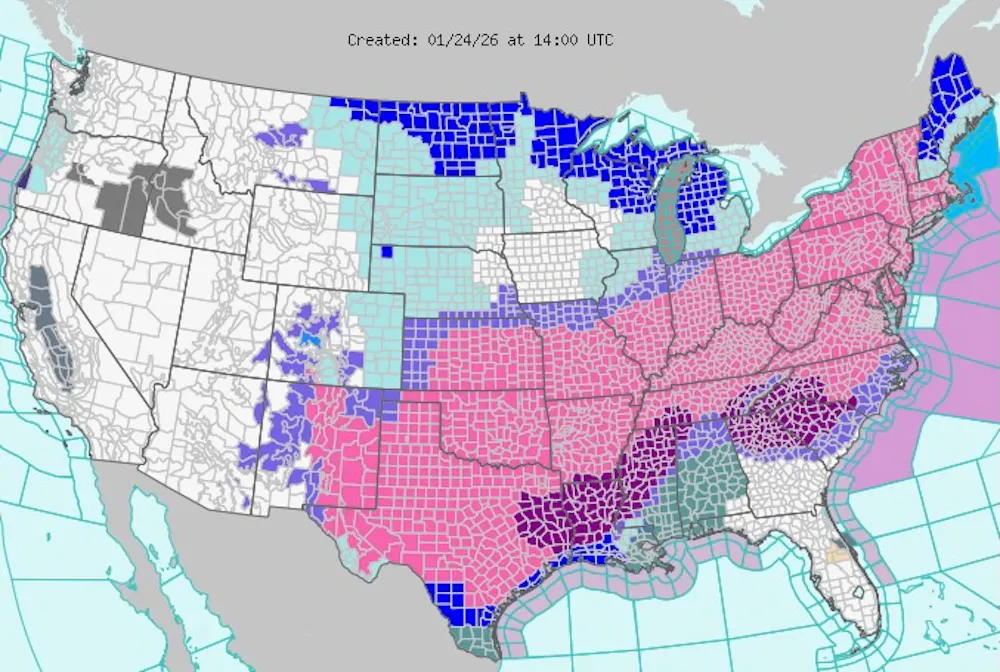
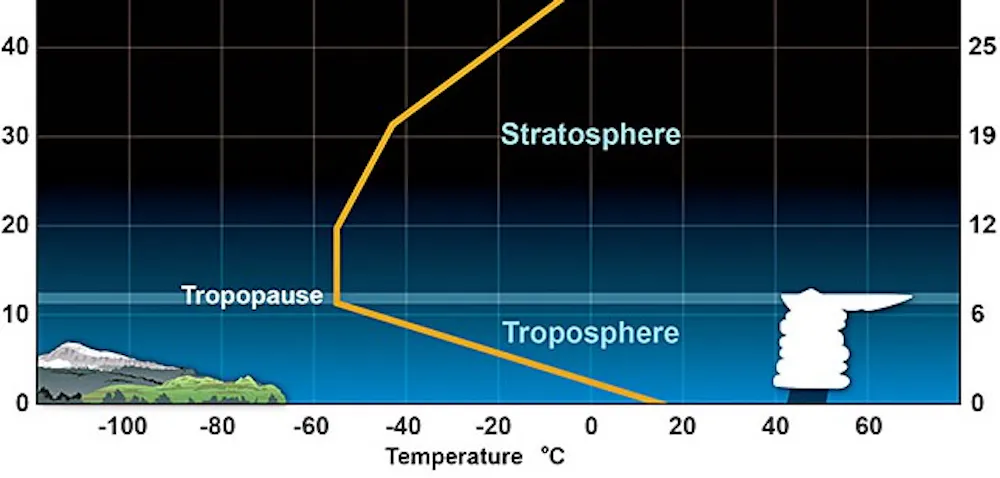
The National Weather Service issued severe storm warnings (pink) on Jan. 24, 2026, for a large swath of the U.S. that could see sleet and heavy snow over the following days, along with ice storm warnings (dark purple) in several states and extreme cold warnings (dark blue). National Weather Service Where does the polar vortex come in?The fastest winds of the jet stream occur just below the top of the troposphere, which is the lowest level of the atmosphere and ends about seven miles above Earth’s surface. Weather systems are capped at the top of the troposphere, because the atmosphere above it becomes very stable.
The stratosphere is the next layer up, from about seven miles to about 30 miles. While the stratosphere extends high above weather systems, it can still interact with them through atmospheric waves that move up and down in the atmosphere. These waves are similar to the waves in the jet stream that cause it to dip southward, but they move vertically instead of horizontally.
A chart shows how temperatures in the lower layers of the atmosphere change between the troposphere and stratosphere. Miles are on the right, kilometers on the left. NOAAYou’ve probably heard the term “polar vortex” used when an area of cold Arctic air moves far enough southward to influence the United States. That term describes air circulating around the pole, but it can refer to two different circulations, one in the troposphere and one in the stratosphere.
The Northern Hemisphere stratospheric polar vortex is a belt of fast-moving air circulating around the North Pole. It is like a second jet stream, high above the one you may be familiar with from weather graphics, and usually less wavy and closer to the pole.
Sometimes the stratospheric polar vortex can stretch southward over the United States. When that happens, it creates ideal conditions for the up-and-down movement of waves that connect the stratosphere with severe winter weather at the surface.
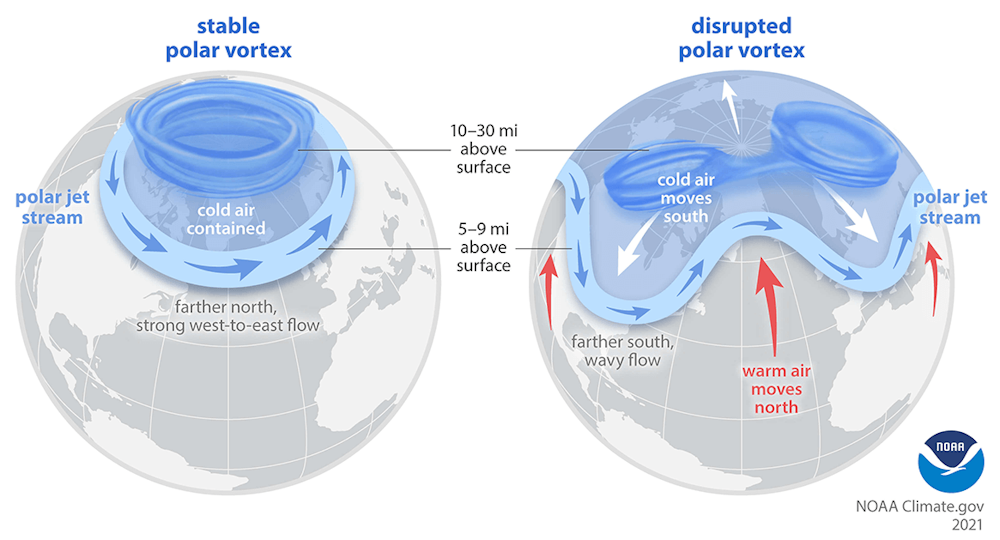
A stretched stratospheric polar vortex reflects upward waves back down, left, which affects the jet stream and surface weather, right. Mathew Barlow and Judah Cohen, CC BYThe forecast for the January storm showed a close overlap between the southward stretch of the stratospheric polar vortex and the jet stream over the U.S., indicating perfect conditions for cold and snow.
The biggest swings in the jet stream are associated with the most energy. Under the right conditions, that energy can bounce off the polar vortex back down into the troposphere, exaggerating the north-south swings of the jet stream across North America and making severe winter weather more likely.
This is what was happening in late January 2026 in the central and eastern U.S.
If the climate is warming, why are we still getting severe winter storms?Earth is unequivocally warming as human activities release greenhouse gas emissions that trap heat in the atmosphere, and snow amounts are decreasing overall. But that does not mean severe winter weather will never happen again.
Some research suggests that even in a warming environment, cold events, while occurring less frequently, may still remain relatively severe in some locations.
One factor may be increasing disruptions to the stratospheric polar vortex, which appear to be linked to the rapid warming of the Arctic with climate change.
The polar vortex is a strong band of winds in the stratosphere, normally ringing the North Pole. When it weakens, it can split. The polar jet stream can mirror this upheaval, becoming weaker or wavy. At the surface, cold air is pushed southward in some locations. NOAAAdditionally, a warmer ocean leads to more evaporation, and because a warmer atmosphere can hold more moisture, that means more moisture is available for storms. The process of moisture condensing into rain or snow produces energy for storms as well. However, warming can also reduce the strength of storms by reducing temperature contrasts.
The opposing effects make it complicated to assess the potential change to average storm strength. However, intense events do not necessarily change in the same way as average events. On balance, it appears that the most intense winter storms may be becoming more intense.
A warmer environment also increases the likelihood that precipitation that would have fallen as snow in previous winters may now be more likely to fall as sleet and freezing rain.
There are still many questionsScientists are constantly improving the ability to predict and respond to these severe weather events, but there are many questions still to answer.
Much of the data and research in the field relies on a foundation of work by federal employees, including government labs like the National Center for Atmospheric Research, known as NCAR, which has been targeted by the Trump administration for funding cuts. These scientists help develop the crucial models, measuring instruments and data that scientists and forecasters everywhere depend on.
Cleantech firm EnviroGold set to list on TSXV
Canadian cleantech firm EnviroGold Global (CSE: NVRO) is set to begin trading on the TSX Venture Exchange on Wednesday, Feb. 4, following exchange approval. Its ticker symbol will remain unchanged.
The TSXV listing is expected to provide increased access for institutional and international investors, improved trading liquidity, and broader market visibility, consistent with the company’s growth strategy, it stated in a press release on Monday.
EnviroGold is currently developing a hybrid acid leaching solution known as NVRO to recover gold and other metals from mine waste and tailings. The technology is designed to operate at low temperatures and atmospheric pressure to break sulphide bonds and recover valuable metals.
According to the company, its NVRO process is able to recover gold and silver at above 95%, with strong performance on copper and other base metals as well. The process is also expected to result in 70% reduction in plant footprint and capital requirements due to pre-concentration integration.
Compared to traditional methods, NVRO could reduce carbon emissions by up to 96%, EnviroGold said.
CEO Grant Freeman said the TSXV listing represents an “important milestone” for the company as it continues to advance its NVRO technology.
“A TSXV listing will provide an opportunity for institutions and international investors to participate in our growth, while supporting our mission to deliver scalable, lower-impact metal recovery solutions that complement traditional mining operations,” he said.
EnviroGold’s shares currently trade at C$0.11 apiece on the CSE with a market capitalization of C$51.5 million ($37.6 million).
Audubon Staff Contributes 164,307 Wildlife Camera Photos to “SnapshotUSA” Program
Pages
The Fine Print I:
Disclaimer: The views expressed on this site are not the official position of the IWW (or even the IWW’s EUC) unless otherwise indicated and do not necessarily represent the views of anyone but the author’s, nor should it be assumed that any of these authors automatically support the IWW or endorse any of its positions.
Further: the inclusion of a link on our site (other than the link to the main IWW site) does not imply endorsement by or an alliance with the IWW. These sites have been chosen by our members due to their perceived relevance to the IWW EUC and are included here for informational purposes only. If you have any suggestions or comments on any of the links included (or not included) above, please contact us.
The Fine Print II:
Fair Use Notice: The material on this site is provided for educational and informational purposes. It may contain copyrighted material the use of which has not always been specifically authorized by the copyright owner. It is being made available in an effort to advance the understanding of scientific, environmental, economic, social justice and human rights issues etc.
It is believed that this constitutes a 'fair use' of any such copyrighted material as provided for in section 107 of the US Copyright Law. In accordance with Title 17 U.S.C. Section 107, the material on this site is distributed without profit to those who have an interest in using the included information for research and educational purposes. If you wish to use copyrighted material from this site for purposes of your own that go beyond 'fair use', you must obtain permission from the copyright owner. The information on this site does not constitute legal or technical advice.
 This site is not the official webpage of the Industrial Workers of the World.