You are here

public sector workers

California Pensions Fail to Engage

By staff - Fossil Free California, June 2022

As the impacts of climate change begin to wreak havoc on our bisophere, the fossil fuel divestment movement has gained remarkable momentum. Globally, 1,500 institutions representing over $40 trillion in assets have already committed to some level of divestment from the fossil fuel industry.

Despite over a decade of pressure from their members, the California Public Employees’ Retirement System (CalPERS) and the California State Teachers’ Retirement System (CalSTRS) continue to invest billions in the fossil fuel industry on behalf of their beneficiaries. Studies have shown that if CalPERS and CalSTRS had divested from fossil fuels in 2010, they would have generated an estimated additional $17.4 billion in returns by 2019.23 So why do California’s public pension funds remain invested in the fossil fuel industry?

CalPERS and CalSTRS claim they are engaging with the fossil fuel industry as stakeholders to mitigate climate change by affecting the conduct of oil, gas, and coal companies. However, a review of their 2022 proxy votes reveals that their shareholder engagement efforts are not only ineffective—they’re undermining climate action.

Download a copy of this publication here (PDF).

EPA union urges Minnesota Supreme Court to take up PolyMet case

By staff - Duluth News Tribune, March 10, 2022

DULUTH — The union representing many midwest employees of the U.S. Environmental Protection Agency have asked the Minnesota Supreme Court to take up a PolyMet case challenging the proposed copper-nickel mine's water permit.

The American Federation of Government Employees Local 704 and other groups filed briefs urging the court to reconsider a January decision by the Minnesota Court of Appeals affirming a 2020 decision by a State District Court judge who said the Minnesota Pollution Control Agency broke no laws or procedures by asking the EPA to keep comments on the permit private. It acknowledged such a move was made to prevent comments from reaching the public and leading to "bad press."

In 2019, AFGE Local 704 said it learned from a whistleblower that comments by the EPA Region 5 office in Chicago on a draft of PolyMet's National Pollutant Discharge Elimination System, or NPDES, were left out of the public record.

“Simply put, when a government agency acts in secret — or deliberately obscures its motives or reasoning — it becomes difficult to tell whether the agency’s actions were lawful or fair," the union wrote in its brief.

EPA Officials Interfered with Chemical Safety Studies

By staff - Union of Concerned Scientists, February 17, 2022

What happened: Officials at the Environmental Protection Agency (EPA) directed agency staff to alter certain chemical safety studies in a way that downplayed the chemical’s health risks. EPA officials have pressured staff to alter hazard information, undermine research, and remove scientific information on potentially toxic chemicals.

Why it matters: By interfering with chemical safety studies, EPA officials undermined one of the major ways by which the federal government protects people from exposure to toxic chemicals. Not only does this action violate the Toxic Substances Control Act (TSCA), but it also endangers the health and safety of communities across the US, especially underserved communities.

Officials at the Environmental Protection Agency (EPA) are pressuring agency employees to tamper with the risk assessments of dozens of hazardous chemicals by excluding evidence of adverse health impacts. Reports of deleted language and major revisions in chemical risk assessments against the consent of agency scientists in response to higher management violates the rules and regulations as outlined by the Toxic Substances Control Act (TSCA) of 1976 which states the EPA is required to uphold the “reporting, record-keeping, and testing requirements and restrictions relating to chemical substances and/or mixtures.”

Four EPA scientists who worked at the agency's Office of Chemical Safety and Pollution Prevention stated that they had experienced numerous incidents in which management and staff pressured them or their colleagues to alter risk assessments in a way that fell out of line with the best available scientific evidence. In a complaint submitted to the EPA inspector on behalf of the four scientists, these unauthorized interferences include deleted language identifying potential adverse effects of toxic chemicals, major revisions that alter the conclusions of a toxic chemical’s toxicity, and risk assessments being assigned to inexperienced employees to avoid pushback.

Phased down and out at COP26

By Stephen Smellie - Unison, November 15, 2021

As proceedings ended at COP26 late on Saturday night, the Glasgow Climate Pact joined a long list of previous agreements, arrived at by world leaders, that have failed to ensure global temperatures stop rising.

The sum of all the commitments given before and during the two-week jamboree is that the Earth is heading for a 2.4 degree increase rather than being held back to 1.5 degrees. This, according to the prime minister of Barbados, will be a death sentence for many small island communities.

COP president Alok Sharma claims that the 1.5 target is still alive; but as many people have said, it is on life support and slipping away.

The hopes for COP26 were high. The stakes were even higher. The science is clear – if we do not cut the emission of greenhouse gases such as CO2 and methane by significant amounts by 2030 we will not meet the target of being net zero by 2050 and the planet will overshoot 1.5 by some way.

As an official observer at COP26 with the International Trade Union Confederation (ITUC), I was privileged to spend the second week in the COP26 blue zone, working with a team of trade unionists from across the globe.

The ITUC’s aims were to lobby the government representatives to ensure that the historic commitment in the Paris Agreement to “ensure Just Transitions that promote sustainable development and eradication of poverty, and the creation of decent work and quality jobs” was retained in the final Glasgow agreement. That was achieved.

However, the lobbying of the ITUC, along with other NGOs and many Global South countries, to secure the $100 billion for mitigation and adaptation in the developing countries by 2020, a mechanism for paying for loss and damage for the impact of climate change that is already happening, and a clear intention to reduce emissions, was not successful.

It is true that the Glasgow Climate Pact recognises, for the first time, the need to address the use of fossil fuels, but it does not set any targets, relying on countries to improve on their existing plans to reduce the burning of climate changing fossil fuels. However, in the final hours, even the limited commitment to “phase-out the use of unabated coal” was watered down by an amendment from China and India to change “phase out” to “phase down”.

Scotland's Rail Unions at COP 26

Rail Unions call for action on climate change

By staff - Transport Salaried Staffs' Association, November 10, 2021

TSSA, ASLEF, RMT, and Unite unions today united with Jeremy Corbyn and the STUC at COP26 to call on the Scottish Government to invest in Scotland’s Railways in order to fight climate change.

The unions held an event in Websters Theatre to promote their report “A Vision for Scotland’s Railways” which calls for better investment in railway infrastructure and staffing in order to encourage passengers back onto the railway. The report argues that staffed stations are safer at night and more accessible for passengers with disabilities.

Jeremy Corbyn said, “The land taken up by railways compared to roads is utterly minimal… For environmental considerations railways are the right way forward and this document indicates all of that.”

TSSA Organiser Gary Kelly said, “It’s not just the climate which is code red, it’s the railway itself. We're in the middle of a climate catastrophe when rainfall puts the railway at risk and the government's answer is to cut Network Rail staff. We're facing a real Code Red here. The question is what are we going to do about it?

ASLEF Organiser Kevin Lindsey said, “We want to see our vision become the template…. It’s crucial that passengers have an input, whether that’s people representing women, people representing young people or people representing disabled passengers, or just general passengers we want all voices to be heard. It’s so crucial to have a railway for all of Scotland.”

RMT Organiser Mick Hadley said “If we are serious about addressing the concerns about Scotland by giving the most vulnerable people access to trains, we need to give them access to staff - we need station staff to ensure it's safe to use Scotland's trains”

The unions criticised privatisation for failing both ScotRail and the people of Scotland.

Unite the Union Organiser Pat McIlvogue said, “All Abellio are concerned about is the profit, not concerned about the service, not concerned about the people, not concerned about the country. We've got a chance for a change now.”

Chairing the event, STUC General Secretary Roz Foyer said, “The current rail model fails services users and employees. We have a real opportunity when Scottish Government takes over ScotRail in April… There's an absolute need for us to mobilise people to demand that it stays a public service”

The tragic events at Stonehaven show climate change is real - it's here we're living with the effects. We need change. The rail unions are committed to working together to make that change happen.

Better public transport is the only way to cut carbon emissions, unions and campaigners urge

By Niall Christie - Morning Star, November 10, 2021

Cop26 summit ignores rail, buses, ferries and bicycles and puts its focus on cars and planes instead.

CREATING universal and comprehensive public transport is the only way to effectively cut carbon emissions from travel at home and abroad, unions and campaigners have said during Cop26.

Campaigners and politicians condemned the lack of consideration of rail, bus, ferry and cycle transport during proceedings at the summit today, where the focus was put on cars and planes instead.

Officials and delegates at the gathering in Glasgow made a number of announcements on transport, including on zero-emissions vehicles, so-called green shipping corridors, and on decarbonising air travel.

Tory Transport Secretary Grant Shapps said that travel, including aviation, should be “guilt-free.” He also said that the government did not see flying as “the ultimate evil,” after officials, including Prime Minister Boris Johnson, were condemned for using planes for short journeys during Cop26.

But unions and campaign groups highlighted the need for stronger rail and bus services throughout Britain, and backed public ownership to ensure that services work for all.

Before talks began at the conference hall on the River Clyde, a large demonstration took place in George Square with demands for equal access to transport systems in the summit’s host city.

Delegates at the summit have been given a travel pass which grants free travel on buses, trains and the subway system.

But no integrated travel system exists in Scotland, and the cost of the largely privatised sector has been on the rise in recent years.

Friends of the Earth Scotland transport campaigner Gavin Thomson told the Morning Star that only a radical overhaul of the transport system can deliver a just transition to a greener planet.

“We need to start thinking about transport like we do about health and education: as so important to public life that it’s paid for out of general taxation and free at the point of use,” he said.

“Not just because we drastically need to reduce emissions from transport, but because it is so important to things like education, employment and reducing social isolation.”

Trade union leaders joined the call for focus on public transport, with STUC deputy general secretary Dave Moxham asserting that the free market has no place in the sector.

The alternative is to run our own bus and rail networks, he said, adding that now is the time to act.

A Transport Scotland spokesman said the government “is taking forward a comprehensive suite of measures to promote more sustainable, affordable public transport journeys and deprioritise car use.”

At an event organised by the Peace and Justice Project, rail unions set out their vision for the railways.

Kevin Lindsay, Aslef’s organiser in Scotland, said that rail in Scotland will largely remain privatised even after Scotrail returns to public hands next year.

In a move towards providing a railway for all, he said that everybody under the age of 24 should be given free transport on rail services.

RMT organiser Mick Hogg said he was increasingly concerned about suggested cuts to services, and called for passengers, vulnerable communities and railway infrastructure to be put first.

We Own It director Cat Hobbs said that Britain must bring buses and trains back into public ownership and control.

“We can’t tackle the climate crisis unless we give people a real alternative to cars and planes, instead of just trying to make them greener,” she said.

“We need a decent, affordable, high-quality public transport network that we can all rely on, to make the best use of shared resources.

“The privatisation money-grab of the last 30 years hasn’t served passengers or the planet.”

Former Labour leader Jeremy Corbyn said there must be an increase in rail capacity from north to south, and called for urgent action to protect the future of the railways in Scotland and beyond.

The transfer of Scotrail to public hands must be the beginning of full public ownership of public transport in Britain, he said, adding: “Get the leeches off the railway, get the staff into the trains, and get the public back onto the railway.”

Refuse workers take strike action during COP26 climate talks

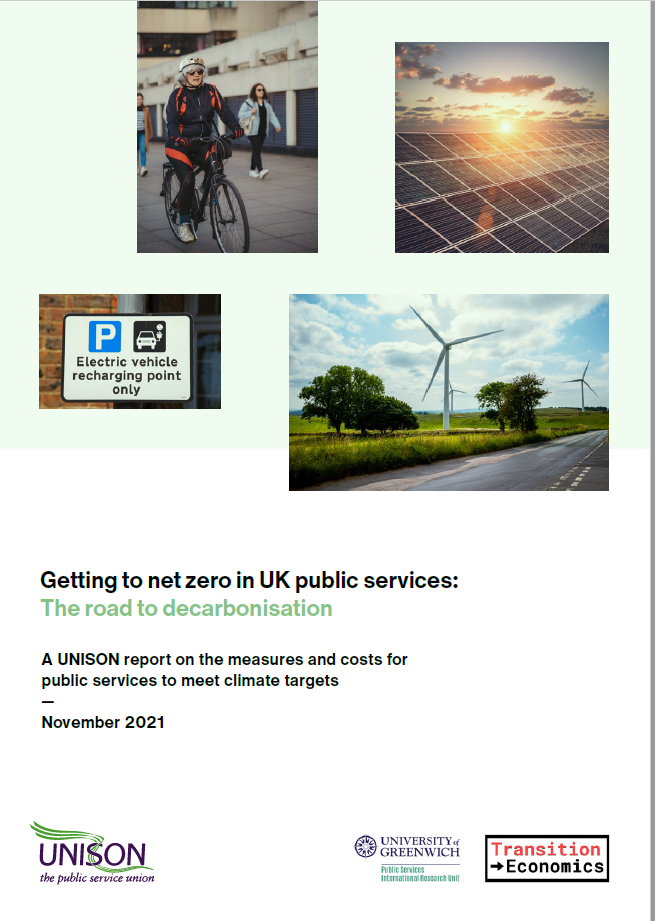
Getting to Net Zero in UK Public Services: The Road to Decarbonisation

By Dr. Vera Weghmann, et. al. - Unison, November 2021

Public services as a whole (excluding transport) represent about 8% of the UK’s direct greenhouse gas emissions. The NHS alone represents about 4% of the UK’s emissions. When procurement, construction, and social housing are taken into account, public services’ impacts are much greater.

Different sectors within the overall framework of public services have declared their decarbonisation plans. Some are ahead of the national targets. The NHS has declared that it will reach net zero by 2040, with an ambition to reach an 80% reduction by 2028 to 2032. More than one-third of local authorities (single- and upper-tier) committed themselves to decarbonise their local area by or before 2030.

The government aims to reduce direct emissions from public sector buildings by 75% against a 2017 baseline by the end of the Sixth Carbon Budget.

This report identified 21 different measures that should be taken across buildings, transport, electricity generation, waste, procurement and land use along with costed measures for each of nine different public services.

In our analysis, the UK’s public services need a capital investment injection of over £140 billion to 2035 to meet their Net Zero obligations. This will set the public sector on track to meet their climate targets and contribute to the UK’s overall carbon reduction aims. The analysis also identified measures that required annual operational expenditures of £1 billion to hit net zero targets. UNISON fully advocates that quality public services are best delivered by public ownership of public services and utilities rather than privatisation, outsourcing or PFI contracting of public services.

As well as improving the quality of life for service users, workers and the wider community, a number of the measures will also result in significant savings to public services’ budgets, through lower energy bills, cheaper to run fleets, and procurement savings. UNISON fully advocates that quality public services are best delivered by public ownership of public services and utilities rather than privatisation, outsourcing or PFI contracting of public services.

Read the text (PDF).

Postal banking services begin in Nova Scotia, Alberta and the US

By Elizabeth Perry - Work and Climate Change Report, October 12, 2021

The Canadian Union of Postal Workers (CUPW) announced that Canada Post will launch postal banking, with pilot sites opening in Nova Scotia in September and in Alberta in October. The goal is to offer the new financial services in over 249 Canada Post locations before the end of 2021. (Financial Services Update #4, July 2021). This brings to fruition an initiative which began with the 2012-2016 collective agreement between CUPW and Canada Post, and its Appendix T: Service Expansion and Innovation and Change Committee. That Appendix secured the right “to establish and monitor pilot projects which will test the viability of the proposals” to expand services, as envisaged in the Delivering Community Power campaign. That larger campaign, which still continues, is meant to green Canada Post, and includes postal banking, conversion of the postal fleet to electric vehicles, provision of electric vehicle charging stations at Canada Post outlets, and more. The test program offers unsecured loans, and will run in collaboration with TD Bank. CUPW continues to work to establish a postal banking service independent of the big banks, as stated in Financial Services Update #5 (Sept. 2021). The arguments for postal banking appear on the CUPW website, and in Why Canada Needs Postal Banking, a research paper published by the Canadian Centre for Policy Alternatives in 2013.

The U.S. Postal Service also launched a pilot project to offer banking services in four cities in September, allowing customers to cash payroll or business checks of up to $500 and have the money put onto a single-use gift card, which the postal service already sold. The back story is described in “USPS begins postal banking pilot” (American Prospect, October 11), and in “Postal Banking Could Become a Reality Even Without Congress. Here’s How” (In these Times, May 2018). As in Canada, the American Postal Workers Union negotiated a Memorandum of Agreement as part of its 2016 collective bargaining agreement, which called for a joint labor/​management task force to consider pilot programs for opportunities to increase revenue – including two specific ideas: ​“modernization of money orders” and “expansion of international money transfers.” The APWU is an important member of the coalition, Campaign for Postal Banking , whose website chronicles the U.S. campaign.

Pages

The Fine Print I:

Disclaimer: The views expressed on this site are not the official position of the IWW (or even the IWW’s EUC) unless otherwise indicated and do not necessarily represent the views of anyone but the author’s, nor should it be assumed that any of these authors automatically support the IWW or endorse any of its positions.

Further: the inclusion of a link on our site (other than the link to the main IWW site) does not imply endorsement by or an alliance with the IWW. These sites have been chosen by our members due to their perceived relevance to the IWW EUC and are included here for informational purposes only. If you have any suggestions or comments on any of the links included (or not included) above, please contact us.

The Fine Print II:

Fair Use Notice: The material on this site is provided for educational and informational purposes. It may contain copyrighted material the use of which has not always been specifically authorized by the copyright owner. It is being made available in an effort to advance the understanding of scientific, environmental, economic, social justice and human rights issues etc.

It is believed that this constitutes a 'fair use' of any such copyrighted material as provided for in section 107 of the US Copyright Law. In accordance with Title 17 U.S.C. Section 107, the material on this site is distributed without profit to those who have an interest in using the included information for research and educational purposes. If you wish to use copyrighted material from this site for purposes of your own that go beyond 'fair use', you must obtain permission from the copyright owner. The information on this site does not constitute legal or technical advice.