You are here

agricultural workers and peasants

Gulf South for a Green New Deal Policy Platform

By Colette Pichon Battle, et. al. - Gulf South Rising, Spring 2019

The Gulf South is uniquely positioned to be a national leader in the movement for a Green New Deal. With the climate crisis accelerating faster than even most scientific predictions, deep investment in Gulf South frontline communities will yield an opportunity for this region to be a global leader in equitable approaches to a socio-economic transformation that builds wealth and sustainability for the nation and the world.

Gulf South for a Green New Deal is a multi-state effort to address the impact of the global climate crisis on some of the most unique communities in the US. In May 2019, more than 800 advocates, farmers, fisherfolk, and community leaders from across the Gulf South gathered in New Orleans around a shared vision to advance regional sustainability in the face of the global climate crisis.

The creation of the Gulf South for a Green New Deal (GS4GND) Policy Platform was a six-month process anchored by the Gulf Coast Center for Law & Policy (GCCLP). Using techniques from the People’s Movement Assembly Process, GCCLP facilitated a five-state process of formalizing frontline voices. Through a broader regional organizing effort, over 100 original signatories are listed herein. Additional signatories will be updated quarterly.

This document is a collective assertion that the Gulf South must be included in the development of national policy. This platform is not a comprehensive policy vision, but rather a starting point and living tool of regional alignment and broad organizing in the Gulf South. The principles, goals, and strategies of this Policy Platform are offered to address what a Green New Deal must look like to be successful in the Gulf South.

We offer this document as a step towards climate justice, self-determination, and dignity for all people everywhere.

As goes the South, so goes the nation.

Night Work: A Growing Trend in Western Agriculture?

By staff - Western Center for Agricultural Health and Safety, March 7, 2019

Farming doesn’t stop just because the sun sets. Across the West, a variety of crops are harvested at night, such as wine grapes, tomatoes, onions, garlic, and corn. Harvest, equipment transportation, set up, and maintenance as well as field prep and repairs, irrigation work, and pesticide application are other activities done at night.

Night Work is Increasing

The general, unofficial consensus among a number of professionals involved in agriculture is that night work is increasing. Possible reasons include rising temperatures and heat illness prevention regulations, increasing labor shortages, product quality and taste preferences, time-sensitive harvests, and avoidance of pests.

“The area’s cool nights create better working conditions—not only is the temperature more tolerable, but bees and rattlesnakes stay away at night” explains Lino Bozzano, VP of Vineyard Operation, in the Laetitia Vineyard and Winery blog, “Why We Harvest Fruit At Night.” Head Winemaker, Eric Hickey adds that “grapes are firmer, making them easier to work with.”

Standard databases provide limited information. For example, the Bureau of Labor Statistics public records report the time of non-fatal injury by fixed time frames that cross day- and nighttime hours (e.g., 4 pm to 8 pm), making it difficult to determine how many accidents occur in the dark or how many accidents occurred from actual farm work versus transportation to and from the work site.

No More Toxic Chemicals in Agriculture!

By Farmworker Association of Florida - La Via Campesina, December 7, 2016

December 3, 1984 was a day of infamy that resounded around the world.  Today, we say "No more" to poisoning of people and the planet!

Thirty-two years ago, on this day, a leak at a Union Carbide pesticide plant in Bhopal, India resulted in a horrendous tragedy that poisoned hundreds of thousands of innocent people in the middle of the night and early morning hours of December 3rd.  More than 30 tons of the pesticide methyl isocyanate were released into the air, causing widespread panic and suffering, as some 600,000 men, women and children experienced severe symptoms from exposure to the toxic gas and several thousand victims died.   In the ensuing years, there have been another estimated 15,000 deaths related to the pesticide accident, and an untold number of children born with physical and/or mental health problems.

Today, we remember Bhopal and all the innocent victims who were needlessly harmed and killed.  But, sadly, this is still happening - in smaller ways - all the time all over the globe.  As long as transnational agrochemical companies continue to grow, gain power, produce and distribute increasingly more toxic agricultural chemicals, people, animals, the air, land, water and our food around the world will continue to be contaminated by pesticides, while corporations profit at the expense of health, human rights and a safe environment.  And, farmworkers are often the first ones on the frontlines of these exposures. 

AGROTOXICOS DAY is a call to action (español) to peel back the curtain on the myths surrounding the lies the agrochemical industry tells the world.  Small-scale, local and sustainable agriculture is the true key to end world-wide hunger and to pull communities out of poverty, disenfranchisement and disempowerment.   Millions of acres of agricultural land world-wide are dominated by the cultivation of a few crops - corn, soy, palm oil, sugar cane - that do not feed people at all, but are used for fuel and other products.   Agriculture must return to its origins of being deeply rooted in communities and in working with, not against the earth.

In October, the Farmworker Association of Florida sent a delegation to Brazil to meet with others from South America to share information and develop networks and strategies of resistance to the domination by transnational corporations coopting agriculture.  In Florida, FWAF has four community gardens projects at which we are learning and practicing agroecological principles.  These gardens are a grassroots form of resistance to the dominant culture of agriculture. 

Stand up today and demand "no more toxic chemicals" in agriculture

International Day of the Struggle Against "Agrotoxicos"

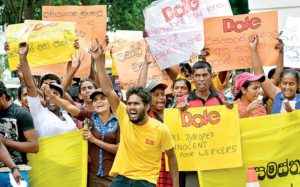
Government prepares to legitimize Dole Lanka’s illegitimate endeavors company allowed to retain forest land illegally encroached?

By Sajeewa Chamikara - La Via Campesina, January 19, 2018

Movement for Land and Agriculture Reform (Monlar)

The current United National Front for Good Governance (UNFGG) administration seems to be continuing the support given to Dole Lanka Private Limited, which has illegally cleared protected forests, which acted as catchment areas and destroyed farm lands owned by small holders, given by the Mahinda Rajapaksa administration. The Department of Forest Conservation has obtained court orders to remove farm lands operated by Dole Lanka Private Limited, scattered in various lands owned by the department in the Sri Lankan dry zone. However the government has halted the implementation of these court orders and is attempting to hand over the land to the controversial company.

The first step of this legitimization of Dole was the cabinet paper (CP 16/1934/752/023) regularizing the land used for banana cultivation by Dole Lanka Private Limited in Kuda Oya and Demodara in Moneragala district’ on September 15, 2016 by Malik Samarawickrama, Minister of Development Strategies and International Trade. President Maithripala Sirisena, as the minister of Mahaweli and Environment as well as the ministers of Lands and Finance has also noted their observations to the cabinet paper. The note to the cabinet by President Maithripala Sirisena clearly states that Dole Lanka Private Limited has not obtained the permission of the Department of Forest Conservation to establish these banana plantations. The note also states that the Dole Lanka Private Limited has admitted before court that it is using the lands in Kuda Oya and Demodara without permission or approval. However the cabinet memorandum has recommended to seek the advice of the Attorney General to come into an agreement with Dole Lanka Private Limited, so that the company can continue to use the lands. Thus the Attorney General is studying how Dole Lanka Private Limited can keep on using these lands.

However according to the laws of the land, it is not possible to transfer the ownership of land that belong to the Department of Forest Conservation to Dole Lanka Private Limited, or any other private entity. The Commissioner of Lands can release lands for any investment, only if approval is granted by relevant agencies after conducting the necessary feasibility studies. The government can release the land, on long term lease, to a private entity, according to the Section 199 (G) of the land Ordinance, only after that requirement has been completed. For this the approval of the Minister of lands is needed and the land can be released after recommendations by the President.

Although this is the standard procedure when it comes to releasing land for an investment, a number of factors prevent Dole Lanka Private Limited from accessing state owned land. Chief among them is the fact that Dole Lanka Private Limited has encroached the land that belongs to the Department of Forest Conservation and has used these lands for several years illegally and the fact that they have used the land without any feasibility studies prior to the commencement of the project. Moreover the Forest Conservation Department has taken legal action against Dole Lanka Private Limited, for illegally maintaining farm lands in Kuda Oya and Demodara at the Wellawaya Magistrates’ Court (case numbers MC 215 and 216.) Given this context the attempts by the Cabinet to handover these illegally encroached lands to Dole Lanka Private Limited is a bad example.

Affected from the world, unite!

By Viviana Rojas - La Via Campesina, October 23, 2017

Nicinha’s body was found five months after her disappearance; she was an activist of the Brazilian´s Movement of People Affected by Dams (MAB) and was murdered last year, thousands of stories like this multiply throughout Latin America and in other parts of the world.

This crime has aroused outrage and national and international rejection. It has once again seen persecution and death against those who defend territories, water and dignified life, opposing the interests of capital and states, which, instead of guaranteeing the rights of the populations affected, are accomplices of these crimes.

But just as the repression and criminalization of the struggles has increased, we also see solidarity and internationalism as a potent strategy of peoples’ resistance against extractive capital.

From October 6 to 8, the “International Seminar: Energy Transition for a Popular Energy Project” was held, organized by MAB, a member of Via Campesina in Brazil, and the Movimiento de Afectados por Represa in Latin America (MAR). Among its main objectives are the denounce against current economic system and its energy model, the constant violations of human rights and the exploitation of the affected populations. And on that basis, strengthen unity, solidarity and define common strategies of struggles, both nationally and internationally, for a society alternative to capitalism.

Southern Africa Permanent Peoples Tribunal (PPT) on Transnational Corporations

By staff - La Via Campesina, August 16, 2016

For the Economic, Political, Cultural and Environmental Sovereignty of Our Peoples End the Impunity of Transnational Corporations NOW!

The time has come to unite our struggles in Southern Africa - the campaigns, networks, movements and organizations that are combating transnational corporations - the way they are exploiting our destinies, natural heritage and human rights, dismantling public services, destroying the commons, fomenting violence and endangering food sovereignty in every corner of the continent. 

The Southern Africa Campaign to Dismantle Corporate Power invites you to participate in the Permanent People’s Tribunal on Transnational Corporations. The Tribunal will bring affected peoples from Southern Africa together to make their problems visible, analyse them and collaborate and share experiences in order to strengthen our joint struggle.

The effort to unify Southern African struggles is one part of a major global campaign to fight the exploitation of our lands, our eco-systems, our labour and our bodies by big corporates acting together with powerful states. These mega transnational corporations have created a blanket of impunity – getting away with their crimes unpunished and without repercussions - through the dismantling and systematic violation of laws and the signing of international trade and investment agreements, which award investors more rights than citizens. As a result, peoples’ rights have been systematically violated, the Earth and its resources destroyed, pillaged and contaminated, and resistance criminalized, while corporations continue committing economic and ecological crimes with total impunity.

Driven by the imperative to maximize profit, TNCs seek to pit workers from different countries against one another in what is a race to the bottom for the world’s working people. The governance and policies of the multilateral institutions, the International Monetary Fund, World Bank and World Trade Organisations have long served corporate interests, while the institutions of the United Nations, Southern African Development community and the African Union have been increasingly captured by TNCs and placed at their service. In most countries, governments increasingly act at the service of corporate interests, awarding them with tax breaks and a legal system that works to their benefit. National elites use their access to political power and influence over state policy to position themselves so as to benefit from corporate power and stop at nothing to continue plundering the wealth of nations and maintain their predatory relation to nature.

Working class and peasant women carry the major impacts of corporate-led theft of land, water and forests, and the pollution of the resources that peoples across Southern Africa rely on for livelihoods and survival. The patriarchal division of labour means that women have to work longer hours and bear heavier burdens as they search out livelihood alternatives when land-based ones are destroyed, safe water when these resources are stolen or polluted, and alternative energy when forests are destroyed. And it is women’s unpaid labour that fills in for public services that are cut to service debts in support of major infrastructure investments that benefit corporates, and when workers and family members fall ill from environmental pollution and unsafe working environments.

In the face of mounting criticism of their operations, TNCs’ use Corporate Social Responsibility to clean up their image with minor investments and no change in destructive business practice. They recruit private security arms, often acting in collaboration with state militaries, to patrol their territories and enforce the compliance of communities through intimidation, arson, rape, sexual harassment and murder. And they control major media agencies, which play a key role in ensuring the continuity of corporate hegemony. Acting with brutality in the rich countries from which they originate, but especially in countries of the Global South, including those in Southern Africa, major corporations are appropriating more and more of our collective wealth and rights.

Yet, resistance is growing across the world and throughout our region. Every day, there are more communities, movements and peoples struggling against TNCs – often confronting specific companies or sectors and winning important victories. If we are to challenge corporate power and the system that protects and benefits TNCs it is necessary that we come together and offer a systematic response. 

We must unite our experiences and our struggles, learn collectively from our victories and our failures and share our analysis and strategies for putting an end to the impunity of TNC’s. We must converge our struggles within and across countries, regions and continents.

We must build on our ways of life, our forms of production, our ways of nurturing and living alongside eco-systems and each other in harmony and with love - it is these ways of being, seeing, relating and producing that are the basis for building an alternative society in which we, the people, are the protagonists.

Dismantling the transnationals’ system of power demands coordinated action at the regional level: engaging in struggles in various spheres and sectors of the economy, combining mobilizations on the streets and in territories with popular education and actions in parliaments, media and international forums and organisations. By creating a powerful movement of solidarity and action against TNCs, their apologists and promoters, we will begin to build a world free from corporate power and greed.

We, the Southern African Campaign to Dismantle Corporate Power, Stop Impunity, and Reclaim Peoples’ Sovereignty, welcome you to join us in collectively building this process of mobilization towards a campaign against the power of corporations and their crimes against humanity. The Permanent Peoples’ Tribunal will take place in three sessions: A first set of hearings in August 2016 in Swaziland, the second in May 2017, and soon after, the delivery of the verdict by a panel of respected judges.

To sign on to the Call to Action or to participate in the Tribunal email ilham@aidc.org.za

Our land is worth more than carbon: Civil Society Statement COP 22

By staff - La Via Campesina, November 16, 2016

The Paris Agreement required the 196 Parties to the UN Climate Convention to limit temperature increases to 2° or 1.5°C below preindustrial levels. While COP21 benefitted from a high degree of mobilization linked to the adoption of an international agreement, COP 22 on the other hand has received rather less attention. 

Yet the stakes remain significant. 

In its haste, COP 22, being called the “action COP” or the “agriculture COP”, is in danger of adopting various misguided solutions for agriculture. Last May at the Climate Convention HQ in Bonn, discussion on this sector was a source of tension between countries. They studiously avoided the key question of differentiating between agricultural models according to their impact on climate change and their ability to provide food sovereignty to people. At the same time, and outside official negotiating channels, voluntary initiatives, especially in the private sector, have expanded and may well become incorporated in countries’ future public policies. 

Although 94% of countries mention agriculture in their strategies for combating climate change, the Paris Agreement fails to mention the word “agriculture” even once. You have to read between the lines to understand what is really at stake. 

It is really the highly political subject of agriculture that hides behind the use of the expression “carbon sink”. It is true that the soil plays an important role in sequestering CO2 (carbon dioxide), turning it into a genuine “carbon sink”, like forests. Yet that is not soil’s only role, particularly if farming land that is central to food sovereignty is involved. Unfortunately its use (employing the expression “land use”) in combating climate change represents a huge opportunity currently for those promoting misguided solutions and serves as an excuse for public inaction. 

In searching for a balance between emissions and absorption by greenhouse gas sinks, the Paris Agreement enshrined the principle of compensation in dealing with the climate crisis. This notion does not mean that emissions actually have to decrease but that emissions and absorption can cancel each other out. This approach has already begun with forests through the highly controversial REDD+ mechanism and, to an increasing degree, is now targeting farming land, the new carbon Eldorado. 

We must remember that unlike avoided emissions, natural carbon sequestration is reversible and has a limited lifetime. So rather than attempting to reduce greenhouse gas emissions drastically, agriculture is becoming a unit of accounting permitting emissions to continue or even increase. Consequently, though roundly condemned by civil society and social movements, various initiatives have arisen around climate discussions that appear to many to be misguided solutions. This is the case with climate-smart agriculture and its global alliance (GACSA) which, in the absence of clear criteria, does a balancing act between promoting agroecology and the use of GM seeds and their herbicides. Moreover, 60% of GACSA’s private sector members are companies in the pesticide and agricultural input sector. 

This alliance and its concept are nothing more than an empty shell that agro-industrial multinationals can hide in to continue the industrialization of agriculture, to the detriment of smallholders. 

Similarly, the 4 per 1000 initiative fails to make clear choices in promoting transition in farming systems. Its scattergun approach to the problem fails to take account of considerations beyond carbon sequestration such as the use of herbicides for example. 

Unless there is a real re-examination of agro-industrial models that are highly dependent on chemical inputs and based on exports, such initiatives have absolutely no place in the list of solutions. 

Quite apart from the question of the agricultural model there is also the danger of pressure on land and the financialization of natural resources. Therefore by putting a value, through compensation, on farming land as a tool in combating climate change, you increase the pressure on it. So the small scale farmers who were already the first victims of climate change become doubly threatened. If we are to encourage investment in agriculture to sequester more carbon, especially from private sources, much greater expanses of land will be needed with an increased risk of land grabbing. This danger would be multiplied if the race for land were accompanied by mechanisms linked to carbon finance. Numerous studies on similar mechanisms developed for forests (like REDD+) have already demonstrated the dangers of an approach that pays scant consideration to protecting human rights. This approach to combating climate change opens the door ever wider to endangering small scale farmers’ rights and their acquired knowledge, food sovereignty and ecosystem integrity. 

Our organisations deprecate this rush towards compensation to tackle the climate crisis. Only immediate, drastic reduction of greenhouse gases will prevent a dramatic increase in the impact of this crisis even though it will still only limit it. Farming land cannot become an accounting tool for managing the climate crisis. It is fundamental to around a billion people in the world who are working towards food sovereignty, an inalienable right of people who have already been harmed enough. We support the continued existence of agriculture suited to meeting the agricultural challenges already magnified by the climate crisis. Such farming methods, based on peasant agroecology which, in addition to a store of good practice, imply socially- and ecologically-based farming rooted in its home territory and a rejection of the financialization of Nature.

The agricultural policy must serve the people

By Geneviève Savigny - La Via Campesina, March 30, 2017

Where have the consistency between the objectives and tools that prevailed in 1957 gone, when we signed the Treaty of Rome A radical shift in policy is necessary in the European Union.

Agriculture, a source of food and of numerous useful products for human life, concerns the whole of society. There was surely a sort of consensus between the agricultural world, policy makers and society on the role played by farmers and the objectives of an agricultural policy, when the Treaty of Rome, signed in 1957, laid the foundations for the first Common Agricultural Policy. It was first necessary to guarantee food security for people, and thereby produce more, modernize farms but also equip the houses of peasant families where several generations often lived together with the comfort already found in cities. The initial objectives and tools were consistent; increase agricultural productivity, ensure a fair standard of living for the agricultural population, stabilise markets, guarantee security of supply, and ensure reasonable prices for consumers. Cheap food would enable keeping low wages and foster Europe’s industrial development. 

Tea Plantation workers in Sri Lanka march for Food Sovereignty!

By staff - La Via Campesina, October 17, 2011

As part of the mobilisations to mark the International Day of Action for Peoples’ Food Sovereignty and against Transnational corporations, plantation communities in Sri Lanka has requested and demanded successive administrations to ensure that they have land rights, which is essential for dignified living. In this regard, Movement for Land and Agricultural Reform (MONLAR) and the people of the estates organised a People’s Caravan for Food Sovereignty from 8th to 13th October 2017. The caravan drew attention to a number of issues.

  • Ensuring the rights to own land

It’s been 150 years since tea plantations were established in the country. A few months ago the country celebrated this landmark with great pageantry, however the estate sector workers who have shed blood, sweat and tears to ensure that the tea production goes on, still live like slaves, stuck in squalid rooms of 400 square feet. This practice has to end. These workers must be granted at least a plot of 20 perches, by a deed, so that they can build a house, to farm and to raise a cow.

  • Stop the sale of properties that belong to estates

The government has commenced an initiative to sell the assets of Sri Lanka State Plantation Corporation (SLSPC), Elkaduwa Plantations and Janatha Estates Development Board (JEDB) cheaply and to close down the operations. Those who depended on work provided by these estates will soon lose their livelihoods.

By 1972 -75 the tea yields have dwindled and plantation companies started making losses due to mismanagement. Thus these estates were nationalized; however the export and sale of tea were left at the hands of private entities, which had earlier destroyed the plantations by mismanagement. This, coupled with state mismanagement and the world economic crisis, the estates continued to make losses and they were privatized again between 1992 -94.

Sri Lanka State Plantation Corporation (SLSPC) and Janatha Estates Development Board (JEDB) were left with 39 midland tea estates which yielded little harvest. Instead of taking steps to develop these estates, the administrators had continuously attempted to sell off the assets of these and that process has sped up under this administration. While the tea plantations are making losses, the workers are not responsible for the results of mismanagement by administrators.

Given the current economic trends and the nature of the ‘investors’ we have, it is obvious that they are not interested in developing these estates. They are more interested in converting the estate bungalows to tourist hotels, cutting down trees in the estates, selling the machinery for scrap metal, extracting granite and other mineral resources and the sale of land. After these resources are exhausted they will sell the land.

Final Statement of the Peoples’ Summit “WTO Out, Building Sovereignty”

By staff - La Via Campesina, December 20, 2017

The Peoples’ Summit “WTO Out, Building Sovereignty” gathered on December 11-13, 2017 in Buenos Aires, Argentina, against the XI Ministerial Conference of the World Trade Organisation (WTO) in this city.

The networks and trade unions, human rights, territorial, students, women, political, peasants, social and anti-extractives organizations amongst others from all over the world constituting the Peoples’ Summit reaffirm our rejection of free trade policies of the WTO. The WTO reflects the interests of a more concentrated transnational capital aiming to eliminate barriers to the free movement of goods, services and capital. It is an organization that only takes into account the needs of capital, helping the reproduction of capitalist relations of exploitation and looting. These policies affect rights conquered historically through the struggles of the peoples of the world.

Transnational corporations act under the umbrella of an Architecture of Impunity which includes the system of Debt, Free Trade Agreements (FTAs) and the protection of investments and multilateral organizations such as the WTO, which produce a form of globalization based on their desire for and pursuit of profit. In this context, public Debt has become one the main tools of capitalist expansion of concentration, inequality and oppression. It subordinates the models of production and consumption to the need to pay ever-increasing interests. We commit ourselves to work towards unveiling the repercussions that debt entails in the multiple forms of resistance, denouncing its illegitimate character, demonstrating who really owes what to whom and building a horizon of transformation and hope, while standing as People Creditors of debts that are not only economic, but also social, historical, ecological, democratic and gender, amongst others. We need to continue building from the struggles of the peoples to advance in this process, which includes actions such as comprehensive and citizen audits of Debt, ethical courts and popular consultations, amongst other strategies.

Faced with corporate power impersonating the dispossession of territories by transnational corporations, we commit ourselves to globalize the struggles and to continue strengthening ties and articulations. We must continue fighting to achieve an international treaty that ensures the respect of human rights by transnational corporations. We must dispute legislative and judicial spaces, denouncing how laws are violated, twisted, misinterpreted and adapted in the interest of transnational corporations. We must maintain the autonomy of social movements in relation to governments, emphasising our solidarity with persecuted and repressed Peoples, communities and organizations all over the world.

The liberalization of trade and financial flows unevenly impacts the daily lives of women and deepens inequalities and poverty by expanding unemployment, informality and compulsively financializing our lives, thus deepening all forms of patriarchal violence. Women, lesbians, trans, transvestites, bisexuals, gays, non-binaries, Afro-Argentines, afro-descendants, migrants, displaced, refugees, indigenous, blacks, peasants, self-managed workers gathered in the forum and the great Feminist Assembly against free trade affirm our anti-patriarchal, anti-racist and anti-capitalist struggle.

Pages

The Fine Print I:

Disclaimer: The views expressed on this site are not the official position of the IWW (or even the IWW’s EUC) unless otherwise indicated and do not necessarily represent the views of anyone but the author’s, nor should it be assumed that any of these authors automatically support the IWW or endorse any of its positions.

Further: the inclusion of a link on our site (other than the link to the main IWW site) does not imply endorsement by or an alliance with the IWW. These sites have been chosen by our members due to their perceived relevance to the IWW EUC and are included here for informational purposes only. If you have any suggestions or comments on any of the links included (or not included) above, please contact us.

The Fine Print II:

Fair Use Notice: The material on this site is provided for educational and informational purposes. It may contain copyrighted material the use of which has not always been specifically authorized by the copyright owner. It is being made available in an effort to advance the understanding of scientific, environmental, economic, social justice and human rights issues etc.

It is believed that this constitutes a 'fair use' of any such copyrighted material as provided for in section 107 of the US Copyright Law. In accordance with Title 17 U.S.C. Section 107, the material on this site is distributed without profit to those who have an interest in using the included information for research and educational purposes. If you wish to use copyrighted material from this site for purposes of your own that go beyond 'fair use', you must obtain permission from the copyright owner. The information on this site does not constitute legal or technical advice.