






You are here
green jobs
 Tackling climate change is good for the economy, good for business and good for people. This is the narrative often pushed out by campaigners, researchers and governments around the world.
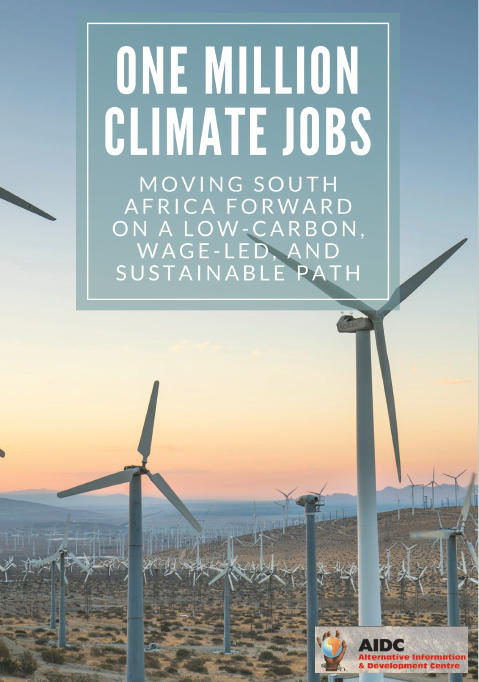 The One Million Climate Jobs Campaign is an alliance of labour, social movements and popular organisations in South Africa that is campaigning for the creation of a million climate jobs as part of a collective approach to the crisis of unemployment and climate change. The Campaign was launched in 2011 and since then has been mobilising thousands of South Africans around real solutions to slowing down climate change, protecting the natural environment, improving the quality of life for all and moving towards a sustainable development path. Climate change will exacerbate inequality and poverty because it reduces access to food, water, energy and housing. Thus it is vital that social justice struggles around these issues incorporate struggles around climate change.
 EDMONTON — A group of oil-and-gas workers has a plan to create job opportunities and retrain workers for clean energy projects, and they are calling on the federal government to step up.
 Back in the 1970s, with unemployment rising and British industry contracting, workers at the arms company Lucas Aerospace came up with a pioneering plan to retain jobs by proposing alternative, socially-useful applications of the company’s technology and their own skills. The ‘Lucas Plan’ remains one of the most radical and forward thinking attempts ever made by workers to take the steering wheel and directly drive the direction of change.
  Alberta has a meaningful plan to enable the growth of a clean energy industry, with commitment to 30% of electricity generated by renewable sources by 2030, and phasing out pollution from coal-fired generation. A portion of the anticipated revenues from the province’s economy-wide carbon levy will be used to enable these efforts. This provides a great opportunity for sustainable employment growth in the clean energy sector. This is in line with the global trends of declining investment and employment in the coal industry, while investment and employment in the renewable sector expands.
 The ACTU is primarily concerned with workers, their rights, their welfare and their future. A just and civil society is one where everyone shares in the wealth of the nation but it is also one where economic costs are equally shared.
The Fine Print I:
Disclaimer: The views expressed on this site are not the official position of the IWW (or even the IWW’s EUC) unless otherwise indicated and do not necessarily represent the views of anyone but the author’s, nor should it be assumed that any of these authors automatically support the IWW or endorse any of its positions.
Further: the inclusion of a link on our site (other than the link to the main IWW site) does not imply endorsement by or an alliance with the IWW. These sites have been chosen by our members due to their perceived relevance to the IWW EUC and are included here for informational purposes only. If you have any suggestions or comments on any of the links included (or not included) above, please contact us.
The Fine Print II:
Fair Use Notice: The material on this site is provided for educational and informational purposes. It may contain copyrighted material the use of which has not always been specifically authorized by the copyright owner. It is being made available in an effort to advance the understanding of scientific, environmental, economic, social justice and human rights issues etc.
It is believed that this constitutes a 'fair use' of any such copyrighted material as provided for in section 107 of the US Copyright Law. In accordance with Title 17 U.S.C. Section 107, the material on this site is distributed without profit to those who have an interest in using the included information for research and educational purposes. If you wish to use copyrighted material from this site for purposes of your own that go beyond 'fair use', you must obtain permission from the copyright owner. The information on this site does not constitute legal or technical advice.
 This site is not the official webpage of the Industrial Workers of the World.