You are here

ecosocialism

(Working Paper #4) Power to the People: Toward Democratic Control of Electricity Generation

Press Release - Trade Unions for Energy Democracy, June 24, 2015

Unions welcome new report highlighting the need to ‘reclaim’ and democratize the energy system and to promote publicly owned renewable power

Globally, the energy system is failing to protect workers and communities.  Airborne and water pollution levels are out of control, especially in Asia. Energy-related emissions continue to rise as more fossil-based power comes on line. Union leaders say the struggle for democratic control of electrical power generation is central to the struggle for a healthier, safer and fairer world. A major scale-up of publicly owned but democratically controlled renewable power is required. Public renewable power will make it possible to conserve energy, control and then reduce demand, and begin to make transport as well as electrical power less dependent on fossil fuels. A truly “just transition” for workers and communities will require re-asserting the public good over private greed.

A new Trade Unions for Energy Democracy (TUED) working paper titled Power to the People: Toward Democratic Control of Electricity Generation shows how “another energy is possible, and absolutely necessary.” It succinctly explains the failure of profit-driven approaches to either emissions reductions or controlling energy demand. The TUED paper, published by the Rosa Luxemburg Stiftung–New York Office, examines the actual and potential content behind the term energy democracy in order to help unions get a better grasp of what is happening now and what could happen in the future. It discusses the major “fronts” on which the struggle for democratic control of power generation is currently expressing itself: cooperatives in the renewable energy sector and their potential contribution to energy democracy, as well as recent attempts to reclaim electrical power generation at the municipal level. The 4-part paper also examines the historical experience of the “public works” approach to energy transition during the New Deal in the United States and, in particular, the Rural Electrification Administration—a model of state-cooperative interaction and partnership replicated successfully in numerous countries during the post-World War II period. It proposes that a “Renewable Energy Administration” is needed today.

Unions and social movements have the power to help create a new energy system, one that will be located at the heart of a new political economy grounded in equity, true sustainability, and economic democracy. This paper, co-authored by Sean Sweeney (Murphy Institute, CUNY) Kylie Benton-Connell (New School for Social Research) and Lara Skinner (Worker Institute at Cornell) explores concrete possibilities for moving toward this goal.

According to Sweeney, the coordinator of TUED, “The paper is not a blueprint. It shows what is happening, and also what needs to happen in order to reduce emissions and pollution in a way that shifts power toward workers and communities. Its main message is, if we want to control atmospheric warming and to protect our common home, then we have to get serious about reclaiming and democratizing energy.  Unions in different countries and from all sectors are increasingly aware of the need to do this.”

Capitalism vs. Ecology: We Need to Change Everything! Resistance and Alternatives

By the Centre for Social Justice and Socialist Project - Socialist Project, June 21, 2015

Disclaimer: The views expressed here are not the official position of the IWW (or even the IWW’s EUC) and do not necessarily represent the views of anyone but the author’s.

It is no longer plausible to propose incremental solutions to the ecological crises of our time. The numbers are clear: to avoid a trillion metric tons of cumulative carbon emissions by 2039, and an increase in global average temperatures of 2°C, it is necessary to stabilize immediately Greenhouse Gas emissions. The ecological scars of desertification, coastline loss, species extinction, destruction of habitat, and much else is evident for all to see.

The main culprit of runaway climate change and environmental degradation, as Naomi Klein points out in her new book, is the economic system itself: capitalism. This is a class system that requires endless growth and is incompatible with sustainability and meaningful climate action. Market solutions from the last decades of neoliberalism have miserably failed. The tactics of even "Big Green" environmental groups have too often pursued immediate reforms that fail to address the real sources of the crisis in the unequal relations at work, the need for endless consumption, and the hollowness of democracy today.

But what might serve as an alternative political program for an ecological transition? Where might new radical political movements emerge to carry forward such an ecological revolution? Is "Blockadia" enough? Or is there even more needed to, as Klein suggests, "build the world that will keep us all safe"?

Moderated by Lana Goldberg. Presentations by:

  • Niloofar Golkar is a Toronto-based activist with Rising Tide Toronto and a graduate student in the Department of Political Science at York University.
  • Greg Albo is a professor of Political Economy at York University, co-editor of the Socialist Register (recent volume: Transforming Classes), and director of the Centre for Social Justice.
  • Jodi Dean is a professor in the Political Science department at Hobart and William Smith Colleges in New York State. She has been active in the We Are Seneca Lake anti-gas struggle and is the author of Democracy and Other Neoliberal Fantasies (2009), Blog Theory (2010), and The Communist Horizon (2012), among others.

The forum was sponsored by: Centre for Social Justice and Socialist Project.

NUMSA and allies call for dismantling the ‘mineral energy complex’

By NUMSA - Trade Unions for Energy Democracy, June 19, 2015

Electricity Crisis Conference Declaration

  1. Introduction:

We, as representatives of trade unions that organise in the energy sector and delegates from communities that are struggling around outages, loadshedding, high electricity prices and poor quality of energy services, met for four days (from 02 to 05 June 2015) in the midst of what we consider as a far-reaching electricity crisis in our country. As we met, on the table of the National Energy Regulator of South Africa (Nersa) is an application by South Africa’s electricity utility – Eskom – for a 25.3% increase in the price of electricity for the year 2015/16 to 2017/18. As we met, Nersa had agreed to grant municipalities an above-inflation increase of 12.2% from 01 July 2015 and that nine municipalities were applying for average increases above the Nersa increase guideline of 12.2%. We also gathered when delegates at this conference from two municipalities were unsure whether they will reach their homes at the end of our deliberations still with some power, as Eskom threatened to plunge into darkness their defaulting municipalities today.

The electricity crises that face us worsen with each day that passes. The crisis is multipronged. It is a supply crisis and chronic load-shedding. What we see is a financial meltdown of Eskom; massive cost and time overruns in the build programme of new power plants such Medupi and Kusile; and a worsening governance practices within Eskom as executives come and go, leaving with millions of rands as golden handshakes. We have also seen the downgrading of Eskom within capital markets and a ballooning debt for the utility as municipalities fail to pay their bills to Eskom.

As delegates to this Electricity Crisis Conference, we are enthused that our people are refusing to shoulder the implications and consequences of the crises. Throughout the four days, we heard of gallant battles against unaffordable electricity increases and imposition of prepaid meters that are being waged in different communities who refuse to have the burden of the electricity crises shifted onto them. At the forefront of these battles are women who unfortunately still bear the brunt of reproductive activities in our society. Our people realise that the electricity crises directly affects their children’s ability to learn and to be taught as schools are cut off. Our people realise that as most of their staple diets are electricity intensive, tariff hikes increase food hunger in South Africa. They know that an increase in the price of electricity will lead to retrenchments and short-time for workers.

Review: Hamza Hamouchene and Mika Minio-Paluello, The Coming Revolution in North Africa: The Struggle for Climate Justice

By Hamza Hamouchene and Mika Minio-Paluello - Jadaliyya, June 10, 2015

Disclaimer: The views expressed here are not the official position of the IWW (or even the IWW’s EUC) and do not necessarily represent the views of anyone but the author’s.

Hamza Hamouchene and Mika Minio-Paluello, editors, The Coming Revolution in North Africa: The Struggle for Climate Justice. Platform (London), Rosa Luxemburg Foundation (North Africa), and Environmental Justice North Africa (EJNA), 2015.

Jadaliyya (J): What made you put together this book?

Hamza Hamouchene and Mika Minio-Paluello (HH & MM-P): The idea was both to highlight the violence of climate change in North Africa, and the need for an indigenous response. We wanted to point out that survival relies on structural change, and on facing the challenge of talking about climate justice in Arabic.

Climate change is already a reality in North Africa. People are dying and communities are being forced off their lands, with stronger and more frequent droughts and winter storms, as deserts grow and sea levels rise.

There is a growing literature in Arabic on the threat, but this knowledge production is dominated by neoliberal institutions like the World Bank, the German Gesellschaft für Internationale Zusammenarbeit (GIZ), and European Union agencies. They highlight the dangers of a warmer world and they argue for urgent action. But their analysis of climate change does not include questions of class, justice, power, or colonial history. They re-empower those who have wealth, and their vision of the future is marked by economies subjugated to private profit and further privatization of water, land—even the atmosphere.

There is no reference to the historic responsibility of the industrialized West for causing climate change, of the crimes of oil companies like British Petroleum and Shell, or the climate debt owed to the Global South. Most Arabic-language writing on climate change in the Middle East and North Africa includes no references to oppression—or to resistance.

We wanted to point to the failure and bankruptcy of the global climate talks. These have been hijacked by corporate power and private interests that promote profit-making false solutions like carbon trading, instead of forcing industrialized nations to reduce carbon emissions and leaving fossil fuels in the ground.

Through compiling and editing this book, our goal was to counteract the dominant neoliberal discourse on climate change in Arabic, and point to the need for a revolutionary alternative grounded in justice. 

J: What particular topics, issues, and literatures does the book address?

HH & MM-P: We think this is the first book in Arabic to address climate justice (though we would be really happy if that is not the case!). It includes six essays on climate violence and false solutions in Egypt, Morocco, Algeria, and the wider region.

A further fifteen essays introduce inspiring and liberating perspectives advanced by radical and progressive intellectuals, activists, politicians, organizations, and grassroots groups from the Global South. We selected essays, interviews, and statements in which social movements describe what they are fighting against, how they are organizing, and what they are demanding. The chapters cover a broad geography—from Ecuador to India, South Africa to the Philippines.

The book addresses the burning issue of climate change in North Africa and the Global South through a justice lens rather than a security one. A future framed around “security” subjugates our struggles to a conceptual and imaginative framework that ultimately re-empowers the state’s repressive power. Through the different articles and essays, we argue that the climate crisis is the epitome of capitalist and imperialist exploitation of people and the planet. Climate change is a class war—a war by the rich against the working classes, the small farmers, and the poor who carry the burden on behalf of the privileged.

There are four sections in the book, with twenty-one chapters. The first section, “The Violence of Climate Change,” highlights the scale of the threat posed by climate change. The second section, “System Change Not Climate Change,” points to the economic and power structures driving climate change, and what a different system should look like. The third section, “Beware the False Solutions,” examines how the powerful have attempted to use the climate crisis to profit and entrench inequality by pushing false solutions. The final section, “Organizing for Survival and Climate Justice,” looks at how people are mobilizing for a different future.

Production for Use and the Cooperative Commonwealth: A Necessary Addition to the Sustainability Conversation

By Jim Senter - Resilience, May 28, 2015

Disclaimer: The views expressed here are not the official position of the IWW (or even the IWW’s EUC) and do not necessarily represent the views of anyone but the author’s.

"The natural scientist has found that he must examine the lower forms of life as a preliminary to the study of the more complex. It is equally necessary that any real adequate study of the complicated economic institutions of today be grounded thoroughly in the evolutionary process of which they are merely the latest stage. Cooperation is much too complex an economic and social institution to flourish on mere enthusiasm. It must be grounded on patient and fearless study of its past as well as its present manifestations and disinterested discussion of the issues on their merit."1

Edwin G. Nourse
The Cooperative Marketing of Livestock

READ PART 1: Self-Help by the People: A Short History of Cooperatives in Britain, With a Foray into the United States

In the wake of the economic meltdown of 2006-08, tremendous interest has been expressed in workplace cooperation as an alternative way of doing business. The Spanish cooperative network Mondragon has received a great deal of attention, including a working agreement with the United Steel Workers to develop worker owned enterprises in the U. S.. The Mondragon model inspired the Evergreen Cooperative network in Cleveland. Workplace cooperation has great benefits- the empowerment of working people, stabilizing and enriching communities, and breaking the stranglehold corporations have on our economy, society and politics. As beneficial and critical as it is, workplace cooperation only takes us part way to where we need to go.

Workplace cooperation is justified, in part, by the idea that labor creates value, and the belief that the creators of value should be the ones to benefit most from its creation. However, this labor theory of value doesn't tell the whole story. Production without consumption has no value at all. It is landfill. Producers and consumers cooperate in the creation of value and have a common interest in stable, sustainable economic processes. This common interest can be a building block of a cooperative economy.

Reviewing the two-hundred year history of cooperative economic development in Britain and the United States, one thing becomes obvious. While both consumer and workplace cooperatives existed in both countries in the nineteenth century, consumer cooperation dominated in Britain while the cooperative movement in the USA centered in workplace [aka producer] cooperatives. In Britain, lasting institutions were built in the industrial sector based on consumer cooperation; while in the United States, workplace cooperation failed, for the most part, to make lasting additions to the economic landscape. While longevity is not the sole consideration, the causes of this divergence have interesting suggestions to make about the design of sustainable communities. In this paper, I examine the lessons I believe can be learned from this history.

Green Capitalism Won’t Work

By Sean Sweeney - New Labor Forum, June 1, 2015

For the last twenty years, unions in the United States and internationally have generally accepted the dominant discourse on climate policy, one that is grounded in assumptions that private markets will lead the “green transition,” reduce emissions, and stabilize the climate over the longer term. Indeed, unions began attending the climate negotiations convened by the United Nations in the early 1990s, a time when the “triumph of the market” went unchallenged and the climate debate was awash with neoliberal ideas. Unions, therefore, focused on articulating the need for “Just Transition” policies to deal with the negative impacts on employment brought about by climate policies and to highlight the need for income protection, re-employment opportunities, education and re-training, and job creation.1
In keeping with the policy discourse of the time, unions talked and acted as if the transition to a low carbon economy was inevitable—the science was, after all, definitive and a broad consensus was emerging among business, governments, and civil society that emissions reductions were urgently needed and made good economic sense. Few unions openly expressed the view that capitalism might be incapable of addressing climate change and that radical restructuring of political economy is necessary in order to stay within planetary boundaries.

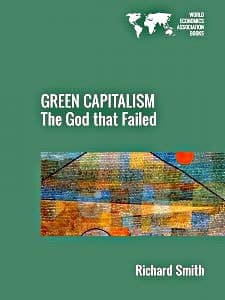
Green Capitalism: the God That Failed

By Richard Smith - World Economics Association - 2015

This book is a collection of five essays that deal with the prime threat to human life on Earth: the tendency of global capitalist economic development to develop us to death, to drive us off the cliff to ecological collapse. It begins with a review of the origins of this economic dynamic in the transition to capitalism in England and Europe and with an analysis of the ecological implications of capitalist economics as revealed in the work of its founding theorist – Adam Smith. I argue that, once installed, the requirements of reproduction under capitalism – the pressure of competition, the imperative need to innovate and develop the forces of production to beat the competition, the need to constantly grow production and expand the market and so on, induced an expansive logic that has driven economic development and overdevelopment, down to the present day.

In successive essays I explicate and criticize the two leading mainstream approaches to dealing with the ecological consequences of this over-developmental dynamic – décroisance or “degrowth”, and “green capitalism”. I show that the theorists and proponents of no-growth or de-growth – like Herman Daly or Tim Jackson – are correct in arguing that infinite economic growth is not possible on a finite planet, but that they’re wrong to imagine that capitalism can be refashioned as a kind of “steady state” economy, let alone actually “degrow” without precipitating economic collapse. There are further problems with this model, which I also investigate. I show that the theorists and proponents of “green capitalism” such as Paul Hawkin, Lester Brown and Frances Cairncross are wrong to think that tech miracles, “dematerialization”, new efficiencies, recycling and the like, will permit us to grow the global economy – more or less forever – without consuming and polluting ourselves to death. I show that while we’re all better off with organic groceries, energy-efficient light bulbs and so on, such developments do not fundamentally reverse the eco-suicidal tendencies of capitalist development, because in any capitalist economy the environment has to be subordinated to maximizing growth and sales, or companies can’t survive in the marketplace. Yet infinite growth, even green growth, is impossible on a finite planet.

In the final essays I argue that since capitalism can only drive us to ecological collapse, we have no choice but to try to cashier this system and replace it with an entirely different economy and mode of life based on: minimizing not maximizing resource consumption; public ownership of most, though not necessarily all, of the economy; large-scale economic planning and international coordination; and a global “contraction and convergence” between the North and the South around a lower but hopefully satisfactory level of material consumption for all the world’s peoples. Whether we can pull off such a transition is another question. We may very well fail to overthrow capitalism and replace it with a viable alternative. That may be our fate. But around the world, in thousands of locations, people are organizing and fighting against corporate power, against land grabs, against extreme extraction, against the incessant commodification of our lives. Here and there, as in Greece and China, ruling classes are on the defensive. All these fights have a common demand: bottom-up democracy, popular power. In this lies our best hope. This little book is intended as more ammunition for that fight.

Read the report (Link).

On Climate Satyagraha: Interview with Quincy Saul

By Javier S Castro - CounterPunch, April 10, 2015

Disclaimer: The views expressed here are not the official position of the IWW (or even the IWW’s EUC) and do not necessarily represent the views of anyone but the author’s. 

The socio-ecological catastrophe that is global capitalism is clear for all to see. We are in dire need of an alternative system which does not ceaselessly destroy nature and oppress and impoverish the vast majority of humankind, including our future generations, whose lives may very well be highly constrained if not outright canceled due to prevailing environmental destructiveness. It is in this sense of contemplating and reflecting on alternatives to capitalist depravity that I was fortunate enough recently to discuss the present moment and some of the possible means of displacing hegemonic power with Quincy Saul of Ecosocialist Horizons (EH). Quincy and the rest of the members of this collective have envisioned a compelling means of overcoming the environmental crisis: that is, through climate Satyagraha.

The latest biological studies show a decline of a full half of animal populations on Earth since 1970, and an ever-burgeoning list of species and classes of vertebrates at immediate risk of extinction: a quarter of all marine species, a quarter of all mammals, and nearly half of all amphibians are on the edge.1 Moreover, two independent studies published in Science and Anthropocene Review in January conclude that the present rate of environmental destruction essentially threatens the fate of complex life on the planet.2 Meanwhile, global carbon emissions continue in relentless expansion, with each new year bringing a new broken record, whether in terms of total greenhouse gas emissions, average global temperatures, or both. Truly, then, this is a critical moment in human history, one which could lead to utter oblivion, as through the perpetuation of business as usual, or alternately amelioration and emancipation, as through social revolution.

Quincy, could you share your assessment of the global climate-justice movements at present, some seven months after the People’s Climate March (PCM)—a development of which you were famously highly critical—and five months after yet another farcical example of the theater of absurd that is the international climate-negotiation process, as seen at the Twentieth Conference of Parties (COP20) in Lima, Peru?

Thank you Javier for compiling those statistics. There’s such an immense range of data out there, and it’s important to hone in on the key information. In terms of the climate-justice movement, the problem I see is that the whole doesn’t add up to the sum of its parts. So you have this amazing, fearless, courageous work that’s happening on local levels, all over the world—too numerous to even start listing. When it comes to resistance struggle, people are resisting mines, pipelines, and destructive development projects from the Altiplano of Peru to central Indian jungles, the Amazon River, indigenous reservations in the U.S., the factory-cities of China, the Niger Delta—uncountable acts of courage that people are taking to defend their ecosystems and their lives, whether climate change is the central issue, or it’s about defense of a single ecosystem. And then on the prefiguration side, there are people on every continent who are working really hard laying the foundations for the next world-system. Seed-saving, agroecologies—people are combining ancestral productive projects with appropriate technologies, building community resilience, and constructing community democracy in the context of war and natural disaster. So this is hopeful and wonderful work that has be encouraged. But somehow it’s not adding up.

Why the Climate Change Movement Must Demand Energy Industry Nationalization

By Bruce Lesnick - Truthout, Op-Ed, March 27, 2015, reprinted by permission, © truthout 2015

Disclaimer: The views expressed here are not the official position of the IWW (or even the IWW’s EUC) and do not necessarily represent the views of anyone but the author’s.

"All the forces in the world are not so powerful as an idea whose time has come."
- Victor Hugo

Ever since scientists discovered a runaway greenhouse effect on our nearest planetary neighbor, Venus, we've known that climate Armageddon is a possibility. Even though Venus is closer to the Sun than the Earth, Venus' thick cloud layer permits only one-sixth as much sunlight to reach the planet's surface. And while Mercury is nearly twice as close to the Sun as Venus, the surface on Venus is 10 percent hotter, measuring more than 864 degrees Fahrenheit. Why is Venus so hot? Its atmosphere is 97 percent carbon dioxide.

We know that human activities are adversely affecting Earth's climate. Scientists began to draw our attention to the link between fossil fuels, greenhouse gases and climate in the 1980s. Since then, the evidence for anthropogenic climate change has become overwhelming.

All that's left to debate is what to do about it.

Under the current setup, energy conglomerates that owe their fortunes to fossil fuels have every incentive to dismiss global warming and to cast aspersions on climate change research. The top five oil companies (BP, Chevron, ConocoPhillips, ExxonMobil and Shell) reported combined profits of $93 billion for 2013. That's more than the discretionary US budget that year for health, human services, Medicare and Medicaid ($80.6 billion). It's more than 10 times the federal budget for environmental protection ($9.2 billion). The more coal, oil and natural gas that get burned, the more the climate is thrown out of whack, and the more these companies are rewarded financially.

If you give a dog a piece of meat every time it bites someone, it could reasonably be argued that you are encouraging this dangerous and irresponsible behavior. In light of environmental necessity, we might beseech the energy companies to behave responsibly, but they are guaranteed to ignore us. Why? Because they earn large sums of money when they do so. A demand for reform of energy policy may be well framed and well founded, but it is wasted wind if the current setup, which so richly rewards all of the wrong behaviors, is allowed to persist.

If we're serious about addressing climate change, nationalization of the energy industry must become a central organizing demand.

A “Climate Movement Across the Movements”

By Patrick Bond - CounterPunch, March 31 2015

Disclaimer: The views expressed here are not the official position of the IWW (or even the IWW’s EUC) and do not necessarily represent the views of anyone but the author’s.

Looming ahead in eight months’ time is another Conference of Polluters, or COP (technically, the Conference of the Parties to the United Nations Framework Convention on Climate Change). The last twenty did zilch to save us from climate catastrophe. Judging by early rough drafts of the Paris COP21 agreement recently leaked, another UN fiasco is inevitable.

The ‘Coalition Climat21’ strategy meeting for Paris was held in Tunis on March 23-24, just before the World Social Forum. I had a momentary sense this could be a breakthrough gathering, if indeed fusions were now ripe to move local versions of ‘Blockadia’ – i.e. hundreds of courageous physical resistances to CO2 and methane emissions sources – towards a genuine global political project. The diverse climate activists present seemed ready for progressive ideology, analysis, strategy, tactics and alliances. Between 150 and 400 people jammed a university auditorium over the course of the two days, mixing French, English and Arabic.

It was far more promising than the last time people gathered for a European COP, in 2009 at Copenhagen, when the naivety of ‘Seal the Deal’ rhetoric from mainstream climate organisations proved debilitating. That was a narrative akin to drawing lemmings towards – and over – a cliff: first up the hill of raised expectations placed on UN negotiators, before crashing down into a despondency void lasting several years. Recall that leaders of the US, Brazil, South Africa, India and China did a backroom deal that sabotaged a binding emissions follow-up to the Kyoto Protocol. In ‘Hopenhagen,’ even phrases like ‘System change not climate change’ were co-opted, as green capital educated by NGO allies agreed that a definition of ‘system’ (e.g. from fossil fuels to nuclear) could be sufficiently malleable to meet their rhetorical needs.

That precedent notwithstanding, the phrase “A climate movement across the movements” used here seemed to justify an urgent unity of diverse climate activists, along with heightened attempts to draw in those who should be using climate in their own specific sectoral work. The two beautiful words ‘Climate Justice’ are on many lips but I suspect the cause of unity may either erase them from the final phraseology or water them down to nebulousness.

Pages

The Fine Print I:

Disclaimer: The views expressed on this site are not the official position of the IWW (or even the IWW’s EUC) unless otherwise indicated and do not necessarily represent the views of anyone but the author’s, nor should it be assumed that any of these authors automatically support the IWW or endorse any of its positions.

Further: the inclusion of a link on our site (other than the link to the main IWW site) does not imply endorsement by or an alliance with the IWW. These sites have been chosen by our members due to their perceived relevance to the IWW EUC and are included here for informational purposes only. If you have any suggestions or comments on any of the links included (or not included) above, please contact us.

The Fine Print II:

Fair Use Notice: The material on this site is provided for educational and informational purposes. It may contain copyrighted material the use of which has not always been specifically authorized by the copyright owner. It is being made available in an effort to advance the understanding of scientific, environmental, economic, social justice and human rights issues etc.

It is believed that this constitutes a 'fair use' of any such copyrighted material as provided for in section 107 of the US Copyright Law. In accordance with Title 17 U.S.C. Section 107, the material on this site is distributed without profit to those who have an interest in using the included information for research and educational purposes. If you wish to use copyrighted material from this site for purposes of your own that go beyond 'fair use', you must obtain permission from the copyright owner. The information on this site does not constitute legal or technical advice.

