You are here

green jobs

42,000 jobs can be created making UK schools safer, greener and more energy efficient

By staff - Trades Union Congress, July 7, 2022

  • Funding already allocated covers just 3% of retrofits needed by schools, as energy bills rise by 93%
  • Unions hit back at government suggestions that existing funding for retrofits will be cut
  • It is “irresponsible” not to use existing technology so that schools will have more money for education and lower emissions, says TUC

Making UK school buildings energy efficient and fit for the future is a win-win, according to a new report published today (Thursday) by the TUC.

The report looks at the current spending on schools through the Public Sector Decarbonisation Scheme (PSDS), and estimates how much more investment is needed.

Achieving a Net-Zero Canadian Electricity Grid by 2035

Rhode Island Unions Help Win 100% Renewable Power by 2033

By staff - Labor Network for Sustainability, July 2022

The Rhode Island legislature has just required that 100 percent of electricity sold in the state comes from renewable sources such as wind and solar by 2033. That’s sooner than any other state in the country.

According to the Boston Globe, “Labor and environmental groups have joined together in the Climate Jobs Rhode Island coalition” which is advocating for a “just transition to a pro-worker and pro-climate green economy” in Rhode Island.

Patrick Crowley, secretary-treasurer of the Rhode Island AFL-CIO and Co-Chair of Climate Jobs Rhode Island said,

 We’re hoping that by demonstrating that the labor movement and the environmental movement can work together, that other states—my sister and brother labor organizations across the country—can look at this as an example for how to get things done in a big way.

“If we continue down this path, we will show the labor and environmental communities across the country that this is how it’s done,” Crowley said. “If you want to get it done, you do it the Rhode Island way.”

Shifting America to Solar Power Is a Grueling, Low-Paid Job

By Lauren Kaori Gurley - Vice, June 27, 2022

Thomas Shade got his first job in a solar field at age 41. "I fell in love with it. I left a job where I didn't feel like a human," Shade told Motherboard. At 16, Shade worked in a cotton mill dyeing fabrics to support a newborn son. He then passed through a series of fiberglass factories. He spent a decade on the open road as a long haul trucker. In 2011, he was sick of working the graveyard shift in the oven room of a machine generator plant, so when a friend called him and said a temp firm was hiring laborers to install utility-scale solar power near his hometown in rural western North Carolina, Shade thought to himself “I wouldn’t mind doing that as a side gig.” Soon he had quit his other jobs to work full time in the solar fields. 

"Outside on the solar farm, I felt more free,” he said. “You didn't feel like you was trapped like you were inside of a plant.”

When the project ended, a few months later, Shade signed up with PeopleReady, the national temp labor agency, to work on another utility-scale solar farm two hours away in Rockingham, North Carolina. Since then, Shade has lived on the road chasing solar projects, from Texas to Virginia to South Carolina to Nevada to Florida to Maryland to Georgia. "It's a hard life to live," said Shade. "You're always away from friends and family. Sometimes you don't know anybody."

Temp agencies are as common in the solar industry as they are in construction. Many workers are needed to install a solar field, but much fewer are needed once it's up and running. Besides PeopleReady, there's companies like WorkRise, 360 Industrial Services, Aerotek, and Tradesmen. Shade has worked for lots of different temp companies.

For each project, Shade has had to negotiate with a recruiter on the phone over his hourly wages and a daily housing stipend, known as a per diem. In the solar industry, it's common to have two workers doing the same job for vastly different pay and living stipends, multiple solar workers and labor organizers told Motherboard. Nico Ries, an organizer at Green Workers Alliance who has engaged with hundreds of renewable energy workers, said getting paid a higher wage than other workers with the same experience often “boils down to nepotism.” “Workers often refer to it as the good ol’ boy system,” they said. Frequently, local hires and other newcomers to the industry who might commute an hour or two to get to a worksite do not receive per diem stipends.

170+ Organizations Sign Letter Opposing Subsidies to Delay Closure of Diablo Canyon Power Plant

By staff - Nuclear Information and Resource Service, June 21, 2022

Over 170 organizations, including Beyond Nuclear, North American Water Office, Food & Water Watch, Institute for Policy Studies Climate Policy Program, Nuclear Energy Information Service (NEIS), Center for Biological Diversity, International Marine Mammal Project of Earth Island Institute, Nuclear Information and Resource Service (NIRS) and more sent a letter to Secretary of Energy Jennifer Granholm opposing the misuse of the Department of Energy’s Civil Nuclear Credit program (CNC) to dismantle the fossil-free phaseout and just transition plan for the Diablo Canyon Nuclear Power Plant. 

The CNC was created by the bipartisan Infrastructure Investment and Jobs Act (IIJA) to mitigate potential greenhouse gas emissions (GHG) increases due to the closure of unprofitable nuclear reactors that operate in competitive electricity markets. The letter explains how applying the CNC program to Diablo Canyon would violate the letter and intent of the law. The nuclear power plant is not eligible for funds under the CNC program because it does not meet the basic requirements of the IIJA, nor those of the CNC program guidance DOE published to implement the program. 

The letter highlights climate, economic, environmental justice, and power supply concerns with abandonment of the just transition agreement dictating the planned closure of Diablo Canyon’s nuclear reactors in 2024 and 2025. 

Over 50 organizations from the State of California signed onto the letter, including San Luis Obispo Mothers for Peace, Physicians for Social Responsibility-Los Angeles, SoCal 350 Climate Action, Tri-Valley CAREs, Physicians for Social Responsibility/Sacramento, San Francisco Bay Physicians for Social Responsibility, Oceanic Preservation Society, Electric Vehicle Association of CA Central Coast, Californians for Energy Choice, Parents Against Santa Susana Field Lab and more. 

Tim Judson, NIRS executive director said, “Diablo Canyon’s planned phaseout and just transition accelerates California’s climate and renewable energy goals, supports Diablo workers and local communities, and promotes economic and environmental justice. Misusing the CNC program to unravel that progress would betray President Biden’s commitments to climate and environmental justice.” He added, “The Diablo Canyon phaseout plan which California is implementing is a just transition model DOE should promote instead of seeking to preempt it. The basis for the plan shows how phasing out nuclear power plants along with fossil fuel generation can help accelerate emissions reductions, the growth of the renewable energy economy, and a just and equitable transition for workers and communities. Is DOE afraid to let that happen while it is spending billions of dollars to promote the idea that we need to invest in overly expensive, failure-prone nuclear power plants?”

The Cost of Living Crisis is a Climate Crisis

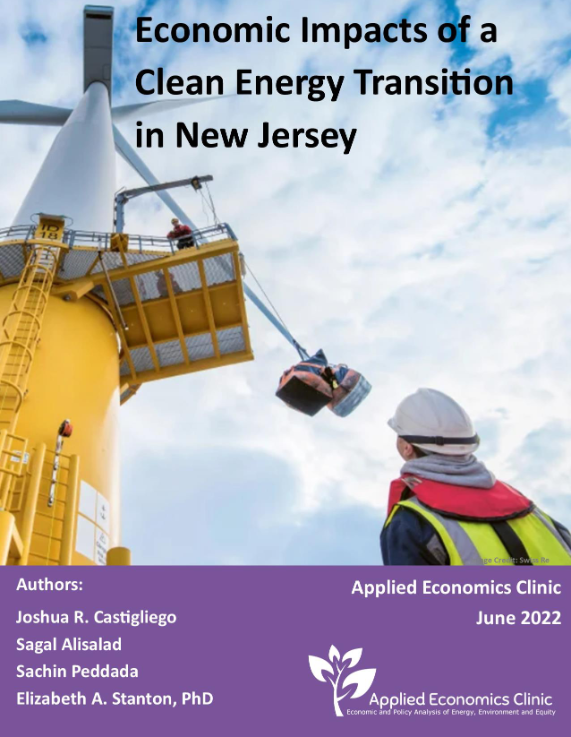
Economic Impacts of a Clean Energy Transition in New Jersey

By Joshua R. Castigliego, Sagal Alisalad, Sachin Peddada, and Liz Stanton, PhD - Applied Economics Clinic, June 7, 2022

Researcher Joshua Castigliego, Assistant Researchers Sagal Alisalad and Sachin Peddada, and Senior Economist Liz Stanton, PhD prepared a report on the economic impacts associated with a clean energy transition in New Jersey that aims to achieve the State’s climate and energy goals in the coming decades. AEC staff find that adding in-state renewables and storage, and electrifying transportation and buildings creates additional job opportunities, while also bolstering the state’s economy. From 2025 to 2050, AEC estimates that New Jersey’s clean energy transition will result in almost 300,000 more “job-years” (an average of about 11,000 jobs per year) than would be created without it. AEC also identifies a variety of additional benefits of a clean energy transition, including several benefits that are conditional on the design and implementation of the transition.

In a companion publication to this report—Barriers and Opportunities for Green Jobs in New Jersey—AEC discusses equity, diversity and inclusion in New Jersey’s clean energy sector along with barriers that impede equitable representation in New Jersey’s green jobs.

Download a copy of this publication here (PDF).

Barriers and Opportunities for Green Jobs in New Jersey

By Bryndis Woods, PhD, Joshua R. Castigliego, Elisabeth Seliga, Sachin Peddada, Tanya Stasio, PhD, and Liz Stanton, PhD - Applied Economics Clinic, June 7, 2022

Senior Researcher Bryndis Woods, PhD, Researcher Joshua Castigliego, Assistant Researchers Elisabeth Seliga and Sachin Peddada, Researcher Tanya Stasio, PhD, and Senior Economist Liz Stanton, PhD prepared a report that assesses New Jersey’s current clean energy workforce, identifies barriers to green jobs that impede access to—and equitable representation within—the clean energy sector, and provides recommendations regarding how the State of New Jersey can shape policy and regulations to enhance the equity, diversity and inclusion of its clean energy jobs. AEC staff find that there are important barriers to green jobs that reinforce existing inequities in New Jersey’s clean energy workforce, including: educational/experience barriers, logistical barriers, equitable access barriers, and institutional barriers. Achieving a future of clean energy jobs in New Jersey that is diverse, equitable and inclusive will require overcoming barriers to green jobs with intentional efforts targeted at marginalized and underrepresented groups, such as racial/ethnic minorities, women, low-income households, and people with limited English proficiency.

In a companion publication to this report—Economic Impacts of a Clean Energy Transition in New Jersey—AEC assesses the job and other economic impacts associated with achieving a clean energy transition in New Jersey over the next few decades. 

Download a copy of this publication here (PDF).

Labour movement agendas in conflict over decarbonisation pathways

By Les Levidow - Greener Jobs Alliance, June 7, 2022

The Just Transition concept has sought to avoid socially unjust means and consequences of a low-carbon transition. Alternatives could provide the basis for a common agenda of the labour movement. Yet trade unions have had divergent perspectives on decarbonisation pathways, especially as regards the potential role of technological solutions. 

Such conflict has focused on Carbon Capture & Storage (CCS). This is favourably called ‘carbon abatement’ or pejoratively called a ‘technofix’. As one reason for US trade-unions supporting CCS and thus the fossil fuel industry, often they have achieved relatively greater job security and wages there; such gains may seem jeopardised by substituting renewable energy.

UK CCS agendas focus on the prospect to decarbonise natural gas into hydrogen. This agenda unites the UK ‘energy unions’ with their members’ employers, as a cross-class alliance for a CCS fix. From a critical perspective, this seeks to accumulate capital by perpetuating natural gas, while undermining or delaying its renewable competitors.

Trade-union divergences have arisen in many ways. For a Just Transition, ITUC has advocated phasing out ‘unabated coal’, implying that coal with CCS could continue indefinitely. In the name of climate justice, the TUC has advocated CCS as a means to continue fossil fuels within a ‘balanced energy’ policy. By contrast, according to the PCS, CCS ‘is not yet a proven technology at scale’, and we don’t have the luxury to wait; it counterposes a strategy of energy democracy.

Such political divergences within the labour movement have arisen around Just Transition proposals at TUC conferences, likewise around agendas for a Green New Deal. In 2019 these were promoted within the US Democratic Party and UK Labour Party. Both underwent internal conflicts over decarbonisation pathways, expressing conflicts within the labour movement. 

Decarbonizing energy intensive industries: what are the risks and opportunities for jobs?

Pages

The Fine Print I:

Disclaimer: The views expressed on this site are not the official position of the IWW (or even the IWW’s EUC) unless otherwise indicated and do not necessarily represent the views of anyone but the author’s, nor should it be assumed that any of these authors automatically support the IWW or endorse any of its positions.

Further: the inclusion of a link on our site (other than the link to the main IWW site) does not imply endorsement by or an alliance with the IWW. These sites have been chosen by our members due to their perceived relevance to the IWW EUC and are included here for informational purposes only. If you have any suggestions or comments on any of the links included (or not included) above, please contact us.

The Fine Print II:

Fair Use Notice: The material on this site is provided for educational and informational purposes. It may contain copyrighted material the use of which has not always been specifically authorized by the copyright owner. It is being made available in an effort to advance the understanding of scientific, environmental, economic, social justice and human rights issues etc.

It is believed that this constitutes a 'fair use' of any such copyrighted material as provided for in section 107 of the US Copyright Law. In accordance with Title 17 U.S.C. Section 107, the material on this site is distributed without profit to those who have an interest in using the included information for research and educational purposes. If you wish to use copyrighted material from this site for purposes of your own that go beyond 'fair use', you must obtain permission from the copyright owner. The information on this site does not constitute legal or technical advice.