You are here
News Feeds
Food Tank Explains: Food Sovereignty
This article is part of Food Tank’s primer series, “Food Tank Explains.” Each installment unpacks the ideas, innovations, and challenges shaping today’s food and agriculture systems, offering clear insights into complex topics. To explore more articles in the series, click here.
Food sovereignty is the right of peoples, communities, and countries to healthy and culturally appropriate food produced through socially just, ecologically sound, and sustainable methods, and their right to define their own policies, strategies, and systems for food production, distribution, and consumption.
While food security names the destination, food sovereignty defines a democratic path to reach it. According to the U.N. Food and Agriculture Organization (FAO), food security is a condition in which everyone has reliable access to sufficient, safe, and nutritious food.
Food sovereignty accepts that objective but shifts the focus to power and governance, arguing that achieving lasting food security requires placing decision-making in the hands of the people who produce, distribute, and consume food, rather than markets or dominant governments.
Food sovereignty emerged in the 1980s and 1990s as a response and challenge to the social, economic, and environmental consequences of globalization and industrialized agriculture. 44 percent of the world’s population was living in extreme poverty in 1981, and the number of hungry people grew by 15 million between 1970 and 1980, even as surplus food flooded global markets.
Mechanization of agricultural tasks like sowing seeds, harvesting crops, milking cows greatly reduced and sometimes eliminated the need for human and animal labor, leaving many without jobs. The share of the U.S. workforce employed in agriculture fell from 41 percent in 1900 to 2 percent by 2000, and between 1950 and 1997 the average farm more than doubled in size while nearly half of farms disappeared.
The 1980s marked a sharp increase in global temperatures and, in 1988, NASA scientist James Hansen told Congress he was “99 percent sure” that global warming was upon us. Indigenous, rural, peasant, and small-scale farming communities were left facing overlapping crises of poverty, environmental degradation, and hunger.
Recognizing urgent necessity for an organized, collective, and internationalist response, La Via Campesina coined the term food sovereignty at the 1996 World Food Summit. A decade later, 700 delegates from five continents gathered at the 2007 International Forum for Food Sovereignty in Nyéléni, Mali to further deepen collective understanding on the topic, developing the six pillars of food sovereignty.
The framework centers food as a human need rather than a commodity, supports sustainable livelihoods for food providers, and localizes food systems and shortens the distance between producers and consumers. It places decision-making power in the hands of local communities, builds on traditional knowledge strengthened by research, and works with nature instead of industrial, energy-intensive models.
During Canada’s subsequent People’s Food Policy process, members of the Indigenous Circle added a seventh pillar, which states that “food is sacred,” asserting that food is a gift of life and must not be reduced to a commodity.
Nearly three decades after La Via Campesina introduced food sovereignty, the hunger, poverty, ecological degradation, and concentrated market power it sought to confront persist. Today’s industrial food system generates record levels of calories, yet nearly one-third of the global population remains food insecure. Food systems contribute up to one-third of global greenhouse gas emissions, and agriculture threatens more than 80 percent of species at risk of extinction.
Corporate consolidation has deepened across the food system, with four firms controlling nearly 70 percent of the global pesticide and seed market. And small-scale and family farmers comprise over 98 percent of farms, but control just 53 percent of agricultural land.
Beyond codifying the right to food and control over food systems, and recognizing the contribution of indigenous peoples, pastoralists, forest dwellers, workers and fishers to the food system, food sovereignty offers a framework to address the harms of industrial agriculture.
By localizing production and prioritizing agroecological methods, food sovereignty can shorten supply chains and reduce emissions while restoring soil health and biodiversity. Research also finds that food sovereignty–based approaches, such as strengthening school food systems, improving soil fertility, advancing gender equity, and confronting structural racism, can support long-term health equity.
Scaling food sovereignty requires structural reforms that confront concentrated power and expand equitable access to land. IPES emphasizes the need to democratize governance and counter corporate control of the food system through stronger conflict-of-interest safeguards, revitalized antitrust enforcement to reduce market concentration, and stricter transparency and lobbying rules.
Others like the National Young Farmers Coalition call for eliminating inequities in land ownership, protecting farmland, securing affordable land tenure, and supporting farm viability and transition.
“If people don’t control the food, they don’t control the power,” Morgan Ody, General Coordinator for La Via Campesina, tells Food Tank.
Articles like the one you just read are made possible through the generosity of Food Tank members. Can we please count on you to be part of our growing movement? Become a member today by clicking here.
Photo courtesy of Evan Rally, Unsplash
The post Food Tank Explains: Food Sovereignty appeared first on Food Tank.
Extreme heat is rewriting food security. The best fixes are already within reach
Kaveh Zahedi is the Assistant Director-General of the UN Food and Agriculture Organization (FAO) and Director of FAO’s Office of Climate Change, Biodiversity and Environment. Ko Barrett is the Deputy Secretary-General of the World Meteorological Organization (WMO).
Every crop, every animal and every fish has a thermal limit, the point where additional heat stops being normal weather and starts doing damage. In food systems, that threshold arrives sooner than many people realise.
For key agricultural species, the danger zone often sits between 25 and 35°C at the moments that matter most, such as flowering and reproduction. As climate change drives more days into the mid-40s°C in major breadbaskets, those limits are already being crossed. The result is lower yields, weaker livestock, stressed fisheries, higher fire risk and farmworkers – the backbone of the system – forced into unsafe conditions.
A new joint FAO-WMO report, released on April 22, shows that extreme heat is already cutting production and exposing agricultural workers to dangerous conditions. One analysis found that beef cattle mortality reached as high as 24% in some documented heatwaves. Marine heatwaves were linked to an estimated $6.6 billion loss in fisheries production. And the outlook worsens as temperatures rise. For every 1°C of warming, maize and wheat yields are projected to drop 4–10%.
US pressure puts World Bank’s climate plan at risk
Adapting to a hotter world will take long-term investment in science, technology and infrastructure if food supplies are to keep pace with demand. We will need more heat-tolerant varieties and breeds, new farming practices, and we will need to make hard choices about what can still be grown as conditions change. But we also need a plan for next season, not just 2100.
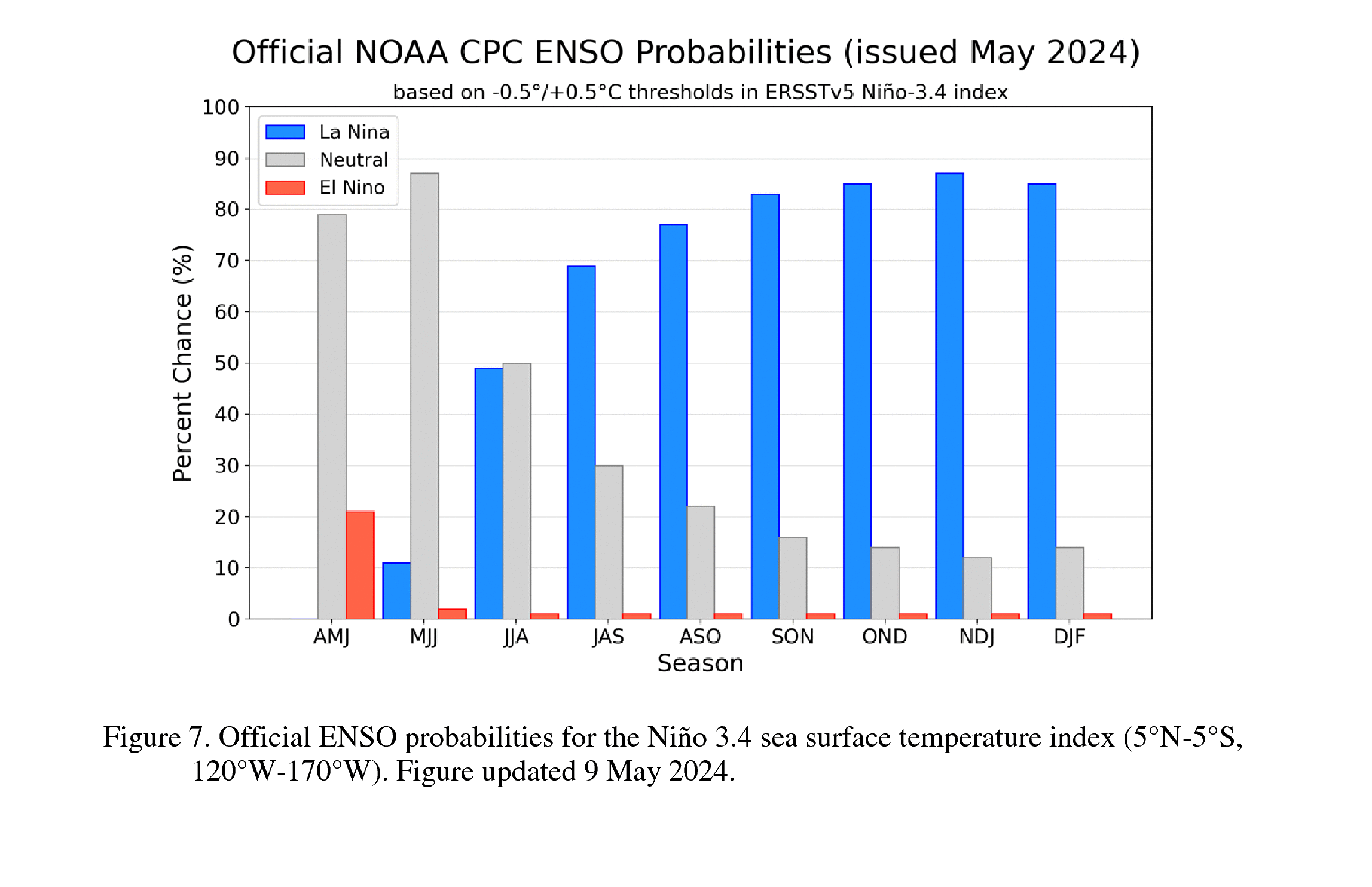
With more severe heat likely in the coming years and another El Niño poised to test unprepared systems, the priority is to move from crisis response to heat readiness. That starts with early warnings and practical measures to help farmers protect harvests, supply chains and their own safety.
Heat warnings farmers can useWeather forecasts should give farmers time to act before extreme heat turns into loss. That is the strategy behind Early Warnings for All, the UN initiative coordinated by WMO with partners including FAO. But early warning only works when reliable observations, modelling and verification turn weather and climate data into forecasts farmers can actually use.
Cambodia’s Green Climate Fund-funded PEARL project, supported by FAO, upgraded and installed new weather stations to feed a phone-based app that sends forecasts with crop- and region-specific guidance. When forecasts exceed 38°C, alerts recommend maintaining soil moisture with mulch, shading vegetables, delaying sowing rice seeds, and shifting irrigation to cooler hours.
Soda Thai (pictured in a blue T‑shirt) receives training from a Commune Agriculture Officer on how to use the GCF‑funded PEARL Project’s agrometeorological advisory service on her smartphone. (Photo: FAO/Pisey Khun) Soda Thai (pictured in a blue T‑shirt) receives training from a Commune Agriculture Officer on how to use the GCF‑funded PEARL Project’s agrometeorological advisory service on her smartphone. (Photo: FAO/Pisey Khun)That advice is part of a practical set of heat measures that help farmers reduce losses before extreme heat turns into crisis. In some cases, that means shading crops with cloth or solar panels, increasing water storage, installing low-cost cooling misters, or adjusting planting windows. Cattle generate heat when they eat, so feeding them in cooler hours can help.
Poultry cannot sweat, so shade is essential. Where extreme heat is becoming the norm, farmers may need to move from cattle to more heat-tolerant goats and sheep, or even switch crops. Evidence from Pakistan shows these adjustments can pay off. A FAO-GCF project field-tested the combination of heat- and drought-tolerant cotton and wheat varieties with mulching and adjusted planting windows. Over six seasons, returns reached as high as $8 for every $1 invested.
Extreme heat doesn’t only damage food in the field. It also speeds up spoilage after harvest, turning heat stress into income loss and poorer diets. An estimated 526 million tonnes of food, about 12% of the global total, is lost or wasted because of insufficient refrigeration. In Jamaica, a GCF-funded, FAO-supported programme treats cold storage as climate adaptation, using solar-powered cold storage to help smallholders keep produce market-ready when heat hits.
Protecting workersCold chains and toolkits matter, but they don’t protect the people doing the work. Extreme heat is one of the biggest threats to farmers’ health, driving dehydration, kidney injury and chronic disease, and taxing public health systems in the process. More than a third of the global workforce, around 1.2 billion people, face workplace heat risk each year, with agriculture among the hardest-hit sectors.
We already know what basic protection looks like, and it is already being put into practice in Cambodia, where the extreme heat advisories are paired with advice for farmers to shift heavy work to cooler hours and ensure access to water, shade and rest breaks.
The World Health Organization (WHO) and WMO are calling for the same approach at a wider scale: adjusted work–rest schedules, access to shade and safe drinking water, training to recognize heat illness, and integrating weather and climate information into workplace risk management.
Why preparation paysThe tools to prepare for extreme heat already exist. The problem is that funding still falls far short of the scale of the risk, and rural communities are too often overlooked by the assumption that extreme heat is mainly an urban problem.
In 2023, agrifood systems received just 4% of total climate-related development finance. Without more investment, early warnings won’t reach the people who need them most, extension services will remain under-resourced, and basic protections for crops, livestock and workers will stay out of reach.
Preparing in advance is cheaper than absorbing the same losses year after year. It can stabilise production and prices now, while buying time for the bigger scientific and structural shifts agriculture will need in a hotter world.
We don’t need a new playbook. We need to use the one we already have. The FAO-WMO report lays out the risks of extreme heat. Now is the time to use that evidence to protect food systems and the people who sustain them.
The post Extreme heat is rewriting food security. The best fixes are already within reach appeared first on Climate Home News.
Russian Reactors Abroad: A Tool of Soft Power
The Russian state nuclear enterprise Rosatom has become the most active exporter of nuclear technology in the world over the past decade. Wherever the corporation operates, it presents atomic energy development as indispensable for climate action and national sovereignty. Yet beyond building reactors, Rosatom establishes an integrated model of political and societal influence, often entrenching censorship and eschewing democratic oversight.
When Russia’s state nuclear corporation Rosatom signs an agreement to build a nuclear power plant, it exports far more than turbines, containment domes, and fuel assemblies. Alongside engineering contracts and state-backed loans comes a broader ecosystem: educational programmes, public diplomacy platforms, youth initiatives, science centres, cultural partnerships, and communication strategies designed to shape how nuclear energy is perceived.
Over the past decade, Rosatom has become the most active exporter of nuclear technology in the world. Its reactors are under construction across Europe, Asia, Africa, and the Middle East. But its expansion cannot be understood purely in terms of energy capacity or industrial success. Rosatom has evolved into a vertically integrated actor that offers governments a full package: construction, financing, fuel supply, operational management, training, and long-term service agreements. Embedded within that package is something less visible but equally strategic: soft power influence.
In many host countries, nuclear cooperation is accompanied by programmes aimed at cultivating “public acceptance,” shaping youth perspectives, and aligning local institutions with Rosatom’s long-term presence. In political environments where civic space is limited or fragile, this model can intersect with authoritarian governance structures, narrowing public debate and marginalising dissent. Rosatom presents its activities as supporting development, sovereignty, and clean energy. Critics argue that its approach often produces long-term dependencies – technical, financial, and political – while reshaping the civic landscape around major infrastructure decisions.
Weak independent oversightRosatom actively promotes itself as a global leader in corporate social responsibility. It highlights awards for sustainability and transparency and emphasises adherence to international anti-corruption standards. Its official narrative presents nuclear energy as a driver of national modernisation and energy independence.
Yet a closer look at where Rosatom operates reveals a pattern. Many of its flagship international projects are located in countries governed by authoritarian or semi-authoritarian regimes, or in states with severely constrained civic space. These political environments are not incidental. They are often conducive to large-scale infrastructure agreements that require limited public debate, minimal parliamentary oversight, and restricted independent review.
In Hungary, the Paks II nuclear project has been framed as essential for energy security. Early public protests were dispersed, and critics have long argued that the project advanced without meaningful public consultation. Despite tensions between Russia and the European Union following the invasion of Ukraine, Paks II has continued under sanctions exemptions, illustrating how deeply embedded nuclear agreements can complicate broader geopolitical positioning.
In Turkey, the Akkuyu Nuclear Power Plant is being built under a build-own-operate model, granting Rosatom long-term operational control. Workers protesting conditions at the site have faced police intervention, while environmental activists opposing the project have been arrested. Public access to detailed safety and financial information remains limited.
Many of Rosatom’s flagship international projects are located in countries governed by authoritarian or semi-authoritarian regimes, or in states with severely constrained civic space.
In Kazakhstan, public hearings on proposed nuclear expansion have reportedly restricted critics’ participation. In Bangladesh, the Rooppur Nuclear Power Plant has been accompanied by allegations of corruption and concerns raised by civil society groups about emergency preparedness infrastructure. Rosatom has rejected corruption allegations and, in some cases, threatened legal action in response to claims.
The most extreme case is Ukraine. During Russia’s occupation of the Zaporizhzhia Nuclear Power Plant, employees were detained, interrogated, and reportedly subjected to coercion and abuse. While this situation is not directly comparable to commercial nuclear projects abroad, it underscores how nuclear infrastructure can become entangled with state power in coercive contexts.
Across these cases, one pattern recurs: nuclear projects often advance in environments where independent oversight is weak and dissent carries political risk.
Manufacturing Public AcceptanceRosatom’s strategy does not rely solely on executive agreements. It systematically invests in shaping public narratives around nuclear energy. In multiple countries, memoranda of understanding include commitments to “form a positive public attitude” toward nuclear power. Around project sites, Rosatom supports networks of aligned NGOs, expert councils, grant initiatives, and public forums that present themselves as platforms for dialogue and consensus.
The messaging surrounding these projects often follows strikingly similar patterns across different regions. In Hungary, the Paks II project has been promoted as “key to Hungary’s energy future” and essential for “energy security”. In Turkey, the Akkuyu plant has been framed as a step toward “technological sovereignty” and “new energy for a powerful Turkey”. In Bangladesh, the Rooppur project is regularly justified through the language of “energy independence” and the claim that development “cannot happen without nuclear energy”. Similar narratives appear in Kazakhstan, where nuclear expansion has been promoted as a “path to stability”, and in Egypt, where the El Dabaa project is framed as a matter of “national pride” and a source of “clean electricity”. In Rwanda, nuclear cooperation has been described as a way of “leapfrogging to modernity,” while in several African states cooperation agreements are presented as tools for national development.
Large-scale events such as Atomexpo, World Atomic Week, and regional nuclear forums position Rosatom as a convener of global legitimacy. These gatherings feature government officials, regulators, and industry-aligned experts discussing nuclear energy as indispensable for climate action and national sovereignty. Independent environmental organisations and critical voices are often marginal or absent, while company-aligned NGOs and expert councils that operate under the language of dialogue, sustainability, and climate action are fully supported. Initiatives such as “Mission Impact” are presented as inclusive platforms bringing together youth, experts, and industry leaders to shape a sustainable future.
This narrative framing is consistent: nuclear energy is presented as clean, modern, and essential; alternatives such as decentralised renewables, energy efficiency, or demand reduction are rarely foregrounded. Over time, repetition across multiple forums and countries can create the impression of an emerging global consensus.
Rosatom’s Information Centres on Nuclear Energy (ICNE) represent another layer of this strategy. By 2026, 27 such centres operate across Russia and partner countries including Bangladesh, Turkey, Uzbekistan, Belarus, Kazakhstan, Vietnam, and Egypt. These centres function as high-tech educational spaces offering interactive exhibits, science competitions, youth festivals, and virtual plant tours.
Officially, they are designed to promote science education. In practice, they embed nuclear energy within local narratives of modernisation and progress. By linking atomic technology to national pride and technological sovereignty, they help transform complex industrial agreements into symbols of national achievement.
Exporting governance practicesCritics argue that Rosatom exports more than nuclear hardware. It also exports governance practices. Large-scale nuclear projects require centralised decision-making, restricted information flows, and strong executive coordination. In democratic systems with robust oversight, such projects can face lengthy public scrutiny. In more centralised systems, they can move forward with fewer obstacles.
Where civic space is limited, opposition to nuclear projects can be framed as anti-national or anti-development. In Bolivia, legal frameworks have restricted the operating space of NGOs critical of extractive and infrastructure projects. In Egypt, public protest around major state projects is effectively banned. In Myanmar, nuclear cooperation agreements have been signed under military rule, including memoranda referencing the promotion of a positive public attitude. Rosatom has signed cooperation agreements with nearly 20 African countries, the majority of which have repressive governmental systems.
The interplay between nuclear expansion and constrained civic environments raises questions about whether the technology’s governance requirements reinforce existing authoritarian tendencies. While Rosatom does not create these political systems, its projects often align comfortably within them.
Building a generation of atomic advocatesYouth engagement is perhaps the most forward-looking component of Rosatom’s soft power strategy. The corporation funds scholarships and educational programmes that bring students from partner countries to Russia to study nuclear engineering and related disciplines. Participants receive technical training, internships, and access to professional networks that frequently lead into Rosatom-linked projects at home.
Within Russia, the Rosatom Corporate Academy and youth science competitions cultivate early identification with the nuclear sector. International youth forums such as the International Youth Nuclear Forum in Obninsk and the BRICS Youth Energy Summit reinforce this professional pathway.
Rosatom has also extended its presence into global youth policy spaces. Representatives associated with Rosatom-supported initiatives have organised and participated in side events at the United Nations Economic and Social Council Youth Forum and during UNFCCC climate conferences. In these arenas, nuclear energy is framed as central to sustainable development and decarbonisation.
Such engagement is presented as empowering young leaders. Yet it also embeds nuclear advocacy within influential international platforms where youth participation carries moral authority. Over time, this may help normalise a particular model of energy transition – one in which centralised, state-backed nuclear infrastructure plays a dominant role.
Rosatom’s global expansion is not simply an industrial story. It is a political and societal one. By combining reactor construction, state-backed financing, fuel supply, long-term operational control, narrative management, and youth engagement, Rosatom has built an integrated model of influence. In many partner countries, this model operates within political environments where public scrutiny is limited and dissent carries risk.
Rosatom’s global expansion is not simply an industrial story. It is a political and societal one.
Nuclear energy projects, by their nature, create decades-long commitments. When those commitments are bundled with soft power instruments – public information centres, aligned civil society platforms, elite training pipelines, and international forums – the result is not merely energy infrastructure, but institutional alignment.
As nuclear energy regains prominence in global climate discussions, the governance dimension of these projects deserves equal attention. The question is not only whether nuclear power can reduce emissions, but how decisions are made, who shapes public understanding, and what forms of political dependency accompany the technology.
In the case of Rosatom, reactors are only part of the story. The rest is built through influence carefully constructed, globally networked, and designed to last as long as the plants themselves or even longer.
This article originally appeared on the website of the Heinrich Böll Stiftung as part of a dossier marking 40 years after the Chernobyl nuclear disaster. It is republished here with permission.
Out of Pocket: the real cost of fossil fuels on our groceries
This is a guest blog by Nicole Pita, Programme Manager at IPES-Food, the International Panel of Experts on Sustainable Food Systems, a global think tank and expert group guiding action for sustainable food systems around the world.
If you’ve been feeling like your grocery bills keep climbing, you’re not alone. In the United States, families are paying nearly 25% more for food than they did in 2020. In Germany, food costs 43% more than five years ago, while in Mexico and Brazil prices have jumped 42% and 50%. Now experts are warning of a looming food price crisis as a result of the global energy price spikes triggered by the US and Israeli war on Iran.
Why is this happening? Ultimately, it’s because our food systems run on fossil fuels, and every time there’s a crisis – a pandemic, a war, a drought – we all pay the price. At the International Panel of Experts on Sustainable Food Systems (IPES-Food) we have outlined this in our report, Fuel to Fork.
Food systems consume 15% of global fossil fuels. Source: Global Alliance for the Future of Food. (2023). Power shift: Why we need to wean industrial food systems off fossil fuel.
How is our food connected to fossil fuels?
Food systems consume 15% of all fossil fuels globally. From chemical fertilizers and diesel tractors to long-distance transport and cooking gas, fossil fuels power every step of producing, processing, and consuming food. When oil and gas prices spike, food prices follow.
Food, fertilizer and fossil energy prices are deeply interlinked.
Source: Levi, IMF Primary Commodity Price Index.
This fossil fuel dependence creates a triple threat. First, it makes food vulnerable to oil price spikes. Second, it drives climate breakdown, causing droughts and floods that destroy harvests. Third, a handful of corporations control the system and profit enormously every time there’s a crisis.
This isn’t a new problem, but it’s getting worse. During the COVID-19 pandemic, supply chain disruptions pushed food prices up. When Russia invaded Ukraine in 2022, energy, fertilizer, and wheat prices soared, driving grocery bills higher. Each time, pushing millions of people into hunger, especially in the world’s poorest and most vulnerable regions.
Now, as war erupts in the Persian Gulf, it’s happening again. Global oil and fertilizer prices have increased by 50% since the war began. Food prices haven’t spiked yet – but they will. One-third of crude oil and one-third of fertilizers all normally pass through shipping routes now blocked by the conflict. Even if the war ended tomorrow, it would take months for supply chains to recover.
The shocks of COVID and the Ukraine war accounted for nearly half of all grocery price increases in the US and 35% of price increases in the EU over the past five years. During 2021-2022 alone, 45 million more people went hungry because they couldn’t afford food.
There’s another reason food keeps getting more expensive: the fossil-fueled climate crisis. Droughts in the US Midwest and Canada destroyed harvests in 2022. Floods in India and South Asia pushed up rice prices in 2023 and 2025. The climate crisis is affecting crop production itself, making food harder to grow. The irony is that food systems produce one-third of global greenhouse gas emissions, making them both a victim and a driver of the crisis.
A carefully designed system built to stay dependent on fossil fuelsFossil fuel dependence in food systems didn’t happen by accident. Governments and funding institutions pushed farmers toward growing commodity crops for export using chemical fertilizers made from fossil fuels. Today, governments spend close to $800 billion per year supporting this chemical-intensive agriculture, while sustainable farming gets only a fraction of that support.
And corporate lobbyists are spending hundreds of millions to keep it that way. In Europe alone they spend at least €343 million per year on lobbying – with fossil fuel and agribusiness firms increasing their spending since 2020. Companies like Shell and Bayer follow the same playbook: delay action, weaken regulations, protect profits.
This fossil fuel-dependent system ends up being incredibly profitable for a few corporations. Just a handful of corporations control how food is produced, transported, and sold. They set the prices and we have no choice but to pay them. And when crises hit, they exploit the chaos.
During COVID and the Ukraine war, the largest fertilizer companies hiked prices far beyond their actual costs. Grain traders, food manufacturers, and retailers did the same. In the US, corporate profiteering accounted for 54% of food price increases between 2020 and 2021. During a food price crisis, while families struggled to afford food, these corporations posted record earnings.
These three problems feed each other. Fossil fuel dependence creates vulnerability to shocks. Climate chaos makes food scarce. And corporate concentration lets companies exploit both for profit. Breaking this cycle means completely reconfiguring the way we grow, process, and consume food.
A better, more affordable food system is already taking rootAnother food system is possible – one that’s resilient to shocks, protects the climate, and works for people instead of corporate profits. Across the world – from Cuba to India to France – millions of farmers have already transitioned to agroecology, sustainable farming that doesn’t depend on fossil fuels or chemical inputs. These farmers build fertility naturally by planting beans that enrich soil, rotating crops, and composting waste instead of buying chemicals. Studies show these farms match or exceed conventional yields, can be profitable for farmers, and feed communities better.
The transition takes time and farmers need support, but it makes farming systems more resilient rather than vulnerable to price shocks. It’s also clearly needed as part of the fight to tackle the climate crisis.
The solutions exist, what’s missing is the political will. Governments have the tools to make food affordable right now while building a better food system for the future. Here’s what must happen:
- Tax the corporations that profit from crises. Windfall taxes on fossil fuel and agribusiness firms could immediately bring down costs for consumers and farmers.
- End the subsidies that keep us locked into dependence. Stop giving billions to fossil fuel corporations and chemical-intensive agriculture. Redirect that money to renewable energy and sustainable farming.
- Invest in local and regional food systems that don’t depend on long, fragile supply chains vulnerable to shocks, as outlined in our IPES-Food report Food from Somewhere.
If we want to stabilize food prices, we have to break food’s dependence on fossil fuels. Otherwise, every new crisis will keep showing up at the checkout.
Ending fossil fuel addiction isn’t just about climate – it’s about making food affordable.
Governments won’t change course unless we demand it. Tell your leaders: End fossil fuel subsidies and tax polluters. Invest in renewable energy and sustainable, chemical-free farming.
The post Out of Pocket: the real cost of fossil fuels on our groceries appeared first on 350.
MPs demand end to tax havens for oil
Ontario’s development changes could risk energy affordability and economic opportunity
How to Maximize Your Bonus Winnings Tangandewa Site
hambachforest.org – Maximizing your bonus winnings on the Tangandewa site is all about strategy and smart choices. Start by carefully reading the terms associated with each bonus. Understanding wagering requirements can save you time and effort.
Take advantage of promotional offers frequently available on the platform. These limited-time bonuses often provide extra value, increasing your chances of winning big.
Utilize various games to diversify your bets. Slot machines may have different payout rates, so experimenting with several options can lead to unexpected rewards.
Managing your bankroll effectively plays a crucial role as well. Set limits for yourself, ensuring that you don’t overspend while chasing those enticing jackpots.
Remember to keep an eye out for loyalty programs too. Engaging consistently can earn you additional perks that enhance your gaming experience significantly.
Utilizing Promotions Tangandewa and Special Offers to Increase Your WinningsPromotions and special offers can significantly enhance your gambling experience on tangandewa. They provide opportunities to stretch your budget further, allowing you to explore more games without risking too much of your bankroll.
Keep an eye out for seasonal promotions or exclusive events. These often come with attractive bonuses that can boost your winnings dramatically. Whether it’s a holiday-themed promotion or a weekend deal, participating could lead to unexpected rewards.
Additionally, loyalty programs are worth considering. Accumulating points through regular play can unlock various perks, such as cashbacks or free spins. This not only enhances the fun but also maximizes potential payouts over time.
Don’t forget to read the terms and conditions associated with each offer. Understanding wagering requirements is crucial in making informed decisions about which promotions will benefit you most during gameplay on Tangandewa.
Strategies for Managing Your Bonus Money EffectivelyManaging your bonus money wisely can significantly enhance your gambling experience. Start by setting a clear budget for how much of the bonus you’re willing to spend. This helps prevent overspending and keeps your gaming enjoyable.
Next, focus on games with favorable odds or high return-to-player (RTP) percentages. Understanding which slots or table games offer the best chances can maximize your potential winnings.
Consider breaking down your bonus into smaller amounts for each session. This strategy allows you to play longer while reducing risk, giving you time to enjoy different games without blowing through your funds too quickly.
Keep an eye out for promotions during gameplay as well. These can provide additional bonuses or free spins that complement what you’ve already received, further extending the value of your initial deposit.
Always remember to review the terms associated with the bonus money. Knowing when and how you must wager ensures you’re making informed decisions along the way.
Conclusion: Enjoying Bonus Winnings Responsibly and Wisely on TangEngaging with bonuses on Tangandewa can transform your gaming experience. However, the thrill of winning should always come with a sense of responsibility.
Set limits for yourself before diving into any game. Knowing when to stop is crucial in making your bonus work for you, rather than letting it dictate your playtime.
Also, treat these bonuses as opportunities for fun rather than guaranteed income. Enjoying the process keeps the excitement alive and helps manage expectations.
Stay informed about the terms tied to each bonus. Understanding wagering requirements can make all the difference in how effectively you use your winnings.
Remember that gambling should be entertaining first and foremost. Prioritize enjoyment over chasing losses or maximizing profits to maintain a healthy approach while enjoying everything Tangandewa has to offer.
The post How to Maximize Your Bonus Winnings Tangandewa Site appeared first on HAMBACHFOREST.
SexyGeming Jadi Sorotan, Gaya Berani yang Bikin Gamer Penasaran
termasuk dalam sektor hiburan daring seperti SEXYGEMING. Dalam beberapa tahun terakhir, tren ini menunjukkan peningkatan signifikan, didorong oleh kemajuan teknologi serta perubahan perilaku pengguna yang semakin mengutamakan kecepatan dan keamanan dalam mengakses layanan.
Berdasarkan pengamatan di lapangan, para pemain kini tidak lagi hanya mencari hiburan semata. Mereka mulai selektif dalam memilih platform yang mampu memberikan pengalaman stabil, respons cepat, dan perlindungan data yang terjamin. Hal ini menjadi faktor penting yang mendorong kompetisi antar penyedia layanan semakin ketat.
Dari sisi, banyak pengguna mengaku lebih nyaman menggunakan platform yang memiliki tampilan sederhana namun responsif. Akses yang cepat tanpa hambatan teknis menjadi nilai tambah utama. Selain itu, fitur navigasi yang jelas membantu pemain menghemat waktu saat mencari permainan favorit mereka.
Dalam aspek, para pengembang platform SEXYGEMING terus berinovasi dengan menghadirkan sistem yang lebih canggih. Mereka memanfaatkan teknologi enkripsi serta optimalisasi server agar mampu menangani lonjakan pengguna tanpa mengorbankan performa. Keahlian ini terlihat dari kemampuan platform dalam menjaga kestabilan layanan, bahkan saat jam sibuk.
Sementara itu, juga semakin terlihat melalui kehadiran platform-platform yang telah dikenal luas oleh komunitas pemain. Reputasi yang baik biasanya dibangun dari konsistensi layanan, transparansi sistem, serta dukungan pelanggan yang responsif. Pemain cenderung memilih layanan yang sudah memiliki rekam jejak jelas dibandingkan yang belum terbukti.
Di sisi lain, faktor menjadi kunci utama dalam pertumbuhan industri ini. Pemain kini lebih waspada terhadap risiko keamanan digital. Oleh karena itu, mereka lebih memilih platform yang menyediakan sistem perlindungan data, metode transaksi aman, serta kebijakan privasi yang transparan. Kepercayaan ini tidak terbentuk secara instan, melainkan melalui pengalaman penggunaan yang positif secara berkelanjutan.
Menariknya, tren terbaru menunjukkan bahwa akses melalui perangkat mobile semakin mendominasi. Kemudahan bermain kapan saja dan di mana saja membuat pemain lebih aktif. Hal ini mendorong penyedia layanan untuk terus mengoptimalkan versi mobile agar tetap ringan, cepat, dan aman digunakan.
Dengan semua perkembangan ini, industri SEXYGEMING diprediksi akan terus tumbuh dalam beberapa tahun ke depan. Namun, pemain tetap perlu bijak dalam memilih platform. Akses cepat memang penting, tetapi keamanan dan kepercayaan harus tetap menjadi prioritas utama.
Sebagai penutup, perubahan perilaku pemain telah mendorong industri ini ke arah yang lebih profesional dan kompetitif. Platform yang mampu menjawab kebutuhan akan kecepatan dan keamanan akan bertahan, sementara yang tidak mampu beradaptasi perlahan akan ditinggalkan.
Symposium on Promising Practices in Scholar-Union Collaboration: Lessons for Building Effective Research Partnerships
Academics and trade unions can do great research together, to the benefit of both sides. This special symposium of articles discusses how to do it right.
Promising Practices in Scholar-Union CollaborationThe symposium is published open-access in the leading Canadian journal Relations Industrielles / Industrial Relations. It contains 2 parts:
- The 2025 JD Woods lecture presented by Centre for Future Work Director Jim Stanford at the 2025 meetings of the Canadian Industrial Relations Association.
- Three case studies of excellent union-scholar collaboration, presented at a panel organized at the 2025 conference of the Canadian Association of Work and Labour Studies.
The symposium explores ingredients of sustained, productive, respectful scholar-union collaborations: including transparency, ethics, respect for constraints each side faces, and recognition that workers and their unions are a vulnerable community (not ‘lab rats’ to be studied).
The productive and mutual collaborations covered in the case studies are:
- Pat Armstrong (York University) and Michael Hurley (Ontario Council of Hospital Unions/CUPE): years of joint research on conditions for health workers.
- Sean Tucker (University of Regina) and Kevin Bittman (Unifor Local 594) on sustained research on the struggles of refinery workers.
- Johanna Weststar (Western University) and Jakin Vela, PhD (International Game Developers Association, IGDA) on union organizing in non-standard employment.
These three collaborations all embody the mutual, respectful trust- and relationship-building that is vital to successful, productive, ethical joint research.
This symposium will be a lasting resource for both grad students & young scholars seeking to build experience and contacts in the field of trade union studies, and for trade unionists wondering how evidence-based research from IR scholars could strengthen their campaigns.
Many thanks to all those scholars for using their resources & knowledge to help empower the unions they study. Many thanks to all those unionists for making space for this important joint research. And many thanks to Fred Wilson for co-sponsoring the whole project.
Please see the full symposium here.
The post Symposium on Promising Practices in Scholar-Union Collaboration: Lessons for Building Effective Research Partnerships appeared first on Centre for Future Work.
Rediscovering the Handcart
The human-powered handcart is the oldest of vehicles, and it will likely be the last one around in the future. Of all vehicles, it’s the cheapest and least complex to build and use. It offers a large advantage over carrying a load on your back or dragging it over the ground - the even older concept of the sled. On the other hand, the handcart is cheaper and easier to use than the animal-powered cart. Oxen and donkeys eat more than humans, and they have their own will, which can work against the driver.
Like any other wheeled vehicle, the handcart requires roads to drive on. This infrastructure has not always been available anywhere or at any time in history. For example, in medieval Europe, porters and pack animals were more common than handcarts because of poor roads. 1 In the West, the handcart only reached its heyday during the first decades of the Industrial Revolution, when it connected fast-growing cities to train stations and harbors. In China, on the other hand, the handcart was the backbone of the transport network for millennia. 2
Of all vehicles, the handcart is the cheapest and least complex to build and use.
There are still many human-powered carts in modern society: strollers, grocery carts, roller suitcases, and various utility and folding carts. However, these modern carts are to their predecessors what birds are to dinosaurs. They are small, often with very small wheels, and we use them for very short distances, usually inside buildings. In contrast, old-fashioned handcarts were often large and had big wheels, and they were pushed or pulled on roads and over longer distances. Many crafts and professions had their own type of handcart.
Image: Low-tech Magazine's handcart. Photo by Kris De Decker. Why I need a handcartPeople still use large handcarts in so-called “developing countries”. However, they can be just as useful again in the large cities of the industrialized world, as I can testify after using one for a couple of months. Last autumn, I received an internship application from Kozimo, who studies at the Design Academy Eindhoven. In his application, Kozimo sent a video of a large handcart he made, which he was driving on the streets of Rotterdam, the Netherlands.
I have always dreamt of a handcart. I have never owned a car, and the only times I miss one are when I have to move stuff, something which has become increasingly common lately. Consequently, I proposed to Kozimo to build a handcart for me.
Now, I can no longer imagine living without it. I have used the vehicle to move houses and offices, pick up materials and objects I bought online, new or second-hand, and transport workshop and event materials (bike generators, solar panels, solar ovens, books, sound systems). I have done the same for friends. During these trips, I often took home materials, furniture, or objects that I found for free on the streets of Barcelona.
Image: Kozimo and Kris De Decker with Low-tech Magazine's handcart, halfway through a 30 km trip along the coast of Spain. Photo by Linda Osusky.Unlike a van or a car, my handcart doesn’t need gasoline, electricity, or batteries, making it entirely independent from energy infrastructures. Neither do I need to pay taxes and insurance. The handcart is a very democratic vehicle. It allows anyone to carry a load wherever they want, while older, less affordable cars and vans are no longer allowed to enter city centers due to the installation of Low Emission Zones.
A handcart doesn’t need gasoline, electricity, or batteries, making it entirely independent from energy infrastructures.
It would make a lot of sense to offer vehicles like this at community centers, where they are available for all neighbors to use when needed. Few people would need a handcart each day, and communal use would solve the parking problem. Although our handcart can also be parked vertically, it won’t fit in most apartments.
Description of the handcartThis article will not explain in detail how to build a handcart. We want to do that another time with a simpler handcart model, because the vehicle we present in this article is not one that most people can make themselves. You need good woodworking and metalworking skills, and in fact, two people made the handcart.
Kozimo designed and built the whole structure from wood, while Guilhem Senges - visual artist and one of my neighbors - designed and made several essential reinforcements from metal; the wheels, the brakes, and the handlebars are all connected to the wood structure with custom-made iron parts.
Image: Detail of the handcart, showing the underside of the vehicle. Photo by Kris De Decker. THIS ONE OR THE NEXT ONE. --> Image: The underside of the handcart. Photo by Kris De Decker. Image: Detail of the handcart, showing the underside of the vehicle. Photo by Kris De Decker. --> Images: The front and back of the handcart. Photos by Kris De Decker. Image: The lights are mounted in coconuts. Photo by Kris De Decker. Load weight and volumeLow-tech Magazine’s handcart is 250 cm long and 100 cm wide, while the platform itself measures 210 by 85 cm. Assuming a load height of 50 cm, the cargo volume is roughly 1.55 m3 (37 cubic feet or 1050 liters). That’s two to four times the typical trunk space in a European car. We have transported cargo that is wider or longer than the cart: a large heated table measuring 140x140cm, and several loads of wooden beams, each three meters long.
The load weight is limited by the wheels, which come from a wheelchair. They can support up to 150 kg. 3 The cart itself weighs 32 kg, so the practical maximum cargo weight is about 120 kg. The loading platform consists of slats with gaps between them, making it easy to secure various types of cargo.
Images: The handcart with various cargoes. Upper left: a 6m2 wooden floor and a chest. Upper right: 3-meter-long wood beams. Below: A heated table ready for transport. It drives itself!Over the past few months, we’ve learned that people have many misconceptions about handcarts. For example, you may think that pushing a handcart takes a lot of effort, perhaps based on your experience pushing supermarket carts through parking lots or pulling heavy suitcases through city centers (which is how I moved stuff before I had a handcart).
However, using the handcart can be so effortless - even when it’s heavily loaded - that it feels like you are not pushing at all. Once in motion, you can often guide it with one hand, and it sometimes feels like the cart is pulling you forward. It’s no exaggeration to say that pushing the handcart with a 100 kg load is more comfortable than walking while carrying a 10 kg heavy backpack.
Using the handcart can be so effortless - even when it’s heavily loaded - that it feels like you are not pushing at all.
There are several reasons for this light operation, rooted in physics. Each vehicle has to overcome three forces: rolling resistance, air resistance, and gravity. Air resistance is negligible at walking speed, meaning that a handcart user on flat terrain mainly needs to overcome rolling resistance. That’s the friction between wheels and road surface, a factor that’s largely independent of speed.
In contrast, air resistance increases with the square of speed. A cyclist, going at 15-20 km/h, already spends more effort overcoming air resistance than overcoming rolling resistance, which is the same in both cases because both vehicles have similar wheels. In short, the handcart’s low speed minimizes air resistance, while its narrow wheels minimize rolling resistance.
Image: Driving the handcart. Photo by Linda Osusky.Second, accelerating a vehicle requires more energy than maintaining a constant speed. You only need to sustain momentum, not build it. Our handcart is pushed by a person walking, so the effort to accelerate lasts no longer than one or two seconds. In contrast, a cyclist takes much longer to reach cruise speed, and because of the higher air resistance, it takes more effort to sustain that speed. If the handcart is heavily loaded, it also gains significant kinetic energy, even at low speed. That explains why it sometimes feels like the cart is pulling you forward - because it actually is.
Finally, our wheels are much larger than those used on modern pushcarts. That makes for comfortable driving on asphalt and sidewalks, which are not as smooth as airport or supermarket floors. Large wheels increase air resistance, but because of our low speed, that doesn’t matter.
Handcarts and gravityHowever, an effortless ride requires two conditions: flat terrain and a well-balanced load. Both involve the third force any vehicle must overcome: gravity.
Balancing the handcart: distributing the loadA two-wheeled cart becomes heavy and difficult to use when too much weight is placed on the front or back. Consequently, you need to load the vehicle so that the weight is equal on both sides of the wheels. That’s easy to check: the cart should remain in a horizontal position for several seconds without you touching it. If there’s just one piece of cargo, place it above the center of the wheels. If there are more things to carry, the total weight should be divided equally over the two sides. Finetuning the balance often involves moving a backpack from the front to the back of the cart, or vice versa.
You need to load the vehicle so that the weight is equal on both sides of the wheels.
A two-wheeled cart also needs additional support to keep it horizontal when parked, for instance, when loading or unloading cargo. Otherwise, the cart may suddenly flip to the other side. Our handcart carries four support beams, two on each side. When the cart is moving, they are in a horizontal position. When the cart is parked, we remove one or more beams and place them in a vertical position. Each beam can be set to a different length, allowing us to stabilize the cart on uneven terrain. We tighten the beams with screws.
Image: The handcart is parked with four supporting legs. Photo by Kris De Decker. Image: Detail of the supporting beam holder. Photo by Kris De Decker.Many people have asked us why we didn’t build a four-wheeled cart that wouldn’t need to be balanced. However, four wheels would double the rolling resistance and thus the effort required to push the cart. Furthermore, a four-wheeled cart is less maneuverable and more difficult to drive on uneven terrain. You also need to get two extra wheels, and you need to build a steering mechanism. Throughout history, the two-wheeled handcart (or one-wheeled handcart in the case of China) was much more common than the four-wheeled cart. 1
Going uphill: you need helpAn effortless ride also requires more or less flat terrain, which is what you get here in many parts of Barcelona. If you go up a steep slope, you suddenly feel the weight of the cart and its cargo. Climbing with a heavily loaded cart can be as strenuous as running up stairs or cycling at top speed. People tell us we should put an electric motor on the cart, and that’s perfectly possible.
However, we found a simpler solution: if necessary, we ask for help from another person. Our handlebars are wide enough for two or even three people to push together, which makes going uphill a lot easier. Adding an electric motor and a battery would significantly increase the vehicle’s weight, and it only makes sense if you regularly have to climb hills.
Going downhill: brakesGoing downhill, you have to counter gravity forces to prevent the handcart from hurling down a slope, which would be very dangerous. Rather than pushing the cart, you’ll have to pull it back instead. Here, cyclists have all the advantage, as they can use gravity to its full benefit during a descent.
We made going downhill a lot easier by adding bicycle brakes. In combination with the large wheels, the brakes also allow the handcart to be taken down sidewalk curbs or even stairs without damaging it. They double as a hand brake as well, by tightening two lashing straps around them. That allows leaving the cart unattended on a slope or in high winds.
Image: The brakes. Photo by Kris De Decker. Handcarts go on the sidewalkMany people assume that handcarts go on the road, with the cars, or on the cycling path. That’s not the case: you use it on the sidewalk. Legally, handcart users are in a similar position to other pedestrians pushing a smaller handcart, such as a stroller. The only difference is that, when they are forced onto the road because there’s no sidewalk or it’s blocked, handcart users should walk on the right side of the road, while other pedestrians should walk on the left. For now, the police have stopped us only once, and they were just curious.
Legally, handcart users are in a similar position to other pedestrians pushing a smaller handcart, such as a stroller.
We could find no traffic laws that limit the size of a handcart, at least not in the handful of countries we researched, including Spain. However, in practice, there are clear limits. If your vehicle is wider than the space between traffic bollards that keep cars out of pedestrian streets, all pedestrian zones will become inaccessible to you. You should also take into account other obstacles on the sidewalk, such as building scaffolding. Consequently, it’s rarely practical to build a handcart more than one meter wide.
Barcelona has very wide sidewalks in most of the city. We rarely have to share the road with cars or cyclists. Of course, that’s not the case in every city, and then the use of a handcart becomes less attractive. Using a handcart on the road or cyclepath is rather dangerous because other vehicles are much faster.
Image: Kozimo pushes the handcart through a narrow walkway. Photo by Kris De Decker. Respecting other pedestriansDriving a large handcart on the sidewalk demands your full attention. You don’t want to hit any infrastructure, and you surely don’t want to hit someone’s legs. You need to drive it with respect for other pedestrians and their pets (some dogs start barking at the vehicle). In general, the handcart is very safe to use because it travels at a very low speed. That makes accidents less likely in the first place and less impactful if they do happen. You also have a very good overview of your vehicle, much better than for a car or a bicycle. As long as you keep your eyes on the handcart, you are unlikely to hit anything or anyone.
However, our handcart is so silent that people don’t hear it coming. We added a bicycle bell to warn people, but we hope to find a better tune in the future: every vehicle needs its own type of sound. We also need a bell for oncoming pedestrians who are watching their phones while walking and expect others to make space. With the handcart, we cannot always make that space. Our handcart has front and rear lights as well, wired to a USB power bank mounted underneath the platform. Lights are very helpful on sidewalks, both day and night, as they make the vehicle more visible. Furthermore, lights are essential if you need to move onto the road after dark.
Images: Kris De Decker drives the handcart through Barcelona. Photos by Guillaume Lion.Even in Barcelona, sidewalks can get crowded, and a busy sidewalk will slow down the vehicle considerably. With little chance to overtake someone, we tend to get stuck behind the slowest walkers.
A handcart is not a difficult vehicle to drive, but nowadays people in industrialized societies have no experience with it. Apart from driving it attentively, you also need to be careful when rounding blind corners (take the turn as wide as possible) and when you leave a garage or any other type of exit (pull rather than push the cart). By the time you see oncoming traffic, you already have 2 meters of your handcart on the road or around the corner.
Why not a bike trailer?Almost everyone who sees the handcart for the first time asks the same question: how do you attach it to a bicycle? You don’t. You push it while walking. When we say that, there follows a silence. Pushing a handcart seems like one step too far back, even for people committed to living more sustainably. Why would you push a handcart if you could just as well use a much faster bike trailer, or a cargo bike?
In fact, there are several practical reasons to opt for a handcart rather than a bike trailer, and we have already mentioned many of them. First, a handcart lets you go anywhere a pedestrian can, while cyclists often need to get off their bikes and push them - just like a handcart. A handcart is also more agile. For example, although the cart is 2.5 meters long, it takes just two seconds and little space to turn it around and walk in the opposite direction from where you came from.
Why would you push a handcart if you could just as well use a much faster bike trailer, or a cargo bike?
A handcart can be built larger than a bike trailer as well. Although it’s perfectly possible to build a bike trailer the size of our handcart, its higher speed would pose much greater risk of accidents and damage, both to the cart and to other road users. As a bike trailer, it would also need to be made sturdier, and it would need a more elaborate mechanism to operate the brakes.
All this does not mean that bike trailers are a bad idea. We have used the handcart mainly for trips between 5 and 10 km, which comes down to one to two hours of walking. For longer distances, the bike trailer has the obvious advantage of speed. If you need to cover 40 km, you would need to travel eight hours with a handcart, compared to just two hours with a bike trailer.
Image: Guilhem Senges, who built the vehicle's metal parts, pushes the handcart to a welding job a few streets up in the neighborhood. The merits of slow travelHowever, when people ask us why we don’t use it as a bike trailer, we can also answer differently: why the rush? Deciding to travel with the slowest vehicle possible is subversive because it questions values we take for granted in the modern world, such as speed and utility.
To many people, walking a handcart seems like a waste of time, but our experience is exactly the opposite. Every trip is an adventure, and we always look forward to using it again. It’s a pleasure to drive the vehicle, more like steering a boat than driving a land vehicle. It’s easy to chat with other pedestrians, who tend to be very curious about our vehicle. Consequently, the trip takes even longer.
To many people, walking a handcart seems like a waste of time, but our experience is exactly the opposite.
Driving a handcart feels entirely different from using any other mode of transport. When people are walking, they usually cannot carry much with them, either in terms of weight or volume. In contrast, the handcart allows you to walk with a lot of stuff close at hand: drinks, food, a sound system, books, extra clothes. Furthermore, you have a large platform, which allows you to rest and invite others to do the same. It becomes a vehicle for wandering and roaming, and for connecting to other people.
Image: It's a pleasure to drive the vehicle, more like steering a boat than driving a land vehicle. Model: Rocío Sánchez. Photo by Kris De Decker. Image: The handcart with rain protection. Photo by Kris De Decker. Handcart AccessoriesOnce the handcart proved its utility as a cargo vehicle, Kozimo began designing and building additional structures to expand its uses. These objects make use of the slatted platform or the support beam design. Unfortunately, Kozimo’s internship ended before we could test all these extensions, but the little experience we gained by now shows that the handcart can be much more than just a cargo vehicle.
Passenger seatThe first, and perhaps most powerful addition, is a foldable seat. While our handcart can be - and usually is - operated by only one person, it’s ideally handled by two people, especially for longer voyages. Thanks to the seat, one person can push the cart while the other one rests in the vehicle.
As long as the road is flat, the extra weight of the passenger does not significantly increase the effort to push the cart. Consequently, two people can travel faster or farther in a single day. When climbing hills or bridges, the passenger gets off the seat. If necessary, he or she also helps to push the cart.
One person can push the cart while the other one rests in the vehicle, increasing the distance that two people can travel in a day.
An extra pair of eyes on the road is also handy. The seat can be put in two positions, so that both the passenger and the driver are either looking in the same direction or facing each other, which makes it easier to talk and allows the passenger to serve as the rear-view mirror.
We used the seat on a 30 km day trip along the coast of Catalunya, Spain, moving stuff from my old place to my new place. For one person, this would have been an exhausting trip. However, there were several people on the way there, and two people on the way back. The fact that we could rest from time to time - without stopping - made a great difference, especially on the way back. An extra person also proved useful when unexpected obstacles arose. For example, there was a bridge under repair, which forced us to carry the cart down the rocks, over the beach, and up the rocks again.
Image: A foldable seat on the slatted platform. Photo by Kris De Decker. Image: Kozimo drives the handcart along the coast. Linda Osusky is filming while resting in the seat. Photo by Kris De Decker. Images: Carrying the handcart over the rocks. Photos by Linda Osusky. Digital nomad officeAs a second addition, we combined the seat with a work table that doubles as a solar power plant, resulting in a digital nomad office. The table fits onto the sides of the handcart and slides back and forth. The solar panel can be in a horizontal position or at various tilted angles. It can charge a laptop or any other device requiring up to 100 watts of power.
If you’re two people traveling, one person can work at the table while the other drives. If you’re alone, you can wheel the vehicle to the nearest park or beach, set up the four support legs, and work all day. In 2016, I took my home office off the grid with solar panels on the window sills. 4 Ten years later, both the office and the solar panels have become mobile.
Images: Digital nomad office. Photos by Kris De Decker. Image: Digital nomad office. Photo by Kris De Decker. Renewable power plantAlthough we built only one solar panel support structure, the handcart platform is large enough to support a total of four 100-watt solar panels. That would provide us with 400 watts of solar power for a concert or emergency power, for example. The handcart can also transport the two bike generators Low-tech Magazine has in Barcelona. 5Consequently, the cart enables us to quickly provide power within a radius of several kilometers, at any time of the day. The handcart could also be wheeled into a sunny spot during the day, charging a battery bank to power a household during the night and in bad weather.
Mobile homeIf you want to get back home the same day, the handcart’s range is roughly 40-80 km (8-16 hours of walking, back and forth). However, at least in my case, nobody obliges me to come back home the same day. I could use the handcart for longer voyages, especially since it offers me a place to sleep.
The four supporting legs that make loading and unloading the cart more practical can also be used to turn the vehicle into a bed. After Kozimo went back to the Netherlands, I bought a foldable mattress that fits neatly on the platform. During a trip, I can store the other cargo under the cart at night. Alternatively, I could push a passenger who’s lying in the bed, turning the vehicle into an adult version of a baby stroller.
Images: A foldable sleeping mattress on the handcart. Photos by Kris De Decker. Image: A mosquito net covers the handcart with a sleeping mattress. Photo by Kris De Decker.Kozimo also made four supporting legs that are almost two meters long. I can use them to erect a tent around the bed, and cover the structure with modern tent materials, wool blankets, or a mosquito net. The large poles can also dry laundry. Furthermore, I could use the supporting legs in various combinations to convert the cart into a podium, expo stand, market stand, or a cinema or presentation screen.
The seat, table, solar panel, sleeping mattress, and longer poles can all be carried on the handcart simultaneously, leaving ample space for other luggage. That means that I could potentially work, live, and travel in the vehicle, turning it into a nomadic home. It fits somewhere between the tiny house on wheels, the tipi, and the homeless shack. Rents got very expensive in Barcelona, so I may as well give it a try.
Image: The handcart is packed for a longer trip. Photo by Kris De Decker. Sailing and roller skating the handcartFinally, Kozimo made a small sail for the handcart to help pull a heavy load in a good wind; the vehicle is sometimes used along the coast. Of course, we got the inspiration from the use of sails on the historical Chinese wheelbarrow. For a longer trip, the sail fits on the cart, so I could use it whenever the opportunity arises.
Images: The handcart with a 1m2 sail. Model: Iris De Decker. Photos by Kris De Decker.We could increase the speed of the handcart by using a larger sail, and combining it with roller blades, inline skates, or a skateboard. In that case, the cart would pull the driver in good winds. It’s also possible to push the cart while using roller blades, inline skates, or an electric unicycle, without a sail. For now, we did a first small test on flat terrain using inline skates, with very good results. If you would take enough cargo, the kinetic energy of a skate-powered handcart would regularly pull you forward even without a sail.
The higher speeds of these configurations obviously introduce more risk and, most likely, trouble with the police. Higher speeds require ample space, free of pedestrians. That almost always pushes the handcart on the road, between the cars, as most cycle paths are not wide enough. However, it shows that sustainable vehicles could take many different forms if only we would give them the space to flourish. There are more than enough roads suitable for sailing and roller-skating handcarts; we need to empty them of cars and vans.
Images: Julia Steketee drives the handcart on online skates. Photos by Kris De Decker.- Handcart design and construction: Kozimo, Guilhem Senges.
- Photos: Kris De Decker, Linda Osusky, Guillaume Lion.
- Special thanks to: AkashaHub Barcelona, Carmen Tanaka, Gaston Quispe Castros, Linda Osusky, Guillaume Lion, Rocío Sánchez, Iris De Decker, Lili-Roos Noeyens, Julia Steketee, Tim Rudolph, Guilherme Maglio, Selcen Küçüküstel.
- Marie Verdeil and Roel Roscam Abbing contributed to the selection of images.
-
Bulliet, Richard W. The wheel: inventions and reinventions. Columbia University Press, 2016. ↩︎ ↩︎
-
How to downsize a transport network: The Chinese wheelbarrow, Kris De Decker, Low-tech Magazine, 2011. https://solar.lowtechmagazine.com/2011/12/how-to-downsize-a-transport-network-the-chinese-wheelbarrow/ ↩︎
-
You could build a handcart with stronger wheels, either heavy-duty wheelchair wheels (available up to 350 kg) or cargo-bike wheels. However, stronger wheels are likely wider, which increases rolling resistance. It would also become more difficult to push these heavier loads up a steep incline. ↩︎
-
How to get your apartment off-the-grid, Kris De Decker, Low-tech Magazine, 2016. https://solar.lowtechmagazine.com/2016/05/how-to-get-your-apartment-off-the-grid/ ↩︎
-
How to build a practical household bike generator, Kris De Decker & Marie Verdeil, Low-tech Magazine, 2022. https://solar.lowtechmagazine.com/2022/03/how-to-build-a-practical-household-bike-generator/ ↩︎
Earth Day is an opportunity for communities to show the way on climate action
Ilka Vega is the executive for economic and environmental justice at United Women in Faith, the largest denominational faith organisation for women in the United States.
For climate justice advocates around the globe, many of the United States’ environmental policies have felt dangerous. In this moment, Earth Day might feel sobering as we acknowledge the gravity of these dangers. However, we cannot allow bad actors at the national level to shake our spirit. Instead, we can harness the energy of Earth Day and mobilize our communities for change.
Of course, while local action is powerful, it is against a backdrop of rollbacks to environmental protections. In 2026, the current US administration has continued on its track of undermining climate action, taking us back decades on efforts to mitigate and adapt to the escalating climate crisis.
In January, the US withdrew from several international climate organizations and treaties, including the United Nations Framework Convention on Climate Change and the Paris Agreement. In February, the Environmental Protection Agency (EPA) repealed the Greenhouse Gas Endangerment Finding, which will make it more difficult to regulate greenhouse gas emissions and pollutants.
More destructive weather extremesClimate change is not a future threat – it is affecting people right now. And it is not an abstract concept. We have seen its impact in tangible ways.
In 2025, the mainland United States experienced the fourth hottest year on record. In February of this year, the National Oceanic and Atmospheric Administration reported an average surface temperature 2.12° F higher than the 20th-century average.
Tornadoes, tropical cyclones, floods and other natural disasters devastated communities around the world, and have been growing more frequent and destructive due to climate change. Frontline communities disproportionately suffer these effects. Women and children are most likely to be displaced and are more likely to suffer gender-based violence when natural disasters and weather emergencies occur.
As climate change devastates communities, it is important that we take practical steps to prevent future harm. We can work with each other to encourage new practices, even without the support of powerful people. Our force can have an impact on communities beyond our imaginations. I have seen this in action, from my own neighborhood to organizations across the US and around the world.
Communities resisting the old and building the newFor example, last year in Texas, people from all walks of life came together to protest the toxicity of fossil fuels in front of oil and gas CEOs. In Oak Flat Arizona, an Apache stronghold is still resisting a destructive copper mine project despite setbacks that threaten to shatter their sacred lands.
One woman in La Mesa, California led efforts to engage nearby school districts in discussions about joining the EPA’s Clean School Bus program. In the wake of hurricanes, First Grace United Methodist Church in New Orleans used their solar panels to offer relief through charging and cooling for neighbors experiencing power outages.
Q&A: Look beyond Trump for the full story on US climate action, says university dean
In Marange, Zimbabwe, Environmental Buddies Zimbabwe installed energy-efficient stoves in their community. A project with similar goals, Eco-Green Gold in Bolgatanga, Ghana trained 40 women to produce charcoal from grass as an eco-friendly alternative to wood-based charcoal. They both are creating opportunities for their neighbors while reducing deforestation and promoting renewable energy.
Shared responsibility for a cleaner, safer planetThese communities have shown that we all have a responsibility to fight for a cleaner, healthier and safer Earth. That responsibility does not end when the government is not doing enough; rather, it becomes imperative that we boost our efforts.
Although there is only so much we can do about the actions of a powerful government and wealthy corporations, we can influence what happens in our own communities – and that influence matters.
Individual actions build powerful movements; change must always begin at the local level. When we see people around the world organizing and taking direct action, we realize the true scale of what is possible. Every effort, no matter how small, becomes part of a larger movement that cannot be ignored.
We hold onto the unwavering belief that we can still turn the tide on climate change – and it is that hope that drives every step of our work toward a better, sustainable future.
The post Earth Day is an opportunity for communities to show the way on climate action appeared first on Climate Home News.
Learning to Find Common Ground Together
By Andrew Ha & Tallulah Shepard
California is facing significant challenges in addressing both housing affordability and climate related vulnerabilities. These urgent issues are more related than many realize, and to effectively overcome these challenges for a more resilient future, we must collaborate across these issue areas. However, the people most dedicated to working on housing and climate often work in separate rooms, speak different languages, and occasionally find themselves on opposite sides of the same fight. Common Ground exists to change that. These big challenges require bold action but the pace of the change means there is a real risk of advocates talking past each other.
In the Winter 2025-26 Common Ground Learning Series, the Alliance for Housing and Climate Solutions (AHCS) brought together over 250 housing and environmental advocates across five sessions to do exactly the opposite—discussing and engaging with each other. Here’s what we learned.
The rules are finally changing — but are they changing in the right way?For decades, California’s housing shortage has been exacerbated by a thicket of regulations that make infill development slow, expensive, and legally risky. The California Environmental Quality Act (CEQA) has long been both a vital environmental protection and, critics argue, a tool easily weaponized to delay or kill housing near transit and jobs.
In 2025, the state legislature moved faster than it had in years. Two major CEQA reform bills, AB 130 and SB
131, cleared with Governor Newsom’s support, creating new exemptions for infill housing and advanced manufacturing. Our session with Zack Subin from the Terner Center helped situate these changes in a longer arc: California has been gradually shifting away from sprawl toward urban infill and transit-oriented development, but the pace still falls well short of what people actually need. While there is no clear consensus on exactly the size of our housing shortage, organizations like the California Housing Partnership found that we are facing a 1.3 million affordable housing deficit.
The reforms were met with a mix of enthusiasm and apprehension in the Common Ground discussion. AB 130’s targeted infill housing exemption landed relatively well. SB 131 prompted harder questions. Some participants worried it was too deferential to manufacturing interests and too vague about habitat protections.
UC Berkeley Professor Eric Biber offered one path forward: “So there are ways you could resolve this by doing some mapping. You could determine that within a certain core area, we’re going to prove that there are no wetlands and habitat to worry about. And then outside of that core area, you can take an exception if you do a site evaluation on those issues… You’d want to do careful upfront mapping because there’s going to be things you’ll carve out.”
It became clear through the session that a lot remains unknown. In this uncertainty, cities have already begun to receive new AB 130 development applications while policy advocates continue to propose new cleanup bills. What is known is that these CEQA reforms mark a pivotal, albeit controversial, shift in changing the housing landscape of California.
Climate risk isn't coming. It's here, and it's reshaping where and how we can build.Header photo credit: Fire in the Hills by CALfire Flickr/CC-BY-NC
Wildfire has changed the calculus of homeownership in California in ways that would have seemed extreme just five years ago. Insurance companies are now charging steep premiums and, in many cases, simply not renewing high-risk policies, leaving homeowners exposed and entire communities questioning their long-term viability. Siew Gee Lim from Milliman pointed out that overall nonrenewal rates roughly doubled in California over the last five years due to increased wildfire risk.
This creates a real paradox for housing advocates: we need to build more, but we also need to build smarter. Common Ground’s session on wildfire and insurance didn’t just surface the scale of the problem. It pointed toward emerging solutions. New wildfire modeling practices, combined with community mitigation efforts, clearer standards, and new public-private partnerships, may be opening a path toward a more stable and competitive insurance market.
The broader lesson is: you cannot build resilient, affordable communities without confronting where and how you build.
The hidden costs of housing aren't hidden anymore.Reducing the cost of housing isn’t just about zoning or permitting. It’s about every fee, every remediation requirement, and every financing gap that stacks up before a single unit is built. Speakers from CA YIMBY and Prosperity California pushed this conversation into uncomfortable but necessary territory.
Brownfield development—meaning building on formerly industrial or contaminated land—represents a major opportunity to add housing in urban areas without displacing green space or wildlife. But it comes with real environmental justice stakes: remediation has to be done right, and future residents, who are often lower-income, shouldn’t bear the health burden of a cleanup that wasn’t done right.
Impact fees generated some of the liveliest debate. These are charges levied on new development to fund public infrastructure like parks, schools, and utilities. In theory, they make sense. In practice, participants questioned whether they had become too burdensome and whether the costs were being distributed fairly.
Aaron Eckhouse of CA YIMBY put it plainly: “I love parks — but if we’re placing the entire burden of funding our park system and the growing park needs of the entire community specifically on new housing, we’re going to get less new housing. And that new housing that we get is going to be more expensive.”
That’s not an argument against parks. It’s an argument for honest accounting about who pays for them.
You can't get anywhere without transit, and transit is in trouble.If there’s one session that felt like a wake-up call, it was the one on public transit. The Bay Area’s transit agencies are facing a genuine fiscal cliff: pandemic-era federal relief funds are running out, ridership hasn’t fully recovered across many systems, and the funding mechanisms meant to sustain these agencies were designed for a different era. A conservative estimate from SPUR and the Connect Bay Area campaign cites a $793 million deficit for the 4 major Bay Area transit agencies
in the coming year. For BART alone, that would be $350 million or approximately 30% of their operating budget.
This might seem tangential to housing and climate work. It isn’t. Transit-oriented development only works if the transit actually works. Greenhouse gas reductions depend on people having real alternatives to driving. And the communities most dependent on public transit, lower-income residents, seniors, and people with disabilities, are the same communities most at risk from both the housing crisis and climate change.
Common Ground doesn’t resolve these issues. But bringing the people working on them into the same room and clearly naming the stakes is how you start to galvanize action.
California isn’t short on people who care about getting this right. What we’re short on is time and the kind of alignment that turns good intentions into policy that actually moves.
CEQA is being rewritten, the insurance market is destabilizing, and transit agencies are facing an existential funding gap. These aren’t abstract problems. They’re being decided now, and the outcomes will shape the state for a generation.
Common Ground exists because we believe the people working on housing and climate are stronger together and because the hardest conversations are worth having out loud, in the same room, with people who might push back.
Missed the sessions? Check them out here.
The post Learning to Find Common Ground Together appeared first on Greenbelt Alliance.
Energy security is now inseparable from national security. Australia has options, but they’re being neglected
by Adm Chris Barrie & Ian Dunlop, first published at The Sydney Morning Herald
Camels flee a burning oil well during the first Gulf War, Kuwait,
1991. Photo: Steve McCurry
Just as the war on Iran dents oil production, drives up petrol prices and ricochets around the global economy, Thursday’s fire at the Geelong oil refineries causes even more domestic pain. The disturbing energy vista only heightens the need for a far faster transition to renewables and widespread electrification.
The fragility of fossil fuel supply lines and our reliance on them is now obvious, yet the newly released defence strategy downplays the strategic consequences of Australia’s fossil fuel dependence. The strategy fails to fully recognise how Australia’s expanding coal and gas exports are perpetuating a cycle of fossil fuel addiction, undermining our long-term security and claims to regional leadership.
Australia faces a profoundly altered security environment, shaped by the convergence of climate disruption and risks of nuclear escalation, but the defence strategy by the government flinches from the strategic clarity we urgently need. Focusing on the immediate period and current preoccupations and downplaying bigger threats in the future is poor strategic thinking. In reality, this is not a strategy. Rather, as so often before, it is a short-term tactical response to current events.
Many Pacific and Asian partners have long described climate change as their central security threat. But it has been sidelined by our government, yet again. What is missing is an acceptance that extreme climate impacts, geopolitical tension, authoritarianism and disinformation, along with the existence of large nuclear arsenals, form a single, interconnected security risk environment – and that these elements can reinforce one another in dangerous ways, leading to systemic breakdown.
So, we need a national security strategy to deal with these issues properly. The solutions to this crisis require a big-picture response from our government.
Yes, it is oil, but also the urea and ammonia that come from oil refining, and higher transport and agriculture costs that heighten global food insecurity and inflation. There is helium from Qatar, necessary in chip-making and medical imaging. And sulphuric acid, which is essential in critical minerals extraction. This is a security threat on many levels.
Energy security is inseparable from national security because modern economies and military capability depend on reliable energy supplies. But up to 10 per cent of global greenhouse emissions come from the military sector if war and conflicts are included. Australia imports around 90 per cent of its refined fuel, leaving the whole economy strategically vulnerable. Australia’s fuel reserves remain well below our international commitments, increasing disruption exposure. Australians would be shocked at how quickly our military would run out of fuel, especially in northern Australia, if the north–south transport routes were cut by extreme rain and flooding in a defence emergency.
Global oil supply shocks have historically been triggered by wars and geopolitical crises, demonstrating how quickly energy security can deteriorate. It happened with Suez in 1956, the big oil shock after the 1973 Arab-Israeli war, and again in wars between Iraq and Iran, two wars on Iraq, and now the war on Iran. If the Middle East was not an oil hub, most of these wars would not have happened.
Geopolitical tensions, driven in part by authoritarian governments, are obviously rising, increasing the likelihood of further oil supply disruptions. And climate change is now a driver of social conflict and war globally.
Food shortages, water stress and extreme heat have already contributed to social breakdown across the Middle East and North Africa, including Syria. As global warming intensifies, competition for water, food and resources, including oil will further increase the risks of insecurity and war. And the conflicts themselves add dramatically to climate change with increased military and reconstruction emissions. These risks are all connected. Continuing fossil fuel dependence, let alone the government’s current support for expansion, intensifies climate change impacts, creating a growing threat to Australia’s economic and national security.
The continuing reliance on imported fossil fuels in these circumstances is a gamble rather than a viable long-term strategy. Securing Australia’s energy system through rapid renewable deployment and electrification is a strategic necessity, not just an environmental goal. As we currently stand, In the event of a major long-term disruption to global oil supply, Australia would struggle to maintain essential services and economic stability. Australia has had decades of warning and opportunity to address fuel vulnerability, but both major political parties failed to act.
The government’s current policies are too slow and contradictory, relying on long-term targets that do not address immediate risks and short-term climate threats to regional stability, such as the forthcoming Super El Niño. The opposition remains in climate denial, undermining progress by promoting misinformation about renewable energy and defending the fossil fuel economy. This has created a bipartisan failure characterised by delay on one side and obstruction on the other.
A rapid transition to domestically produced renewable energy would improve Australia’s energy security. Electrification would significantly reduce reliance on imported oil. Already China with its electric vehicles has become the single biggest source of new cars and utes for Australia.
Australia’s transport system can be electrified. That’s what miners like Fortescue are already doing, as well as building self-reliant renewable energy supplies. Expanding renewable power and strengthening domestic energy systems would increase economic resilience and stability. The economic imperative is clear: renewable electricity is cheaper than coal and gas generators. Electric cars are much cheaper to charge than petrol or diesel vehicles. Australia possesses exceptional renewable energy resources, giving it a natural advantage. Short-term politics and ideology have meant that Australia failed to capitalise on these advantages fast enough, thereby diminishing our security in multiple ways.
We must now embrace the sustainable future we see, rather than defending the unsustainable past.
Chris Barrie is a former chief of the Australian Defence Force. Ian Dunlop is formerly a senior international oil and gas executive and ex-chair of the Australian Coal Association.
New Orleans nurses announce five-day strike against LCMC’s bad faith bargaining
Global warming is making the strongest hurricanes stronger
This is a re-post from Yale Climate Connections by Jeff Masters
In brief:
- Multiple studies have found that tropical cyclones are becoming stronger worldwide.
- New so-called attribution studies have linked increased wind speeds to human-caused ocean warming.
- In the future, scientists expect an increase in the proportion of Category 4 and Category 5 tropical cyclones.
The dangers posed by one of humanity's greatest scourges – the tropical cyclone – are being significantly increased by human-caused global warming. In fact, one of the more confident predictions about how climate change will affect these great storms — which we will refer to by their Atlantic name when they reach winds of 74 mph (119 km/hr) or greater, the hurricane — is that the winds of the strongest ones will get stronger. But how much stronger? Are we already seeing this happening? And how do scientists know?
Spotty dataPeople began collecting high-quality, satellite-based global tropical cyclone data only around 1982. The relatively poor quality and short length of the global hurricane database, combined with the natural high variability in hurricanes, make ironclad scientific statements on how climate change is affecting hurricanes difficult. In their Global Warming and Hurricanes explainer, scientists at NOAA's Geophysical Fluid Dynamics Laboratory wrote, "it is premature to conclude with high confidence that human-caused increases in greenhouse gases have caused a change in past Atlantic basin hurricane activity that is outside the range of natural variability." Statements like this are often used by climate deniers to downplay climate change risks.
That said, scientists do understand the basics. Hurricanes are heat engines that take heat energy out of the ocean and convert it to the kinetic energy of their winds. A hotter ocean will allow hurricanes to grow more powerful, assuming that the other factors that support intensification, including low wind shear and a moist atmosphere, are present.
And there is already evidence that the strongest storms are getting stronger. For example, a July 2025 analysis found that human-caused climate change increased the intensity of 2024's Atlantic hurricanes by 3%-12%. This may seem trivial, but a 5% increase in hurricane winds yields about a 50% increase in damage: Hurricane damage increases exponentially with an increase in winds (see NOAA's damage multiplier table in Fig. 3)
For 2024's devastating Hurricane Helene, another study found an 11% increase in winds because of climate change, accounting for 44% of the $81 billion in damage caused by Helene.
An increase in Cat 5 storms globallyHigh-quality satellite-based data shows an increase in the number of Category 5 storms. Of the 217 Cat 5s globally during the 44-year period 1982 to 2025, 59% occurred in the last half of the period (Fig. 1), and there has been an increase in the number of Cat 5s since accurate global satellite data became available in 1982 (and technically, this is statistically significant at better than the 1% level – meaning that this is a real trend and not random variability). And if we look at the strongest tropical cyclones by ocean basin since 1980 (Fig. 2), the records for nine out of 11 of these ocean basins were set in the last half of the 46-year period ending in 2025.
Figure 1. Category 5 storms globally, 1982-2025. The blue line shows a linear increasing trend, which is statistically significant at better than the 1% level.
Figure 2. Strongest tropical cyclones by ocean basin, 1980-2026, using ratings from NHC and JTWC. Background image credit: Robert Rhode.
Five studies showing tropical cyclones are already getting strongerAccording to a 2020 paper by MIT scientist Kerry Emanuel, Evidence that hurricanes are getting stronger, global warming should cause an increase in the probability of encountering major tropical cyclone wind speeds (Cat 3 and stronger) of about 7.5% per decade. This finding mirrors the most often-cited study showing that the strongest hurricanes are already getting stronger – a 2020 paper, Global increase in major tropical cyclone exceedance probability over the past four decades. Based on a review of six-hour data points of hurricane strength collected from 1979 to 2017, the study found that the fraction of major hurricane data points increased by 10%. This increase was greatest in the Atlantic, where major hurricanes data points comprised 40% of all hurricanes data points in the most recent 20-year period they studied, compared to 23% during the prior 20 years.
At least four other studies have since also observed that tropical cyclones are getting stronger globally:
- A 2026 paper, Weak self-induced cooling of tropical cyclones amid fast sea surface warming, found that from 1992-2021, Cat 1+ hurricanes globally intensified by 3.9 mph (6.3 km/h) over the 30-year period.
- A 2026 paper, Shortened intensification duration offsets the increase of tropical cyclone lifetime maximum intensity, found from 1982-2023, Cat 3+ hurricanes globally intensified by 8.8 mph (14 km/h) over the 42-year period.
- A 2022 paper, Ocean currents show global intensification of weak tropical cyclones, found that tropical cyclones below hurricane strength strengthened by four mph (6 km/h) per decade over the period 1991-2020, based on ocean current measurements.
- A 2020 paper, Continued Increases in the Intensity of Strong Tropical Cyclones, found from 2007-2019, winds of Cat 1+ hurricanes globally were 4% higher than those from the prior 26 years, when considering the strongest 25%, 10%, and 5% of storms. In the Atlantic, the strength of the strongest 5% of hurricanes increased by about 5%.
Figure 3. Damage multiplier for hurricane winds compared to a minimal Category 1 hurricane with 75 mph winds. The difference in damage potential between each Saffir-Simpson category is roughly a factor of four. (Image credit: NOAA)
Model predictions for the future: a global 5% increase in intensity for 2°C more global warmingA 2020 review paper by 11 hurricane scientists, Tropical Cyclones and Climate Change Assessment: Part II: Projected Response to Anthropogenic Warming, summarized dozens of modeling studies on how hurricanes would respond to 2 degrees Celsius of global warming, relative to 1986-2005 conditions. (Because Earth has been warming at about 0.2 degree Celsius per decade, we've already seen about 0.6 degree Celsius of that 2-degree warming.) Globally, in the higher-resolution studies, the median projected increase in lifetime maximum surface wind speeds was about 5%, and the increase in the proportion of tropical cyclones reaching Category 4-5 levels was +13%. For the Atlantic, the 52 models evaluated showed about a 3% increase in lifetime maximum surface wind speed.
New studies evaluate the influence of climate change on hurricanesStill in their infancy, attribution studies examining specific hurricanes are now being performed in near real time. These studies evaluate the degree to which climate change influenced a given weather event.
For example, human-caused climate change increased Hurricane Melissa’s peak sustained wind speeds by 7% (11 mph, or 18 km/h), making 34% of its damages attributable to climate change, according to researchers at the Imperial College of London. Melissa made landfall in Jamaica in October 2025 as the strongest landfalling hurricane on record, with sustained winds of 185 mph (300 km/h). In a separate report, the researchers found that the winds of Category 4 Hurricane Beryl of July 2024 were increased by 10 mph (16 km/h) – a 7% increase – as the storm brushed Jamaica.
World Weather Attribution, an international scientific group, released a report showing that the winds of Florida's 2024 Hurricane Milton increased by about 11 mph (18 km/h), or 10%, as a result of climate change, a conclusion echoed by researchers at the Imperial College of London, who studied the same storm independently.
A third organization, France-based climatameter.org, also performs attribution studies shortly after extreme events occur. They found that human-caused climate change could have increased the winds of Hurricane Ian (2022) by 6 mph (10 km/h), Hurricane Beryl (2024) by 5.6 mph (9 km/h), Hurricane Helene (2024) by 3 mph (5 km/h), and Hurricane Melissa (2025) by 5 mph (8 km/h).
A 2024 paper, Human-caused ocean warming has intensified recent hurricanes, found that between 2019 and 2023, the maximum sustained winds of Atlantic hurricanes were, on average, 19 mph (31 km/h) higher because of human-caused ocean warming. A parallel report by Climate Central, a nonprofit scientific research organization, applied the techniques developed in the paper to the 2024 hurricane season, finding that climate change increased maximum wind speeds for all 11 Atlantic hurricanes in 2024 by nine to 28 mph (14-45 km/h).
Figure 4. Change in wind speed for the 11 Atlantic hurricanes of 2024 from human-warmed ocean temperatures (revised version from July 2025). (Image credit: Climate Central)
However, these approaches looked only at how warmer oceans alone influenced storm strength. Rising atmospheric temperatures and moisture can make the tropical atmosphere more stable, counteracting the intensity increase computed using sea surface temperatures alone.
In an email, the lead author of that study, Daniel Gilford of Climate Central, said that an improved method taking this effect into account had been developed, and using this method, "I expect the 2019-2023 estimates to be about 50% lower, though the amount of damping will vary from storm to storm."
In July 2025, Climate Central used this improved method for the hurricanes of 2024, resulting in climate change-driven intensification estimates (Fig. 4) that were about 50% lower than their original estimates. Below is their revised table, published in July 2025, showing a human-caused intensity increase ranging from 3%-12% for 2024's Atlantic hurricanes:
Hurricane Maximum intensity Increase in maximum intensity Beryl 165 mph 5 mph Debby 80 mph 5 mph Ernesto 100 mph 8 mph Francine 90 mph 7 mph Helene 140 mph 10 mph Isaac 105 mph 12 mph Kirk 145 mph 6 mph Leslie 105 mph 6 mph Milton 175 mph 8 mph Oscar 80 mph 3 mph Rafael 120 mph 14 mph Climate change expected to generate more "Cat 6" superstrength hurricanesA paper published in 2024 by hurricane scientists Michael Wehner and James Kossin, The growing inadequacy of an open-ended Saffir – Simpson hurricane wind scale in a warming world, argued that we now need a “Category 6” rating for hurricanes with winds of 193 mph (311 km/h) or greater, because global warming is expected to cause significant increases in maximum potential intensity. The study found that if the climate warms by 2 degrees Celsius (3.6°F) above preindustrial levels – which could happen by midcentury – the risk of such a Category 6 storm in the Gulf of Mexico would double (Fig. 5).
Figure 5. Change in days where the tropical cyclone potential intensity exceeds the Category 6 threshold for 2°C of global warming above preindustrial levels. (Image credit: Wehner and Kossin, 2024, The growing inadequacy of an open-ended Saffir – Simpson hurricane wind scale in a warming world, PNAS, February 5, 2024, 121 (7) e2308901121,https://doi.org/10.1073/pnas.2308901121, CC BY)
Scientists expect an increase in the proportion of Cat 4 and Cat 5 tropical cyclonesOne of the first analyses documenting an apparent global increase in Category 4 and 5 hurricane frequency was published in September 2005, less than a month after catastrophic Hurricane Katrina. Interest in the topic has been keen ever since. Because there are many more Cat 4 and 5 storms than Cat 5 storms alone, there is a higher potential for a change to be deemed statistically significant.
The latest Intergovernmental Panel on Climate Change report, published in 2021, says: “The proportion of intense tropical cyclones (Category 4-5) and peak wind speeds of the most intense tropical cyclones are projected to increase at the global scale with increasing global warming (high confidence).”
Preliminary evidence suggests this shift may already be occurring. A 2022 paper, Trends in Global Tropical Cyclone Activity: 1990–2021, found a 2%/decade increase in the percentage of global hurricanes reaching Cat 4 or Cat 5 strength (Fig. 6). The increase was highest in the Atlantic basin, with a 5% per decade increase.
Figure 6. The percentage of global hurricane-strength tropical cyclones reaching Cat 4 or Cat 5 strength since 1982 has been increasing, according to ratings by NHC and JTWC. The blue linear trend line is statistically significant at better than the 1% level – meaning that this is a real trend and not random variability.
In a 2019 review paper by 11 hurricane scientists, Tropical Cyclones and Climate Change Assessment: Part I. Detection and Attribution, eight of 11 authors concluded that the balance of evidence suggests that human-caused climate change contributed to the detectable increase in the global average intensity of global hurricanes since the early 1980s. All 11 authors agreed that the balance of evidence suggests that the proportion of all hurricanes reaching Category 4 to 5 strength has increased in recent years; eight of 11 authors concluded that the balance of evidence suggests that human-caused climate change contributed.
A preprint of a 2025 paper that is under review and has not yet been published, Oceanic Warming Has Lengthened Intense Tropical Cyclone Seasons Globally, found that since 1980, the length of the Cat 4 and Cat 5 hurricane season globally has increased by nine to 14 days per decade. The lengthening is characterized by a late end to the season in the Atlantic and an early onset in most of the other ocean basins.
However, though the proportion of Cat 4 and Cat 5 hurricanes globally has increased, the total number did not see an increase between 1990 and 2021, according to a 2022 paper, Trends in Global Tropical Cyclone Activity: 1990–2021. One potential reason: a more La Niña-like base climate state from 1990 to 2021, which suppressed tropical cyclone activity in the North and South Pacific – the most active ocean basins for tropical cyclones. As a result, a reduction in the total number of hurricanes of all categories globally occurred (though the Atlantic saw an increase in activity).
Our other posts in this series- Will climate change bring more major hurricane landfalls to the U.S.? (2026)
- The emerging danger of post-hurricane heat waves (2026)
- The future of Atlantic hurricane tracks (2026)
- Climate change strengthened Hurricane Melissa, making the storm’s winds stronger and the damage worse (2025)
- Climate change behind 36% of damage inflicted by Typhoon Ragasa in China (2025)
- Climate change brings more rapidly intensifying hurricanes; NOAA cuts makes forecasting them harder (2025)
- Human-caused ocean warming intensified recent hurricanes, including all 11 Atlantic hurricanes in 2024 (2024)
- Without climate change, Hurricane Milton would have hit as a Cat 2, not a Cat 3 (2024)
- Four ways climate change likely made Hurricane Helene worse (2024)
- Does the Saffir-Simpson Scale for hurricanes need a Category 6? (2024)
- Hotter ocean temperatures from global warming likely increased Idalia’s destructive power by at least 40-50% (2023)
- How sea level rise contributes to billions in extra damage during hurricanes (2022)
- Warming climate makes extreme hurricane rains more likely for Puerto Rico (2022)
- Why are there so many Atlantic named storms? Five possible explanations. (2021)
Bob Henson contributed to this post.
This article first appeared on Yale Climate Connections and is republished here under a Creative Commons Attribution-NonCommercial-NoDerivatives 4.0 International License. //
CJA Condemns Trump Administration’s Use of the Defense Production Act to Expand Fossil Fuels
WASHINGTON, D.C. – Following the Trump administration’s decision to invoke the Defense Production Act to subsidize fossil fuel expansion under the guise of an “energy emergency”, Mar Zepeda, Legislative Director for CJA, issued the following statement:
“This decision is not a solution to the rising costs, climate disasters, and public health challenges communities are facing. Rather, this is a continuation of false proclamations designed to lock the United States into deeper fossil fuel dependence while maintaining a system that profits from pollution and extraction.
This action builds on a broader pattern of public giveaways to an already profitable industry, including billions in federal subsidies that shift financial risk away from corporations and onto taxpayers. At a time when the U.S. is already one of the world’s largest fossil fuel producers, doubling down on oil, gas, and coal will not deliver energy security or affordability. It will instead entrench price volatility, delay the transition to stable, community-centered clean energy, and deepen the climate crisis.
At its core, this is about the continued consolidation of wealth and power. By invoking emergency authorities to fast-track fossil fuel expansion, the administration is sidelining public input, weakening accountability, and concentrating decision-making in the hands of corporate actors. This undermines democratic governance and strips communities of their right to shape their own energy futures.
From an environmental justice perspective, the impacts are stark. These investments will concentrate pollution in frontline and low-income communities that are already overburdened, increasing risks to public health while driving up economic costs. At the same time, they deepen global inequities, locking countries into cycles of fossil fuel dependence, volatility, and debt.
Fossil fuel corporations are not passive in this system. They actively shape and defend it, using financial and legal tools to protect profits and limit democratic decision-making.
This is not energy security. It is wealth consolidation at the expense of communities and the planet. A just energy future requires investing in community-led solutions that reduce pollution, lower costs, and protect the health and self-determination of all people.”
###
The post CJA Condemns Trump Administration’s Use of the Defense Production Act to Expand Fossil Fuels appeared first on Climate Justice Alliance.
Metro Still Planning 605 Freeway Widening Mega-Project, Additional $46.9M Slated to be Approved This Week
April 2026 Redrock Report
Redrock Report: Earth Week Edition
Happy Earth Week! Here at SUWA we remain laser-focused on defending Grand Staircase-Escalante National Monument from congressional attacks. But this week we’re also celebrating the power of our collective action, which is fueled by our love for this magnificent landscape.
Please continue to speak out for Utah’s wild places in any way you can, and if you live in Utah, see below for some local opportunities to support the Protect Wild Utah movement, celebrate Earth Day, and help shape a better future through civic engagement. Thanks for all you do!
Latest Updates on Grand Staircase-Escalante and the Congressional Review Act
Boundary Waters Suffers Major Blow, Grand Staircase-Escalante Could Be Next
First, the bad news. Last week, the U.S. Senate voted 50-49 to pass H.J. Res. 140, which overturns the 20-year mining ban in the headwaters of the Boundary Waters Canoe Area Wilderness in northern Minnesota, the most visited wilderness area in America. As you know, Grand Staircase-Escalante National Monument faces a similar threat (undoing of the monument management plan) using the same legislative tool: the Congressional Review Act (CRA). If this obscure law can be weaponized against public lands in Minnesota and Utah, it can happen anywhere in the country.
“Today is a tragic day for the Boundary Waters and all who care about stewarding public lands and wilderness,” said SUWA Executive Director Scott Braden in a recent press statement. “Using the Congressional Review Act to undo protections is a short-sighted mistake—whether it’s the Boundary Waters or Grand Staircase-Escalante National Monument. Congress should stop attacking cherished public lands.”
Our work to protect Grand Staircase-Escalante is unwavering—and now with more clarity than ever before. You’ve heard us say this before and it remains true: SUWA has never backed down from a hard fight, and we’re not going to start now.
Photo © Dave Freeman
Outcry Grows Over Misuse of CRA
The good news is that there is widespread and growing opposition to use of the CRA against Grand Staircase-Escalante National Monument. We’ve seen statements, letters, and resolutions from the Grand Staircase-Escalante Inter-Tribal Coalition; the Navajo Utah Commission; local businesses; outdoor companies; faith leaders; the town of Boulder, UT; and more than 125 local, state, and national organizations (a compilation can be found here). Meanwhile, the Salt Lake Tribune, Grand Junction Sentinel, Idaho Statesman, and Durango Herald have all editorialized in support of the monument.
Your Involvement Remains Critical
We know we’ve been asking a lot of you lately, but now is not the time to let up. If you’ve emailed or called your members of Congress, please encourage friends and family to do the same. Write or call again yourself, submit a letter to the editor, meet with your elected officials, view and share our Grand Staircase-Escalante StoryMap, or create artwork celebrating the monument and send it to loveforgse@suwa.org. No matter where you live, our Grassroots Organizing Team can help you find the most effective ways to take action. Click here to learn more.
Live in Utah? Get Involved Locally
Attend a Candidate Debate for Utah’s New 1st Congressional District
Utah’s elected officials at the federal Level—our senators and representatives—have the power to determine what happens on our treasured public lands. With new maps being used for U.S. House races this November, your vote in the congressional elections could matter more than ever. If you live in the new 1st District (which covers most, but not all, of Salt Lake County), we encourage you to join SUWA and our partners at Stewardship Utah for a 1st District Candidate Debate in Salt Lake City this Wednesday, April 22 (Earth Day) from 6:00 – 8:30 pm. Click here to learn more and RSVP.
Take Part in a Clean-Up Day on the Navajo Nation
Join us on Saturday, April 25 for a trash clean-up on the Navajo Nation! SUWA is partnering with C 4Ever Green to show care for the natural world this Earth Week. Meet us at the Red Mesa Chapter House (155 Red Mesa Rd #35, Montezuma Creek, Utah) at 8:30 am. We’ll spend the morning cleaning up and share a meal together in the afternoon. A group of us will be camping out in the Bluff area the night before. Email Mimi (mimi@suwa.org) or Nicole (nicole@suwa.org) for more information and to let us know you’re coming. Carpooling is encouraged.
Participate in the Earth Action Rally at the State Capitol
On Sunday, April 26, from 1:30 – 3:30 pm, Salt Lake Valley residents will gather on the Utah State Capitol steps for this year’s Earth Action Rally: Our Power, Our Planet. Local issues on this year’s agenda include air quality, the shrinking Great Salt Lake, nuclear energy, data centers, and more. Come listen to speakers, chat with local nonprofits, enjoy musical performances, and connect with your community to create change.
Act Locally, Give Locally
This year, communities across Utah are coming together for UTAHGIVES—a 24-hour celebration of generosity that puts the spotlight on nonprofits doing the essential work that makes this state stronger. Across Utah, from Logan to Moab to St. George, people are supporting what they love and showing up for the places and organizations that matter to them. SUWA is proud to be part of this community event on Thursday, April 30!
Early giving is already open. From now through April 30, please visit our our UTAHGIVES page and make your gift. Then tell a friend! Every donation, whatever the size, is a direct investment in the Protect Wild Utah movement. Thank you!
The post April 2026 Redrock Report appeared first on Southern Utah Wilderness Alliance.
In Memory of Noel Braymer 1952 – 2026
Cascade researchers warn of “bad-to-worse” crises in The New Republic
By Thomas Homer-Dixon and Christopher Collins
The version of record of this op-ed appeared in The New Republic
The world is in crisis right now, but the summer is shaping up to be much worse—for reasons beyond every country’s control, including America’s.
President Trump’s war on Iran is the cause of the current crisis. Iran’s retaliatory closure of the Strait of Hormuz to most trade has caused oil and natural gas prices to skyrocket, forcing countries to find creative ways to cut energy demand, and caused a fertilizer shortage that is certain to reduce crop yields around the world while also increasing the costs of agricultural goods. All of this comes as economic growth has slowed globally and governments have amassed record levels of debt.
And then, in a couple of months, we’ll likely have El Niño to contend with too. Welcome to the polycrisis.
That term, which was coined back in the 1970s, has gained popularity in recent years—thanks in part to Columbia professor Adam Tooze. Popularly, it’s sometimes seen as shorthand for “a lot of bad things happening all at once,” but that misses its real meaning. A true polycrisis is not a pile-up of unrelated calamities. Rather, it occurs when separate crises in different systems become entangled, feeding off each other and producing damage greater than the sum of their parts.
Consider fertilizer. The Persian Gulf region is a major producer of it, and roughly one-third of the world’s seaborne fertilizer trade passes through the Strait of Hormuz. Moreover, both natural gas and sulfur are critical inputs for fertilizer production, and Persian Gulf supplies of these commodities have also been cut off. This has caused fertilizer plants in South Asia to shut down, while China, one of the world’s largest fertilizer suppliers, has restricted exports to protect its domestic market.
So global fertilizer prices are surging, just as the spring planting season begins across the northern hemisphere. Around the world, governments are scrambling to secure fertilizer supplies and concerns are growing about food security in developing countries and rising grocery prices in wealthier ones. Farmers have been advised to expect tighter supply and margin pressures. In the U.S, this has already resulted in the lowest planting of spring wheat since 1970.
Now add weather. Forecasts predict that 2026 will be one of the hottest years on record, as the concentration of human-made greenhouse gases in the atmosphere continues to rise. Extreme heat accelerates moisture evaporation from soil, aggravates droughts, and reduces crop yields. Worse, there’s an 80 percent chance that an El Niño will develop this year, altering global rainfall patterns and triggering droughts in some regions and floods in others. NASA estimates that El Niño harms crop yields on at least a quarter of the world’s farmland. And there is a 25 percent chance this will be a “super” El Niño, intense enough to cause globally catastrophic extreme weather.
Research shows a strong El Niño can have an impact on global food supplies that causes six million children to go hungry. But these calculations do not include a global fertilizer shortage. Climate stress with adequate fertilizer is challenging. Climate stress without it is an entirely different order of crisis.
Unfortunately, these two crises are largely locked in, and there is little we can do in the short term to prevent their collision during the 2026 growing season. Even if the Strait of Hormuz reopened tomorrow, it would take time to restore global supply chains. The seeds of the polycrisis have already been planted, both literally and figuratively.
Yet food is only one system facing a shock. The Iran war is upending global energy markets, driving inflation, and lowering economic growth around the world. And this is all occurring at a time when many countries are still burdened by record levels of public debt left over from the pandemic, something the International Monetary Fund has termed “the fiscal version of long COVID.”
Research shows that food price shocks can act as a “threat multiplier,” transforming existing political dissatisfaction into widespread violent uprisings. As evidence, a global food price crisis in 2007–08 and a similar spike in food prices in 2010–11 caused riots and political instability in many countries.
The pressures building this summer are broader than what we’ve seen in the past, and the political and humanitarian consequences will be severe. Our institutions were not built to manage interrelated crises. Defense ministries watch the Strait of Hormuz, agriculture departments track fertilizer prices, climate agencies issue El Niño bulletins, and Treasury officials supervise debt levels. Each institution monitors and tries to manage crises in a single system, but nobody is tasked with modeling and mitigating the consequences when apparently distinct crises converge.
An effective response demands an integrated playbook. Contingency plans for this summer’s harvests need to simultaneously account for fertilizer shortages and extreme weather. International coordination should extend to fertilizer allocation, not just oil reserves. A planned United Nations fertilizer coordination initiative is a strong start, but developing countries also need urgent help diversifying their fertilizer import supply chains. Humanitarian organizations must prepare for dramatically elevated demand for food aid, and donors need to mobilize now—not after the harvests fail.
In the longer term, the world’s multilateral system needs standing capacity to monitor how crises in different domains interact, so that we stop being repeatedly blindsided by cascading crises that careful analysis could have anticipated. This is what polycrisis analysis seeks to address. The goal is not to replace specialists but to develop the tools and foster the conversations that track risk interactions across silos before containable shocks compound into systemic breakdowns.
None of this is happening at the required pace. Around the world, farmers are preparing to plant while facing both drought forecasts and disrupted supplies of fuel and fertilizer. They’re on the front lines of this polycrisis right now, but soon we all may be embroiled in it.
Read the article in The New Republic The post Cascade researchers warn of “bad-to-worse” crises in The New Republic appeared first on Cascade Institute.
Pages
The Fine Print I:
Disclaimer: The views expressed on this site are not the official position of the IWW (or even the IWW’s EUC) unless otherwise indicated and do not necessarily represent the views of anyone but the author’s, nor should it be assumed that any of these authors automatically support the IWW or endorse any of its positions.
Further: the inclusion of a link on our site (other than the link to the main IWW site) does not imply endorsement by or an alliance with the IWW. These sites have been chosen by our members due to their perceived relevance to the IWW EUC and are included here for informational purposes only. If you have any suggestions or comments on any of the links included (or not included) above, please contact us.
The Fine Print II:
Fair Use Notice: The material on this site is provided for educational and informational purposes. It may contain copyrighted material the use of which has not always been specifically authorized by the copyright owner. It is being made available in an effort to advance the understanding of scientific, environmental, economic, social justice and human rights issues etc.
It is believed that this constitutes a 'fair use' of any such copyrighted material as provided for in section 107 of the US Copyright Law. In accordance with Title 17 U.S.C. Section 107, the material on this site is distributed without profit to those who have an interest in using the included information for research and educational purposes. If you wish to use copyrighted material from this site for purposes of your own that go beyond 'fair use', you must obtain permission from the copyright owner. The information on this site does not constitute legal or technical advice.
 This site is not the official webpage of the Industrial Workers of the World.