You are here

Donald Trump

Rallies Held Across US for 'Climate, Care, Jobs, and Justice'

By Kenny Stancil - Common Dreams, April 23, 2022

Scores of people in communities around the United States took to the streets on Saturday to demand swift and bold legislative and executive action to tackle the fossil fuel-driven climate crisis as well as skyrocketing inequality.

At "Fight for Our Future" rallies held in Washington, D.C., Phoenix, Atlanta, and more than 40 additional cities across the country, the message was simple: Time is running out for Congress and President Joe Biden to make the bold investments needed to create millions of unionized clean energy and care sector jobs that can simultaneously mitigate greenhouse gas pollution along with economic and racial injustice.

The nationwide mobilization—organized by a coalition of more than 20 labor, civil rights, and environmental justice groups including SEIU, NAACP, the Sierra Club, the Sunrise Movement, the Center for Popular Democracy, and the Green New Deal Network—took place one day after Earth Day.

Climate Change Is Making Jobs Deadlier—and OSHA Can’t Take the Heat

By Emily Hofstaedter - Mother Jones, April 19, 2022

At 5:30 p.m., December 10 of last year, they heard the unmistakable wail of tornado sirens. Some of the workers crafting cinnamon, pumpkin spice, and vanilla candles asked to go home: Western Kentucky’s Mayfield Consumer Products plant, with its vulnerable wide-span roof, was the kind of building to avoid in a storm.

Staff were first told to shelter in a hallway. But they were soon ordered back to the factory floor to finish their ten-hour shifts. Leave, managers warned, and you’re fired. The threat worked.

Just after 9 p.m., the sirens wailed again. The tornado obliterated the Mayfield plant. Eight workers died.

Mayfield’s management, according to a survivors’ class-action suit, was aware of the danger—forecasters had been predicting major tornadoes all week—and had rejected a request by floor supervisors to stop work for the day. But the firm’s other plant, just six miles away, did shut down for the storm. The difference? The first factory was working overtime to ship candles for the lucrative Christmas rush.

The company now faces a state investigation, but it doesn’t have much reason to worry: thanks to weak state and federal worker protections, companies responsible for on-the-job deaths pay an average fine of $12,000. That’s if the laws are enforced—a 2019 federal audit found that Kentucky “failed to properly investigate nearly every single worksite death” in a two-year period, and its safety record’s far from the worst.

Who Is Working-Class, and Why It Matters

By Van Gosse - Convergence, April 9, 2022

Many political analysts, including some on the Left, are positing a radically new configuration of class in the United States. Their argument, reduced to its essence, is that the traditional markers of class are no longer relevant, and now the great divide is between those who have graduated from college versus the rest. It is further argued that this new class structure is reshaping our political party system in dramatic ways:  the Democrats are becoming the party of the educated, in addition to traditional constituencies among African Americans and single women. Conversely, the Republicans are becoming a party of the working class—defined as the non-college-educated—across traditional racial and ethnic lines (for a cogent example of this analysis, see Matt Karp’s “The Politics of a Second Gilded Age”).

I think this analysis is wrong in all respects.  We need an analysis of how class functions in the U.S. that is based in our distinct history of stratification (and division) along ethno-racial lines.  Beyond that, we need an accurate reading of the Democratic Party in particular, if we are to advance the struggle for a multiracial democracy against white nationalism.

Fossil Fuel Phaseout–From Below

By Jeremy Brecher - Labor Network for Sustainability, March 2022

Protecting the climate requires rapidly reducing the extraction of fossil fuels. That’s a crucial part of the Green New Deal. While the federal government has done little so far to reduce fossil fuel production, people and governments all over the country are taking steps on their own to cut down the extraction of coal, oil, and gas.

Introduction

The U.S. needs to cut around 60% of its greenhouse gas (GHG) emissions by 2030 to reach zero net emissions by 2050.[1] The world will need to decrease fossil fuel production by roughly 6% per year between 2022 and 2030 to reach the Paris goal of 1.5°C. Countries are instead planning and projecting an average annual increase of 2%, which by 2030 will result in more than double the production consistent with the 1.5°C limit.[2]

In the previous two commentaries in this series we have shown how initiatives from cities, states, and civil society organizations are expanding climate-safe energy production and reducing energy use through energy efficiency and conservation. These are essential aspects of reducing climate-destroying greenhouse gas emissions, but in themselves they will not halt the burning of fossil fuels. That requires action on the “supply side” – freezing new fossil fuel infrastructure and accelerating the closing of existing production facilities. That is often referred to as a “phaseout” or “managed decline” of fossil fuels.

Such a phaseout of fossil fuel production is necessary to meet the goals of the Green New Deal and President Joe Biden’s climate proposals. The original 2018 Green New Deal resolution submitted by Rep. Alexandria Ocasio-Cortez called for a national 10-year mobilization to achieve 100% of national power generation from renewable sources. Biden’s Build Back Better plan sought 100% carbon-free electricity by 2035 and net zero GHG emissions by 2050. These goals cannot be met without reducing the amount of fossil fuel that is actually extracted from the earth.[3]

While the US government and corporations are failing to effectively reduce the mining and drilling of fossil fuels, hundreds of efforts at a sub-national level are already cutting their extraction. 50 US cities are already powered entirely by clean and renewable sources of energy. 180 US cities are committed to 100% clean energy.[4] According to a report by the Indigenous Environmental Network and Oil Change International, Indigenous resistance has stopped or delayed greenhouse gas pollution equivalent to at least one-quarter of annual U.S. and Canadian emissions.[5] Such reductions are an essential part of a widespread but little-recognized movement we have dubbed the “Green New Deal from Below.”[6]

Court Blocks Giant Gulf Fossil Fuel Lease Sale

By staff - Labor Network for Sustainability - March 2022

In November 2022 the Biden Administration prepared to sell oil and gas permits for 80 million acres in the Gulf of Mexico – the largest such sale in US history. Now a federal court has halted the sale because of the failure to adequately assess the impact on climate change.

The court ruled that the Biden Administration must consider the emissions and climate impacts in the leasing program. This ruling will stop not only Lease Sale 257 but future leasing decisions as well.

A sign-on letter urges President Joe Biden and Interior Secretary Deb Haaland not to appeal the decision.

The DOI should now accept the court’s ruling on Lease Sale 257 to vacate the sale and correct the Trump administration’s flawed climate impact assessments that falsely conclude that the resulting emissions from offshore drilling would have no impact on the climate crisis. The DOI should not continue to defend unlawful drilling for oil and gas in public waters in appellate court given the impacts on our climate, clear violations of federal environmental standards, and public commitments made by President Biden to end the practice. https://www.labor4sustainability.org/strike/climate-safe-energy-production-from-below/

"Freedom" Comes to Canada

By Bryan D. Palmer - Verso, February 15, 2022

Canada has been rocked in recent weeks by the "Freedom Convoys" that have descended on the nation's cities and blocked border crossings across the country. Bryan D. Palmer maps the political and social composition of this new alt-right uprising.

Everything happening in the United States comes to Canada, only a little later and a tad more politely. The rage that erupted in a Presidential-endorsed riot in Washington on 6 January 2021 has now exploded to the north. Fueled by a confused swirl of resentment against the array of pandemic protocols that all advanced capitalist states have invoked to curb and contain Covid-19 – including vaccination passports, mandatory masking, business lockdowns, and cross-border restrictions – so-called “Freedom Convoys” have descended on the nation’s capital Ottawa, holding the city hostage. US-Canada border crossings have been blocked in Ontario, British Columbia, Manitoba, Saskatchewan, and Alberta, and the convoys have staged sporadic protests across the country, from Fredericton, New Brunswick to Surrey, British Columbia.

Ostensibly led by “truckers,” the mobilization has generated international attention. Copy-cat movements are springing up around the world, with Wellington, New Zealand besieged, Washington, DC threatened, and the Los Angeles – hosts of the recent Super Bowl LVI – worried that they would have had to face the blaring horns and diesel-fume spewing tractor trailer rigs of the “No Mandates: Freedom Now!” crusade. In Europe, Paris and Brussels are currently targeted by the vehicular brigade, although Macron’s gendarmes, fresh from street battles with the gilets jaunes, have indicated they will brook no blockades.

“Freedom” in the face of the pandemic we have all been living through has a nice ring to it. But the politics of these Canadian convoys do not. They are animated by a Breitbart-like appreciation that destabilization of the status quo is the first step in halting the rush to a Marxist-inspired, totalitarian world order and the restoration of a political economy of acquisitive individualism. You do not have to scratch too deeply below the surface of the leadership of this movement to discover alt-right conspiracy theories, Q-Anon claptrap, and racist anti-Muslim and white supremacy sensibilities. Twitter chatter has dubbed this mobilization the FluTruxKlux.

The Fossil Fuel Industry Is a Jobs-Killer

By Wenonah Hauter - In These Times, February 14, 2022

For years now, any discussion about climate action or the need to move off fossil fuels has run headlong into a familiar quandary: The industries fueling the climate crisis create good jobs, often in areas of the country where finding work that can support a family is incredibly difficult. 

This leaves activists gesturing towards well-intentioned goals like a ​“just transition,” a promise that likely rings hollow for workers and many labor unions because it’s hard to see where this has actually happened — even though, by every measure, we need to create some real policies that turn this vision into reality. While there are encouraging examples of labor unions throwing their support behind robust climate plans, it has proven difficult for the climate movement to find its way out of the jobs versus environment framing. 

But that is especially true when we refuse to question the original premise. The truth is that the fossil fuel industry wildly inflates its employment record, and the recent data show they are producing more fuel with fewer workers. Instead of avoiding this reality, perhaps it is time to tackle it head on. Dirty energy corporations are not creating jobs as much as they are cutting them these days, and that provides an opening to envision the kinds of employment — in areas like orphaned well clean up and energy efficiency — that will provide employment for the thousands of workers the industry is no longer employing. 

Some of the most common jobs estimates are produced by the American Petroleum Institute (API), the powerful oil and gas trade association. Over the years, API has released reports claiming that the domestic fracking industry creates somewhere between 2.5 million to 11 million jobs, both directly and indirectly. These numbers — or versions of them — are floated in political debates and in the media, but they are significantly out of step with other estimates, including the federal government’s labor reports. Food & Water Watch, an organization I founded, created a more accurate model that relies on direct jobs and relevant support activities, including pipeline construction and product transportation. The total comes to just over 500,000 in 2020, or about 0.4 percent of all jobs in the country. 

How to explain the massive gap between industry propaganda and reality? The API figures include a range of employment categories; in addition to direct industry employment, they add indirect jobs (those within a supply chain) and induced jobs (those that are supposedly ​‘supported’ by direct and indirect jobs). These categories make up the vast majority of their total. Convenience store workers, for example — working where gas happens to be sold — make up almost 35 percent of the industry’s supposed employment record.

Miners vs. Vultures

By Sarah Jones - Intelligencer, January 20, 2022

Over the last ten months, Brian Kelly has traveled, twice, from his home in Alabama to New York City. Kelly, along with roughly 900 of his co-workers, has been on strike since April 2021, a lengthy ordeal they pin on their employer Warrior Met Coal’s lackluster proposals for a new contract. In an unusual move for a labor strike, he and hundreds of workers came to protest the three hedge funds that own Warrior Met and pressure them to pressure the company’s management. It hasn’t been easy: Last November, the NYPD arrested Kelly and several others in front of the headquarters of BlackRock, the largest shareholder in Warrior Met.

A third-generation coal miner, Kelly worked for Warrior Met’s predecessor, Walter Energy, for two decades until it filed for bankruptcy protection in 2015. That’s when a judge allowed the private equity firms that took it over, including Apollo Global Management, Blackstone, and KKR, to reject prior labor contracts with Kelly’s union, the United Mine Workers of America, as the Financial Times previously reported. Miners accepted a pay cut of $6 an hour to keep their jobs. Health-insurance costs increased. “Then they forced us to work seven days a week, up to 16 hours a day,” Kelly recalled. “Overall, we made a sacrifice during that time.” The firms say they saved jobs; instead, miners say private equity prospered from their suffering. Though private equity no longer owns the company, the strike is arguably their legacy.

“All told, we estimate that this conglomerate of private equity firms realized about $1.1 billion in savings coming out of the bankruptcy court just over the past five years, that were essentially taken out of the pockets of workers,” said Phil Smith, a spokesperson for the United Mine Workers. A bigger payday was still to come. “Before its initial public offering in 2017, Warrior paid them a $190m dividend from cash on hand,” the Financial Times reported. “A few months later it paid a $600m dividend funded with cash as well as a $350m debt offering.” Austerity for some can be a windfall for others.

In statements, Apollo, Blackstone, and KKR all emphasized that they are no longer intertwined with Warrior Met. “Our former investment in Warrior Met saved the company’s mining operations from the brink of collapse, allowed the company to deleverage and invest in its business and preserved more than a thousand high-paying jobs in Alabama,” a spokesperson for Apollo said. “During the time of Apollo’s investment until our ultimate exit in 2019, the company thrived — its stock price increased, they had positive relations with its workforce and the representative union, and employees, who rank among the top earners in Alabama, received significant pay increases and bonuses.”

That likely won’t persuade Smith or the miners who make up his union. Smith calls the firms “vulture capitalists,” which he explained in detail. “What the vultures do is they see something lying down on the ground and they come and they eat it, right?” he said. Warrior Met’s predecessor, Walter Energy, “was lying dead in bankruptcy court,” he explained, when private equity swooped in. “They’re preying on distressed and dead companies and figuring out ways to extract more money for themselves and for their investors from the bones and the remains of those companies,” he added.

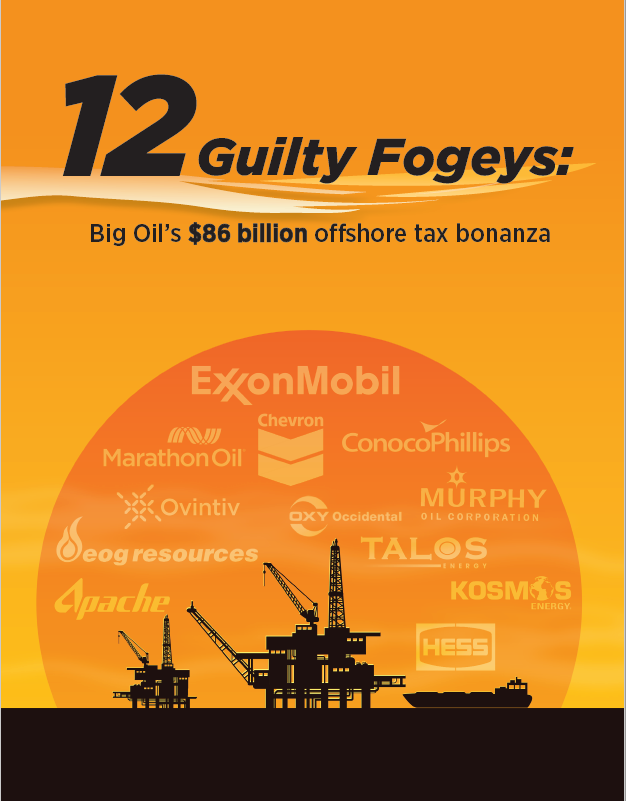
12 Guilty Fogeys: Big Oil’s $86 billion offshore tax bonanza

By staff - Friends of the Earth, Bailout Watch, and Oxfam, September 2021

Few letter-soup acronyms in Washington bureaucratese are so aptly pronounced as GILTI and FOGEI, two esoteric provisions in the tax code worth tens of billions of dollars to Big Oil’s multinational majors.

Under the Trump Administration’s radical 2017 tax law, companies that extract oil and gas overseas enjoy special exemptions within the Global Intangible Low-Tax (GILTI) regime covering Foreign Oil and Gas Extraction Income (FOGEI).

It is a fitting accident of nomenclature: FOGEI’s GILTI carveout helps prop up the fossil firms most culpable for the climate crisis — to the tune of $84 billion. An additional international tax loophole enjoyed by Big Oil is worth at least another $1.4 billion, for a grand total of over $86 billion in offshore tax giveaways.

Read the text (PDF).

Indigenous Resistance Against Carbon

By Dallas Goldtooth, Alberto Saldamando, and Kyle Gracey, et. al. - Indigenous Environmental Network and Oil Change International, September 1, 2021

This report shows that Indigenous communities resisting the more than 20 fossil fuel projects analyzed have stopped or delayed greenhouse gas pollution equivalent to at least 25 percent of annual U.S. and Canadian emissions. Given the current climate crisis, Indigenous peoples are demonstrating that the assertion of Indigenous Rights not only upholds a higher moral standard, but provides a crucial path to confronting climate change head-on and reducing emissions. 

The recently released United Nations climate change report by the Intergovernmental Panel on Climate Change (IPCC) states that in order to properly mitigate the worst of the climate crisis, rapid and large-scale action must be taken, with a focus on immediate reduction of fossil fuel emissions. As the United Nations prepares for its upcoming COP 26 climate change conference in Glasgow, Scotland, countries are being asked to update their pledges to cut emissions — but as the IPCC report states, current pledges fall short of the changes needed to mitigate the climate chaos already millions of people around the world. 

While United Nations member countries continue to ignore the IPCC’s scientists and push false solutions and dangerous distractions like the carbon markets in Article 6 of the Paris Agreement, Indigenous peoples continue to put their bodies on the line for Mother Earth. False solutions do not address the climate emergency at its root, and instead have damaging impacts like continued land grabs from Indigenous Peoples in the Global South. Indigenous social movements across Turtle Island have been pivotal in the fight for climate justice.

Read the text (PDF).

Pages

The Fine Print I:

Disclaimer: The views expressed on this site are not the official position of the IWW (or even the IWW’s EUC) unless otherwise indicated and do not necessarily represent the views of anyone but the author’s, nor should it be assumed that any of these authors automatically support the IWW or endorse any of its positions.

Further: the inclusion of a link on our site (other than the link to the main IWW site) does not imply endorsement by or an alliance with the IWW. These sites have been chosen by our members due to their perceived relevance to the IWW EUC and are included here for informational purposes only. If you have any suggestions or comments on any of the links included (or not included) above, please contact us.

The Fine Print II:

Fair Use Notice: The material on this site is provided for educational and informational purposes. It may contain copyrighted material the use of which has not always been specifically authorized by the copyright owner. It is being made available in an effort to advance the understanding of scientific, environmental, economic, social justice and human rights issues etc.

It is believed that this constitutes a 'fair use' of any such copyrighted material as provided for in section 107 of the US Copyright Law. In accordance with Title 17 U.S.C. Section 107, the material on this site is distributed without profit to those who have an interest in using the included information for research and educational purposes. If you wish to use copyrighted material from this site for purposes of your own that go beyond 'fair use', you must obtain permission from the copyright owner. The information on this site does not constitute legal or technical advice.