You are here

energy democracy

‘Transition is inevitable, but justice is not.’ A challenge to social movements in the rich countries

By staff - People and Nature, February 13, 2023

“Clean energy transitions” by rich countries of the global north are producing “a new phase of environmental despoliation of the Global South”, states a manifesto published last week by an alliance of social and environmental organisations.

“This decarbonisation of the rich, which is market-based and export-oriented, depends on a new phase of environmental despoliation of the Global South, which affects the lives of millions of women, men and children, not to mention non-human life”, the Manifesto for an Ecosocial Energy Transition says.

Women, especially from agrarian societies, are among the most impacted. In this way, “the Global South has once again become a zone of sacrifice, a basket of purportedly inexhaustible resources for the countries of the North.”

As the rich countries secure supply chains for these “clean” transitions, the web of debt and trade agreements in which countries outside the rich world are caught is tightened.

I hope that social movements and the labour movement in the rich countries will not only sign the manifesto (which you can do here), but also – probably more to the point – think about and discuss what it means for us.

Manifesto for an Ecosocial Energy Transition from the Peoples of the South

By Peoples of the Global South - Foreign Policy in Practice, February 9, 2023

An appeal to leaders, institutions, and our brothers and sisters

More than two years after the outbreak of the COVID-19 pandemic—and now alongside the catastrophic consequences of Russia’s invasion of Ukraine—a “new normal” has emerged. This new global status quo reflects a worsening of various crises: social, economic, political, ecological, bio-medical, and geopolitical.

Environmental collapse approaches. Everyday life has become ever more militarized. Access to good food, clean water, and affordable health care has become even more restricted. More governments have turned autocratic. The wealthy have become wealthier, the powerful more powerful, and unregulated technology has only accelerated these trends.

The engines of this unjust status quo—capitalism, patriarchy, colonialism, and various fundamentalisms—are making a bad situation worse. Therefore, we must urgently debate and implement new visions of ecosocial transition and transformation that are gender-just, regenerative, and popular, that are at once local and international.

In this Manifesto for an Ecosocial Energy Transition from the Peoples of the South, we hold that the problems of the Global – geopolitical – South are different from those of the Global North and rising powers such as China. An imbalance of power between these two realms not only persists because of a colonial legacy but has deepened because of a neocolonial energy model. In the context of climate change, ever rising energy needs, and biodiversity loss, the capitalist centers have stepped up the pressure to extract natural wealth and rely on cheap labor from the countries on the periphery. Not only is the well-known extractive paradigm still in place but the North’s ecological debt to the South is rising.

What’s new about this current moment are the “clean energy transitions” of the North that have put even more pressure on the Global South to yield up cobalt and lithium for the production of high-tech batteries, balsa wood for wind turbines, land for large solar arrays, and new infrastructure for hydrogen megaprojects. This decarbonization of the rich, which is market-based and export-oriented, depends on a new phase of environmental despoliation of the Global South, which affects the lives of millions of women, men, and children, not to mention non-human life. Women, especially from agrarian societies, are amongst the most impacted. In this way, the Global South has once again become a zone of sacrifice, a basket of purportedly inexhaustible resources for the countries of the North.

Reimagining Energy For Our Communities

By Crystal Huang, Jessica Tovar, Nora Elmarzouky, Ruth Santiago, and Al Weinrub - The Energy Democracy Project, February 2023

The energy systems in place today, in which energy development, control, ownership, and decision-making resides within Wall Street and corporate electric utilities, negatively impact the health and safety of communities, and fail to provide the energy needed to live, especially in the face of climate disaster.

A product of deep collaboration between grassroots organizations, the REFOCUS zine is a graphic tool meant to be shared with community, teams, and anyone interested in understanding the path towards energy justice.

Download the zine to learn how Energy Democracy work is connected from Alaska to Puerto Rico, and build a movement for energy democracy with your community! 

Download a copy of this publication here (PDF).

'Our Future Is Public': Santiago Declaration Envisions End of Neoliberalism Death Spiral

By Kenny Stancil - Common Dreams, January 27, 2023

A new manifesto calls for building "a sustainable social pact for the 21st century" in which "our rights are guaranteed, not based on our ability to pay, or on whether a system produces profit, but on whether it enables all of us to live well together in peace and equality."

An international coalition made up of more than 200 trade unions and progressive advocacy groups on Thursday published the Santiago Declaration, a manifesto for "a complete overhaul of our global economic system."

The undeniably anti-neoliberal document proclaiming that "our future is public" is the product of a meeting held in Chile—the "laboratory of neoliberalism" where Milton Friedman and his University of Chicago acolytes' upwardly redistributive economic model was first imposed at gunpoint by Gen. Augusto Pinochet's military junta.

From November 29 to December 2, more than 1,000 organizers from over 100 countries gathered in Santiago and virtually to germinate a left-wing movement against "the dominant paradigm of growth, privatization, and commodification."

"We are at a critical juncture," the manifesto begins. "At a time when the world faces a series of crises, from the environmental emergency to hunger and deepening inequalities, increasing armed conflicts, pandemics, rising extremism, and escalating inflation, a collective response is growing."

"Hundreds of organizations across socioeconomic justice and public services sectors—from education and health services, to care, energy, food, housing, water, transportation, and social protection—are coming together to address the harmful effects of commercializing public services, to reclaim democratic public control, and to reimagine a truly equal and human rights-oriented economy that works for people and the planet," reads the document. "We demand universal access to quality, gender-transformative, and equitable public services as the foundation of a fair and just society."

TUED South Platform: a “Public Pathway” Approach to a Just Energy Transition in the Global South

Justice40: Strategies and Successes

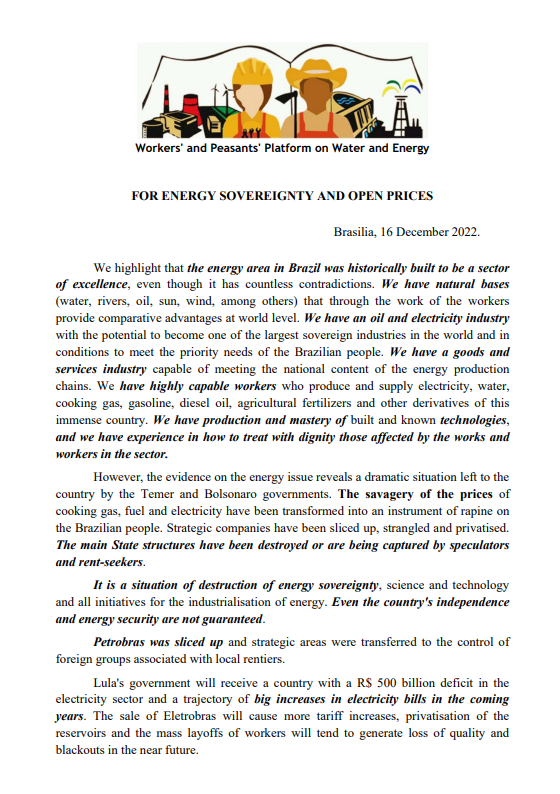
For Energy Sovereignty and Open Prices

By Workers' and Peasants' Platform for Water and Energy - Workers' and Peasants' Platform for Water and Energy, December 16, 2022

We highlight that the energy area in Brazil was historically built to be a sector of excellence, even though it has countless contradictions. We have natural bases (water, rivers, oil, sun, wind, among others) that through the work of the workers provide comparative advantages at world level. We have an oil and electricity industry with the potential to become one of the largest sovereign industries in the world and in conditions to meet the priority needs of the Brazilian people. We have a goods and services industry capable of meeting the national content of the energy production chains. We have highly capable workers who produce and supply electricity, water, cooking gas, gasoline, diesel oil, agricultural fertilizers and other derivatives of this immense country. We have production and mastery of built and known technologies, and we have experience in how to treat with dignity those affected by the works and workers in the sector.

However, the evidence on the energy issue reveals a dramatic situation left to the country by the Temer and Bolsonaro governments. The savagery of the prices of cooking gas, fuel and electricity have been transformed into an instrument of rapine on the Brazilian people. Strategic companies have been sliced up, strangled and privatised. The main State structures have been destroyed or are being captured by speculators and rent-seekers.

It is a situation of destruction of energy sovereignty, science and technology and all initiatives for the industrialisation of energy. Even the country's independence and energy security are not guaranteed.

Read the entire statement (PDF).

Climate Change As Class War: A Review

By Tom Wetzel - Ideas and Action, December 6, 2022

As the burning of fossil fuels continues to pump up the size of the carbon dioxide layer in the atmosphere, the global warming crisis becomes ever more acute. In its “Code Red for Humanity” warning in 2021, the UN’s Intergovernmental Panel on Climate Change said: “The alarm bells are deafening, and the evidence is irrefutable: greenhouse gas emissions from fossil-fuel burning and deforestation are choking our planet and putting billions of people at immediate risk. Global heating is affecting every region on Earth…”

But we’re losing the climate battle thus far. In Climate Change as Class War, Marxist geographer Matthew Huber argues that the climate movement is losing because it is rooted in the “professional class.” He argues that this class lacks the power to defeat the powerful capitalist interests that drag their heals against the kind of drastic cutting back of fossil-fuel burning that is needed. For Huber, the climate movement needs to be rooted in the working class to have sufficient power to enact radical structural reforms needed to effectively fight global warming. 

Huber analyses the existing climate movement as consisting of three layers. First, there are the “science communicators” like James Hansen who try to do popular education about climate change science. A second group are “policy technocrats” with expertise in law or policy studies and work in think tanks, the university world, or non-profits. Their orientation is to craft “smart” policy solutions. A third group are the “anti-system radicals” whose exposure to the science of environmental devastation “leads to a kind of political radicalization.” Huber views these groups as part of the “professional class” and tries to use his theory of this class to explain the politics of the climate movement. Huber pinpoints two features of the climate movement that he sees as sources of weakness: (1) The emphasis on high levels of personal consumption as a factor in global warming, thus leading to a “politics of less” — especially a feature of “degrowth” politics; and (2) an emphasis on science education. “Making climate politics purely about science evades the question of power. It allows us to attribute…inaction on climate change as simply due to misinformation rather than a lack of power.”

Huber appeals to the theory of the “Professional-Managerial Class” (proposed by Barbara and John Ehrenreich) to try to explain the origin of these features of the “professional class” climate movement. Here he points to the centrality of credentials which mediates the access of the “professional class” to the labor market. This includes “the existence of a specialized body of knowledge, accessible only by lengthy training,” degree and licensing programs, professional associations, which he regards as “forms of class organization.” This tends to encourage acceptance of meritocratic ideology which favors decision-making power for managers and professionals. This emphasis on the importance of knowledge and the role of professionals tends to favor the science education emphasis of the climate movement, as Huber sees it.

In the Ehrenreichs’ theory of the PMC their class position is based on their control over cultural and social reproduction. This is how teachers and writers are included in the class. Among both Marxists and libertarian socialists, however, class has historically been seen as an institutional group-to-group power relation in social production, as in Marx’s concept of capital as a social power relation. Looking at it from this point of view, I think the PMC theory tends to paper over a distinction between two different class groups. First, there is a group I call the bureaucratic control class. This group’s class position is based on their relative monopoly of decision-making power, via bureaucratic hierarchies that exist to control labor and run corporations and government agencies day-to-day. This includes not only salaried managers but high-end professionals who work closely with management to control labor and defend corporate interests, such as corporate lawyers, HR experts, and industrial engineers who design jobs and work organization. This class power relation is the basis of the clear antagonism between this layer and the working class. 

It’s noteworthy that school teachers, newspaper reporters, script writers, and nurses all form unions and occasionally go on strike. These lower level professional employees are not usually part of the management apparatus, and don’t manage other workers. As such, they have a structural position like the core working class of manual workers, not the bureaucratic control class. The people in this lower professional layer often have college degrees, and sometimes do show elitism towards the core manual working class. They also tend to have more autonomy in their work. However, the “skilled trades” in the early 20th century often showed elitism towards less skilled manual workers and often had relative autonomy in their work. But we generally regard skilled blue collar workers (such as tool and die makers) as part of the working class. 

Lower level professional employees may be tempted to middle class meritocratic ideology. As such they will be in a conflicted position, as they also share the subordination of the working class position. This is why Erik Olin Wright’s phrase “contradictory class location” is appropriate for this group — a point that Huber concedes.

Working Paper 16: Towards a Public Pathway Approach to a Just Energy Transition for the Global South

By staff - Trade Unions for Energy Democracy, December 2022

This TUED Working Paper was written to inform discussion at the launch of “TUED South” meeting that took place in Nairobi, Kenya, during October 11th-13th, 2022.

In the weeks following the meeting, it was revised to reflect the discussions that took place. The Nairobi meeting occurred at a time of geopolitical turbulence due to the war in the Ukraine. In many countries, energy has become front page news as prices rise and the major economies rush to secure new sources of gas, coal, and oil. Energy-related anxieties have been accompanied by growing concerns about climate change. The year 2022 produced several headline-making extreme weather events, with devastating floods in Pakistan and in South Africa’s KwaZulu-Natal province together claiming the lives of more than 2,000 people and leaving hundreds of thousands of poor people homeless. Europe’s record-breaking heatwave and wildfires killed 16,000 people, and China’s summer produced a heatwave more severe than any in recorded history.

Today it is widely recognized that the impact of climate change on the poorest countries is already more severe than it is for the richer countries, and that inadequate public services are contributing to its many damaging effects.

In 2019 the UN’s Special Rapporteur on extreme poverty and human rights noted “hundreds of millions will face food insecurity, forced migration, disease, and death.”

Climate change is a huge threat to jobs, livelihoods, and security to workers everywhere. But it is the working class and poor people of the South who will be hit the first and the hardest.

Download this document (PDF).

What Is Needed For A Just Transition To Renewables?

By Carolyn Fortuna - Clean Technica, November 2, 2022

Big Oil is trying to get climate liability lawsuits moved from state to federal courts, where they believe they’d be more likely to prevail against efforts to make them pay for damaging the environment. Key communities are laying out explicit steps to help move their economies away from coal. Debates are taking place in the tech sector that analyze the social and political changes inevitable to implement renewable energy at scale. These are all dilemmas within what’s called a just transition, and it’s at the core of renewable energy activism.

In its original incarnation, a just transition pointed to workers’ rights, but, over the past few years, the concept expanded into relevance for fields beyond the labor market. A just transition is a future-oriented concept, guided by principles of sustainability and climate justice.

Unfortunately, these concepts don’t always work in concert.

What is a Just Transition, Anyway?

The transition to a clean energy economy is escalating, yet it takes thoughtful planning and robust resources. There are several dimensions to a just transition to move economies and regions away from fossil fuels and towards creating sustainable value and solving issues of climate injustice.

An opposition point of view claims that the shift to clean energy will spur gaps in well paying jobs with good benefits, loss of health insurance, reduced property values, gaps in local tax revenues, unfunded liabilities for environmental cleanup, and uncertainty around future community economic development.

Include social and political participation of affected groups: A just transition is about focusing on support for communities that bear a disproportionate burden of industrial and fossil fuel pollution. These citizens suffer tremendous health effects and are denied commensurate economic benefits. Locations where deep pockets of industrial fossil fuel pollution occur are known as “sacrifice zones,” where toxic air inflicts health problems such as asthma and high rates of cancer. They’re also typically where low income communities of color live and where institutional barriers have afflicted generations of citizens.

Assist workers in unsustainable sectors whose jobs will get lost in the economic reorganization: For many advocates, a just transition encompasses not only support for displaced fossil fuel workers and front-line communities but also a tectonic shift in the design of the economy. For example, workers who engage with toxic materials face the likelihood of illness and death, yet these provide the world with the energy and the materials it needs to recreate energy systems.

Recognize where benefits are accumulated by only a small part of relevant stakeholders: A just transition considers less wealthy countries that depend on fossil fuels for a major part of their GNI. Many advocates are calling upon wealthier nations to help countries with less total domestic and foreign input to switch to clean energy.

Create reskilling and new opportunities for workers whose jobs are lost due to restructuring: A just transition means taking an extractive economy — one that exploits workers and resources — and transforming it into a regenerative economy — one that relies on renewable resources and puts people’s well-being before profit. Just transition initiatives shift the economy from climate polluting fossil fuels to energy democracy. No longer do highways receive mass federal funding; instead, an emphasis on public transit takes place. Costs for discarding waste in landfills skyrockets as do incentives to compost and purchase compostable packaging. Ecosystem destruction halts and ecosystem restoration becomes a huge focus. All of these will create new job opportunities.

Pages

The Fine Print I:

Disclaimer: The views expressed on this site are not the official position of the IWW (or even the IWW’s EUC) unless otherwise indicated and do not necessarily represent the views of anyone but the author’s, nor should it be assumed that any of these authors automatically support the IWW or endorse any of its positions.

Further: the inclusion of a link on our site (other than the link to the main IWW site) does not imply endorsement by or an alliance with the IWW. These sites have been chosen by our members due to their perceived relevance to the IWW EUC and are included here for informational purposes only. If you have any suggestions or comments on any of the links included (or not included) above, please contact us.

The Fine Print II:

Fair Use Notice: The material on this site is provided for educational and informational purposes. It may contain copyrighted material the use of which has not always been specifically authorized by the copyright owner. It is being made available in an effort to advance the understanding of scientific, environmental, economic, social justice and human rights issues etc.

It is believed that this constitutes a 'fair use' of any such copyrighted material as provided for in section 107 of the US Copyright Law. In accordance with Title 17 U.S.C. Section 107, the material on this site is distributed without profit to those who have an interest in using the included information for research and educational purposes. If you wish to use copyrighted material from this site for purposes of your own that go beyond 'fair use', you must obtain permission from the copyright owner. The information on this site does not constitute legal or technical advice.