You are here

energy democracy

COP26: Trade Unions Must Fight for a Socialist Transition to Renewables

By Chris Baugh - The Bullet, October 26, 2021

The UK government is hosting the 26th United Nations Climate Change “Conference of the Parties” (COP26) in Glasgow from 31 October to 12 November 2021.

The Intergovernmental Panel on Climate Change (IPCC) was formed in 1988. Its latest report to the UN in August of this year contains even starker warnings for the Earth’s climate than previously, unless decisive action is taken to cut greenhouse emissions. Without this, there is little prospect of keeping an average global temperature increase below the 1.5 to 2 degrees Celsius target in the 2015 COP21 Paris Agreement.

This was the first time an agreement had been reached on target reductions but it excluded major polluting industries like aviation and shipping and was devoid of any mechanism for implementing the targets. This reflects the global capitalist consensus that it is market mechanisms that will make the adjustment from fossil fuels to a zero carbon economy. This is despite the warning of Lord Stern who famously described climate change as “the biggest market failure in human history.”

Articles in the pages of The Socialist and Socialism Today have pointed out that it is capitalism’s insatiable pursuit of profit that has led us to this situation. Capitalism has shown itself unwilling and an actual impediment to the action on the timescale and scope required. An article published by Trade Unions for Energy Democracy (TUED) gives recent evidence of how renewable energy companies are “party to a race to the bottom, capitalist dynamic.”

It cites the use of forced Uyghur labour in China-based solar companies and the ‘off-shoring’ of manufacturing for the Scottish wind industry. The large wind and solar companies prop up a market architecture that is sucking in huge amounts of public money to guarantee profit margins. The report is quoted as saying “these companies have not just gone over to the political dark side, they helped design it.”

While richer governments of US and Europe talk up their climate commitments, the solutions proposed will not fix the climate crisis. UK plans to transition to renewable energy are reliant upon an unprecedented wave of resource extraction from ‘Global South’ countries. Intensifying the mining of so-called transition metals and minerals used to produce green technologies such as solar panels, wind turbines and electric vehicle batteries, is devastating communities from Chile to China.

Puerto Rican Electrical Workers Union Fights Privatization of Island’s Grid

By Ángel Figueroa Jaramillo - Labor Notes, October 26, 2021

The people and workers of Puerto Rico are suffering the consequences of the privatization of our electricity system, which has been handed over to a new company, LUMA Energy, a subsidiary of Houston-based Quanta Services and Canadian firm ATCO.

Our union, UTIER—the Puerto Rico Electric and Irrigation Industry Workers Union—has been fighting for months against the disastrous contract that the Puerto Rican government signed with LUMA to operate our electricity grid for the next 15 years.

Privatization has dismembered the electrical system’s workforce in a transparent attempt to break up our union. LUMA was not required to hire employees of the Puerto Rico Electric Power Authority (PREPA)—the public company whose assets were privatized. Nor did LUMA comply with the existing collective agreements between PREPA and its unions. Instead, LUMA offered reduced benefits and job protections.

LUMA began its contract on June 1 with only half the number of employees PREPA previously had, many of them are untrained and unfamiliar with our electrical system. The result has been ongoing outages and customer service debacles. If a major hurricane had hit Puerto Rico this summer, the outcome would have been much worse.

Plagued by Daily Blackouts, Puerto Ricans Are Calling for an Energy Revolution. Will the Biden Administration Listen?

By Kristoffer Tigue - Inside Climate Newses, October 25, 2021

Many residents say a record amount of incoming federal aid provides a once-in-a-generation opportunity to transition the island to clean energy. So far, the funds are mostly going to natural gas.

Eddie Ramirez has never understood why his government doesn’t more aggressively pursue renewable energy.

When Hurricane Maria swept across Puerto Rico in September 2017, shredding the energy grid and knocking out power for nearly all the island’s 3.4 million residents for months on end, Casa Sol—Ramirez’s five-bedroom bed and breakfast—was one of the only buildings in San Juan with working electricity, with 30 solar panels bolted to its roof.

When a large fire this June at an electrical substation in San Juan plunged more than 800,000 Puerto Rican homes into darkness and knocked out power to another 330,000 the following week, Casa Sol’s lights stayed on, even as its neighbors lost power.

And when a series of equipment failures and poor maintenance led to cascading power outages across the island in August, September and October, leaving hundreds of thousands of Puerto Ricans without electricity for days at a time and prompting calls for Puerto Rico Gov. Pedro Pierluisi to resign, Ramirez and his solar-powered hotel carried on, business as usual.

“We don’t even know when it happens,” Ramirez said of the blackouts, which have become a daily part of life for many Puerto Ricans since June, when the private company LUMA Energy took over the island’s electricity transmission system.

With Puerto Rico’s grid still in shambles four years after Maria’s landfall, and $12.4 billion in federal aid earmarked to help repair the territory’s electrical systems and jumpstart its economy, many Puerto Ricans, like Ramirez, see a once-in-a-generation opportunity to reimagine the island’s tattered power system as a modern grid powered by clean energy and far better at withstanding the worsening threats of the climate crisis.

But many Puerto Ricans worry their political leaders are squandering that opportunity by planning to rebuild the electricity grid with natural gas power plants that continue to emit greenhouse gases and feed lengthy transmission lines that are vulnerable to natural disasters.

Trade Unions for Energy Democracy Global Forum on the IPCC Report

Hoodwinked in the Hothouse: Examining False Corporate Schemes advanced through the Paris Agreement

People's Utility Justice Playbook​

By Yesenia Rivera and Johanna Bozuwa - Energy Democracy Project, October 2021

Have you ever wondered who is in charge of your electricity? And why?

The People’s Utility Justice Playbook has two components:

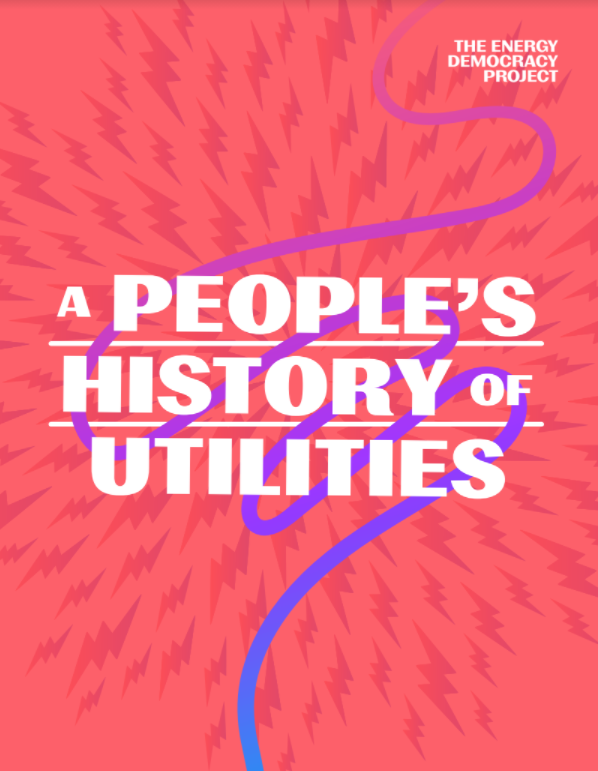
  1. a “History of Utilities” report to summarize the history of utilities for everyone to understand how our current energy system originated.
  2. a “People’s Utility Justice Playbook” to expose the tactics from electric utilities that are undermining community’s efforts, so we can build our organizing strength—to not only fight back but also to build the democratic energy system for climate justice.

This is the basic information we need to fight back against energy utilities attempting to slow or stop progress toward economic and climate justice.

History of Utilities​

Electric utilities have expanded into almost every aspect of our lives to become one of the most powerful and concentrated industries on Earth. To have a better understanding of what we’re fighting against, we first need to learn about the history of energy utilities! This PDF summarizes the entire timeline and how the rise of energy democracy came about.

People's Utility Justice Playbook

In order to fight the industry-owned utilities’ tactics, we need our own strategies for combat!

We have our very own playbook sourced from energy justice activists on the ground. They suggest strategies and tactics they employ when fighting against utilities that anyone fighting against utilities could use!

Read the History (PDF).

Read the Playbook (PDF).

Renewable Energy companies seen as barriers to a successful public energy transition

By Elizabeth Perry - Work and Climate Change Report, September 8, 2021

Recent issues of New Labor Forum include articles promoting the concept of energy democracy, and bringing an international perspective. In “Sustaining the Unsustainable: Why Renewable Energy Companies Are Not Climate Warriors” (New Labor Forum, August), author Sean Sweeney argues that renewable energy companies “are party to a “race to the bottom” capitalist dynamic that exploits workers – citing the example of alleged forced Uyghur labour in China-based solar companies, and the offshoring of manufacturing for the Scottish wind industry. He also argues that “large wind and solar interests’ “me first” behavior is propping up a policy architecture that is sucking in large amounts of public money to make their private operations profitable. They are sustaining a model of energy transition that has already shown itself to be incapable of meeting climate targets. In so doing, these companies have not just gone over to the political dark side, they helped design it.”

The theme of the Spring New Labor Forum was A Public Energy Response to the Climate Emergency , and includes these three articles: “Beyond Coal: Why South Africa Should Reform and Rebuild Its Public Utility”; “Ireland’s Energy System: The Historical Case for Hope in Climate Action”; and Mexico’s Wall of Resistance: Why AMLO’s Fight for Energy Sovereignty Needs Our Support .

The author of Sustaining the Unsustainable is Sean Sweeney, who is Director of the International Program on Labor, Climate & Environment at the School of Labor and Urban Studies, City University of New York, and is also the coordinator of Trade Unions for Energy Democracy (TUED). In August, TUED convened a Global Forum, “COP26: What Do Unions Want?” – with participation from 69 unions, including the Scottish Trades Union Congress (STUC), the UK Trades Union Congress (TUC), the International Transport Workers Federation (ITF), Trade Union Confederation of the Americas (TUCA), the UK’s Public and Commercial Services Union (PCS), and Public Services International (PSI). Presentations are summarized in TUED Bulletin 111, (Aug. 18), and are available on YouTube here .

Energy Justice Statement on Rooftop Solar and Distributed Generation in California

By Alexis Sutterman, et. al. - CAUSE, Environmental Health California, APEN, CEJA, the Greenlining Institutem and Leadership Council for Justice and Accountability, September 2021

Communities are being bombarded by cumulative and intersecting energy pressures: an affordability crisis, rising rates, major utility debt, economic insecurity, and ongoing power outages. In the face of intensifying climate impacts and the need for rapid decarbonization, Net Energy Metering (NEM) policies have supported tremendous growth of distributed solar resources, making California a national leader and helping to dramatically improve the economics of distributed generation and rooftop solar. Due to the intersectional impacts of redlining, California’s inequitable energy policies, and ongoing oppression, however, environmental justice (EJ) communities have experienced structural barriers in accessing and benefiting from NEM. Data shows that NEM disproportionately benefits wealthier, white, single-family homeowners. By its very design, NEM has not enabled rooftop solar to adequately penetrate EJ communities. Despite representing 25% of the State’s population, only 11-12% of households living in disadvantaged communities (DACs) in California are on NEM rates.

Read the text (PDF).

Opinion: Public Utility Campaigns Have A Labor Problem

By C.M. Lewis - The Strike Wave, July 28, 2021

Maine Governor Janet Mills’ labor-backed veto of LD 1708—which would have consolidated two private utility corporations into a statewide consumer cooperative, Pine Tree Power—is a sober warning to those fighting for public utilities: neglect unions at your peril.

Mills is no friend to labor. She previously vetoed pro-worker labor reforms and pledged to veto the right to strike for public workers. But her veto, sustained by the legislature, still accomplished the goal of concerned unions like the International Brotherhood of Electrical Workers, Local 567, who were alarmed at a potential change in legal jurisdiction.

Union resistance to progressive proposals can often cause consternation. Culinary 226’s opposition to Medicare for All notably caused a stir during the Nevada caucuses, raising the ire of many progressives. However, an immediate assumption that IBEW was wrong to oppose the bill buries the complicated reality: the bill would’ve tangibly harmed union workers. 

IBEW’s opposition was driven by concern that the bill would move workers from jurisdiction under the National Labor Relations Board to the Maine Labor Relations Board, bringing them into the public sector. Although that superficially sounds like a minor administrative change, and no reason for opposition, it would’ve had severe consequences for their workers—notably losing the statutory right to strike, and the imposition of the open shop through the Janus vs. AFSCME ruling

Viewed through that lens, IBEW’s opposition—while frustrating—is not unreasonable, and it speaks to a difficult problem faced by advocates for public utilities: that under present law, there is little to no way to bring private utilities under public control without stripping union rights from workers.

Wind energy on the Northeast Brazilian coast and the contradictions between ‘clean energy’, injustices and environmental racism

By Cris Faustino and Beatriz Fernandes - World Rainforest Movement, July 9, 2021

In dominant models of energy production and consumption, the centralization of the energy matrix and the concentration of decision-making power remain, and with all the marks of inequalities, patriarchy and environmental racism, even if the source of energy has changed.

Energy production in the face of demand to sustain, develop and expand predominant urban-industrial-capitalist ways of life in so-called global society, does not take place without high levels of interference on a daily basis in nature and the environment, as well as in multiple societies and peoples, their territories and experiences. Regardless of the source of energy and of the technology used to generate it, in these dominant models, energy ventures produce countless socio-environmental conflicts, risks and damage in contexts of deep-seated inequalities.

It just so happens that in Brazil and Latin America, the dynamics of demand for, access to and use of land, water and territory, as well as the ecological and socio-environmental harm that results from them, carry the inheritance of historical facts. An example of this is the expropriation of others’ territories and the setting up of a political, economic, legal, military and religious power based on the supremacy of the colonizer, white men and women, over indigenous and black people. In these processes, violence, subjugation and violation of bodies, of history and of dignity, were instituted as methods. To this day, despite all the achievements in terms of winning rights, these inheritances are encrusted in the dominant political, economic and socio-cultural powers. In the current socio-environmental conflicts, such inheritances manifest themselves in the naturalization of white privileges over state policies and in the relations of the state and the private sector with each other and with black populations, indigenous peoples, riverine peoples, fisherfolk, quilombola communities and others. These do not necessarily have as a reference the consumerist and energy-intensive models of living and organizing life.

In these circumstances, even if the source for producing energy via the wind industry in Brazil, and particularly in the Northeast Region, is considered technologically and ecologically cleaner, the concrete way in which wind farms are implemented is marked by the productivist/consumerist logic. According to the values of this logic, the provision of human needs is only viable in the form of hyper-exploitation and profits at the expense of the environment, of territories and their peoples. And this does not take place without being cut across by structural racism and its expressions in the environmental reality and in the democratic fragilities involved in ensuring the rights of peoples.

Pages

The Fine Print I:

Disclaimer: The views expressed on this site are not the official position of the IWW (or even the IWW’s EUC) unless otherwise indicated and do not necessarily represent the views of anyone but the author’s, nor should it be assumed that any of these authors automatically support the IWW or endorse any of its positions.

Further: the inclusion of a link on our site (other than the link to the main IWW site) does not imply endorsement by or an alliance with the IWW. These sites have been chosen by our members due to their perceived relevance to the IWW EUC and are included here for informational purposes only. If you have any suggestions or comments on any of the links included (or not included) above, please contact us.

The Fine Print II:

Fair Use Notice: The material on this site is provided for educational and informational purposes. It may contain copyrighted material the use of which has not always been specifically authorized by the copyright owner. It is being made available in an effort to advance the understanding of scientific, environmental, economic, social justice and human rights issues etc.

It is believed that this constitutes a 'fair use' of any such copyrighted material as provided for in section 107 of the US Copyright Law. In accordance with Title 17 U.S.C. Section 107, the material on this site is distributed without profit to those who have an interest in using the included information for research and educational purposes. If you wish to use copyrighted material from this site for purposes of your own that go beyond 'fair use', you must obtain permission from the copyright owner. The information on this site does not constitute legal or technical advice.