You are here

green economics

Canada’s banks continue to finance oil and gas

By Elizabeth Perry - Work and Climate Change Report, May 19, 2021

A report released at the end of April examines the performance and the links between Canada’s oil companies and the big banks which form Canada’s “comfortable oligopoly”: Royal Bank (RBC), Toronto-Dominion Bank, Bank of Nova Scotia, Bank of Montreal, Canadian Imperial Bank of Commerce, and the National Bank of Canada. Fossilized Finance: How Canada’s banks enable oil and gas production is written by Donald Gutstein and published by by the B.C. Office of the Canadian Centre for Policy Alternatives as part of its Corporate Mapping Project. The report outlines the bank presence in the Canadian energy sector since the collapse of oil prices in 2014 – lending, underwriting, advising and investing. It also examines interlocking directorates, executive transfer, industry conference sponsorships and industry association memberships.This reveals different details than the international report, Banking on Climate Chaos, published by BankTrack in late March.

While acknowledging that the banks have begun to invest in some renewable energy projects, Fossilized Finance shows that this leopard has not changed its spots:

“In contrast to the need to reduce financing of fossil fuels, banks actually increased their lending and commitments to the industry by more than 50 per cent—to $137 billion—between 2014 and 2020. Toronto-Dominion, in particular, upped its lending by 160 per cent over the seven-year period, to nearly $33 billion in 2020. As well, banks have invested tens of billions of dollars in fossil fuel and pipeline company shares. Here, Royal Bank leads the pack with nearly $21 billion invested in the top 15 fossil fuel and pipeline companies as of November 2019. Banks continue to underwrite fossil fuel company stock and bond issues, and they continue to provide key advice on mergers, acquisitions and other corporate moves.”

Many of the researchers involved in the CCPA/Corporate Mapping Project have written chapters in Regime of Obstruction: How Corporate Power blocks Energy Democracy, a book edited by William Carroll and published by Athabasca University Press. Readers of the WCR may be particularly interested in Chapter 15, “From Clean Growth to Climate Justice” by Marc Lee, but all the excellent chapters are available for free download here. The publisher’s summary states: “Anchored in sociological and political theory, this comprehensive volume provides hard data and empirical research that traces the power and influence of the fossil fuel industry through economics, politics, media, and higher education. Contributors demonstrate how corporations secure popular consent, and coopt, disorganize, or marginalize dissenting perspectives to position the fossil fuel industry as a national public good. They also investigate the difficult position of Indigenous communities who, while suffering the worst environmental and health impacts from carbon extraction, must fight for their land or participate in fossil capitalism to secure income and jobs. The volume concludes with a look at emergent forms of activism and resistance, spurred by the fact that a just energy transition is still feasible. This book provides essential context to the climate crisis and will transform discussions of energy democracy.”

If you are outraged by what these researchers reveal, a personal option to switch banks is now made easier through the Bank Green website, launched in April in association with BankTrack. So far, Bank Green covers more than 300 banks globally, including only two “ethical banks” in Canada: Vancity, and Duca Credit Union. The website provides information for customers and encourages them to switch banks and divest from fossil fuels.

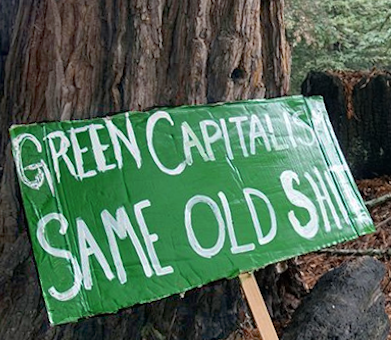
Green Economy, Green Capitalism? The Case Against The Case for Climate Capitalism

By Nick Grover - The Bullet, May 14, 2021

Even now, with a ten-year timeframe left for action, it’s rare for the climate crisis to be treated as the emergency it is. So, credit where due to Tom Rand. In his The Case for Climate Capitalism: Economic Solutions for a Planet in Crisis (Toronto: ECW Press, 2020), Rand calls for a rapid transition away from fossil fuels and toward renewables; he blames the political and business elite for the mess and says they will have to pay the price as markets turn against oil and assets are stranded; he even advocates for expansion of public transit. Where the book gets less refreshing is Rand’s tone toward the people who have been saying these things all along: his secondary enemy, leftists fusing demands for climate action with calls for economic justice.

Rand’s Case for Climate Capitalism aims to preserve and “co-opt” the forces of capitalism to usher in a transition toward green tech. His case is presented as simple pragmatism: the emergency we face affords us no time to discuss economic reforms; we must unite and do what works instead of holding out for a perfect system. His concern is that left ideas like the Green New Deal and Leap Manifesto – which wed strong climate action with job guarantees, labour protections, taxing the rich, and expanding social programs – alienate conservatives and the business class when we need them in our coalition to save the planet.

Green Energy, Green Mining, Green New Deal?

Job creation potential of nature-based solutions to climate change

By Elizabeth Perry - Work and Climate Change Report, May 10, 2021

U.K. think tank Green Alliance commissioned research to measure the economic impact of nature-based investments for a green recovery, and released the results on May 4. The full report, Green Renewal – The Economics of Enhancing the Natural Environment, was written by WPI Economics, and states: “Looking at just three types of enhancement (woodland creation, peatland restoration and urban green infrastructure) we find that an expanded programme of nature restoration could create at least 16,050 jobs in the 20% of constituencies likely to face the most significant employment challenges. We present place-based analysis of the labour market and nature based solutions, which can also be found on an interactive webpage here.” The report emphasizes that nature-based interventions can create jobs in areas that need them the most – stating that two thirds of the most suitable land for planting trees is in constituencies with worse than average labour market challenges.

Jobs for a Green Recovery is a summary report written by Green Alliance, based on the economic WPI report. It emphasizes the impact of Covid on youth employment, stating that 63% of those newly unemployed in 2020-21 are under 25, argues that nature-based jobs are long-term, skilled and productive, and makes specific recommendations for the British government so that such jobs can become part of the U.K. green recovery. Green Alliance estimates that investments in nature-related jobs have a high cost-benefit ratio, with £4.60 back for every £1 invested in peatland, £2.80 back in woodland, and £1.30 back for salt marsh creation.

Jobs for a Green Recovery includes brief U.K. case studies. An interesting a related Canadian example can be found in the new Seed the North initiative, described in The Tyee here . Seed the North is a small start-up company in Northern B.C., with big ambition to scale up. Currently, the project collects wild seed from Canadian trees, uses innovative technology to encase the seed in bio-char, and then uses drone technology to plant seeds in remote forest areas. The result: increased regeneration of disturbed land, restored soil health, a statistically significant contribution to carbon sequestration, and economic benefits flowing through co-ownership to the local First Nations communities who participate.

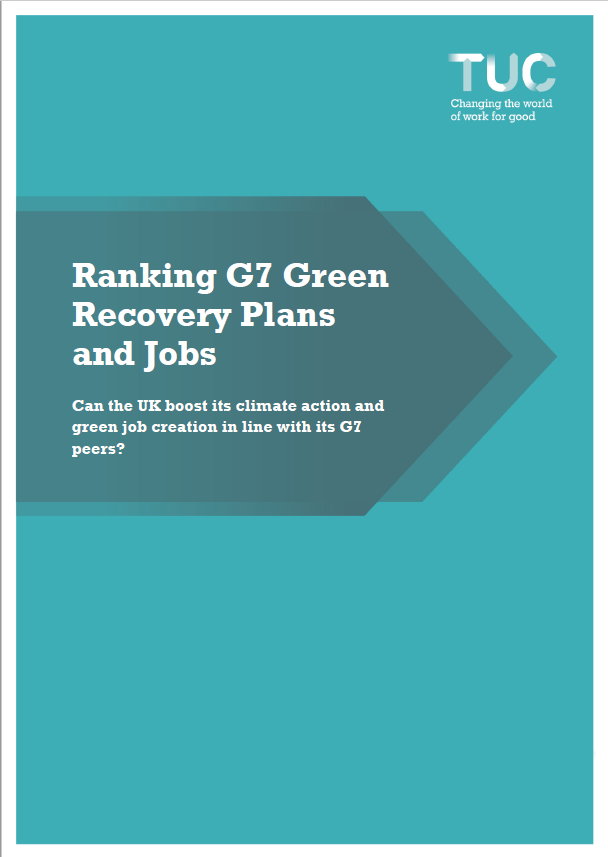
Ranking G7 Green Recovery Plans and Jobs: Can the UK boost its climate action and green job creation in line with its G7 peers?

By staff - Trades Union Caucus (TUC)May 2021

This report ranks G7 countries’ green recovery and job creation plans. It shows how the UK is lagging behind its G7 peers, and the potential to do much more to expand green jobs and accelerate climate action.

The TUC’s ranking of all G7 countries’ green recovery and jobs investments shows that the UK comes sixth. Only Japan scores worse per person.

The UK’s green recovery plans remain only a tiny fraction of that in other G7 countries, despite the government’s flagship Ten Point Plan for a Green Industrial Revolution which purports to support the UK’s climate targets and establish UK world leadership in some areas of green technology. Scaled by population, the UK green investment plans are only 26% of France’s, 21% of Canada, 13% of Italy’s and 6% of the USA’s.

This means that the UK Prime Minister would need five Ten Point Plans to match Prime Minister Trudeau in Canada, eight Ten Point Plans to match Prime Minister Draghi in Italy, and sixteen Ten Point Plans to match President Biden’s in the US.

Read the text (PDF).

For an ecosocialist transition that breaks from capitalism: Arguments and proposals

By Claude Calame - Global Ecosocialist Network, April 13, 2021

The 149 proposals issued by the French Citizens’ Convention on Climate last June, with the goal of achieving at least a 40% reduction in greenhouse gases by 2030 compared to 1990, manifestly belong to a thoroughly reformist approach. Nevertheless, Emmanuel Macron, only days after environmentalist candidates made gains in municipal elections, rejected three of those proposals:

  • the reduction of the motorway speed limit to 110 km/h (what else could one expect from the Finance Minister under Hollande who wanted to create competition between buses and trains?);
  • a 4% tax on dividends (the rejection of this proposal is consistent with the President’s abolition of the wealth tax among his first acts after being elected, in line with the demands of Medef);
  • the inclusion of ecology in the preamble to the Constitution (this proposal is clearly contrary to the principles of the President’s neoliberal worldview, which sees ‘nature’ itself only as something to be turned into a commodity to be submitted to the market and exploited for profit).

Beyond the Growth Imperative

By Olaf Bruns - Green European Journal, April 13, 2021

For 30 years, environmental economist Tim Jackson has been at the fore of international debates on sustainability. Over a decade since his hugely influential Prosperity Without Growth, the world is both much changed – reeling from a pandemic and with unprecedented prominence for environmental issues – and maddeningly the same, still locked in a growth-driven destructive spiral. What does Jackson’s latest contribution, Post Growth, have to say about the way out of the dilemma?

Tim Jackson’s new book, Post Growth: Life after Capitalism (Polity Press, 2021), follows his ground-breaking Prosperity without Growth (2009, updated in 2017). Whilst the previous work reflected, partly, the austerity-driven answers to the Great Recession, Post Growth falls into a different world. It is a world where the recognition of climate change as the greatest challenge facing humankind is moving towards consensus. In the United States, even the Republican Party’s younger members are looking for ways out of the corner into which the party has manoeuvred itself.

It is also a world where the Covid-19 pandemic has not only taken many lives and destroyed many livelihoods, but – via the need for state intervention – has also dealt a blow to the gung-ho neoliberalism that is one of the main culprits of financial chaos and the looming breakdown of planetary life-support systems.

US President Joe Biden’s rescue plan as well as the EU’s Next Generation pandemic recovery fund are questioning the free-market paradigm that has held sway the since the Reagan-Thatcher area, and that had trickled down into centre-left politics as well. In parallel, from the Paris Agreement to the European Commission’s European Green Deal, environmental concerns that were condescendingly smiled upon until recently have now moved centre stage. The newly discovered role for the state and the emerging environmental consciousness might not be discussed at length in Jackson’s new book, but they are the backdrop against which it is to be read.

Recharge Responsibly: The Environmental and Social Footprint of Mining Cobalt, Lithium, and Nickel for Electric Vehicle Batteries

By Benjamin Hitchcock Auciello, et. al. - Earthworks, March 31, 2021

It is critical that the clean energy economy not repeat the mistakes of the dirty fossil fuel economy that it is seeking to replace. The pivot from internal combustion engines towards electric vehicles provides an unprecedented opportunity to develop a shared commitment to responsible mineral sourcing. We can accelerate the renewable energy transition and drive improvements in the social and environmental performance of the mining industry by reducing overall demand for new minerals, increasing mineral recycling and reuse, and ensuring that mining only takes place if it meets high environmental, human rights and social standards.

This report is designed to inform downstream battery metal users of key environmental, social, and governance issues associated with the extraction and processing of the three battery metals of principal concern for the development of electric vehicles and low-carbon energy infrastructure—lithium, cobalt and nickel—and to offer guidance on responsible minerals sourcing practices. This report reflects and summarizes some of the key concerns of communities impacted by current and proposed mineral extraction in hotspots around the world: Argentina, Chile and the United States for lithium, Papua New Guinea, Indonesia and Russia for nickel, and the Democratic Republic of Congo for cobalt.

Read the text (PDF).

To Save America, Help West Virginia

By Liza Featherstone - Jacobin, March 30, 2021

A Democratic swing vote in an evenly divided Senate, West Virginia Democrat Joe Manchin has already proved to be a significant obstacle to progressive policy. His opposition was a significant reason for Biden’s failure to raise the minimum wage to $15; Manchin also played a key role in shrinking the household stimulus checks, as well as the weekly unemployment checks. He will be a necessary and highly undependable vote as Democrats attempt to address the climate crisis, advance union organizing rights, and counter racist Republican efforts to legislate voter suppression.

However, the infrastructure bill that Biden and the Democrats are preparing to unveil, which is expected to call for $3 trillion in investment in public goods and services, presents an opportunity for West Virginians — and for all of us. Manchin has been championing this legislation, even calling for it to be funded with an increase in taxes on corporations and the wealthy. On this issue, Eric Levitz of New York magazine has convincingly argued, Manchin is actually pulling Biden to the left.

Manchin’s salience puts West Virginia in a powerful position. The state has urgent needs, given the long decline of the coal industry and the double impact of the opioid and coronavirus public health crises. Almost a third of West Virginians filed for unemployment between mid-March 2020 and the end of January 2021.

A report by University of Massachusetts economists with the Political Economy Research Institute (PERI), released in late February, proposed a recovery plan for West Virginia, with good jobs and environmental sustainability at its center. The study showed how compatible these priorities really are. The state’s coal industry has spent years successfully demonizing Democrats and environmentalists as job killers. Under recent regimes of neoliberal austerity, there might been some truth to that, but with more generous investment from the federal government, West Virginia can redevelop its economy and lead the nation in fighting climate change at the same time.

PERI found that the struggling Appalachian state could reduce carbon emissions by 40 percent by 2030 and reach zero emissions by 2050 — the targets the Intergovernmental Panel on Climate Change (IPCC) determined in 2018 were needed in order to avoid irreversible damage to our planet and to human civilizations — while creating jobs and promoting prosperity. The UMass researchers found that $3.6 billion per year in (both public and private) investments in a clean energy program — averaged over the 2021–2030 time period — would generate about 25,000 West Virginian jobs per year. The PERI researchers also analyzed the effect of $1.6 billion a year — also over 2021–2030 — in investments in public infrastructure, manufacturing, land restoration, and agriculture, finding that these efforts would generate about 16,000 jobs per year.

In fighting for such priorities, progressives need resist the pull of what we might call “woke neoliberalism.” Woke neoliberalism functions by using charges of racism and sexism — very real problems! — against initiatives that could help the entire working class. (Remember Hillary Clinton’s, “If we broke up the big banks tomorrow, would that end racism?”) In the debate over the Biden infrastructure bill, some well-meaning people are falling into that trap, already pitting investment in care work and infrastructure against each other.

The Washington Post reported on Monday, “Some people close to the White House say they feel that the emphasis on major physical infrastructure investments reflects a dated nostalgia for a kind of White working-class male worker,” citing SEIU president Mary Kay Henry’s private admonitions to the White House not to overlook the care economy. Henry said, “We’re up against a gender and racial bias that this work is not worth as much as the rubber, steel and auto work of the last century.” Economists Heidi Shierholz, Darrick Hamilton, and Larry Katz reportedly argued to the White House that investing in care work would create more jobs than investing in infrastructure.

Let’s not do this.

Ecosocialismo: Envisioning Latin America’s Green New Deal

Pages

The Fine Print I:

Disclaimer: The views expressed on this site are not the official position of the IWW (or even the IWW’s EUC) unless otherwise indicated and do not necessarily represent the views of anyone but the author’s, nor should it be assumed that any of these authors automatically support the IWW or endorse any of its positions.

Further: the inclusion of a link on our site (other than the link to the main IWW site) does not imply endorsement by or an alliance with the IWW. These sites have been chosen by our members due to their perceived relevance to the IWW EUC and are included here for informational purposes only. If you have any suggestions or comments on any of the links included (or not included) above, please contact us.

The Fine Print II:

Fair Use Notice: The material on this site is provided for educational and informational purposes. It may contain copyrighted material the use of which has not always been specifically authorized by the copyright owner. It is being made available in an effort to advance the understanding of scientific, environmental, economic, social justice and human rights issues etc.

It is believed that this constitutes a 'fair use' of any such copyrighted material as provided for in section 107 of the US Copyright Law. In accordance with Title 17 U.S.C. Section 107, the material on this site is distributed without profit to those who have an interest in using the included information for research and educational purposes. If you wish to use copyrighted material from this site for purposes of your own that go beyond 'fair use', you must obtain permission from the copyright owner. The information on this site does not constitute legal or technical advice.