You are here

green economics

COP26 to CON26: how we need to be at DEFCON level 1 to save our people and planet

By Dave Sherry - Scottish Left Review, January 2022

Climate Jobs: Building a workforce for the climate was written and published by the Campaign Against Climate Change Trade Union Group (CACCTU) to coincide with COP26. It is a response to the urgency of the climate crisis and lays out the type and scale of the transition needed to match it. It is essential reading for every trade unionist and climate activist.

It provides a detailed, in-depth update of the earlier work produced by CACCTU, One Million Climate Jobs (2014), showing that there are many more than a million, well paid, skilled jobs that could be created if we get serious and urgently tackle the climate emergency. Packed with ideas, examples, and accompanying technical resources, it outlines the type of workforce needed and argues that to deliver it we need to break from the failed reliance on the market and instead invest in a huge expansion of public sector jobs across all sectors – from transport, energy and food to homes, education and more.

The pamphlet argues this will require a National Climate Service, which can organise, plan and train workers as well as deliver the jobs so urgently needed, amounting to a radical transformation which will improve our lives, ensuring among other things we have warm, affordable homes, a fully integrated public transport system and most importantly a safe climate and ecology now and in the future.

World leaders, NGOs, pressure groups and corporates jetted into Glasgow for COP26. Like previous summits, it saw major corporations vie with each other in the dark arts of greenwashing, having paid millions to sponsor the event itself. COP1 met in Berlin in 1995. Since then, the process has seen a quarter-century of failure with the environmental crisis becoming rapidly and terrifyingly worse.

Failure has much to do with the fact that the COP process has never been short of corporate influence. Glasgow had 11 major sponsors, including the energy giants Hitachi, National Grid, Scottish Power and SSE. Other sponsors included Microsoft, Sky media and NatWest. Boris Johnson, Jeff Bezos, Joe Biden, Barack Obama and India’s Narendra Modi arrived in town with the world’s media touting Glasgow as the ‘last chance saloon’. But Glasgow proved to be CON26. In the run-up activists around the world were already claiming it would be the most elitist, least democratic COP ever, with the politicians of the rich countries dominating the agenda and excluding representatives of the people bearing the brunt of the crisis. And, so it proved.

Now that the circus has left town every day that passes rams home its failure and the growing existential threat we face. 2021 was a year of unprecedented climate crisis marked by terrifying floods, wildfires, hurricanes and droughts. Tipping points, like the collapse of the Gulf Stream and the Greenland ice sheet, are in danger of being crossed. Meanwhile, the Amazon rainforest now emits more carbon dioxide than it absorbs, making it a source of, rather than a sink for, greenhouse gas emissions.

The crisis is spiralling out of control because capitalism’s inherent inequalities of class, race and gender block any prospect of climate justice. Estimates of who’ll be displaced by climate change vary dramatically. The most cited figure is that by 2050 there will be 200m climate refugees fleeing harvest failures, droughts and floods. No wonder the UN Climate Report flashed up Code Red for humanity, warning that the worst scenarios can only be avoided by immediate government action.

The Quiet Culprit: Pension Funds Bankrolling the Climate Crisis

By staff - Climate Safe Pensions, December 2021

A first-of-its-kind report ... from Climate Safe Pensions Network and Stand.earth reveals that just 14 pension and permanent funds finance fossil fuels to the tune of $81.6 billion.The report shows a comprehensive accounting of the fossil fuel exposure of 14 pension funds in one report from Climate Safe Pensions Network and Stand.earth reveals that just 14 U.S. public pension funds are the quiet culprits of climate chaos: with $81.6 billion invested in coal, oil, and gas.

With over $46 trillion in assets worldwide, pension funds are among the largest institutional investors in fossil fuels. These investments have dangerously underperformed the rest of the market, making public pensions’ fossil fuels investments inherently risky.

Pension funds’ financial influence make them a force to reckon with in the battle to confront, slow and mitigate climate change. Pension fund decision-makers must take climate protection seriously — not only for their financial well-being, but also for the well-being of their millions members.

With 10 years of data, there’s hard evidence that divestment is a winning financial strategy. The fastest way for pensions to address climate change is to divest fossil fuel holdings and invest in just and equitable climate solutions.

Read the text (PDF).

New website launched to promote greener international trade agreements

By Elizabeth Perry - Work and Climate Change Report, November 10, 2021

GreenNewTrade.org is a new website aimed at climate justice activists and the general public, describing past and current trade challenges to “Green New Deal–type policies”, and calling for changes to trade rules. For Canadians, the most famous such international trade dispute occurred when Japan and the EU challenged the domestic content provisions in Ontario’s Green Energy Act – and in 2013, the World Trade Organization ruled against Ontario. There have also been numerous challenges under the investor–state dispute settlement (ISDS) rules of NAFTA and the successor United States Canada Mexico Trade Agreement (USMCA) – the website gives the example of US coal mining company Westmoreland, which in 2018 challenged Alberta’s planned phaseout of coal-fired power plants.

For an introduction to the issues, see Beyond NAFTA 2.0: A Trade Agenda for People and Planet, a report released in 2019 by some of the same groups behind this new website: the Canadian Centre for Policy Alternatives, the Institute for Agriculture and Trade Policy, Institute for Policy Studies, and the Rosa Luxemburg Stiftung–New York. A blog post at the Business and Human Rights Resources website describes GreenNewTrade.org .

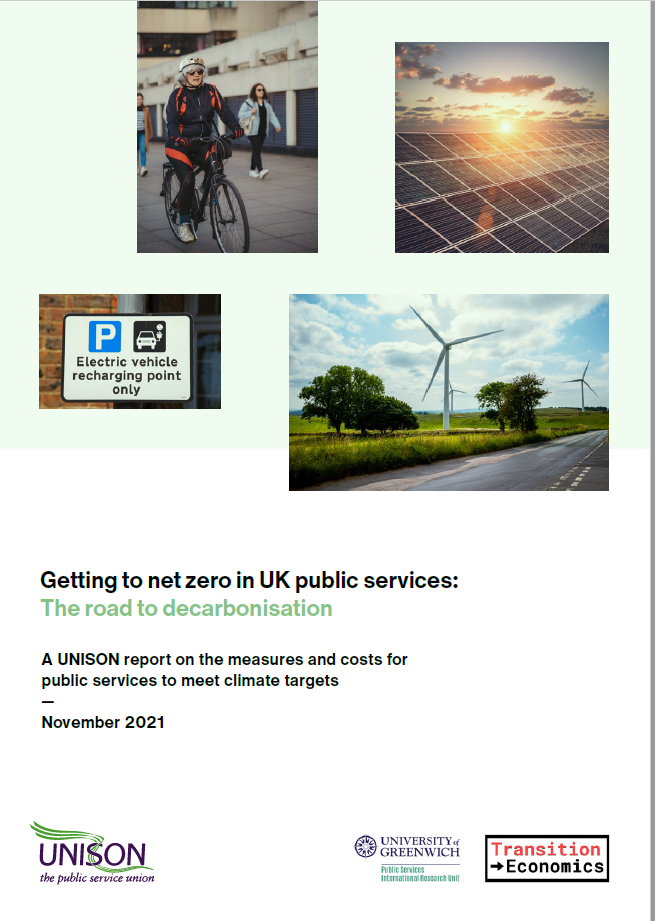
Getting to Net Zero in UK Public Services: The Road to Decarbonisation

By Dr. Vera Weghmann, et. al. - Unison, November 2021

Public services as a whole (excluding transport) represent about 8% of the UK’s direct greenhouse gas emissions. The NHS alone represents about 4% of the UK’s emissions. When procurement, construction, and social housing are taken into account, public services’ impacts are much greater.

Different sectors within the overall framework of public services have declared their decarbonisation plans. Some are ahead of the national targets. The NHS has declared that it will reach net zero by 2040, with an ambition to reach an 80% reduction by 2028 to 2032. More than one-third of local authorities (single- and upper-tier) committed themselves to decarbonise their local area by or before 2030.

The government aims to reduce direct emissions from public sector buildings by 75% against a 2017 baseline by the end of the Sixth Carbon Budget.

This report identified 21 different measures that should be taken across buildings, transport, electricity generation, waste, procurement and land use along with costed measures for each of nine different public services.

In our analysis, the UK’s public services need a capital investment injection of over £140 billion to 2035 to meet their Net Zero obligations. This will set the public sector on track to meet their climate targets and contribute to the UK’s overall carbon reduction aims. The analysis also identified measures that required annual operational expenditures of £1 billion to hit net zero targets. UNISON fully advocates that quality public services are best delivered by public ownership of public services and utilities rather than privatisation, outsourcing or PFI contracting of public services.

As well as improving the quality of life for service users, workers and the wider community, a number of the measures will also result in significant savings to public services’ budgets, through lower energy bills, cheaper to run fleets, and procurement savings. UNISON fully advocates that quality public services are best delivered by public ownership of public services and utilities rather than privatisation, outsourcing or PFI contracting of public services.

Read the text (PDF).

Climate Jobs: Building a Workforce for the Climate Emergency

By Suzanne Jeffery, editor, et. al - Campaign Against Climate Change, November 2021

This report was written by the Campaign Against Climate Change Trade Union Group (CACCTU). It builds on and develops the earlier work produced by CACCTU, One Million Climate Jobs (2014). The editorial group and contributors to this report are trade unionists, environmental activists and campaigners and academics who have collaborated to update and expand the previous work. Most importantly, this updated report is a response to the urgency of the climate crisis and the type and scale of the transition needed to match it.

This report shows how we can cut UK emissions of greenhouse gases to help prevent catastrophic climate change. We explain how this transformation could create millions of climate jobs in the coming years and that the public sector must take a leading role. Climate jobs are those which directly contribute to reducing emissions. This investment will give us better public transport, warmer homes, clean air in our cities and community renewal in parts of the country which have long been neglected. Most importantly, it will give us a chance for the future, avoiding the existential threat of climate breakdown.

Read the text (Link).

The Green New Deal–From Below

By Jeremy Brecher - Labor Network for Sustainability, October 30, 2021

This is the first in a series of commentaries on “The Green New Deal–From Below.” This commentary explains the idea of a Green New Deal from Below and provides an overview of the series. Subsequent commentaries in this series will address dimensions of the Green New Deal from below ranging from energy production to the role of unions to microgrids, coops, anchor institutions, and many others.

The Green New Deal is a visionary program to protect the earth’s climate while creating good jobs, reducing injustice, and eliminating poverty. Its core principle is to use the necessity for climate protection as a basis for realizing full employment and social justice.

The Green New Deal first emerged as a proposal for national legislation, and the struggle to embody it in national legislation is ongoing. But there has also emerged a little-noticed wave of initiatives from community groups, unions, city and state governments, tribes, and other non-federal institutions designed to contribute to the climate protection and social justice goals of the Green New Deal. We will call these the Green New Deal from Below (GNDfB).

The purpose of this commentary is to provide an overview of Green New Deal from Below initiatives in many different arenas and locations. It provides an introduction to a series of commentaries that will delve more deeply into each aspect of the GNDfB. The purpose of the series is to reveal the rich diversity of GNDfB programs already underway and in development. The projects of Green New Dealers recounted here should provide inspiration for thousands more that can create the foundation for national mobilization–and reconstruction.

The original 2018 Green New Deal resolution submitted by Rep. Alexandria Ocasio-Cortez called for a national 10-year mobilization to achieve 100% of national power generation from renewable sources; a national “smart grid”; energy efficiency upgrades for every residential and industrial building; decarbonizing manufacturing, agriculture, transportation, and other infrastructure; and helping other countries achieve carbon neutral economies and a global Green New Deal. It proposed a job guarantee to assure a living wage job to every person who wants one; mitigation of income and wealth inequality; basic income programs; and universal health care. It advocated innovative financial structures including cooperative and public ownership and public banks. Since that time a wide-ranging discussion has extended and fleshed out the vision of the Green New Deal to include an even wider range of proposals to address climate, jobs, and justice.

The Green New Deal first emerged as a proposal for national mobilization, and national legislation has remained an essential element. But whether legislation embodying the Green New Deal will be passed, and how adequate it will be, continues to hang in the balance. Current “Build Back Better” legislation has already been downsized to less than half its original scale, and many of the crucial elements of the Green New Deal have been cut along the way. How much of the Green New Deal program will actually be passed now or in the future cannot currently be known.

But meanwhile, there are thousands of efforts to realize the goals of the Green New Deal at community, municipal, county, state, tribal, industry, and sectoral levels. While these cannot substitute for a national program, they can contribute enormously to the Green New Deal’s goals of climate protection and economic justice. Indeed, they may well turn out to be the tip of the Green New Deal spear, developing in the vacuum left by the limitations of national programs.

Energy transition or energy expansion?

By Sean Sweeney, John Treat, and Daniel Chavez - Trade Unions for Energy Democracy and Trans National Institute, October 22, 2021

From politicians to corporate executives, media commentators to environmental campaigners, narratives evoking the “unstoppable” progress of a global transition from fossil fuels to renewable energy have grown increasingly commonplace.

However, in reality, the global shifts in energy production, energy usage and greenhouse gas emissions we urgently need are not happening:

  • In 2019, over 80% of global primary energy demand came from fossil fuels, with global greenhouse gas emissions at record levels.
  • In 2020, wind and solar accounted for just 10% of global electricity generated.
  • Despite stories of its decline, coal-fired power generation continues to rise globally. In 2020, global efforts to decommission coal power plants were offset by the new coal plants commissioned in China alone, resulting in an overall increase in the global coal fleet of 12.5 GW.

Recently, some have argued that the Covid-19 pandemic and subsequent contraction in economic activity signal a turning point. Indeed, global energy demand fell by nearly 4% in 2020, while global energy-related CO2 emissions fell by 5.8% — the sharpest annual decline since the second world war.

Despite these short-term shifts, the pandemic has failed to result in any significant long-term changes for the energy sector or associated emissions:

  • Global energy-related CO2 emissions are projected to grow by 4.8% in 2021, the second highest annual rise on record.
  • Demand for all fossil fuels is set to rise in 2021.6 A 4.6% increase in global energy demand is forecast for 2021, leaving demand 0.5% higher than 2019 levels.
  • By the end of 2020 electricity demand had already returned to a level higher than in December 2019, with global emissions from electricity higher than in 2015.
  • By the end of 2020, global coal demand was 3.5% higher than in the same period in 2019. A 4.5% rise in coal demand is forecast for 2021, with coal demand increasing 60% more than all renewables growth combined and undoing 80% of the 2020 decline.
  • Oil demand is forecast to rebound by 6% in 2021, the steepest rise since 1976. By 2026, global oil consumption is projected to reach 104.1 million barrels per day (mb/d), an increase of 4.4 mb/d from 2019 levels.

As such, an energy transition with the depth and speed necessary for meeting the 2015 Paris Agreement shows no sign of materializing. Indeed, most of the world’s major economies are not on track to reach their Nationally Determined Contributions (NDCs) on emissions reductions.

These facts point to a clear conclusion: the dominant, neoliberal climate policy paradigm, which deploys a “sticks and carrots” approach that attempts to disincentivize fossil fuels through carbon pricing, while promoting low-carbon investment through subsidies and preferential contractual arrangements has been completely ineffective. This policy paradigm positions governments as guardians and guarantors of the profitability of private actors, thus preventing them from addressing social or environmental challenges head-on.

Read the text (PDF).

Building Bridges from Intersectional Ecosocialism to Radical Climate Justice and Systemic Transformation

By John Foran - Resilience, October 14, 2021

Ecosocialist strategic thinker Ian Angus has observed, with reason that “There is no copyright on the word ecosocialism, and those who call themselves ecosocialists don’t agree about everything.”

That’s true. One puzzle that many ecosocialists, especially here in the “global North,” seem to share is: Why are there so few ecosocialists?  For most of us – I count myself as part of the ecosocialist movement – it feels intuitively natural to hold a political orientation to the world based on the principles of the interconnectedness of an ecological approach and the universal solidarity, egalitarianism, and social justice orientation of a democratic socialism. Indeed, what other kind can there be after the authoritarian horrors of the 20th century?

Why, then, are we so few?

In my country, some may suppose that this can be explained away by the U.S. working class’s lack of consciousness of a world beyond capitalism, or by the pull that the values of feminism and racial justice exert on a younger generation preventing activists from recognizing the economic roots of the evils of the capitalist system that saturates our lives.

But aren’t these all caricatures? Are there not ecosocialists who have understood that race, ethnicity, nationality, gender, sexuality, and indeed all systems of division intersect with class? Are there not working people and unions who live every day with the economic and political abuses of capitalism?  And are there not young social-justice activists who are acutely aware of how capitalism works to cause untold suffering?

There are, fortunately, in all these cases, and their numbers are growing.

I began thinking about this essay early in 2020. Now, in the waning months of 2021, everywhere, people live in a world transformed by pandemic, rebellion, and the multiple pre- and post-pandemic crises that remain with us. In a way, this new world only underlines the importance of ecosocialism’s promise, as well as gives life and urgency to my thesis that 21st-century ecosocialism will either be intersectional or remain marginal to the needs of, and alternatives to, our collective moment.

Are ‘Green’ Jobs Good Jobs? How lessons from the experience to-date can inform labour market transitions of the future

By Dr Anna Valero, et. al. - London School of Economics, October 2021

As governments worldwide are increasing their commitments to tackling climate change, efforts are growing to quantify and characterise the ‘green economy’, and to identify opportunities to be seized and challenges to be overcome in the transition to the net-zero economy of the future. The aim of this report and accompanying policy brief is to shed light on the quantity and quality of current green labour markets, to inform policy action and future research for the net-zero transition.

Main messages

  • Research on green jobs often uses a narrow definition of the green economy that does not cover all the jobs that will be important for driving forward the net-zero transition.
  • In contrast, the authors apply a broad approach to the UK and European economies.
  • They find that around 20% of jobs in the UK and 14 European economies can be considered directly and indirectly green, taking a broad, occupation-level definition of the ‘greenness’ of jobs.
  • They find some evidence that greener jobs tend to be ‘better’ jobs.
  • Workers in some types of green jobs, particularly those that are new occupations related to greening the economy, are likely to be educated to a higher level and be on permanent contracts, though there are differences in these relationships across countries, sectors and regions.
  • For the UK, the authors also find that greener jobs tend to pay higher wages, and are more resilient to automation.
  • Greener jobs tend to be occupied by older workers and men. Policymakers will need to ensure equitable access to green, future-fit jobs. Educational and training requirements of ‘green’ jobs will need to be met with new education and skills policies, including improved incentives for firms and individuals to train.

Read the text (link).

Honest Government Ad: Carbon Capture & Storage

Pages

The Fine Print I:

Disclaimer: The views expressed on this site are not the official position of the IWW (or even the IWW’s EUC) unless otherwise indicated and do not necessarily represent the views of anyone but the author’s, nor should it be assumed that any of these authors automatically support the IWW or endorse any of its positions.

Further: the inclusion of a link on our site (other than the link to the main IWW site) does not imply endorsement by or an alliance with the IWW. These sites have been chosen by our members due to their perceived relevance to the IWW EUC and are included here for informational purposes only. If you have any suggestions or comments on any of the links included (or not included) above, please contact us.

The Fine Print II:

Fair Use Notice: The material on this site is provided for educational and informational purposes. It may contain copyrighted material the use of which has not always been specifically authorized by the copyright owner. It is being made available in an effort to advance the understanding of scientific, environmental, economic, social justice and human rights issues etc.

It is believed that this constitutes a 'fair use' of any such copyrighted material as provided for in section 107 of the US Copyright Law. In accordance with Title 17 U.S.C. Section 107, the material on this site is distributed without profit to those who have an interest in using the included information for research and educational purposes. If you wish to use copyrighted material from this site for purposes of your own that go beyond 'fair use', you must obtain permission from the copyright owner. The information on this site does not constitute legal or technical advice.