You are here
News Feeds
Are you an Undocumented Care Worker in Toronto? Join Our Meeting.
Join a private and confidential meeting for undocumented care workers.
Request an invitation Meeting details
Saturday, August 8
3:00–5:00 p.m.
In person in Toronto
The location will be shared only with people who are invited and confirmed to attend.
Who is this meeting for?This meeting is for people who:
- Live in the City of Toronto
- Do not currently have valid immigration status in Canada
- Currently work or have previously worked in care
The criteria for this meeting were set by the City of Toronto, which is funding this project.
Space is limited. We will review responses and contact people who are invited.
People who are invited and attend the full two-hour meeting will receive:- A $50 gift card
- Food
- PRESTO fare
- Access to health care, housing, transit and other City services
- What support undocumented care workers need
- Problems at work, including low wages, unpaid wages, abuse or unfair treatment
- Immigration status, permits and access to permanent residency
- What needs to change in Toronto and across Canada
Your experiences will help us identify the changes, services and resources undocumented care workers need. We will also share information about services and support available in Toronto.
Need support or do not meet the criteria?Contact us for support , join us as a member or call 437-518-8662.
This is a private and confidential process. Your name, immigration status, employer information and other personal information will not be shared with the City of Toronto, immigration authorities or your employer. We will not contact your current or former employer. Request an invitationShare your information below. We will contact you if you are invited and send you the meeting location.
Request an invitation (function () { var registrationSection = document.getElementById("mwac-registration"); var stickyButton = document.getElementById( "mwac-mobile-register-button" ); if ( !registrationSection || !stickyButton || !("IntersectionObserver" in window) ) { return; } var observer = new IntersectionObserver( function (entries) { entries.forEach(function (entry) { if (entry.isIntersecting) { stickyButton.classList.add("is-hidden"); } else { stickyButton.classList.remove("is-hidden"); } }); }, { threshold: 0.08 } ); observer.observe(registrationSection); })();The post Are you an Undocumented Care Worker in Toronto? Join Our Meeting. first appeared on Migrant Workers Alliance for Change.
The post Are you an Undocumented Care Worker in Toronto? Join Our Meeting. appeared first on Migrant Workers Alliance for Change.
LFF Volume #29: Across Borders, a New Vision for Maternal Care
This is Volume #29 of the Leading from the Feminine newsletter, a vibrant resource in the flourishing world of leading from the heart, hands and spirit.
Subscribe to receive the newsletter straight to your inbox.
Motherhood has become one of the defining fault lines of our time. From the dismantling of maternal health systems in Gaza to the ever-present crisis of Black maternal mortality in the U.S., the policies around and resources for caregiving are increasingly shaped by those who have the political and economic leverage to bypass restrictions created by our failing systems and institutions. Yet across these vastly different contexts and continents, the people at the center of intervention are often the same: midwives, nurses, lactation consultants, community organizers, and mothers themselves.
From Gaza to Oakland, the work of nurturing mothers and children—and expectations around how mothers should nurture their children—reveal just how intimately braided social, environmental, and reproductive justice are. When maternal healthcare systems collapse, when clean water becomes scarce, and when communities lose the threads to traditional and intergenerational knowledge that once sustained them, the damage disrupts generations. These systems we’ve built often exploit both the planet and the people whose labor sustains it, especially women, caregivers, and communities on the frontlines of injustice.
These realities raise an urgent question for us all: what does it mean to care for life in a time of cascading crises? As ecosystems unravel, conflict displaces communities, and inequities deepen, the health of our societies is inseparable from the health of the living world.
The most attuned solutions to ecological and social crises emerge by listening to the people closest to them. The Earth—our first mother—offers an abundance of models for generosity, interdependence, and regeneration. Nurse logs—old fallen trees—provide homes, water, and food for tiny new seedlings to grow. Fungi connect tree roots underground to trade water and nutrients through mycorrhizal networks. In wetlands marshes filter dirty water and renew the health of local rivers. These other mothers—the nurse logs, the tree roots, the wetlands—demonstrate how to sow the seeds of renewal and rebuild a village from the ground up.
Their work challenges us to imagine a culture where care is recognized as essential infrastructure, where communities hold the wisdom to heal, and where the work of mothering, in all its forms, becomes a blueprint for building a more just and life-affirming future. It’s time to turn to our mothers and ask: what do you need in order to caretake safely, with dignity?
The following conversation brings together four women approaching this work from radically different vantage points: Brandi Gates-Burgess, founder of Breast Friends Lactation and Support Services, who has spent her career closing the breastfeeding gap in Black communities across the Bay Area; Sandra Adler Killen, an ER and pediatric nurse who has deployed to Gaza three times to train local clinicians in infant nutrition and lactation care amid famine and mass casualty; and Dr. Cindy Nelly, a global health consultant and midwife who has spent 25 years building health systems in conflict zones from Rwanda to the Democratic Republic of Congo to Gaza. Sandra brought everyone together, and journalist Tiffany McElroy facilitated the conversation.
What emerges is not a comparison of suffering, but something more like a shared diagnosis of what happens when the people closest to a crisis aren’t the ones being listened to, and what changes when they finally are.
What follows is an edited excerpt of a conversation recorded at the Bioneers 2026 conference.
TIFFANY: Why did you choose to get into the specific work you’re doing right now? Brandi, let’s start with you.
BRANDI: Black women are least likely to breastfeed their babies. There are enormous health disparities behind that fact, and it’s what drew me into this work.
I was 21, in college at UC Riverside, when I had my daughter. I breastfed her because I was a broke college student — but once I learned how critical breastfeeding is to Black maternal health, and how much it reduces infant mortality, I knew I had to get the word out. I changed my major to sociology so I could understand how these outcomes were shaping Black birth in this country.
The numbers are what convinced me this was my life’s work: Black women and birthing people are three times more likely to die in childbirth than any other race or ethnicity. If we can get Black families to breastfeed for at least six months, it changes the health trajectory of an entire community — lower rates of diabetes, asthma, allergies, obesity, breast cancer. Once I understood that, the mission became simple: We support each other, and we get moms breastfeeding for at least six months.
In 2023, I launched Breast Friends Lactation to bring that support to low-income families in the Bay Area, specifically pairing them with lactation consultants who look like them and understand what it means to navigate motherhood as a Black woman in America. We’ve been at it ever since, and we’re booked solid.
SANDRA: Nursing is actually my fifth career. I came to it late — I became a nurse at 50, after working in several very different fields, because I wanted to dedicate myself to this work. I worked as an ER nurse and a postpartum nurse, and I’d always wanted to do lactation support. I breastfed my own two children and saw firsthand the health benefits, the bonding, how emotionally powerful it was. So I became an IBCLC, just like Brandi.
For many years now, I’ve done international humanitarian work, first in Syria and Lebanon with refugee populations, and for the last two years in Gaza, training neonatologists, pediatricians, OB/GYNs, midwives, doctors, and nurses to deliver this kind of support in some of the most challenging environments imaginable.
CINDY: My own path, I’ll admit, wasn’t especially altruistic at the start. I began traveling early, and as someone very privileged to be able to do that, I started noticing the disparities around me. I wanted to keep traveling, but I wanted it to mean something — to give something back to the communities I was moving through.
Then I had my daughter at 23. I chose a midwife without really thinking about why, but my great-grandmother had been a midwife, and somehow, through whatever force that is, maternal lineage, I knew that was how I needed to give birth. My first career had actually been in environmental science, but in that moment of giving birth, with that connection to my midwife, I realized: This is what I want to do.
As healthcare providers, we have incredible privilege. We’re present with people during the most painful, and sometimes the most joyful, most intimate moments of their lives. When else do we get that? It’s sacred. We can find that connection with trees, with plants, with nature — but connecting human to human in such a vulnerable space is powerful in a different way.
Read the full excerpt of the conversation For Further ComplexityWe would be remiss in not touching on what often gets lost in the conversation around infant feeding: women’s choice. For some mothers, breastfeeding is an empowering and rewarding experience. For others, it can be physically difficult, medically contraindicated, or simply not possible.
Factors including low milk supply, infant feeding difficulties, workplace barriers, and the need to continue medications for mental or physical health can all shape feeding decisions. In these situations, discussions about infant nutrition can sometimes overlook the health, well-being, and autonomy of the mother herself. While public health messaging has emphasized the benefits of breastfeeding—which are real and substantial—many parents suffer from pressure and guilt when their circumstances do not align with that ideal. These considerations are especially relevant in communities where safe drinking water and infant formula are readily available, making formula feeding or combination feeding safe options.
Holding these truths together means recognizing that promoting breastfeeding and centering maternal well-being are not competing priorities but complementary ones: children flourish when the women caring for them are healthy, supported, and empowered to make informed choices for themselves and their families.
Some of the resources below offer additional perspectives on the complexities of infant feeding, including a “fed is best” perspective.
Featured MediaWatch:
Indigenous Milk Is Medicine from director Missy Whiteman (Northern Arapaho and Kickapoo) and the American Indian Cancer Foundation
Andrea McLean on letting go of breastfeeding pressure from Giovanna Fletcher’s Happy Mum Happy Baby Podcast
Read:
‘For the women who gave birth in the dark’: a portrait of motherhood in Gaza from The Guardian
When breast isn’t best by Laura Frances Callahan in Aeo
Listen:
Midwifing a Movement: Birth Centers and the Care Economy – Bioneers Radio & Podast episode
Trump Destroyed USAID. Now People Are Dying. Reveal Podcast episode
Earth Altars by Laura LoescherThe post LFF Volume #29: Across Borders, a New Vision for Maternal Care appeared first on Bioneers.
Petition: Justice for Sinhue Garcia. Safer roads and support for migrant workers now.
Sinhue Garcia, a migrant farmworker from Mexico, was killed while riding his bicycle in rural Niagara-on-the-Lake. He leaves behind a wife, two children, and many loved ones. He is not the first. At least six other migrant farmworkers have been killed or seriously injured on Niagara roads in recent years.
Send the email nowWe grieve with Sinhue’s family, friends, co-workers, and the migrant worker community. But his death is not an isolated tragedy.
Migrant farmworkers keep Niagara’s farms, greenhouses, wineries, restaurants, and food system running. Too many have no choice but to travel long rural roads by bike or on foot, often at night, without safe transportation, wide shoulders, bike lanes, proper lighting, or access to public transit.
This is a public safety crisis and reflects serious gaps in road infrastructure, housing, workplace protections, and political responsibility.
We are calling for action at every level of government.- Safer roads and transportation, including lighting, protected shoulders and bike lanes, lower speeds, and traffic calming.
- Worker-led road safety planning, with dangerous routes identified by workers, acted on, and publicly reported.
- Safe and dignified housing, with stronger standards and enforcement.
- More control over work schedules and protection from reprisals, so workers can make decisions about their own safety.
- A coroner’s inquest, compensation, and support for injured workers and families of workers who die in Canada.
- Permanent resident status so migrant workers can speak up, change jobs, and exercise their rights without fear.
Migrant workers are not disposable. They are our neighbours, co-workers, friends, and community members. They deserve to live with dignity.
Send an email now to Niagara-on-the-Lake, Niagara Region, Ontario, Canada, and election candidates.
This petition is co-hosted by Niagara Community Legal Clinic, Migrant Workers Alliance for Change and other local migrant worker organizations.
Send the emailAdd your name. You can edit the message before sending.
One message goes to all listed decision-makers. It takes less than two minutes. Every message increases public pressure. Migrant workers feed our communities, care for our families, and keep the economy running. Safe roads, safe work, support and permanent resident status cannot wait.The post Petition: Justice for Sinhue Garcia. Safer roads and support for migrant workers now. first appeared on Migrant Workers Alliance for Change.
The post Petition: Justice for Sinhue Garcia. Safer roads and support for migrant workers now. appeared first on Migrant Workers Alliance for Change.
Challenging American Patriarchy at Its Roots
Sociologist, storyteller, and best-selling author Anna Malaika Tubbs calls for dismantling the key system that has determined who actually gets to be considered human in the United States: The American patriarchy. She says that transforming the forefathers’ vision of a republic of men requires deep change at the personal, community, and national levels.
FeaturingAnna Malaika Tubbs, Ph.D. is a bestselling author and leading multidisciplinary expert on race, gender, and equity. Her most recent bestselling book is Erased: What American Patriarchy Has Hidden From Us (2025).
Lisa Rudman, Partnership Director at the San Francisco Public Press, a local investigative newsroom, is a lesbian feminist journalist, media professional and environmentalist.
Credits- Executive Producer: Kenny Ausubel
- Written by: Stephanie Welch and Emily Harris
- Senior Producer and Station Relations: Stephanie Welch
- Producer: Teo Grossman
- Associate Producer and Program Engineer: Emily Harris
- Host and Consulting Producer: Neil Harvey
Erased: What American Patriarchy Has Hidden From Us
This is an episode of the Bioneers: Revolution from the Heart of Nature series. Visit the radio and podcast homepage to find out how to hear the program on your local station and how to subscribe to the podcast.
Subscribe to the Bioneers: Revolution from The Heart of Nature podcast TranscriptNeil Harvey (Host): After 250 years of existence as a republic, the United States stands as a symbol of many things to many people. Some struggle every day to counter the popular notion that the U.S. is a thriving democracy. They work to shed light on how the country has always been separate and unequal for Black people and other people of color, and how the patriarchal structure that the founding fathers crafted from the very beginning remains firmly embedded in the systems that shape U.S. society.
As a scholar and author, Anna Malaika Tubbs has carefully studied how patriarchy and systems of capitalism, white supremacy, and colonialism intersect and reinforce one another.
In a conversation at a Bioneers Conference, Lisa Rudman, Partnership Director at the San Francisco Public Press, spoke with Anna Malaika Tubbs about her book Erased: What American Patriarchy Has Hidden From Us, and strategies to move beyond this deeply embedded and destructive system.
Lisa Rudman (LR): Anna is a New York Times best-selling author and multi-disciplinary expert on current and historical understandings of race, gender and equity, with a PhD in sociology and a Master’s in multi-disciplinary gender studies from the University of Cambridge, in addition to a Bachelor’s in medical anthropology from Stanford. You see why I wanted to go through this. [LAUGHTER]
Anna Malaika Tubbs (AMT): I’m just a nerd, just a proud nerd. [LAUGHTER]
LR: Anna translates her academic knowledge into stories that are clear – that is true – and engaging.
Please join me in welcoming Anna Malaika Tubbs. [APPLAUSE]
AMT: Thank you. Thank you so much. Thank you.
LR: You made a distinction earlier that I think is a good segue. You said, you know, in America, we like to talk about patriarchy everywhere else. You specifically talk about the brand of American patriarchy. I really want you to start there, and if you can define what you mean by both those words together, both those words separately, anywhere you want to take that.
Lisa Rudman and Anna Malaika Tubbs speaking at Bioneers 2026. Source: @annamalaikatubbsAMT: Yes. I love defining it. It’s one of my favorite things to do. So thank you. And I’ll say, when I wanted to talk about American patriarchy, it’s not because I think that it’s the worst patriarchy in the world. I’m really not in the business of ranking patriarchies. They’re all bad. [LAUGHTER] We’ll just say that. But I think that we haven’t spoken as much about patriarchy in the United States. And I think that, from what I’ve observed and from what I’ve studied, patriarchy operates differently in each of the places that it exists.
And so our definition of patriarchy has often really been reduced to this notion that it’s about men against women. That’s not the case. That’s not the definition of patriarchy. It’s actually about how we define who gets to be human in any nation, and that changes, right, from place to place. So patriarchy in the U.S. is different than patriarchy in India. It’s different than patriarchy in France. It’s different.
And so, in the U.S., I point to the founding fathers, and that doesn’t mean that they created patriarchy. Right? Obviously, they’re taking from the monarchy, etc. But when we’re looking at each nation, we can really point to the leaders who chose patriarchy. So we have to remember patriarchy is not divine. It’s not the natural order. It wasn’t our first way of organizing ourselves. Right? Indigenous people organized themselves very differently. There still made of—might have been some elements of patriarchy, but it’s different than what we’re seeing right now.
And so, in 1776, if we just all go back to look at the founding fathers for a second, they win the Revolutionary War. This is a surprise to everybody. They were the underdogs. They weren’t expecting to win. [LAUGHS] No one was really expecting them to win. Many of them were young men. They are very fearful that this revolutionary spirit is going to spread across this new nation, because they’re also oppressing a lot of people who they needed to win the Revolutionary War, so they’re oppressing the women in their lives, they’re certainly oppressing Indigenous people, they’re certainly oppressing people who are enslaved – Black people. So they’re very afraid of what happ—they’re oppressing poor people, poor farmers, especially. They’re afraid of what would happen if that revolution spreads.
And so the period of time between writing—or the Declaration of Independence, winning the Revolutionary War, and then writing the Constitution, we all—we see several rebellions taking place, one of them, the most famous, being Shay’s Rebellion. It’s the thing that makes them want to go and write the Constitution, because they’re worried that they couldn’t actually quell this rebellion fast enough, and they want to form a national military, mainly inspired by and—a local conflict, not an international one. So they’re motivated to write the Constitution and decide who is going to get to have power in this nation. This is when we choose patriarchy – they do. And they say that they want to create a republic of men.
Anna Malaika Tubbs. Source: annamalaikatubbs.comSo the Constitution tells us that they are the ones that are going to get to own land. They are the ones that are going to get to vote. There’s a lot of other things they’re going to get to do, but these are two of the primary ones. They, on purpose, leave out women. And we see in the letters that they write to their mothers, to their wives, to their daughters, that women should not participate politically. They do not want that to happen.
“Depend upon it, We know better than to repeal our Masculine systems. Altho they are in full Force, you know they are little more than Theory. We dare not exert our Power in its full Latitude. We are obliged to go fair, and softly, and in Practice you know We are the subjects. We have only the Name of Masters, and rather than give up this, which would compleatly subject Us to the Despotism of the Peticoat, I hope General Washington, and all our brave Heroes would fight. I am sure every good Politician would plot, as long as he would against Despotism, Empire, Monarchy, Aristocracy, Oligarchy, or Ochlocracy.”
Letter from John Adams to Abigail Adams, April 14, 1776
Now this is not just a sign of the times, because there are other countries that are choosing differently. In fact, we see in France, not that women could vote, but that women could have Parisian salons where they talk about politics and voice their opinions, at the very least they’re allowed to talk about it. And Thomas Jefferson says that this is going to ruin France. And so he says, in particular in the United States, we will not repeat the mistakes of the French.
So they’re aware there are other ways and other things that they could choose. They choose a republic of men.
So they define women as those who are simply meant to reproduce the power of men through children. This is where we get the binary in the United States, of—there’s a man that’s recognized, there’s woman that’s recognized. Clearly that’s leaving out a lot of people who they’re not recognizing as neither man nor woman, so they create a problematic binary. But then we have, in the Constitution, clauses to protect the institution of slavery. So they’re not including Black people in the definition that’s already limited of man and woman. They’re not including Indigenous populations. They’re not including immigrants from that point forward. They’re no longer including them. They’re not really including poor white people either. They make it up to the states to decide if people who don’t own property can vote. It was really important to some of the founding fathers it would only be people who could—who owned property who would be allowed to participate.
So then all these people who are excluded from notion of man and woman are told: You’re not going to be treated as human beings, however, you may some day be treated as human beings if you assimilate to the two groups that are recognized. And if you do your part to protect this social order, then one day you might be able to ascend this made-up ladder of humanity. And that’s where the trick of so many people who are not included in it fully still support it, protect it, because they think some day they’ll be able to get there.
And so all of American history can really be summarized by a group of people who loved that social order, who thought this is the way that this nation needs to be organized, who said that that was democracy, but it’s not democracy, because democracy means that power is vested in the people, all of the people. So we’ve not actually experienced that. So what we’ve actually experienced is American patriarchy.
But then you have a part of American history, the other part of it, which were all the people who were not included but who did not fall for the trick, and who said: This is not good enough, this is not democracy; we can get closer to democracy. The more that we include people, then we will be closer to that ideal, and that has been the tug of war of American history ever since.
LR: You have to. Yeah, I mean…[LAUGHTER]
To your point about these structures and systems are not accidental, they get set up, they… give power and privilege to certain people, it’s not about a conspiracy, it’s saying this is not an accident. And so I’m going to ask you, how do you see, then, the structures and systems of white supremacy and racism interlocking with American patriarchy? Because even though this book is defining American patriarchy, I’m trying to think of gender binaryism and – it’s more than sexism. It’s really about everything underneath that umbrella. So how do you see those systems interlocking and working? And maybe there’s a story from the book that you want to refer to.
AMT: Yeah. So I see American patriarchy encompassing all of those -isms, because if you’re saying that people who are enslaved are not counting as man or woman, that’s how we’re furthering the justification of racism in the United States. And if you’re saying that people who don’t own land cannot participate, that’s where we have classism. If we’re saying that in order for us to be human we must be man or woman, of course, you’re leaving out people who are non-binary, and you’re very specifically erasing many Indigenous belief systems that did recognize people beyond this gender binary. It’s where all of it kind of stems from under first telling us that you either have to be a man or a woman.
And so, in a way, we’ve all been told that we’re kind of fighting for our right to be gendered in the United States, that gender becomes our path to humanity. But it’s not just gender, it’s white elite gender. So it is all of those things. That’s why American patriarchy is really unique. That’s where—That’s the difference.
And as an example, if—in the example that I gave earlier, where the founding fathers are saying we are the ones who get to have power, we are the ones who get to have status, and the women in our lives are solely meant to reproduce that status through children, if we look instead at Black women at the time, Black women who are enslaved, the law was saying that their children were not children but were somebody else’s property, and that no matter how a Black woman came to have children – and we know that there horrific ways in which this has happened – no matter how, that child would always carry the status of the mother. So this is a direct opposite definition than what they’re showing of the white male.
So this is why, in many ways historically, Black women have been seen as the antithesis of that power. But what I argue is that actually that, having been so separated from it, is the power that Black women hold, because if you were told by law you’re not a human being, your children are not human beings, in fact, you’re somebody else’s property, Black women don’t go, oh, well, if the law says it, it must be true. [LAUGHTER] Instead, you immediately wake up to the con, and you say this is BS, this is made up; I don’t believe you, and therefore I need to make up something else; I need to create new systems; I need to reclaim systems before patriarchy; and I need to make this nation worthy of me, worthy of my children. That is how progress has happened in the United States. That’s how change has happened. It’s not ever been that those who loved the original social order woke up one day and said: [SIGHS] I feel like giving people their rights today. You know? I’ve changed my mind. They deserve their rights. No. It’s been that those who did not have those rights guaranteed to them, they grabbed it with their hands, they fought, they bled, they sacrificed. They made it so that we made it to where we are today.
July 4, 1863 issue of Harper’s Weekly depicting slaves escaping to a Union ship in the Combahee River Raid, organized by Harriet Tubman. Source: Library of CongressAnd so when we’re having even conversations right now, where so many people are saying this is the worst it’s ever been, we don’t know what to do, that is just a complete misunderstanding of American history, quite frankly. This is a continuation of the pattern, and now we’re being called to fight like those who had to redefine and make new systems, and claim those rights and protect them.
Host: More from Anna Malaika Tubbs and Lisa Rudman when we return…
I’m Neil Harvey. You’re listening to the Bioneers: Revolution from the Heart of Nature.
Host: Let’s return to the conversation with Anna Malaika Tubbs and Lisa Rudman… Waging a fundamental challenge to the American patriarchal system, Anna says, requires solidarity and looking to the long tradition of collective struggle in the United States, which has repeatedly confronted and reshaped American institutions.
Lisa asked Anna about the role of white women in sustaining and challenging patriarchal structures—a complicated dynamic, given that white women both benefit from, and are harmed by, those structures.
AMT: So white women…So the reason—And I will say it first, too. My mom was a white woman, so I’m also going to talk about the allyship of white women, but first I want to talk about the problematic part. A lot of people ask this question: Why are white women voting for Trump? Why are they protecting this? What is—You know, this is not in their best interests, and they’re voting against themselves, all those things. But if you understand American patriarchy, you understand that actually, in a lot of ways, they’re not, in their minds, voting against their interests, because in American patriarchy, they’re at least recognized, they’re seen. If we’re looking at the scale that I described, and you have the white elite man, and then you have the wife connected to him who has a role to play – you can talk about “trad wives” if we want to – she has a role to play in reproducing the power of that man. And we see that everyone else has just said you don’t get any of this recognition. Okay? Well, in that case, that person is saying I kind of would like to stay in this; I have some proximity to this power.
So, similar to what I was saying earlier around how Black women were cast so far away from that power, that they see it very clearly; they’re not trying to fall for the trick, those who have any proximity to the power can be fooled.
LR: A little more erased for them?
AMT: Yeah. They can be closer to it. They want to replicate it. They want to protect it. They want to play their role in it.
But that’s not all white women. And so in the book I also talk about allyship. I talk a lot about how my mom, in particular—it’s something that I took for granted because she’s my mom. I wasn’t really even thinking of her obviously in the sense of an ally, but the more I had conversations with people who struggled with allyship and what it means to be an ally, I realized that there was a lot that they could learn from my mom, because my mom never said to me that she knew, because she was a woman too, what it would be like to be a Black woman. Never. In fact, she said, “I don’t know what that is like, but I will do my part to learn; I will walk alongside you.” And similar to what I was saying earlier about Black mothers, she said, “I will do what I need to do to make this world worthy of you, my child.” And that’s allyship.
So even if it doesn’t—you don’t feel like you know exactly that experience, you have to see what it means to change this world for all of us to be included.
LR: And you don’t need to be stuck, if I can say, in the essentialism of who you are. You need to recognize that. You might feel guilty for a couple minutes, but guilt is not really motivating emotion, really—doesn’t really get you into change. But then you can decide where you want to be—What I always say, like, in relationship to struggle. And really, it’s beautiful what you said about your mother saying my relationship is to change the world to deserve you.
You get to choose how you want to—and it might mean you have to give up some stuff to move away from that proximity to power, and to join with people who—who you know are really fighting for the new world.
AMT: Yeah. And the thing is it’s this trick of power and what that means. Right? Everybody’s losing in this system. It’s hurting everybody. It’s hurting those who were supposed to be the primary beneficiaries. Even, you know, white men who seem to have it all, if they are not aware of the trick of this system, they’re actually experiencing really high levels of depression, drug dependency. People don’t realize there’s a lot of pain, no matter where you fall in this system. And that’s where those who have kind of woken up to it, to the con, choose allyship, choose let’s stop trying to ascend this ladder, it’s made up; the system isn’t working; let’s try to change the system versus let me try to thrive within it.
LR: Yeah. And individually navigating a way as opposed to collectively seeing where liberation is.
You talk about “breaking free”, so we want to talk about what we can do and how to actually work together. But I know that you have some more to say about men particularly, and fear, how fear motivates a certain amount of staying stuck in what’s not really even good for any humans.
AMT: Yeah. I think that anything that comes from fear and insecurity is going to lead to control. It’s going to lead to having to silence parts of yourself that keep you from being vulnerable, that keep you from being an actual human being. You know, obviously the violence that’s been waged against women is not something that I’m trying to minimize by any means, and so much of that has come from men not being allowed to be fully human. And so there is just a conversation to be had there.
And then in terms of the layers of how we start to break free from this, I think the first layer is it happens on a personal level. This book is deeply personal for a reason. I want the reader to also really take kind of—to see how it’s operating in your own life, first of all, how are you speaking about yourself to yourself. For many of us, we really have internalized the notion of I am supposed to be quiet, I am supposed to be in the background, I am supposed to allow somebody to talk to me any kind of way. Or we’ve internalized I’m supposed to dominate, people are supposed to listen to me— so what’s going on internally? That’s going to be really important as a step. And all of this can happen simultaneously, it doesn’t have to be one at a time. But internal work is really important.
The second part is in our relationships, we may be replicating American patriarchy, whether that’s in our friendships, whether that’s in romantic relationships, certainly within parenting. If we look at our children and we’re thinking, actually, I need to just tell you how the world works right now, and you need to fit into that; or are asking them something June Jordan said is that “when a child is born, the world begins again”. And if we look at children in that way, instead we think what beautiful new world are they carrying, and how do I protect that as much as possible. That would be the opposite of American patriarchy. But if we’re saying to them: This is how things work, and this is how you need to do it, and this is the box you need to fit in, that’s one way in which we’re replicating it. So then we need to analyze it on that relationship level.
Public domain image donated by Robert “Bob” SimpsonThe third level is really kind of one of the most important. This is the community level. This is where we see new systems forming all the time. This is actually where change happens always first, is at the community level. It doesn’t happen nationally first. It always happens where a neighbor sees a mother who needs help with childcare, and they help; where a person says, “It doesn’t make sense that children don’t have food,” and let’s say the Black Panther Party, they make free meal systems. Right? These are where we see the models of what the world could look like. If we look at American history and we look at Black American history in particular, the Black church was one example. There’s other issues with—we could talk about the Black church, but the good parts have been meeting the community needs and creating a nation within a nation. It’s why so many of the powerful orators in American history have come from Black church, because that was one of the first places where they were allowed to speak as human beings, and be taken seriously.
And then, that’s when you actually start to see something take hold on a national level, because people have been able to see it operating. And so they then advocate for that on a political or policy level. And that’s really kind of like a fourth layer of change.
So, yes, it can feel very daunting when you’re coming up against American patriarchy because it’s in all of our experiences. It’s in all of our systems. Every law that came out of this vision of insecurity, every—the medical system, you know, why Black women are dying at such high rates when they go in to give birth, all of it comes back to this. And we’re not just—None of us are going to solve this on our own. It’s not going to be one person who brings the solution to everything, but if we recognize that we’re a part of a larger team of people in this tug of war, and we recognize the needs of those around us, and we recognize that we actually have the power to always create something new in every single one of our interactions, you can start right away.
And the final part is that when we talk about people saying: We don’t know what to do right now; this is so scary. I’m not minimizing how scary it is, I agree. It’s scary. It’s one of the scary times. But this is when you really learn how people have done this in the past. What did they create together in order to achieve change, in order for us to have many years of, honestly, privilege that we’ve forgotten what it means to be brave? This is the time to study them. We know how to live differently every single day. We have the tools, we have the stories. If we’re not doing so, that’s just our choice.
Host: “Challenging American Patriarchy at Its Roots” with Anna Malaika Tubbs and Lisa Rudman
The post Challenging American Patriarchy at Its Roots appeared first on Bioneers.
ACTION ALERT: Pittsburgh City Council Considers New Slush Fund for Downtown Developers—on our Dime
Developers are asking Pittsburgh City Council to vote on another major tax giveaway scheme – giving up to $200 million dollars to a handful of Downtown private real estate companies, without any requirements around public benefit. This vote to implement the Downtown Transit Revitalization Improvement District (TRID) will divert tax revenue from the Strip District, Downtown and the North Shore for the next 40 (!) years into the coffers of private corporations.
Right now, when working people and our public agencies are struggling to make ends meet, Pittsburgh City Council is being asked (via the Urban Redevelopment Authority) to hand the Golden Triangle yet another golden ticket.
Take Action: Tell Council to fund neighborhoods, not developers What is the TRID proposal?A TRID is a type of legislation intended to fund transit improvements—but this one won’t do that. Instead, here’s how this proposal would work:
- The City (i.e., taxpayers) would initially borrow $50 million to invest exclusively in the TRID area: the Strip District, parts of the North Shore, and Downtown. This money would effectively be a grant paid to wealthy developers, with the City gambling on future tax revenue to pay down the debt.
- Many Downtown developers are concurrently challenging their commercial property assessments, so that they could pay lower taxes in the future.
- Many Downtown developers are concurrently challenging their commercial property assessments, so that they could pay lower taxes in the future.
- Only 20% of this money would be invested in public infrastructure—but they’ve not named any particular public projects that would benefit. By contrast, the remaining 80% has been earmarked for specific, private, for-profit real estate developers.
- All future public tax dollars from Downtown, the Strip District, and the North Shore for the next 40 years would be diverted to a “Golden Triangle Reinvestment Fund”, exclusively financing development in a small pocket of Downtown. This fund would be controlled by the non-elected Urban Redevelopment Agency (URA)—not City Council, a public body that is accountable to the public.
Members of Pittsburgh City Council and the Mayor’s administration have said that we are facing a massive City budget crisis. So why are they fast-tracking a $200 million handout to Downtown developers, with almost no public process?
What’s at stakeWe have already given almost a billion dollars to Downtown developers in tax breaks over the past 5 years. Enough is enough.
Our communities deserve so much more: public transit infrastructure, affordable housing, local food initiatives, street and sidewalk repairs, childcare programs and more. These are critical investments for the well-being of our City—and we cannot fund them if our City Councilmembers signs away millions in tax dollars to private developers for the next four decades.
Transit riders must tell our elected officials to vote NO on implementing the Downtown Transit Revitalization Investment District (TRID). Public dollars – whether borrowed or generated from tax revenue – should be invested across all communities – from Fairywood to Fineview, Brookline to Bloomfield. Our resources should be allocated through the annual City budgeting process, with robust public input to ensure that our tax resources are distributed equitably and address the needs of the moment.
We say: no more handouts to Downtown corporations until our neighborhoods, our small businesses, our workers and our students are given their fair share!
Take Action NowAfter you send a letter, CALL your City Councilmember to urge them to vote NO (find your councilmember here):
- District 1 (Northside, Strip District, Parts of Downtown):
Bobby Wilson (412) 255-2135 - District 2 (West End, Sheraden, Elliott, Banksville):
Kim Salinetro (412) 255-8963 - District 3 (Oakland, Southside, Arlington, Allentown):
Bob Charland (412) 255-2130 - District 4 (Beechview, Brookline, Carrick, Overbrook):
Anthony Coghill (412) 255-2131 - District 5 (Greenfield, Hazelwood, Lincoln Pl, Swisshelm Park):
Barb Warwick (412) 255-8965 - District 6 (Manchester, Downtown, The Hill, Uptown, Perry Hilltop):
Danielle Lavelle (412) 255-2134 - District 7 (Bloomfield, Lawrenceville, Polish Hill, Stanton Heights) :
Deb Gross (412) 255-2140 - District 8 (Squirrel Hill, Shadyside, Oakland):
Erika Strassburger (412) 255-2133 - District 9 (East Liberty, Larimer, Homewood, Garfield):
Khari Mosley (412) 255-2137
The post ACTION ALERT: Pittsburgh City Council Considers New Slush Fund for Downtown Developers—on our Dime appeared first on Pittsburghers for Public Transit.
Transporte Público para la Gente: Únete a la campaña de Socios 2026
Me llamo Evelyn Ulysse Alcántara. Uso el transporte público a diario para ir al trabajo, al médico, actividades de ocio, reuniones, llevar a mi hijo al colegio— para todo.
Soy latina y mi inglés no es perfecto, así que cuando me mudé a Pittsburgh me costó usar el transporte público porque había muy poca información disponible en español. Por eso me ofrecí de voluntaria para ayudar como embajadora en los Recorridos de tránsito de PPT. Fue muy frustrante y aislante intentar aprender a usar el sistema de transporte público por mi cuenta. Sabía que si podía hacer algo para apoyar el aprendizaje de mi comunidad, ¡tenía que hacerlo!
Ser miembro de PPT no solo ha mejorado mis propias necesidades de transporte. Me abrió la puerta para ayudarme a marcar la diferencia.
Cuando hubo recortes en el transporte público en Beechview, hubo ocasiones en que el autobús o el Tren no venían—y no sabía la razón, porque los cambios sólo se comunicaban en inglés. Pero hoy, si vas a Steel Plaza o Wood Street Station, ¡escucharás anuncios en español! Y hay instrucciones paso a paso en español en la web de PRT. Esto se debe a que PPT y Casa San José se unieron para dar voz a mi comunidad, para que PRT pudiera entender el verdadero impacto que esto estaba teniendo en nosotros.
Este es el verdadero poder de PPT: realmente escuchan a la gente.
Cuando descubrí que PPT, me pedían testimonios sobre el papel que tiene el transporte público en la vida de las personas, para mostrar lo importante que sería un programa de media tarifa. Sabía que tenía que dar mi testimonio, porque necesitábamos actuar para mejorar el acceso. En aquel entonces solo era una idea y un proyecto, pero hoy es una realidad que lleva el servicio de transporte a la gente.
Me encanta el PPT porque sé de primera mano lo que podemos lograr juntos.
Solo en 2026:
- Llevamos a 120 miembros a Harrisburg para arrojar luz sobre la brecha presupuestaria de 80 millones de dólares y enfatizar la importancia de los servicios para tránsito y viajes compartidos para nuestros representantes.
- Compartimos habilidades y construimos poder con 170 personas de todo el país, compartimos habilidades y construyeron poder en nuestro Entrenamiento de Primavera 2026.
- Formamos a 13 becarios de organización comunitaria en toda la colina del barrio de PGH, y las regiones de Lancaster y Lehigh Valley en Pensilvania.
Por eso quería preguntar: ¿apoyarán el trabajo urgente de PPT haciéndote miembro que paga cuotas hoy?
Puedes apuntarte por solo 2,75 $, ¡el precio actual del billete de autobús del PRT! Ese dinero va directamente a la defensa de un presupuesto de transporte que mueve a TODOS los habitantes de Pensilvania. Todo el mundo merece acceso al transporte público.
¿Nos ayudarás a hacer realidad ese sueño?
The post Transporte Público para la Gente: Únete a la campaña de Socios 2026 appeared first on Pittsburghers for Public Transit.
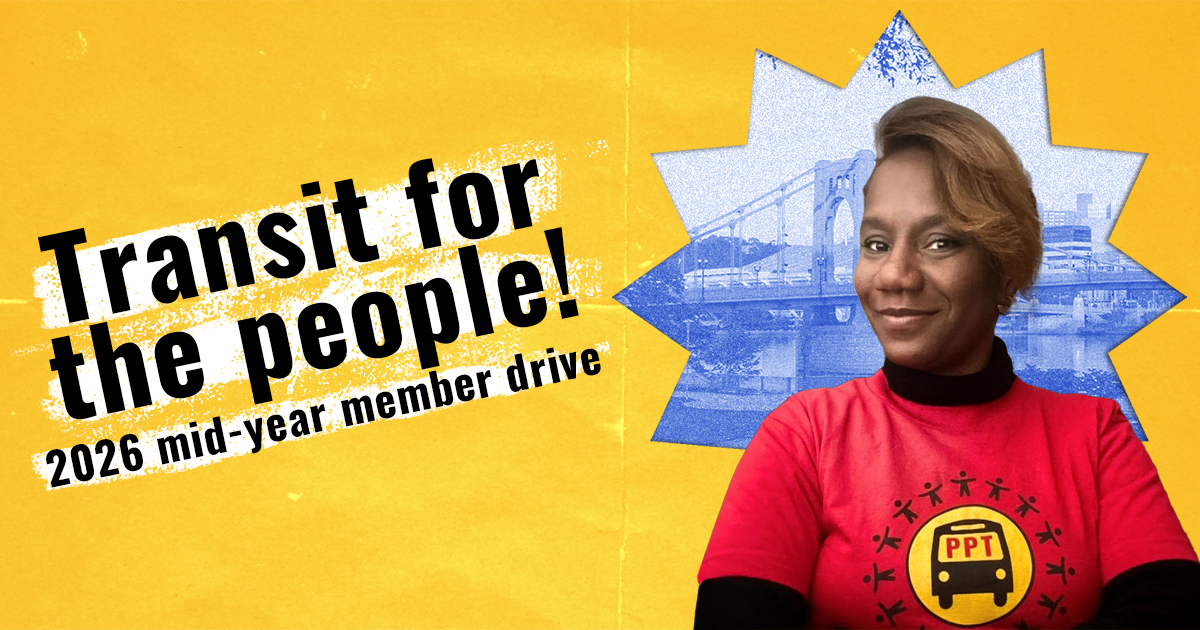
Transit for the People: Join the 2026 Member Drive
Image Description: Evelyn Ulysse Alcantara, a dark-skinned woman in a red PPT shirt, smiles in front of a collaged picture of Pittsburgh
I’m a mother and member of the Latino community fighting with PPT for a transit system that truly serves everyone. Will you join me by becoming a dues-paying member? Donate to become a PPT member!My name is Evelyn Ulysse Alcantara. I use public transportation daily for going to work, the doctor, leisure activities, meetings, bringing my son to school—everything.
I’m Latina and my English isn’t perfect, so when I first moved to Pittsburgh I struggled to use public transportation because there was so little information available in Spanish. This is why I volunteered to help be an ambassador for PPT’s Transit Tours. It was so frustrating and isolating to try and learn how to use the system by myself. I knew that if I could do something to support my community’s learning, I had to do it!
Being a PPT member hasn’t just improved my own transit needs. It opened the door to help me make a difference.
When there were cuts to transit in Beechview, there were times the bus or T didn’t come—and I didn’t know why because the changes were only communicated in English. But today, if you go to Steel Plaza or Wood Street Station, you’ll hear announcements in Spanish! And there are step by step instructions in Spanish on PRT’s website. This is because PPT and Casa San Jose came together to uplift my community’s voice, so that PRT could understand the true impact this was having on us.
This is PPT’s real power: they truly listen to the people.
When I first found out about PPT, they were asking for testimonies about the role transit has in people’s lives, to show how important a half-fare program would be. I knew I had to give my testimony, because we needed to take action to improve access. Back then it was just an idea, but today it’s a reality that brings transit service to the people!
I love PPT because I know firsthand what we can accomplish together.
In 2026 alone, we have:
- We brought 120 members to Harrisburg to shed light on the $80 million dollar transit budget gap, and emphasise the importance of paratransit and shared ride services to our representatives.
- We trained 13 community organizing fellows across the Hilltop neighborhood of PGH, and the Lancaster and Lehigh Valley regions of PA.
- Shared skills and built power with 170 people from across the country at our 2026 Spring Training.
That’s why I wanted to ask: will you support PPT’s urgent work by becoming a dues-paying member today?
You can join for just $2.75—the current cost of a PRT bus fare! That money goes directly towards advocacy for a transit budget that moves ALL Pennsylvanians. Everyone deserves access to public transportation. Will you help us make that dream a reality?
Donate now to join Evelyn as a member—and build transit for the people!The post Transit for the People: Join the 2026 Member Drive appeared first on Pittsburghers for Public Transit.
From remunicipalisation to the democracy of the commons
By Vanessa Mascia Turri
Naples became one of Europe’s most ambitious experiments in democratic water governance after Italy’s 2011 referendum against water privatisation. Yet bringing water back into public hands did not necessarily redistribute power over how water itself would be governed.
In 2011, after the Italian referendum against water privatisation, Naples became one of the most ambitious experiments in remunicipalised water governance in Europe. The city transformed its water utility into ABC Napoli (Acqua Bene Comune Napoli), a publicly owned entity presented not simply as a return to public management, but as an attempt to implement the “democracy of the commons” theorised by the Italian Forum of Water Movements.
Within this perspective, water was understood not only as a public service, but as a common good whose governance should involve the direct participation of citizens and social movements.
Over the following decade, Naples became a testing ground for a broader political question that has emerged across many remunicipalisation struggles: what happens when the language and practices of the commons enter public institutions? The Neapolitan experience shows that bringing water back into public hands does not automatically democratise its governance. Instead, participation became continuously negotiated and reshaped through political conflict, financial pressures and struggles over who should control public resources.
From water struggles to the democracy of the commonsSince the early 2000s, struggles against water privatisation have connected local mobilisations to broader debates around the commons. Struggles against water privatisation in Europe have often gone beyond opposition to market reforms and increasingly connected demands for public ownership with broader claims around the commons and direct democracy, as explored throughout the Reimagining, remembering and reclaiming water series. In many countries, water movements have challenged not only privatisation, but also the idea that essential services should be governed through technocratic and top-down forms of management, increasingly linking water struggles to broader claims around the commons and direct democracy, as discussed in Transforming capitalism? The role of the commons and direct democracy in struggles against water privatisation in Europe.
In Italy, these debates converged in the Italian Forum of Water Movements, one of the broadest water movements in Europe. As broader discussions around the commons in Italy have shown, these debates extended well beyond water itself and raised wider questions about collective resources, democracy and institutional change. Under the slogan “si scrive acqua, si legge democrazia” (“it is written water, it is read democracy”), the movement argued that remunicipalisation should involve not only public ownership, but also direct civic participation in water governance.
Naples became the most ambitious attempt to translate this political vision into institutional practice.
Poster from the 2011 Italian referendum campaign against water privatization reading “Water is not for sale.” Image courtesy of the Forum Italiano dei Movimenti per l’Acqua.
Naples became the most ambitious attempt to translate this political vision into institutional practice.
Yet public and academic debates on remunicipalisation have often focused on privatisation conflicts and legal transitions, paying far less attention to what happens afterwards. How are participatory mechanisms actually organised inside remunicipalised utilities? How much power are institutions willing to share with social movements and citizens once remunicipalisation has taken place?
My article From theory to practice: evaluating civic participation in Naples’ remunicipalised water service examines these questions through the case of ABC Napoli, reconstructing how participation was progressively organised, contested and reshaped during the decade following remunicipalisation.
Participation and the limits of the commonsAt the moment of remunicipalisation, Naples faced deteriorated infrastructures, chronic underinvestment and a massive municipal public debt. For many activists of the Neapolitan water movement, remunicipalisation was therefore not only about public ownership, but also about transforming the priorities of water governance through ecological restoration, infrastructural investment and more equitable access to water.
Over the following decade, ABC Napoli experimented with different forms of civic participation. Initially, the municipal government opened the board of directors to representatives linked to the Italian Forum of Water Movements and to environmental associations. Yet local activists who had led the mobilisation against privatisation were largely excluded from these arrangements, generating immediate tensions over who had the legitimacy to participate in the governance of the utility.
The most ambitious participatory experiment emerged with the creation of the Civic Council, a public assembly open to citizens, activists and ABC workers. Meetings were held directly inside the company and addressed issues such as tariffs, infrastructure maintenance, hiring policies and investment priorities. Delegates from the assemblies also participated in discussions with the board of directors, creating one of the most advanced attempts in Europe to institutionalise direct civic participation inside a remunicipalised water utility.
However, participation became far more conflictual once these assemblies started intervening in concrete political and economic questions. Members of the Civic Council promoted long-term infrastructural investments and the recruitment of specialised personnel while defending the financial stability of the utility. According to several interviewees, these priorities increasingly clashed with those of the municipal government, which was more focused on short-term employment policies and the management of public-sector jobs within a broader context marked by debt, unemployment and political pressures surrounding public employment.
These tensions ultimately led to the removal of the board of directors and to the progressive weakening of participatory governance. In the following years, participation increasingly shifted towards weak consultative mechanisms with limited influence over decision-making processes. Many activists gradually distanced themselves from the experiment, while severe financial constraints continued to limit investments in infrastructures and ecological renewal.
Rather than evolving towards deeper forms of democratic governance, the Neapolitan experience progressively revealed the difficulties of institutionalising the “democracy of the commons” within existing municipal structures and political priorities.
Remunicipalisation without democratisation?Poster from the Italian public water movement following the 2011 referendum campaign, emphasising water as a public right rather than a source of profit. Image courtesy of the Forum Italiano dei Movimenti per l’Acqua.
The experience of ABC Napoli complicates many celebratory narratives surrounding remunicipalisation. Bringing water back into public hands did not automatically redistribute power inside public governance. On the contrary, the Neapolitan case shows how quickly the language of the commons can become absorbed into existing institutional structures once participation starts challenging concrete political and economic interests.
The weakening of participatory governance inside ABC Napoli did not result from a lack of civic mobilisation or technical expertise. Quite the opposite: activists involved in the water movement developed increasingly detailed proposals on tariffs, infrastructures and long-term investments, becoming capable of intervening directly in the governance of the utility. Participation became problematic precisely when it stopped being symbolic and started questioning how public resources, infrastructures and employment should be managed.
In Naples, these tensions unfolded within a broader context marked by public debt, deteriorated infrastructures, unemployment and long-standing systems of political mediation surrounding public-sector employment. Under these conditions, the “democracy of the commons” increasingly collided with the political and administrative logics shaping municipal governance.
More broadly, the Neapolitan experience suggests that remunicipalisation alone cannot democratise essential services without a real willingness from public institutions to share decision-making power. Commons become politically difficult when they move beyond participation as consultation and start demanding participation as co-governance.
Rather than offering a linear model of democratic transformation, Naples reveals the unresolved tensions that emerge when social movements attempt to institutionalise the commons inside existing state structures. The question, then, is not simply whether remunicipalisation is possible, but whether public institutions are truly willing to democratise the power through which public resources are governed.
—
Featured image: Protest sign reading “Public water, public management. Clear?” during a demonstration of the Italian water movement. Photo courtesy of the Forum Italiano dei Movimenti per l’Acqua (acquabenecomune.org).
The post From remunicipalisation to the democracy of the commons appeared first on Undisciplined Environments.
Russian socialists: “Solidarity means accepting Ukrainians’ pain and suffering as our own”
Organising action on climate and social justice: what next
NEW We the People Story Map
Backbone Intern Giacomo Moody's Story Map for We the People is now LIVE!.
The Story Map traces the journey of this Iconic image, from its 2007 debut at Seattle Center to its current deployments in pro-democracy protests around the country. Check out Giacomo's great work and the amazing fruits of our collective labors.
Learn more about joining us in DC or pitching in to support our team going to Washington, DC to mark the 250th Birthday of this country. We'll once again take the streets in a defiant and beautiful expression of common cause and our shared commitment to fulfilling mission of creating a more just, sustainable, and democratic nation, and a future we can be proud to hand our children.
Check out the We the People Story Map at BackboneCampaign.org/WeThePeople.
We the People on display at Folklife 2026!
We the People featured at NW Folklife Festival this weekend!
Two copies will be at Seattle Center this weekend at the NW Folklife Festival, one at the Mural Amphitheater Stage, near the Space Needle and another in the International Fountain Pavilion, with pens for signing. Use this chance to add your signature in time for it to be taken to DC this July 4th!
Over the last 19 years, Backbone's giant We the People banner has served as an icon of people power and our aspirations to fulfill the shared mission of creating a more perfect union. Adding two more Preamble sections has allowed it to appear in even more cities in the past year, collecting signatures and grabbing the attention of the press and public as a symbol of resistance and resilience.
How the Gutting of the Voting Rights Act Deepens Environmental Injustice
In April 2026, the Supreme Court’s 6-3 ruling in Louisiana v. Callais gutted a core protection of the Voting Rights Act of 1965 — the provision barring racial gerrymandering designed to dilutes the voting power of Black communities. The Trump administration called it a victory. For communities on the frontlines of pollution, climate change, and environmental injustice, it is one most deliberate act of erasure and as Dr. Beverly Wright of Deep South Center for Environmental Justice (DSCEJ) says, it is a “theft of our movement’s inheritance”.
This ruling did not arrive alone. It is part of a coordinated, multi-front strategy to remove impacted communities — particularly Black communities — from the rooms where decisions get made. Through the courts, through Executive Orders seizing control of elections, through the SAVE Act’s documentation barriers that would block more than 21 million Americans from voting, through a Department of Justice that has sued all 50 states to build a national voter surveillance database, and through the threat of criminal prosecution against election officials and civic organizations.
This administration’s goal is not election integrity. The goal is the permanent political marginalization of Black communities, Indigenous communities and communities of color.
The pattern is unmistakable when you see it whole. The Supreme Court’s ruling applies not just to Congressional districts, but also to state legislative districts and maps for county and municipal elections — determining who gets to serve on a school board, a city council, or in the judiciary.
Meanwhile, the administration has turned the Civil Rights Division of the Justice Department into an agency that violates the very definition of civil rights, redirecting it toward suppressing voting rather than protecting voting rights.
At the same time, another assault on voting rights is being advanced through Congress. If signed into law, the SAVE Act would require every American to produce a passport or certified birth certificate, in person, at an election office just to register to vote, eliminating online registration, mail registration, and most voter registration drives. For Black communities, this lands on a foundation of deliberate historical denial: many older Black Americans were never issued birth certificates by governments that refused to recognize their full humanity.
For Indigenous communities, the SAVE Act’s promise that Tribal IDs will suffice is a fiction, ignoring the fact that virtually no Tribal ID includes place of birth, another barrier buried in the bill’s text. And even with documents in hand, the nearest election office can be a hundred miles away across reservation land, or in Alaska, accessible only by plane.
These are not bureaucratic inconveniences; they are systemic barriers deeply rooted in this country’s history of racial segregation. They reflect the architecture of laws written around people who were never meant to be politically represented and applied to communities still fighting to be counted.
The same communities facing barriers to their rights to vote are bearing the greatest burden of air pollution, toxic contamination, extreme heat, and climate disasters. And the fact that these communities are overwhelmingly Black, Brown, Indigenous, and low-income, and this is not a coincidence. It is the predictable result of political exclusion and the enduring legacy of segregation.
When communities cannot elect representatives who share their priorities, when their votes are diluted through racial gerrymandering, the outcome is a petrochemical plant permitted next to an elementary school, a neighborhood left without clean water, or a community absorbing the full cost of an energy system it had no power to refuse.
A political system that makes voting harder perpetuates the very conditions that make environmental justice necessary.
This is also why the assault extends beyond the ballot. The same administration that is dismantling voting rights protections is also terrorizing immigrant communities — deportation threats, surveillance, and the weaponization of documentation status as a tool of political control.
What this administration is attacking, in every instance, is the fundamental democratic principle that the people most affected have a rightful voice in decision-making.
That principle does not begin and end at the voting booth. It lives in every planning meeting, every regulatory comment period, every public hearing, every coalition room where communities are fighting for their lives and their land. Undocumented neighbors, visa holders, green card holders, people who live and work and raise children in the same fenceline communities, who breathe the same air and drink the same water, carry knowledge and moral authority that no policy process can afford to exclude.
Voting is an essential mechanism through which communities exercise the most direct form of political power available to our communities, and its protection is non-negotiable. The fight for voting rights and the fight for full community participation are intrinsically linked because they are being waged against us by the same forces, for the same purpose: to ensure that the communities with the most at stake in our climate and environmental future have the least say in shaping it.
Our communities continue to show up, no matter the barriers put in our way: voters and non-voters, citizens and non-citizens, people who cast ballots, people who testify, and people who organize. No matter the injustices we face, environmental justice leaders know that our solidarity is unstoppable and our resolve to fight for true representation will never be broken by any court or politician.
Byron Ramos Gudiel is Executive Director of the Center for Earth, Energy & Democracy (CEED).
Sources:
https://www.brennancenter.org/our-work/analysis-opinion/save-act-and-election-power-grab
https://www.vote.org/save-act/
https://narf.org/wordpress/wp-content/uploads/2025/04/narf-save-act-native-voters.pdf
https://www.aclu.org/trump-on-voting-rights
https://www.brennancenter.org/our-work/research-reports/how-gerrymandering-tilts-2024-race-house
LCV – https://www.lcv.org/media-center/lcv-statement-on-scotus-decision-in-louisiana-v-callais/
Not NRDC Action Fund: https://www.nrdcactionfund.org/news/scotus-voting-rights-act-decision-hurts-our-democracy-and-the-court-itself/
Sierra Club: https://www.sierraclub.org/press-releases/2026/04/sierra-club-statement-supreme-court-ruling-gut-voting-rights-act
The post How the Gutting of the Voting Rights Act Deepens Environmental Injustice appeared first on CEED.
Food Justice from the Local to the Global: A Conversation with Raj Patel and Leah Penniman
At our recent annual Conference, Bioneers brought together two ground breaking figures in the struggle for an equitable and healthy food system. One working on the global architectures of that system and the other a hands on farmer and educator exemplifying how solidarity can empower dispossessed communities to reclaim their food sovereignty. Raj Patel is one of the world’s experts on sustainable food system, and a tireless activist against neocolonial and extractive agriculture, Leah Penniman is the visionary founder of Soul Fire Farms and the author of Farming While Black. The conversation was moderated by Naomi Starkman founder and former Editor-in-chief of Civil Eats, the award winning nonprofit newsroom focused on the US food system. The following is an edited excerpt of that conversation.
NAOMI: We are living in a time of multiple crises. How do we understand what the polycrisis means for us?
RAJ: The idea of polycrisis is that it appears that there’s a whole bunch of very bad things happening at the same time: the climate crisis, the rise of authoritarianism, the pandemic disease, catastrophic weather events, and a range of things that are a series of unfortunate events. That is, I think, a misunderstanding of the structural forces that are driving all of these events.
Capitalism has always managed to patch up problems by extracting in new places, and finding new frontiers to open up. You see this process even happening now, where Elon Musk, for example, has a new frontier in low Earth orbit. He’s created a new space that’s monetized and is now his zone to be able to extract wealth from. He’s the king of low Earth orbit [with his company Space X], and he will be for a while. But there’s only so much deferring and fixing that can happen.
Now, what we’re seeing is what happens when there’s no more cheapening of the world that can be done, and the climate crisis is not just bad, but getting worse. There was a terrifying paper in the Reviews of Geophysics two weeks ago that shows that the rate of climate change is going up; the world is not just heating, it’s heating up faster than we thought it was.
On top of that, of course, we are seeing rising authoritarianism. The far right capturing our media, our means of attention. All of this is not an accident but precisely an outcome of a series of crises in capitalism that have been brewing for a while.
When you hear polycrisis, sometimes you will hear a narrative that it’s just a really bad time, but it’s going to get better. But unfortunately you need a clear-eyed structural analysis to understand that, in fact, movements on the frontlines that are taking on the crisis understand this to be the outcome of decades, even centuries of capitalist accumulation. If you understand that, then you can understand why the imagination of what needs to come next is so radical, and in which lots of post-capitalist experiments are happening.
One of the things that you need if you’re going to imagine a better world is a rocket fuel of joy. That’s why protests like the No Kings marches matter, even though at times they get criticized for not having a focused political agenda, while white supremacist organizations are undermining the state.
But a protest, when it’s done right, is how we meet and intersect and listen to one another by meeting people who are not necessarily in our normal circle. I have to declare a preference here. I met my wife on a protest.
NAOMI: This might be the moment for Leah to talk about strategic optimism.
LEAH: I would like to bring Wendell Berry into the conversation. One of my favorite poems is the “Mad Farmer Liberation Front Manifesto.” Please read it if you have not, there are many quotable lines. The one that is relevant to this conversation is “Be joyful, though you have considered all the facts.”
At Soul Fire Farm, the way we situate our work as Afro-Indigenous regenerative agriculturalists is by feeding the community and training farmers. We’re builders. We’re building these institutions that inhabit the values we wish to see in the new world. But that can’t be the only strategy.
I like the image of butterfly with each of its four wings representing aspects of transformative social justice: build, resist, reform, and heal with kinship at its center. Resist includes protests and civil disobedience. Reform is getting involved in the electoral politics and public education, and then heal. So we build, resist, reform, and heal with kincentricity at its center which fuels of our love, our connection, our Ubuntu, “I am because you are.” That helps us to envision a post-capitalist society.
I agree with Raj about the insanity of the growth imperative of a three percent compound growth on a finite planet is literally insane, and it is colonial, it is white supremacist, it is dualist, and the only way that we’re going to survive on this planet is in reciprocity with all the other beings that live here.
NAOMI: My daughter is now 23, but when she was 19 or so, we had the talk, and it’s not the talk you’re thinking. It was the climate catastrophe talk. If any parents have had to try to convince their child it’s worth going on with their hopes and dreams in this catastrophe, it’s a really hard. It’s much harder than the birds and the bees talk.
My daughter, bless her heart, was challenging me about optimism. What we decided together is something that we call strategic optimism.
If you decide to be a pessimist, then the rational behavior would be some sort of hedonistic nihilism. You would be like let me accumulate as much as I can in the near term, bump everybody else; I’m just going to get mine because everything’s about to go up in flames. No long-term planning, no altruism, no generosity, no compassion. That’s sort of the logical extreme of this pessimistic, nihilistic viewpoint.
If on the other hand you choose optimism as a practice – not as a feeling but as a practice – then your attitude is I’m going to get up today and I’m going to plant this crop, I’m going to feed my community, I’m going to sequester carbon in the soil, I’m going to look out for my neighbor. Maybe there is only an infinitesimal chance we will win. But in the meantime, today I can alleviate suffering for some beings in my immediate community, and tomorrow I can alleviate some more. And maybe, just maybe we can alleviate enough suffering that we’ll all survive together.
But if we don’t do that, there’s absolutely no hope. So we’ve decided in our family that this strategic optimism is our practice. It’s our discipline. The way that you get up and you take your vitamins, or you go on a run, or you brush your teeth. You get up and you decide to do whatever step it is on whatever wing of the butterfly you have access to help build that world that we want to see.
We talk about food justice. We talk about equity. We talk about sovereignty. We talk about accessibility. A lot of the practices at Soul Fire Farm are not only about those three, but are also about weaving in Black and Indigenous wisdom, and ancestral wisdom into the land, and teaching people to become their own sacred farmers on other lands.
LEAH: I love the term sacred farmer. I would like to bring the ancestors into the room. Fannie Lou Hamer organized the Mississippi Freedom Democratic Party. She was sick and tired of being sick and tired. She was radicalized as a sharecropper. She was only 6 years old when she noticed that the landowner was setting the scales incorrectly to undervalue the cotton harvest and not pay the Black laborers their fair due. That kept them indebted and in extreme poverty so they couldn’t leave the plantation. As a child her first act of civil disobedience was to fix the scales.
Later in her life, when she was an organizer during the Civil Rights movement, she learned that many sharecroppers were being kicked off their land for registering to vote, for joining a protest, signing a petition, or joining the NAACP. She would have organizing meetings in her house, and as a farmer, she canned food that she grew. Radical youth would ask, “Mama Hamer, why you wasting your time canning these peaches and stuff?” Her answer was, “Child, if you have 400 quarts of greens and gumbo soup canned for the winter, no one can push you around or tell you what to say or do.”
So she organized the Freedom Farm Cooperative, where 500 sharecroppers who had lost their land co-owned the land. They were doing all kinds of beautiful mutual aid.
So Fannie Lou Hamer is our inspiration at Soul Fire Farm. To realize the idea that to free ourselves we must feed ourselves, we have to make sure that our agriculture is locally rooted, it’s regenerative, it’s tied to our heritage, and it’s in our hands.
There were 16 million Black farmers in the early 1900s. Most of them were kicked off their land by white supremacists, literally pushed off their land and lynched. The U.S. Department of Agriculture selectively gave loans to white farmers, causing bankruptcy among Black farmers. TIAA – Teachers Insurance and Annuity Association – and other investment firms unscrupulously grab up Black owned land, which is vulnerable because a lot of Black farmers don’t have access to lawyers and don’t leave wills.
So the rising generation of Black and Brown farmers is landless, they have no capital, and are just a few generations away from the red clays of Georgia – with its traumatic association with the forced removal of Cherokee people and the slave labor of African descended people. We say the land was the scene of the crime, but the land was never the criminal. Now a beautiful rising generation of people who are the color of soil are ready to reclaim that right to belong to the earth, to have agency in the food system, and are recognizing that regenerative agriculture was invented by Indigenous and Black people.
Dr. George Washington Carver is literally the godfather of regenerative agriculture. He worked with farmers when he was at Tuskegee University from 1890 to 1940 promoting cover crops, compost and crop rotation. Dr. Carver made sure that the soil health was the foundation of farming practices. He had a whole generation of Black farmers doing regenerative agriculture before Rodale came onto the scene in the 1940s.
We can look back to the Ovambo people of Namibia with their raised beds and the people of Liberia with their African dark earth, and the polycultures of Nigeria. That’s the kind of agriculture that we’re doing. We feed our community, no cost, door-step delivery. We train thousands of Black and Brown farmers in person on the farm through a 50-hour course, and then they go off and they do their sacred farming all across Turtle Island and, beyond.
The theory of change involves practices like sewing of seeds, of being trans-local, and locally adapted. Providing land-based mutual aid, in which the farm becomes a hub for feeding folks, for gathering, for organizing, a safe haven, a kind of aboveground railroad. The land becomes the scene of the revolution, just as it was in the Civil Rights movement. Black farmers were the ones who housed, fed and clothed and protected the freedom riders. If there were no Black farmers, there wouldn’t have been a Civil Rights movement. You think the Freedom Riders stayed at the Hyatt? No, they went to a Black farmer’s house. That’s where they hid. That’s how they stayed alive. As Malcolm X said, “Land is the basis of all revolution, all freedom, all justice.”
NAOMI: Thank you for all of your work. I just have to ask, how your work has been impacted by the current administration.
LEAH: It sucks. But we’re not stopping, I would say one of the more heartbreaking things, is that we had a major legislative victory with the Inflation Reduction Act under the Biden administration. They actually folded in a provision for Black farmers that we had fought for for over a decade. Historically, the USDA had discriminated against Black farmers. There was a landmark Civil Rights settlement called Pigford v. Glickman in 1999 that offered a very small amount to each of the farmers who had lost their land, but it wasn’t nearly enough. We needed full debt forgiveness for these farmers.
So we helped, along with farmers across the country, to introduce legislation, the Justice for Black Farmers Act, which was led by Senator Cory Booker. It was debated and I got to speak to Congress. It was crazy. They were actually listening to Black people. I could hardly believe what was happening.
A 5 billion dollar provision for the debt relief went into the Inflation Reduction Act, and was passed; payments were going out. And now they stopped.
The Disadvantaged Farmers and Ranchers Training grant is gone. All of the socially disadvantaged farmers programs are gone. People bought things based on contracts that were made, now the contracted money has evaporated. So it’s a shit show. It’s really, really rough.
We’re doing our best to piece together mutual aid networks. Susu is a Caribbean lending society. We’re trying to put together a national susu to try to stop the bleeding, so we don’t lose any more land. But now all the funders are skittish. Their attitude is, Black people were cool in 2020, but they’re not cool anymore. Don’t you do any programs for white farmers? I’m like, are you kidding me? The white farmers receive over 90% of the USDA funds. We absolutely need to support Indigenous and Black folks in getting through these times, and to continue the work.
NAOMI: Raj, when the government starts to clamp down, what are the models that you’ve seen that have been successful? Where can we look for inspiration in places perhaps in this country, historically, as Leah has been sharing with us, but also around the world?
RAJ: One of the places I have been very inspired by is Arkansas. I was just traveling through Arkansas for a book that I just finished that weaves together the history of all the things that have happened in Arkansas, ranging from Indigenous dispossession to the Elaine Race massacre [1919 massacre in which as many as several hundred Black tenant farmers, who were organizing against abuses were murdered], the site of the largest race massacre in U.S. history, to the rise of Walmart also in Arkansas.
One of the movements that I particularly was taken by is the Southern Tenants Farmers Union. The origins of this are germane to us now because in 1928, the Mississippi flooded and grew to 60 to 100 miles wide, depending on where you were. It was a catastrophe. The cleanup was a billion dollars back then. It was a huge expense, but of course, Black farmers saw none of that money. In fact, it was that event that flipped Black farmers’ voting allegiance from Republican to Democrat.
It was the failure of the federal response to a catastrophe that politicized people. It wasn’t the event, it wasn’t the flood. It was the government’s failure afterwards. This is important for our mobilizing in this moment, because in that moment, there was socialist organizing happening throughout the South, and the Southern Tenants Farmers Union was a site of social organizing where white and Black tenant farmers together organized despite the attempts of white supremacists to sew racial division. It turned out that white and Black tenant farmers had much more in common with each other than they did with the white bourgeoisie.
That is a moment that we can learn from particularly as we see the betrayals of the white working class and the absence of any dividend of white supremacy for white working class people. This is a moment to be able to split what appears to be a fairly firm hegemonic block into its constituent parts and to recruit. It is something to think about because this is a moment in which government failure writ large is a recruiting ground for a genuine grounded working class transformation.
But it depends on us using the language of recognition, mutuality, solidarity and socialism. It doesn’t happen because we’re just all going to get along and kumbaya our way out of this. You need a materialist analysis, otherwise people don’t see one another and recognize that we have much more in common than the white supremacists would have us believe.
Elsewhere in the world, there are movements that have managed to lay foundations that are paying off right now. One of my favorites is in India in the state of Andhra Pradesh. There are descendants of organizations that started off as women’s literacy groups, and that have survived the scourge of Hindu supremacy. It’s not an accident that Narendra Modi and Donald Trump were best buds in his first term I’m thinking of an event in Texas called Howdy, Modi, which was the only event that Trump came to where he was not the star. Trump opened for Modi in a stadium in Houston, and then Trump buggered off and everyone cheered for Modi because there’s a whole phalanx of rightwing desis [Indian Americans], who are part of the South Asian diaspora who believe in Hindu supremacy.
In India, Hindu supremacy is nasty and vile, and there have been people who have fought back against that, particularly in Andhra Pradesh where there is a system of farming that was originally coded as Hindu natural farming, but has been reclaimed as the world’s largest agroecological transition. More agroecological farmers have been spawned in Andhra Pradesh than anywhere else, where over two million farmers are currently agroecological farmers. And by 2035, six million farmers will be agroecological farmers.
India is hostage to fossil fuels, particularly through the Gulf of Hormuz, and hostage to fossil fuel based fertilizers which are scarce and expensive due to the US/Iran war. One of the ways to avoid using fertilizer is to farm agroecologically. They’ve set up systems so that farmers wean themselves off fertilizer, so they don’t pay the high cost of fertilizer and can start making money.
It’s predominantly women and Adivasi [people indigenous to an area], and low-cost farmers. That has happened despite the scourge of Hindu supremacy because these movements have been robust and understood how to experiment and how to protect oneself against divisive racial rhetorics.
NAOMI: Raj, you’ve written about the difference between food security and food sovereignty Would you explain that.
RAJ: The idea of food security is a way of depoliticizing the word hunger, because it renders hunger into something that’s tractable for the state. Food security is when you have sufficient access to foods to be able to lead a healthy life. But you can be food secure in prison. The idea of food security says nothing about power.
The term food sovereignty was coined by La Via Campesina in the early ‘90s, and launched in 1995 at the World Food Summit in Rome. The idea of food sovereignty is about reclaiming power from the World Trade Organization and the World Bank. Food sovereignty is about a community’s right to be able to end hunger and define its own food policy.
What that means is that communities have to decide what food sovereignty is by studying and discussing it. La Via Campesina decided that food sovereignty was dependent on an end to all forms of violence against women. The idea being that if this is about communities’ right to decide what food policy is, then everyone has to be equal, and the biggest obstacle to that, as identified by La Via Campesina, was patriarchy and that needs to be fought against.
Particularly now, given the revelations about Cesar Chavez, that dialectic is sharp and vital to remember: food sovereignty is about a radical naming of inequality of power and a redressing of it.
NAOMI: Leah, the matriarchy is a big part of your practice. Would you talk about your work on farms in Haiti and Dominican Republic, and how that may relate to the matriarchy and the patriarchy.
We don’t really have an agroecological movement in this country. We don’t have a politicized agricultural alternative community. It’s happening in smaller ways in which people are being trained how be farmers, as well as how to be the next generation of political leaders.
LEAH: When we talk about deconstructing the patriarchy, our model is not one of franchising; the other farms I work on are not our farms. We intentionally have a de-growth framework. We are aiming towards our own irrelevance. We have no interest in pushing our survival on anybody. We are part of mycelial network.
The farms in our network are all women-led, as is our farm. We only have two men on our staff of 22 (those poor guys). Altair Rodriguez runs an organic family farm in the Dominican Republic called La Finca Tierra Negra in the area that was the training ground for the militia against the Trujillo regime. Trujillo burned down the farm of Altair’s great grandfather and killed many family members. She revived the farm out of the ashes. It’s an agroecological farm growing coffee and 22 other crops. They are constantly producing fruits and medicines and work with Haitian migrants and Dominican women.
We have a sister farm amongst my homeland of Ayiti (Haiti) on the Western side of the island, outside of Léogâne, where one-third of the community was killed in an earthquake in 2010. We did so much grief work there. Out of the ashes of that earthquake, we planted thousands of fruit trees, moringa trees, and had woman-led seed exchanges. We helped reforest the hillsides that were denuded by the French as part of their extortion and punishment of our beautiful revolutionary island.
On the Caribbean island of Vieques is the Maroon Farm. In an effort led by women, they cleaned the soil that the U.S. military destroyed. They are providing food security by feeding the entire island. We also work with farmers in Sierra Norte in Oaxaca, Mexico.
All of these farms are incredible. We spend our winters doing solidarity brigades. We raise money, we bring resources, we bring skilled people to do projects that they want to do, not ones that we pretend we know that they should do. We do consciousness raising. We do political education. We’re all members of La Via Campesina. We study together and we plan and strategize together.
Something that I’ve noticed in the past ten years especially in the Caribbean, is people used to identify with colonial borders that have been imposed by the French, English and Spanish, but there has been a revival of Taíno and Arawak identity. At food sovereignty conferences by and for Taíno and Arawak Black women, the perspective has changed to “we’re one people; what is this BS they’ve been trying to convince us of? We have enough food. We have the best soil. There’s food all year round; let’s feed our people.”
NAOMI: Raj, in this very strange post-neoliberal world that we are entering into, there might be some hope that there could be some transformation. Do you think in this time of seemingly endless uncertainty and confounding ways that there might be some potential for optimism?
RAJ: There’s nothing guaranteed. Often at this stage of the conversation, it turns to “if only we do this, this and this, everything’s going to be fine.” No, because that’s an unreasonable way of understanding the world. In Brazil, for instance, under the first Lula administration, there were some victories. For example, in the food system, there were certain laws about being able to get food, one example was the Popular restaurant initiative, supported by the government that offered very cheap healthy meals. Here in the U.S. now most food is eaten outside the home, and to have public restaurants is a way to have dignity for the working class.
Then under the Bolsonaro administration, that was ground into dirt. And most of the public restaurants now are roach motels. But now under the second Lula administration, they have a program for cozinhas solidárias, or solidarity kitchens. The government will pay people to open a licensed kitchen and make local food available to the public. There are still some public restaurants, but the zones in which organizing happens have moved into these spaces of social gathering in the solidarity kitchens.
What does that have to do with hope? Well, this is precisely the dialectical process. We won something under the first Lula administration, then the fascists came and then destroyed it. Now we rebuild with something else. The engine for hope is always the social movements. One of the engines for getting rid of Bolsonaro was his abject failure in dealing with the massive floods that Brazil had experienced a couple of years back. Again, the failure of a government to be able to respond to the climate crisis is an engine for the kinds of radical care that our movements are in the business of providing.
What I see that as the fulcrum of hope is the recognition that movements are already providing care. And, there’s nothing inherently leftwing about that. If you followed what happened after the hurricane Helene that tore through North Carolina, there were neo-Nazis on horseback, providing aid and media and solidarity. The far right are doing it as well, and that’s the terrain on which we struggle, we need to recognize it. They get a move in this world as well. They get to redefine the terms of climate change. They get to have a say about how climate change needs to be met with yet more racist exclusion. Our recruiting has to be stronger. We have to organize better, and there’s no guarantee we’ll win, but there’s everything to fight for.
NAOMI: The examples that Raj gave of the Popular restaurants and solidarity kitchens in Brazil makes me think of the concept of food commons. Leah, how do food commons come into your work?
LEAH: What unifies nonviolent strategies is the idea of ubuntu – “I am because you are” – of kinship. It’s an indigenous concept of animism or non-duality, this idea that I am the mountain, the mountain is me; I’m not a defender of the river, I am the river. The pre-enclosure concept that you could own a person or the land, is absolute insanity. You mean to say we’re going to take Mother Earth and put some lines on her and this part is going to be mine, and I have the right to exclude everyone, even if they starve? Insanity.
The idea of the commons is a reclamation of our sanity to humble ourselves below our big siblings who are the hawks, and the rivers, and the sequoias. They were on the scene before us; we came later, and are younger and less wise. So we need to defer to those who have figured out how to live in relationship and harmony. They understand that if there’s some sugar, some photosynthate coming into the forest ecosystem, that it will be shared amongst kin and non-kin. If there is a pest coming in and there’s a warning that needs to be distributed, everyone’s going to get the warning, not just the people I like or the cute ones, but everybody’s going to get it. The air is to be shared, the water is to be shared. When we signed papers for our farm we immediately got to work figuring out how to put it in a cooperative, which is a Western legal approximation of an indigenous commons.
The land has veto power over the people in our cooperative. We gave our pro bono student lawyers the challenge of giving the legal right for the land to have veto power. The local indigenous Mohican people need to have it too. We became the first cooperative in New York state to do a culture respect easement with Indigenous people, and also the first in New York state to do the Rights of Nature with our co-op.
So our little 80 acres is somewhat of a commons, but we want to spread this idea. Food is for everybody. Water’s for everybody. The land is for everybody.
The post Food Justice from the Local to the Global: A Conversation with Raj Patel and Leah Penniman appeared first on Bioneers.
Tackling extreme heat in India: aiming at a moving target
Recent immigration changes: Free online information session
Rumours. False announcements. Lies. What’s going on with immigration changes in Canada these days?!
Join us on June 10 for a free online information session just for migrants like you. Let’s break through the noise together to get the facts, and learn how migrants are uniting to take action against unfair immigration rules to win permanent status for all.
What we’ll cover:
- Recent TR to PR announcement
- Changes to Express Entry
- What to do if your permit is expiring
- & more
Don’t miss out! Sign up now and invite a friend:
The post Recent immigration changes: Free online information session first appeared on Migrant Workers Alliance for Change.
The post Recent immigration changes: Free online information session appeared first on Migrant Workers Alliance for Change.
How PRT’s Bus Line Refresh Draft 2.0 Can Benefit Our Region
A bus network redesign is a tool for massive change—whether good or bad. With the Bus Line Refresh, Pittsburgh Regional Transit (PRT) has the opportunity to make positive changes that our system needs. PRT has shown a commitment to rider needs by updating its Bus Line Refresh Draft 2.0 to include valuable new neighborhood connectors, expanding service frequencies on popular routes, and more. But in order to make the system work for its riders, PRT needs to commit to improving ridership, reliability, funding, and rider/worker satisfaction—regardless of what shape the Refresh ends up taking.
A strong transit system is one in which ridership is robust, buses and trolleys show up on time, and both riders and workers feel positive about their experience with the service. A strong transit system is also one in which there is stable funding to maintain and expand the service.
Ridership, Reliability, and Satisfaction Metrics Should Come FirstAt May’s Pittsburgh Regional Transit (PRT) Board of Director’s committee meetings, we were pleased to see some progress in our organizing for more transit system accountability, with PRT staff reporting to their Board on ridership and reliability trends by month. That’s a start: with more attention paid to these metrics, we hope to see clearer plans for how PRT is going to improve them. We have seen 40% of our total transit service cut over the last 20 years, and PRT service reliability is poor- as a result, transit ridership levels are now at a devastating low. That is why it is critical that PRT identifies goals and a plan for strengthening our system, and makes it clear how the Bus Line Refresh will help meet those goals.
The Bus Line Refresh needs to be part of a coherent broader PRT strategy around transit restoration, growth and improvement-—not just managing or accelerating decline—and the public must be able to evaluate the success of the plan implementation against those metrics. A Bus Line Refresh that clearly lays out its purpose in strengthening our transit system to the benefit of riders can then be used as a tool to organize for stable and expanded state transit funding.
Since the Bus Line Refresh is cost-neutral, any service improvements in one community must come at the expense of others. Over the last several weeks, our participatory research committee has identified the potentially harmful impacts of this proposal as well as the improvements that riders would see under Draft 2.0.
4 Key Recommendations for a Successful Refresh 1 . PRT should establish specific goals for growing ridership, improving reliability, improving rider/worker satisfaction, and supporting advocacy for expanded state funding.Whatever the Refresh looks like, our system cannot succeed without dedicated attention and clear progress towards these vital goals.
2 . PRT must create transparency and accountability towards these goals by collecting data related to the impact of the Bus Line Refresh—before, during, and after implementation.
PRT should report monthly on these critical metrics to the PRT website and Board of Directors, as well as the Western PA Regional Data Center. Data to report include
- Average ridership by route
- On-time performance by route
- Crowding by route
- Number and type of customer complaints and their resolutions (in particular, as a way of daylighting ongoing communications, scheduling, disability and safety-related issues).
In addition, PRT should run parallel transit rider and transit worker satisfaction surveys, before, during, and after the implementation of the Bus Line Refresh. This will provide critical insights on whether the Refresh has improved or worsened transit outcomes for its primary stakeholders- its users and its workforce.
Some key questions to ask riders in these surveys are:
- Overall approval of transit
- Ease of use
- Perception of reliability
- Satisfaction with amenities at stops, stations or on vehicles
- Satisfaction with the safety, accessibility and proximity of the bus stops to trip origins and destinations
- First-last mile accessibility
- Satisfaction with value for the fare paid
- Total commute time
- Do you have more or fewer transfers under the Bus Line Refresh than before?
- How long is the wait time for your transfer(s)?
- Do you feel like your trip is very fast, ok, or too long?
- Are you paying more, less, or the same for transit?
- Is your bus easier or harder to identify with the new naming system?
- Demographic and geographic data, to assess Refresh impacts based on those characteristics
- PRT should not cut bus stops as a part of the Bus Line Refresh. Bus stop usage and accessibility must be carefully evaluated before any consideration of stop removals are advanced.
- PRT should maintain the existing route names to the greatest extent possible, to keep buses familiar and legible for riders.
- PRT must minimize the number of new forced transfers under the plan. Adding transfers where riders previously had direct connections causes riders to stop taking transit.
- Some widely beneficial aspects of the Refresh—like the restorations of the 61D and 71A/C/D Downtown—do not need to wait for a full Refresh implementation, and can be implemented during regular service changes. PRT can also make immediate changes to alleviate overcrowding, expand weekend service, and make other minor improvements as appropriate.
The Bus Line Refresh is a massive change to almost the entire system. Without a thoughtful, clearly communicated plan for implementation, riders will not be able to successfully navigate it. Here are some ways that PRT can ensure a clear, harm-minimized rollout:
- In implementing the full Refresh, it is important that neighborhoods gain any service improvements at the same time as any service losses, so that they do not suffer any gaps in transit service.
- There must also be opportunities built into the implementation process in which PRT pauses and evaluates the impacts of the Refresh—and reverse course if necessary.
- During implementation, PRT must pay careful attention to how they are scheduling multiple routes sharing a common corridor. PRT schedulers must ensure that those routes are evenly spaced, providing the most convenient level of service for riders, rather than having multiple buses arrive at the same time, with a subsequent large gap in service.
- PRT needs to ensure that their communications on their website, social media, Ready2Ride and third-party transit apps, on the printed schedule and at the bus stop are aligned, so that riders are clear about the changes before they happen.
The post How PRT’s Bus Line Refresh Draft 2.0 Can Benefit Our Region appeared first on Pittsburghers for Public Transit.
The Communities that would Benefit Most from the Bus Line Refresh Draft 2.0
Whether you live in McKeesport or McKees Rocks, the Hill District or the South Hills, our public transit system needs to work for everyone.
Pittsburgh Regional Transit (PRT) will soon close their community engagement period for the second draft of their Bus Line Redesign (BLR). The redesign proposes a completely redrawn map of where transit routes will run. It includes new schedules for how frequently and how late at night buses and trains operate, and renames all the routes in the system.
Tens of thousands of people who use the system every day will be affected. Allegheny County Transit riders, transit workers, businesses, social service providers—we all have a stake in a Bus Line Redesign that works for all.
The Bus Line Refresh plan is complicated and will affect everyone differently. That’s why it’s very important that transit riders and transit workers review your routes and give feedback now! You can check out how your routes will be impacted and give feedback online, by phone, or at an upcoming PRT community event here.
This is the last opportunity for the public to weigh in before PRT finalizes and ratifies this transit plan—one that will impact our transit service for generations!
Notable Improvements Under the Proposed Bus Line Refresh Draft 2.0Under the Bus Line Refresh Draft 2.0, some communities are being proposed for transit service improvements: higher frequency service, or new direct connections to critical destinations. Other communities will see transit service cuts; this is the consequence of Pittsburgh Regional Transit deciding to develop a “cost-neutral” plan rather than a more visionary proposal for service restoration and expansion.
But riders spoke up about Bus Line Redesign Draft 1.0 and Pittsburgh Regional Transit made important changes based on our feedback! In particular, PRT took our advice to scale back the proposed disruption to our routes. They also provided riders with a commute “calculator”, allowing riders to model proposed changes to our trips, and ensured that the proposed “microtransit zone” communities like McKeesport, the Southern Hilltop and Natrona Heights would be provided with expanded fixed route buses, not irregular on-demand shuttles.
Check the list below to see if your routes/communities would gain significant service under the Refresh Draft 2.0.
Note: Old route numbers are listed where those numbers are continuing to be used, otherwise the new route number is listed here. Routes are listed numerically regardless of alpha-prefix.
Service Restoration- Restoration of service to Arnold
- N63 restored Jenny Lind Ave service
- 71C Restored to downtown and uptown
- P78 restoration of weekend service
- 6 Spring Hill extension to North Hills Village
- 12 McKnight extension to Wexford
- 16 Brighton extension to Emsworth
- 28X extension to Carnegie
- 79 extension from Lincoln Park to East Liberty via Larimer
- N1/N3 Extends and restores service to parts of Allegheny And Natrona Heights
- 7 Spring Garden all day service on weekdays
- D25 Moon/Robinson to Downtown all day, 7 day service ( Also restores 25A connection between Robinson and Moon cut over 15 years ago )
- N77 all-day weekday service on Universal Rd in Penn Hills
- O9 new connection between the East End to McKnight Rd ( Pseudo 12U restoration )
- N17 new connection between Bellevue/Avalon/West View to McKnight Rd ( pseudo restoration of 15A / Partial 9/11C restoration )
- 27 new connection between McKees Rocks to Crafton-Ingram shopping center ( Partial Restoration of 24A )
- N34 new connection between Carnegie crosstown to Brentwood loop
- O35 new connection between West Liberty to Oakland
- N41 new connection between Bower Hill Rd to Carnegie
- O45 new connection between Carrick to Oakland to East Liberty
- 54 new connections between Polish Hill to Bloomfield and the Southside Works
- D58 new connections between Swisshelm Park, Squirrel Hill and Greenfield
- 64 new connection to Millvale
- N66 new connection North Braddock to Walmart
- O73 new connection between Homewood to Bates St to Southside Works to Wharton Square
- 81 new connection between Lawrenceville to Bloomfield to Hill District to Mercy Hospital
- N84 new connection between the Hill District and the Strip District
- 86 new connection between the Strip District and Penn Hills
- 87 new connection between the Downtown to the Strip District to Garfield Heights
- D89 new connection between the Lawrenceville to Stanton Heights to East Liberty
The post The Communities that would Benefit Most from the Bus Line Refresh Draft 2.0 appeared first on Pittsburghers for Public Transit.
A Double Bass, a Hydrophone, and a Conversation With Whales
For bassist and composer Garth Stevenson, improvisation is not just a musical practice. It’s a way of listening deeply enough to search for connection across species. Over the last two decades, Stevenson has explored music as a form of interspecies encounter, creating improvised performances in forests, on remote coastlines, and even underwater with whales. Rather than trying to mimic animal communication, he’s interested in something more elusive: the possibility that music can create moments of connection between beings that experience the world in fundamentally different ways.
Stevenson, who is especially known for creating music in direct relationship with the natural world, first traveled to Antarctica in 2010 with legendary whale biologist Roger Payne, where he learned to imitate whale calls on his double bass and attracted a dozen sei whales to their icebreaker. More recently, during a 2025 trip to Baja California documented by Andy Mann, Stevenson performed underwater music for humpback whales while listening to their vocalizations through hydrophones.
The following is an edited excerpt from Stevenson’s remarks during a conversation at the 2026 Bioneers Conference, adapted from the original transcript. Watch his performance at the Conference here.
GARTH STEVENSON:
I grew up in British Columbia. My family spent a lot of time in the outdoors going on some pretty extreme camping trips, and that really became the foundation of a part of my soul. I had an amazing experience kayaking as a teenager: A humpback whale came up out of the water right in front of us, with all these fish trying to escape its mouth, and then went back under. Then it just kind of followed us around the bay for an hour. It really imprinted on me. I had seen whales before, but this felt special and kind of spiritual.
After high school, I went to the Berklee College of Music in Boston. When I got there, my connection to the natural world kind of collapsed. I spent most of my time in practice rooms — and if you’ve never seen music school practice rooms, imagine a hallway lined with a hundred tiny telephone booths, each with someone practicing their own thing. Walking down the hallway sounded like the score of a horror movie: saxophone, bagpipes, upright bass, drums — none of it listening to each other.
I really wanted to find a quieter place to play. I discovered Walden Pond just outside of Boston, and I started taking my bass there every day and hiking to the far end of the lake. I worked on the music that I was practicing at school, which was mostly jazz at that time. After doing that for about a week, the music just didn’t sound right. There were birds singing and the wind blowing up in the tree canopy … and I was trying to learn a bee-bop melody on my bass. I asked myself what music would sound right at this location on a given day, and that slowly started changing the way I approached playing the bass. I began to spend a lot more time listening and finding the gaps in the sounds of nature for the notes to sneak in.
I’ve been doing that since 2002. Every new location teaches me something different. Sometimes when I’m playing out in nature, animals will come by. I was playing for a group of people outside once, and we had a giant bear come down and circle around us.
I’ve noticed that when I’m out in the woods listening to music with other people, the sounds of nature afterward, especially the interactions between birds, feel much more vivid and alive. It’s hard to tell whether we simply weren’t paying attention before, or whether the orchestra of nature briefly adapted itself to the music.
I’ve spent most of my music career playing with other humans, and a lot of that music has been improvised. In many of the bands I’ve played with, we improvised entire concerts. It’s very different from playing music you already know because it requires a deeper kind of listening — not just, “Oh, you’re playing a C, so I’ll play a C.” You can mimic each other, but that gets old pretty quickly.
What I’ve found is that when you close your eyes and improvise with another musician, you can almost see right into their soul. You can sense how they’re feeling that day. And sometimes, something really special happens that I still can’t fully explain. It’s the same feeling I’ve experienced in other profound moments in life — watching a beautiful sunset, witnessing a child being born, or playing music for a friend who was dying of cancer.
Over the years, I learned how to imitate whale calls — mostly humpback calls — pretty accurately. That was cool, but it was really just a baseline attempt to connect with them. Whales have been around for millions of years, and I’m sure that when they heard me playing, they immediately knew I was not a whale. If they could speak our language, they’d probably say, “Go spend another million years on whale Duolingo, then come back and try again.”
When I played for humpback whales in Mexico, my bass was connected to an underwater speaker that amplified what I was playing. I also had hydrophones monitoring the incoming sound so I could hear the whales in return. After making that initial “hello,” showing them I could kind of play whale calls, I started sharing some of my own human music.
I wasn’t listening to see whether they were matching my notes. What I was searching for was the same feeling I sometimes experience while improvising with other musicians: a sense of connection that goes beyond imitation. The connection I’m looking for with animals through music isn’t about obvious mimicry. It’s something deeper than that.
A really interesting experience I had was playing for around 40 turtles being treated in a veterinary hospital. Every turtle had its own tank, and I was set up at one end of the room. All the turtles swam as close to the front of their tanks as they could to get nearer to the source of the music. I also played for penguins and seals out in different places in Antarctica. But the most powerful experiences have been with whales, including most recently in Baja California in Mexico.
One of the reasons I was in Mexico was to support an organization called FOMARES, which is working to create a 200,000-square-kilometer marine protected area around Southern Baja. Mexico’s Minister of the Environment attended one of the concerts I performed there, and later that night, after I had returned to the boat where I was sleeping, another boat pulled alongside ours. It was him.
He said, “I want to hear the whales.”
I had no idea what kind of sounds they might be making at night, but we dropped the hydrophones into the water. The whales sounded so beautiful that he became visibly emotional.
We recorded the sounds, and there was this echo to them, a kind of natural reverb. I’ve spent so much of my life tweaking delays and reverbs that I immediately became curious about where it was coming from. When I looked at a map, I saw all these underwater canyons nearby. The sound we were hearing was the whales’ voices bouncing off the canyon walls. The whales were using reverb long before humans ever did.
Over the years, I’ve realized that whether you’re a human, a whale, or even a lawnmower, we all have to follow the same rules of sound and physics. In the end, it’s all frequencies moving through the world.
Some animals can see far more colors than we can. We can’t even imagine what they’re experiencing. Others can hear frequencies far above or below our range. Humpback whales are interesting because their vocal range overlaps pretty well with human hearing. Even so, I had to approach the experience knowing I couldn’t fully understand what the whales were sensing. Whatever it is I’m chasing in those moments feels almost like another kind of sense — something humans may still possess, but that has faded over time. Maybe it was much stronger thousands of years ago.
We humans are animals too, and we’re very curious with our ears. Whales, who’ve developed their hearing and singing to such an amazing level, are probably curious too.
Out in nature, there are all these competing frequencies. Birds are competing with cicadas. Every species may subtly adapt the notes they sing to fit into a larger symphony. Blue whales, for example, sing so low they’re almost beyond human hearing, and researchers have found that after ship propellers began filling the oceans with low-frequency noise, blue whales lowered their pitch even further so they could still communicate.
When I was listening to the whales in Baja, I wasn’t trying to isolate individual calls anymore. I was trying to hear the whole thing together. Maybe seven whales, maybe ten — all these little dots of sound bouncing around like instruments in an orchestra. I wasn’t expecting whales to copy my notes any more than I would copy theirs. Maybe the connection was happening somewhere else. Maybe it was in the way our rhythms and tones were interlocking as part of a larger composition.
Continue exploring interspecies intelligence and connection: Read how neuroscientist Gül Dölen used octopuses and psychedelics to rethink consciousness and evolution in The Neuroscientist Who Gave MDMA to Octopuses, and how primatologist Elodie Freymann is uncovering the shared “forest pharmacies” humans and animals have relied on for generations in Inside the Science of Animal Self-Medication.
The post A Double Bass, a Hydrophone, and a Conversation With Whales appeared first on Bioneers.
Inside the Science of Animal Self-Medication
Research is increasingly confirming what many Indigenous communities and traditional healers have understood for generations: Humans are not the only species that knows how to use the natural pharmacy of the living world. Around the globe, scientists are documenting how animals ranging from chimpanzees to elephants to birds seek out medicinal plants to treat illness, parasites, and injury.
For Elodie Freymann, a primatologist, botanist, filmmaker, and conservation advocate, that realization has reshaped the way she thinks about medicine, intelligence, and humanity’s relationship to the rest of the natural world. Freymann recently attracted international attention for her research in Uganda’s Budongo Forest documenting how wild chimpanzees use medicinal plants to self-medicate. But one of her most important discoveries came through conversations with local healers, who explained that many of the same plants used by the chimpanzees were already part of nearby communities’ traditional medicinal knowledge systems.
Freymann’s work now focuses on what she describes as “shared forest pharmacies” — the overlapping medicinal relationships between humans, animals, and ecosystems. Blending primatology, anthropology, ecology, and art, her research explores how species learn from one another, how medicinal knowledge moves across generations and ecosystems, and what modern science still has to learn from Indigenous and local knowledge systems. She is currently expanding this research through the first systematic study of non-human self-medication in the Peruvian Amazon.
The following is an edited excerpt from Freymann’s remarks during a conversation at the 2026 Bioneers Conference, adapted from the original transcript. Read more about Freymann’s incredible work in our recent interview.
ELODIE FREYMANN:
I took a very winding path to end up where I am, doing what I’m doing. As a child, I was always fascinated by two things that I never thought went together. The first was chimpanzees. I’ve tried hard to figure out where that fascination came from, and I think it probably traces back to climbing as a kid and being called a monkey by family members, so I started associating myself with primates. Like many young people, I was also deeply influenced by the work of Jane Goodall. For me, she was a hero — someone I could look up to and think, “Okay, this is possible. I can do this too.”
I was also passionate about medicinal plants. I remember finding out when I was a kid that the Earth produces medicines, and I thought that was so cool.
I think what those interests have in common is that, like many of us, I was raised within a culture that teaches humans to see ourselves as separate from the natural world: exceptional, more intelligent, more complex, and more emotional than the other beings we share this planet with.
But when I looked at chimpanzees, I saw cousins. I could look into their eyes and recognize something familiar. And with medicinal plants, I began to understand that we share a long and complex co-evolutionary history with them. Somehow, the chemicals plants produce to heal and protect themselves can also heal us when we consume them. That’s not a coincidence. It’s because we are part of the same community of life. We’ve co-evolved for millions of years. We even share a common ancestor with plants.
So plants and chimpanzees brought me into the natural world. And as someone who grew up in New York City surrounded by buses and tall buildings and not a lot of trees, that was very intoxicating.
But it’s been a long, winding road. I did a lot of art as a kid. Both of my parents are artists, and for a long time, I never saw myself as a scientist. I briefly worked in documentary filmmaking and studied social anthropology in college, but I still felt this deep need to reconnect with the things that fascinated me as a child. Somehow, I ended up finding a master’s program where I could study how chimpanzees use medicinal plants. How cool is that?
I learned about this field no one has heard of and no one knows how to pronounce: zoopharmacognosy. When you break down the word, it’s zoo, as in animals, pharma, as in medicine, and cognosy, as in cognition/knowledge. It’s the study of how animals know about the medicines in their natural environments, in their ecosystems.
It’s not just chimps that do this. Chimps were the first animal that we discovered to be self-medicators, but the more researchers set their mind to it, the more we realized that actually this is happening all throughout the animal kingdom, from chimps, to elephants, to great bustard birds, to bears, to civets, to snow geese. It’s incredible. The more we study animal self-medication, the more examples we discover across the animal kingdom.
It turns out that healthcare is not one of the things that sets our species apart; it’s actually something – surprise, surprise – that’s universal. And animals, just as they know how to seek shelter and find food, know how to find medicine as well.
When I began my master’s research at the University of Oxford, which later transitioned into a Ph.D., I wanted to start with a very simple question. I knew I’d be working in the Budongo Forest in western Uganda, and I wanted to identify new medicinal plants used by chimpanzees. At that point, researchers only knew about a small handful of plant medicines chimps used, partly because the field had slowed down for a while. Funding was limited, there were methodological challenges, and after several decades of research, we still only knew of a few plants chimpanzees used to treat internal parasites.
I wanted to expand that dataset so we could begin asking more complex questions, like how chimpanzees know which plants in their environment are medicinal and which are simply part of their regular diet.
To do this, I had to use a very interdisciplinary methodology, which for me was ideal, because I had a very interdisciplinary and weird past. I had studied social anthropology and had an art background, but I didn’t have much formal training in the quantitative sciences. I had never even taken a statistics class, so I spent a lot of time teaching myself, learning new methods, and talking with researchers who had found unusual ways to bridge disciplines and combine fields.
Then I headed out into the field, completely green. I had never seen a chimpanzee in the wild before. I arrived in the middle of the pandemic and began what became a completely life-changing experience: spending nine months living alongside wild chimpanzees at a research station.
And I learned so much, not just about the chimps but about the forest ecosystem. My first paper wasn’t even about chimps; it was about red-tailed monkeys. And I wrote another paper about birds from my observations there. One of the biggest takeaways for me was that science is everywhere and everything. You have to keep your eyes really wide open, and the more you do, the more you see.
As for the chimps, I was collecting a lot of their poop and examining it under microscopes to identify parasites. I was analyzing urine samples for signs of infection, carefully monitoring their diets, and paying close attention to any plants they ate that seemed unusual. I was also collecting plant samples themselves and bringing them to a lab in Germany, where we ran pharmacological tests to see whether they had antibacterial or anti-inflammatory properties.
Spoiler alert: they absolutely did.
The final part of the research, and the part that excited me most, was having the privilege of sitting down with healers in nearby villages who also used the forest as a pharmacy and medicine cabinet. I spoke with them about several plants I had been watching closely because the chimpanzees were seeking them out in unusual ways. By that point, I had gathered evidence suggesting the chimps were occasionally using the bark of certain trees that were not part of their normal diet.
The healers generously shared that some of those same trees were also used as medicines in their own communities. Surprise, surprise.
It was groundbreaking for me. I had been so focused on these natural medicine cabinets from the animals’ perspective that I hadn’t been thinking about them as shared. I wasn’t thinking about all the many interspecies entanglements that must exist around the world when it comes to medicines different species, including ours, are using.
I published some of those results, and now I’m working on a new postdoctoral project. In many ways, the direction has stayed the same. I’m still studying how animals use medicine in the wild, but now I’m approaching it through the lens of these medicinal entanglements and shared forest pharmacies. In some ways, it’s an expansion of the concept of Indigenous traditional ecological knowledge, which is incredibly important.
At international forums, there are many conversations about the importance of medicinal plants as a primary source of healthcare for people around the world. But the more-than-human world is often absent from those discussions, even though many animals rely on some of the same medicinal resources.
We at least have some safeguards in place to protect traditional ecological knowledge in human communities, though those protections are still far too weak and exploitation remains widespread. But there are virtually no protections in place for the medicinal resources that other species depend on.
That has become my mission, both as a scientist and a science communicator: to change the way we think about medicine on this planet. Medicine isn’t something that exists only for humans. It’s something all living beings rely on to survive and flourish, especially amid the rapid changes ecosystems are facing today.
Right now, I’m working with colleagues and collaborators to draft what could become the first protections for the traditional medicinal knowledge of animals, along with safeguards for the resources themselves against exploitation, degradation, and biopiracy.
I also recognize what a privilege it is to spend time with animals in the wild, and I never take that for granted. I want to do whatever I can to bring those experiences to people who don’t have the opportunity to interact with animals on a daily basis. That’s part of why I’ve started working on films, using a handful of very small grants to help share this work with a wider audience.
This knowledge has existed for thousands of years. It’s not something we’re only discovering now. People living within these ecosystems have understood many of these relationships for generations, and science is only beginning to catch up.
I saw that firsthand while working in Uganda. I had become fascinated by a behavior called bark feeding, where chimpanzees strip and consume the bark of certain trees. In primatology, this had often been dismissed as a kind of “fallback food” behavior, something animals do when there are no better options available. But the more evidence I collected, the less that explanation made sense.
When I started speaking with healers in nearby villages, I asked whether they also used bark from certain tree species medicinally, and whether they thought chimpanzees might be doing the same thing. They just laughed at me. To them, the answer was obvious. Of course humans used those barks as medicine. Of course the chimps did too.
That experience deeply shaped the way I think about science now. I’m an outsider when I enter these ecosystems. I always try to begin by listening to the people who live there and know those environments intimately. Otherwise, trying to understand these medicinal relationships is like searching for a needle in a haystack.
There’s absolutely a knowledge interchange happening between humans and other animals. Across many cultures, people have learned medicines by observing animals. And in some cases, animals may even be learning from people as well.
That perspective is shaping my current work in the central Peruvian Amazon, where I’m collaborating with an incredible team that includes Asháninka scientists. Instead of beginning solely with animal observation, we’re starting by asking which medicinal plants and resources are already culturally important within local communities, and then studying how animals interact with those same species.
It’s also changed the way I think about scientific collaboration itself. Too often, researchers parachute into ecosystems, extract knowledge, and fail to properly credit local scientists and collaborators. That has been a longstanding problem in primatology and conservation science. For me, collaborative authorship and local expertise are non-negotiable. The people who live in and understand these ecosystems are not secondary contributors to this work. They are central to it.
A lot of what I’m trying to do now is listen deeply enough to learn the right questions to ask, and help build collaborative teams that bring together many different voices and ways of knowing from around the world. Then the goal is to carry those insights back into the scientific community until science finally begins catching up with local knowledge.
Continue exploring the hidden intelligence of the more-than-human world: Read how musician Garth Stevenson uses improvisation and whale song to search for interspecies connection in A Double Bass, a Hydrophone, and a Conversation With Whales, and how neuroscientist Gül Dölen is using octopuses to rethink consciousness and evolution in The Neuroscientist Who Gave MDMA to Octopuses.
The post Inside the Science of Animal Self-Medication appeared first on Bioneers.
Pages
The Fine Print I:
Disclaimer: The views expressed on this site are not the official position of the IWW (or even the IWW’s EUC) unless otherwise indicated and do not necessarily represent the views of anyone but the author’s, nor should it be assumed that any of these authors automatically support the IWW or endorse any of its positions.
Further: the inclusion of a link on our site (other than the link to the main IWW site) does not imply endorsement by or an alliance with the IWW. These sites have been chosen by our members due to their perceived relevance to the IWW EUC and are included here for informational purposes only. If you have any suggestions or comments on any of the links included (or not included) above, please contact us.
The Fine Print II:
Fair Use Notice: The material on this site is provided for educational and informational purposes. It may contain copyrighted material the use of which has not always been specifically authorized by the copyright owner. It is being made available in an effort to advance the understanding of scientific, environmental, economic, social justice and human rights issues etc.
It is believed that this constitutes a 'fair use' of any such copyrighted material as provided for in section 107 of the US Copyright Law. In accordance with Title 17 U.S.C. Section 107, the material on this site is distributed without profit to those who have an interest in using the included information for research and educational purposes. If you wish to use copyrighted material from this site for purposes of your own that go beyond 'fair use', you must obtain permission from the copyright owner. The information on this site does not constitute legal or technical advice.
 This site is not the official webpage of the Industrial Workers of the World.