






You are here
The Burden Of Pollution And Proof
By Strela Cervas - California Environmental Justice Alliance, February 6, 2017
 While California is a climate leader, it’s still an uphill battle to ensure that environmental justice issues are addressed in state policy. But with a series of new reports released over the past several months, we’ve got mounting evidence that demonstrates the urgent need to address climate and air quality impacts in California’s low-income communities and communities of color.
Last Fall, leading academics released a groundbreaking report on the impacts of California’s cap and trade program on low-income communities and communities of color. Just last week, a new report released by the Office of Environmental Health and Hazard Assessment (OEHHA) shows, yet again, that many of the concerns raised by environmental justice (EJ) communities are valid: our largest climate polluters are located disproportionately in communities of color, and along with the greenhouse gases they emit comes a whole slew of toxic air contaminants that clog our lungs and impact our quality of life.
The new agency report looks at the the location of facilities covered under California’s cap and trade program, which regulates greenhouse gas (GHG) emissions from stationary sources, such as refineries, cement and power plants. The researchers analyzed their location, how many tons of GHG’s they are emitting, and what other types of air contaminants are being released from these same facilities.
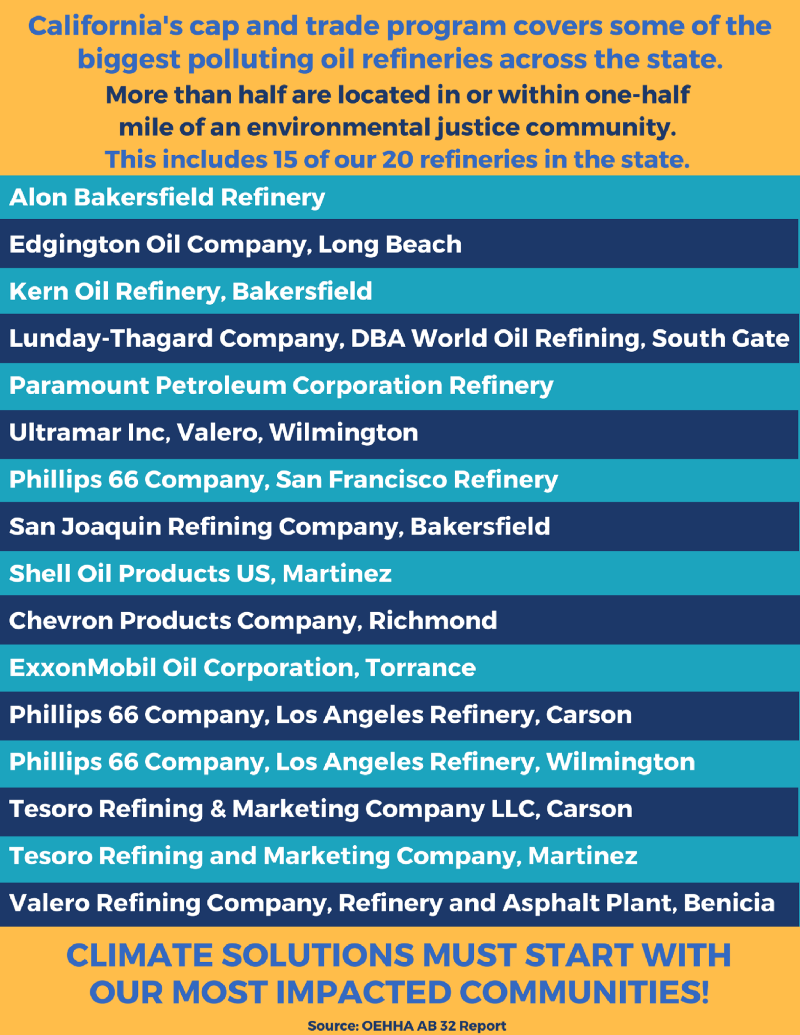
The report found that — not surprisingly — greenhouse gas facilities are disproportionately located in EJ communities. More than half (57%) are located in or within one-half mile of a disadvantaged community. This includes 15 out of the 20 refineries in the state.
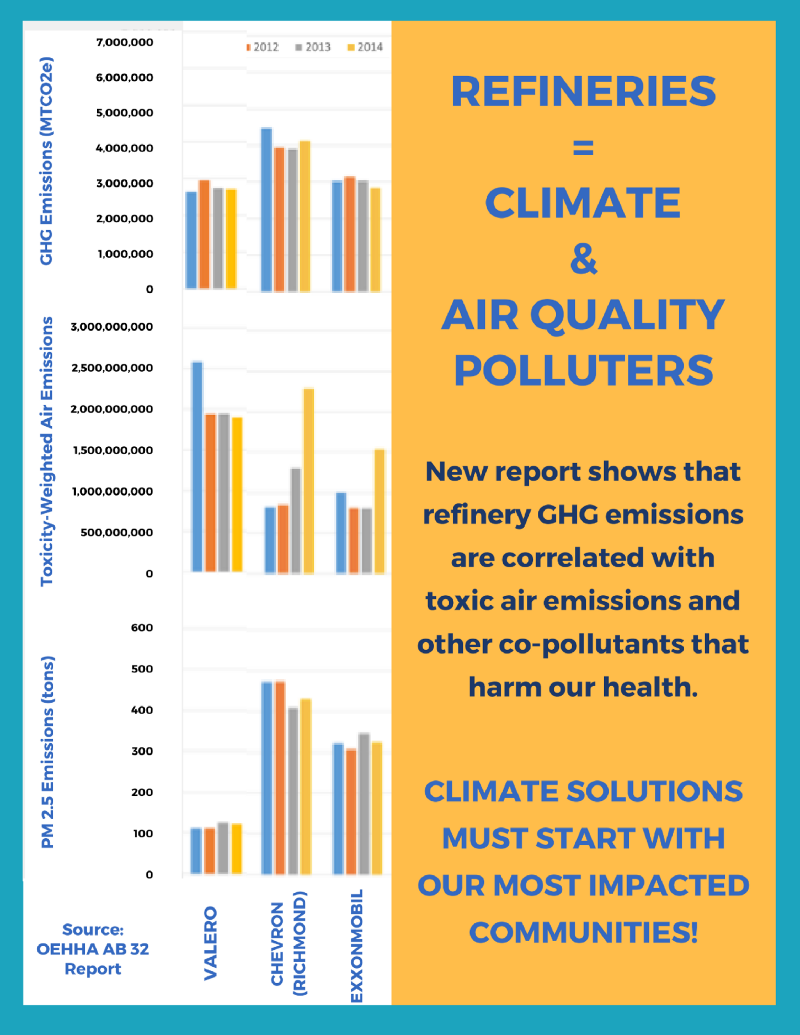
The report also found that these facilities are not just releasing greenhouse gases; they are also releasing other toxic air pollutants. These include criteria air pollutants and air toxics (ozone, particulate matter, sulfur dioxide, nitrogen dioxide, carbon monoxide, and lead), all of which are known to have negative health impacts. This correlation was especially notable for refineries, hydrogen plants and cement plants. Finally, the report found that facilities that emit higher levels of GHGs tend to have higher emissions of air toxics and criteria air pollutants.
The extent of analysis was limited by the patchwork approach to data collection and reporting at our state and local regulatory agencies. Data collected by multiple entities, on varying timelines, submitted to different databases, and not all publicly available, undermines our ability to really understand what is happening with air quality and GHG emissions.
All this evidence supports another long-held conviction in the EJ community: the cap and trade system gives big polluters loopholes to avoid reducing their emissions, which perpetuates local air quality hotspots. And that leads to dirty air, worse health, and more GHG emissions here in California at a time when we have set ambitious and achievable goals to dramatically reduce GHGs.
As Martha Arguello, an Environmental Justice Advisory Committee member and Executive Director of Physicians for Social Responsibility — Los Angeles, said recently at a California Air Resources Board hearing: “We must take these early warning signs seriously, and not see them as threats to the program, but ways we can make the program work and keep its promise to not making things worse in environmental justice communities.”
If we are indeed to take these warning signs seriously, here’s just a few of the things we need to do in climate policy:
- Ensure our climate polluters reduce their emissions directly. In order to stop climate change and clean up the air, it’s a simple solution: polluters must directly reduce what comes out of their smokestack. This in fact is already required by AB 197, a law passed in 2016, which mandates that CARB prioritize direct emission reductions.
- Better align statewide air quality and climate policies. The OEHHA report says it all: “Reductions in GHG emissions from large GHG-emitting facilities are likely to result in lower emissions and exposures to other pollutants in nearby communities.” Since these emissions come out of the smokestack together, they should be regulated together.
- Coordinate GHG and air quality data reporting and make it publicly available. Without data reporting from all facilities in a shared format, our regulatory agencies will be unable to accurately track what is happening with both GHGs and air quality in our communities.
While the bad news may be that our current cap and trade system is failing environmental justice communities, the good news is that there are multiple policy venues where we can make changes. The legislature is currently exploring ways to meet our ambitious 2030 climate goals enacted through SB 32, including extending the cap and trade system; the equity issues outlined by the reports must be the starting place for those conversations, and we must see these early warning signs as a clear evidence that the status quo is not acceptable.
The California Air Resources Board also recently released their plan to meet 2030 GHG targets, called the “Draft Scoping Plan.” Unfortunately, the plan fails to meaningfully address many of the environmental justice concerns that have been documented by the recently released reports, and that have been raised repeatedly by the formal Environmental Justice Advisory Committee. CARB must update the plan to fully address the range of issues identified by the reports, the Committee and other environmental justice advocates over the past year.
California’s climate leadership is even more important now in the face of the Trump administration. The best way to maintain this leadership is to confront the core equity issues that our most vulnerable communities experience everyday. In fact, as communities of color, which are a critical constituency in California’s diverse state, have persuasively shown over the past several years: this may be the only way to truly win on climate.
Disclaimer: The views expressed here are not the official position of the IWW (or even the IWW’s EUC) and do not necessarily represent the views of anyone but the author’s.
The Fine Print I:
Disclaimer: The views expressed on this site are not the official position of the IWW (or even the IWW’s EUC) unless otherwise indicated and do not necessarily represent the views of anyone but the author’s, nor should it be assumed that any of these authors automatically support the IWW or endorse any of its positions.
Further: the inclusion of a link on our site (other than the link to the main IWW site) does not imply endorsement by or an alliance with the IWW. These sites have been chosen by our members due to their perceived relevance to the IWW EUC and are included here for informational purposes only. If you have any suggestions or comments on any of the links included (or not included) above, please contact us.
The Fine Print II:
Fair Use Notice: The material on this site is provided for educational and informational purposes. It may contain copyrighted material the use of which has not always been specifically authorized by the copyright owner. It is being made available in an effort to advance the understanding of scientific, environmental, economic, social justice and human rights issues etc.
It is believed that this constitutes a 'fair use' of any such copyrighted material as provided for in section 107 of the US Copyright Law. In accordance with Title 17 U.S.C. Section 107, the material on this site is distributed without profit to those who have an interest in using the included information for research and educational purposes. If you wish to use copyrighted material from this site for purposes of your own that go beyond 'fair use', you must obtain permission from the copyright owner. The information on this site does not constitute legal or technical advice.
 This site is not the official webpage of the Industrial Workers of the World.