






You are here
First year progress report on the Pan-Canadian Framework lacks any mention of Just Transition
By Elizabeth Perry - Work and Climate Change Report, December 12, 2017
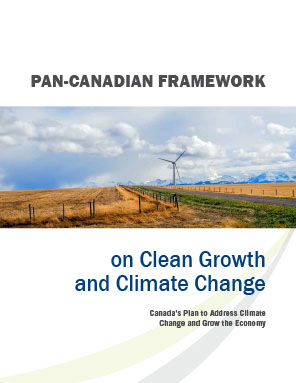 On December 9th, the Governments of Canada and British Columbia jointly announced the first annual progress report on the implementation of the Pan-Canadian Framework on Clean Growth and Climate Change – officially titled, the First Annual Synthesis Report on the Status of Implementation – December 2017 (English version) and Premier rapport annuel du cadre pancanadien sur la croissance propre et les changements climatiques (French version). The report summarizes the year’s policy developments at the federal and provincial/territorial level – under the headings pricing carbon pollution ; complementary actions to reduce emissions; adaptation and climate change resilience ; clean technology, innovation and jobs; reporting and oversight; and looking ahead. It is striking that the report is up to date enough to include mention of the Saskatchewan climate change strategy, released on December 4, as well as the Powering Past Coal global alliance launched by Canada and Great Britain in November at the Bonn climate talks – yet in the section on “Looking Ahead”, there is no mention of another important outcome of the Bonn talks: a Just Transition Task Force in Canada. As reported by the Canadian Labour Congress in “Unions applaud Canada’s commitment to a just transition for coal workers”, “Minister McKenna also announced her government’s intention to work directly with the Canadian Labour Congress to launch a task force that will develop a national framework on Just Transition for workers affected by the coal phase-out. The work of this task force is slated to begin early in the new year.” No mention of that, nor in fact, any use of the term “Just Transition” anywhere in the government’s progress report.
“Environment Canada touts ‘good progress’ on climate after scathing audit” appeared in the National Oberserver (Dec. 11), summarizing some of the progress report highlights and pointing out that not everyone agrees with the government’s self-assessment that “While good progress has been made to date, much work remains”. Recent criticism has come from the Commissioner of the Environment and Sustainable Development in her October report ; from Marc Lee at the Canadian Centre for Policy Analysis in “Canada is still a rogue state on climate change” (Dec.11) ; and from the Pembina Institute in State of the Framework: Tracking implementation of the Pan-Canadian Framework on Clean Growth and Climate Change . The Pembina Institute report calls on the federal government to speed up on all policy fronts, with specific recommendations including: “extend the pan-Canadian carbon price up to $130 per tonne of pollution by 2030, implement Canada-wide zero emission vehicle legislation, ban the sale of internal combustion engines, and establish long-term energy efficiency targets.”
Disclaimer: The views expressed here are not the official position of the IWW (or even the IWW’s EUC) and do not necessarily represent the views of anyone but the author’s.
The Fine Print I:
Disclaimer: The views expressed on this site are not the official position of the IWW (or even the IWW’s EUC) unless otherwise indicated and do not necessarily represent the views of anyone but the author’s, nor should it be assumed that any of these authors automatically support the IWW or endorse any of its positions.
Further: the inclusion of a link on our site (other than the link to the main IWW site) does not imply endorsement by or an alliance with the IWW. These sites have been chosen by our members due to their perceived relevance to the IWW EUC and are included here for informational purposes only. If you have any suggestions or comments on any of the links included (or not included) above, please contact us.
The Fine Print II:
Fair Use Notice: The material on this site is provided for educational and informational purposes. It may contain copyrighted material the use of which has not always been specifically authorized by the copyright owner. It is being made available in an effort to advance the understanding of scientific, environmental, economic, social justice and human rights issues etc.
It is believed that this constitutes a 'fair use' of any such copyrighted material as provided for in section 107 of the US Copyright Law. In accordance with Title 17 U.S.C. Section 107, the material on this site is distributed without profit to those who have an interest in using the included information for research and educational purposes. If you wish to use copyrighted material from this site for purposes of your own that go beyond 'fair use', you must obtain permission from the copyright owner. The information on this site does not constitute legal or technical advice.
 This site is not the official webpage of the Industrial Workers of the World.