






You are here
Employment After Coal: Creating new jobs in eastern Kentucky
By Frank Ackerman, PhD and Tyler Comings - MACED, December 30, 2015
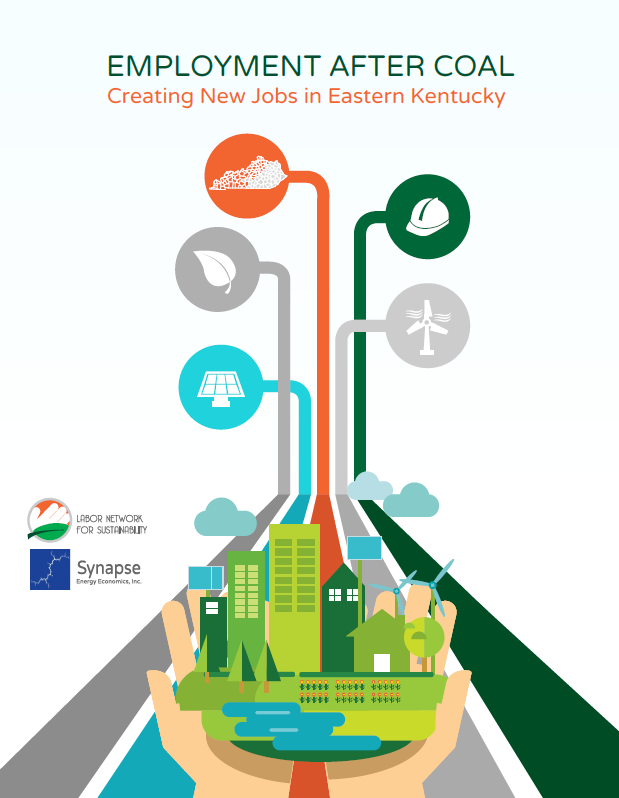 The steep, ongoing decline of coal mining has caused the loss of 30,000 coal jobs in eastern Kentucky in the last 30 years. Trends in energy markets and public policy make it clear that a coal‐based economy is not coming back. A successful response to this crisis, replacing the lost kingdom of coal with a sustainable, community‐controlled economy, is crucial to the hopes for forward‐looking economic development in the region.
The issue reverberates far beyond the coalfields, as the national search for clean energy alternatives confronts impassioned claims about the need to protect coal mining jobs. In Kentucky and in the nation, a common but misleading frame on the debate suggests that there is no alternative, that “real” jobs can only be created by traditional industries, even if they are environmentally damaging.
In fact, the narrow, coal‐centered vision of “real” jobs is fading away, and discussion of newer, cleaner alternatives is already underway. Community organizations such as the Mountain Association for Community Economic Development (MACED) and Kentuckians for the Commonwealth (KFTC) have sponsored grassroots job creation initiatives, and have identified key sectors where employment growth should be possible. Both MACED and KFTC advocate for a Just Transition, a bigger picture that combines existing initiatives into a single vision of a working economy, mapping the sustainable occupations and industries that will fill the void left by coal.
Our analysis describes a new pattern of employment that Appalachian Kentucky could aspire to reach by 2030. It is a more challenging and longer‐term goal than is usually found in immediate grass‐roots campaigns. At the same time, it is more limited, detailed and practical than a grand statement of ultimate objectives. It occupies an intermediate level of abstraction, a mid‐range strategic vision of what the regional economy could look like in ten to twenty years.
Disclaimer: The views expressed here are not the official position of the IWW (or even the IWW’s EUC) and do not necessarily represent the views of anyone but the author.
The Fine Print I:
Disclaimer: The views expressed on this site are not the official position of the IWW (or even the IWW’s EUC) unless otherwise indicated and do not necessarily represent the views of anyone but the author’s, nor should it be assumed that any of these authors automatically support the IWW or endorse any of its positions.
Further: the inclusion of a link on our site (other than the link to the main IWW site) does not imply endorsement by or an alliance with the IWW. These sites have been chosen by our members due to their perceived relevance to the IWW EUC and are included here for informational purposes only. If you have any suggestions or comments on any of the links included (or not included) above, please contact us.
The Fine Print II:
Fair Use Notice: The material on this site is provided for educational and informational purposes. It may contain copyrighted material the use of which has not always been specifically authorized by the copyright owner. It is being made available in an effort to advance the understanding of scientific, environmental, economic, social justice and human rights issues etc.
It is believed that this constitutes a 'fair use' of any such copyrighted material as provided for in section 107 of the US Copyright Law. In accordance with Title 17 U.S.C. Section 107, the material on this site is distributed without profit to those who have an interest in using the included information for research and educational purposes. If you wish to use copyrighted material from this site for purposes of your own that go beyond 'fair use', you must obtain permission from the copyright owner. The information on this site does not constitute legal or technical advice.
 This site is not the official webpage of the Industrial Workers of the World.