






You are here
Well Worker Safety and Statistics
By Samantha Malone, MPH, CPH – Manager of Science and Communications, FracTracker Alliance, May 14, 2014
Disclaimer: The views expressed here are not the official position of the IWW (or even the IWW’s EUC) and do not necessarily represent the views of anyone but the author’s.
The population most at risk from accidents and incidents near unconventional drilling operations are the drillers and contractors within the industry. While that statement may seem quite obvious, let’s explore some of the numbers behind how often these workers are in harm’s way and why.
O&G Risks

Fig. 1. Number of oil and gas worker fatalities over time
Data Source: U.S. Bureau of Labor Statistics, U.S. Department of Labor, 2014
Drilling operations, whether conventional or unconventional (aka fracking), run 24 hours a day, 7 days a week. Workers may be on site for several hours or even days at a time. Simply the amount of time spent on the job inherently increases one’s chances of health and safety concerns. Working in the extraction field is traditionally risky business. In 2012, mining, quarrying, and oil and gas extraction jobs experienced an overall 15.9 deaths for every 100,000 workers, the second highest rate among American businesses. (Only Agriculture, forestry, fishing and hunting jobs had a higher rate.)
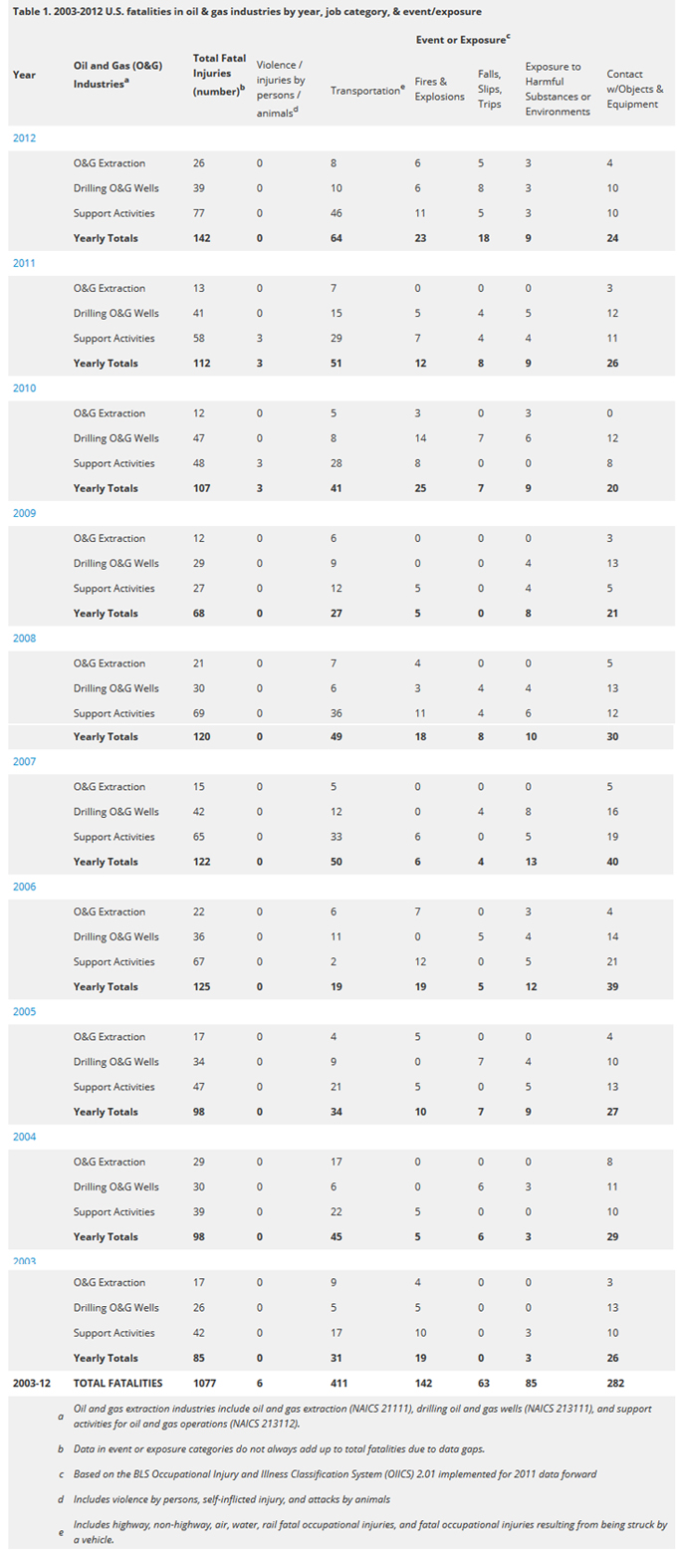
According to the Quarterly Census of Employment and Wages of the U.S. Bureau of Labor Statistics, the oil and gas industry employed 188,003 workers in 2012 in the U.S., a jump from 120,328 in 2003. Preliminary data indicate that the upward employment trend continued in 2013. However, between 2003 and 2012, a total of 1,077 oil and gas extraction workers were killed on the job (Fig. 1).
Causes of Injuries and Fatalities in Oil and Gas Field

Fig. 2. Reasons for O&G Fatalities 2003-12. Aggregated from Table 1.
Like many industrial operations, here are some of the reasons why oil and gas workers may be hurt or killed according to OSHA:
- Vehicle Accidents
- Struck-By/ Caught-In/ Caught-Between Equipment
- Explosions and Fires
- Falls
- Confined Spaces
- Chemical Exposures
If you drill down to the raw fatality-cause numbers, you can see that the fatal worksite hazards vary over time and job type1 (Table 1, bottom). Supporting jobs to the O&G sector are at higher risk of fatal injuries than those within the O&G extraction job category2. The chart to the right shows aggregate data for years 2003-12. Records indicate that the primary risk of death originated from transportation incidents, followed by situations where someone came into contact with physical equipment (Fig. 2).
Silica Research

Fig. 3. Number of total silica-exposed workers and those exposed above PEL – compared across industries
Source: OSHA Directorate of Standards and Guidance
A recent NIOSH study by Esswein et al. regarding workplace safety for oil and gas workers was that the methods being employed to protect workers against respirable crystalline silica3 were not adequate. This form of silica can be found in the sand used for hydraulic fracturing operations and presents health concerns such as silicosis if inhaled over time. According to Esswein’s research, workers were being exposed to levels above the permissible exposure limit (PEL) of ~0.1 mg/m3 for pure quartz silica because of insufficient respirator use and inadequate technology controls on site. It is unclear at this time how far the dust may migrate from the well pad or sand mining site, a concern for nearby residents of the sand mines, distribution methods, and well pads. (Check out our photos of a recent frac sand mine tour.) The oil and gas industry is not the only employer that must protect people from this airborne workplace hazard. Several other classes of jobs result in exposure to silica dust above the PEL (Fig. 3).
References and Additional Resources
1. What do the job categories in the table below mean?
For the Bureau of Labor Statistics, it is important for jobs to be classified into groups to allow for better reporting/tracking. The jobs and associated numbers are assigned according to the North American Industry Classification System (NAICS).
(NAICS 21111) Oil and Gas Extraction comprises establishments primarily engaged in operating and/or developing oil and gas field properties and establishments primarily engaged in recovering liquid hydrocarbons from oil and gas field gases. Such activities may include exploration for crude petroleum and natural gas; drilling, completing, and equipping wells; operation of separators, emulsion breakers, desilting equipment, and field gathering lines for crude petroleum and natural gas; and all other activities in the preparation of oil and gas up to the point of shipment from the producing property. This industry includes the production of crude petroleum, the mining and extraction of oil from oil shale and oil sands, the production of natural gas, sulfur recovery from natural gas, and the recovery of hydrocarbon liquids from oil and gas field gases. Establishments in this industry operate oil and gas wells on their own account or for others on a contract or fee basis. Learn more
(NAICS 213111) Drilling Oil and Gas Wells comprises establishments primarily engaged in drilling oil and gas wells for others on a contract or fee basis. This industry includes contractors that specialize in spudding in, drilling in, redrilling, and directional drilling. Learn more
(NAICS 213112) Support Activities for Oil and Gas Operations comprises establishments primarily engaged in performing support activities on a contract or fee basis for oil and gas operations (except site preparation and related construction activities). Services included are exploration (except geophysical surveying and mapping); excavating slush pits and cellars, well surveying; running, cutting, and pulling casings, tubes, and rods; cementing wells, shooting wells; perforating well casings; acidizing and chemically treating wells; and cleaning out, bailing, and swabbing wells. Learn more
2. Fifteen percent of all fatal work injuries in 2012 involved contractors. Source
3. What is respirable crystalline silica?
Respirable crystalline silica – very small particles at least 100 times smaller than ordinary sand you might encounter on beaches and playgrounds – is created during work operations involving stone, rock, concrete, brick, block, mortar, and industrial sand. Exposures to respirable crystalline silica can occur when cutting, sawing, grinding, drilling, and crushing these materials. These exposures are common in brick, concrete, and pottery manufacturing operations, as well as during operations using industrial sand products, such as in foundries, sand blasting, and hydraulic fracturing (fracking) operations in the oil and gas industry.
4. OSHA Fact Sheet: OSHA’s Proposed Crystalline Silica Rule: General Industry and Maritime. Learn more
Employee health and safety are protected under the following OSHA regulations. These standards require employers to make sure that the workplace is in due order:
- OSHA’s General Industry Standards (29 CFR 1910)
- OSHA’s Construction Standards (29 CFR 1926)
- General Duty Clause of the Occupational Safety and Health (OSH) Act
The Fine Print I:
Disclaimer: The views expressed on this site are not the official position of the IWW (or even the IWW’s EUC) unless otherwise indicated and do not necessarily represent the views of anyone but the author’s, nor should it be assumed that any of these authors automatically support the IWW or endorse any of its positions.
Further: the inclusion of a link on our site (other than the link to the main IWW site) does not imply endorsement by or an alliance with the IWW. These sites have been chosen by our members due to their perceived relevance to the IWW EUC and are included here for informational purposes only. If you have any suggestions or comments on any of the links included (or not included) above, please contact us.
The Fine Print II:
Fair Use Notice: The material on this site is provided for educational and informational purposes. It may contain copyrighted material the use of which has not always been specifically authorized by the copyright owner. It is being made available in an effort to advance the understanding of scientific, environmental, economic, social justice and human rights issues etc.
It is believed that this constitutes a 'fair use' of any such copyrighted material as provided for in section 107 of the US Copyright Law. In accordance with Title 17 U.S.C. Section 107, the material on this site is distributed without profit to those who have an interest in using the included information for research and educational purposes. If you wish to use copyrighted material from this site for purposes of your own that go beyond 'fair use', you must obtain permission from the copyright owner. The information on this site does not constitute legal or technical advice.
 This site is not the official webpage of the Industrial Workers of the World.