






You are here
You Can’t Just Speak a General Strike, Let Alone a Revolution, into Existence
By That Green Union Guy - IWW Eco Union Caucus, July 27, 2025
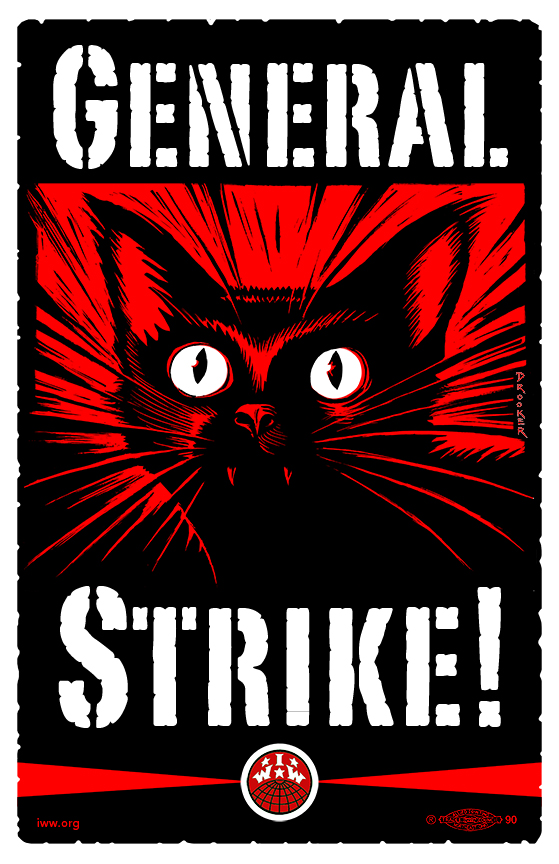 As the crises unfolding from Felonious Trump’s lawless coup continue, and the apparent inability by what’s left of the American putatively constitutional government to stop it grow increasingly odious, desperation among the people seems to be festering. This includes growing calls for a “general strike” on various social media platforms.
What is a general strike? Well, it’s what happens when all workers in a specific industry or geographical location cease work simultaneously, thus bringing business as usual to a halt. Such activity can be used with great effect to beat back growing oppressive conditions, brought on by the bosses or by governments. There is a rich history of such strikes throughout history.
The idea predates the IWW, but it was the Industrial Workers of the World, or “Wobblies” as they’re affectionately still known, that was one of the revolutionary unions who made it a central focus of their strategy. Both William “Big Bill” Haywood and Ralph Chaplin devised detailed descriptions of how this might work in practice. Chaplin, by the way, is the individual who wrote the lyrics to organized labor’s most famous anthem, Solidarity Forever (which essentially explains the concept of the “general strike” through its lyrics); he also conceived of the IWW’s mascot: the black cat.
Careful examination of these texts will reveal that a crucial ingredient of any successful general strike is organization, meaning that such actions do not materialize out of nothing. Unfortunately, this point seems lost on far too many people. That is why, like clockwork, anonymously wheatpasted posters calling for a “General Strike!” frequently appear all over financial districts and countercultural enclaves the last week in April each year, but such strikes unfold.
With apologies to “Boromir”, from Lord of the Rings, one cannot simply speak a General Strike into existence. They must be organized. Workers, particularly those not represented by a union—and that amounts to more than 87% of American wage earners—face enormous risks for taking collective action at all, let alone something as forceful as a strike. That doesn’t mean workers not formally represented by a union cannot strike. In fact, they can, and what’s more, such activity is protected under labor law if the workers are employed in the private sector (in the case of the public sector, certain transportation workers, or farm workers, it’s a bit more complicated). Even if workers aren’t legally allowed to strike, if enough defy the laws, as would be the case in most general strikes, but even without formal representation, the aforementioned workers would still need to coordinate with each other, have support and mutual aid networks in place, and coordinate with grassroots community organizations. Otherwise, these workers would be sitting ducks, and likely all get fired.
To put it bluntly: just because someone proposes a general strike, and even if the idea “goes viral” (which is quite possible with social media), it doesn’t magically create these organizations nor does it spontaneously imbue workers with courage. The very nature of capitalism is that wage earners are essentially wage slaves, and as such, bring under the constant boot of the boss, especially when one doesn’t have a union or routinely practice engaging in direct action at the point of production, breeds subservience that isn’t easily shaken. That’s why both Haywood and Chaplin postulated that the workers must build their proverbial muscles by engaging in small workplace actions initially, and then building up their capacity to engage in class struggle. A general strike would represent the pinnacle of such activity.
General strikes have been made more difficult by the fact that various laws passed by Congress over the years, particularly Taft-Hartley, in the mid 1950s, have made many of the aspects of them, such as so-called “secondary boycotts” (i.e. anything that doesn’t directly involve the direct employer which is the strike’s target) illegal. Additionally, many union contracts contain “no strike” clauses that prohibit strikes (except in rare instances for specific grievances) during the duration of the agreement. Workers and unions can, of course, attempt to defy these laws and engage in “wildcat” (unsanctioned) strikes, but there are much greater risks to them in doing so.
That’s not to suggest a general strike is a bad idea. If workers and unions are sufficiently motivated and organized, and the strike has widespread support across the working class, they might risk defying the laws that limit their activity or the fear of reprisal from the employers, not to mention the government. Again, however, the key ingredient is organization. All of these conditions have, for the last 3/4ths of a century, largely lacking.
That said, unions have been experiencing a recent upsurge as support for them among the public is at an all time high due to various factors (including, in opposition to the return of Trump). There is actually talk among some workers and unions about organizing toward a general strike by having multiple union contracts expire in the same day. United Auto Workers president, Shawn Fain, has called for this to occur on April 30, 2028, so that a general strike could theoretically occur on May Day. Environmental groups with a class struggle orientation, such as the Sunrise Movement, have endorsed this idea and are actively organizing to make it possible. Even if these efforts don’t ultimately result in a general strike on May 1, 2028, they can lead to one further down the road, strengthening the union and environmental movement, and help defeat MAGA and the far right.
Those of you feeling desperate about the current lawlessness by the Trump Administration can join in these efforts and help the work along. Or, better yet, you can organize your workplace if it’s not currently unionized, or at least support such efforts when they occur. Casually calling for a “general strike” on social media, on the other hand? That’s no different than anonymously wheat passing posters calling for one in late April, a time honored tradition that yields little results beyond giving civic workers another tedious task to do.
Disclaimer: The views expressed here are not the official position of the IWW (or even the IWW’s EUC) and do not necessarily represent the views of anyone but the author.
The Fine Print I:
Disclaimer: The views expressed on this site are not the official position of the IWW (or even the IWW’s EUC) unless otherwise indicated and do not necessarily represent the views of anyone but the author’s, nor should it be assumed that any of these authors automatically support the IWW or endorse any of its positions.
Further: the inclusion of a link on our site (other than the link to the main IWW site) does not imply endorsement by or an alliance with the IWW. These sites have been chosen by our members due to their perceived relevance to the IWW EUC and are included here for informational purposes only. If you have any suggestions or comments on any of the links included (or not included) above, please contact us.
The Fine Print II:
Fair Use Notice: The material on this site is provided for educational and informational purposes. It may contain copyrighted material the use of which has not always been specifically authorized by the copyright owner. It is being made available in an effort to advance the understanding of scientific, environmental, economic, social justice and human rights issues etc.
It is believed that this constitutes a 'fair use' of any such copyrighted material as provided for in section 107 of the US Copyright Law. In accordance with Title 17 U.S.C. Section 107, the material on this site is distributed without profit to those who have an interest in using the included information for research and educational purposes. If you wish to use copyrighted material from this site for purposes of your own that go beyond 'fair use', you must obtain permission from the copyright owner. The information on this site does not constitute legal or technical advice.
 This site is not the official webpage of the Industrial Workers of the World.