You are here

Pennsylvania

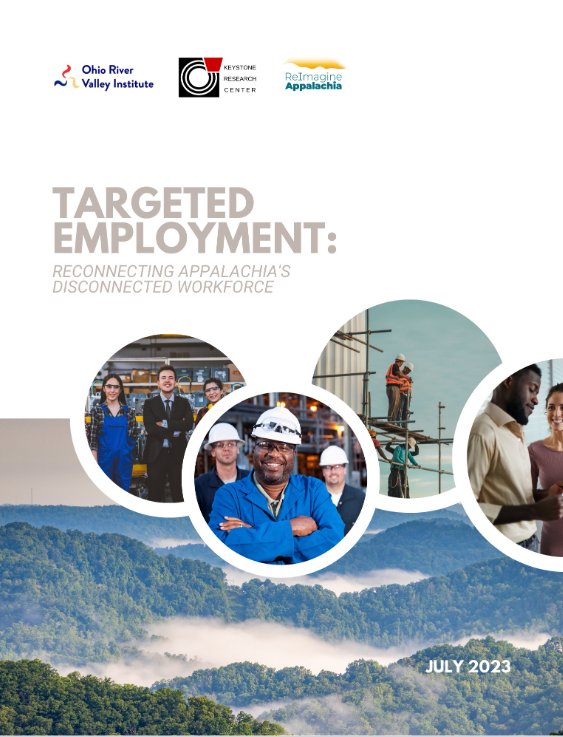
Targeted Employment: Reconnecting Appalachia’s Disconnected Workforce

By Claire Kovach, Stephen Herzenberg, Amanda Woodrum, and Ted Boettner - ReImagine Institute, Keystone Research Center, Ohio River Valley Institute, July 25, 2023

The Appalachian region has long suffered from not having enough good paying jobs. Even when the unemployment rate is low, too many Appalachians are disconnected from the workforce entirely due to a myriad of factors. The result has been a long-term structural unemployment problem that has persisted for decades, with too many Appalachian adults out of the workforce entirely and unable to secure a decent paying job where they live.

A federal job subsidy program that is targeted at breaking down barriers to employment – such as improving the skills and experience of potential workers to meet current employer demands in their local labor market – and connecting them with a job could not only boost incomes and improve the livelihood of thousands of Appalachians but also give people self-esteem, a source of identity, and feel more connected to their community.

This report examines the economic conditions of Appalachia with a particular focus on the Appalachian counties of four states—Kentucky, Ohio, Pennsylvania, and West Virginia—that comprise the footprint of ReImagine Appalachia and the Ohio River Valley Institute. This includes describing how Appalachia has been a “region apart” from the rest of America, including its history of resource extraction and exploitation, the collapse of the steel industry, and now coal, that has led to large employment losses in the area, and how the region’s uneven development has led to chronically low rates of employment, disenfranchisement from the labor market and even loss of hope underpinning the opioid epidemic from which the Appalachian region was particularly hard hit.

Download a copy of this publication here (PDF).

Train Builders Strike, Demand to Build Green Locomotives

By staff - Labor Network for Sustainability, June 30, 2023

In what may be the first strike in US history to demand green jobs, 1400 striking members of UE Locals 506 and 618 who build locomotives for Wabtec in Erie, PA are demanding that their employers start producing green locomotives. Their proposals grow out of UE’s “Green Locomotive Project,” which aims to “build the worker and community power necessary to compel the railroads to upgrade their locomotive stock and adopt green technology, and to ensure that new technologies lead to jobs at existing union factories.” A recent report from the University of Massachusetts Amherst finds that building such locomotives would create between 2,600 and 4,300 jobs in the Lawrence Park plant, as well as three to five thousand additional jobs in Erie County.

For more on the strike: Wabtec Workers Walk Out for Grievance Strikes and Green Locomotives | Labor Notes

For background on the Green Locomotive Project: The Filthy Emissions of Railroad Locomotives—and the Rail Unions Sounding the Alarm | The American Prospect

To contribute to the strike solidarity fund: https://actionnetwork.org/fundraising/support-ue-members-striking-for-green-jobs

LNS Supports Workers’ Demand to Build Green Locomotives

By staff - Labor Network for Sustainability, June 30, 2023

1400 workers in Erie, PA have been out on strike since June, demanding that their employer, Wabtec, start producing green locomotives. In a statement of solidarity, the Labor Network for Sustainability said:

The unions were denied their basic rights to strike over grievances, and most importantly, over the company’s refusal to move forward with worker-supported, environmentally necessary green locomotive production.

 This strike may well represent the first instance ever of unionized workers striking to force their employers to make products to protect the climate. That’s historic. 

 The Labor Network for Sustainability supports the United Electrical Workers in their fight to manufacture more sustainable transportation. Their decision to strike represents their decision to prolong life on our planet by making lower emission locomotives to carry freight across this great country. Their decision also upholds the livelihood of many communities that these railroads run through that face negative effects from the current engines.

 The railroad industry is still behind with making the necessary steps in maximizing their efficiency with their right-of-way, including: electrifying the last-mile of their urban rail yards, sharing their tracks with electrified inter and intracity transit, and upgrading their locomotives to non-pollutant green locomotives, ones touted by the UE workers in Erie.

Employment Creation through Green Locomotive Manufacturing at Wabtec’s Erie, Pennsylvania Facility

By Alex Press - Jacobin, June 24, 2023

On the evening of June 22, members of the United Electrical, Radio and Machine Workers of America (UE) crowded into Iroquois High School to vote on whether they would accept what their boss was offering them. They are employed by Wabtec (an abbreviation of Westinghouse Air Brake Technologies Corporation), at a four-million-square-foot locomotive manufacturing plant in Lawrence Park, on the east side of Erie, Pennsylvania.

Lawrence Park was built by General Electric (GE), which ran the plant for more than a century before the company spun off its $4-billion-a-year transportation arm in 2019, transferring ownership to Wabtec. The area still feels like a company town: the roughly four thousand residents are tied to the plant in countless ways, and UE signs dot Lawrence Park’s Main Street, affixed to telephone poles and stuck in front lawns.

At Iroquois High, the members of UE Local 506 and Local 618 (the latter consists of the plant’s clerical employees whose jobs have not been eliminated by automation, now numbering in the single digits) were voting on Wabtec’s last, best, and final offer for a new four-year contract. They struck for nine days to win that first contract in 2019, defeating some of Wabtec’s most egregious proposals but giving up certain provisions they had enjoyed under GE, some of which they hoped to win back during the current negotiations. The company’s 1,400 workers have now been without a contract since June 10, when that first contract expired.

Months of bargaining failed to produce a tentative agreement, and the company’s actions only increased the workers’ frustration. Hours before the contract expired, Wabtec informed Local 506 president Scott Slawson that it was considering permanently subcontracting out 275 union jobs, which members read as a threat. That interpretation was only confirmed when the company then told Slawson on June 20 that it would rescind that move should the workers accept the offer.

UE Locals 506 and 618 Strike Wabtec Locomotive Plant, Demanding Green Jobs

By Scott Slawson - United Electrical Workers, June 22, 2023

After rejecting the company’s last, best and final offer today, the 1400 members of UE Locals 506 and 618 are on strike at Wabtec’s locomotive plant in Lawrence Park.

“Building green locomotives is essential to the future of our country, and will benefit the local economy here in Erie,” said UE Local 506 President Scott Slawson. “Unfortunately, Wabtec’s unwillingness to work with us to resolve problems, either through the grievance process or through contract negotiations, is a major impediment to that bright future.”

Slawson also denounced the company’s announcement during bargaining that they are considering moving at least 275 jobs out of the plant.

“While the union is working hard to bring new work into the plant and new jobs to Erie through our Green Locomotive Project, the company is refusing to work with us on this project, and is instead holding the community of Erie hostage with the threat of moving work,” Slawson said. “We will not give in to their blackmail.”

A recent report by the Political Economy Research Institute at the University of Massachusetts-Amherst found that the production of green locomotives at the Erie plant could bring thousands of new, high-quality jobs to northwest Pennsylvania, an area that has been especially hard-hit by de-industrialization. During contract negotiations, the union has proposed language that would guarantee that green locomotive work be done in Erie.

In addition to the green locomotive proposal, the union has proposed returning to the dispute resolution process used for over eight decades prior to the plant’s sale to Wabtec in 2019. Under that process, workers had the right to strike after exhausting the grievance procedure, which gave the company an incentive to settle disputes at the lowest possible level. Since the union’s first contract with Wabtec went into effect in June 2019, the number of grievances reaching the final stage of the grievance procedure has increased tenfold.

Steel built the Rust Belt. Green steel could help rebuild it

By Katie Myers - Grist, May 11, 2023

In the Mon Valley of western Pennsylvania, steel was once a way of life, one synonymous with the image of rural, working-class Rust Belt communities. At its height in 1910, Pittsburgh alone produced 25 million tons of it, or 60 percent of the nation’s total. Bustling mills linger along the Monongahela River and around Pittsburgh, but employment has been steadily winding down for decades.

Though President Trump promised a return to the idealized vision of American steelmaking that Bruce Springsteen might sing about, the industry has changed since its initial slump four decades ago. Jobs declined 49 percent between 1990 and 2021, when increased efficiency saw the sector operating at its highest capacity in 14 years. Despite ongoing supply chain hiccups and inflation, demand continues growing globally, particularly in Asia. But even as demand for this essential material climbs, so too does the pressure to decarbonize its production.

Earlier this month, the progressive Ohio River Valley Institute released a study that found a carefully planned transition to “green” steel — manufactured using hydrogen generated with renewable energy — could be a climatic and economic boon. It argues that as countries work toward achieving net-zero emissions by 2050, a green steel boom in western Pennsylvania could help the U.S. meet that goal, make its steel industry competitive again, and employ a well-paid industrial workforce.

“A transition to fossil fuel-free steelmaking could grow total jobs supported by steelmaking in the region by 27 percent to 43 percent by 2031, forestalling projected job losses,” the study noted. “Regional jobs supported by traditional steelmaking are expected to fall by 30 percent in the same period.”

Green Steel in the Ohio River Valley: The Timing is Right for the Rebirth of a Clean, Green Steel Industry

By Jacqueline Ebner, Ph.D., Kathy Hipple, Nick Messenger, and Irina Spector, MBA - Bob Muehlenkamp, April 17, 2023

For more than a century, steel has played an important role in the economy and culture of the Ohio River Valley. But the traditional method of making steel, known as BF-BOF (blast furnace-blast oxygen furnace), requires lots of energy and produces lots of climate-warming emissions. The iron and steel sector is currently responsible for about 7% of global greenhouse gas (GHG) emissions, according to the International Energy Agency.

Shifting to fossil fuel-free steelmaking could reduce greenhouse gas emissions, boost jobs, and grow the region’s economy. Fossil fuel-free DRI-EAF (direct reduced iron-electric arc furnace) steelmaking uses green hydrogen—created with wind and solar energy—to make steel with nearly zero climate-warming emissions.

Investing in fossil fuel-free steelmaking is a win for the climate and the economy. This report looks at Mon Valley Works, a steelmaking facility in southwestern Pennsylvania, as a model for transitioning from carbon-intensive BF-BOF steelmaking to fossil fuel-free DRI-EAF steelmaking.

Key takeaways:

  • A transition to fossil fuel-free steelmaking could grow total jobs supported by steelmaking in the region by 27% to 43% by 2031, forestalling projected job losses. Regional jobs supported by traditional steelmaking are expected to fall by 30% in the same period, data show.
  • Transitioning to fossil fuel-free steelmaking will cut Pennsylvania’s industrial sector emissions by 4 million metric tons of CO2e per year, improving quality of life and saving the state $380 million in health, community, and environmental costs.
  • The Ohio River Valley is uniquely positioned to become a decarbonized industrial hub. A skilled workforce with applicable manufacturing experience, ready access to water and iron ore, and high potential for solar, wind, and green hydrogen development situate the region to lead a growing green manufacturing industry.
  • Billions in federal funding from the Bipartisan Infrastructure Law, the Inflation Reduction Act, and the CHIPS and Science Act will boost demand for American-made steel while supporting worker retraining programs, hydrogen infrastructure, and renewable energy development.

Download a copy of this publication here (PDF).

New Bigger Risks Await Poorly Regulated Rail Industry

By Justin Mikulka - DeSmog, March 31, 2023

In July of 2013, a train carrying Bakken oil from North Dakota derailed and exploded in Lac-Mégantic, Quebec, killing 47 people and destroying the downtown. I spent the five years after that accident researching what happened, following the railroad regulatory process that spans the U.S.-Canada border, and publishing a book about that experience. The main lesson of that book was that the regulatory process in America is deeply flawed and controlled by industry — both rail and oil interests. 

As we approach the 10-year anniversary of Lac-Mégantic, the disaster in East Palestine shows just how little was done to protect the public from these dangerous trains. Meanwhile, the public is facing new rail risks that are receiving scant attention — and once again federal regulators are allowing industry to move forward without proper consideration of the health and safety risks. I live three blocks from a busy rail line and what worries me the most when I hear the trains rumble past is not that they’re carrying vinyl chloride or even Bakken oil, but the looming risk of mile-long trains of liquefied natural gas (LNG) and hydrogen. 

In 2019, then-President Trump issued an executive order to fast-track new regulations that would allow shipping liquefied natural gas by rail without any meaningful guardrails on its transport. 

But Earthjustice and other organizations sued the administration over this move, citing the perils. “It would only take 22 tank cars to hold the equivalent energy of the Hiroshima bomb,” according to Earthjustice attorney Jordan Luebkemann. 

Modeling by the Pipeline and Hazardous Materials Safety Administration (PHMSA) estimates that for a train pulling 100 tank cars of LNG and traveling at 40 miles per hour, a derailment is expected to cause four punctures in the tank cars. 

The Biden administration is reviewing this Trump-era regulation, but the only sensible option is to ban the movement of LNG-by-rail. 

Over the last year, Russia’s invasion of Ukraine has upset global energy markets, giving a big boost to plans to increase exports of American LNG overseas and placing pressure to move as much LNG as possible as quickly as possible — including by rail.

Fossil Fuel Industry Phase-Out: Three Critical Worker Guarantees for a Just Transition

In Coal Country, Young Workers Seek a Sustainable Future

By Jonathan Blair - In These Times, March 8, 2023

This article, republished from the Daily Yonder, is part of a series of photo essays created for the American Creed ​“Citizen Power” multi-platform documentary initiative exploring American idealism and community leadership from a range of young adult perspectives. 

Jonathan Blair lives, works, and studies at Alice Lloyd College, in Eastern Kentucky. He coordinates a work-study crew of about 60 people, mostly first-generation college students from rural Appalachia. Blair and two of his crew members — Jacob Frazier and Carlos Villanueva — document their connection to blue-collar work in and around the Appalachian coal industry, and they reflect on their hopes for the region. 

Explore more of Jonathan Blair’s story here.

My grandfathers on both sides were coal miners. My father is a mechanic for one of the railroads that transport coal. Basically, ever since our family has been in these hills, the coal business has put food on our table, and that’s the case for most families in our region. Even if it’s not why they came here, it kind of became what they did, because that was what paid, and you’re going to do whatever it takes. 

Survival is a big aspect of Appalachian culture. For a long time, coal meant survival, but there was never a sense of stability because the coal business is like a light switch: It’s either ​“on” or ​“off.” And when that switch was off, a lot of people, like my grandpa, would find manufacturing jobs elsewhere, in Ohio and other places. And whenever the coal business picked back up, they would come back, because this is home. Today, you look around and you can see the mountaintops have been removed to extract the coal from them, and much of the coal that was deep in the ground is gone. The coal business is a phantom, a shadow of what it used to be. We can’t rely on it coming back to what it once was.

Pages

The Fine Print I:

Disclaimer: The views expressed on this site are not the official position of the IWW (or even the IWW’s EUC) unless otherwise indicated and do not necessarily represent the views of anyone but the author’s, nor should it be assumed that any of these authors automatically support the IWW or endorse any of its positions.

Further: the inclusion of a link on our site (other than the link to the main IWW site) does not imply endorsement by or an alliance with the IWW. These sites have been chosen by our members due to their perceived relevance to the IWW EUC and are included here for informational purposes only. If you have any suggestions or comments on any of the links included (or not included) above, please contact us.

The Fine Print II:

Fair Use Notice: The material on this site is provided for educational and informational purposes. It may contain copyrighted material the use of which has not always been specifically authorized by the copyright owner. It is being made available in an effort to advance the understanding of scientific, environmental, economic, social justice and human rights issues etc.

It is believed that this constitutes a 'fair use' of any such copyrighted material as provided for in section 107 of the US Copyright Law. In accordance with Title 17 U.S.C. Section 107, the material on this site is distributed without profit to those who have an interest in using the included information for research and educational purposes. If you wish to use copyrighted material from this site for purposes of your own that go beyond 'fair use', you must obtain permission from the copyright owner. The information on this site does not constitute legal or technical advice.