You are here

energy democracy

Ecosocialismo: Envisioning Latin America’s Green New Deal

Trade Unions for Energy Democracy: Global Forum on Mexico

By staff - Trade Unions For Energy Democracy, March 25, 2021

Speakers:

  • Heberto Barrios Castillo, Undersecretary, Mexican Energy Ministry- SENER
  • Martín Esparza, General Secretary, Sindicato Mexicano de Electricistas- SME
  • Silvia Ramos Luna, Secretary General, Unión Nacional de Técnicos y Profesionistas Petroleros - UNTyPP
  • Fernando Lopes, trade union consultant in Brazil and former Assistant Secretary General of IndustriALL
  • Ozzi Warwick, Chief Education and Research Officer, Oilfields Workers' Trade Union (OWTU), Trinidad and Tobago

French Energy Union FNME-CGT Endorses TUED Call for Public Energy in Texas

By Staff - Trade Unions for Energy Democracy, March 8, 2021

In a March 8 Press Release, FNME-CGT — the energy and mining division of French trade union confederation CGT — has republished a TUED briefing paper on the recent power sector crisis in Texas. TUED’s briefing paper argued that the recent catastrophic power sector failures in Texas “serve as a stark warning that unregulated, privatized and marketized electricity systems pose a serious threat to human life.”

As we have previously reported in TUED Bulletins 104 and 105, FNME is currently involved in a major struggle by striking French electricity and gas workers in defense of the country’s publicly owned energy company, EDF. The target of the strikes is a set of proposals being advanced by the French government, at the heart of which is a plan to “restructure” the country’s major national power utility, EDF. According to the unions, the proposed changes would undermine EDF’s ability to continue to operate as an integrated public utility, would jeopardize energy security and jobs, and would be against the general public interest.

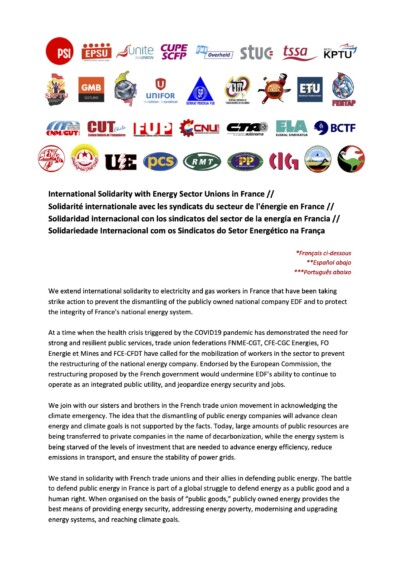
Over the recent December holiday period, 33 union bodies from 20 countries and regions signed a statement of solidarity with the striking unions and workers.

In support of the striking workers’ defense of EDF, FNME-CGT republished the TUED briefing document with the following additional remarks:

Texas, an extreme example demonstrating that we must say “STOP” to market logics in dealing with the vital common good that energy represents. These same logics, combined with a desire for regional autonomy, have created an anti-citizen cocktail that is becoming a deadly poison!

Confronted with extreme temperatures, many Texas residents have received bills for staggering amounts, up to $17,000. A peak at $9,000 per MWh was reached when the usual seasonal average is $50: capitalists rub their hands… Texans “put on their sweaters” and rub them too, but to keep warm.

The conclusion is therefore clear and indisputable: energy is a vital asset that can no longer be indexed to the financial markets, to the detriment of both commercial and domestic users.

However, while this example rages on, in France, discussions are well underway (for example, EDF’s Hercule project, which only reaffirms the notion of a market) and we are even seeing a new “miracle” tariff offer with a new operator that would index the bill to the price on wholesale energy markets!

Moreover, it is highly likely that generators incompatible with the energy transition will have a bright future ahead of them … a question of survival!

The FNME-CGT condemns this new tariff system where only consumers will sooner or later lose out and where change will mean an increase in fuel poverty.

With support from global union federation Public Services International (PSI), FNME-CGT and TUED are currently working to convene a Trade Union Task Force on Decarbonisation. The Task Force will produce an interim analytical report to guide the development of a “Trade Union Charter for Public Energy in Europe,” which will be debated at a June meeting being convened by the French trade union confederation, CGT.

The June meeting will also bring together social forces from across and beyond Europe to explore and debate a broad range of issues related to the socio-ecological transformation. Unions interested in participating should email Irene Shen at ireneTUED@gmail.com.

A Santa Cruz Green New Deal: Yes to Social Justice! No to Green Capitalism!

By Ecosocialist Working Group - Santa Cruz Left, March 6, 2021

Proposed as a green jobs and justice program for the next ten years, the Green New Deal is both a social movement to unite diverse social justice struggles and a comprehensive platform for addressing climate change. Alexandria Ocasio-Cortez (D-NY) and Ed Markey (D-MA) introduced it in Congress in 2019, where it failed to gain traction in the Republican-controlled senate. But endorsed by organizations including the Sunrise Movement, the Indigenous Environmental Network, Climate Mobilization, Bernie’s Our Revolution, and DSA, the GND remains a powerful vision to organize around for a world worth living in.

Warning of an unfolding climate holocaust, massive loss of life, suffering, and financial devastation, AOC and Markey’s GND resolution notably joins decarbonization to social justice and equity. It proposes infrastructural renewal, economic investment for the wellbeing of all, and guaranteeing clean air, water, and land, in ways that repair the “historic oppression of indigenous peoples, communities of color, migrant communities, deindustrialized communities, depopulated rural communities, the poor, low-income workers, women, the elderly, the unhoused, people with disabilities, and youth.” In 2019, AOC narrated an amazing short video (brilliantly animated by Molly Crabapple) that pictures what a GND-inspired future might look like.

DSA’s Ecosocialists (national) have added their own priorities, including democratizing control over major energy systems and resources; centering the multiracial working class in the just transition to an economy of societal and ecological care; demilitarizing, decolonizing, and striving for a future of international solidarity and cooperation; and decommodifying survival by guaranteeing living wages, healthcare, and affordable housing for all. As such, they join Indigenous and environmental, and racial justice social movements that stress the need for a bottom-up, inclusive, and democratized approach, rather than top-down governmental policy directives.

Joining the GND to the decolonial Red Deal, as proposed by The Red Nation, also makes compelling sense. As Nick Estes argues in Jacobin, “The GND has the potential to connect every social justice struggle—free housing, free health care, free education, green jobs—to climate change. Likewise, the Red Deal places anti-capitalism and decolonization as central to each social justice struggle as well as climate change. The necessity of such a program is grounded in both the history and future of this land, and it entails the radical transformation of all social relations between humans and the earth.” And while such a program must not only be intersectionalist but also global in scope, it’s less clear what the GND would mean on a local level and how it might offer a useful instrument to connect diverse regional struggles. But it’s on the local scale that we can most meaningfully engage with this all-encompassing struggle, in support of its national and international horizons.

Climate Emergency: A 26-Week Transition Program for Canada

By Guy Dauncy - Canada 26 Weeks, March 2020

This is a work of imagination. But the urgency of the crisis is real, the need for the suggested programs is real, and the data included in these proposals is real.

What could the government of Canada do if its Ministers, MPs and civil servants really understood the severity of the climate emergency, and the urgency of the need? This paper shows how we could target a 65% reduction in emissions by 2030 and 100% by 2040. It proposes 164 new policies and programs, financed by $59 billion a year in new investments, without raising taxes or increasing public sector borrowing. The new programs and policies are announced every Monday morning between January and the end of June. To learn what they are, read on.

Read the text (PDF).

Ecosocialism: A Brief Description

By Mike Shaughnessy - London Green Left Blog, January 27, 2021

This is a write up of a talk I gave to my local Green Party meeting in Haringey, north London, a little while back, on ecosocialism. 

Ecosocialism is a green political philosophy - it is an ecocentric and democratic socialism, not to be confused with social democracy, at least in the longer run.

It is not like twentieth century socialisms, it is more like nineteenth century socialisms and owes a fair amount to anarchist theory. Twentieth century socialisms had, if anything, an even more dismal record than capitalism on ecology.

Ecosocialism is anti-capitalist, and sees the capitalist system as the effective cause of the ecological crisis.

Capitalism commodifies everything and puts a price on it, which is exchange value, and uses the earth as a resource for production and sink for the dumping of toxic waste from the production process, usually free of cost. Climate change is the most spectacular aspect of the ecological crisis, but not the only one. Capitalism releases toxic pollution, into the air, land and sea.

Capitalism is unable to solve the ecological crisis it has set going, because the logic of the system is to ‘grow or die’. Growth that is exponential and the earth is now close to its limit of being able to buffer the damage caused by this required infinite growth, on a finite planet.

I’m going to say something about the historical lineage of the philosophy, threads of which can be traced back for as long as human beings have formed communities, where some elements of ecosocialism can be found in the way people have lived in balance with nature. And today, many indigenous peoples around the world still practice some of these forms of social and economic management.

Karl Marx is somewhat of a controversial figure for ecosocialists, with some believing that he was essentially a ‘productivist.’ For myself, I believe that Marx’s work was of its time, and incomplete, but he certainly had a green side to him. Take this quote for example from the third volume of Capital:

From the standpoint of a higher economic form of society, private ownership of the globe by single individuals will appear quite as absurd as private ownership of one man by another. Even a whole society, a nation, or even all simultaneously existing societies taken together, are not the owners of the globe. They are only its possessors, its usufructuaries, and, like boni patres familias, they must hand it down to succeeding generations in an improved condition. (Marx 1894: 776). 

In South America ecosocialism has found its way into government. Venezuela, has a Department of Ecosocialism, although the ecosocialism pursued is not the purest in form. Bolivia runs forms of ecosocialism in government and has fought off many capitalist corporations plunder of the country’s natural resources, in mining and gas extraction on common land.

There is an English line too. The first stories to be told about Robin Hood, were of a man fighting against crown enclosures of common land. He has become famous for ‘robbing from the rich to give to the poor’, but in fact what he was doing, was fighting to stop the rich robbing from the poor.

Then there were the Diggers during the English civil war, who set up communes on common land and called for a ‘common treasury of the land.'

And William Morris, the nineteenth century socialist and craft movement champion. If you read his novel News from Nowhere, it describes an ecosocialist utopia.

In the modern age, ecosocialism emerged in the mid 1980s, in the west, in the United States, although you can argue quite convincingly that in the US it goes back to Murray Bookchin’s social ecology movement in the mid 1960s. And in the east, in India, where to a lesser extent ecosocialism emerged but more so in the philosophy of ecofeminism, which is a similar philosophy to ecosocialism. 

For example, ecosocialists agree with ecofeminists that the oppression of women in our society is part and parcel of the system's domination of nature, reproduction in particular. This is done by the capitalist system co-opting the prevailing patriarchal practices, to extract extra surplus value from the workers, in terms of unpaid domestic labour, without which the system could not function. 

And all for free to the system.

Examples of modern day ecosocialism, to an extent, can be found in the Kurdish area of northern Syria called Rojava and the Zapatistas in Chiapas the most southern state in Mexico.

So, what are the component parts of ecosocialism? There are many, but I’ve selected four of the main ones:

Defending Public Energy, French Energy Unions Build International Support

By Staff - Trade Unions for Energy Democracy, January 17, 2021

As we reported in TUED Bulletin 104, in recent weeks French electricity and gas workers have been striking in defense of the country’s publicly owned energy. These actions have been led by French energy union federations FNME-CGT, CFE-CGC Énergies, FO Energie et Mines and FCE-CFDT.

Over the holiday period, 33 union bodies from 20 countries and regions signed a statement of solidarity with the striking unions and workers.

The target of the strikes is a set of proposals being advanced by the French government, at the heart of which is a plan to “restructure” the country’s major national power utility, EDF. According to the unions, the proposed changes would undermine EDF’s ability to continue to operate as an integrated public utility, would jeopardize energy security and jobs, and would be against the general public interest.

During the week of January 11, 2021, TUED received a letter from the leadership of FNME-CGT, which welcomed the international support that has been expressed, and reaffirmed the union’s commitment to the struggle underway. Jointly signed by Sébastien Menesplier, General Secretary for International Affairs, and Muriel Marcilloux, Federal Secretary for European Affairs, the letter reads, in part:

We are taking action in France for energy: a basic common good and not a commodity that must remain at the service of the general interest. At a time when the challenge of climate change is global, in order to gain the 2°C of the COP 21 in Paris, we will need to switch to electric power, with low- carbon electricity. This will require a commitment from each country. This challenge for the future cannot be met in a market logic where the priority is financial return.

This issue of energy under public control is essential for the future of future generations.

For France, the fight is being waged now. We must lead the fight until the withdrawal of these harmful projects and show that another way other than finance is possible.

Your international support clearly shows that we are not alone in fighting for a quality public energy service accessible to all. Trade unions and their allies know that a just transition cannot be achieved by relying solely on the privatisation, liberalisation and commodification of energy, which is vital for just and sustainable human and economic development.

The letter also stated FNME-CGT’s intention to develop the international dimension of the struggle for public energy, noting in particular the upcoming UN COP26 climate talks scheduled for November of this year. The full letter is available in English here, and in French here.For additional background information, you can read the recent Letter from CGT EDF Directors (in French; English translation available here).

As a next step, the unions will hold a “Day of Action” on Tuesday, January 19th, in a continuing display of opposition to the government’s proposals. On Twitter, you can follow developments directly (in French) via @FNMECGT.

IndustriALL Global Union has also expressed solidarity with the striking workers as part of its ongoing reporting on this crucial struggle over many months.

We encourage unions to share news of this important ongoing struggle in the fight for climate protection and a sustainable future with their members and networks.

Fight the Fire: Green New Deals and Global Climate Jobs

By Jonathan Neale - The Ecologist, January 2021

As I write, we are in the midst of a global pandemic which reveals every kind of cruelty and inequality. Worse is to come. We are entering into a global recession and mass unemployment. Looming beyond that is the threat of runaway climate change. But this is also a moment in history. It may be possible, now, to halt the onward rush of climate breakdown.
A door is opening. In every country in the world, a great debate is beginning. The question is, what can be done about the economy? In every country, one answer will be that the government must give vast sums of money to banks, hedge funds, oil companies, airlines, corporations and the rich. And that the government must pay for all this by cutting hospitals, education, welfare and pensions.

The other answer will be that we must spend vast sums of money to create new jobs, build a proper healthcare system, meet human needs and stop climate change.

Who do we rescue? Their banks and their corporations, or our people and our planet?

The answer in favour of helping people, not the rich, is called a “Green New Deal”. The idea of a Green New Deal has been around for a decade in many countries. But the decisive moment came in 2017, when Alexandria Ocasio-Cortez and Bernie Sanders in the United States decided to back a Green New Deal. That resonated widely. As we entered the pandemic, that idea was already there.

But those three little words, Green New Deal, can mean everything, anything and nothing. We want one particular kind of deal. The words need to mean something real and particular if the deal is to make a difference.

Read the text (link).

Greenpeace USA’s Just Recovery Agenda: A Pathway to a New Economy

By Ryan Schleeter, Amy Moas, Ph.D., and Tim Donaghy, Ph.D. - Greenpeace, November 17, 2020

The economy we have today works for the 1%, not the 99%. The devastation wrought by COVID-19 in the United States—the death, anxiety, isolation, and instability—is the direct result of a system designed to concentrate power in the hands of a few. People are suffering and dying not only because of the virus, but because of the longstanding inequality and racism it has laid bare. This is the same system that has landed us in a climate and extinction crisis in which our very life support system—our planet—is under attack.

As we chart the course toward recovery, we must also confront these social, environmental, and economic injustices at their roots. The centuries-long era of racial capitalism[1]—the system under which wealthy white elites and massive corporations have controlled and exploited land, communities, and cultures to acquire power—must end.

Going back to normal is not an option. The past was not only unjust and inequitable, it was unstable. What we knew as “normal” was a crisis. We must reimagine the systems our country is built on from the ground up. We envision a world where everyone has a good life, where our fundamental needs are met, and where people everywhere have what they need to thrive.

Read the text (PDF).

Building our Energy Future

Pages

The Fine Print I:

Disclaimer: The views expressed on this site are not the official position of the IWW (or even the IWW’s EUC) unless otherwise indicated and do not necessarily represent the views of anyone but the author’s, nor should it be assumed that any of these authors automatically support the IWW or endorse any of its positions.

Further: the inclusion of a link on our site (other than the link to the main IWW site) does not imply endorsement by or an alliance with the IWW. These sites have been chosen by our members due to their perceived relevance to the IWW EUC and are included here for informational purposes only. If you have any suggestions or comments on any of the links included (or not included) above, please contact us.

The Fine Print II:

Fair Use Notice: The material on this site is provided for educational and informational purposes. It may contain copyrighted material the use of which has not always been specifically authorized by the copyright owner. It is being made available in an effort to advance the understanding of scientific, environmental, economic, social justice and human rights issues etc.

It is believed that this constitutes a 'fair use' of any such copyrighted material as provided for in section 107 of the US Copyright Law. In accordance with Title 17 U.S.C. Section 107, the material on this site is distributed without profit to those who have an interest in using the included information for research and educational purposes. If you wish to use copyrighted material from this site for purposes of your own that go beyond 'fair use', you must obtain permission from the copyright owner. The information on this site does not constitute legal or technical advice.