You are here

energy democracy

A Pathway to a Regenerative Economy

By various - United Frontline Table, June 2020

The intersecting crises of income and wealth inequality and climate change, driven by systemic white supremacy and gender inequality, has exposed the frailty of the U.S. economy and democracy. This document was prepared during the COVID-19 pandemic which exacerbated these existing crises and underlying conditions. Democratic processes have been undermined at the expense of people’s jobs, health, safety, and dignity. Moreover, government support has disproportionately expanded and boosted the private sector through policies, including bailouts, that serve an extractive economy and not the public’s interest. Our elected leaders have chosen not to invest in deep, anti-racist democratic processes. They have chosen not to uphold public values, such as fairness and equity, not to protect human rights and the vital life cycles of nature and ecosystems. Rather, our elected leaders have chosen extraction and corporate control at the expense of the majority of the people and the well-being and rights of Mother Earth. Transforming our economy is not just about swapping out elected leaders. We also need a shift in popular consciousness.

There are moments of clarity that allow for society to challenge popular thinking and status quo solutions. Within all the challenges that this pandemic has created, it has also revealed what is wrong with the extractive economy while showcasing the innate resilience, common care, and original wisdom that we hold as people. Environmental justice and frontline communities are all too familiar with crisis and systemic injustices and have long held solutions to what is needed to not only survive, but also thrive as a people, as a community, and as a global family. We cannot go back to how things were. We must move forward. We are at a critical moment to make a downpayment on a Regenerative Economy, while laying the groundwork for preventing future crises.

To do so, we say—listen to the frontlines! Indigenous Peoples, as members of their Indigenous sovereign nations, Asian and Pacific Islander, Black, Brown and poor white marginalized communities must be heard, prioritized, and invested in if we are to successfully build a thriving democracy and society in the face of intersecting climate, environmental, economic, social, and health crises. A just and equitable society requires bottom-up processes built off of, and in concert with, existing organizing initiatives in a given community. It must be rooted in a people’s solutions lens for a healthy future and Regenerative Economy. These solutions must be inclusive—leaving no one behind in both process and outcome. Thus, frontline communities must be at the forefront as efforts grow to advance a Just Transition to a Regenerative Economy.

A People’s Orientation to a Regenerative Economy offers community groups, policy advocates, and policymakers a pathway to solutions that work for frontline communities and workers. These ideas have been collectively strategized by community organizations and leaders from across multiple frontline and grassroots networks and alliances to ensure that regenerative economic solutions and ecological justice—under a framework that challenges capitalism and both white supremacy and hetero-patriarchy—are core to any and all policies. These policies must be enacted, not only at the federal level, but also at the local, state, tribal, and regional levels, in US Territories, and internationally.

Read the text (PDF).

Future Beyond Fossil Fuels: California’s Just Transition

By staff - Sunrise Movement, May 1, 2020

You may have heard the term ‘Just transition’ floating around, but what does it mean? This webinar will focus on what a just transition means for workers in California, and how the vision of a Green New Deal can guide the much-needed economic recovery from the COVID crisis.

This video features IWW Environmental Unionism Caucus cofounder, Steve Ongerth, speaking on workers, unions, and just transition in Northern California.

Going Slowly to 100% Renewables … by 2025?

By Dan Fischer - Peace News, April 5, 2020

It has been 55 years since the social ecologist Murray Bookchin argued that “wind, water, and solar power” (hereafter, WWS) could “amply meet the needs of a decentralized society” and eventually replace all fossil, nuclear, and bioenergy sources. The alternative, he warned, would be a future of “radioactive wastes,” “lethal air pollution,” “rising atmospheric temperatures,” “more destructive storm patterns,” and “rising sea levels.” Having declined to tear down its smokestacks, society has entered Bookchin’s dreaded scenario and, according to today’s scientists, accelerates toward “hothouse Earth,” “doomsday,” and even an “annihilation of all life.”

The urgency for reaching 100% WWS can’t be overstated. Leading climate scientists report that “tipping points could be exceeded even between 1 and 2°C of warming,” and today’s level is already at 1.2° and rapidly climbing. Moreover, society has pushed Earth past four other “planetary boundaries.” While all energy sources have an impact, small-scale WWS sources are by far the cleanest option available, and they also doesn’t involve nuclear power’s existential weapons proliferation risks.

It’s no wonder, therefore, that many Green New Deal supporters call for 100% WWS by 2030 or sooner. Activists in the United States and the United Kingdom are calling for zero emissions nationally by 2025, a stringent deadline that requires a very rapid phase-out of fossil and bioenergies and that necessarily excludes the lengthy construction of new nuclear power facilities and large-scale hydroelectric dams. The journalist Hazel Healy has even written about achieving zero emissions worldwide by 2025. To be sure, these targets are mind-bogglingly ambitious compared to, say, Joe Biden’s mid-century target. But if anything, 2025 is already pushing our luck from a climate and ecological perspective.

Wondering about the potential for rapidly reaching 100% renewable energy, I reached out to two of the most optimistic and two of the most pessimistic scholars on the technologies. Based on these conversations, I offer the following suggestion. Achieving 100% WWS within five to ten years, if it can be done at all, would likely require slowing down the industrialized world. It would mean abandoning what Michelle Boulous Walker calls today’s “culture of haste” and “relentless demand to decide, respond and act.” Instead of a frantic construction of hydrogen-powered airplanes and concrete-intensive high-speed rail, it would mean making most production local and most travel leisurely-paced. It would mean switching from full-time jobs to part-time crafts and hobbies, from patenting technology to sharing it, and from GDP to something like the Indigenous Environmental Network’s proposed “Index for Living Well.” While it’s common to read of “roadmaps” to WWS, we would probably get to the destination sooner with maps of biking trails and bus routes.

(Working Paper #13) Transition in Trouble?: The Rise and Fall of "Community Energy" in Europe

By Sean Sweeney, John Treat and Irene HongPing Shen - Trade Unions for Energy Democracy, March 2020

This TUED Working Paper explores the current crisis of local, community, and cooperative energy. Our focus is Europe where these types of initiatives have made the most progress but now find themselves facing an uncertain future. In this paper we will explain what happened, and why. The goals of this paper are twofold.
The first goal is to draw a clear line of demarcation between the bold claims being made in the name of local and community energy, “energy citizenship,” and similar concepts on the one hand, and the cur-rent reality on the other—a reality that largely confines local energy initiatives to the margins of energy systems. In the case of Europe, the distance between the claims and the reality is vast, and it is widening.

Local and community energy has attracted a lot of support and enthusiasm from activists, and it is not hard to understand why this is the case. Efforts to advance community energy are frequently carried out in the name of a commitment to social justice, advancing equality, and empowering ordinary people to take a more active role in the transition to a low carbon future. Additionally, the activists and organizations undertaking such initiatives nearly always identify with a “values-driven” mission and aim to rise above considerations of personal gain or private profit.

For a period, it seemed that such initiatives were emerging everywhere across Europe. The growth of renewable energy and the proliferation of citizen and community ownership seemed to be in-separable from each other. Spurred on by falling costs of wind and solar technologies, a radical transition in energy ownership—and a shift in control away from large energy companies to small producers and consumers—seemed not only possible, but perhaps even imminent.

But recent policy changes in Europe have placed community energy into a pattern of decline. The removal of subsidies, particularly the Feed-in Tariff, and other incentives has led to a dramatic slow-down in local energy initiatives and cooperatives. The number of households installing solar photovoltaic panels (solar PV) has slowed to a crawl as onshore wind projects have also declined. While offshore wind installations are increasing, the total level of investment and deployment of renew-able energy in Europe has fallen dramatically.

Read the report (PDF).

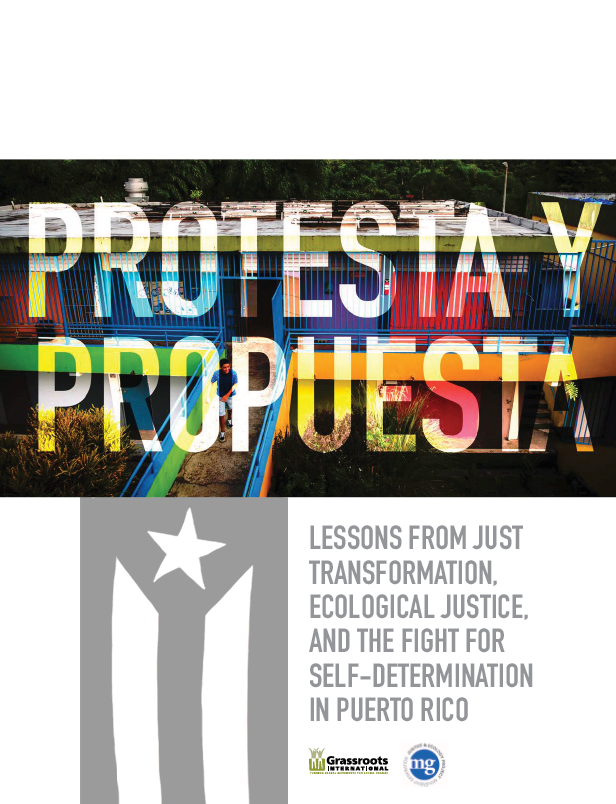
Protesta Y Propuesta: Lessons from Just Transformation, Ecological Justice, and the Fight for Self-Determination in Puerto Rico

By Brooke Anderson and Jovanna García Soto - Grassroots International and Movement Generation, February 2020

“De la Protesta a la Propuesta” (“From protest to proposal”). That’s the slogan that watershed protectors used when they successfully stopped open pit mining in the heart of Puerto Rico’s mountains then brought those same lands under community control. For those of us looking to build just transformation in place, we have much to learn from Puerto Rico’s social movements which are at once both visionary and oppositional, centering sovereignty and self-governance.
Just transformation, or just transition, is the work “to transition whole communities toward thriving economies that provide dignified, productive, and ecologically sustainable livelihoods that are governed directly by workers and communities.”

In the U.S., the term just transition was originally used by the labor movement to demand that with the phaseout of polluting industries, workers would be retrained and adequately compensated rather than bear yet another cost from working in that industry. Environmental justice communities on the fenceline of these polluting industries then built common cause with workers for a just transition that would not put the environmental or economic burden on workers or communities. In the U.S., the term has since further evolved to capture systemic transformation of the whole economy. While U.S. frontline groups often use the term just transition, some Puerto Rican social movements use the term just transformation—especially as a way to capture the necessity of achieving decolonization and sovereignty as part of any transition. As such, we’ll be using just transformation in this report, as well as other concepts such as self-determination and ecological justice.

Read the report (Link).

Weaponizing the Numbers: The Hidden Agenda behind the Fossil Fuel Subsidy Reform

By Sean Sweeney - New Labor Forum, February 2020

Among progressives concerned about climate change, few issues provoke as much anger as the knowledge that governments continue to subsidize fossil fuels. According to the International Monetary Fund (IMF), in 2017 these subsidies totaled $5.2 trillion annually.

Don’t governments realize that fossil fuels are cooking the planet? The scientific community says we are in a desperate race against time, but the coal, oil, and gas companies apparently still have their noses deeply in the public trough.

Most policy elites think fossil fuel subsidies should go. A decade ago, Group of Twenty (G20) leaders committed to “rationalize and phase out” government support for coal, oil, and gas, a decision supported by major institutions like the IMF and the World Trade Organization (WTO). At a summit in May 2019, U.N. Secretary-General António Guterres said “taxpayers’ money” was being used “to boost hurricanes, to spread droughts, to melt glaciers, to bleach corals. In one word—to destroy the world.”

…[T]here is good reason to be wary of the global elite’s call for subsidy reform

These are fighting words, but there is good reason to be wary of the global elite’s call for subsidy reform. This call is framed in ways that seek to legitimize and universalize neoliberal approaches to energy transition. Activists may think, “So what? If it gets rid of subsidies, what’s the problem?” But there is a real risk that the consolidation of neoliberal policy will produce outcomes that are considerably worse than the outcomes produced by fossil fuel subsidies.

Regenerative & Just 100% Policy Building Blocks Released by Experts from Impacted Communities

By Aiko Schaefer - 100% Network, January 21, 2020

The 100% Network launched a new effort to bring forward and coalesce the expertise from frontline communities into the Comprehensive Building Blocks for a Regenerative and Just 100% Policy. This groundbreaking and extensive document lays out the components of an 100% policy that centers equity and justice. Read the full report here.

Last year 100% Network members who are leading experts from and accountable to black, indigenous, people of color (BIPOC) and frontline communities embarked on a collective effort to detail the components of an ideal 100% policy. The creation of this 90-page document was an opportunity to bring the expertise of their communities together.

The Building Blocks document was designed primarily for frontline organizations looking to develop and implement their own local policies with a justice framework. Secondly, is to build alignment with environmental organizations and intermediary groups that are engaged in developing and advocating for 100% policies. The overall goals of the project are to:

  • Build the capacity of BIPOC frontline public policy advocates, so that impacted community groups who are leading, working to shape or just getting started on 100% policy discussions have information on what should be included to make a policy more equitable, inclusive and just
  • Align around frontline, community-led solutions and leadership, and create a shared analysis and understanding of what it will take to meet our vision for 100% just, equitable renewable energy.
  • Create a resource to help ensure equity-based policy components are both integrated and prioritized within renewable energy/energy efficiency policies. 
  • Build relationships across the movement between frontline, green, and intermediary organizations to create space for the discourse and trust-building necessary to move collaboration forward on 100% equitable, renewable energy policies. 

Power to the People: Winning public control of electric utilities

By Juliana Broad - Next System Project, January 10, 2020

The devastation wrought in recent years by preventable wildfires, targeted power shutoffs, and exorbitant rate hikes—with their hefty cost to life, health, and livelihoods—has made it clear that the for-profit model of electric utility provision has definitively failed. However, alternatives to this broken system have not only been proposed, but are gaining substantial traction. In the past few years, we’ve witnessed an eruption of support for taking back public control over electric utilities from absentee investors. With the public in charge, we can provide cheaper services—across the board, publicly owned utilities provide lower rates than investor-owned ones—and push for renewable energy to address the economic, environmental, and racial justice issues that are necessarily intertwined with how we meet our energy needs. 

But wresting control of our utilities from powerful corporate interests is not easy, and the community organizations and elected officials pushing for these changes have pursued a variety of strategies not only to change the narrative around public ownership⁠—long denigrated and vilified by profit-hungry private interests⁠—but to win the concrete, systemic changes we need to have an economy that serves our communities. Here, we highlight some of the wins, losses, and ongoing fights for public control of power that are playing out across the country at the city and state level.

Disasters Spark Public Ownership Campaigns

Bargaining Electric Power: Miners, Blackouts, and the Politics of Illumination in the United States, 1965-1979

By Trish Kahle - Journal of Energy History, December 12, 2019

This article examines how the perils conjured by blackouts in American cities after 1965 became interpreted as a key point of political and bargaining leverage for the nation’s coal miners. The anxieties provoked by these blackouts –sexual deviance, urban unrest, spoiled food, lost productivity, and Cold War incursions– pointed to a broader crisis of American political and social life driven by the massive social changes which had taken place since the end of the Second World War. As the United States entered the 1970s, a long-range energy crisis appeared not only to secure the future of the once-imperiled coal industry in the United States, but also allowed miners to recast their union as a bedrock of national security rather than as one of the main sources of the nation’s labor unrest.

Evoking the threat of coerced darkness in the modern American home which had been designed for bright illumination, they also pointed to the figurative darkness of the coal mining workscape, described by one miner as “beating the devil at a game of hell”: the constant threat of black lung, disablement, and death. A form of collective bargaining leverage thus opened up a broader debate: how, given the deadly work of coal extraction, could energy be produced in a democratic society that guaranteed the right to life, liberty, property, and, increasingly, light? Did “one man” have to “die every day” to keep the nation’s lights on? This paper argues that miners used the framework of lights and darknesses to contend that mines must be made safe and energy democratized in order to stabilize the energy regime in crisis. In so doing, they framed a new politics of illumination which allowed them to navigate a new terrain of collective action.

Read the text (PDF).

The Green New Deal, Net-Zero Carbon, and the Crucial Role of Public Ownership

By John Treat, Sean Sweeney, and Irene HongPing Shen - Trade Unions for Energy Democracy, November 15, 2019

On September 28, 2019, more than 150 trade union representatives, activists and policy allies from more than a dozen countries came together in New York City for a one-day international conference on “The Green New Deal, Net-Zero Carbon, and the Crucial Role of Public Ownership.”

The conference took place against the backdrop of the massive “Global Climate Strike” actions led by young people in numerous countries around the world, coinciding with the UN “Climate Week” of talks in New York City. In the weeks before those actions, TUED organized a “Global Web Forum” on the #Strike4Climate, and subsequently compiled a list of union statements and actions in support of the strikes.

Framing and Meeting Highlights

The conference program was framed around a number of issues and concerns that have emerged out of recent union-led struggles to both defend and extend public ownership of energy in key countries and regions. Over the course of the day’s proceedings, a number of key themes and broadly shared conclusions emerged, including:

  • Investor-focused climate policy is not delivering the energy transition
  • Privatization of state-owned electricity utilities has failed—but alternatives exist
  • Defending public ownership of energy requires a reform agenda that can drive “de- marketization”
  • Confidence is rising to reverse electricity privatization where it has happened
  • Defending and reclaiming public energy requires building union power
  • The transition must take into account the real development needs of the global South, while contesting carbon- intensive “development as usual”
  • There is an urgent need for technical, programmatic work to make achieving the ambitious goals of the Green New Deal possible

Read the report (PDF).

Pages

The Fine Print I:

Disclaimer: The views expressed on this site are not the official position of the IWW (or even the IWW’s EUC) unless otherwise indicated and do not necessarily represent the views of anyone but the author’s, nor should it be assumed that any of these authors automatically support the IWW or endorse any of its positions.

Further: the inclusion of a link on our site (other than the link to the main IWW site) does not imply endorsement by or an alliance with the IWW. These sites have been chosen by our members due to their perceived relevance to the IWW EUC and are included here for informational purposes only. If you have any suggestions or comments on any of the links included (or not included) above, please contact us.

The Fine Print II:

Fair Use Notice: The material on this site is provided for educational and informational purposes. It may contain copyrighted material the use of which has not always been specifically authorized by the copyright owner. It is being made available in an effort to advance the understanding of scientific, environmental, economic, social justice and human rights issues etc.

It is believed that this constitutes a 'fair use' of any such copyrighted material as provided for in section 107 of the US Copyright Law. In accordance with Title 17 U.S.C. Section 107, the material on this site is distributed without profit to those who have an interest in using the included information for research and educational purposes. If you wish to use copyrighted material from this site for purposes of your own that go beyond 'fair use', you must obtain permission from the copyright owner. The information on this site does not constitute legal or technical advice.

