

You are here

Labor Network for Sustainability (LNS)

8 Unions Have a Plan for Climate Action—But It Doesn’t Mention Fighting the Fossil Fuel Industry

By Rachel M. Cohen - In These Times, August 26, 2019

On June 24, the BlueGreen Alliance — a national coalition which includes eight large labor unions and six influential environmental groups—released an eight-page document laying out its vision to curb climate change and reduce inequality. The report, dubbed Solidarity for Climate Action, marks a significant development in the world of environmental politics. It argues the needs of working people must be front-and-center as the U.S. responds to climate change, and rejects the ​“false choice” between economic security and a healthy planet.

While the report’s focus on public investment, good jobs and justice shares much in common with the federal Green New Deal resolution introduced in February, it also stands in tension with environmentalists who demand the U.S. work to transition more quickly away from oil, coal and natural gas. ​“We’d really like them to be stronger and more concise about what it means to move away from fossil fuels and transition to renewables,” said José Bravo, executive director of the Just Transition Alliance and speaking on behalf of the Climate Justice Alliance. Members of the BlueGreen Alliance say the ultimate goal should be to decarbonize the economy — to reduce CO2 emissions, but not necessarily end the fossil fuel industry itself, with its tens of thousands of high-paying jobs. Other climate groups say that won’t be enough, and humanity cannot afford to preserve industries that have caused so much environmental harm. This difference in vision will stand as one of the most fundamental political questions facing progressives in the next decade.

The report spells out a series of principles, including limiting warming to 1.5°C, expanding union jobs, modernizing infrastructure, bolstering environmental protections and rebuilding the nation’s manufacturing sector with green technologies. It also elevates the issue of equity, calling to ​“inject justice into our nation’s economy by ensuring that economic and environmental benefits of climate change solutions support the hardest hit workers and communities.” The BlueGreen Alliance emphasizes the disproportionate impact low-income workers and communities of color will face, and says those affected by the energy transition must receive ​“a just and viable transition” to new, high-quality union jobs.

(Read the rest here)

Earth Srike: Intersecting Labour and Environmental Movements

By various - Earth Strike and IWW Environmental Unionism Caucus, 2019

The scientific consensus is clear. Climate change is happening. It is happening now and it’s impacts are only going to get worse.

Climate change is not a stand alone issue, it affects and exacerbates all of the existing inequalities and exploitations within our society. In our struggle to fight against climate change we stand shoulder to shoulder with those fighting against racism, sexism and colonialism inherent within global capitalism.

Climate change will not be solved through individual lifestyle changes. Just 100 companies are responsible for 71% of all industrial greenhouse gas emissions. To tackle climate change therefore we must challenge the power of these companies and the governments that support them.

Simply shifting the concentration of wealth to other so-called “sustainable industries” will not change the over- consumptive and self destructive drive of capitalism that has caused climate change and the mass extinction of species. Nor will it remove the ability of those with wealth to buy political power and get away with their planet killing practices.

Whilst increasingly the global economy is becoming an automated and auto-managed machine, labour still has power. The current economic system depends on the participation of a large labour force for both the extraction of natural resources and to perpetuate the unsustainable cycle of global consumption.

History has demonstrated that when a significant amount of the labour force organises for industrial action they can bring the bosses to the negotiating table and extract real gains for the workers. Likewise the environmental movement has demonstrated that community-led organising and direct resistance to natural exploitation can successfully defend ecological and social justice.

By bringing these two movements together, ending our self-destructive participation in the techno-industrial complex and resisting the capitalist economics of infinite growth we can change the current system and prevent global environmental catastrophe.

Earth Strike is therefore uniting the green and red by building for a global general climate strike. The IWW Environmental Committee recognises the huge importance of this initiative and will play it’s part to support it.

Read the report (PDF).

18 Strategies for a Green New Deal: How to Make the Climate Mobilization Work

By Jeremy Brecher - Labor Network for Sustainability, 2019

The Green New Deal projects a broad vision of creating a climate-safe America through an economic and social mobilization on a scale not seen since the New Deal and World War II.
That mobilization can provide a historic opportunity to create millions of good, high-wage jobs, virtually eliminate poverty, provide unprecedented levels of prosperity and economic security, and counteract systemic injustices. So far discussion about the Green New Deal has rightly focused on values and goals. But there are many practical problems that will have to be solved as well.

The LNS discussion paper 18 Strategies for a Green New Deal: How to Make the Climate Mobilization Work lays out how the Green New Deal can realize its goals.

Read the report (PDF).

Calling All Union Members

By Jonathan Guy - The Trouble, May 20, 2019

Teachers, construction workers, nurses, miners, frycooks—you have an indispensable role to play in the passage of the Green New Deal. Here are five concrete steps to take.

It’s no secret that the American labor establishment is ambivalent about the rising prospects for climate policy change. After battling environmental activists throughout the 2010s over a series of tar sands pipeline projects, unions from carbon-loving industries are balking at the prospect of a Green New Deal, even as the resolution bends over backwards to address their concerns. The AFL-CIO’s energy committee decried the flexible resolution as “unrealistic” and threatening “immediate harm to millions of our members and their families.”  Construction union LiUNA had even harsher words, calling the GND “the sails of fantasy” and its backers’ approach to inclusive coalition-building “exactly how not to enact a progressive agenda to address our nation’s dangerous income inequality”.  In the fossil fuel sector, unions like Mine Workers of America cheer the demise of even modest climate regulations such as the Clean Power Plan, insisting beyond all evidence that carbon capture and storage technology is a viable alternative to renewable energy. Given these union leaders’ stunning obstinacy, even as the climate left dangles gigantic carrots in front of their faces—full severance pay, a job guarantee, project labor agreements, unionization mandates—it would be easy to write them off as inevitable foes.

Such a dismissal, of course, would be gravely mistaken. While the electoral and lobbying influence of unions has waned, they still play a key veto role inside the Democratic Party, and have enjoyed a revival over the past two years as public sector workers found their voice against the devastating Supreme Court decision Janus and endless austerity enacted at the state level in places such as West Virginia and Oklahoma. More to the point, labor unions represent our best hope for organizing the emerging majority-minority working class who must play the central role in a political realignment around a new, low-carbon social compact which emphasizes social equality and economic fairness. Any movement which does not address the concerns of labor—particularly the building trades—is surely doomed.

This article, however, is not yet another paean to the importance of centering a just transition. That genre is well-established. Lord knows that staffers and strategists at 350.org and Sunrise and Ed Markey’s offices have internalized the previous paragraph, and are already tearing their hair out day and night over how to get labor on board. Outside groups like these can surely have some positive impact; see for example, the successful efforts towards a consensus recently won in Maine. But after years of neoliberal environmentalists betraying unions, a lot of distrust has built up which frankly will not be worked out within the short timeframe we have left to avert a two-degree plus warming scenario. In order to really move the needle, pressure on locals and internationals alike will have to be applied from within.

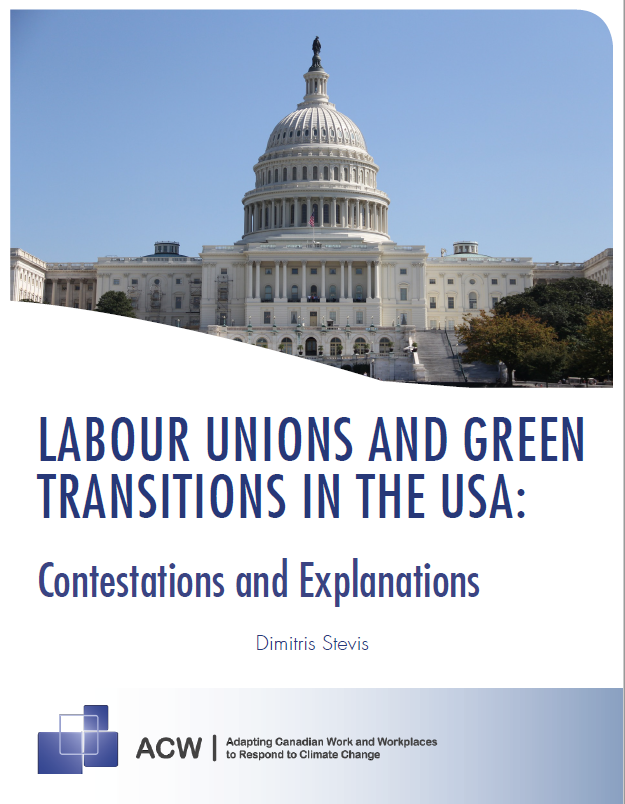
Labor unions and green transitions in the USA

Reviewed by Valerie Lannon - Climate and Capitalism, May 10, 2019

Dimitris Stevis
LABOR UNIONS AND GREEN TRANSITIONS IN THE USA
Contestations and Explanations

ACW: Adapting Canadian Work, 2019

reviewed by Valerie Lannon

“Long term solutions require broader and public just transition policies and those can only be the result of strong political coalitions…. Such coalitions must and should include workers across the board – as well as other societal forces … nor can others speak for the workers affected.” —Dimitris Stevis

With interest growing in Green New Deals in various countries, and even talk, by Yanos Varoufakis and others, of an International Green New Deal, it is imperative that we consider the views of workers whose active, mass support is essential if any GND is to succeed.

In that context, this report, published by the Adapting Canadian Work and Workplaces to Respond to Climate Change program at York University in Toronto, is very timely. Dimitris Stevis of Colorado State University investigates how US unions have addressed climate change — and why and how their positions vary.

Union Locals Build Support for the Green New Deal’s “Just Transition”

By Candice Bernd - Truthout, April 6, 2019

Undeterred by the Senate’s recent dismissal of the Green New Deal, Rep. Alexandria Ocasio-Cortez (D-New York) recently accepted Congressional Coal Caucus member Rep. Andy Barr’s (R-Kentucky) invitation to tour a coal mine in his district and meet with mine workers and voters in Appalachia to talk about how they could benefit from the resolution’s “just transition.”

That transition, as laid out in Representative Ocasio-Cortez’s plan, would include a federal jobs guarantee for U.S. workers. This includes former fossil fuel sector workers as they transition to build the infrastructure needed to shift the country to 100 percent renewable energy within 10 years.

Even as many of the resolution’s proponents are now turning their focus away from passing the Green New Deal on the heels of March’s procedural vote in the Senate, climate change legislation remains a priority for the Democratic Party. The resolution’s supporters are now looking at multiple bills in hopes of advancing standalone elements of the broader initiative as grassroots groups like the Sunrise Movement continue efforts to build support for the plan.

But what exactly would a Green New Deal or another piece of climate chance legislation focused on transitioning to renewables mean for the Kentucky coal workers Ocasio-Cortez is set to meet?

The plan backs union jobs and outlines commitments to “wage and benefit parity for workers” affected by the energy transition. The resolution also supports collective bargaining rights for workers while calling for “trade rules, procurement standards, and border adjustments” with strong labor protections.

Still, labor leaders like those on the AFL-CIO’s Energy Committee remain skeptical of the resolution’s call for a just transition. The Energy Committee sent an open letter to the resolution’s authors, Sen. Edward Markey (D-Massachusetts) and Ocasio-Cortez, blasting the resolution last month. “We will not stand by and allow threats to our members’ jobs and their families’ standard of living go unanswered,” wrote Cecil Roberts, president of the United Mine Workers of America, and Lonnie Stephenson, president of the International Brotherhood of Electrical Workers (IBEW).

The March 8 letter comes on the heels of a February letter sent to the chair of the House Energy and Commerce Committee, Rep. Frank Pallone (D-New Jersey), and its ranking member, Rep. Greg Walden (R-Oregon), outlining the “grave concerns about unrealistic solutions such as those advocated in the ‘Green New Deal,’” by seven unions representing workers in the building industry.

The strongest support for the plan has come from the joint executive board of the 163,000-member East Coast property service union, 32BJ SEIU, which passed its own resolution in February in support of the Green New Deal. Union President Héctor Figueroa recently condemned the Senate’s procedural vote to reject the plan, saying in a statement that, “Creating good jobs in this exciting new industry is as doable as it is necessary, but only if we work together in unity rather than giving into Washington’s divisive tactics.”

AFL-CIO Energy Committee releases letter opposing the Green New Deal

By Elizabeth Perry - Work and Climate Change Report, March 12, 2019

A letter, dated March 8, was addressed to Senator Ed Markey and Representative Alexandra Ocasio Cortez, and signed by  Cecil Roberts, president of the United Mine Workers of America , and Lonnie Stephenson, president of the International Brotherhood of Electrical Workers, on behalf of the  AFL-CIO’s Energy Committee.  The letter  states :   “..the Green New Deal resolution is far too short on specific solutions that speak to the jobs of our members and the critical sectors of our economy. It is not rooted in an engineering-based approach and makes promises that are not achievable or realistic.”  “…We want to engage on climate issues in a manner that does not impinge on enacting other labor priorities, especially much-needed infrastructure legislation…”

How they would engage and what they would propose is contained in a position paper posted on the IBEW website, and drafted by the IBEW, UMWA, and five other unions in the electric utility, construction, and rail transport sectors.  The position paper,  Preliminary  Labor Positions on Climate Legislation , states their opposition to carbon tax legislation and grave concerns about the Green New Deal . It calls for comprehensive, economy wide climate legislation which would include an national emissions trading scheme, to be introduced no earlier than 10 years after enacting legislation, to allow for development of Carbon Capture Utilization and Storage (CCUS)  technologies.  It also calls for worker transition protections, including compensation and retraining.  The policy document was submitted to the House of Representatives Energy and Commerce Committee for the record of their  February 6th meeting:  “Time for Action: Addressing the Economic and Environmental Effects of Climate Change“.

Reaction:  The Washington Post reported:  “AFL-CIO criticizes Green New Deal, calling it ‘not achievable or realistic’” (March 12)  and  in a follow-up piece , “Labor opposition to Green New Deal could be a big obstacle” ( March 14).  The United Mine Workers re-posted the Washington Post article .  Friends of the Earth, in its reaction to the March 8 letter, states “one-fifth of the unions that make up the AFL-CIO energy committee commented on the Green New Deal”,  and,  “With the energy committee’s position, the AFL joins climate deniers like the Koch brothers, the Republican Party and Big Oil. We encourage the AFL and other unions within it to rethink this position.”

LNS Videoconference: The Green New Deal – What Does It Mean for Labor?

By staff - Labor Network for Sustainability, March 2019

Sunrise Movement founders Varshini Prakash and William Lawrence speak and answer questions at a special LNS videoconference on labor and the Green New Deal. View it here »

Labor Unions and Green Transitions in the USA

By Dimitris Stevis - Adapting Canadian Work and Workplaces to Respond to Climate Change, February 27, 2019

“In broad terms there are now two camps amongst US labour unions with respect to climate change and renewables (the two not always related). On one side, are those unions that believe that something needs to be done about climate change and that renewables are a good strategy. On the other side are those that are opposed to meaningful climate policy –even as they claim that climate change is a problem.”

This report outlines the deep cleavages with respect to climate policy but also argues that the views of unions are more complex and contradictory than the opposition-support dichotomy. Additionally, it seeks to understand what explains the variability in union responses to climate change and policy. What can account for the contradictions evident amongst and within unions?

Read the report (PDF).

The Green New Deal and Labour

By Elizabeth Perry - Work and Climate Change Report, February 27, 2019

The Labor Network for Sustainability in the U.S.  published a new Discussion Paper written by Jeremy Brecher in late February.   18  Strategies for a Green New Deal: How to Make the Climate Mobilization Work  states that initial discussion of the Green New Deal resolution was rightly focussed on values and goals, but this Discussion paper moves on to the “how”- in 18 specific proposals which are itemized individually, but are intended to work together. The paper explains and consolidates many of the goals and strategies which have been proposed before by  LNS, including: protect low-income energy consumers and empower communities; mobilize labour and leave no worker behind; ensure worker rights and good union jobs, and yes, provide a “job guarantee.”  The 18 Strategies Discussion paper is summarized as “The Green New Deal can work: Here’s How”, which appeared in Commons Dreams on February 25  and was re-posted in  Resilience on Feb. 26.  In the article, Jermey Brecher states: “A GND will not pit workers against workers and discourage the growth of climate-protecting industries and jobs abroad. It will oppose both escalating trade wars and the free trade utopia of neoliberalism.”

The Labor Network for Sustainability has worked to build solidarity behind the Green New Deal, and on February 26,  published a Special  Issue of their newsletter, which profiles the GND endorsements and initiatives of the San Diego and Imperial Counties Labor Council in California, SEIU Locals 32BJ in New York, SIEU Local  1021 in San Francisco, and the Business Manager of IBEW Local 103 in Dorchester, Massachusetts, along with other examples and resources.  The LNS  website also hosts a new blog by Todd Vachon,  Green New Deal is a Good Deal for New Jersey workers , in which he argues for the GND and cites some of his research  which shows that union members are more likely than the general population to support environmental action.

Pages

The Fine Print I:

Disclaimer: The views expressed on this site are not the official position of the IWW (or even the IWW’s EUC) unless otherwise indicated and do not necessarily represent the views of anyone but the author’s, nor should it be assumed that any of these authors automatically support the IWW or endorse any of its positions.

Further: the inclusion of a link on our site (other than the link to the main IWW site) does not imply endorsement by or an alliance with the IWW. These sites have been chosen by our members due to their perceived relevance to the IWW EUC and are included here for informational purposes only. If you have any suggestions or comments on any of the links included (or not included) above, please contact us.

The Fine Print II:

Fair Use Notice: The material on this site is provided for educational and informational purposes. It may contain copyrighted material the use of which has not always been specifically authorized by the copyright owner. It is being made available in an effort to advance the understanding of scientific, environmental, economic, social justice and human rights issues etc.

It is believed that this constitutes a 'fair use' of any such copyrighted material as provided for in section 107 of the US Copyright Law. In accordance with Title 17 U.S.C. Section 107, the material on this site is distributed without profit to those who have an interest in using the included information for research and educational purposes. If you wish to use copyrighted material from this site for purposes of your own that go beyond 'fair use', you must obtain permission from the copyright owner. The information on this site does not constitute legal or technical advice.
