

You are here

Labor Network for Sustainability (LNS)

Strike! Audio Commentary by Jeremy Brecher. Fighting the Great Depression from Below

By Jeremy Brecher - Labor Network For Sustainability - July 14, 2020

The United States has entered the deepest economic crisis since the Great Depression of the 1930s. This commentary describes the grassroots movements of the early years of the Great Depression in order to learn something about the dynamics of popular response to depression conditions. These early unemployed, self-help, labor, and other movements helped lay the groundwork for the New Deal and the massive labor struggles of the later 1930s. The next commentaries in this series will portray the grassroots movements of the Coronavirus Depression and ask what they might contribute to the emergence of a Green New Deal and a new labor movement. Subsequent commentaries will compare local and state actions in the early years of the Great Depression to such activities today. These commentaries are part of a series on the Emergency Green New Deal.

The Pandemic May Be a Preview of Our Climate Future

By staff - Labor Network for Sustainabaility - July 1, 2020

Todd E. Vachon, faculty coordinator of the Labor Education Action Research Network (LEARN) in the School of Management and Labor Relations at Rutgers, The State University of New Jersey and an active trade unionist and member of the Labor Network for Sustainability, recently wrote an article in the New Jersey Star-Ledger. Warning that “The Pandemic May Be a Preview of Our Climate Future.”

Todd says,

Vital government agencies have been defunded, understaffed or put under the charge of industry hacks who do not believe in the missions of the agencies they are tasked with running. The production of vital healthcare equipment has been outsourced in pursuit of cheaper labor and lax environmental regulations. And perhaps worst of all, the Trump administration has refused to use all the tools at its disposal to protect American lives. These ideologically driven actions have left the federal government incapable of marshaling the health and safety equipment needed to help critically ill Americans and protect the courageous first responders and healthcare workers trying to save them.

He calls for a Green Stimulus and an Emergency Green New Deal (EGND) “to not only get our economy back up and running after the COVID-19 crisis but also to reduce the risk of climate-related disasters and to increase our general preparedness for all disasters.” He says “such an effort would strengthen the social safety net, decouple health insurance from employment, and create millions of family-sustaining green jobs while accelerating a just transition away from fossil fuels and toward renewable energy.”

Read Todd’s entire piece »

A Pathway to a Regenerative Economy

By various - United Frontline Table, June 2020

The intersecting crises of income and wealth inequality and climate change, driven by systemic white supremacy and gender inequality, has exposed the frailty of the U.S. economy and democracy. This document was prepared during the COVID-19 pandemic which exacerbated these existing crises and underlying conditions. Democratic processes have been undermined at the expense of people’s jobs, health, safety, and dignity. Moreover, government support has disproportionately expanded and boosted the private sector through policies, including bailouts, that serve an extractive economy and not the public’s interest. Our elected leaders have chosen not to invest in deep, anti-racist democratic processes. They have chosen not to uphold public values, such as fairness and equity, not to protect human rights and the vital life cycles of nature and ecosystems. Rather, our elected leaders have chosen extraction and corporate control at the expense of the majority of the people and the well-being and rights of Mother Earth. Transforming our economy is not just about swapping out elected leaders. We also need a shift in popular consciousness.
There are moments of clarity that allow for society to challenge popular thinking and status quo solutions. Within all the challenges that this pandemic has created, it has also revealed what is wrong with the extractive economy while showcasing the innate resilience, common care, and original wisdom that we hold as people. Environmental justice and frontline communities are all too familiar with crisis and systemic injustices and have long held solutions to what is needed to not only survive, but also thrive as a people, as a community, and as a global family. We cannot go back to how things were. We must move forward. We are at a critical moment to make a downpayment on a Regenerative Economy, while laying the groundwork for preventing future crises.

To do so, we say—listen to the frontlines! Indigenous Peoples, as members of their Indigenous sovereign nations, Asian and Pacific Islander, Black, Brown and poor white marginalized communities must be heard, prioritized, and invested in if we are to successfully build a thriving democracy and society in the face of intersecting climate, environmental, economic, social, and health crises. A just and equitable society requires bottom-up processes built off of, and in concert with, existing organizing initiatives in a given community. It must be rooted in a people’s solutions lens for a healthy future and Regenerative Economy. These solutions must be inclusive—leaving no one behind in both process and outcome. Thus, frontline communities must be at the forefront as efforts grow to advance a Just Transition to a Regenerative Economy.

A People’s Orientation to a Regenerative Economy offers community groups, policy advocates, and policymakers a pathway to solutions that work for frontline communities and workers. These ideas have been collectively strategized by community organizations and leaders from across multiple frontline and grassroots networks and alliances to ensure that regenerative economic solutions and ecological justice—under a framework that challenges capitalism and both white supremacy and hetero-patriarchy—are core to any and all policies. These policies must be enacted, not only at the federal level, but also at the local, state, tribal, and regional levels, in US Territories, and internationally.

Read the text (PDF).

For a Sustainable Future: The Centrality of Public Goods

By Nancy Holmstrom - Socialist Register, Spring 2020

The most recent report of the UN’s Intergovernmental Panel on Climate Change (IPCC) makes it absolutely clear that ways of living in the twenty-first century must be premised on the existential threat to our survival posed by multiple ecological crises. Indeed it could all be over before the end of the century. If we do not radically suppress global CO2 emissions, global warming will rise to the point where it cannot be stopped. While not long ago the word ‘catastrophe’ seemed hyperbolic to many, today few could deny it is fitting. Melting glaciers, rising sea level, drought, fires, and flooding all over the world and the resulting migration are catastrophes for those who suffer them – and give us a taste of far worse catastrophes to come. Already the World Health Organization (WHO) estimates that there are 150,000 excess deaths per year due to climate change, likely to double by 2030.

After the 9-11 attack on the World Trade Center we heard the word ‘security’ incessantly, almost always invoked as intentional threats to our safety and well-being, which of course means they are threats by people, whether they be individuals, groups, or nations. Global warming, on the other hand, is a threat from nature that is an unintended result of human action – not what is usually intended by a ‘security’ threat, and it does not grip our imagination and fears in any way proportional to its severity. But it is not only intentional acts that can threaten our safety and well-being. Once threats to our security are conceived more broadly, consider the greater dangers from unclean air and water and contagious diseases, whatever the mix of intentional and unintentional acts that created the problem.

Download (PDF).

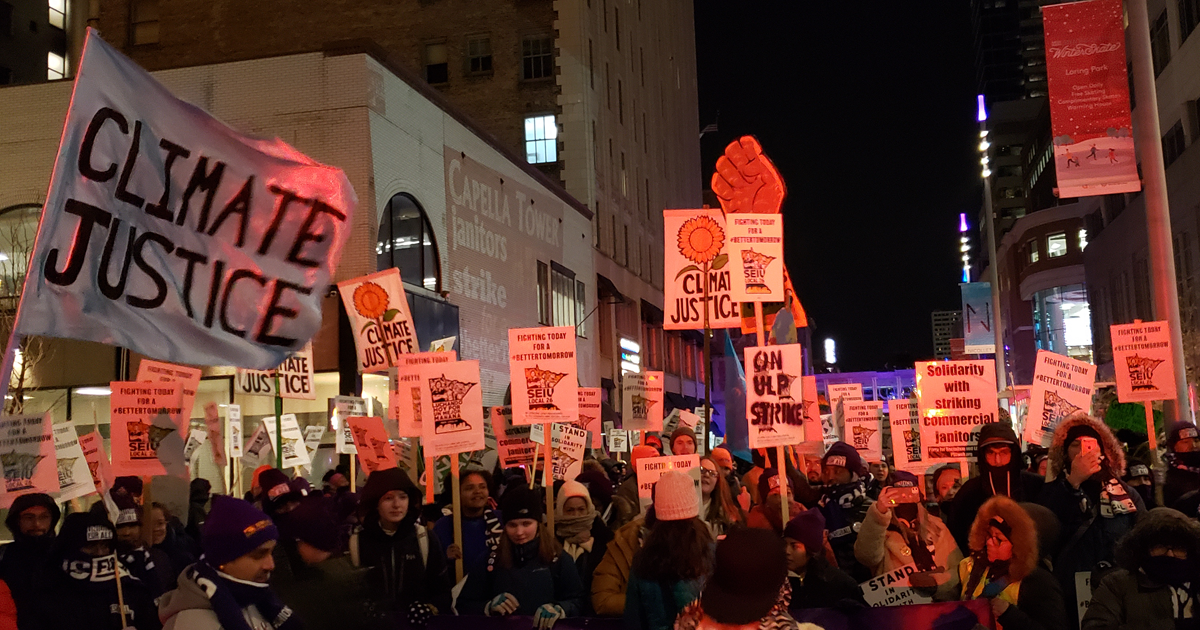
First U.S. Union-Authorized Climate Strike?

By Jeremy Brecher - Labor Network for Sustainability, March 2020; images by SEIU Local 26

Above: Thousands of Minneapolis cleaning workers walked off their jobs and struck their downtown commercial high-rises. Among their key demands was that their employers take action on climate change. Quite possibly the first union sanctioned strike in the U.S. for climate protection demands. Credit: SEIU Local 26.

It isn’t easy for unions to strike to protect the climate. U.S. labor law doesn’t make it easy to strike over anything except wages, hours, and working conditions – even over things like climate change that profoundly affect workers and their future. So it was important news when Minneapolis commercial janitors held an Unfair Labor Practices strike this week to protest employer stalling – including on demands that their employers help fight climate change. This is the third in a series of commentaries on The Future of Climate Strikes. For the entire series see here.

On Thursday February 27 thousands of Minneapolis cleaning workers walked off their jobs and struck their downtown commercial high-rises. Among their key demands was that their employers take action on climate change. It was one of the first—as far as I have been able to discover, the very first—union sanctioned strike in the U.S. for climate protection demands.

The janitors are members of Service Employees International Union Local 26. They are employed by over a dozen different subcontractors like ABM & Marsden to clean corporate buildings like IDS, Capella Tower, EcoLab, U.S Bank, Wells Fargo, United Health Group, Ameriprise and many more across the Twin Cities.[1] The workers are overwhelmingly immigrants and people of color. One observer described the meeting authorizing the strike as “a rainbow coalition of immigrants from all over the world and people from every race and religion in the state.” The union provided simultaneous interpretation into Spanish, Somali, Vietnamese, Amharic, and Nepalese.[2]

I wanted to know something about the background to the strike, so I called Steve Payne, who wrote an excellent article about plans for the strike in Labor Notes.[3] He spent years as an organizer for Local 26 and now works for the North Star chapter of the Sierra Club. Much of this commentary is informed by my discussion with him.

An Emergency Jobs Program for an Emergency Green New Deal

By Jeremy Brecher - Labor Network for Sustainability, March 2020

This is the second of a series of commentaries proposing an Emergency Green New Deal. The first, “As Workers Fight Coronavirus, They Are Laying the Basis for an Emergency Green New Deal,” describes the need for emergency employment to meet the coronavirus crisis and the economic devastation it is bringing to American workers; tells how worker action on the job, in the community, and in the political arena is already addressing that need; and explains how their action can be the start of an Emergency Green New Deal. This commentary lays out a practical plan for a Green New Deal Work Program that can start right now addressing the emergency needs of the coronavirus era and can develop into a program to provide jobs for all who want them helping fix the damage done by the coronavirus and creating a just transition to a climate-safe economy.

On March 19, New York activist and student Erik Forman wrote, “I spent some of today doing deliveries with a volunteer crew of unemployed Uber drivers, mostly to elderly people living in public housing developments.” He asked for a small amount of funds to continue this work and scale it up, and “build momentum for emergency funds to pay for home delivery of meals as a public utility in the crisis.”[1]

That is a microcosm of what we as a society need to do in the face of the coronavirus pandemic – and the economic pandemic that is following hard on its heels. We need to apply the central premise of the Green New Deal – put people to work doing the things we as a society need. It is time to start an emergency jobs program based on that principle. Such a program is necessary to protect against the coronavirus. It is necessary to meet the wave of layoffs that has already begun. And it is necessary to solve the deep crises of climate change and inequality that will still face us when the coronavirus wave eventually subsides.

The coronavirus layoffs have started. According to an NPR/Marist poll, 18% of households have already reported someone being laid off or having hours reduced because of the epidemic. It was 25 percent for those earning less than $50,000.[2] In New Jersey, 15,000 people applied for unemployment benefits on a single day, a twelvefold increase over normal levels; in Rhode Island applications went from 10 one week to 6,282 the next. The U.S. Travel Association projects 4.6 million jobs lost this year in the travel industry alone.[3] Secretary of Treasury Steven Mnuchin warned Republican Senators behind closed doors that without emergency government action the unemployment rate could reach 20% — more like the Great Depression of the 1930s than anything we’ve known since.[4]

In less than a week our government has allocate ed $1.5 trillion to save Wall Street and is proposing another trillion or more for a bailout that will leave most people with nothing except possibly a week’s wages ($1000 per family in Trump’s current proposal) in their pockets. So far the big bucks – trillions of them – are going to protect Wall Street. Programs for fossil fuel and airline industries appear to be on the way. While coronavirus legislation is pending, its main provision to help regular people – sick leave – turns out to exclude 80 percent of workers. Proposals are being made for extended unemployment compensation, healthcare for all, and sending checks to all American families. So far, however, there have been few proposals to deal with the mass joblessness that will follow the pandemic.

When the coronavirus is finally defeated we will face economic devastation that is likely to take years to repair. And we will still face the unrepaired damage of decades of climate crisis, growing inequality, and racial injustice.

In Coronavirus Fight, Workers Are Forging an Emergency Green New Deal

By Jeremy Brecher - Labor Network for Sustainability, March 2020

This is the first of a series of commentaries on the Green New Deal. It argues that in the face of government and employer failure, workers and communities must take the lead to protect ourselves and each other from the coronavirus and its economic and social impacts. It proposes an emergency program to do just that. Funny – it looks a whole lot like a do-it-yourself Green New Deal.

The coronavirus pandemic threatens all of us. People are scared, and rightly so. But when we look to our government officials and employers, whose responsibility it is to provide protection in an emergency, what do we find? In the words of the National Nurses United – a union whose members are risking their lives every day on the frontlines of the coronavirus pandemic — “Federal, state, local, and employer efforts to fight the coronavirus” are “outrageous” and “ineffective.”

At least until those in authority get their act together, we need to start protecting ourselves and each other – not only as individuals, but collectively. Call it a “do-it-yourself Green New Deal.”

The core idea of the Green New Deal is to put people to work meeting our needs. So far the GND has been aimed primarily at challenging climate destruction and inequality. But our most urgent need right now is to protect against COVID-19 and the devastating impacts it will have on our communities and our jobs. The government isn’t doing it. Our employers aren’t doing it. So, if it is going to be done the people have to do it ourselves. We can take the core idea of the GND and start applying it right now. That means an “Emergency People’s Green New Deal.”

Let’s start by looking at the emergency needs that have to be met. Then we can look at the human resources we have to meet them. Finally, we’ll look at the social and political process we need to make it happen.

Twin Cities Janitors and Guards Feature Climate and Housing in Their Strike Demands

By Steve Payne - Labor Notes, February 20, 2020; images by SEIU Local 26

“Twin Cities janitors and security officers vote to authorize strike over pay and sick leave,” read the headline in the Minneapolis Star Tribune.

It’s true that those are among the workers’ top demands. But Service Employees (SEIU) Local 26’s fight is also for something bigger: affordable homes and a healthy planet for us all.

The union is demanding that companies negotiate over climate emissions and pay more to support affordable housing.

On February 8, 500 janitors, security officers, and their allies crowded into a warehouse space normally used for photo shoots. Banners lined the walls as people waved signs.

Local 26 has lined up every single one of its contracts, covering 8,000 workers, for this moment. Commercial office janitors, retail janitors, security officers, window cleaners, and airport workers are all fighting simultaneously.

The room was a rainbow coalition of immigrants from all over the world and people from every race and religion in the state. The union provided simultaneous interpretation into Spanish, Somali, Vietnamese, Amharic, and Nepalese. Chants in multiple languages filled the air.

Supporters from other unions and the city’s regional labor federation were there, along with a more unusual set of allies—representatives of the state’s environmental movement, including MN350 and young climate strikers.

No Worker Left Behind: Protecting Workers and Communities in the Green New Deal

By Jeremy Brecher - Labor Network for Sustainability, December 2019

The Green New Deal Resolution submitted by Rep. Alexandria Ocasio-Cortez and Senator Ed Markey, while it includes many protections and benefits for workers, does not include language that specifically addresses workers who might be adversely affected by the transition to a climate-safe economy. Such GND proposals were soon criticized as too vague to provide protections that workers and unions could count on. AFL-CIO president Richard Trumka, for example, told the Economic Club of Washington, DC, "We would want a whole lot of changes made so that workers and our jobs are protected in the process."

There are now several GND plans proposed by political figures, including Democratic presidential candidates, that spell out how protections for workers might be implemented. There are also a variety of GND proposals from individuals and groups that further spell out such protections.

In this briefing paper we lay out the basic elements that have been proposed to protect the well-being of workers and communities who may be adversely affected by aspects of the GND and the transition to a climate-safe economy. We summarize how each of the plans would go about protecting workers and communities whose jobs may be threatened. In the Appendix we provide partial texts from which these summaries are extracted.

The purpose of this compendium is not to evaluate which candidate or other proponent has the best plan. Rather, the purpose is to present the various strategies and programs from which future shapers of the GND can select and combine to forge the best possible program.

Read the report (PDF).

Broadening Engagement With Just Transition: Opportunities and Challenges

By Robin Webster and Dr Christopher Shaw - Climate Outreach, September 2019

The idea of just transition first emerged in the 1970s, when US union leader Tony Mazzocchi1 proposed that people whose jobs were threatened by nuclear disarmament should be compensated for the loss. In the 1990s Mazzocchi broadened the argument to refer to workers in environmentally damaging jobs, whose employment is affected by new policies aiming to reduce pollution.

The International Trade Union Confederation (ITUC) now defines just transition as reducing emissions while ensuring “decent work, social inclusion and poverty eradication.” Its basic elements, according to ITUC, include public and private investment to create green jobs, advance planning to compensate for the negative impacts of climate policies and opportunities for retraining for people whose jobs are affected.

A wide range of groups - including environmental NGOs, labour justice groups and policymakers - have since adopted the idea and it is codified in international climate policy. The preamble to the 2015 Paris Agreement requires the international community to take into account “the imperatives of a just transition of the workforce and the creation of decent work and quality jobs” and the European Commission aims to bring more focus on “social fairness” in tackling climate change.

Just transition is an important concept; a tool for facilitating dialogue between different stakeholders and challenging the discourse of ‘jobs versus climate.’ As one report puts it, it has the potential to be “at the heart of a powerful narrative of hope, tolerance and justice; a narrative that is grounded in people’s actual lived experiences and aspires to guide collective action while simultaneously giving rise to tangible alternatives.”

It is also important from a pragmatic perspective. Recent events - including the Gilets Jaunes protest against a government proposal to raise fuel prices in France and President Trump’s championing of jobs in the US coal industry as a reason for pulling out of the Paris climate change agreement - demonstrate the need to seek social consent for the low-carbon transition, or risk it being undermined.

The term itself, however, is little used outside the policy and technical literature, and hardly used at all in the global South, where it may conflict with other strong cultural narratives - for example the need for poorer countries to develop and use more energy.10 In countries where the idea is more current, only a limited amount of research has been carried out exploring what the idea of just transition means to the communities it is meant to help.

Yet the idea of ‘social dialogue’ between governments, businesses, trade unions and civil society is at the core of just transition, according to many unions.12 Social dialogue means engaging in discussions about what transition means for people’s lives and sense of identity; for jobs, communities and place.13 If just transition is to move from pages of policy reports into reality, then attention needs to be paid to how to frame the dialogue between advocates of a low-carbon economy, and those who are likely to be most fundamentally affected.

Read the report (PDF).

Pages

The Fine Print I:

Disclaimer: The views expressed on this site are not the official position of the IWW (or even the IWW’s EUC) unless otherwise indicated and do not necessarily represent the views of anyone but the author’s, nor should it be assumed that any of these authors automatically support the IWW or endorse any of its positions.

Further: the inclusion of a link on our site (other than the link to the main IWW site) does not imply endorsement by or an alliance with the IWW. These sites have been chosen by our members due to their perceived relevance to the IWW EUC and are included here for informational purposes only. If you have any suggestions or comments on any of the links included (or not included) above, please contact us.

The Fine Print II:

Fair Use Notice: The material on this site is provided for educational and informational purposes. It may contain copyrighted material the use of which has not always been specifically authorized by the copyright owner. It is being made available in an effort to advance the understanding of scientific, environmental, economic, social justice and human rights issues etc.

It is believed that this constitutes a 'fair use' of any such copyrighted material as provided for in section 107 of the US Copyright Law. In accordance with Title 17 U.S.C. Section 107, the material on this site is distributed without profit to those who have an interest in using the included information for research and educational purposes. If you wish to use copyrighted material from this site for purposes of your own that go beyond 'fair use', you must obtain permission from the copyright owner. The information on this site does not constitute legal or technical advice.
