

You are here

Labor Network for Sustainability (LNS)
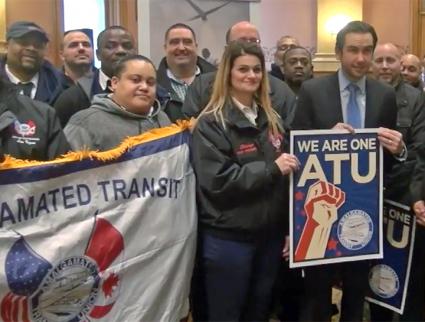
A national coalition demands transit justice

By Kacie Harlan - Socialist Worker, February 14, 2018

JUST OVER 62 years ago, Rosa Parks defied Jim Crow segregation that consigned Black passengers to sit in the back of the bus. Her act of resistance spurred the African American community to organize the 381-day-long Montgomery Bus Boycott, one of the most important events of the civil rights movement.

Half a century later, Park's civil disobedience has inspired a national coalition of labor, civil rights and environmental groups to organize Transit Equity Day.

According to the Labor Network for Sustainability, Transit Equity Day "is a collaborative effort of several organizations and unions to promote public transit as a civil right and a strategy to combat climate change." The coalition chose Parks' birthday of February 4 for the day of action, but observed it on February 5 this year since it was a weekday.

While the coalition is small and the day of action made few headlines, Transit Equity Day is a good first step toward a badly needed public transit movement in the U.S.

Labor and climate groups support Transit Equity Day

By Bill Onasch - Socialist Action, February 1, 2018

On Feb. 5, civil rights, trade union, student, church, and environmental activists in communities across North America will come together in a variety of events to call attention to a looming crisis in public transit.

The diversity of these groups indicates that they recognize not only the urgent need to save what we have but also the potential crucial role transit expansion can play in providing affordable transportation that is accessible to all, that can reduce traffic fatalities and congestion—and that can curtail greenhouse gas emissions driving climate change.

But today, New York City’s subways—moving a record 5 million passengers a day—are on the verge of collapse, a major line is being shut down for renovation lasting for more than a year, and their buses aren’t doing much better. Washington, D.C., has neglected even routine maintenance, leading to accidents and delays on the Metro.

Transit-union contract negotiations remain highly contentious in Washington and Chicago. Some public agencies continue to contract work out to non-union penny-pinching private outfits who can do it cheaper only by providing inferior service and paying substandard wages. Washington, D.C., is moving to privatize the Red Line subway. More of the same—and even worse—are in store.

This is not the first crisis for transit. After setting record ridership numbers during World War II, when there was full employment, no new cars were being built, and tires and gasoline were rationed, the ruling class took America into a very different postwar development scheme. From the end of World War II on, highly subsidized urban sprawl promoted a massive exodus of residents and jobs to new suburban areas. The streetcar and bus lines in the urban cores did not follow them.

In many cases, such as in Los Angeles and Kansas City, consortiums of auto, oil, and tire companies became silent owners of transit properties. They dismantled their impressive electrified streetcar and trolley bus networks—which would require many billions to replicate today—replacing them with diesel buses produced by General Motors, as they steadily slashed service. One result in Los Angeles was the introduction of a new word to our vocabulary—smog. Out of sprawl an important new division in the working class soon emerged—either car dependent or transit dependent.

Because a high percentage of the transit-dependent population remaining in the depleted urban cores are African Americans, transit has often been on the agenda of the Civil Rights movement. The chosen date in February marks the birthday of the late Rosa Parks, who became famous for an act of civil disobedience that launched the well-planned boycott campaign to end racial segregation on Montgomery, Ala., buses in 1955. This pivotal action, initiated by Black trade unionists led by E.D. Nixon, is credited with launching the revival of the mass Civil Rights Movement in the South—and propelling Dr Martin Luther King into national prominence.

Would the Atlantic Coast Pipeline be the job creator its TV ads claim?

By Sue Sturgis - Facing South, December 15, 2017

Dominion and Duke Energy got more bad news about their controversial Atlantic Coast Pipeline project this month, with North Carolina regulators announcing they would not issue the necessary air quality permit for a planned compressor station in Northampton County by Dec. 15, as the utilities had hoped. The proposed 600-mile pipeline would carry fracked gas from West Virginia to North Carolina, with most of it used to generate electricity at gas-fired power plants.

On Dec. 4, the N.C. Department of Environmental Quality (DEQ) — headed by the Environmental Defense Fund's former Southeastern regional director Michael Regan — asked for additional information about air pollution impacts, indefinitely extending the deadline for a response. This marks the fifth time that Democratic Gov. Roy Cooper's administration has asked the ACP developers for more information about the project, which has the necessary approvals from the Federal Energy Regulatory Commission but still needs air, water and erosion permits in North Carolina. Last month the state requested additional details about economic benefits to communities along the pipeline's route.

Amid ongoing questions from state regulators about the ACP's impacts, its developers are running TV ads in North Carolina touting the project's job-creation potential. They're doing so through a group called the EnergySure Coalition, an alliance of pro-pipeline businesses and associations that's funded by Dominion and Duke as well as the other two minor ACP investors, Piedmont Natural Gas and Southern Company Gas.

One of the recent ads features Durwood Stephenson, a commercial and industrial construction contractor based in Johnston County, which lies along the ACP's route. He's also the executive director of the U.S. 70 Corridor Commission, a regional economic development group.

"We need the pipeline if we're going to bring in industries and jobs," Stephenson says.

But are those job claims accurate? Will the $5.5 billion pipeline that would be financed primarily by Dominion and Duke Energy ratepayers be an economic boon for Eastern North Carolina, a region that faces higher-than-average unemployment?

An analysis released last week concluded that the developers' jobs claims are overly optimistic. It was commissioned by the Natural Resources Defense Council and carried out by the Applied Economics Clinic (AEC), a nonprofit consulting group housed at Tufts University in Massachusetts that focuses on energy, environment and equity. The researchers looked at the overall economics of the ACP as well as specific claims about manufacturing jobs and found the developers' promises to be unsubstantiated.

"Recent data on states with new natural gas pipeline capacity does not support the claim that the addition of a new natural gas pipeline in a state is correlated with lower industrial electricity prices or an increase in the number of manufacturing jobs in that state," the report said.

U.S. unions fighting climate change with innovative campaigns

By Elizabeth Perry - Work and Climate Change Report, November 7, 2017

Labour and climate activists gathered to exchange experiences and plan for future action at the Second Labor Convergence on Climate event, held on September 23-24, under the banner “Building Worker Power to Confront Climate Change.”  The meeting was hosted by the Labor Network for Sustainability (LNS), which  recently released a report on the meetings  summarizing the impressive initiatives and projects,  including:  the Canadian Postal Workers Union proposal Delivering Community Power,  which envisions expansion and re-purposing of the postal station network to provide electric vehicle charging stations, farm-to-table food delivery, and  community banking ; the International Brotherhood of Teamsters described the San Francisco Zero Waste program that now diverts 80% of municipal waste from landfills into recycling and composting and provides union jobs; Service Employees International Union (SEIU) 1199  described their environmental and climate justice programs, resulting from the impact of disasters  like Superstorm Sandy;  worker training programs at the Net-Zero Energy training facility built by the  International Brotherhood of Electrical Workers (IBEW) Local 595 in partnership with the Northern California National Electrical Contractors Association; the United Food and Commercial Workers described their experience with the  Good Food Purchasing Policy as a tool for protecting and enhancing labor standards for workers in the food industry and advancing climate justice; and the International Brotherhood of Locomotive Engineers and Trainmen profiled their successful Green Diesel campaign to win cleaner fuel engines and a visionary strategy called  “Solutionary Rail” ,  profiled in “How we can turn railroads into a climate solution”  in Grist (March 2017) and in “ Electric Trains everywhere – A Solution to crumbling roads and climate crisis”  in  YES Magazine (May 2017).

Participants at the Second Labor Convergence on Climate included over 130 people –  labour union leaders, organizers, and rank and file activists from 17 unions, 3 state federations/central labor councils and 6 labor support organizations,  as well as environmental and economic justice activists.

News Bites from Labor Network for Sustainability

By Jeremy Brecher - Labor Network for Sustainability, July 7, 2017

San Diego area’s Local 569 Is Helping to Lead the Transition to a Low-Carbon Economy

Local 569 has a position in support of a transition to a low-carbon economy. How did it come to take such a stand and what is it doing to promote it? ... read more.

We Have to Have an Eye Toward the Future - LA’s IBEW Local 11 Spearheads a Transition to Clean Energy

Los Angeles IBEW Local Union 11 represents 13,000 Electricians, Communications and Systems Installers, Transportation Systems Journeyman, Civil Service Electricians, Apprentices, Construction Wireman and Construction Electricians. It describes itself as “a movement for social justice, safe jobsites, training, green jobs and opportunity for all.” It has become a pioneer in the transition to a climate-safe, worker-friendly energy system ... read more.

We Knew Big Changes Were Coming to our Industry - Tom Dalzell, Business Manager of IBEW Local 1245

This article is based on an interview with Tom Dalzell, Business Manager of IBEW Local 1245 conducted by Jeremy Brecher. Headquartered in Vacaville in northern California but extending into Nevada, Local 1245 has more than 18,000 members, 12,000 in Pacific Gas and Electric Co., the rest in nearly 100 signatory contractors with labor agreements ... read more.

ecology.iww.org web editor's note: in this last article, Dalzell makes some rather unsubstantiated claims about net metering and distributed renewable energy being a subsidy for the rich; this is, in fact, untrue, and--for the most part--a investor owned utility talking point. LNS acknolwedges this and states that Dalzell's position is his own.

Paris is Burning

By James P. Hare - Rosa Luxemburg Stiftung, June 2017

With Trump’s decision to formally withdraw from the Paris Agreement, he has put an end to months of apparent indecision. This withdrawal does not dissolve the agreement, which still includes nearly every nation on the planet, but it is hard to imagine how an already weak agreement can be expected to slow—not to mention reverse—greenhouse gas emissions without the participation of the United States. Seeing this decision as anything other than a nail in the coffin of the global climate regime is nothing but wishful thinking.

For an administration that has promoted a seemingly unending series of bad policies—from healthcare to immigration to militarism to the unceasing transfer of wealth from working people to the wealthy—this may be its worst. When future generations look back at the harm done by this president, they may remember this as his greatest crime. This is not to minimize the damage of his other policies or of the racism, xenophobia, and misogyny that drove his campaign and brought him into the White House, but climate change is the ultimate issue. It will affect everyone while exacerbating existing inequalities, and we only have one chance to get it right.

This decision is no surprise. Throughout his campaign, Trump promised to pull out of the Paris Agreement as part of his “America First” agenda that pits the promise of domestic jobs against environmental protections and international cooperation. We must reject Trump’s noxious brand of nationalism and climate denialism. It is critical, however, not to sugarcoat the nature of much of what passes as international cooperation. So-called trade agreements have benefitted corporations and the wealthy at the expense of working people both in the United States and abroad.

It is not, as Trump’s nativist critique would have it, that the United States made a bad deal with Mexico when negotiating NAFTA. Rather, elites in the United States, Mexico, and Canada made a good deal for themselves at the expense of the citizens of each country. Still, working people understand what NAFTA did to their workplaces and their communities, and Trump’s attack on trade deals may have helped him to win enough working-class support in critical states to shift the electoral map in his favor, even if the extent of his working-class support has been greatly overstated by centrist commentators.

Toward a climate insurgency

By Jay O'Hara - Waging Nonviolence, May 16, 2017

To the outward eye, the climate movement looks to be back on its heels, reeling from the ascendancy of a fossil fuel regime, the completion of the Dakota Access Pipeline, the zombie Keystone XL and the threatened departure of the United States from the Paris Climate Accord. And there’s not much I can offer, as a climate organizer, to dissuade one from that opinion. The one major effort thus far was a massive march on Washington, D.C. that was planned when most expected Hillary Clinton to be in the White House. So we’re left wondering: What the hell are we supposed to do now?

Into this breach steps Jeremy Brecher’s slim new volume “Against Doom: A Climate Insurgency Manual.” Neither glitzy, eloquent nor subtle, Brecher methodically lays out an interlocking vision of direct action within a constitutional legal framework to build the powerful nonviolent climate insurgency necessary to turn the ship around. “Against Doom” smartly connects disparate threads of the existing climate movement and pulls them together with strategic vision. I finished the book fired up with a clearer sense of where my own work with the Climate Disobedience Center, as well as my Quaker faith community, fits into an unfolding climate insurgency. And I’m ready to get back to the pipeline valves, coal piles, construction sites, boardrooms and courtrooms where we have the opportunity to stem the tide of climate cataclysm.

Brecher puts all this in perspective right up front: Before Trump, the Paris agreements represented merely “the illusion that world leaders were fixing climate change” — with ineffectual emissions reduction targets of only 2 degrees Celsius (non-binding) and 1.5 degrees (aspirational). As such, Trump is only a refreshingly honest manifestation of the movement’s failure to muster sufficient power to achieve its ultimate aims. The illusion of the efficacy of an inside politics game somehow survived the failure of cap-and-trade among the major environmental groups, and those groups refocused on the Obama administration’s potential for executive action. At the same time, the national fight against Keystone XL and grassroots resistance by frontline communities across the country and globe have laid the groundwork for a strategy of insurgency.

A climate insurgency: building a Trump-free, fossil-free future

By Jeremy Brecher - The Ecologist, April 28, 2017

As the thousands of foot-weary protesters leave the April 29 Peoples Climate March in Washington, DC - and its scores of sister marches around the country - one question will no doubt be foremost on their minds:

How can a march, or indeed any other action they take, force a reversal in the world's hurtle to climate doom?

After all, a single march, no matter how large, is not going to force President Trump and his administration of fossil-fuel company executives and climate-change deniers to reverse course.

They have already cancelled the Environmental Protection Agency's Clean Power Plan, authorized drilling and mining on public lands, and gutted regulations that protect local people and environments against the extraction of fossil fuels.

He has cleared the way for the Keystone XL and Dakota Access pipelines. His allies in Congress are whetting their knives to gut the Clean Air, Clean Water and Environmental Policy Acts. The fossil fuel industry is lining up for permits to build new infrastructure that will accelerate global warming and threaten local environments to boot.

Jobs for Climate and Justice: A Worker Alternative to the Trump Agenda

By Staff - Labor Network for Sustainability, April 24, 2017

We are in a critical political moment. The impacts of climatechange are increasingly severe, taking a toll on our health, environment and our economies. In the midst of this growing crisis, the United States now has a President and Congressional leadership that simultaneously attack climateclimate science and aim to comprehensively roll back climate protection measures and the rights of workers to organize.

Jobs for Climate and Justice exposes and challenges the Trump agenda and proposes the kind of economic program we must fight for. It also offers examples of the great organizing efforts around the country – led by working people – that provide the foundation for the a transition to a just and climate-safe economy. It is organized based on 4 elements:

  1. Create good jobs fixing the climate
  2. Protect threatened workers and communities
  3. Remedy inequality and injustice
  4. Lay the basis for a New Economy

The full working paper can be found [Here]

Trump’s Energy Plan: A “Brighter Future” for American Workers?

By staff - Labor Network for Sustainability, March 28, 2017

Full PDF of the White Paper can be found HERE

The day he was inaugurated, President Donald Trump issued his “America First Energy Plan.”[1] It presented policies it said would “stimulate our economy, ensure our security, and protect our health” and thereby provide “a brighter future.” Trump has promised that his energy policy will create “many millions of high-paying jobs.”[2]

What do American workers need in an energy policy? Does President Trump’s energy plan provide it? Or does it threaten our future? Is it credible or deceptive? Does it put us on the road to good jobs in an affordable, reliable energy future? Or does it threaten to reverse a massive shift to a more secure, climate-safe, fossil-free energy system — a clean energy revolution that will benefit American workers, and that is already under way?

Some in organized labor have been attracted by President Trump’s energy plan, even echoing the claim that it will provide “a brighter future.” But one thing you learn when you negotiate a contract for a union is to take a hard look at proposals you are offered— however attractive they may appear, it is best to unwrap the package and see what’s really in it before you agree. Labor should conduct similar “due diligence” for Trump’s America First Energy Plan. Was it designed to meet the needs of American workers, or of the global oil, gas, and coal companies whose executives have been appointed to so many top positions in the Trump administration? Will it encourage or hold up the energy revolution that is making renewable energy and energy efficiency the way of the future?

Pages

The Fine Print I:

Disclaimer: The views expressed on this site are not the official position of the IWW (or even the IWW’s EUC) unless otherwise indicated and do not necessarily represent the views of anyone but the author’s, nor should it be assumed that any of these authors automatically support the IWW or endorse any of its positions.

Further: the inclusion of a link on our site (other than the link to the main IWW site) does not imply endorsement by or an alliance with the IWW. These sites have been chosen by our members due to their perceived relevance to the IWW EUC and are included here for informational purposes only. If you have any suggestions or comments on any of the links included (or not included) above, please contact us.

The Fine Print II:

Fair Use Notice: The material on this site is provided for educational and informational purposes. It may contain copyrighted material the use of which has not always been specifically authorized by the copyright owner. It is being made available in an effort to advance the understanding of scientific, environmental, economic, social justice and human rights issues etc.

It is believed that this constitutes a 'fair use' of any such copyrighted material as provided for in section 107 of the US Copyright Law. In accordance with Title 17 U.S.C. Section 107, the material on this site is distributed without profit to those who have an interest in using the included information for research and educational purposes. If you wish to use copyrighted material from this site for purposes of your own that go beyond 'fair use', you must obtain permission from the copyright owner. The information on this site does not constitute legal or technical advice.
