

You are here

Labor Network for Sustainability (LNS)

The Climate Insurgency Trilogy

By Jeremy Brecher - Labor Network for Sustainability, July 25, 2017

The Labor Network for Sustainability is pleased to announce the publication of Jeremy Brecher’s Climate Insurgency Trilogy:

Climate Insurgency: A Strategy for Survival (2nd edition)

Climate Solidarity: Workers vs. Warming

Against Doom: A Climate Insurgency Manual

Together these three books present a comprehensive look at the challenges and possibilities of protecting the earth’s climate through a global nonviolent climate insurgency.

Climate Insurgency: A Strategy for Survival (2nd edition) presents the first history of climate protection movements “from above” and “from below”; explains why climate protection efforts have so far failed; and proposes a worldwide constitutional insurgency to overcome that failure.

Climate Solidarity: Workers vs. Warming presents a vision for the labor climate movement that provides a comprehensive and at times provocative view of the past, present, and future of how workers and the labor movement relate to climate change.

Against Doom: A Climate Insurgency Manual tells how to put the climate insurgency strategy into action. It provides a handbook for climate insurgents.

Jeremy Brecher is the author of more than a dozen books on labor and social movements, including the labor history classic Strike!, recently published in an expanded fortieth anniversary edition by PM Press. He is a co-founder of the Labor Network for Sustainability.

Fritz Edler on Green Unionism

Fritz Edler interviewed by Labor Network for Sustainability, July 6, 2017

Open Letter To Union Leaders: Act On Climate

By Staff - Labor Network for Sustainability, October 2017

To the leaders of the American labor movement:

Working people, poor people, and frontline communities are most heavily impacted by the effects of climate change. We feel the force of this devastation first and worst—from more powerful hurricanes to wildfires, from rising sea levels to crop-destroying droughts and floods. Our families and communities receive the greatest blow and have the biggest stake in moving as rapidly as possible from a fossil fuel-based society to a sustainable energy society.

Global warming represents an existential threat to the world’s people. We must act rapidly to avoid even more devastating climate change. But moving to 100% renewable energy will also impact jobs for many of us. So any transition, to be just, must protect workers and frontline communities impacted by the changes we must make from having to disproportionately bear rather than share the social cost.

Organized labor with its allies is the strongest, best-organized force to turn this around. Who will speak for the global majority of working people and poor people if organized labor does not?

The Earth is our only home. There is no Planet B. And there are no jobs on a dead planet.

As union members and families of union members, we call on you to take the lead in backing policies that call for:
(1) A rapid transition from fossil fuels to renewable energy;
(2) Massive rebuilding of our energy, transport, and other infrastructure in support of that transformation; and
(3) A just transition for workers and communities directly affected by climate change and the transition to renewable energy – including income support, retraining, retirement security, and the creation of quality living-wage union-protected jobs in infrastructure, energy efficiency, and clean energy.

Future generations will ask what the labor movement did to respond to, slow and mitigate the worst effects of climate change. We urge you to take bold action to address the climate crisis with solutions that protect our planet and our people. You will have my full backing for these policies and the backing of millions of working Americans who are looking for your leadership at this critical moment.

The actions we take today will determine the world that our children, grandchildren, and future generations will inhabit tomorrow and for centuries to come. Let’s act decisively now to improve rather than imperil their lives.

Labor Network for Sustainability Calls for “Climate Solidarity” on Anniversary of Superstorm Sandy

By staff - Labor Network for Sustainability, Octber 24, 2017

On this fifth anniversary of Superstorm Sandy, it is time to recognize that climate change is a dagger pointing at the jobs and well-being of American workers.

Since Sandy we have seen storm after storm, wildfire after wildfire, flood after flood, all demonstrating the greater intensity that climate scientists have warned us will result from climate change. In the aftermath of Hurricanes Harvey and Irma, the Labor Department said 1.5 million workers were not at their jobs because of weather. And the experience of Sandy, Katrina, and other climate-intensified storms shows that the devastation to workers and unions continues for years after the immediate impact.

There is no escape from climate devastation except a planned transition from a fossil fueled economy to a fossil free economy. That will require change in every industry from manufacturing to construction to agriculture. And that will require millions of jobs. Climate protection is our best jobs program.

The transition to a climate-safe economy must be a just transition. We need to use that transition to reverse the growing inequality and injustice of our society. And we need to make sure that poor and working people are protected against any unintended side effects of climate protection.

The labor movement’s most essential value is solidarity. Summed up in the hallowed adage “An injury to one is an injury to all,” it is the recognition that “looking out for number one” doesn’t work, that we will survive and prosper only if we look out for one another. Climate protection is the new solidarity: protecting our brothers and sisters as well as ourselves from destruction.

The New AFL-CIO Stand on Climate Change

By Jeremy Brecher - Common Dreams, November 3, 2017

At its Quadrennial Convention in late October, the AFL-CIO unanimously adopted a resolution on “Climate Change, Energy, and Union Jobs.” [https://aflcio.org/resolutions/resolution-55-climate-change-energy-and-union-jobs] The resolution says that the fastest and most equitable way to address climate change is for “labor to be at the center of creating solutions that reduce emissions while investing in our communities, maintaining and creating high-wage union jobs, and reducing poverty.”

If acted on, the resolution will bring about significant changes in organized labor and will bring American trade unions into far closer alignment with allies in the climate protection movement.

The resolution starts with the facts of global warming. It acknowledges “the overwhelming scientific consensus” that climate warming is “due to human activities” and that higher global temperatures will trigger “irreversible changes in our climate,” causing “a rise in sea levels and storm surges, an increase in droughts and extreme weather events, a substantial threat of increased extinctions, decreased food security in some regions, and an increase in heat-induced health problems.”

The resolution turns next to the social justice dimensions of climate change. “Workers, communities of color and low-income Americans suffer disproportionately from environmental degradation and climate change” through “polluted air, water and land,” and from “drought and extreme weather events.” It cites Pope Francis and other religious leaders on the “moral imperative to address both climate change and poverty.”

The resolution notes that tens of thousands of union members work in industries that rely on fossil fuels or live in regions where fossil fuels are “the primary economic driver in their communities.” Like all workers, they have a right to “a strong, viable economic future” including good jobs at union wages and benefits. It cites the Paris Agreement on “the imperative of a just transition” of the workforce and “decent work and quality jobs” when addressing climate change. It resolves to fight politically and legislatively “to secure and maintain employment, pensions and health care” for workers affected by changes in the energy market.

NYC Public Pension Funds Fossil Fuels Divestment Campaign

By Nancy Romer - Labor Network for Sustainability, November 22, 2017

New York City Public Worker Pension Funds are on the cusp of selling off or divesting from their fossil fuel stocks.  How and why are NYC workers and climate activists so intent on achieving this?  What will it mean if they win this?  First some background.
Pension Funds are the Capital of US Workers

American workers too often feel overwhelmed by the power of capitalism in general and financial corporations in particular.  We may feel we have few economic resources with which to exert our opinions and defend our needs in a system based on money.  We may want to challenge “fossil fuel capitalism” that threatens the future for our grandchildren, but how?

Most American workers do own capital in the form of their own homes and, especially, in their pension funds.  Often the pension funds are managed with the support and participation of their unions or, more specifically, their union leaders. What if union members were to look closely at our pension funds and see how we could use them to create the kind of world we want:  investments in renewable energy, public transportation, affordable housing, public education, regenerative agriculture?

As a sector, pension funds are the single largest institutional investor followed by banks, investment firms, and insurance companies (Global Pension Statistics Project, GPS).  Approximately $40 trillion was invested by pension funds in financial markets in 2015 and that gives workers much more financial punch than we realize or use.

Pensions represent deferred compensation to workers and are negotiated through contracts on behalf of union members.  The intention is to provide income during retirement years. Workers have the potential financial power through collectively using their pension funds to both protect us through financially insecure times such as these and to have an impact on the world we want to see, the world we want to leave to our children and future generations.  Too often the second part of this formula—having an impact on the world we want to see—is totally ignored.

A growing number of American workers are questioning the wisdom of keeping their hard-earned deferred income in fossil fuel holdings.   Some unions, particularly public service unions, are joining the other financial entities, like universities, faith organizations, and foundations, which have divested their funds from fossil fuel holdings. Pension funds committed to divestment comprised 12% of all divestment commitments. Globally, a full $5.2 trillion in assets has been pledged to divest from fossil fuels. [Arabella Global Divestment Report, 2016]  That’s a huge start!  We are denying funds from the fossil fuel industry, devaluing their stocks, stopping to “feed the beast”, making fossil fuel corporations pariahs, like we did with tobacco companies that caused cancer.

Fighting for Green Solutions to Pittsburgh’s “Sewage in the Rivers Problem”

By Thomas Hoffman - Labor Network for Sustainability, January 4, 2018

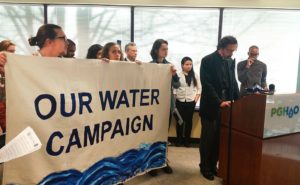
Almost 7 years ago, six Pittsburgh based organizations realized that our region was going to spend $2-4 billion dollars of area residents’ money to stop 9+ billion gallons of untreated sewage from flowing into our iconic three rivers. The overflows occur when stormwater runs off roads roofs and parking lots into the storm sewers which are the same as the waste sewers.

Pittsburgh is not unusual – many older industrial cities have the same problem. If you combine all the money that will be spent by these cities fixing this problem it totals to roughly half a trillion dollars.

The groups formed the Clean Rivers Campaign to win a “maximum green first followed by right sized gray” solution to cleaning our rivers. They felt that in addition to cleaning our rivers such a solution would bring maximum community benefits back to area residents. These benefits include long term local family sustaining Union jobs, cleaner air and water, and revitalized communities.

The six organizations are Pittsburgh United, a PWF affiliate composed of labor, faith and community groups, Pennsylvania Interfaith Impact Network, a faith based organization, three enviro groups -Sierra Club, Clean Water Action and Nine Mile Run Watershed Association and Action United, a low income neighborhood organizing group. The Unions in Pittsburgh United (SEIU, UFCW and USWA) have been very supportive of the campaign because the neighborhoods where much of the green investments would happen are where their members live.

The alternative solution being promoted by our regional sewer authority, ALCOSAN, is the construction of miles of massive tunnels to collect all the stormwater runoff and sewage overflow. The sewage would then be pumped out of the tunnels using pumps powered by fossil fuels and then treated  before being released into the river again. While this would solve the sewage in the rivers problems it would have none of the community benefits listed above. It would also do nothing to reduce the flooding that may low income and minority communities are experiencing.

Why U.S. Unions Marched for the Climate

By staff - Trade Unions for Energy Democracy, May 5, 2017

On Saturday, April 29th, unions from around the country and from a wide range of sectors joined tens of thousands of others for the “People’s Climate March” in downtown Washington, D.C., braving the 33-degree Celsius heat to take to the streets in a massive demonstration of resistance to the Trump administration’s “energy superpower” agenda, its attacks on environmental regulations, and its reckless promotion of climate change denial.

According to climate activist group 350.org, more than 200,000 people marched in the U.S. capital, with coordinated marches and demonstrations across the country and beyond. The record  temperatures in Washington — which equaled the previous record for April 29th, from 1974 — only underscored the importance of the action and the significance of the large turnout, which exceeded predictions.

The labor contingent for the march convened in front of the U.S. Department of Labor for a preliminary rally. Leaders from several unions and networks addressed the gathering crowd before lining up to join the main column for the march up Pennsylvania Avenue to surround the White House for the feature rally.

Towards a Progressive Labor Vision for Climate Justice and Energy Transition

By Sean Sweeney and John Treat - Trade Unions for Energy Democracy, June 2, 2017

Discussion document submitted to Labor for Our Revolution (LFOR):

This memorandum proposes an analysis and provisional framework around which to construct an ambitious and effective agenda for progressive labor to respond to the converging environmental crises, and to pursue a rapid, inclusive approach to energy transition and social justice.

Such an agenda could serve to bring a much-needed independent union voice to policy and programmatic debates on climate change and energy within Our Revolution spaces and processes. Labor’s voice in these debates frequently echoes the large energy companies on one side, or the large mainstream environmental NGOs on the other.

Unions that supported Bernie, alongside other union locals and individual leaders and activists who participate in Labor for Our Revolution (LFOR), understand that we cannot afford to regard environmental issues and climate change as peripheral concerns situated outside of labor’s “core agenda.” This is not the place to review the science, but recent assessments from climate scientists, already sobering, have become increasingly grave. The health impacts of rising airborne pollution and warming temperatures already cut short the lives of millions on an annual basis, and will increasingly do so without a major change in direction.

Importantly, a global movement has emerged that today challenges the destructive trajectory of “business as usual.” This is a movement that progressive labor in the US can work with and should support.

Progressive labor can and should articulate a clear alternative to the anti-scientific, “energy superpower” agenda being advanced by Trump—an alternative that can help build and strengthen alliances with the climate and environmental justice movements. Progressive unions are already involved in Labor Network for Sustainability (LNS) and / or Trade Unions for Energy Democracy (TUED); both LNS and TUED bring significant experience and capacity, and can serve as platforms for expanded and accelerated collaboration and programmatic work.

Many would agree that progressive labor’s approach must be science-based and internationalist. It must aspire to be socially and economically transformative, and must be able simultaneously to inspire and mobilize union members, and provide a basis for durable, effective alliances with other social movements. This, then, is our starting point.

At the same time, progressive labor’s approach must recognize that incremental efforts to “move the needle” are no longer sufficient. For this reason, such an approach must also be built around clear programmatic commitments that are evidence-based, grounded in a realistic assessment of the urgency, and commensurate to the task.

Pages

The Fine Print I:

Disclaimer: The views expressed on this site are not the official position of the IWW (or even the IWW’s EUC) unless otherwise indicated and do not necessarily represent the views of anyone but the author’s, nor should it be assumed that any of these authors automatically support the IWW or endorse any of its positions.

Further: the inclusion of a link on our site (other than the link to the main IWW site) does not imply endorsement by or an alliance with the IWW. These sites have been chosen by our members due to their perceived relevance to the IWW EUC and are included here for informational purposes only. If you have any suggestions or comments on any of the links included (or not included) above, please contact us.

The Fine Print II:

Fair Use Notice: The material on this site is provided for educational and informational purposes. It may contain copyrighted material the use of which has not always been specifically authorized by the copyright owner. It is being made available in an effort to advance the understanding of scientific, environmental, economic, social justice and human rights issues etc.

It is believed that this constitutes a 'fair use' of any such copyrighted material as provided for in section 107 of the US Copyright Law. In accordance with Title 17 U.S.C. Section 107, the material on this site is distributed without profit to those who have an interest in using the included information for research and educational purposes. If you wish to use copyrighted material from this site for purposes of your own that go beyond 'fair use', you must obtain permission from the copyright owner. The information on this site does not constitute legal or technical advice.
