

You are here

Labor Network for Sustainability (LNS)

A Green New Deal for American Labor?

By Saurav Sarkar - Labor Notes, February 15, 2019

The simple yellow protest signs were stenciled “Green Jobs for All.” Speaker after speaker stepped into the middle of the office floor, marked with a U.S. House of Representatives seal. Representative-Elect Alexandria Ocasio-Cortez, fresh off her election win, gave the protesters high fives.

That was the scene in November when the youth climate justice organization Sunrise Movement held a sit-in at the office of Rep. Nancy Pelosi, who was soon to be the Speaker of the House.

Most Americans had never heard of the “Green New Deal” at the time.

Now, it’s on the mainstream radar. The New York Times and the Washington Post ran multiple stories when Ocasio-Cortez introduced a resolution on February 7 to reduce carbon emissions through a massive good jobs program. The resolution has 67 House co-sponsors, while the Senate version has 12.

Even stronger than the original New Deal in the ’30s, her version of a Green New Deal would include a federal guarantee of living-wage employment—that is, anyone who wanted a job could get one at a salary that could support a family, with an emphasis on union jobs and protecting the right to organize.

The plan would also include public investments in clean energy infrastructure. But “there are millions of good, high-wage jobs that will be available through the Green New Deal, and they’re not just jobs that are in the manufacture of clean energy,” said security officer Judith Howell, a Service Employees 32BJ shop steward. For instance, she said, it will take work to clean up the environment where it’s already been damaged.

Howell has been an environmental activist since hearing Ray Charles sing “America the Beautiful” on Earth Day. Last year she helped push through a carbon tax in her hometown of Washington, D.C.

Activists like her are responding to the acute necessity to deal with climate change before the earth is drastically damaged.

It’s not too soon. Scientists now estimate that humanity has 12 years to cut carbon pollution by 45 percent to avert dramatic increases in droughts, flooding, heat, and poverty. Among the costs will be exposure to deadly heat illnesses for 350 million more people around the world by 2050 and $500 billion lost annually to the U.S. economy by 2100.

It's Rosa Parks' Birthday. Let's Honor Her Legacy by Continuing Her Struggle!

By Basav Sen - Common Dreams, February 4, 2019

Transit equity cuts across race, class, jobs, and climate. Let's get organizing.
February 4, 2019 marks the 106th birth anniversary of visionary movement leader Rosa Parks. Anniversaries such as this are not just moments for celebration. They are a time to rededicate ourselves to the struggles they commemorate.

Rosa Parks is best remembered for her role in the bus boycott in Montgomery, Alabama. The legally sanctioned racial discrimination in access to public transit that the bus boycott campaign targeted has ended. But barriers to adequate public transit access remain, making it harder for people — particularly people of color and poor people — from being able to get to jobs, school, and wherever else they need to go. The lack of adequate public transit service also exacerbates environmental disparities and climate change.

Only 5.2 percent of commuters nationwide use public transit to get to work, but 11 percent each of Black and Asian-American commuters and 7.7 percent of Latinx commuters use transit. People of color are clearly more dependent on transit.

This is partly because of vehicle ownership disparities. Nationwide, 84 percent of households own vehicles, but the corresponding numbers are 69 percent for Black households and 78 percent for Latinx households.

Yet when it comes to reductions in transit service, communities of color bear the brunt.

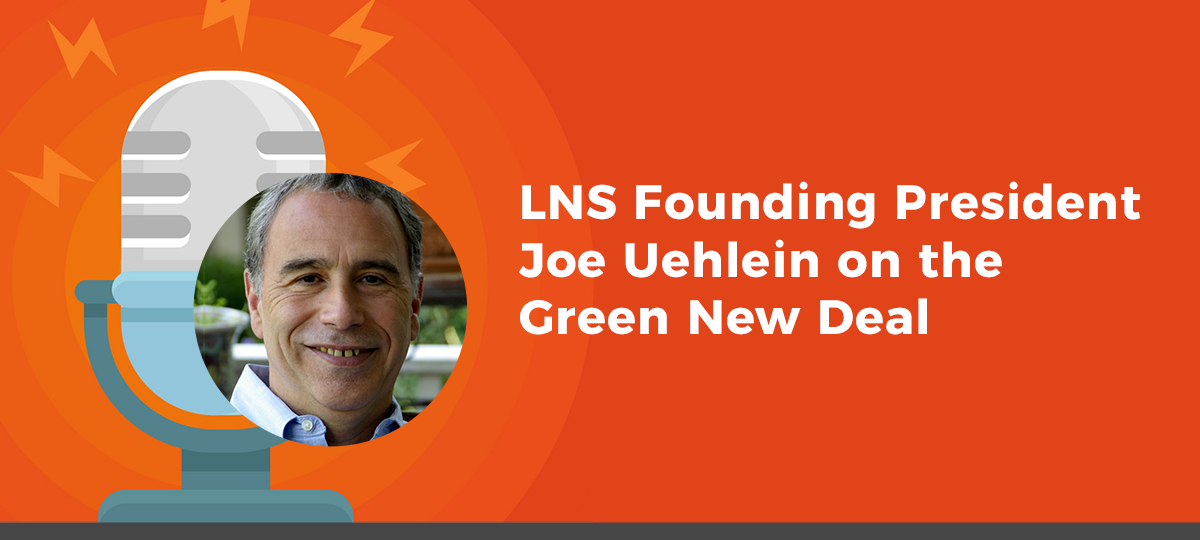
Joe Uehlein on the Green New Deal

By staff - Labor Network for Sustainability, February 2019

On Monday, February 18, 2019, Chris Bangert-Drowns, a senior reporter with WPFW, the Pacifica Radio affiliate in Washington, D.C. spoke with LNS founding president Joe Uehlein about the Green New Deal and the tepid response from some unions. Listen below.

Audio Player

Listen here.

What Do Eco-Socialists Have to Say About the Climate Movement?

By Nancy Romer - New Politics, Winter 2019

To me the role of eco-socialists is to raise transitional demands, demands that bring a broader understanding of the role of capital in creating climate change and the ways that capitalism can be challenged by working people and people most affected by the vast inequality it has created.

Two criteria seem pertinent to me:

1) How do we articulate what it will actually take to save our planet for the humans and other species? That will require a deep transformation that will include locking out at least the fossil fuel and auxiliary corporations and economy, ending wars and militarization of society, taking up a race- and gender-based liberation politics, and creating a thoroughly transforming social-service safety net that expands human development and allows people to look at the whole of society and our planet and make responsible decisions. Without that transformation, certain sectors—by job, by race, by gender, by class, by region—will continue to exert uneven and inadequate pressure on climate-based decisions.

2) How do we create mass movements, often united fronts of a wide range of people and social-political sectors, that can join together to exert power to make real change? How do we articulate demands that can bring the movements together while keeping those demands just a bit beyond the consensus, prodding the movement forward? How do we engage people in a mass-based struggle so that we begin the process of gaining the kind of power needed for the transformation described above?

I have spent much of my political life working in united fronts, organizational expressions of movements, coalitions, and so on, that put forward mass demands that raise consciousness, build power through the movements, and actually create some of the changes we need, not-quite-adequate as they may often be due to movements’ weakness. I have also been a leftist without too much of a “brand” or group of socialists that I have formally joined. Right now I am in Democratic Socialists of America and feel the broad politics of the organization is what keeps it active, muscular, and pushing. They are good comrades to the rest of the climate movement—willing to show up, picket, petition, study, strategize, and to be kind and generous comrades. They are well-respected as a relatively new activist organization in New York. DSA existed for many years before Trump, but after Trump was elected the numbers have exploded—presently up to 50,000 nationally and 5,000 in New York City. Yes, DSA pushes for publically owned and operated, 100 percent renewable, energy now or as soon as possible. Yes, they call for an end to the fossil fuel regime and for a polluters tax. Outside of the “publically owned and operated” part of the demand, these are the demands that our local climate movement has adopted. It is our job as eco-socialists to support the demands of the united front—in this case the Peoples Climate Movement and New York Renews—and push the demands further, specifically toward public power or public ownership of the new renewable energy grid. We need to articulate a fuller politics than can the united front coalitions due to their organizational support and membership, especially in the unions. That “prod” is essential for direction of the coalitions and movement.

12 Reasons Labor Should Demand a Green New Deal

By Jeremy Brecher and Joe Uehlein - In These Times, December 17, 2018

Workers have gotten a raw deal. Employers and their Republican allies are trying to eliminate workers’ rights both in the workplace and at the ballot box. But even when Democrats controlled the presidency and both houses of Congress, they did little to protect, let alone expand, the rights of working people. Workers need a new deal.

Now, an alliance of social movements and members of Congress are proposing a Green New Deal to create millions of jobs by putting Americans to work making a climate-safe economy. This program meets the needs of—and has the potential to unite—the labor movement, environmentalists, and all those who have been the victims of inequality, discrimination, racism and, now, climate change.   

In the week following the 2018 midterm elections, a group of 150 protesters led by young people with the Sunrise Movement occupied the office of likely Democratic House Majority Leader Nancy Pelosi, urging her to support a Green New Deal. Newly-elected House Rep. Alexandria Ocasio-Cortez (D-NY) joined the protest with a resolution in hand to establish a Select Committee for a Green New Deal. The proposal has since amassed growing support among Congressional representatives, progressive organizations and young people across the country. 

The Green New Deal is poised to become a factor in the 2020 elections. Labor unions should take this opportunity to embrace the proposal—and fight to make sure it’s a strong vehicle for advancing workers’ rights.

New Report: Protect the Climate, Save Money, and Create Jobs

By Joe Uehlein - Labor Network for Sustainability, October 14, 2015

Disclaimer: The views expressed here are not the official position of the IWW (or even the IWW’s EUC) and do not necessarily represent the views of anyone but the author’s.

Today labor and environmental organizations released a new report, The Clean Energy Future: Protecting the Climate, Creating Jobs and Saving Money, showing that the United States can reduce greenhouse gas [GHG] emissions 80 percent by 2050 — while adding half-a-million jobs and saving Americans billions of dollars on their electrical, heating, and transportation costs.
Joe Uehlein of the Labor Network for Sustainability says, “This report is good news for American workers. Protecting the climate has often been portrayed as a threat to American workers’ jobs and the U.S. economy. But this report shows that a clean energy future will produce more jobs than “business as usual” with fossil fuels.”

May Boeve of 350.org says, “This report presents a practical, realistic way for the United States to address the climate crisis and proves that we don’t have to choose between jobs and the environment.”

The Clean Energy Future: Protecting the Climate, Creating Jobs and Saving Money refutes the claim that meeting the IPCC targets will cause economic devastation. Indeed, not only can these targets can be met, but meeting them will create more jobs and save money. This report, prepared by the Labor Network for Sustainability and 350.org, with research conducted by a team led by economist Frank Ackerman of Synapse Energy Economics, lays out an aggressive strategy for energy efficiency and renewable energy that will:

Transform the electric system, cutting coal-fired power in half by 2030 and eliminating it by 2050; building no new nuclear plants; and reducing the use of natural gas far below business-as-usual levels.

  • Reduce greenhouse gas emissions 85 percent below 1990 levels by 2050, in the sectors analyzed (which account for three-quarters of US GHG emissions).
  • Save money – the cost of electricity, heating, and transportation under this plan is $78 billion less than current projections from now through 2050.
  • Create new jobs – more than 500,000 per year over business as usual projections through 2050.

This program will help bring together environmental and labor advocates around their common interest in putting Americans to work saving the earth’s climate. Climate protection has caused significant friction between labor unions and environmentalists around whether to create jobs or address climate change. The report demonstrates that this is a false choice. For unions and other jobs advocates, climate protection is also a great jobs program. We can create many more jobs by protecting the environment than by expanding the fossil fuel infrastructure.

Read the full report here: PDF

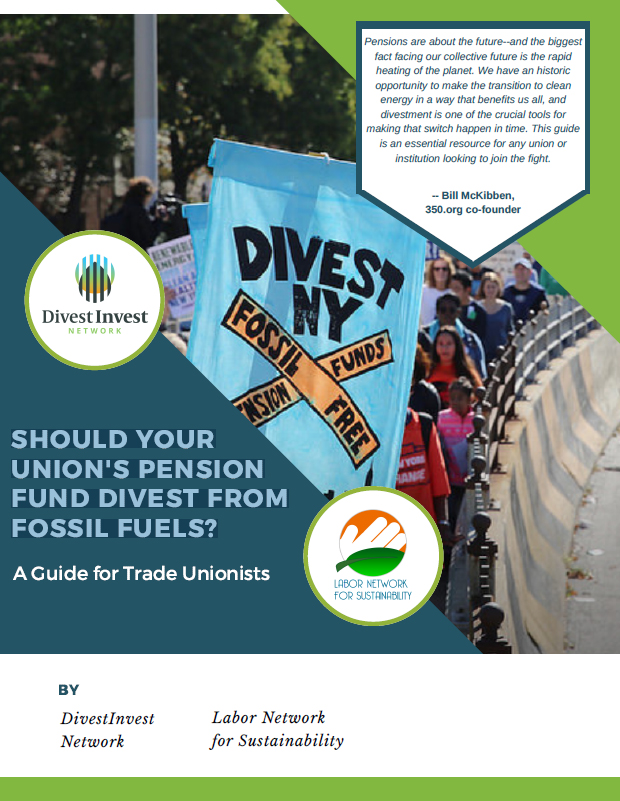
Should Your Union’s Pension Fund Divest from Fossil Fuels?

By staff - Labor Network for Sustainability, November 2018

This guide is designed to help you and your union consider whether you should divest from fossil fuels.

Working people collectively own an enormous amount of capital in our pensions. As a sector, pensions are the largest source of investment in financial holdings, even larger than standard investment houses and banks! Pensions constitute over $40 trillion! Our pension funds are invested in stocks and bonds that may not be serving our interests as working people and may be harming our families’ futures. Imagine what we might be able to support and build, imagine the great jobs we could create, if we use more of our pension funds to directly benefit our members and our families.

The Guide Contains:

  • An introduction to pension fund divestment and links to further information about it
  • Whether failure to divest can constitute a failure in fiduciary responsibility
  • How you can respond to divestment proposals and what questions need to be answered to reach a decision
  • How to start a divestment campaign yourself and answers to questions you may encounter from union members and divestment opponents

Download and Read the PDF Here.

Climate Insurgency Webinar with Jeremy Brecher

By Jeremy Brecher - 350.org YouTube, June 26, 2017

An introduction to the Climate Insurgency strategy framework, which weaves together many strands of climate organizing--mass nonviolent direct action, freezing fossil fuel infrastructure, public trust, and just transition--into a global strategic framework to protect our climate.

This is the first of a series of Exploring Climate Strategy Webinars.

To find out about the following webinars visit: https://350.org/webinars-exploring-cl...


Creating a Just Transition Webinar

By Jeremy Brecher, Labor Network for Sustainability - July 14, 2017

How can we organize to avoid letting our opponents pit "jobs," workers and unions against climate, water and community protection? How can we build "just transition" that includes a better future for workers who produce and use fossil fuels, construction workers who build fossil fuel infrastructure and communities that depend on them?

Pages

The Fine Print I:

Disclaimer: The views expressed on this site are not the official position of the IWW (or even the IWW’s EUC) unless otherwise indicated and do not necessarily represent the views of anyone but the author’s, nor should it be assumed that any of these authors automatically support the IWW or endorse any of its positions.

Further: the inclusion of a link on our site (other than the link to the main IWW site) does not imply endorsement by or an alliance with the IWW. These sites have been chosen by our members due to their perceived relevance to the IWW EUC and are included here for informational purposes only. If you have any suggestions or comments on any of the links included (or not included) above, please contact us.

The Fine Print II:

Fair Use Notice: The material on this site is provided for educational and informational purposes. It may contain copyrighted material the use of which has not always been specifically authorized by the copyright owner. It is being made available in an effort to advance the understanding of scientific, environmental, economic, social justice and human rights issues etc.

It is believed that this constitutes a 'fair use' of any such copyrighted material as provided for in section 107 of the US Copyright Law. In accordance with Title 17 U.S.C. Section 107, the material on this site is distributed without profit to those who have an interest in using the included information for research and educational purposes. If you wish to use copyrighted material from this site for purposes of your own that go beyond 'fair use', you must obtain permission from the copyright owner. The information on this site does not constitute legal or technical advice.
