You are here
E2. Front Line Community Green
Richmondside: Court-appointed former school superintendent to ensure WCCUSD hires qualified teachers
September 9, 2026—Richmondside reporter Jana Kadah covered the appointment of Carl Cohn, a former superintendent and state Board of Education member, to ensure West Contra Costa Unified complies with a requirement to staff its classrooms with qualified teachers. The appointment follows a March ruling from the California First District Court of Appeal in Cleare v. West Contra Costa Unified School District — a two-year legal battle brought by a Public Advocates representing WCCUSD parents and teachers—requiring the district to stop using 30- and 60-day substitutes beyond state time limits and to fill all teacher vacancies at Stege Elementary, Helms Middle, and Kennedy High School. Cohn, appointed by a Superior Court judge on August 27, will recommend compliance steps and mediate disputes going forward. The piece notes Cleare was the first lawsuit filed under the Williams Settlement Legislation, the 2004 agreement guaranteeing California students access to qualified teachers, adequate textbooks, and safe facilities—setting a statewide precedent that teacher shortages can’t justify long-term reliance on substitutes. The article also reports WCCUSD has cut teaching vacancies significantly this year, from over 100 two years ago to 34 at the start of this school year.
The post Richmondside: Court-appointed former school superintendent to ensure WCCUSD hires qualified teachers appeared first on Public Advocates.
A Zambian Youth’s Journey to the Africa Zero Waste Academy 2026
By Cyrus Malama, 2026 Africa Zero Waste Academy Participant
When I boarded my flight on July 26, 2026, I was more than just a Junior Councillor; I was a young Zambian with a vital question: How can we transform the waste problem in our communities into a solution? This question drove me to Accra, Ghana, for the Africa Zero Waste Academy 2026, hosted by the Green Africa Youth Organization (GAYO) and the Global Alliance for Incinerator Alternatives (GAIA).
My purpose was not only to learn about waste management but also to explore culture, leadership, and Africa’s future.
Learning the Principles in KpongThe first phase of the Academy took place at Ensign Global University in Kpong, Eastern Region, from July 27 to 30. Our days were filled with energy and learning as we discussed:
- Climate action and its significance for African youth
- Zero waste principles—understanding that waste is not an endpoint but a starting point for jobs, composting, and clean energy
- Communication and advocacy—recognising that as young leaders, we must express our ideas clearly to effect change
- The Conference of the Parties (COP)—exploring the role of youth in global climate conversations
However, the best lessons awaited us outside the classroom.
Learning from the Ground in AccraOn July 30, we moved to Accra and settled in at the AH Hotel in East Legon. For the next three days, Ghana taught me through its hands, its people, and its stories.
At Kpone Landfill, I witnessed the harsh reality of waste—the mountains, the smoke, and the individuals working under difficult conditions. It reminded me of home and reinforced the urgency of our mission.
At the launch of the Federation of Informal Sector Waste Pickers Association, I met heroes—men and women who collect and recycle daily, often without recognition. Seeing them honoured made me proud and reminded me how important it is to include everyone in creating solutions.
At the Multi-Facility Recovery Centre, I witnessed circularity in action: one person’s waste became another person’s resource. At Kwame Nkrumah Memorial Park, I paused to reflect. Surrounded by Ghana’s history, I thought about leadership. Nkrumah fought for Africa’s independence, and now, our generation is fighting for Africa’s climate future.
Between site visits, I laughed, shared meals, and exchanged stories with youth from across the region. We learned new greetings, tasted different foods, and realised that while waste challenges may vary across Africa, the solutions all begin with people. This cultural exchange was as powerful as the training.
Cyrus and other participants during a session Coming Home with CommitmentOn August 2, I said goodbye to Accra and landed in Lusaka on August 3 at 3:00 AM, where my family welcomed me. Although I was exhausted, my heart was full.
The Africa Zero Waste Academy was transformative. It changed my view of waste—from a problem to something with economic and environmental value. Most importantly, I returned committed to advocating for inclusive, community-driven zero-waste initiatives in Zambia. I aim to apply what I learned in Ghana to make a difference in Lusaka.
I returned with:
- Practical knowledge of zero waste systems
- Enhanced advocacy and communication skills
- A network of African youth committed to developing climate solutions
Most importantly, I returned with a commitment: to advocate for inclusive, community-driven zero- waste initiatives in Zambia. I aim to apply what I learned in Ghana to make a difference in Lusaka. I am deeply grateful to GAYO, GAIA, and everyone who supported me in representing Zambia in Ghana. Thank you for investing in young leaders. This experience was not just a trip; it was a turning point.
Writer’s Bio
Cyrus Malama is a Junior Councillor based in Lusaka, Zambia. His work centres on child rights, climate action, community development, and issues affecting young people. He believes that because the future belongs to youth, leaders must actively listen to young voices and take action to protect every child.
The post A Zambian Youth’s Journey to the Africa Zero Waste Academy 2026 first appeared on GAIA.
GAIA Response to the Aid to Negotiations
Your excellency, Amb. Julio Cordano,
The release of the Aid to Negotiations marks a key step in the process to develop a legally binding international instrument to end plastic pollution. Unfortunately, rather than bringing the Parties closer to delivering the ambition mandated by the United Nations Environment Assembly (UNEA) Resolution 5/14, the document raises profound concerns about both its substance and the process by which it was developed.
Your Aid to Negotiations is not a neutral facilitation document. It is a political document that makes choices. These choices consistently favor the lowest common denominator – about what is prioritized, what is sidelined, and what is left unresolved. And time and again, sacrificing the ambition mandated by governments in Resolution 5/14.
The result is deeply troubling: rather than facilitating progress towards an ambitious, fit-for-purpose treaty supported by a majority of countries, as demonstrated in previous rounds of negotiations, the Aid to Negotiations text is an insidious attempt to compromise on the wishlist of a small group of petrostates.
Rather than helping Parties conclude a treaty capable of truly ending plastic pollution, the document renders ineffective the core elements needed to achieve its objective. It systematically removes obligations to address upstream measures, weakens the financial mechanisms necessary to ensure effective implementation of the instrument, and excessively relies on voluntary, non-binding, nationally determined measures whilst sidelining binding ones. It gives disproportionate weight to positions advanced by a small group of countries that have consistently sought to delay, dilute, and derail negotiations, while disregarding proposals supported by broad majorities of Parties.
Since your assumption of the Chairmanship, observers—particularly those representing the communities most impacted by plastic pollution—have repeatedly been denied access to the process. This has effectively turned what should be an inclusive, transparent, and fair multilateral process into almost a year-long series of closed-door meetings, under the pretext of an informal Member State-led process. The ambiguity in the Rules of Procedure regarding observer participation in informal meetings has been repeatedly invoked to justify our exclusion. Such restrictions undermine the transparency, inclusivity, and legitimacy of the process. Those living on the frontlines of the plastics crisis cannot be expected to accept decisions being made about their lives, livelihoods and communities from behind closed doors. Yet, we remain attentive, engaged and determined to achieve an ambitious, fit-for-purpose treaty that protects human health and ensures environmental justice to all. The Aid-to-Negotiations text carries a conscious choice. Specifically:
- Conference Room Papers supported by large numbers of ambitious governments on key upstream measures have been ignored, while weaker downstream options championed by a handful of spoiler countries are prioritized
- The text regress us instead of building on progress achieved over the past five negotiation sessions
- The interpretation of “balance” consistently result in lower ambition
- Texts that have been officially rejected by the International Negotiations Committee at INC-5.2 are considered as references
- Low-ambition text that has not been previously negotiated in the formal INC process, has been introduced
These are not rhetorical questions. They go to the heart of whether this process is still serving the mandate governments agreed to in Nairobi in 2022.
UNEA 5/14 Is Not Open for RenegotiationThere is no legitimate disagreement about the treaty’s purpose. Governments agreed that this instrument must end plastic pollution through a comprehensive approach addressing the full lifecycle of plastics. Yet, the document repeatedly treats upstream obligations as optional, secondary, or politically unrealistic while upending the waste hierarchy and prevention principles.
Plastic pollution does not begin at the waste stage; it begins with fossil fuel extraction, petrochemical production and ever-increasing plastic production. No amount of geopolitical influence can override the prevailing scientific evidence when it comes to reordering the stages of the plastics lifecycle. The science is clear: the plastics crisis must be addressed across its full lifecycle, and no political maneuvering can change that reality.
Three-quarters of greenhouse gas emissions from primary plastic production occur before polymers are even manufactured. Waste management systems cannot solve a crisis driven by unchecked production. Only around 9% of all plastics ever produced have been recycled. A treaty that does not address production cannot end plastic pollution if it ignores its primary driver.
Consensus cannot become a VetoThe document also perpetuates another false narrative: that consensus at any cost is necessary for success. It is not.
More than 115 countries support maintaining the ability to adopt decisions by voting after all efforts to reach consensus have been exhausted. This reflects a standard and widely accepted practice under international law. Without this safeguard, an impasse shaped by a handful of minority countries seeking to delay or weaken the treaty could render any progress or achievement supported by the overwhelming majority of governments meaningless.
The climate regime offers a clear warning: overreliance on consensus has delayed, weakened, and postponed critical decisions for decades. The plastics crisis cannot afford to wait 30 years for urgent action.
Consensus should be the preferred outcome, not a permanent veto for those most invested in preserving the status quo. Consensus is not interchangeable with unanimity.
The document points toward a Framework ConventionThe most worrying feature of the Aid to Negotiations is its overall direction. Throughout your communications, you have emphasized that the treaty should be “concise”, “adaptable,” and capable of evolving over time. Taken together with the removal of substantive obligations throughout the document, this suggests a deliberate shift toward a framework convention. A treaty that establishes broad aspirations today while postponing binding and urgent measures until future protocols is spineless. That is not what governments mandated in the UNEA 5/14 Resolution.
Framework conventions delay action, postpone difficult decisions, and require years, sometimes decades, of additional negotiations before meaningful obligations exist, if they are ever achieved. The world does not have that time.
The plastics treaty must include binding global control measures from the outset, supported by annexes that can be strengthened over time by independent, science-based evidence. This is how a treaty can both evolve and remain relevant and effective.
Transparency has been replaced by OpaquenessThe concerns extend far beyond the text itself. The process through which this document has been developed has lacked transparency from the outset – and this deficit has become increasingly pronounced since you assumed the Chairmanship of the Committee.
Governments, rights-holders and observers have no clear understanding of how negotiating advances were discarded, why widely supported proposals disappeared, or on what basis competing options were selected.
A Chair’s document should faithfully reflect Parties’ positions; it should not quietly rewrite them. When choices consistently favor those seeking weaker obligations, confidence and trust in the neutrality of the process inevitably erode.
With a document so consistently aligned with the agenda of countries seeking the weakest possible treaty, it is reasonable to ask: Whose positions is this document actually reflecting and representing?
At every stage of this process, meaningful civil society and rightsholders participation has been systematically sidelined, increasingly reduced to the margins and, in practice, denied altogether. Governments face language barriers that prevent meaningful participation from any non-English-speaking delegation. Indigenous Peoples, waste pickers, frontline communities, women, youth, scientists, and public health experts have repeatedly been prevented from fully and effectively engaging in this process.
In your 4th letter to the Committee, you proposed a new multi-stakeholder action agenda. Observers are not asking for another forum; we are asking to participate in the negotiations and to have the right to engage with our country’s representatives present at the negotiations.
We also reject the false equivalence implied by the term “Observers.” Communities living with plastic pollution are rights-holders. Corporations whose business models depend on expanding plastic production are not. The Tobacco Convention recognized this distinction and succeeded in solving the problem it was intended to address. The Plastics Treaty must do the same.
Leadership requires Upholding the Mandate, not Lowering ItThe Committee won’t succeed by producing a document that everyone dislikes equally. Your responsibility is not to protect the comfort and interests of the least ambitious Parties. It is not to make a treaty that is politically convenient for spoiler countries. It is to facilitate negotiations that allow governments to deliver the treaty they were mandated to negotiate.
The Aid to Negotiations does the opposite: it narrows ambition. It privileges obstruction. It weakens obligations. And it risks steering this process toward a treaty incapable of ending plastic pollution.
A Note to Ambitious Countries
We, Observers, recognize that this process has been intense, demanding, and frustrating. Yet, we have not come this far to agree to a text that does not fulfill the mandate of Resolution 5/14. We request that Governments reject any negotiating text that retreats from the agreed mandate.
The world did not launch these negotiations to produce another framework for future discussions. It was launched to end plastic pollution. That remains the benchmark by which this process should be judged.
Civil society will stand with ambitious countries that reject a weak treaty. Your leadership is needed to avoid a catastrophic outcome. No treaty remains a better option than a bad treaty.
We also encourage you to consider negotiating a treaty outside the UN. The UNEP umbrella has consistently failed to deliver a fair process, and unfair processes do not result in strong outcomes. A treaty driven by the ambitious majority, guided by a genuine desire to end plastic pollution and by the power and experience of countries that have demonstrated commitment to the process has a winning chance to deliver the needed outcomes. If you decide to move in the direction of a Coalition of the Willing, civil society will stand firmly alongside you applauding your braveness, supporting your decisiveness and ready to work with you.
The post GAIA Response to the Aid to Negotiations first appeared on GAIA.
Utah Study Blesses Investment in Oakland Coal Terminal But Leaves Key Questions Unanswered
After sitting on a 231-page “feasibility study” of a West Coast coal terminal for more than a month, the eight-county Rural Utah Infrastructure Coalition (RUIC) finally released the engineering and economic analysis on the Saturday of Labor Day weekend, just five days before a public hearing on RUIC”s proposal to invest $40-45 million of Utah public money in the Oakland export facility and another $10 million in a more distant facility in Longview, Washington.
In February of this year, RUIC commissioned Norda Stelo, a giant Canadian-based engineering firm, aided by Wood Mackenzie, a Scottish energy consultancy, “to identify replacement export capacity for Utah coal following the planned closure of the Levin-Richmond terminal at the end of 2026.” (1) The consultants were paid $488,000 to compare three possible locations: Oakland, Longview, and Guaymas, Mexico.
Guaymas was dismissed without much fanfare, and the competition between frontrunner Oakland and also-ran Longview served mainly as a distraction from the question barely addressed in the report: will the Oakland coal export terminal sink under the weight of economic, regulatory, and political risks. If Utah antes, will any other investors come to the table?
The answer is nowhere to be found in the report. The report gave the Oakland terminal project an overall weighted score of 2.85 on a scale of 1 to 5. The grading considered many detailed requirements where 1 indicates the facility does not meet the requirement and 5 indicates it fully meets the requirement. If 5 is an A and 4 is a B, an overall grade of 2.85 is a ho-hum C, not a strong argument for investment. Nonetheless, Norda Stelo recommends that RUIC invest approximately $43 million in Oakland.
The report brings new clarity to what developers have been up to since the project emerged from a decade of litigation in September 2025. Last Thursday, RUIC presented a vague overview of the plan to funding decision makers at Utah’s Community Impact Board and said they would be back as soon as October 1 to apply for the money, but, first, RUIC plans to hold a public hearing in Provo, Utah and online on Thursday, September 10.
As developers seek financial support from Utah for their private coal export scheme, the Norda Stelo report presents a mixture of revelations, questionable claims, and concessions to reality.
RevelationsThe developers have no intention of designing a state-of-the-art terminal that will prevent any leakage of coal dust. Coal will be stored in two 150,000-ton open air stockpiles (190), not in “[c]overed bulk material storage buildings” described in the Basis of Design and pictured in the conceptual drawings filed with the City in 2015 and 2018.
.stk-6kxoqxe .stk-img-figcaption{text-align:left !important;font-size:16px !important;line-height:1em !important;}@media screen and (max-width: 1023px){.stk-6kxoqxe .stk-img-figcaption{font-size:16px !important;}} This drawing was submitted to the City of Oakland in 2015 as part of OBOT’s Basis of Design. “Commodity A” was the euphemism for “coal” that the developers adopted when they were concealing their ongoing business relationship with a Utah-based coal mining company.The developers need to raise a lot more cash than they admit. Based on comparable coal terminals of similar throughput and material type, Norda Stelo estimates the cost to build the terminal at $430 to $625 million, not the developers’ cost estimate of $250 million. Norda Stelo notes, without comment, that the developer provided no basis for its estimate “beyond some budgetary vendor quotations.” (18)
If engineering got underway immediately, the terminal might take until 2031 to begin operations. “The overall project duration is estimated at approximately 53 months from the start of engineering to first cargo. As highlighted in Section 4, the OBOT proponent’s October 2028 first-cargo target is not consistent with this schedule.” Apparently, Donald Trump’s boast is false: “Starting this summer, the West Gateway project will break ground, and by summer 2028, over 12 million tons of clean beautiful coal per year will be shipped to countries all around the world.” The West Gateway project does not have a building permit, much less a shovel in the ground, and Norda Stelo estimates it will take more than double the President’s timeline to get a terminal up and running.
The “multi-commodity terminal” is no more; it’s all about coal. OBOT’s developers appear to be quietly ditching their oft-repeated (and contractual?) commitment to build a multi-commodity terminal. The only sharing of the terminal discussed by Norda Stelo is between two varieties of coal: Utah coal and Wyoming Powder River Basin coal. Wood Mackenzie provides a pro forma analysis of other commodities – copper, soda ash, and oil and gas – but serious interest in building a multi-commodity terminal is belied by the report’s sharp focus on coal.
Savage Companies, a large Utah-based logistics firm, has signed up to operate the terminal. Savage has contributed an “OBOT Terminal Project Design Basis” document to the Norda Stelo report along with drawings by Millcreek Engineering.
Delusions and questionable claims“A coal handling permit is reportedly in place” (19) There is no such thing as a “coal handling permit.” This is a good reminder of Norda Stelo’s warning that their report is based on whatever the developers fed them: “The evaluation of the two facilities is based on information provided by each facility proponent, supplemented by site visit observations and publicly available documentation. No independent verification or detailed condition assessment was performed by Norda Stelo as part of this study.” (8)
“No pending legislative or regulatory changes are identified.” (22) Based on Norda Stelo’s caveat, it is fair to read this as a statement about what Phil Tagami disclosed or failed to disclose to Norda Stelo. As widely reported, on June 15, 2026, six weeks before the Norda Stelo’s report was finalized, Assm. Mia Bonta introduced the Communities First Coal Review Act (AB40) which would require an Environmental Impact Report for any major new coal terminal. The California Legislature has overwhelmingly passed Bonta’s bill and it is awaiting signature on Gov. Newsom’s desk. Moreover, the Bay Area Air District has been in the process of revising its fugitive dust regulations for many months, including specifically those governing “bulk material handling and storage.” Both AB40 and the new Air District regulations may significantly impact the future of the project. Failure to capture these major developments calls into question the reliability of Norda Stelo’s assessment of regulatory risk.
“Oakland [Bulk & Oversized Terminal[ … has substantial public funding support.” (28) “Approximately USD 315 million in public funding has been identified (USD 75 million federal and approximately USD 240 million state).” (19) This is deeply misleading. The $242 million Transport Corridor Improvement Money grant to the City and Port of Oakland covered horizontal redevelopment of the 360-acre Oakland Army Base. It was spent long ago on a rail yard, roads, cleanup, soil compaction, new utilities, and the like. None of this government money was ever available to any of the private developers leasing land from the City or the Port for private benefit. Thus, Norda Stelo’s conclusion that the project has already lined up $315 million dollars of public money is nonsense. That leaves Donald Trump’s pledge to contribute $75 million under the Cold War era Defense Production Act. Trump’s diktat appears legally shaky given the lack of a nexus between shipments of Utah coal to Asia and a legitimate national defense interest.
Silences That Speak Louder Than WordsNo interest from private investors is mentioned. In 2015, the pitch to the CIB was done by Jeffrey Holt, an investment banker with Bank of Montreal who suggested that, if Utah would seed the project with $50 million of public money, pension funds could be persuaded to make $200 million of non-recourse loans to fund the project. Now, with as much as $625 million to be raised, the report that is supposed to convince the Community Impact Board to open Utah’s pursestrings provides no assurance that there will be any private investors prepared to close the enormous gap between what public sources might provide and the amount needed to get the project off the ground.
Wood Mackenzie’s economic analysis obscures the secular decline of the overseas coal market. The economic analysis consists of 116 densely packed presentation slides without a coherent narrative to tie them together. There is very little information or analysis of the long-term trends or country-by-country risks that may sink any coal export terminal built at this late point in the world’s transition away from coal.
The study does not show that the market for Utah coal exports “should be profitable for at least 20 years.” Neither does it “confirm” that a West Coast bulk commodities terminal is “a sound and prudent investment for Utah.” These representations by RUIC prior to its visit to the Community Impact Board last Thursday are not supported by the report.
Redactions cover up key facts. Utah law allows agencies to redact trade secrets and other confidential business information from public documents before releasing them, but some of RUIC’s redactions appear designed to cover up inconvenient facts. For example, the list of approvals that “may” be needed by the West Oakland terminal begins with a four-inch black stripe. (20) The developer may dispute one or more items on Norda Stelo’s list, but this does not make it a business secret entitled to be kept from disclosure. The answer to a simple question about what site preparation and demolition work would be required prior to construction is half-redacted. (33) Hardly a trade secret or confidential business information that could lead to competitive harm.
Concessions to reality“Significant community, permitting, environmental, and schedule risks have been identified” for the Oakland terminal. (27)
“Very strong opposition is documented from community and environmental organisations including No Coal in Oakland, Sierra Club, San Francisco Baykeeper and Earthjustice, with a demonstrated history of litigation and regulatory intervention. A letter dated 13 May was issued by No Coal in Oakland to the Coalition, Norda Stelo and Wood Mackenzie, stating a commitment to oppose the project by ‘every feasible means.'” (20)
The site remains constrained by its geometry. A loop track is the most efficient way to unload a mile-long train. The train pulls in from Utah, enters a loop, dumps its load a couple of cars at a time into a below-grade dumping station, and heads back to Utah without reconfiguration and consequent delay. Here’s the plan for Oakland:
“Railcar movements are based on switching and segmented handling of unit trains using a dedicated switching locomotive. Coal is delivered in 116-car unit trains and, for yard operations, trains are assumed to be broken into two 58-car segments and then further divided into 29-car cuts for unloading. Two parallel tracks are provided at the in-motion bottom-dump system, with one track designated for active dumping while the adjacent track is used for switching and train set-up.” (190)
Notably, there is no room for expansion to service other commodities that do not share the physical characteristics of coal, none of which are identified in the report. “[T]he limited site area provides little opportunity to accommodate additional commodity-specific storage or handling infrastructure.” (15)
Image at top: Aerial view of the Richmond-Level coal terminal, which will retire from coal shipment at the end of 2026. Image credit: SF Baykeeper.
Note: Up to page 28, the page numbers in the text are those shown at the bottom of each page of the Study Report. Higher page numbers refer to the page location within the PDF.
Why a West Oakland coal terminal matters to Berkeley
On Tuesday evening next week – September 15, 2026 – the Berkeley City Council will vote on the adoption of a resolution “in opposition to the handling, storage, and transport of coal and petroleum coke in the San Francisco Bay Region, urging stringent regulation of such facilities by the Bay Area Air District, and in support of Assembly Bill (AB) 40.” Starting at 6:00 pm outside the City Council meeting, the Keep Coal Out of the East Bay campaign will stage a rally and – we hope – a celebration of the resolution’s passage (event details here).
Join us!
Berkeley’s resolution is prompted by the threat of coal shipment through the proposed Oakland Bulk and Oversize Terminal (OBOT). Local developer Phil Tagami and his partners have been angling for more than a decade to build OBOT as a coal export terminal. The proposed terminal would be located at the foot of the Bay Bridge in West Oakland, near the toll plaza. President Trump and the State of Utah plan to contribute millions of dollars in public funds toward the (private) terminal’s construction. The proposed terminal would ship coal from Utah (and perhaps Wyoming) to buyers in Asia, most likely Japan and South Korea.
In July, the City of Richmond passed a resolution similar to the one on Berkeley’s City Council agenda next week. Other cities along the rail route are also being asked to weigh in against the proposed coal terminal.
But why would a coal export terminal in West Oakland be any of Berkeley’s business? Here are a few top-shelf reasons:
- There’s the existential and moral interest Berkeley has about mining and export to Asian markets of ten to twelve million tons per year of the dirtiest, most polluting fossil fuel: coal that would otherwise be left in the ground. Burning coal anywhere in the world in quantities developers propose to ship through West Oakland would generate over 25 million tons of CO2 emissions every year the terminal operates … adding to emissions humans must radically reduce in order to mitigate the evolving climate crisis.
- Then there’s the neighborly interest Berkeley has about what happens in Oakland. If a toxic, polluting coal terminal threatens to become operational in West Oakland, severely impacting the health of Berkeleyans’ neighbors, friends, and families, how could such a looming travesty not be a concern to the City and people of Berkeley?
- Additionally, there’s self-interest. Coal will not be magically teleported to West Oakland. It will be transported by multiple, daily, mile-long trains in uncovered coal cars. The most likely route those massive trains will take – spewing greasy, grimy, disease-inducing coal dust all along the way – hugs the East Bay shoreline from Martinez to Richmond to West Oakland … and cuts right through the City of Berkeley.
All in all, the proposed coal facility is a textbook example of an axiom central to Berkeleyans’ civic identity: think globally, act locally.
The image (map) at the top of this article suggests the nuts-and-bolts impact of multiple, mile-long coal trains passing through Berkeley every day. Zooming in on a map that illustrates a peer-reviewed study in the journal Environmental Research, shown in the lower left corner of the image above, it makes clear just who and what will be poisoned in Berkeley by coal dust shed from those trains.
- Schools and medical facilities, including Centro Vida Preschool, Ecole Bilingue, Rosa Parks Elementary School, and Kaiser Berkeley.
- Playgrounds and parks, including Adventure Playground, Aquatic Park, the Berkeley Marina, Cedar Rose Park, McLaughlin Eastshore Park, San Pablo Park, Shorebird Park, Strawberry Creek Park, and the Tom Bates Sports Complex.
- Places we live and shop for groceries and grow our own food, including Berkeley Bowl West, the Gill Tract Community Farm, University Village (where thousands of UC Berkeley students and their families live, and whose community garden is right next to the train tracks), and all homes within a half-mile or so of the train tracks.
- Businesses and commercial districts, including Ashby Lumber, Bayer, Berkeley Ironworks, the Fourth Street shopping district, Meyer Sound, and REI.
These are only partial lists. But they make clear that the proposed West Oakland coal terminal is of paramount interest to the City of Berkeley and all its residents … for all kinds of reasons.
That’s why next week’s City Council vote to adopt a No Coal resolution matters. A lot.
Please come out Tuesday evening, 6:00 to 8:00 pm, to rally while the City Council votes, and to celebrate the hoped-for passage of the resolution. The City Council meets at the BUSD Boardroom, at 1231 Addison St. between Bonar and Curtis (map). Event details can be found here.
September 2, 2026 Read great news article about the August 28th town hall meeting in Hanford in California’s Central Valley to educate, unite and mobilize residents against proposed AI Data Centers! Join Greenaction in this fight!
September 2, 2026
Read great news article about the August 28th town hall meeting in Hanford in California’s Central Valley to educate, unite and mobilize residents against proposed AI Data Centers! Join Greenaction in this fight!RJI Community Reports: Research Justice 101
“Research justice” can sound like a big concept, but at its core it’s about valuing the lived experiences and desires of marginalized community members as essential pieces of evidence and data. Incorporating it into your research practices means ensuring meaningful community participation in every step of the research process. Furthermore, research justice centers the desires of communities as key to understanding their circumstances, rather than relying on narratives that present communities as broken or as problems (i.e., deficit narratives).
To gain a deeper understanding of what research justice is, the Research Justice Institute looks to the work of BIPOC (Black, Indigenous, and People of Color) scholars and researchers. Read on to unpack four key terms, along with some suggested readings, that are integral to understanding research justice.
1.Research oppressionTo understand research justice, it is important to start by unpacking what research justice is not. As pointed out by DataCenter in their 2015 report “Introduction to Research Justice,” there is a power imbalance within research practices, wherein dominant institutions control the production of knowledge, resulting in marginalized communities being unable to control or access information produced about them. Research oppression occurs when community members are viewed solely as subjects of research, rather than as active participants in the research process (DataCenter 2015). Social science research has long been used as a tool of oppression. In his book Thicker than Blood: How Racial Statistics Lie, Tufuku Zuberi points to the role that white supremacy plays in our understanding of society. White logic grants objectivity to white scholars while devaluing BIPOC experience and expertise, often framing it as too subjective or anecdotal. Community members’ lived experiences are dismissed as invalid to the research process, leading to dominant institutions controlling the data and the stories that are told about marginalized communities, without the community’s input (Zuberi 2001). When we refuse to use white supremacist logics and tools in our research practices, we envision an alternative to research oppression: research justice. Research justice places community experiences and desires at the forefront of the research process, uplifting community members as integral to every step. Research justice is a process and platform that affirms that marginalized communities are the experts in their own lives.
2.Dominant data vs community dataIt is important to understand the distinction between dominant data and community data, and how each may be utilized to advance the aims of research justice. Dominant data is gathered by dominant institutions such as governments and universities, and is often gathered in service of the dominant institution. These data are typically gathered using large population-level surveys like the Census or through the collection of information an individual provides in exchange for a service (i.e., administrative data). Dominant data, which are often quantitative, can highlight trends within populations, but often perpetuates deficit narratives. Numbers and statistics do not always capture the social, political, economic, and historical contexts of the data, often leading to conclusions that lack nuance and place the blame on marginalized communities for their own marginalizations. For example, without the context of institutional racism, a statistic proving the high amount of police violence in Black neighborhoods might imply that Black neighborhoods are inherently dangerous, or that Black people themselves are violent, rather than acknowledging the many social and political factors that lead to over-policing of Black communities (Lanius 2015).
On the other hand, a key aspect of community data is that it is contextual. At CCC, we define community data as evidence generated by communities about their everyday lives, realities, and desires. Examples of evidence can include numbers, words, art, music, maps, and stories. Community data is collected, interpreted, and used on the terms of the community. By working with communities to understand their everyday experiences, we can gain a true sense of community needs and desires.
3.Community-led researchCommunity control is a key tenet of research justice. Research justice uplifts and values marginalized communities as experts of their own lived experiences and, therefore, as leading experts in how to improve their everyday realities and overall well-being. When conducting research with marginalized communities, it is important to not only include community members, but to treat them as authorities in the research process. Trust and collaboration between researchers and community members are paramount, as demonstrated through the work of anthropologist Mariana Mora. Mora worked with a Zapatista community in Chiapas, Mexico to shape her research on Zapatista politics, autonomy, and self-determination. In her article “The Production of Knowledge on the Terrain of Autonomy: Research as a Topic of Political Debate”, Mora takes readers through her research process, describing the ways in which community members helped to shape and evaluate her research at every step, from research design to reviewing drafts of her 2017 book, Kuxlejal Politics: Indigenous Autonomy, Race, and Decolonizing Research in Zapatista Communities. Mora’s experience highlights the importance of community-led research, and provides a key example of how research can be designed and conducted in collaboration with community members.
4.Damage- vs desire-centered researchIn an open letter to communities, researchers, and educators, Eve Tuck, Unangax̂ scholar, calls for a moratorium on damage-centered research – research that documents pain and oppression in an attempt to leverage change for marginalized communities. Tuck argues that damage-centered research frames marginalized communities as depleted and broken, perpetuating deficit narratives and defining communities solely by their marginalization. Tuck instead proposes a desire-based framework for research, in which lived realities are acknowledged alongside hopes and visions for the future (Tuck 2009). Research justice should employ a desire-based framework in order to avoid framing marginalized communities solely by what they lack, and to acknowledge the full spectrum of inequality, oppression, wisdom, hope, and the potential for change that exists within all communities.
Check out RJI’s reading library to dig deeper into these concepts and more:These concepts and readings provide an overview of the key components of research justice, and it is only the tip of the iceberg. To continue exploring these ideas and access a wider range of resources, we encourage you to visit our growing RJI Zotero library.
A look back: 2025 Summer Soirée "Rooted in Resilience"
State Sen. Khanh Pham sharing meaningful remarks as our featured speaker. Watch the full speech on our YouTube!
“Building community is what gets us through these times,” shared State Senator Khanh Pham to a packed room at this year’s Summer Soirée on June 13.
“It’s being in relationship with people who share our vision and our values – that is what helps us move out of fear and into collective action.”
At the Coalition of Communities of Color, this belief is at the heart of our mission. Our theme Rooted in Resilience was an important reminder that our strength is most powerful when shared, and grows when we’re together – even in the hard times, like the one we’re facing now.
We are so grateful to everyone who joined and supported our 2025 fundraising gala. We filled the night with a festive and meaningful atmosphere, with tunes by DJ Just Jeff, and folks enjoyed bites from our diverse selection of vendors that were both culturally rich and delicious.
A special thank you to our featured speaker, State Senator Khanh Pham, and our guest speakers, Mayor of Portland Keith Wilson and Oregon Community Foundation’s (OCF) Michael McIntosh, for their powerful and inspiring remarks.
Watch State Sen. Pham’s full speech at CCC’s Summer Soirée here!
View Full Album A Successful Summer SoirÉe
We extend a heartfelt thank you to OCF for being our presenting sponsor and for their support in helping make this night a success.
Together, with the power of community, we raised over $270,000 to sustain our work of transforming systems so that every Oregonian – across race, gender, or zip code – can thrive. At a time when our values are being attacked, your support means more than ever. Thank you!
Thank you to everyone who joined our CCC team at the Summer Soirée!
Because of these generous donations, we will be able to continue our efforts to provide research grounded in lived experience, solutions shaped by community voices, and policies that build a more just and resilient environment for those facing the first and worst of the climate crisis. See our work in action: watch our MADE for Health Justice video.
Didn’t have a chance to donate but want to support? Click here to make a donation today. Every donation makes a difference.
We hope you will join us next year as we celebrate our 25th anniversary! Details will be shared as they become available. Subscribe to our email list to stay in the loop.
Take a look at our event details:Our special night took place at the OHSU Robertson Life Sciences Building. We are so grateful to OHSU for being our venue sponsor and for generously supporting our event.
A special shoutout to our host and vendors:
Poison Waters as our Emcee and Auctioneer
Devil’s Food Catering
Plant Based Papi
Annam VL
DJ Just Jeff
And a special thank you to those who donated items for our raffle prizes and auction packages!
Thank you to our Summer Soirée sponsors!Support CCC
CLOSED: We're hiring: Data Systems Administrator
**This opening is now closed. We are not accepting any further applications at this time. Thank you.
Applications due by August 27. Click here to view a full description of the job post.
JOIN OUR TEAM: The Coalition of Communities of Color (CCC) is excited to announce a new role within our Research Justice Institute! We’re looking to hire a dedicated and experienced Data Systems Administrator to lead the development and management of a robust, community-led, environmental justice data system. This role requires someone with technical expertise in developing data systems with a strong focus on equity.
Position OverviewAs the Data Systems Administrator, you will lead the development, management, security, and accessibility of our community-led environmental justice data system. This is a first-of-its-kind opportunity to ensure that qualitative and quantitative data collected by community-based organizations is stored and made available in a way that supports equitable policy decision-making while respecting community ownership.
We are seeking a data platform engineer and community-minded leader that understands both data systems and the ethical considerations of handling dominant institution quantitative and community-generated qualitative data, and shares our values and commitments to research and data justice.
The Data Systems Administrator will play an integral role in advancing CCC’s Modernizing Anti-Racist Data Ecosystems (MADE) local level data ecosystem that will advance regional responses and approaches to extreme weather and climate justice needs. They will lead the development, implementation, and management of CCC’s environmental justice data systems, including selection and oversight of technical vendor(s) and building the back end of our data platform. They will also play a key support role in the Research Justice Institute’s quantitative research and data projects and reports.
For complete details about responsibilities, qualifications and compensation, view the full job posting here.
About the Coalition of Communities of Color
Formed in 2001, the Coalition of Communities of Color is an alliance of culturally specific, community-based organizations engaged in collective action for racial justice. We work to improve outcomes for communities of color through advocacy, environmental justice, and research. Learn more about the Coalition of Communities of Color, its member organizations, and our Research Justice Institute.
TO APPLYPlease send a cover letter (max one page) and resume (max two pages) in one PDF file to HR@coalitioncommunitiescolor.org, with the subject line and file name “[Your name] — Data Systems Administrator.”
Applications are due Wednesday, August 27.
View Full Job PostEarth Day to May Day 2024
“Earth Day to May Day” Marcha Campesina, Skagit County, WA. Photo credit: David Bacon
Happy Earth Day!
Started in 1970, the original Earth Day is often credited to Wisconsin Governor/Senator Gaylord Nelson, but there is actually a lot more grassroots action behind this story. Spurred by the warnings of Silent Spring and 1969 catastrophes such as the Santa Barbara offshore oil spill and the Cuyahoga River catching fire, the young environmental movement organized a national day of campus teach-ins, mass demonstrations, and public school activities such as tree planting and beach cleanup. An estimated 20 million people participated. Given the tenor of the counterculture and anti-war movement at that time, a protest that focused on affirmative, solution-oriented actions was widely embraced by all – a little known fact is that the United Auto Workers (UAW) were the single largest financial supporter of the first Earth Day.
Earth Day actions led to the creation of the EPA, Clean Air Act and Clean Water Act. Over 50 years the idea has spread to nearly every country in the world. But now, it has mostly lost the fierce and urgent edge that it once had. If you attended Earth Day events over the weekend, you likely saw a pavilion with Exxon plastered on it or a stage sponsored by Chevron. Every channel shows ads implying that “BP” stands for “Beyond Petroleum” (to that we say: “BS”). Corporate co-optation and disinformation have neutered and ruined Earth Day, to the point where many in the environmental justice movement ignore it.
But EJ needs to reclaim Earth Day, to make it once again a day of protest, to exceed its inoffensive image by engaging in direct action and demanding the necessary policy changes and redistribution of resources to the grassroots communities and local economies that are fighting to protect their lived environments while also building real solutions from the bottom up.
Next week we will celebrate another holiday that is very important to our movements. May Day has a much longer history, and over the centuries it has become complex and multi-faceted. Originally a fertility ritual rooted in pre-Christian European cultures, May Day was a signal of the beginning of the planting season, and therefore it is inherently “green.” In the 1880’s it gained its “red” aspect after May 1st was declared an international day of demonstration for all workers to demand respect and dignity, and it became firmly entrenched in the early labor movement as a commemoration of the Haymarket martyrs. Ironically, International Workers’ Day has been pretty effectively suppressed in the United States where it originated, but it is a cherished reprieve from work and a vibrant day of action in many other countries. Beginning in 2006, May Day became also “brown” after immigrant workers, mostly Latino and many undocumented, organized marches all over the US declaring that they were unafraid and demanding the human rights they deserved. To this day, our comrades at Familias Unidas por la Justicia organize an annual Marcha Campesina to call attention to farmworkers’ rights.
This “green/red/brown” vision of May Day is so important to us at the Just Transition Alliance. It vibes perfectly with our history and our perspective. We seek to bring together Labor and EJ movements, to center the voices of those on the frontlines and fencelines of production, and to build grassroots power as we restore health to the workers and families who keep our economies running, repair relationships with our neighbors and comrades in struggle, and regenerate thriving ecosystems in the places we call home.
Let’s make “Earth Day to May Day” a continuous ten-day festival. A festival of action and organizing to make a better world possible. A festival of resistance where we raise our voices, not allowing anyone to go on complacently accepting business as usual, where we demonstrate our visions by celebrating our grassroots solutions, and where we recognize our strength by joining together from many perspectives to become unified in our shared need to transcend beyond colonization, extractivism, and oppression.
Content Earth Day to May Day 2024 appears first in Just Transition Alliance.
Successful Trainings with JTA Partners
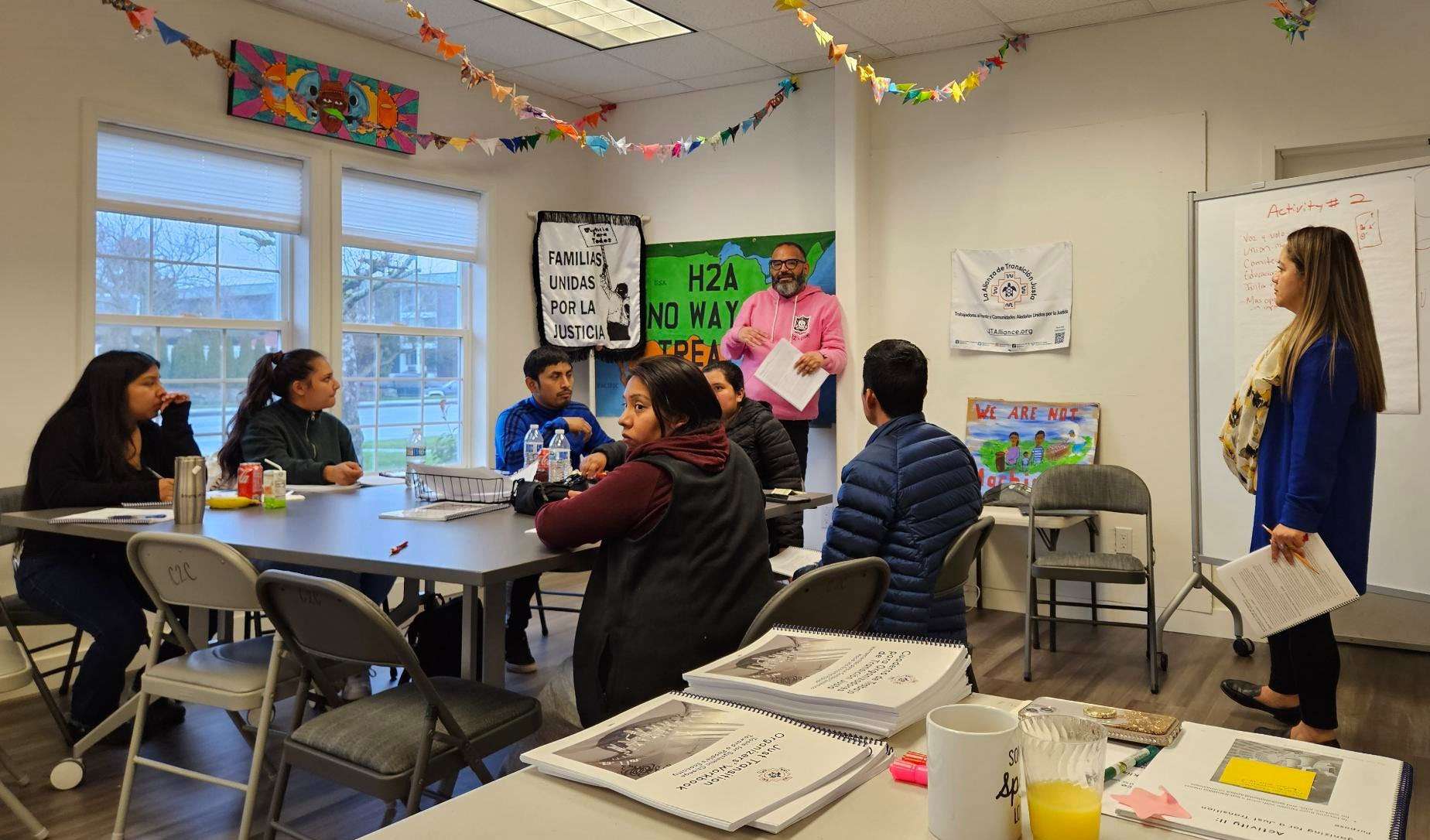
JTA’s José Bravo with trainers Edgar Franks of Familias Unidas por la Justicia and Elizabeth Martinez of Comunidades Aliadas Tomando Acción. Photo credit: José Bravo
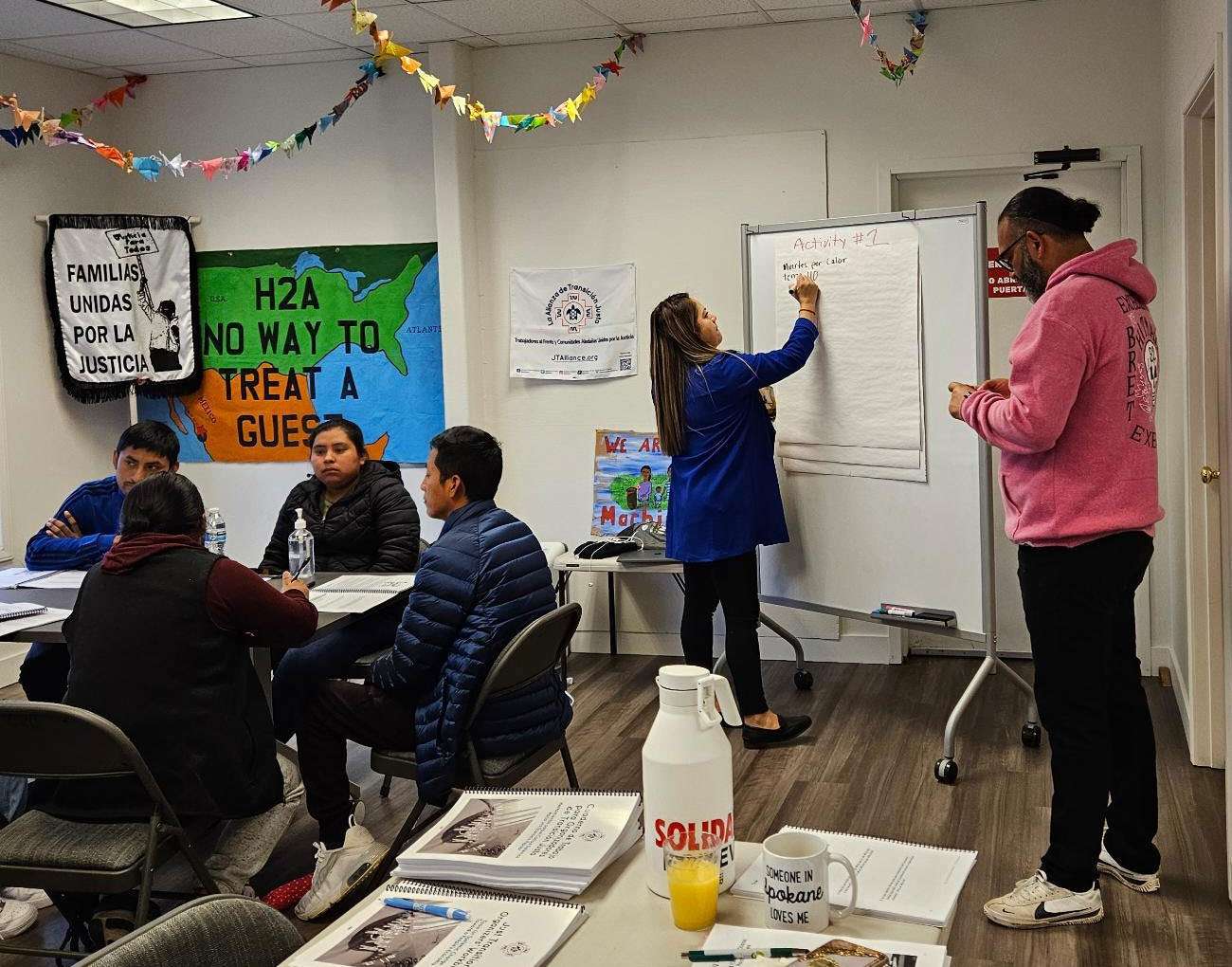
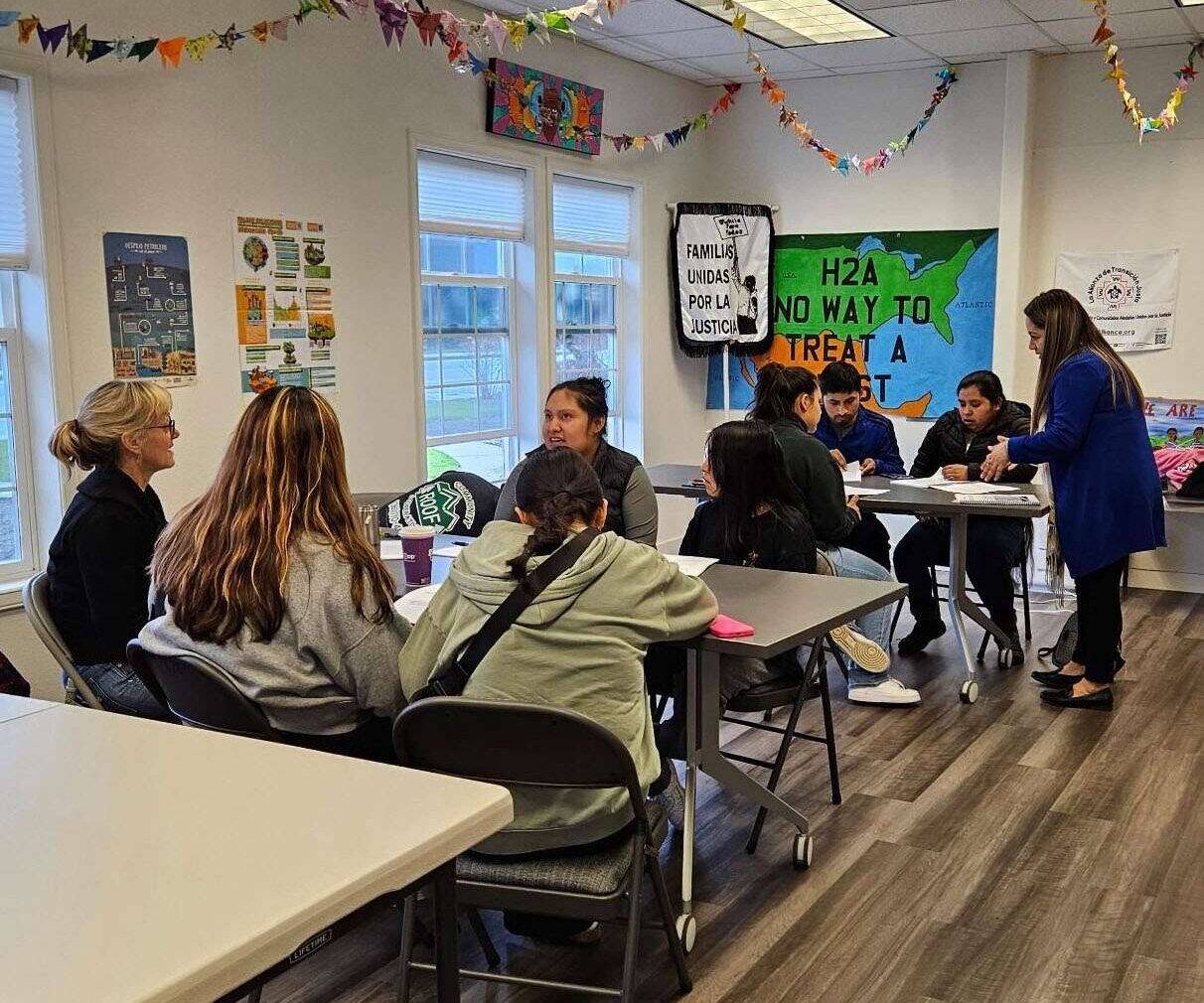
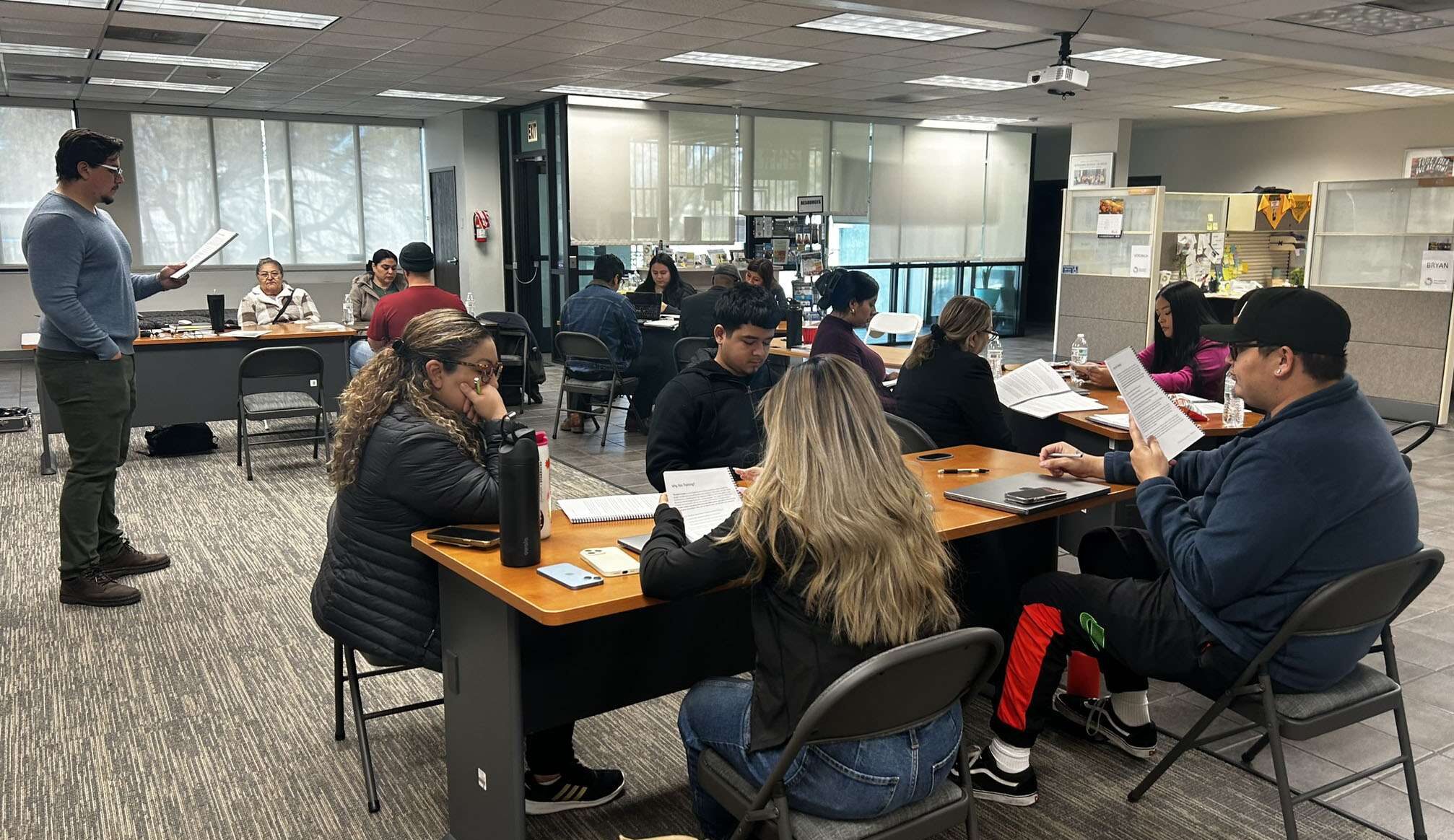
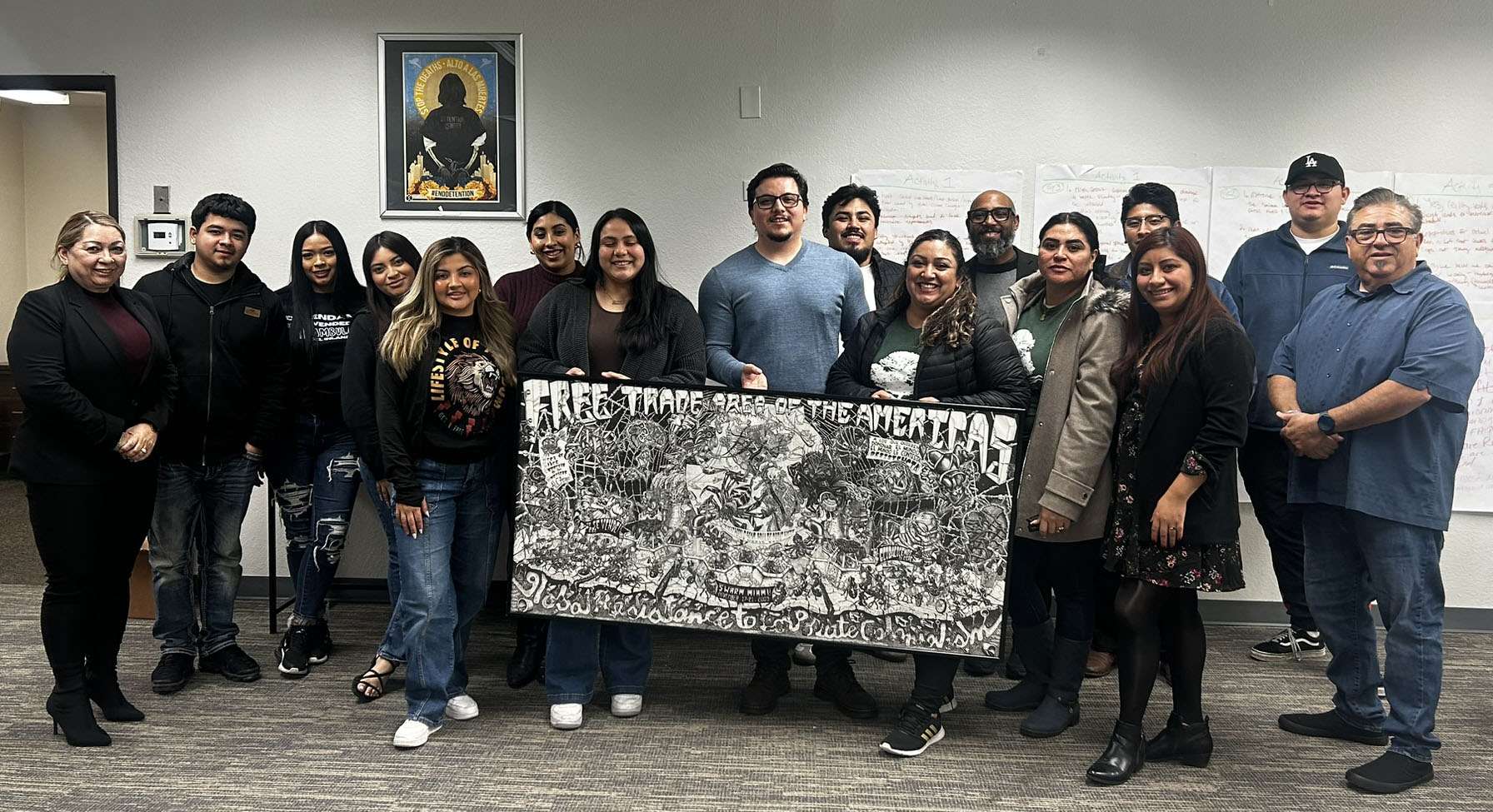
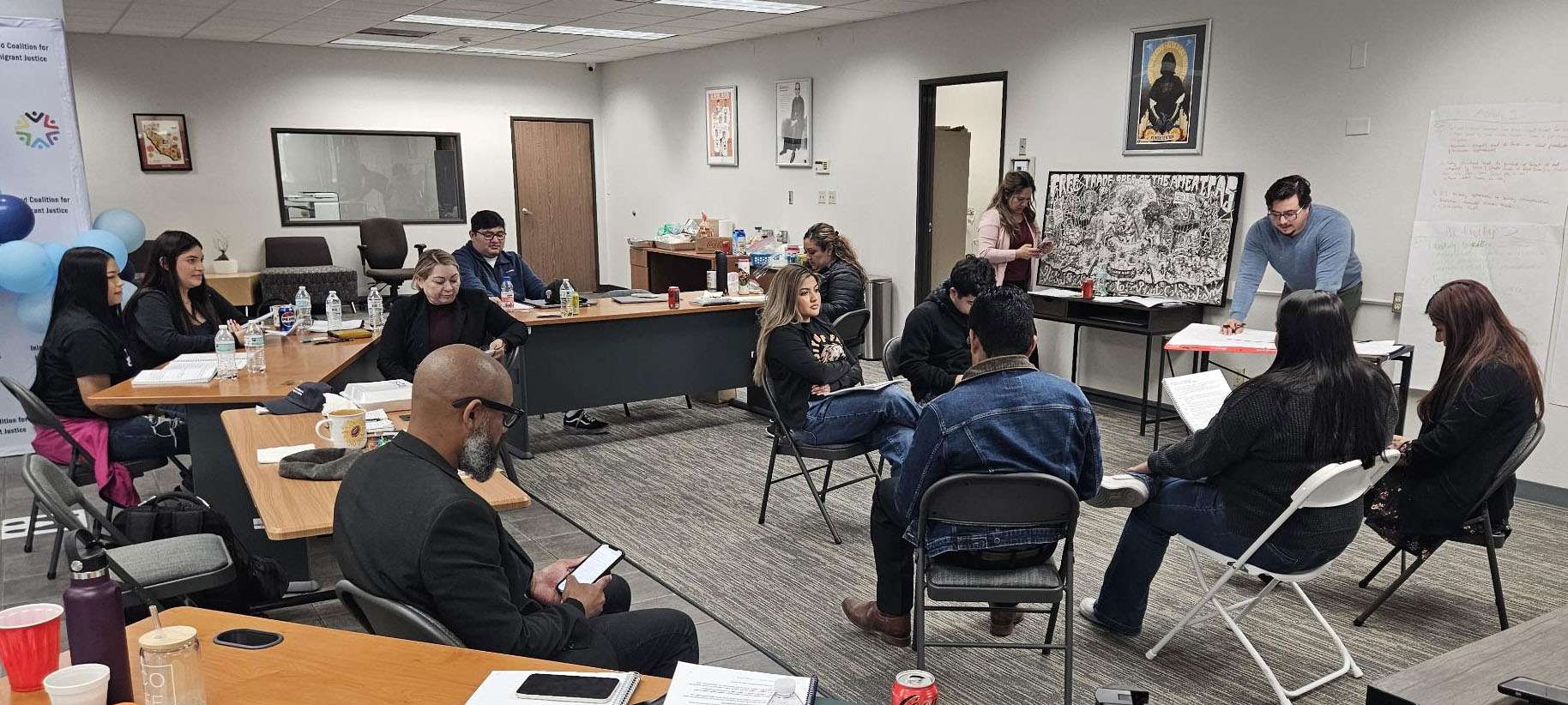
We are so pleased to celebrate our first two trainings of 2024, using our newly updated and expanded program Tools for Systemic Change Toward a People’s Economy. Our talented new cadre of popular education trainers are working together fabulously and raising the bar for engaging participant-driven education.
In February, Familias Unidas por la Justicia hosted a training in Mt. Vernon, WA. And just last week Inland Communities for Immigrant Justice held one in San Bernadino, CA. We have lots more trainings planned throughout the year, so stay tuned for updates!
Scenes from the training with Familias Unidas por la Justicia. Photo credits: José Bravo
Scenes from the training with Inland Communities for Immigrant Justice. Photo credits: José Bravo and Elizabeth Martinez
Content Successful Trainings with JTA Partners appears first in Just Transition Alliance.
From Burning to Building Our Future
Recently closed Covanta incinerator in Long Beach, CA. Photo credit: East Yard Communities for Environmental Justice
EJ Communities force California’s last two waste incinerators to shut downThese are historic times. As the world wakes up to the intersectional nature of environmental racism, climate chaos, genocide and war, thousands of frontline communities continue to engage in pitched battle against those who are destroying people and planet. And while stepping up efforts to stop colonial genocide, we also need to take the time to acknowledge some of our hard-fought movement victories against common foes.
This year marks a couple of historic victories for environmental justice (EJ) communities in the US. After over three decades of struggle, East Yard Communities for Environmental Justice (EYCEJ) and Valley Improvement Projects (VIP), in collaboration with numerous allies, have forced the closure of California’s two remaining waste incinerators. This marks a turning point in an age-old battle with an industry that still operates scores of garbage burning facilities that dump high levels of dioxins, heavy metals, acid gasses and particulate matter in Black, Brown, migrant and poor communities around the US.
Since the 1980s, EJ communities have been hugely successful in thwarting the waste incinerator industry, stopping hundreds of proposals to build these dioxin factories. Still, over a 100 were built in the late 80s and early 90s, predominantly in racialized and poor communities. Despite the severe lack of philanthropic support for EJ groups over the years, our struggles persisted. Between 2000 and 2023, our movement has been able to shut down a number of these incinerators, leveraging a growing public awareness that zero waste alternatives creates far more jobs for a fraction of the cost of building and running a billion dollar incinerator.
Detroit EJ groups and Michigan Teamsters protest the Detroit Incinerator, which was shut down in 2019. Photo credit: Brooke Anderson
In the early 2000s, in a desperate bid to survive such losses, the incinerator industry launched a clever campaign – rebranding their trash burners as “Waste to Energy” (WtE) facilities. This greenwashing ploy allowed the industry to access public subsidies by duping lawmakers into believing they produced renewable energy (RE). Despite the fact that these WtE incinerators are some of the most toxic, carbon intensive and costly energy facilities in the world, the industry has been able to keep over 66 incinerators burning, buoyed by RE subsidies from the federal government and a number of states.
Fifteen years ago, when I worked with the Global Alliance for Incinerator Alternatives (GAIA), I facilitated a workshop for EYCEJ who (at the time) were a relatively young collective of community organizers committed to EJ principles and serving their communities in East Los Angeles and the City of Commerce, CA. At this workshop we discussed the state and federal subsidies that had propped up the incinerator industry, and how Covanta, the largest incinerator company in the US, had been accessing energy and waste policy subsidies by targeting gullible lawmakers and even big green NGOs. East Yard organizers had long been inspired by campaigns led by veteran EJ groups, such as the Mothers of East Los Angeles, who had successfully stopped a number of incinerator proposals back in the day. Some East Yard organizer’s mothers and grandmothers had led these campaigns, so they were inspired to carry on the struggle against polluting corporations like Covanta. A similar story was playing out in Stanislaus County, where a decades-long fight against a Covanta waste incinerator had been taken up in recent years by a young EJ formation – VIP.
The intergenerational leadership of our EJ movement: Juana Beatriz Gutiérrez of the Mothers of East Los Angeles and grandson mark! Lopez, organizing to protect their communities for over 4 decades. Photo credit: mark! Lopez
In 2018, EYCEJ, GAIA and other allies were able to stop the State of California from providing RE credits to incinerators, which forced the closure of the Commerce incinerator. Then, in 2022, EYCEJ, VIP, EarthJustice and other allies, successfully passed a state bill (AB 1857) that removed waste diversion credits from the last two incinerators in Long Beach and Stanislaus County. This removal of state subsidies has forced Covanta to announce the closure of these final two facilities this year. This is a huge win for EJ communities everywhere, and a highly instructive victory, especially since 26 of the 42 state Renewable Portfolio Standards continue to incentivize waste burning.
If EJ groups and their allies in these states were to go after those perverse subsidies, we could see this dinosaur fleet of toxic smoke stacks finally toppled in the coming years! And along with reducing these pollution burdens, this direction could see communities working with local governments and waste and recycling workers to build reuse, recycling and composting infrastructure that could provide millions of well-paying jobs through local, regenerative, zero waste economies. EYCEJ and VIP and other EJ communities are presently leading the way, by working with allies to develop zero waste plans to move away from burning precious resources and move towards long-term community solutions. Now, elected officials and government agencies need to stop giving public dollars to such polluting corporations, and start following the lead of communities and workers on the frontlines of such transformative change!
Content From Burning to Building Our Future appears first in Just Transition Alliance.
Exciting Developments in Building a Just Transition for Adelanto
In 2022, JTA joined a toxic tour of the Adelanto immigrant detention facility organized by the Shut Down Adelanto (SDA) coalition where we learned about the use of a toxic pesticide called HDQ neutral inside the facility and the myriad chronic health conditions afflicting those exposed. According to SDA’s quarterly report from May 2022, “Advocates, the California Department of Justice, and the Department of Homeland Security’s Office of Inspector General have documented the long list of human rights abuses at Adelanto, including inadequate health care, sexual assault, use of solitary confinement, and mistreatment.”
As of January 17th, 2024, ICE decided to extend their decision on the Adelanto facility contract to June 19th, 2024. At that point, they can either decide to close the facility or file for another extension through the end of this year. The move to extend the decision comes as a result of a court injunction (Roman v. Wolf) against GEO Group (which operates the Adelanto ICE facility) led by Inland Coalition for Immigrant Justice (ICIJ) and others: GEO hopes to buy more time for the court to potentially lift this court order. The injunction has prevented GEO from transferring people in or out of Adelanto and facilitated the release of 60,000 people around the country. Because of the injunction, the number of immigrants detained at the Adelanto ICE facility has dwindled to six according to Eddie Torres, Policy Coordinator for ICIJ.
Following the article we published last year detailing their work to close the Adelanto ICE facility, ICIJ and other members of SDA have seized upon the opportunity that the injunction presents. SDA found an ally in congresswoman Judy Chu, who is leading a sign on letter which 24 congressional members have endorsed. In June of 2023, the Dignity Not Detention (DND) coalition (which includes ICIJ) passed HEAL, a California budget initiative which “dedicates 5 million dollars to incentivize California localities to divest from immigration detention by providing them funding to invest in new industries and jobs.” What started as a bright idea in a San Diego retreat space blossomed into a just transition incentivization program to support the local workforce through the facility’s closure. In addition, ICIJ continues to advance its Participatory Action Research project, led by Movement Strategy Associate Esmeralda Santos, to document the community’s vision for a just transition. The community group also intends to strengthen collaborations with local officials aimed around backing alternative solutions to the private prison economy.
We can achieve a just transition for Adelanto by pushing for the closure of its ICE facility and supporting SDA’s efforts to cultivate a vibrant, regenerative local economy. If you’d like to support, ICIJ will host virtual Power Hours in March, April, and May to provide education on this issue and walk through 4 actions:
1) Call Secretary of Homeland Security Alejandro Mayorkas at 202-456-1111
2) Email Secretary Mayorkas at https://www.whitehouse.gov/contact/
3) Call representatives who haven’t signed on to Judy Chu’s letter. Find your local representative here.
4) Post about the issue on social media. Stay up to date by following @shutdownadelanto on Instagram.
Join Faith Power Hour–a collaboration between ICIJ and Interfaith Movement for Human Integrity–to advocate for closure and halt the incarceration of those seeking protection and the right to remain with their families.
Event Details:
- Date: March 22, 2024
- Time: 12 Noon – Pacific Time (US and Canada)
- Platform: Zoom Meeting
- REGISTER HERE
Please join us in calling on President Biden to release the last six men inside the center and the Secretary of Homeland Security and California Congressmembers to shut down the center. ACT TODAY and stay involved with ICIJ to learn more about how you can help.
Power Hour at 12pm, March 22 on Zoom; Register at bit.ly/PowerHourRSVP
Content Exciting Developments in Building a Just Transition for Adelanto appears first in Just Transition Alliance.
Serving Frontline Communities with Humility and Grace
Our comrade Jacqui Patterson, of the Chisholm Legacy Project, was recently recognized by Time Magazine for her role as an outstanding Environmental Justice and Climate Justice champion. Jacqui has certainly been one of the most tireless and dedicated changemakers I have witnessed serving our movements over the years
It’s worth noting that Time Magazine recognized the “revolutionary” nature of her intersectional practice, an approach our EJ movement has always espoused as essential to serving communities on the frontlines of multiple and intertwined forms of harm. Honoring the quiet, selfless way that Jacqui has served impacted communities over the years, I thought I’d share some pivotal moments when she helped lift up the hundreds of organizations that make up our community-rooted movement:
Nearly two decades ago, when she discovered that a climate funders group was hosting a national strategy summit on coal power without inviting any of the communities most impacted by coal mining and power plants, Jacqui convinced these funders to host their first ever panel of EJ leaders from the Navajo Nation, Chicago, New York and Appalachia, whose groups had been effectively organizing and taking direct action against these dirty energy and mining industries.
Then in 2013, Jacqui, drew the attention of environmental funders to the massive, racialized funding disparity between the $billions given to a handful of big green policy NGOs versus the pittance scattered across tens of thousands of grassroots groups working on a myriad of environmental struggles across the US. This exploration helped pave the way for the launch of Building Equity & Alignment for EJ, one of the few participatory grant-making initiatives that continues to bridge the funding gap today.
Following the People’s Climate March in NYC, when a large, new funder emerged to engage big greens in a market-based model for regulating climate pollution, Jacqui (once again) helped open doors for EJ groups to get involved and prevent another “cap and trade” debacle. Working quietly in the background, she helped us push this climate funder to support a wide array of grassroots alliances and networks to carry on our core work, while allowing us to draw some of the big greens into alignment with our fights against various climate false solutions.
Working quietly and diligently in these ways to serve the broader landscape of those first and most harmed, Jacqui has embodied the principles of environmental justice in all aspects of her practice. Thanks Jacqui – for being such an inspiration!
Content Serving Frontline Communities with Humility and Grace appears first in Just Transition Alliance.
Meet Chris Furino, Central Florida Jobs with Justice’s Newest Co-Executive Director!
JTA congratulates our comrade Chris Furino on their promotion to Co-Executive Director of Central Florida Jobs with Justice (CFJWJ)!
CFJWJ coalesces the power of labor unions, community based organizations, faith based and student groups to organize for worker rights. Our work with CFJWJ began through collaborative strategies to bring the Just Transition framework to climate organizing in Florida and then through delegations around the United Nations climate conference. Since then, Chris has joined our all-star team of Just Transition trainers. Chris and their Co-Director Jonathan Alingu have huge plans in the works, and we’re excited to deepen our collaboration to support workers and communities on the frontlines and fencelines of toxic production.
Even before becoming staff with the organization in 2018, Chris had found their organizing home in CFJWJ. They flourished under the mentorship of Jonathan and Denise Diaz (CFJWJ’s founder) and grew through election work and campaigns focused on building grassroots leadership capacity, earning them the role of CFJWJ’s lead organizer. When Chris joined us in Egypt as part of the just transition delegation to COP27, this constituted a major step in the progression of their training for co-executive directorship. After gaining a variety of politicizing experience through their organizing over the years, Chris became Co-Executive Director in January of 2024.
According to Chris, CFJWJ’s trajectory for the coming years supports a massive strengthening in labor and just transition organizing in Florida. The organization started the year with a momentous win: Orange County allocated 4.5 million to CFJWJ’s medical debt forgiveness project, and CFJWJ continues to push their initial request for 8.7 million. Over the coming years, CFJWJ will prioritize coalition building across Florida, primarily in the state’s south. The organization plans to build with labor around key program areas–including climate, health care, and education–and continue to develop grassroots leaders through their campaigns. Moreover, CFJWJ recently hired a Just Transition Organizer to cultivate allied rank-and-file leadership within the building trades, and the organization also plans to build community-labor, co-led energy and utility campaigns.
Chris’ intentions for their new role inspire our radical imaginations around just transition: “I believe a lot in Florida. I don’t want to give up on it. We can shift the trajectory of our state and power and how power is wielded in it to create a world where everyone’s needs are met and people are able to thrive. This position is a way to make that vision a reality,” they shared. Their visionary thinking aligns perfectly with our conception of just transition as a body of principles and practices which supports collective thriving in safe living and working environments. Chris is excited for JTA’s new training curriculum (which they improved through revisions), and they’re gearing up to host a just transition training in Florida, possibly later this year.
Given the strong alignment between our missions, JTA and CFJWJ have many opportunities to collaboratively sharpen our assessments of the labor and environmental justice movements, share our experiences around organizing at the intersection of labor and EJ, and strategize against petrochemical production in the Florida panhandle. We congratulate our friend Chris on this invigorating new chapter in their organizing and look forward to engaging together in the work ahead.
Content Meet Chris Furino, Central Florida Jobs with Justice’s Newest Co-Executive Director! appears first in Just Transition Alliance.
Petrochemical Industry Impunity Must Be Stopped
Signs warning of contaminated water and fish, Houston Ship Channel. Photo credit: Lauren Murphy, Amnesty International
Last month, both Amnesty International and Human Rights Watch released reports about human rights abuses perpetrated by the petrochemical industry in the Gulf Coast. The AI report is titled The Cost of Doing Business? and addresses the impacts on urban communities around the Houston Ship Channel. The HRW report “We’re Dying Here” looks at rural communities in Louisiana’s Cancer Alley.
The USA is the world’s largest oil and gas producer and accounts for more than a third of global oil and gas expansions planned through 2050. Much of these fossil feedstocks will go to the rapidly growing plastics and petrochemical industries in the region between Houston and New Orleans, the “sacrifice zone” that already contains the highest concentration of petrochem plants in the country.
Texas – Houston Ship ChannelAmnesty International researchers detail the negative effects of over 600 petrochemical manufacturing sites concentrated around the Houston Ship Channel, a dredged waterway cut through the former Buffalo Bayou to connect East Houston industries to the Gulf of Mexico. It is one of the busiest waterways in the world, and the surrounding metropolitan cities hold 44% of the USA’s petrochem production capacity. Port Houston exports 59% of all US plastic resins, 73% of polyethylene (which is made into PET bottles). Pollutants present in alarming rates throughout the area include volatile organic compounds (VOCs), such as benzene, 1,3-butadiene, dioxane, ethylene, toluene, styrene and xylene; greenhouse gasses such as methane, carbon dioxide and nitrous oxide; and particulate matter (PM). Ozone, a secondary pollutant formed from the reaction between VOCs, oxides of nitrogen and sunlight, creates persistent toxic smog. Formaldehyde, another secondary pollutant created by reactions from mixed chemicals, is also present at dangerous levels.
From the Amnesty International report
Negative effects on the health of workers and residents range from headaches, dizziness, and vomiting as well as acute eye and lung irritation immediately after these chemicals are released, to asthma and other chronic respiratory illnesses, miscarriages and premature births, and numerous forms of cancer from repeated exposure. Benzene is particularly noxious – the WHO has said that exposure to benzene is “a major health concern” with no safe level of exposure. When accidents lead to large fires, high levels of benzene may be present in the air for over two weeks. Residents are rarely informed of chemical releases and they often struggle to access real-time information, with only unpleasant smells in the environment to tip them off to the danger.
Chemical disasters happen so frequently that they have become normalized for some residents. The AI report states that since 2021 there have been at least 15 chemical explosions, fires and toxic releases reported along the Houston Ship Channel, resulting in at least 28 workers being injured and one death. In 2023 alone, residents along the Houston Ship Channel experienced at least seven petrochemical disasters, including six fires. These figures only capture high-profile chemical disasters that receive media coverage and not the many less visible chemical releases that can still have devastating impacts.
The CAPECO disaster, 2009 in Puerto Rico, another region overburdened by environmental racism. Photo credit: US Chemical Safety Board
Hurricanes and heavy rains can also lead to catastrophic chemical spills. Even in ordinary conditions, the industry is careless about containing leaks and discharges. Between 2019 and 2021, nationwide 83% of refineries report violating their permitted limits on water pollutants. Communities closest to facility fencelines face the greatest harm and have the least time to react in the event of a catastrophic release. Those lower-income and racialized people can have up to 20 years shorter life expectancy compared to averages in the disproportionately affluent and white neighborhoods in western Houston, and much higher rates of all types of cancer.
The Houston metro area, rapidly expanding due to the burgeoning petroleum industry, is incredibly diverse but also extremely racially segregated. A lack of zoning regulations means that industrial facilities are sited right next to residential areas, almost always communities of color. The Texas Commission on Environmental Quality (TCEQ) has clearly shown that they prioritize industry profits over these communities. State records show that TCEQ imposed penalties in less than 3% of cases of unpermitted pollution releases in recent years. A recent review called TCEQ commissioners “reluctant regulators” that encourage industry to “self-police.” Companies routinely avoid penalties for pollution releases by invoking the “affirmative defense,” a loophole in Texas laws that waives enforcement for air pollution that the company reports as “unplanned and unavoidable.”
AI reports that a former air pollution investigator for the City of Houston said, “These fines, they’re hardly a drop in the bucket… They mean nothing when the companies are pulling in billions of dollars a year.” A professor at Rice University explained, “The fines that companies pay are so small compared to the value of the petrochemical products they sell that they can be seen as a routine cost of doing business.” Frustration over underenforcement of already weak regulations was echoed by community members: “TCEQ is so ineffectual. Their fines are so limited. If you do the math for the violations… a company gets fined less than one person who’s affected by it would spend on medical bills. So, it’s very unfair.”
Making their disregard for residents’ health insultingly clear, in June 2023 the Texas legislature passed SB 471, stipulating that TCEQ does not need to investigate or even respond to certain complaints, especially from residents who have filed multiple complaints in the past.
Smoke and flares from petrochemical plants restarting after Hurricane Ida, 2021. Photo credit: Julie Dermansky
As if these stories about Houston were not appalling enough, the Human Rights Watch report about “Cancer Alley” exposes even more egregious environmental racism.
Between Baton Rouge and New Orleans, the banks of the Mississippi River are clustered with over 150 industrial facilities, nearly all of which process fossil fuels. This industry has become a defining feature of Louisiana’s identity. The state’s first oil well was drilled in 1901, and offshore oil extraction was innovated there in 1947. Production boomed and imports arrived as well. Today, Louisiana oil refineries account for one-sixth of the nation’s total capacity, with refined petroleum shipped abroad or pumped through pipelines to the various petrochem plants in Cancer Alley. The story is similar for methane gas. The most active methane gas market center in North America, the Henry Hub in Erath, interconnects nine interstate and three intrastate pipelines.
Louisiana has the highest per-capita energy consumption in the USA, mostly because of these industries (only 7% of total energy goes to homes). It has the worst pollution – according to an analysis of 2021 EPA data, the average Louisiana resident was exposed to four times more industrial pollutants than the average American. The majority of air pollution is occurring in Cancer Alley, as well as the majority of non-nitrate water pollution (nitrates come from fertilizers and are by far the highest source of water pollution). Huge amounts of toxic petrochem byproducts are leached or even dumped directly into the Mississippi River. The EPA found in 2016 and again in 2020 that residents of Cancer Alley were exposed to more than 10 times the health risks experienced by residents living elsewhere in the state. The most polluting operations are disproportionately concentrated within Black communities, and even more facilities are currently being built in those areas. Most residents in Cancer Alley are descendants of formerly enslaved people who had bought small parcels of old plantations. The industry moved in later, and many folks feel like the state prefers to let them move out or die off rather than protect their health and humanity.
Petrochemical plants right next to communities in “Cancer Alley.” Photo credit: Julie Dermansky
The HRW research indicates that many of the plants in Cancer Alley are constantly in “significant violation” of the Clean Air Act and Clean Water Act. One site that they studied had faced six enforcement actions in the last three years, but was fined a mere $300 total. Since 2018, the EPA has required oil refineries to install air monitors that measure benzene at the fencelines of their facilities. Data from these monitors indicate that actual emissions can be as much as 28 times the amounts reported by companies. So far only 13 petrochem facilities nationwide have been compelled to install these monitors, and only a few have collected enough data to be useful. Those in Cancer Alley are routinely emitting benzene well above legal limits.
But state regulators do nothing to change this situation. Interviewees told HRW that the Louisiana Department of Environmental Quality (LDEQ) was actively “hostile” to their interests, acting as a “rubber stamp” and a “revolving door” for the industry. A 2021 audit found that LDEQ failed to adequately track facilities’ emissions reports, including facilities that failed to submit reports entirely. Penalties were not tracked, and frequently were not paid. It takes an average of 20 months for LDEQ to issue enforcement actions after known violations.
Meanwhile, residents continue to be exposed daily to the same chemicals described above, and feel the same effects. The planned expansions of petrochem plants and pipelines promise to worsen these conditions. Pipelines (including carbon pipelines) are much less visible yet insidious, since they receive little attention from regulators, but have high incidences of leaks and spills caused by hurricanes as well as normal wear and tear, and their construction cuts apart and destroys sensitive bayou ecosystems, thereby amplifying all the other negative effects of the industry.
The petrochemical industry has no right to treat our community as a sacrifice zone. It is high time for regulators, legislators, NGOs, and the public to fight for the urgent needs of environmental justice communities.
– Juan Parras, TEJAS
Jeff Landry, a fossil fuel industry lawyer and now the state’s governor, has been an outspoken defender of the status quo. It was his lawsuits that negated Obama’s Clean Power Plan and Biden’s fossil fuel leasing ban. In early 2023, the EPA had been negotiating improvements to LDEQ’s permitting process, such as assessments of cumulative impacts from existing health hazards and racial discrimination. But Landry sued the federal government again, making a sort of “reverse racism” argument that unless a law explicitly says that its intended purpose is to harm people of color, any claims that discrimination is occurring are politically-motivated attacks by partisan regulators “moonlight[ing] as social justice warriors.” One month after the dispute was filed, the EPA abandoned its Title VI investigation, presumably in fear of a judge agreeing with Landry and setting a precedent which would limit their ability to use the Civil Rights Act in the future. Recently, Landry made a highly unusual move by initiating a Freedom of Information Act (FOIA) suit against the EPA, collecting the names and contact information of activists and journalists who have been trying for years to hold LDEQ accountable. This is widely viewed as an aggressive intimidation tactic aimed at silencing environmental justice communities.
Members of Inclusive Louisiana, RISE St. James, and Mount Triumph Baptist Church announcing a 2023 lawsuit requesting a moratorium on new oil and gas industry in St. James Parish. Photo credit: Antonia Juhasz, Human Rights Watch
Framing the daily activities of the petrochem industry as human rights abuses is an important step in holding polluters accountable, as it brings various UN resolutions into the conversation, as detailed in both reports. The communities of the Houston Ship Channel and Cancer Alley, and other overburdened communities in the USA, can be seen as the “Global South within the North” because the non-white, non-affluent residents often bear little responsibility for these harms yet struggle to live amidst the impacts.
Juan Parras of Texas Environmental Justice Advocacy Service (TEJAS), a close ally of JTA, responded to these reports by speaking about the experience in his neighborhood: “Manchester is the most polluted and most densely industrialized community in Houston. We are overwhelmed with the excessive burdens of environmental racism – health problems, poisoned air and water, and constant stress. We have tried numerous times to bring this to the attention of regulators, but they seem to view the situation as unfortunate yet irreversible. Although we often feel hopeless, this invocation of international human rights treaties may finally put enough pressure on government to hold companies accountable. The petrochemical industry has no right to treat our community as a sacrifice zone. It is high time for regulators, legislators, NGOs, and the public to fight for the urgent needs of environmental justice communities.”
In fact, these human rights abuses extend far beyond frontline workers and fenceline communities. Without major reductions in the manufacturing of plastics and other petrochemicals, even 100% renewable energy cannot keep us within global emissions targets. But this industry continues to grow exponentially. The big oil and gas companies are counting on it to keep their profit margins high even as vehicle and power plant technologies change. Climate chaos will have at least some effect on every part of the planet, but the Gulf Coast is one of the very most vulnerable areas, with rising sea levels, increasingly strong storms, and sweltering heat. It is ironic that the industries located in that region are some of those chiefly responsible for the impending catastrophe. Yet the executives and stockholders of the corporations that own these facilities live far away. They no doubt intend to wring out as much money as possible right now, then shutter the plants when forced to make safety improvements for health or disaster readiness reasons. The communities that have been condemned as sacrifice zones will be left behind.
Houston playground adjacent to refinery. Photo credit: Lauren Murphy, Amnesty International
In addition to the worldwide human rights abuses which are perpetrated by those responsible for global warming, the presence of petrochem byproducts – and even those products themselves – constitute an unjust toxic trespass. A recent report by Defend Our Health studies the numerous negative impacts of polyethylene terephthalate (PET, the substance used to make clear plastic drink bottles) from extraction, manufacturing, and waste. The entire PET supply chain spans not only the Gulf Coast region but also many other locations around the USA. The majority of those facilities are located in low-income communities of color.
The plastics industry has consistently lied to the public about the safety and recyclability of their products. Another recent report by Center for Climate Integrity shows that well over 90% of plastics have been landfilled, incinerated, or leaked into waterways, ecosystems and communities. Despite industry claims that recycling can solve the problem, evidence collected from the industry itself shows that this unacceptable trashing of our health and environments will never change. Very few plastic products are actually recyclable, and manufacturers have a powerful profit incentive to ensure that everything they sell is single-use, driving endless demand for more production. All their talk about new recycling technologies is deceptive nonsense – so-called “advanced recycling” means melting plastic back into oil and burning it as fuel, and the majority of the facilities designed to do this have not been profitable and have closed a few years after swindling public money out of lucrative municipal contracts. Despite decades of PR campaigns fooling people into thinking that they just need to “do their part” by placing plastic containers into curbside recycling bins, plastics pollution has become one of our most serious crises, with microplastics found even in clouds.
Small-scale plastic recycling in Indonesia, one of the countries to which Global North waste management companies send plastic trash when it cannot be recycled at a profit. The man in the foreground is cooling melted plastic into bricks which can be sold to manufacturers, inhaling toxic fumes in the process. Photo credit: Focusfeel [wikimedia commons]
We must stop making all this plastic junk designed expressly to become garbage as quickly as possible. While there may be some limited defensible uses of plastics in the fields of medicine and electronics, nearly all of the products being made today are completely unnecessary. Plastics cause so much more harm than good.
We need to uplift the voices of those fighting for their lives in the face of environmental racism and toxic trespass, supporting them to come together, frontline workers and fenceline communities united in creative problem-solving, finding real solutions that can build regenerative solidarity economies that move them toward a healthy and dignified future. These frontliners are already advocating numerous policy solutions. First, subsidies that currently prop up fossil fuel extraction and petrochemical production must be reallocated to research and new facilities for benign, sustainable chemistry. And then, an option that would be easy to achieve immediately would be to expand and replicate existing “orphaned well programs” in which governments and companies collaborate to pay local workers to safely clean up abandoned wellsites and restore ecosystems (the Bipartisan Infrastructure Law included $4.7 billion to do just this, a tiny baby step toward plugging the estimated 300,000-800,000 unidentified orphaned wells across the USA). State legislators should provide funds for additional just transition initiatives similar to California’s HEAL initiative. Federal funding from the Inflation Reduction Act should grow community resilience by building locally-controlled small-scale renewable energy and public transportation. A union-led initiative called the Texas Climate Jobs Project is organizing efforts to do exactly that as the basis for a truly transformative just transition. Their study shows that this transition can create 1.1 million jobs in Texas alone (and cites other researchers’ estimate of 25 million jobs nationwide).
The great potential of a just transition is true not only in Texas, but everywhere, and it goes far beyond job creation. An illuminating report by the Tellus Institute, now over a decade old but more relevant than ever, demonstrates how transitioning our waste management systems to keep materials out of landfills and incinerators by reusing and repurposing as much as possible could create 2.3 million jobs nationwide, as well as reduce emissions and, crucially, slash production of toxic plastics, leading to health improvements in countless communities. California’s Recology is at the leading edge of this increasingly popular transition toward “zero waste.”
Workers sort recyclables at Recology facility, Davis CA. Photo credit: Recology
At every level of public discourse and governance we must debunk the industry lies about “plastics circularity” and demonstrate real circular economies, based on principles of zero waste, localized production, traditional ecological knowledge, and grassroots democracy. One way that JTA is trying to do so is by engaging with the ongoing negotiations to create a UN Treaty on Plastics Pollution, fighting to maintain the integrity of the “just transition” vision in the face of mounting corporate cooptation. Another is working with the Environmental Justice Communities Against Plastics (EJCAP) coalition to push California lawmakers and regulators to close loopholes and improve effectiveness in recent plastic waste reduction law SB 54.
Other groups are beginning to find success with tactics that apply pressure upstream from the manufacturers, pushing pension funds, universities and banks to divest from polluters, demanding that insurance companies revoke policies for facilities that endanger the planet, and organizing the labor sector within predatory private equity firms that own many of the worst offenders.
An additional path that surely will be pursued by states, municipalities and advocacy groups is litigation demanding payments from the offending corporations, both in terms of damages to victims and compensation for the mounting costs of disposal. The fossil fuel companies should be legally restricted and financially reprimanded the same way that big tobacco companies were handled. In tandem with this top-down approach, concerned citizens can advocate for the bottom-up demand to change our laws to roll back the suite of unfair court rulings collectively known as “corporate rights” and to ensure rights for communities and environments (the movement to establish “legal rights for rivers” is succeeding around the world).
The Mississippi River. Photo credit: Ken Lund [wikimedia commons]
Fossil fuel companies have seen record profits in the years since the pandemic began. These profits belie the excuse that inflation is caused by supply chain disruptions. It has become increasingly clear that this lying, cheating, psychopathic industry is at the climax of its abusive behavior of hoovering up heaps of cash by extracting the wealth of the earth while externalizing all the costs onto EJ communities and ecosystems.
We must not let oil and gas corporations continue their human rights abuses by allowing them to sidestep into equally harmful plastics and petrochemicals. We must work together to change our economic systems into something life-giving and holistic, respecting our neighbors and environments, repairing our past harms, and regenerating our relations. We must build the best alternatives by cultivating community power and grassroots democracy. Please take the terrible findings of these reports and transform them, not into passive hopes and prayers for the unfortunate folks on the frontlines and fencelines, but a strong motivation and vigilant commitment to struggle with the workers and communities organizing for a just transition. Remember, “Transitions are inevitable. Justice is not.”
Content Petrochemical Industry Impunity Must Be Stopped appears first in Just Transition Alliance.
Job Opening at JTA! Administrative Assistant
The Just Transition Alliance is hiring!
We’re looking for a half-time Policy Organizer (remote) and a half-time Administrative Assistant (San Diego)
If you’re interested, please email Nona Chai: nona@jtalliance.org.
Please help us spread the word
Content Job Opening at JTA! Administrative Assistant appears first in Just Transition Alliance.
Job Opening at JTA! Policy Organizer
The Just Transition Alliance is hiring!
We’re looking for a half-time Policy Organizer (remote) and a half-time Administrative Assistant (San Diego)
If you’re interested, please email Nona Chai: nona@jtalliance.org.
Please help us spread the word
Content Job Opening at JTA! Policy Organizer appears first in Just Transition Alliance.
Happy Birthday, José!
Our ED José Bravo is a force to be reckoned with–from participating in the drafting team for the Principles of Environmental Justice to helping to organize the shut down of dangerous waste incinerators in Tijuana, Kettleman City, and East LA and so much more.
To celebrate his steadfast service to Indigenous, people of color, and low income communities for over 27 years, would you please consider making a donation to the Just Transition Alliance for his birthday?
Content Happy Birthday, José! appears first in Just Transition Alliance.
Get Your Copy of “Power Lines: Building a Labor-Climate Justice Movement”
We are pleased to announce a collection of essays titled Power Lines: Building a Labor-Climate Justice Movement, co-edited by our dear friend Jeff Ordower and published just a few days ago by The New Press.
Shantell Bingham of Climate Justice Alliance says, “Power Lines presents critical case studies on advancing all communities towards a just transition. The book provides key insights directly from the frontlines on how we can organize our communities towards collective power, navigate tensions, and truly advance change. This book makes it more apparent the critical role that labor plays, and needs to play, in advancing a just transition.”
It features an interview with José Bravo describing the origins of the just transition movement.
Excerpt:
Just transition is not a cookie-cutter approach. It’s not one thing for everyone. But I can tell you beyond a shadow of a doubt that if a just transition doesn’t have workers and there’s only communities at the table, then it’s not a just transition, and vice versa. If it only has workers and the community’s not at the table, then it’s not a just transition. A just transition is literally a cradle-to-grave approach that removes the exploitation out of the whole process of production.
Content Get Your Copy of “Power Lines: Building a Labor-Climate Justice Movement” appears first in Just Transition Alliance.
Pages
The Fine Print I:
Disclaimer: The views expressed on this site are not the official position of the IWW (or even the IWW’s EUC) unless otherwise indicated and do not necessarily represent the views of anyone but the author’s, nor should it be assumed that any of these authors automatically support the IWW or endorse any of its positions.
Further: the inclusion of a link on our site (other than the link to the main IWW site) does not imply endorsement by or an alliance with the IWW. These sites have been chosen by our members due to their perceived relevance to the IWW EUC and are included here for informational purposes only. If you have any suggestions or comments on any of the links included (or not included) above, please contact us.
The Fine Print II:
Fair Use Notice: The material on this site is provided for educational and informational purposes. It may contain copyrighted material the use of which has not always been specifically authorized by the copyright owner. It is being made available in an effort to advance the understanding of scientific, environmental, economic, social justice and human rights issues etc.
It is believed that this constitutes a 'fair use' of any such copyrighted material as provided for in section 107 of the US Copyright Law. In accordance with Title 17 U.S.C. Section 107, the material on this site is distributed without profit to those who have an interest in using the included information for research and educational purposes. If you wish to use copyrighted material from this site for purposes of your own that go beyond 'fair use', you must obtain permission from the copyright owner. The information on this site does not constitute legal or technical advice.
 This site is not the official webpage of the Industrial Workers of the World.