You are here
E2. Front Line Community Green
As Trump Sets Largest Oil & Gas Lease Sale in Almost 20 Years, 75 Groups Urge Gov Newsom: Protect California Before You Go
Federal auction of 43 parcels, including land inside SB 1137’s health protection zones, puts California’s landmark public health law in the crosshairs of Trump’s “drill baby drill” agenda
SACRAMENTO, CA — As the federal Bureau of Land Management (BLM) set a Dec. 1 date to auction off oil and gas drilling rights on roughly 35,000 acres of California public land — the largest oil and gas lease sale since 2009 — 75 environmental justice, health, faith, Indigenous and conservation organizations representing millions of Californians are asking Governor Newsom to protect Californians from federal overreach.
In a letter sent to Governor Newsom, Natural Resources Secretary Wade Crowfoot, Deputy Cabinet Secretary Sarah Swig and State Oil and Gas Supervisor Douglas Ito, the coalition warns that the Trump administration has launched “an all-out attack on our state’s health and environment” by opening up acres of land for oil drilling on the state’s federal land. It urges the Newsom administration to uphold his commitment to the progress he made during his two terms by locking in the protections of SB 1137, the landmark law that prohibits oil drilling within 3,200 feet of communities, and California’s fracking ban before his term ends.
BLM announced today that it will offer 43 parcels in Kern, Kings, San Luis Obispo and Fresno counties at an online lease sale on Dec. 1, 2026. A 30-day public protest period opened today and closes Nov. 2. BLM itself notes that leasing is only the first step, and that no development can begin until an operator applies for a permit to drill, a process in which BLM coordinates with state partners, including CalGEM. That state permit is where California has the power to say no.
“In Kern County, we already live next to thousands of oil wells. BLM calls leasing ‘just the first step.’ We know where those steps lead: to more asthma, more cancer, more families breathing in someone else’s profits. The state permit is the last line of defense, and it has to hold.” said Cesar Aguirre, Director of the Air & Climate Justice Team Central California Environmental Justice Network (CCEJN).
“The federal government just put a date on the calendar to auction off drilling rights next to California homes and schools. Governor Newsom has two months to make sure that when those leases are sold, the state’s answer to new wells in our neighborhoods is already written down: no.” said Ilonka Zlatar, California Climate Justice Organizer with the Oil and Gas Action Network (OGAN).
A federal lease sale that reaches into health protection zones
In June, the federal Bureau of Land Management (BLM) opened more than a million acres of California public land to new oil and gas leasing, including fracking. More than 175,000 people submitted comments opposing it, but BLM made virtually no changes and continues to ignore California’s related laws. Its proposed December 2026 lease sale covers 44 parcels, roughly 36,000 acres in the Bakersfield and Central Coast regions. The sale includes:
- Nearly 3,800 acres inside SB 1137’s health protection zones, the 3,200-foot buffers that keep new wells away from homes, schools, daycares and hospitals
- Nearly 13,000 acres bordering Carrizo Plain National Monument
- More than 1,300 acres within the Lokern-Buena Vista and Chico Martinez Areas of Critical Environmental Concern & habitat for endangered species
“These public lands are precious wild spaces that belong to all Californians, not the polluting oil industry,” said Victoria Bogdan Tejeda, an attorney at the Center for Biological Diversity’s Climate Law Institute. “Trump’s nonsensical fossil fuel frenzy is no excuse to sacrifice California wildlife, communities and the climate. We won’t let this reckless land grab stand.”
BLM’s environmental assessment found “no significant impact” to the drilling expansion. It also found, preliminarily, that no historic properties would be affected, even though the land is within the ancestral homelands of the Chumash, Yokuts and Salinan peoples and near Painted Rock, one of the most significant Indigenous sacred sites in North America.
“This land holds our ancestors’ stories. This 36,000 acre oil lease is on the ancestral homelands of several Tribal Nations, including the Yokuts, Mono, Shoshone, Chumash, Kawaiisu, Tejon, Salinan, and Tübatulabal relatives. For the federal government to claim that drilling near Painted Rock would affect no historic properties shows how little regard it has for Indigenous Peoples. This affects the health of millions of community members, as well as the health of the lands, waters, and natural relatives. California must not rubber-stamp it,” said Starry Insixingmay, Sacred Places Institute for Indigenous Peoples.
The lease sale comes as the U.S. Department of Justice, representing BLM, continues its lawsuit to overturn SB 1137’s health protection zones. On March 31, 2026, a federal court refused the administration’s request to suspend the law while the case proceeds, finding that the federal government “has not demonstrated that it is likely to succeed” on the merits. The lawsuit is still ongoing.
No oil or gas well can be drilled in California, whether on federal, state or private land, without a permit from the state’s Geologic Energy Management Division (CalGEM). That permitting process is discretionary. The coalition is asking the Newsom administration to:
- Direct CalGEM to require full review under the California Environmental Quality Act for any permit tied to this lease sale or any future federal lease, instead of relying on BLM’s federal environmental assessment.
- Affirm that SB 1137’s health protection zones apply in full to every well permit, whether the land or mineral rights are federal, state or private.
- Confirm that the state will enforce its fracking ban on all drilling projects, including those on federal leases.
The groups ask the administration to put these directives in writing through rulemakings, policies, executive orders or guidelines, so the protections outlast the current administration.
“Frontline communities fought for years to win SB 1137. We can’t let a federal agency erase it with a ‘no significant impact’ finding. The Governor has the authority to stop this, and we’re asking him to use it before he leaves office.” said Tanvi Kardile, Coalition Manager for Voices in Solidarity Against Oil in Neighbourhoods (VISION).
The coalition points to Santa Barbara as a warning. There, the Trump administration moved to restart Sable Offshore’s long-dormant, failed pipeline over the objections of the state agencies responsible for protecting the coast. “Just as the state is fighting that action,” the letter says, “it must do everything it can to defend SB 1137 and the state’s fracking ban.California led the nation in protecting communities from the harms of oil and gas drilling,” the letter concludes. “We are asking all of you, together, to use that time and that authority now — this is your legacy to protect.”
Signers include Voices In Solidarity Against Oil in Neighborhoods (VISION), the California Environmental Justice Alliance, Communities for a Better Environment, Sierra Club California, Sacred Places Institute for Indigenous Peoples, Physicians for Social Responsibility – Los Angeles, Oil Change International, GreenLatinos and others. The full letter and list of signers are available here.
The post As Trump Sets Largest Oil & Gas Lease Sale in Almost 20 Years, 75 Groups Urge Gov Newsom: Protect California Before You Go appeared first on Last Chance Alliance.
Regional Leaders, Waste Workers, and Cities Urge COP31 Negotiators to Defund Incineration and Finance Community-Led Methane Solutions
Frontline municipalities, worker cooperatives, and civil society prove decentralized organic waste systems are ready for immediate scale as climate finance continues to favor capital-intensive disposal.
Jakarta, Indonesia 29 September 2026 — At the conclusion of the Second Regional Congress on Organics and Climate held on September 23-24, city and municipal leaders, civil society organizations, researchers, and waste workers across Asia united to adopt the Jakarta Declaration. The declaration sets out a roadmap calling on national governments and financing institutions to halt funding for incinerators and redirect climate finance into low-cost decentralized organic waste management systems and measures for food loss and waste reduction.
With COP31 approaching and as governments face mounting scrutiny to demonstrate tangible climate mitigation measures, delegates underscored a staggering funding imbalance: while the world has funneled nearly 4 billion USD into capital-intensive waste incineration projects, capturing 94% of waste-sector methane finance, barely 1% reaches organic waste management and food rescue systems.
Speakers at the Congress, which was organized by GAIA Asia Pacific together with Dietplastic Indonesia and Aliansi Zero Waste Indonesia, demonstrated that preventing food loss coupled with scaling low-cost, decentralized organic waste diversion is the single fastest climate intervention. Organic matter, primarily discarded food and agricultural matter, makes up 50% to 70% of the total municipal solid waste stream in Asia, rotting under anaerobic conditions in landfills and open dumps, generating climate superpollutants such as methane.
For the delegates, the debate over whether community-led solutions work is closed. The urgent challenge now is securing the policy mandates, institutional support, and dedicated public financing to make decentralized organic waste management and food waste prevention a permanent public service.
The human and environmental toll of centralized dumping took center stage as a spate of landfill disasters, from massive fires to landslides, struck the region within months, blanketing cities and towns in toxic fumes and claiming residents’ lives, many of them waste pickers
GAIA Asia Pacific’s Regional Coordinator, Froilan Grate delivers keynote address.“The landfill crisis is not telling us to set up more landfills. It is telling us that our disposal-dependent system has reached its absolute breaking point,” said Froilan Grate, Regional Coordinator, GAIA Asia Pacific. “When communities prevent food waste and sort organics at the source, we win twice: we cut methane emissions at the source and eliminate the toxic landfill fires choking our neighborhoods. This is justice-centered, cost-effective climate action.”
Economic data released by the Climate Policy Initiative (CPI) dismantled the myth that high-tech, centralized infrastructure is superior. CPI’s cost-benefit analysis of decentralized systems in Bandung, Indonesia,showed that community initiatives save local governments up to IDR 30 billion (USD 1.7 million) annually in avoided transport and tipping fees.
Bandung is not an exception. Other communities in Asia taking a similar approach are proving that zero waste systems deliver measurable economic and environmental results:
- Barangay Potrero in Malabon City, Philippines: The community of 43,000 residents proved that operational costs must prioritize people over machines. With 19% of its total budget allocated to integrating 80 waste workers into its waste management system, it diverts over 100,000 kg of organic waste annually.
- Hoi An, Vietnam: Tackling commercial food waste driven by tourism, the city secured voluntary reduction commitments from over 50 hotels and restaurants to eliminate single-use plastics and curb kitchen surplus. Edible surplus is addressed upstream, while residual prep discards are channeled to the converted Eco-Hub, where workers process 200 kg of organic material daily per person via composting and bioconversion.
- Hong Kong: Partnering across wet markets, bakeries, and supermarkets, Greeners Action established daily logistics pipelines to intercept unsold fresh produce and staples at risk of being discarded. The program routes fresh, safe food daily to registered low-income beneficiaries, proving that retail-level surplus redistribution effectively prevents edible food from entering landfills.
- Pune, India: Solid Waste Collection and Handling (SWaCH) leverages its 4,000 door-to-door waste pickers to enforce daily source segregation across 1 million households. By working directly with 3,000 commercial bulk waste generators to prevent mixed dumping and running in-situ treatment at 270 sites, workers divert 25 tonnes daily of organic waste while eliminating secondary municipal transport entirely.
- San Fernando City, Pampanga, Philippines: The city paired strict source-separation ordinances with commercial food-waste monitoring for restaurants, markets, and institutions. By enforcing on-site organics management for commercial establishments alongside 35 barangay recovery facilities, the city pushed municipal waste diversion to an unprecedented 89%.
- Siquijor Island, Philippines: Lacking space for an extensive landfill, the island mandated backyard composting and decentralized collection,preventing 70%of its waste, mostly biodegradable food discards, from going into landfills.
- Surakarta (Solo), Indonesia: Confronting a city landfill where food waste makes up 60% of daily intake, youth-led network Care Food Solo partnered with hotels, bakeries, caterers, and farmers to intercept edible surplus. In 2025 alone, the initiative rescued and redistributed 46 tonnes of surplus food to vulnerable households and care homes through 12 neighborhood storefronts, routing only non-edible scraps to black soldier fly processing.
- Tanzania: Starting in Bonyokwa, community-built recovery facilities and door-to-door education proved zero waste works in East Africa. The model has expanded to seven communities and across four major cities, replacing centralized dumping with local sorting.
These cities and communities do not only illustrate that Zero Waste solutions are key to effective organic waste management, but, more importantly, that the path forward is to scale these proven solutions, while placing the people who make them possible at the heart of policy, program design, and implementation.
“We cannot continue treating waste management as an exercise in disposal while volumes of food and organic matter rot in landfills,” said Shibu K. Nair, Regional Organics Campaigner for GAIA Asia Pacific. “Infrastructure alone is a hollow investment if we do not fund the people who run it. Waste workers are the backbone of public health and climate infrastructure.”
GAIA members Dietplastik Indonesia and AZWI pass the baton to the Philippines—represented by Mother Earth Foundation, PNWWA, and the Zero Waste Cities Network—as the next hosts of the Regional Congress.As the world marks the International Awareness Day for Food Loss and Waste, delegates sent a clear message to COP31 negotiators: The solutions already exist. The task now is to make them the norm.
The post Regional Leaders, Waste Workers, and Cities Urge COP31 Negotiators to Defund Incineration and Finance Community-Led Methane Solutions first appeared on GAIA.
Saturday, October 17, 2026 See updated poster for 10th Annual White Mesa Ute Community Spiritual Walk and Protest against Energy Fuels’ uranium mill/dump and uranium mines.
Saturday, October 17, 2026
See updated poster for
10th Annual White Mesa Ute Community Spiritual Walk and Protest against
Energy Fuels’ uranium mill/dump and uranium mines.
Broad Coalition Demands Affordable, Safe Energy, Rejects Polluter-Driven Permitting Reform
Contact: kayla@unbendablemedia.com, Climate Justice Alliance / ashley.sullivan@weact.org, WE ACT for Environmental Justice/ Edderdiazmartinez@greenlatinos.org, GreenLatinos/ sweeney@westernlaw.org, Western Environmental Law Center/ Jordan@ienearth.org, Indigenous Environmental Network
WASHINGTON, D.C. – Today, Climate Justice Alliance, GreenLatinos, Indigenous Environmental Network, WE ACT for Environmental Justice, and Western Environmental Law Center led a broad coalition of national organizations representing thousands of frontline, environmental justice, and Indigenous communities across the U.S. to oppose a dangerous deregulatory permitting reform proposal, disingenuously titled the ‘Bipartisan American Affordability and Jobs Act’, currently being negotiated in Congress. We share a deep frustration and outrage over this sidelining effort which shows continued disregard for communities who have spent years demanding policies that protect their health, rights, neighborhoods, and pocketbooks, while also benefitting the larger public good.
We issued the following joint statement:
We cannot allow the lies to continue, as the facts are clear: If this backroom permitting reform deal is pushed through, it will enable a no-guardrails buildout of dangerous projects that will harm our health and environment, drive up energy costs, and violate our rights. This will be especially harmful for communities of color and lower income neighborhoods already overburdened by pollution and climate impacts. Indigenous Peoples, Black, Latinx, Asian Pacific Islander, and working class white communities disproportionately live near fossil fuel infrastructure and endure greater climate impacts due to a legacy of prejudicial redlining practices. Legislation like this claims to advance clean energy, but will only lock in more fossil fuel projects for decades to come, continuing the immoral and damaging practice of using vulnerable communities as sacrifice zones.
Environmental justice communities are sick and tired of being left out of conversations that impact them most, and yet this deal was negotiated in the dark and follows years of similar bad faith legislation communities successfully opposed (e.g. SPEED Act, EPRA). At a time when we need strong leadership to defend our rights from an administration putting polluter profits over our lives, we instead get another effort to remove accountability and democratic processes that give industry a free pass to harm. As energy demand grows, especially from rapidly expanding hyperscale data centers, Congress must not accelerate detrimental infrastructure buildout by shifting its costs, consequences, and risks onto the rest of us.
Communities have already shared practical and evidence-based policy solutions for building clean energy while safeguarding our rights, health, environment, and democratic participation, including:
- Investing in federal agency capacity through funding and training to build expertise on clean energy development and community engagement;
- Embedding early and meaningful community engagement into permitting processes;
- Establishing robust environmental and public health analysis that includes cumulative impacts;
- Addressing transmission barriers acceleration directly rather than weakening environmental review; and
- Increasing transparency via publicly accessible information on permitting status, project details, environmental and public health impacts.
These recommendations are shaped by successful project examples, literature review, and expertise demonstrated in the NEPA Does Not Delay StoryMap report, and are core aspects of the community-informed A. Donald McEachin Environmental Justice for All Act.
This permitting reform proposal cannot be separated from the broader rollback of environmental and public health protections, as well as democratic rights under attack by the Trump administration. If passed, this package would further limit communities’ ability to protect themselves from harmful projects by completely gutting the National Environmental Policy Act (NEPA) and Endangered Species Act, among other bedrock environmental laws. In addition to being a climate-killer, this bill would leave Tribal lands, sacred sites, and historical and cultural items at risk of permanent destruction by restructuring and undermining the government-to-government consultation process under section 106 of the National Historic Preservation Act.
Our coalition of environmental justice leaders and advocates across the environmental, conservation, public-health, climate, and energy movements and our partners will continue to oppose deregulatory permitting proposals that put corporate interests ahead of communities, and will advance solutions that deliver clean, affordable energy while protecting our health, democratic rights, and our shared environment.
COALITION QUOTES
Mar Zepeda Salazar, legislative director at Climate Justice Alliance: “Six years, the same message from frontline communities: listen to us, protect our health, and build solutions with us. Instead, each version of this backroom deal gets worse, and now, rather than listening to their own constituents, politicians are trying to force through legislation that will allow data centers to explode at an even faster pace, even as families across the political spectrum are saying enough is enough. Announcing a deal before the public can even see the bill is simply undemocratic. They may call it affordability, but affordable for whom and at what cost? You don’t make energy cheaper by sacrificing our health, our neighborhoods, and our children’s future. We’ve offered common-sense solutions. We’ve helped craft better policy. And once again, communities are being sidelined for industry gain under the very risky assumption that we won’t make our voices heard at the ballot box.”
Irene Burga, Climate Justice & Clean Air Director, GreenLatinos: “Frontline communities should not have to sacrifice their health, their voices, or their rights in the name of faster permitting. Latino communities already bear disproportionate pollution from highways, oil and gas operations, warehouses, ports, and other industrial facilities. Weakening environmental review and public participation will only make it easier to pile new harms onto communities already carrying far too much. Congress should be strengthening the protections communities rely on — not bargaining them away.”
Leslie Fields, Chief Federal Officer at WE ACT for Environmental Justice: “Here we go again, with the low down dirty deal of permitting reform redux. We must break the cycle of sacrificing vulnerable communities of color and lower income neighborhoods through deregulatory permitting reform. This proposal, like those before it, does not appropriately account for the burdens it will impose on communities, while vastly overstating the clean energy benefits it will achieve. It will instead further condemn communities of color and low income communities to even more environmental, health, and economic degradation. The dual climate and public health crises demand urgent energy policies that advance an affordable and fair clean energy future through processes that actually protect and support communities.”
Erik Schlenker-Goodrich, executive director of the Western Environmental Law Center based in New Mexico: “The permitting deal is a betrayal of public lands, water and wildlife, and environmental justice values. Senator Heinrich has built a name for himself as a champion of these values, but he is poised to sweep aside that legacy in service of AI hyperscaler, energy, and finance lobbyists. This deal will also hand the Trump administration a major political win that will hobble the ability of future administrations to put in place an ambitious climate agenda that opens new doors to a thriving, prosperous world that respects—and does not, as this deal would do, bulldoze over—people and place.”
Jordan Harmon, Policy Specialist at Indigenous Environmental Network: “Indigenous Peoples deserve better than being treated as a negotiation pawn in backroom permitting deals. Any member of Congress who would vote to destroy the Tribal consultation process and violate the Treaty and trust obligations is no climate defender and no ally to Tribes.”
###
More detailed information and resources about permitting reform follows:
Permitting reform: myths vs facts
Permitting reform and communities fact sheet
CJA July 20th bicameral letter on permitting
Post about NEPA/permitting
The post Broad Coalition Demands Affordable, Safe Energy, Rejects Polluter-Driven Permitting Reform appeared first on Climate Justice Alliance.
Press Statement: Public Advocates Condemns Governor Newsom’s Reversal on Substitute Teacher Training, Signing AB 2490
Tuesday, September 29, 2026
Press Contact: Sumeet Bal, Director of Communications, 917-647-1952, sbal@publicadvocates.org
San Francisco—Governor Newsom just made it legal for California’s most vulnerable students—those with special needs—to spend nearly 40% of the school year with a barely-trained substitute standing in for a real teacher. This is not a compromise. Less than a year ago, his own veto message promised to protect these students. Today, he abandoned them.
In vetoing AB 1224 last October, the governor warned that the bill would “allow individuals to serve our highest-need students for as much as a third of a school year without minimally required training or mentorship.” He urged the Commission on Teacher Credentialing (CTC ) or the bill’s author to address the problem. The CTC did exactly that, engaging stakeholders for months to build a new substitute pathway with 15 hours of preservice training and 45 hours in the first year plus 2 hours per week of support and mentoring. AB 2490 guts that work before it even takes effect, replacing it with just FIVE hours of training, no weekly support or oversight and a permit good for 70 days—roughly 40% of the school year.
“Last year, the governor told us that substitutes couldn’t be trusted with our highest-need students without real training. This year, he signed a bill that provides no meaningful protections for those students,” said John Affeldt, Managing Attorney at Public Advocates. “Worse, he has signed a law that puts districts on a collision course with federal law, and puts students’ legally guaranteed services on the line. The Individuals with Disabilities Education Act requires a certified special education teacher in that classroom—full stop. This bill runs headlong into minimum federal standards.”
The harm will fall hardest on students with disabilities. Unlike the CTC’s proposed regulations, AB 2490 reaches directly into special education classrooms, where federal law leaves no room for shortcuts.
“The CTC spent the last year doing exactly what the governor asked, building a real training pathway through a full regulatory process, with input from the people who’d be affected,” said Rachel Murphy, Senior Legislative Counsel at Public Advocates. “The legislature and the governor just undercut that process before it could even take effect. It’s a shortcut that leaves special education students paying the price.”
An equitable education system does not respond to educator shortages by lowering expectations for the students who have historically been least well served. It invests more deeply in them. Students with disabilities deserve educators who are prepared, supported, and equipped to recognize their strengths and meet their needs. What they got was a system that normalizes unequal access to qualified teachers.
“Placing insufficiently trained substitutes in classrooms for extended periods doesn’t create stability—it creates wider learning gaps that harm our most vulnerable students,” wrote Christine Case-Lo, a parent of a child with special needs, in a written testimony to the governor. “Districts should feel urgency to hire qualified teachers—not be given a legislative off-ramp that lets them settle for less.”
Public Advocates has spent over three decades fighting for qualified educators in every California classroom, from suing the state over a discriminatory teacher test in AMAE v. California, to challenging the lack of a system to ensure qualified educators in Williams v. California, to recently overturning the unlawful use of substitutes to fill teacher vacancies in Cleare v. West Contra Costa Unified School District. We will not stand by while the state walks back hard-won protections for the students who need them most.
###
About Public Advocates Inc.
Public Advocates Inc. is a nonprofit law firm and advocacy organization that challenges the systemic causes of poverty and racial discrimination by strengthening community voices in public policy and achieving tangible legal victories advancing education, housing, transportation equity, and climate justice.
.
The post Press Statement: Public Advocates Condemns Governor Newsom’s Reversal on Substitute Teacher Training, Signing AB 2490 appeared first on Public Advocates.
For Immediate Release: White Mesa Utes Invite Public to 10th Annual Spiritual Walk and Protest against Energy Fuels’ uranium mill/dump and mines, October 17th
FOR IMMEDIATE RELEASE
September 29, 2026
White Mesa Concerned Community
protectwhitemesa.org
MEDIA ADVISORYContacts:
Yolanda Badback, White Mesa Concerned Community, (435) 459-2461, ybadback427@gmail.com
Bradley Angel, Greenaction for Health & Environmental Justice, (415) 722-5270, bradley@greenaction.org
Photos and video (free for media use): https://bit.ly/White-Mesa-2025-Photos
White Mesa Ute Invite Public to Join 10th Annual Spiritual Walk to Protest Energy Fuels Uranium Mill
What: A rally and spiritual walk to protect the White Mesa Ute Community’s health, water, air, land, culture, and sacred sites from the Energy Fuels uranium mill located just north of our reservation and just east of Bears Ears National Monument. The community-led walk protests the mill operating as an international dumping ground for radioactive waste. We walk in solidarity with our relatives across Indian Country, and with people across Utah, the Southwest, and the world, from Japan to Europe to Madagascar, suffering due to radioactive materials destined to be processed and buried at the mill near our community. Please join us.
When: Saturday, October 17, 2026, 11 a.m. MDT rally followed by spiritual walk to the Energy Fuels uranium mill, about five miles on relatively flat pavement. Wear comfortable shoes and bring plenty of water. Limited number of vehicle seats available for elders and those not able to walk the whole way.
Where: The White Mesa Ute Community Center in White Mesa, Utah, off Highway 191. The community center is on the west side of the highway. Turn west at the gas station and go one block south.
Why: The Ute Mountain Ute Community of White Mesa and the Ute Mountain Ute Tribe’s Environmental Programs Department are concerned about contamination from the uranium mill and desecration of sacred sites. This is our 10th year of leading the rally and walk to the mill. The uranium mill, owned by Energy Fuels Resources, is also where uranium ore from the Pinyon Plain Mine, near the Grand Canyon, is trucked more than 300 miles for processing; Native American tribes, including the Havasupai Tribe, strongly oppose that mine. Amid the administration and the State of Utah’s push to boost uranium and nuclear power, more uranium is trucked from the Energy-Fuels-owned La Sal Mines Complex about 60 miles to the mill, and at least 72 new mining claims have been staked on lands cut from Bears Ears National Monument. Trucks hauling uranium ore are a constant presence on Highway 191 through our community, the same road our children travel to school, and at least two uranium haul trucks have crashed on the Navajo Nation this year. The waste from all this uranium-ore processing is dumped in pits near our community. As far away as Madagascar, Indigenous people strongly oppose Energy Fuels’ operations.
Quotes:
“They want to expand the mill’s waste pits south towards our reservation. We are standing up and doing whatever we can to stop that from happening. We are a small community. We cannot do this alone. Please come join our walk and show the state of Utah and the world that we’ve had enough. Our children need clean water to drink and clean air to breathe. Your radioactive waste is not welcome here.” –Yolanda Badback, White Mesa Concerned Community cofounder
“The water under the mill is becoming more and more polluted and is moving toward our community. The acidity of the water is increasing, and heavy metals are rising. We used to drink the spring water for ceremonial purposes. We don’t do
that anymore. We used to hunt for animals near our homes; we used to gather plants for baskets, and to eat. We don’t do that anymore as well.” –Anferny Cly, White Mesa Concerned Community
###
White Mesa Concerned Community is a grassroots group of concerned citizens of the Ute Mountain Ute community of White Mesa, Utah, located south of Energy Fuels’ uranium mill. We work to inform our people and protect our community, health, water, air, land, culture, and sacred sites from toxic contamination.
The 10th Annual Rally and Spiritual Walk is sponsored by the White Mesa Concerned Community and the Ute Mountain Ute Tribe’s Environmental Programs Department.
Event co-sponsors:
Ah Mut Pipa Foundation, Bears Ears Inter-Tribal Coalition, Bidii Roots, Children for a Safe Environment, Diné Care, Gila River Alliance for a Clean Environment, Grand Canyon Trust, Greenaction for Health and Environmental Justice, Haul No!, HEAL Utah, Indigenous Environmental Network, Moab Mutual Aid, Multicultural Alliance for a Safe Environment, National Parks Conservation Association, New Mexico Social Justice and Equity Institute, Northern Arizona American Indian Movement, Nuclear Information and Resource Service, PANDOS, Red Water Pond Road Community Association, Sierra Club Utah Chapter, SLC Air Protectors, Southern Utah Wilderness Alliance, Uranium Watch, University of Utah Environmental Justice Clinic.
Click here to download this Press release in PDF Format
Emeryville, Berkeley, and Richmond Urge Stringent Regulation of Proposed Coal Facility
The momentum of East Bay cities pushing back on the proposed West Oakland coal terminal continues to grow with each passing week: No Coal in Oakland stands with Richmond, Emeryville, and Berkeley as those cities reiterate their longstanding opposition to the terminal and urge the Air District to fully exercise its permitting, regulatory, and enforcement authority to prevent PM2.5 emissions from coal transport through the planned Oakland Bulk and Oversized Terminal (OBOT).
Richmond and Berkeley City Councils passed unanimous resolutions against the proposed coal terminal in July and September, respectively, while the City of Emeryville submitted an urgent letter to the Air District.
The letter, dated September 11, 2026 explains that:
The City of Emeryville’s Land Use Section of the General Plan shows the rail line running through High-Density Residential areas, Mixed-Use/Residential areas, Park/Open Space Areas, Office/Technology areas, and Regional/Neighborhood Retail areas…
Maps show that the entire City of Emeryville is within one mile of the rail line, except the Marina Park area at the end of Powell St. The highest density areas are within 2400 feet of the rail line. As a result, the population of Emeryville would be highly exposed to toxic dust if it were to escape from trains passing through the city.
Emeryville passed a resolution in spring 2016 opposing the shipment of coal along the city’s Union Pacific rail line, declaring that “coal burning stands in direct conflict with the City of Emeryville’s Climate Action Plan.”
A month later, Emeryville’s then-Mayor Dianne Martinez co-signed a letter with ten other neighboring cities in a powerful display of unity, reinforcing the city’s opposition to any shipment of coal through West Oakland’s Marine Terminal. (Mayors’ letter on coal, April 14, 2016)
As the fight against Big Coal and developer Phil Tagami continues, now a decade later, so too does Emeryville’s steely resolution against the project. The 2026 letter was signed by current-Mayor Sukhdeep Kaur with the backing of the entire City Council.
Their letter, like the resolutions passed by Richmond and Berkeley, outlines a set of stringent measures the Bay Area Air District should take to protect workers and residents from “exposure to dangerous coal and petcoke emissions” — including covered rail cars and a wholly enclosed facility. It soberly concludes, “Bay Area residents are counting on the District to protect our health and safety.”
Image: Emeryville Amtrak station, June 2018. This is the rail line referenced in Emeryville’s letter (see above). Image credit: Pi.1415926535, via Wikimedia, CC BY-SA 3.0.
SRADev Nigeria: Trust and Shared Ownership made the MAMRN Project Unique
Sustainable Research and Action for Environmental Development (SRADev Nigeria) is a professional, non-governmental, non-profit think tank dedicated to environmental health research, advocacy, and action.
Through evidence-based research, policy advocacy, capacity building, and strategic partnerships, SRADev Nigeria works to improve environmental health, strengthen environmental governance, and foster the sustainable management of natural resources. The organisation facilitates knowledge exchange, builds bridges of understanding among stakeholders, and supports practical solutions to pressing environmental challenges.
At the heart of SRADev Nigeria’s approach is the belief that sustainable development can only be achieved when local communities are empowered to lead. By placing people at the centre of environmental decision-making and action, the organisation helps communities become active participants in protecting their environment and securing a healthier, more sustainable future.
SRADev is a member of the Global Alliance for Incinerator Alternatives (GAIA) and is one of the implementing partners of the GAIA-led Methane Reduction in Nigeria (MAMRN) Project, a major zero-waste and climate-action initiative focused on diverting organic waste from open dumpsites and landfills.
In this piece, we spoke with Jeremiah Ato, Policy/Technical Manager at SRADeV Nigeria, about their work as a partner in Lagos and Abuja.
We are glad to have you join us, Jerry. This project spans several cities in Nigeria and involves different organisations, but with the same goal.
Can you share insights into best practices for collaborating with other organisations in Nigeria?
Effective collaboration with other organisations in Nigeria is strongest when it is built on clarity, trust, and shared ownership. A key best practice is defining roles and responsibilities from the outset, agreeing on who leads, who supports, and how decisions are made. This helps prevent duplication of effort and minimises conflict, particularly in coalition-based initiatives involving civil society, government agencies, and international partners such as GAIA.
Successful collaborations also require a shared vision and a unified voice, while respecting each partner’s unique expertise, mandate, and comparative advantage. Regular communication, structured coordination meetings, joint planning, and transparent information sharing strengthen relationships, maintain accountability, and keep partnerships focused on meaningful, sustainable impact.
Could you share some perspective on the current waste crisis in Nigeria and how this project aims to address it?
Nigeria is facing a deepening waste crisis driven by rapid urbanisation, population growth, and an over-reliance on open dumping and poorly managed landfills. Major cities like Lagos and Abuja generate thousands of tonnes of waste daily, yet waste collection, segregation, and treatment systems remain inadequate. As a result, large volumes of organic waste decompose in open dumpsites, releasing methane, a highly potent greenhouse gas that is over 80 times more powerful than carbon dioxide in the short term. Beyond climate impacts, poor waste management also contributes to flooding, air and water pollution, public health risks, and the loss of livelihoods for informal waste workers operating without protection or recognition.
Despite existing national policies and Nigeria’s commitment to the Global Methane Pledge, implementation gaps persist. These include weak coordination across institutions, policy fragmentation, limited capacity at national and subnational levels, low public awareness, and insufficient integration of zero-waste and circular economy principles into mainstream waste management practices.
This project directly responds to these challenges by tackling waste-related methane emissions through a multi-solving, systems-based approach. It strengthens the enabling environment for sustainable waste management by supporting evidence-based national and subnational action, building the capacity of decision-makers and municipal actors, and promoting waste segregation, recycling, and organic waste diversion.
By combining research, stakeholder engagement, capacity building, and strategic media engagement, the project aims to shift waste management away from disposal-heavy practices toward low-methane, people-centred solutions.
Ultimately, the project seeks to reduce methane emissions at source, improve environmental and public health outcomes, and position waste as a resource rather than a liability while supporting Nigeria’s broader climate commitments and advancing a just transition for communities most affected by the waste crisis.
Do you have a personal milestone or favourite moment in this project so far?
A key milestone has been contributing to early national conversations on methane reduction from the waste sector, particularly by helping elevate waste as a climate issue rather than just a sanitation concern.
Obviously, methane emissions from the oil and gas sector have gained more attention at the global and national level, with National Action Plans setting clear reduction targets for methane; however, the reverse seems to be the case for the solid waste sector, owing to the complexity of waste.
Therefore, being part of the process that links zero-waste solutions to Nigeria’s methane and developing a National Action Plan for methane reduction from the dumpsite (which could be used to update the current NDC commitments) has been especially meaningful.
What is the path forward for your organisation and possible next steps from this project?
For our organisation, the following are the next steps for this project:
1. Develop a draft advocacy toolkit and training materials.
2. Conduct capacity-building workshops for policymakers and municipal leaders in Lagos.
3. Hold a Stakeholders’ Validation Workshop for the National Action Plan in Abuja.
4. Organise media briefings and engagements, jointly coordinated by our Lagos and Abuja offices.
We have seen these key themes emerge in this project (Organic Waste Management, Infrastructure Development, Waste Picker Integration, Capacity Building and Awareness Raising, Local Government Engagement, National Policy Advocacy and Emissions Monitoring. Could you share experiences (as applicable) on any of these topics within this project so far?
I will speak on the National Advocacy Plan. Within this project, our work has focused on strengthening the alignment between sustainable waste management and Nigeria’s climate commitments.
Through stakeholder mapping and strategic engagements with the Federal Ministry of Environment and the Office of the Special Assistant to the President on Climate Change Matters, we have helped elevate waste-related methane emissions as a key national climate priority.
A significant milestone has been the ongoing National Low-Methane Desktop Study, which is identifying policy gaps, institutional overlaps, and opportunities to strengthen the integration of low-methane waste management solutions into national policy frameworks, including the National Action Plan and Nigeria’s updated Nationally Determined Contributions (NDC 3.0). The study is also generating evidence to support more coherent policy development and informed decision-making.
These engagements have underscored the importance of cross-sector collaboration, evidence-based policymaking, and stronger institutional coordination to advance methane mitigation in the waste sector. They have also created opportunities to promote zero-waste and circular economy approaches as practical, climate-smart solutions that can support Nigeria’s environmental and sustainable development goals.
The post SRADev Nigeria: Trust and Shared Ownership made the MAMRN Project Unique first appeared on GAIA.
Energy Analysts Call Utah Coal Terminal Funding “A High-Risk Gamble”
A new report by the Institute for Energy Economics and Financial Analysis (IEEFA) calls a plan to spend $54 million of Utah public funds on coal export terminals in Oakland, California, and Longview, Washington, “a high-risk gamble to spend … money on out-of-state projects that could leave rural Utah with limited economic benefits — even if the coal terminals are eventually built.”
EEFA analyzed a recent report commissioned by the Rural Utah Infrastructure Coalition (RUIC) which recommended investing 80% of the funds ($43.2M) in Oakland and the remainder in Longview. IEEFA’s verdict is summed up in the title of its report, “Extensive financial risks and delays loom as Utah considers investing in coal export terminals that would divert funding from in-state needs.”
Ironically, the report commissioned by RUIC to justify investment in coal export terminals is full of red flags in IEEFA’s view:
The [Norda Stelo] report details a multitude of risks for investing in these projects, including:
- Far higher costs, hundreds of millions of dollars more than estimated by advocates
- Construction timelines at least two to three years longer than currently stated
- Lack of well-capitalized, experienced investors, including mining companies, commodity trading firms, or railroads that could see these projects through
- The very early-stage engineering status of the projects, especially Longview, greatly increasing the odds of delays and cost overruns
- Many potential bottlenecks that could sharply curtail export tonnage, including rail congestion, limited and inflexible terminal space, and loading equipment limitations
- International coal market risks
- Organized and influential state and local opposition in both California and Washington that has stopped previously proposed coal export projects
The report by the IEEFA, “which provides independent, evidence-based financial analysis of global energy markets, investment trends, and policies,” aligns closely with analysis of the Norda Stelo report published by No Coal in Oakland on September 8, 2026.
Though it matters very much to West Oakland residents and workers, the IEEFA didn’t comment on the open air stockpiles in which terminal operators plan to store as much as 300,000 tons of coal on the proposed terminal site — scrapping the empty promises and implications in conceptual drawings and legal filings with which developers marketed their dystopian project 8-11 years ago. It’s fair to assume that this looming threat flew under the IEEFA’s radar because the health and safety of Californians is not the State of Utah’s financial concern.
On the other hand, the IEEFA report details project risks that No Coal in Oakland did not raise in its ‘hot off the press’ analysis of the $488,000 RUIC-commissioned study.
For example, IEEFA cited the risk of increase in the already jaw-dropping OBOT construction cost estimate floated by Norda Stelo, reasoning that there are “significant and interrelated risk factors: additional equipment and construction cost inflation, unforeseen engineering challenges, rising interest rates, […] project delays [, and] the extremely limited size of the coal terminal site…”
IEEFA also called out “lack of well-capitalized, experienced investors” as a “financial red flag”; and the Norda Stelo admission that “rail congestion associated with BNSF and UP services to Californian west coast ports is increasing, with dwell times exceeding eight days at several ports” and “two rail bottlenecks near the Donner Pass that have ‘single-track tunnels with potential waiting and weather / rockslide / washout stoppages.’”
The independent IEEFA report then ends with a bang:
At this early stage of development, and given the absence of solid commitments from any financially strong and experienced commercial backers, these projects pose substantial risks to the RUIC’s money—risks that should not be borne by rural citizens of Utah.
The question now is whether Utah’s Community Impact Board (CIB) — the government entity that will decide whether or not to fund the risk-riddled OBOT project — will be gulled by RUIC’s smoke-and-mirror application for over $50,000,000 in public money … or whether they will act in the best interest of the people of Utah.
Stay tuned. The CIB meets next on October 1st, and it’s not yet clear whether they will evaluate the application for funding out-of-state coal terminals at that meeting, or whether RUIC will engineer a delay as the coalition of mining counties licks the wounds inflicted on its case by the IEEFA report.
A full PDF version of the IEEFA report is available here.
Image: State Capitol of Utah. Image credit: Strobel Adventures, via Wikimedia, CC BY-SA 4.0.
Five Reasons Labor Opposes Coal
The Alameda Labor Council and 19 local unions were among the leadership of this campaign to keep coal out of the East Bay ten years ago.
Today, we need even more labor presence in this campaign.
Let me tell you five reasons why.
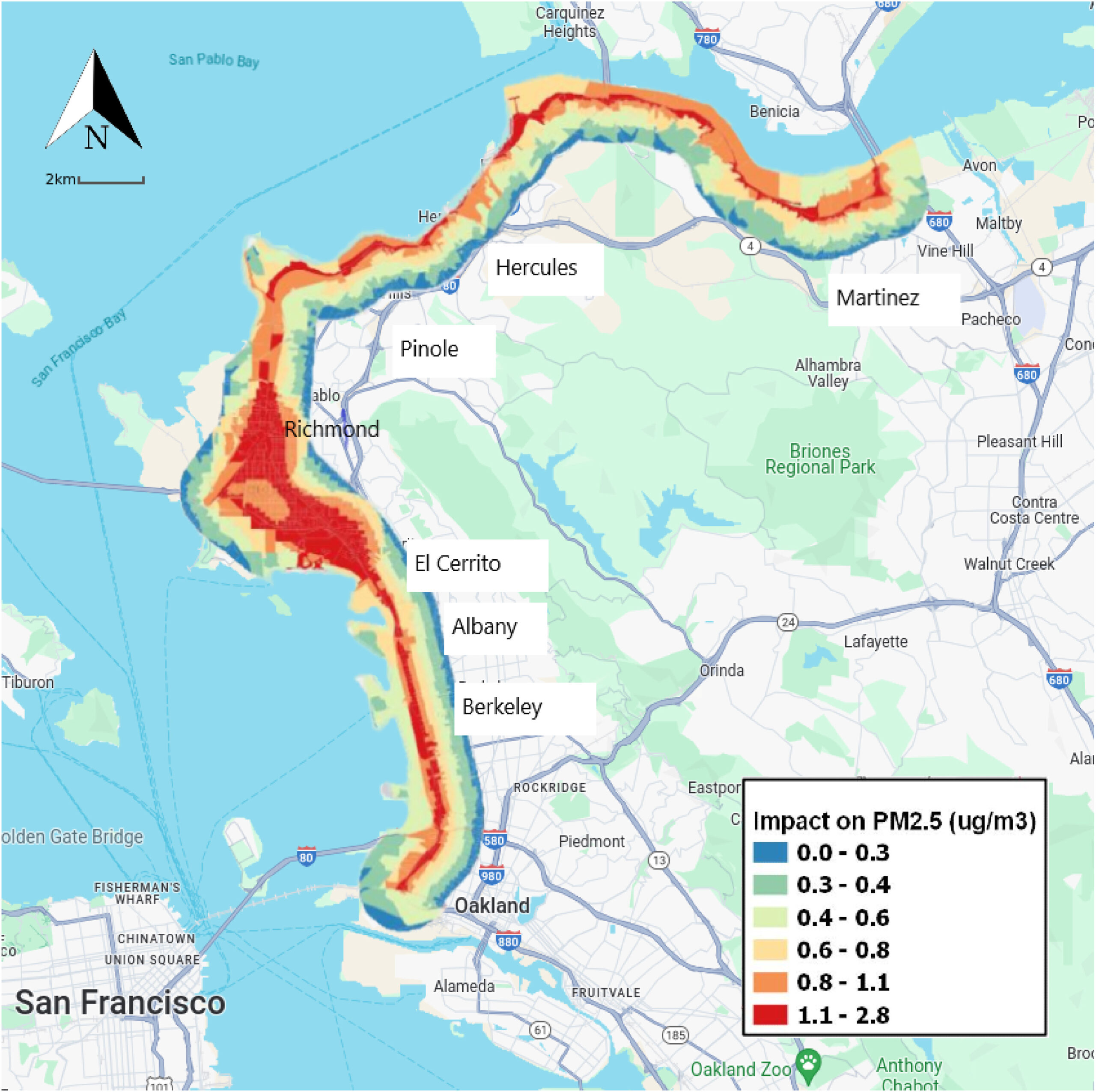
1) As you can see from this map, people of all classes would be hit by the toxic coal. But working-class communities would suffer the most. Workers are more than their jobs. They are parents whose children will be poisoned by coal. They are neighbors who will inhale toxic air and watch the people next door fall ill.
2) Our detractors tell us we have to choose between jobs and the climate, and we therefore must accept the consequences. But this terminal will create at most thousands of unhealthy, short-term jobs and a hundred permanent jobs in toxic workplaces. Some of our laboring brothers and sisters say, “Short-term unhealthy jobs are better than no jobs.” We hear them, we empathize with them, and therefore we are saying:
3) This is a “Yes to Healthy, Unionized Jobs” campaign as much as a No Coal campaign. Our coalition has been championing the redevelopment of the old Oakland Army Base, but in a way that will foster permanent, socially responsible employment. It is therefore crucial that many more unions and laborers join us because we can’t get that kind of development unless there is a mass movement of workers that puts pressure on local, state, and national governments to generate good jobs. This builds up to my next point:
4) The people who are behind this terminal – Trump and his oligarchs – are the same kind of people who bust unions throughout the country. They are also the ones who prevent any kind of legislation that would generate renewable energy jobs. In the last couple of years, bills that could have produced literally millions of green jobs in the US (with a heavy concentration in California) were killed due to their opposition. In other words, they are giving us (at best) thousands of unhealthy, short-term jobs with one hand, while they are taking away potentially millions of healthy, permanent jobs with their other hand.
5) This fight is also a matter of labor pride. The bosses want to build this terminal not just for the cash, which might be their primary motive, but also as an act of class vengeance. They always tell us that without them labor would be nothing. They create the jobs and they pay the wages, we are told. But the labor leadership in this campaign has shown that labor can coalesce with social movements and environmental justice communities to make big things happen. Whenever bosses see that kind of action, they are afraid for their fundamental privileges. That kind of victory shows that a world without oligarchs, a world where labor and communities self-consciously produce and control value, is possible. And therefore, they want to crush any living trace of such victories. Our win in 2016 is a cherished jewel of working-class memory. Ceding this turf to the oligarchs would mean abandoning our belief in a different world as much as abandoning our health and dignity.
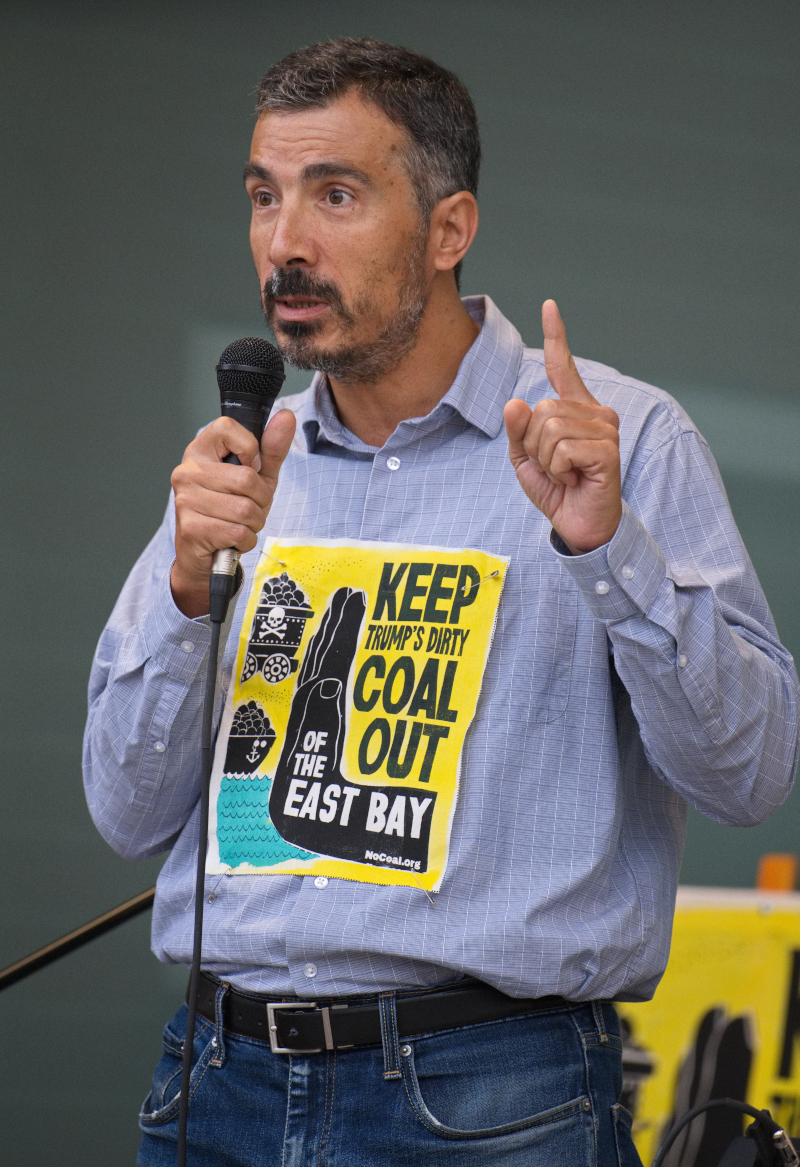
.stk-th4q7m9 {margin-bottom:15px !important;} @media screen and (min-width: 768px){.stk-096d817 {flex:var(--stk-flex-grow, 1) 1 calc(37.5% - var(--stk-column-gap, 0px) * 1 / 2 ) !important;}} @media screen and (min-width: 768px){.stk-0373019 {flex:var(--stk-flex-grow, 1) 1 calc(62.5% - var(--stk-column-gap, 0px) * 1 / 2 ) !important;}}Cihan Tuğal is a sociology professor at UC Berkeley and an organizer in East Bay DSA’s Climate Action Committee. He studies social movements, populism, capitalism, democracy, and religion and has a forthcoming book from Stanford University Press entitled The Social Roots of Autocratic Resilience. This piece is based on remarks Cihan made at the community rally of September 15, 2026, outside the Berkeley City Council meeting that adopted a resolution opposing the proposed Oakland coal depot. Photo credit: Leon Kunstenaar
.stk-q7i5evo {margin-bottom:12px !important;}Photo at top: Labor delegation led by Alameda Labor Council leader Josie Camacho speaks out against coal at Oakland City Council meeting in 2015 | Credit: Brooke Anderson
Learning-oriented collaboration enhances long-term impact: CFEW on the MAMRN Project.
Centre for Earth Works (CFEW) is a research-driven, youth-led organisation committed to protecting the earth by working closely with communities to build practical, lasting solutions that empower people to conserve their environment and adopt sustainable practices that support both livelihoods and ecological balance.
For nearly a decade, CFEW has consistently advanced environmental sustainability through innovative programmes, grounded research, and proactive community-based advocacy. Through this commitment, CFEW supports communities in taking ownership of environmental stewardship and responding to local challenges with locally driven solutions.
Community members and stakeholders cheer for a photograph after a training by CfEWCFEW is a member of the Global Alliance for Incinerator Alternatives (GAIA) and is one of the implementing partners of the GAIA-led Methane Reduction in Nigeria (MAMRN) Project, a major zero-waste and climate-action initiative focused on diverting organic waste from open dumpsites and landfills. It aims to reduce hazardous methane emissions, build circular economies, and empower communities by turning municipal waste into economic gold.
In this article, part of a forthcoming series, we spoke with Benson Dotun, the founder of Centre for Earth Works, about their work as a partner in Jos, Plateau State, for the project.
Thank you for joining us, Benson. Several organisations carry out the project through different activities, but with the same goal. Can you share insights into best practices for collaborating with other organisations on a project in Nigeria?
Collaboration has been a valuable component of this project, particularly through GAIA members’ participation in several activities. Based on our experience within this project and the broader Nigerian context, a few best practices stand out for effective collaboration with other organisations.
Clarity of roles and expectations from the outset is essential. Clearly defining responsibilities, solid deliverables, and areas of contribution helps reduce overlap, manage expectations, and ensure that each organisation’s strengths are effectively utilised.
Open and consistent communication strengthens partnerships. Regular check-ins, transparent information sharing, and timely feedback help build trust and allow partners to adapt quickly to emerging challenges or changes in context.
Finally, learning-oriented collaboration enhances long-term impact. Creating space for reflection, documentation, and knowledge exchange allows partners to learn from one another and strengthens the overall quality of the project. Within this project, collaboration with GAIA members has reinforced the importance of aligning technical expertise with community-based implementation to achieve sustainable outcomes.
Could you share some perspective on the current waste crisis in Nigeria and how this project aims to address this?
Over the past decades, Jos and Nigeria as a whole have experienced rapid population growth and urban expansion, integrating surrounding villages into the metropolitan area. This urbanisation has been paralleled by a sharp rise in municipal solid waste (MSW) generation. Without proper waste management infrastructure, indiscriminate dumping has become widespread, creating both environmental and public health hazards.
Dumpsites are particularly concerning as hotspots for methane emissions. Methane (CH₄) is produced when organic waste (such as food residues, yard waste, and animal waste) decomposes under anaerobic conditions typical of unmanaged dumpsites.
According to the European Environment Agency (EEA, 2025), landfills and dumpsites are the third-largest source of anthropogenic methane emissions globally, after agriculture and fossil fuels. Methane is a short-lived but highly potent greenhouse gas, with 80 times the warming potential of CO₂ over 20 years.
According to the United States Environmental Protection Agency (EPA), food waste comprises about 24% of municipal solid waste disposed of in landfills. Because it decays rapidly, food waste in landfills contributes more to methane emissions than any other landfilled material. An estimated 58% of methane emissions from municipal waste landfills are from landfilled food waste.
This project responds directly to these challenges by addressing methane emissions at their source through improved waste management practices. By promoting separation and composting, the project reduces the volume of biodegradable materials that end up in dumpsites, thereby limiting anaerobic decomposition and methane generation. In doing so, the project not only contributes to climate mitigation but also supports cleaner urban environments, improved public health outcomes, and more sustainable waste management systems within Nigeria.
Do you have a personal milestone or favourite moment in this project so far?
One of the most significant milestones for us at Centre for Earth Works has been establishing the Material Recovery Facility (MRF) and turning the concept into a space for waste sorting and recovery.
The MRF has created a structured system for separating waste streams, particularly organic waste, which is often overlooked but is a major driver of methane emissions when disposed of in open dumpsites.
A waste recovery facility build by CFEW as part of the MAMRN ProjectAnother defining moment has been the pilot implementation of Black Soldier Fly (BSF) farming for organic waste management. This approach has shown the potential to divert biodegradable waste from dumpsites and convert it into useful by-products. For us at the Centre for Earth Works, this pilot has been both a learning experience and a proof of concept that low-cost, nature-based solutions can be effective in the Nigerian context.
Equally important has been the project’s growing awareness component. Through our engagement, it became clear that many waste pickers and other key stakeholders were not previously aware of the link between organic waste, methane emissions, and climate change.
Seeing these groups begin to understand the environmental and health risks associated with unmanaged organic waste and their role in reducing those risks has been particularly rewarding. It highlights the project’s impact beyond infrastructure by building knowledge and changing perceptions around waste and methane reduction.
We have seen these key themes emerge in this project (Organic Waste Management, Infrastructure Development, Waste Picker Integration, Capacity Building and Awareness Raising, Local Government Engagement, National Policy Advocacy and Emissions Monitoring. Could you share experiences (as applicable) on any of these topics within this
Project so far?
Several of these themes have been central to the project’s progress so far and have shaped both implementation and learning at the Centre for Earth Works.
Organic Waste Management has been a core focus alongside the set-up of our Material Resource Recovery Facility and the pilot use of the Black Soldier Fly (BSF) process. These efforts have demonstrated practical ways to divert organic waste from dumpsites, reduce methane emissions, and convert biodegradable waste into useful by-products, while remaining context-appropriate and low-cost.
A CFEW-trained waste picker displays an organic compost and vegetable wasteIn terms of Infrastructure Development, the establishment of the MRF represents a significant step forward. Beyond being a physical structure, it has served as an enabling platform for improved waste sorting and recovery, as well as for experimentation with organic waste treatment solutions. It has also provided a visible reference point for demonstrating what decentralised waste management infrastructure can look like at the community level.
Waste Picker Integration has been another important aspect of the project. Through engagement and sensitisation, waste pickers have been recognised not only as informal actors but as key stakeholders in waste recovery and methane reduction. The project has created space for dialogue, inclusion, and a better understanding of their role within a more organised waste management system.
Capacity Building and Awareness Raising have been critical across all project components. Training and engagements revealed significant gaps in understanding the links between organic waste, methane emissions, and climate change.
Addressing these gaps has empowered waste pickers, community members, and other stakeholders with knowledge to adopt better practices and see their work as part of a broader climate solution.
Finally, on Local Government Engagement, the project has created opportunities to start conversations with relevant authorities on organic waste management, methane reduction, and the need for supportive local policies and infrastructure. These engagements have helped build institutional interest and lay the groundwork for longer-term collaboration.
Overall, these experiences show how the project integrates infrastructure, community engagement, policy, and learning to address organic waste and methane emissions in a holistic and scalable way.
What is the path forward for your organisation and possible next steps from this project?
The path forward for the Centre for Earth Works builds directly on the lessons, structures, and partnerships established through this project. A key next step is to consolidate and scale the organic waste management systems piloted, particularly by strengthening operations at the Material Recovery Facility (MRF) and expanding the use of nature-based solutions, such as the Black Soldier Fly (BSF) process and other composting methods, including biogas production.
Another important priority is to deepen the integration and capacity of waste pickers and community actors. Building on the awareness and skills developed during the project, CFEW plans to support more structured participation, improved working conditions, and stronger linkages between informal waste workers.
CFEW also intends to strengthen engagement with local stakeholders to translate project learnings into more sustained institutional support. This includes advocating for decentralised organic waste management, improved waste segregation practices, and approaches that reduce methane at the local level.
The post Learning-oriented collaboration enhances long-term impact: CFEW on the MAMRN Project. first appeared on GAIA.
Berkeley Passes Resolution Against Toxic Coal Threat
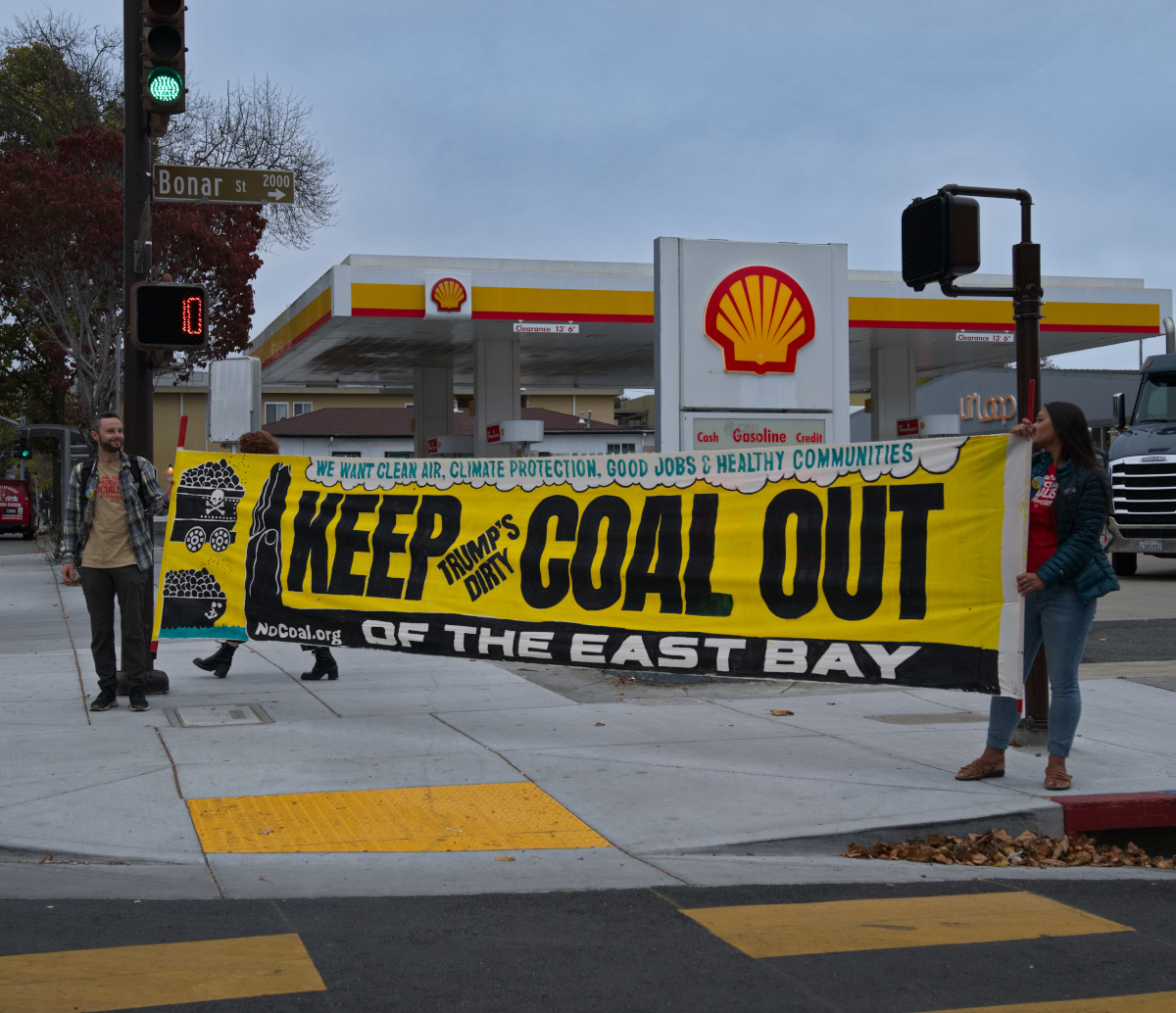
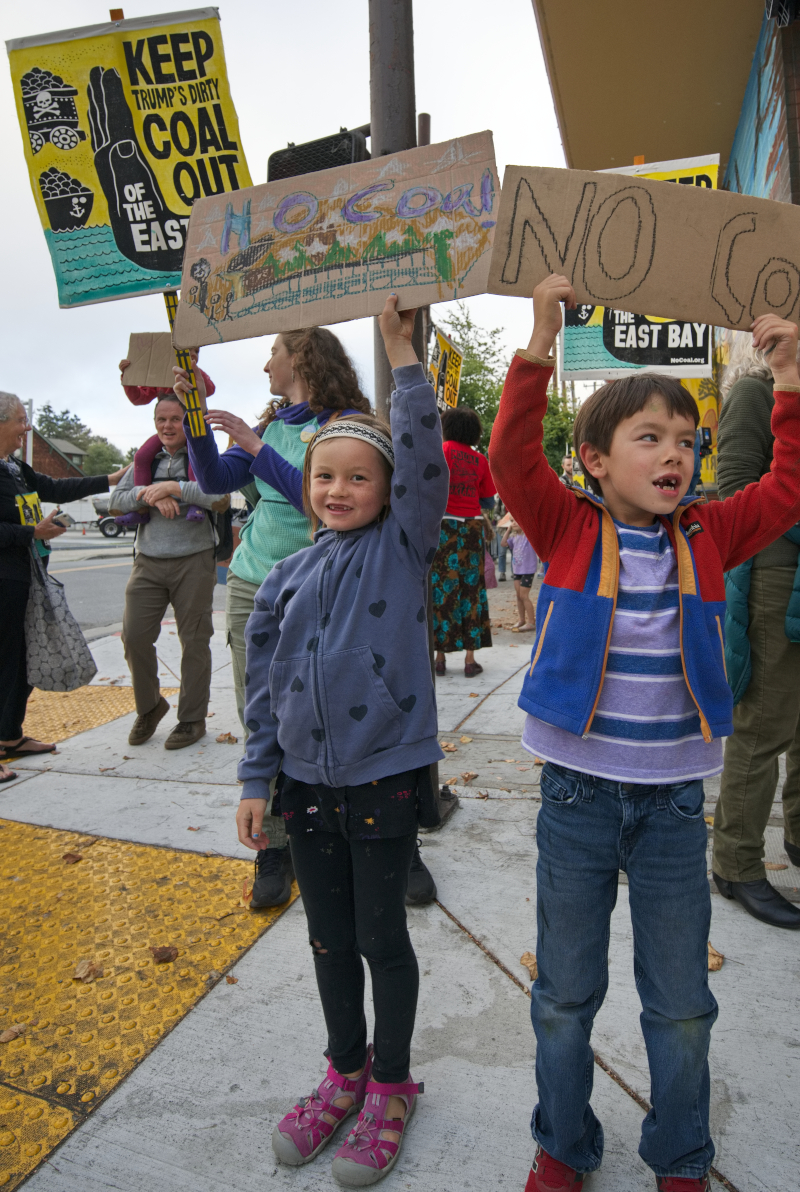
Last night, over 125 people rallied outside Berkeley City Council in support of a resolution opposing coal handling, storage, and transport in the Bay Area while dozens of No Coal advocates made their support known to the City Council with signs and comments.
The Berkeley City Council passed the resolution unanimously.
The resolution is a response to the deadly Trump-funded coal terminal planned in West Oakland. The resolution also calls for the Bay Area Air District to strictly regulate coal facilities, and affirms the City’s support of Assembly Bill 40, which requires environmental review for large coal projects. The resolution was sponsored by Council members Igor Tregub (Author), Rashi Kesarwani (Co-sponsor), and Terry Taplin (Co-sponsor) as well as by Berkeley mayor Adena Ishii.
“We live in the flatlands near the railroad tracks, freeways, refinery, and airport, constantly exposed to various pollutants,” said Ms. Margaret Gordon, a longtime environmental justice advocate and resident of West Oakland. “This proposed coal terminal is one more burden we should not have to suffer under. Homes along the tracks lack indoor air filtration and air conditioning to block out coal dust, posing a direct threat to our health.
“Our health is just as important as corporate profits. Unhoused individuals are especially vulnerable and exposed to pollutants, as they do not have a home to protect their lungs,” said Ms. Margaret. “No coal in the Bay Area!”
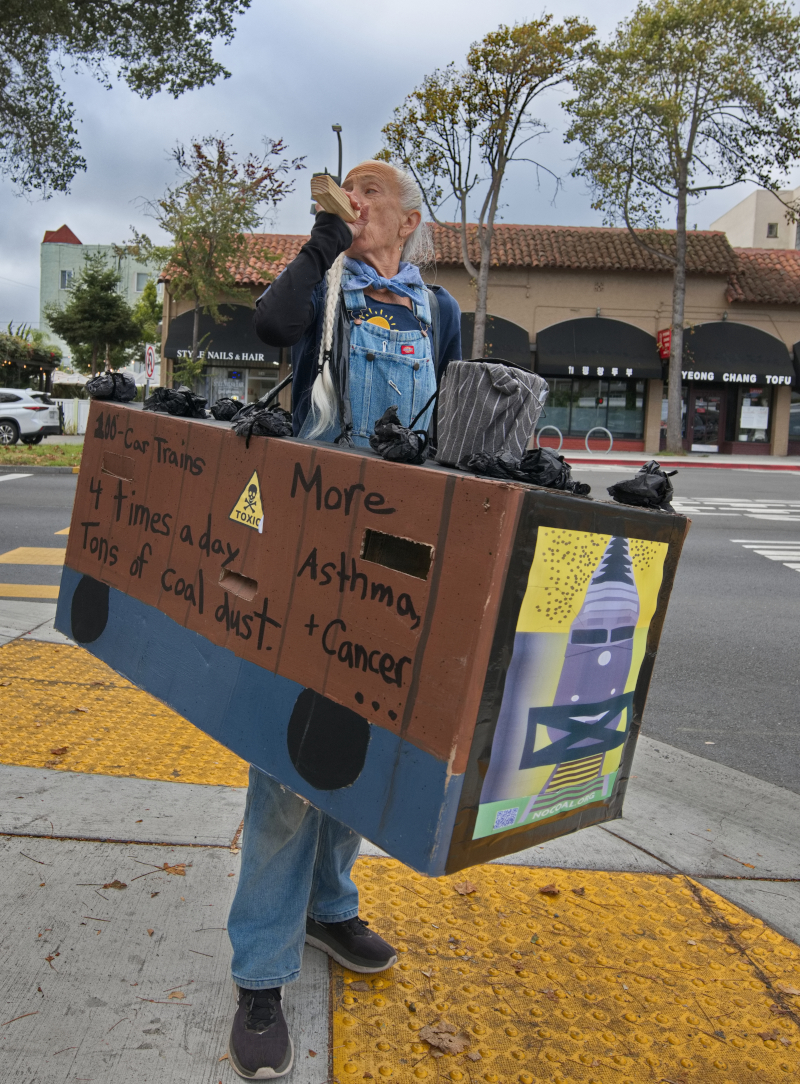
The rally was lively, defiant, and hopeful, with street theater performances including larger-than-life puppets blocking mock coal trains, chants and songs lead by Singing Resistance, and banners created at a community art build organized by “artivist” David Solnit.
“Living in Oakland, I am sick and tired of my community being ground zero for toxic pollution and environmental injustice,” said Berkeley Youth Vs. Apocalypse member Ashley Jahja. “Our health, our lives are not disposable. The fight against the coal terminal started in West Oakland but with recent mapping, is going to impact the entire Bay Area. Our fight is your fight, and we have to do whatever it takes to prevent the coal terminal from happening.”
“Berkeleyans are not about to let the East Bay become a ‘sacrifice zone’ so developers and the coal mining industry can poison the planet while they get even richer,” said Steve Masover, Berkeley resident and No Coal in Oakland organizer. “We’re here tonight because we’re determined to stop this calamity.”
“As a primary care physician, mom and community organizer who lives in West Berkeley, I could not be more opposed to the efforts to build a dirty coal terminal by the Bay Bridge,” said Ashley McClure, MD, the Executive Director of Climate Health Now. “My patients are already dealing with asthma, heart disease and dementia – all of which scientific evidence assures us would be made worse by the dirty soot of toxic coal dust (primarily fine particulate matter, or PM2.5) from coal trains smothering our communities. We care too much about the health of our families and communities to let the selfish profit motives of the billionaire class hawking dirty fossil energy move this ludicrous plan forward. This misanthropic dirty energy plan stops here.”
“These coal trains will pass a few hundred feet from places where my kids play soccer or attend summer arts camp,” said Megan Wachspress, Berkeley parent. “My kids will breathe the dust off these railcars while they’re moving, and kids in West Oakland will breath even more dust while the cars sit and are unloaded. I have a responsibility to my kids and to all the kids and families along these tracks to stop toxic coal dust from entering the East Bay.”
The resolution was proposed in response to the massively unpopular coal terminal planned in Oakland, which would flood Berkeley and other Bay Area cities with toxic coal pollution from mile-long coal trains. In June of this year, President Trump announced $75 million in funding for the terminal. Developer Phil Tagami aims to build a terminal to export coal carried by rail from Utah to Martinez to West Oakland, where he plans to load coal onto ships bound for Asian markets.
This resolution is part of a growing wave of resistance throughout the East Bay and statewide: The City of Richmond passed a similar resolution in July. Coalition members are organizing in other cities along the East Bay portion of the rail route to pass their own resolutions. The California State Legislature passed Assembly Member Mia Bonta’s AB40 last month. Governor Newsom is being urged by dozens of labor, faith, and environmental organizations, Supervisor Nikki Fortunato Bas, and countless Californians to sign it into law.
Rosa Parks Elementary School contingent, Photo Credit Leon Kunstenaar.
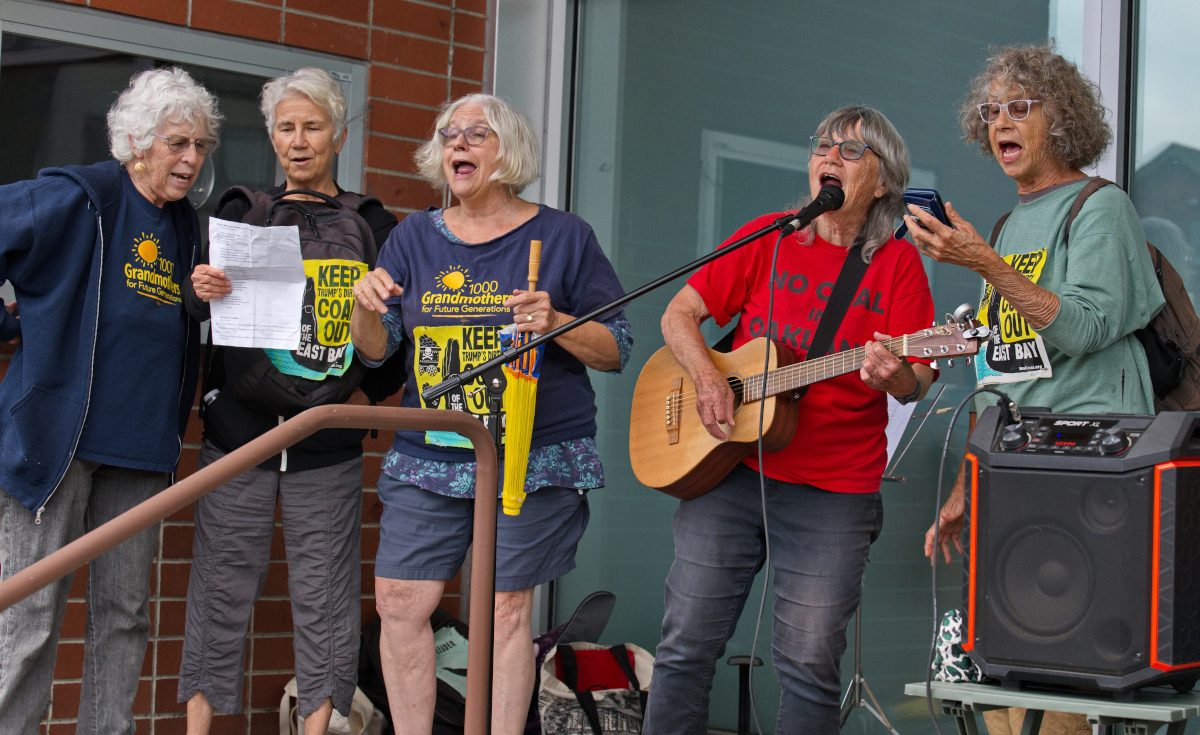
Singing Resistance, Photo Credit Leon Kunstenaar.
Labor speaker Cihan Tugal, Photo Credit Leon Kunstenaar.
Banner, Photo Credit Leon Kunstenaar.
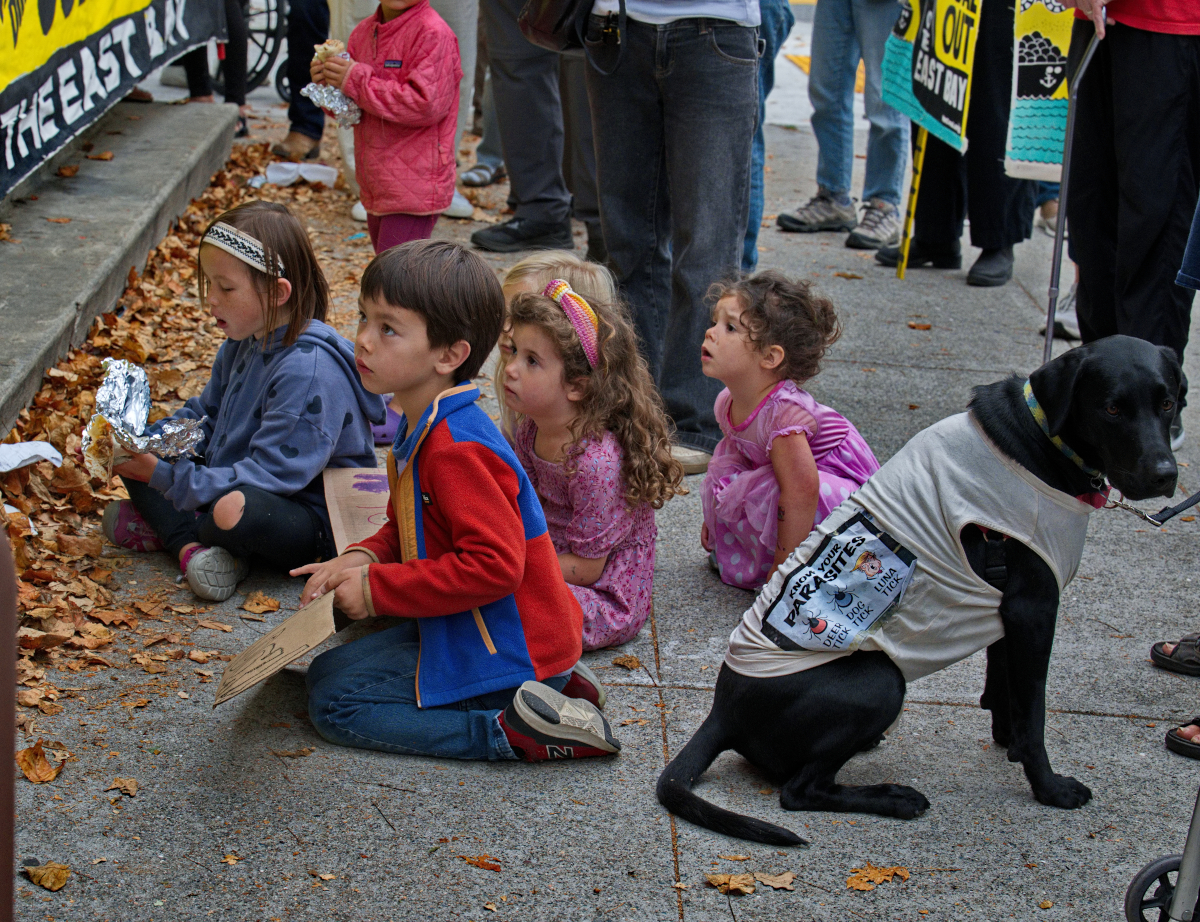
Kids against Coal, Photo Credit Leon Kunstenaar.
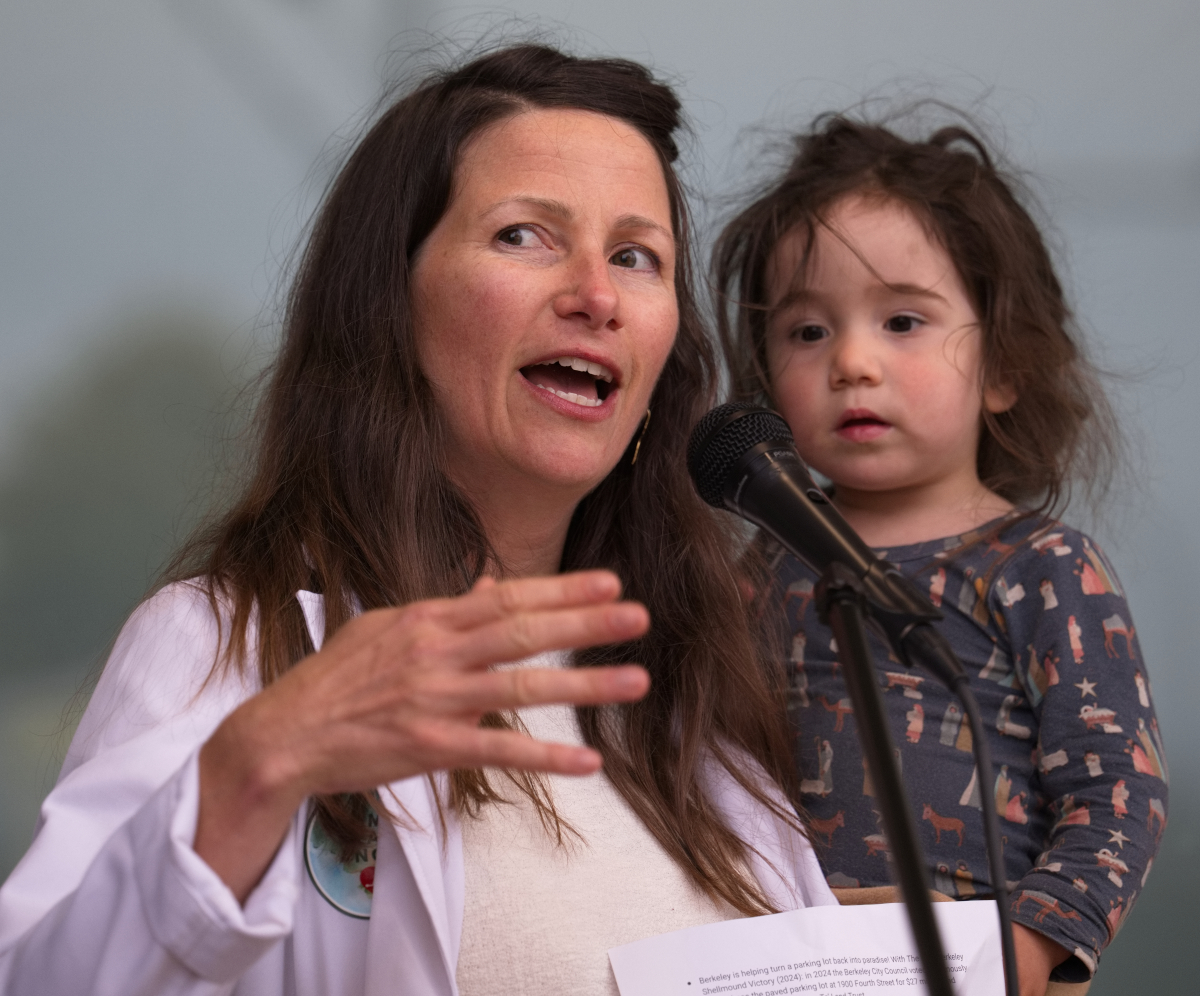
Berkeley Parent Sarah Berg at the mic, Photo Credit Leon Kunstenaar.
Coal Train (1000 Grandmothers), Photo Credit Leon Kunstenaar.
Images credit: Leon Kunstenaar
Africa Zero Waste Academy: Where Knowledge Becomes Movement
By Yvette Ahenkorah, 2026 Africa Zero Waste Academy Participant
I came to the GAIA Africa Zero Waste Academy ready to learn. I expected new knowledge, new ideas and a deeper understanding of what zero waste could look like in our communities. What I did not fully expect was to leave the six-day in-person experience carrying a greater sense of responsibility, not only towards the waste we generate, but towards the people whose lives and livelihoods are deeply connected to it.
Yvette during a presentation at the Africa Zero Waste Academy 2026, in Ghana.There is something about knowledge that changes you when you can no longer separate what you have learnt from what you see around you.
Suddenly, waste is not just the overflowing bin, the plastic on the street or what disappears after collection. You begin to ask where it goes. Who collects it? Who sorts through what we throw away? Who recovers the materials that still have value? Who bears the health and environmental consequences of the systems we have created?
And somewhere within those questions, the people behind our waste systems become impossible to overlook: Waste workers. Who are part of what keeps our communities and cities functioning, yet their contribution can easily disappear from the larger conversation about waste.
For me, the Academy reinforced that we cannot speak meaningfully about a zero waste future without speaking about the people already doing much of the work of recovery, collection, sorting and recycling.
That realisation made zero waste feel less like an environmental concept I was studying and more like a movement I wanted to contribute to.
Because what would a zero waste transition mean if the people already holding parts of our waste systems together are left behind?
Movement building, then, has to be about more than changing where materials go. It must also be about people, dignity, recognition, livelihoods and justice.
Over those six days, learning alongside people committed to changing our relationship with waste reminded me that movements do not always begin with something big. Sometimes they begin with a conversation. With questioning a system we have accepted for too long. With recognising the value in something we once called waste. With listening to those whose livelihoods give them an understanding of these materials that many of us may never have considered.
And perhaps most importantly, movement begins when knowledge moves beyond us.
I have carried that thought with me since the Academy, particularly into my work at AERC-Ghana. As I engage with community-based approaches such as composting and continue exploring circular solutions, I find myself returning to a question that has become increasingly important to me:
How do we turn what we know into action that communities and the people working within our waste systems can experience, own, and sustain?
Yvette & other participants during a session at the Africa Zero Waste Academy 2026, in Ghana.I am learning that building the zero waste movement is not about arriving in communities with all the answers. It is about listening. It is about recognising existing knowledge and labour.
It is about creating space for communities and waste workers to help shape the solutions that affect them. And it is about ensuring that our pursuit of cleaner communities does not erase the people whose work has helped keep those communities clean.
This is where the experience became deeply personal for me. I may have walked into the Academy seeking knowledge about zero waste, but I walked away thinking more deeply about people. About whose voices are heard when solutions are designed. About whose labour we notice. About the kind of transition we are building, and whether dignity and justice sit at the centre of it.
Six days cannot solve our waste crisis.
Six days cannot address every challenge waste workers face.
But six days can change the questions someone begins to ask.
For me, the question is no longer simply, “How do we achieve zero waste?”
It is also, “How do we build a zero-waste movement where no resource and no person is treated as disposable?”
Perhaps that is where knowledge becomes movement. And where movement becomes action.
Writer’s Bio
Yvette is a youth development and sustainability professional from Ghana passionate about climate action, waste management, and community empowerment. She currently works with Alliance for Empowering Rural Communities, where she supports initiatives focused on inclusion, youth engagement, and equal access for underserved communities. Her interests include urban resilience, circular economy solutions, and empowering young people through environmental sustainability and advocacy.
The post Africa Zero Waste Academy: Where Knowledge Becomes Movement first appeared on GAIA.
Tres días de encuentro para compartir y construir el futuro de nuestro movimiento
Del 3 al 5 de septiembre, miembros de GAIA y de Break Free From Plastic en América Latina se reunieron en Santiago para compartir experiencias, celebrar logros y construir prioridades estratégicas para seguir fortaleciendo el movimiento. El encuentro recibió a 44 organizaciones de 14 países de la región.
Septiembre, 2026 – El objetivo central del encuentro fue fortalecer la articulación regional, celebrar los aprendizajes colectivos y construir prioridades estratégicas compartidas para orientar el trabajo conjunto de los próximos años por la justicia ambiental y basura cero.
En la primera parte de la jornada, se pensó colectivamente en la realidad política, social y ambiental de los distintos países. Se coordinaron espacios de conversación que trataron temas relacionados con basura cero en espacios educativos, pirólisis y residuos orgánicos, para luego dar paso a la celebración de los hitos que han marcado el trabajo desde la última vez que nos encontramos en Lima, en 2023.
Foto grupal encuentro de miembros GAIA y BFFP América Latina, Santiago, 2026.Para Karla Escoto de Basura Cero Nicaragua, “Haber sido parte del encuentro ha sido gratificante, renovador. Estos espacios no sólo nos permiten intercambiar las experiencias y acciones que están realizando cada unas de las organizaciones que trabajamos hacia basura cero, también nos permite tener ese contacto directo, humanizar nuestras acciones, compartir, replantearnos, y saber que a pesar de las diferentes circunstancias y contextos de cada país seguimos avanzando desde nuestros territorios, trabajando de la mano de la juventud, las comunidades y recicladores de base.”
Otros espacios importantes fueron las instancias de formación ejecutadas por los mismos miembros y las conversaciones que se dieron en torno a las prioridades estratégicas de la región, con el fin de avanzar en puntos comunes que permitan orientar el trabajo conjunto en los próximos años y reconocer las capacidades que existen dentro de la alianza.
“El encuentro significó confirmar el valor de compartir lo que hacemos desde las comunidades. Pudimos llevar la experiencia de León Cortés, pero también escuchar y aprender de otras organizaciones de la región. Ese intercambio fortalece nuestro trabajo y nos recuerda que, aunque nuestros territorios son distintos, podemos aprender unos de otros.”, comenta Julia Picado de la Asociación Defensores del Monumento Natural Zona de los Santos, Costa Rica.
Los tres días de encuentro terminaron en un ambiente festivo con la feria de causas, donde las organizaciones presentaron el trabajo que están desarrollando en sus territorios. Las experiencias compartidas permitieron conocer mejor la diversidad del trabajo que sostiene el movimiento y las distintas formas en que las organizaciones están impulsando la justicia ambiental e iniciativas de basura cero.
Para Tania Ricaldi, de CESU-UMSS, Bolivia, “El Encuentro de Santiago fue un espacio de diálogo, escucha e interaprendizaje que permitió compartir experiencias de prácticas de basura cero que muestran que desde el accionar local, el trabajo solidario y creativo se están construyendo y reconstruyendo relaciones y transformaciones esenciales para el cuidado de la vida.”
El encuentro en Santiago será recordado como un momento donde se celebró lo construido y donde se delinearon los pasos para construir las estrategias que permitirán avanzar hacia nuevos objetivos y reforzar logros ya alcanzados.
The post Tres días de encuentro para compartir y construir el futuro de nuestro movimiento first appeared on GAIA.
September 15, 2026: Protect Yosemite National Park from Trump’s proposed land giveaway!
September 15, 2026
Protect Yosemite National Park from Trump’s proposed land giveaway!Greenaction joins 149 organizations in opposing the Trump administration’s plan!
The Sacramento Bee: California teachers union to sue state over $3.9 billion in Prop. 98 funds
September 15, 2026—Sacramento Bee reporter Chaewon Chung covers the California Teachers Association’s lawsuit against the state over $3.9 billion in delayed Proposition 98 funding—money guaranteed to K-12 schools and community colleges under the state constitution for nearly 40 years. Districts across California are already feeling the squeeze: Sacramento City Unified is confronting a $222 million structural deficit while banking on withheld Prop. 98 dollars just to stay solvent, and Los Angeles Unified has laid off hundreds of employees amid the shortfall. Public Advocates Managing Attorney John Affeldt helped unpack the legal ambiguity at the heart of the dispute and whether the state has flexibility to wait for final revenue numbers before setting school funding, or must budget off projections when the budget is adopted. As Affeldt put it: “Does the governor have the flexibility to wait and see what the final number is, or do they need to set the amount based on best projections at the time the budget’s adopted?—it’s a bit of a gray area.” With CTA’s suit now headed to court, that gray area is about to get tested.
The post The Sacramento Bee: California teachers union to sue state over $3.9 billion in Prop. 98 funds appeared first on Public Advocates.
Supervisor Nikki Fortunato Bas urges Gov. Newsom to sign AB40 into law
Emphatic support for AB40, the Community First Coal Review Act, was conveyed to Governor Newsom by Alameda County Supervisor Nikki Fortunato Bas (District 5) in an eloquent and detailed letter dated September 9, 2026.
Supervisor Fortunato Bas represents a district that includes the West Gateway site where developers plan to build the proposed coal terminal, as well as the West Oakland neighborhoods adjacent to the site. District 5 also includes Emeryville, Berkeley, and Albany, three of the East Bay cities through which “unit trains” of 100 cars would pass if the coal terminal becomes operational. Uncovered coal cars would shed toxic coal dust in residential and commercial neighborhoods along the rail route, poisoning homes, businesses, schoolyards, parks, and sports fields.
The Governor has until September 30th to sign the bill, introduced by Assemblymember Mia Bonta (Oakland), into law. AB40 would also become law If Newsom neither signs nor vetoes the bill by the end of this month.
Supervisor Fortunato Bas’ letter begins:
On behalf of Alameda County District 5, I respectfully urge you to sign AB 40 (Bonta). This legislation is essential for safeguarding public health in West Oakland, West Berkeley, Emeryville, and other communities along rail corridors that already bear some of the worst cumulative pollution burdens in California.
If and when it becomes law, massive bulk coal facilities like the Oakland Bulk and Oversized Terminal (OBOT) proposed for the West Gateway would require a full Environmental Impact Report (EIR) before discretionary approval (permits) are issued for the project. No prior EIR accounted for the shipment of 10 million tons of coal annually through the facility, as detailed in a 15-page letter sent by Earthjustice Deputy Managing Attorney Colin O’Brien to the Bay Area Air District in July.
We urge readers to contact Governor Newsom in the coming days, urging him to sign AB40 into law. Earthjustice is providing a ready-to-send letter to the Governor urging his signature: please add your voice to this call if you haven’t already.
Photo credit: Brooke Anderson, November 2017: Nikki Fortunato Bas in Oakland’s Chinatown
In addition to the copy linked above, Supervisor Fortunato Bas’ letter is linked from the District 5 Media & Statements page.
Trump Move to Scrap Climate Pollution Limits After Hottest Summer on Record Is Self-destruction
Contact: kayla@unbendablemedia.com
Statement from Mar Zepeda, Legislative Director of the Climate Justice Alliance, on the Trump administration finalizing the repeal of federal limits on greenhouse gas emissions from power plants:
“Scrapping limits on climate pollution places public health and our communities at perilous risk . We just lived through the hottest summer on record, with communities across the country enduring health consequences due to brutal heat, floods, storms and drought, and the Trump administration’s response is to give the fossil fuel industry permission to make the crisis worse. Climate change reduces air quality leading to respiratory and cardiovascular conditions, while extreme heat and flooding can lead to illness, injury and death. These risks are not shared equally: they are often faced by the same communities that have spent generations living next to power plants and other polluting industries.
“The previous power plant rule was far from perfect. We said at the time that its reliance on dangerous and unproven carbon capture technology gave the fossil fuel industry another lifeline when we should be moving away from fossil fuels altogether. The answer should have been stronger protections and a faster transition toward clean, affordable energy: not scrap federal limits on greenhouse gas pollution and give polluters free rein.
“This is also a question of who pays. When pollution continues, the costs do not disappear, they are borne by families and communities, environmental damage, extreme-weather impacts and the public costs of responding to them. Federal policy should protect communities, not leave them and taxpayers carrying the cost that polluters are better positioned to prevent.
“People deserve affordable, reliable energy, and the right to live in healthy communities without having to choose between keeping the lights on and protecting their health. Instead, this administration is choosing to keep us tied to an expensive, polluting energy system because it benefits the corporations that profit from it.”
###
The post Trump Move to Scrap Climate Pollution Limits After Hottest Summer on Record Is Self-destruction appeared first on Climate Justice Alliance.
PAVE: Rooting collaboration in local relationships through the MAMRN Project
The Pan African Vision for the Environment (PAVE) is a Lagos-based grassroots non-profit accredited by the United Nations Environment Programme (UNEP) and the United Nations Convention to Combat Desertification (UNCCD).
Established to promote sustainable development through research, policy dialogue, advocacy, and consultancy, PAVE works on development issues across their environmental and socio-economic dimensions, with a focus on the Sustainable Development Goals, including water and sanitation, agricultural Value Chain promotion, Gender, Disaster Risk Reduction (DRR), Climate change and Clean Energy promotion, Waste Management including E-Waste, Chemical Management, Blue Economy, Ocean Citizen Awareness and literacy, and Stakeholder Engagement
With over 20 years of experience in the development sector, PAVE has worked at local, national, regional, and international levels, presenting research and organising capacity-building workshops on sustainable development across Africa, Asia, Europe, and the Americas.
Grassroots community members at a PAVE training. Lagos, Nigeria.PAVE is a member of the Global Alliance for Incinerator Alternatives (GAIA) and one of the implementing partners of the GAIA-led Multi-Solving Action to Methane Reduction in Nigeria (MAMRN) Project.
In this article, the third of a series, we spoke with Anthony Akpan, Founder of PAVE, about their work as a partner in Lagos for the project.
In this project, several GAIA members are participating in several activities. Can you share insights on best practices for collaborating with other organisations in Nigeria?
Collaboration works best when it is built on trust, respect, and clear communication.
In this project, PAVE has worked closely with GAIA members throughout our workshops and other activities, ensuring that each session runs smoothly, reaches participants effectively, and avoids duplication of efforts. Seeing everyone bring their expertise together to achieve shared goals has been inspiring and demonstrates how partnerships can multiply impact.
Rooting collaboration in local relationships has also been key. Engaging community leaders, local government representatives, and waste pickers early helped ensure that interventions were practical, culturally appropriate, and sustainable.
By staying open to learning from each other and adapting to on-the-ground realities, the partnership has consistently achieved stronger outcomes.
Flexibility and accountability remain central to success. Operating environments in Nigeria can change quickly, and having a spirit of co-creation, regular check-ins, and openness to feedback has allowed PAVE and GAIA to stay aligned while delivering meaningful results.
Could you share some perspective on the current waste crisis in Nigeria and how this project aims to address this?
Nigeria faces a significant waste management challenge, with millions of tons of organic waste generated each year and only a fraction properly collected or treated.
Open dumping, irregular collection systems, and limited infrastructure have led to environmental pollution, greenhouse gas emissions, and public health risks, while informal waste workers often operate in unsafe conditions without recognition or support.
Grassroots community members at a PAVE training. Lagos, NigeriaThe MAMRN Project addresses this crisis through a holistic approach that combines community engagement, practical solutions, and policy-level support. Through the project, PAVE is working to divert organic waste from landfills, promote community-level composting, and strengthen local government systems for more effective waste management, while building the capacity of households, waste pickers, and local authorities with the knowledge and tools to manage waste sustainably.
A practical example from Lagos illustrates the impact: PAVE has trained over 50 waste pickers and approximately 300 households on organic waste segregation, composting, and Black Soldier Fly (BSF) rearing.
Participants learned how to separate food and garden waste from general trash, which was then collected and converted into compost for local urban farms. Putting these practices into action not only reduces methane emissions but also provides valuable resources for the community.
Do you have a personal milestone or favourite moment in this project so far?
A personal milestone for us at PAVE has been supporting participants as they begin to apply what they are learning during our household and waste picker training in Lagos.
Seeing families and waste workers engage with organic waste segregation and composting in real time strongly affirms the project’s vision and highlights the potential for meaningful change on the ground.
Our favourite moments have been during live demonstrations of Black Soldier Fly (BSF) rearing and composting at the workshops. Observing participants’ curiosity, excitement, and hands-on engagement is incredibly inspiring.
Their enthusiasm underscores how knowledge becomes most impactful when experienced directly, and it reinforces the importance of practical, interactive learning in shaping both environmental practices and community action.
Grassroots community members pose for a picture at a PAVE training. Lagos, NigeriaWe have seen these key themes emerge in this project (Organic Waste Management, Infrastructure Development, Waste Picker Integration, Capacity Building and Awareness Raising, Local Government Engagement, National Policy Advocacy and Emissions Monitoring). Could you share experiences (as applicable) on any of these topics within this project so far?
Throughout the MAMRN project in Lagos, several key themes have guided PAVE’s work and shaped our impact. In organic waste management, households and communities have learned to transform food and garden waste into compost or feed for Black Soldier Fly (BSF) larvae.
On waste picker integration, informal waste workers received training and support to improve segregation practices and gain recognition within local waste systems. Seeing participants confidently separate organic waste for composting demonstrated both empowerment and practical impact.
Capacity building and awareness raising have been central to the project, with hands-on workshops bringing households and waste pickers together. Participants eagerly engaged in sorting exercises and BSF demonstrations, translating knowledge into real-world action.
Finally, through local government engagement, PAVE has worked closely with Lagos authorities to ensure that interventions align with municipal waste management plans, strengthen local infrastructure, and integrate informal workers into formal systems.
Together, these experiences show how training, collaboration, and practical, community-driven solutions can tackle Nigeria’s waste challenges, reduce methane emissions, and create meaningful environmental and social impact.
What is the path forward for your organisation and possible next steps from this project?
With the MAMRN project still underway, PAVE is focused on building on the progress made so far and ensuring the remaining activities have maximum impact. We continue to engage households, waste pickers, and local authorities in Lagos, reinforce hands-on solutions like composting and Black Soldier Fly (BSF) rearing, and encourage practical application of the skills learned.
Next steps include expanding ongoing training sessions, deepening community participation, and supporting local government efforts to better integrate informal waste workers into structured waste systems. We are also capturing lessons in real-time, allowing us to adapt and refine our approach as the project unfolds.
Looking ahead, PAVE is committed to turning knowledge into action, empowering communities to adopt sustainable waste practices, and contributing to Nigeria’s methane reduction goals — one household, one waste picker, and one composting initiative at a time. The journey is ongoing, and the best outcomes are still ahead.
The post PAVE: Rooting collaboration in local relationships through the MAMRN Project first appeared on GAIA.
Mad River Union: Humboldt marks california transit month with advocacy, ride contests and a talk on transit and democracy
September 10, 2026—The Mad River Union has a rundown of North Coast activities for California Transit Month, including tonight’s talk by Public Advocates’ Senior Transportation Policy Advocate Laurel Paget-Seekins. Paget-Seekins will present “Protecting Transit’s Role in Multi-Racial Inclusive Democracy” at the McKinleyville Family Resource Center, examining public transit’s historic role in civil rights struggles and the creation of integrated public spaces—AND how the Trump administration’s policies are threatening transit access today. The piece also covers a coalition open letter to Gov. Newsom and gubernatorial candidates on state transit funding, a rider ride-logging contest, and rider ride-alongs with local decision-makers throughout the month.
The post Mad River Union: Humboldt marks california transit month with advocacy, ride contests and a talk on transit and democracy appeared first on Public Advocates.
Pages
The Fine Print I:
Disclaimer: The views expressed on this site are not the official position of the IWW (or even the IWW’s EUC) unless otherwise indicated and do not necessarily represent the views of anyone but the author’s, nor should it be assumed that any of these authors automatically support the IWW or endorse any of its positions.
Further: the inclusion of a link on our site (other than the link to the main IWW site) does not imply endorsement by or an alliance with the IWW. These sites have been chosen by our members due to their perceived relevance to the IWW EUC and are included here for informational purposes only. If you have any suggestions or comments on any of the links included (or not included) above, please contact us.
The Fine Print II:
Fair Use Notice: The material on this site is provided for educational and informational purposes. It may contain copyrighted material the use of which has not always been specifically authorized by the copyright owner. It is being made available in an effort to advance the understanding of scientific, environmental, economic, social justice and human rights issues etc.
It is believed that this constitutes a 'fair use' of any such copyrighted material as provided for in section 107 of the US Copyright Law. In accordance with Title 17 U.S.C. Section 107, the material on this site is distributed without profit to those who have an interest in using the included information for research and educational purposes. If you wish to use copyrighted material from this site for purposes of your own that go beyond 'fair use', you must obtain permission from the copyright owner. The information on this site does not constitute legal or technical advice.
 This site is not the official webpage of the Industrial Workers of the World.