You are here
No Coal in Oakland

Emeryville, Berkeley, and Richmond Urge Stringent Regulation of Proposed Coal Facility
The momentum of East Bay cities pushing back on the proposed West Oakland coal terminal continues to grow with each passing week: No Coal in Oakland stands with Richmond, Emeryville, and Berkeley as those cities reiterate their longstanding opposition to the terminal and urge the Air District to fully exercise its permitting, regulatory, and enforcement authority to prevent PM2.5 emissions from coal transport through the planned Oakland Bulk and Oversized Terminal (OBOT).
Richmond and Berkeley City Councils passed unanimous resolutions against the proposed coal terminal in July and September, respectively, while the City of Emeryville submitted an urgent letter to the Air District.
The letter, dated September 11, 2026 explains that:
The City of Emeryville’s Land Use Section of the General Plan shows the rail line running through High-Density Residential areas, Mixed-Use/Residential areas, Park/Open Space Areas, Office/Technology areas, and Regional/Neighborhood Retail areas…
Maps show that the entire City of Emeryville is within one mile of the rail line, except the Marina Park area at the end of Powell St. The highest density areas are within 2400 feet of the rail line. As a result, the population of Emeryville would be highly exposed to toxic dust if it were to escape from trains passing through the city.
Emeryville passed a resolution in spring 2016 opposing the shipment of coal along the city’s Union Pacific rail line, declaring that “coal burning stands in direct conflict with the City of Emeryville’s Climate Action Plan.”
A month later, Emeryville’s then-Mayor Dianne Martinez co-signed a letter with ten other neighboring cities in a powerful display of unity, reinforcing the city’s opposition to any shipment of coal through West Oakland’s Marine Terminal. (Mayors’ letter on coal, April 14, 2016)
As the fight against Big Coal and developer Phil Tagami continues, now a decade later, so too does Emeryville’s steely resolution against the project. The 2026 letter was signed by current-Mayor Sukhdeep Kaur with the backing of the entire City Council.
Their letter, like the resolutions passed by Richmond and Berkeley, outlines a set of stringent measures the Bay Area Air District should take to protect workers and residents from “exposure to dangerous coal and petcoke emissions” — including covered rail cars and a wholly enclosed facility. It soberly concludes, “Bay Area residents are counting on the District to protect our health and safety.”
Image: Emeryville Amtrak station, June 2018. This is the rail line referenced in Emeryville’s letter (see above). Image credit: Pi.1415926535, via Wikimedia, CC BY-SA 3.0.
Energy Analysts Call Utah Coal Terminal Funding “A High-Risk Gamble”
A new report by the Institute for Energy Economics and Financial Analysis (IEEFA) calls a plan to spend $54 million of Utah public funds on coal export terminals in Oakland, California, and Longview, Washington, “a high-risk gamble to spend … money on out-of-state projects that could leave rural Utah with limited economic benefits — even if the coal terminals are eventually built.”
EEFA analyzed a recent report commissioned by the Rural Utah Infrastructure Coalition (RUIC) which recommended investing 80% of the funds ($43.2M) in Oakland and the remainder in Longview. IEEFA’s verdict is summed up in the title of its report, “Extensive financial risks and delays loom as Utah considers investing in coal export terminals that would divert funding from in-state needs.”
Ironically, the report commissioned by RUIC to justify investment in coal export terminals is full of red flags in IEEFA’s view:
The [Norda Stelo] report details a multitude of risks for investing in these projects, including:
- Far higher costs, hundreds of millions of dollars more than estimated by advocates
- Construction timelines at least two to three years longer than currently stated
- Lack of well-capitalized, experienced investors, including mining companies, commodity trading firms, or railroads that could see these projects through
- The very early-stage engineering status of the projects, especially Longview, greatly increasing the odds of delays and cost overruns
- Many potential bottlenecks that could sharply curtail export tonnage, including rail congestion, limited and inflexible terminal space, and loading equipment limitations
- International coal market risks
- Organized and influential state and local opposition in both California and Washington that has stopped previously proposed coal export projects
The report by the IEEFA, “which provides independent, evidence-based financial analysis of global energy markets, investment trends, and policies,” aligns closely with analysis of the Norda Stelo report published by No Coal in Oakland on September 8, 2026.
Though it matters very much to West Oakland residents and workers, the IEEFA didn’t comment on the open air stockpiles in which terminal operators plan to store as much as 300,000 tons of coal on the proposed terminal site — scrapping the empty promises and implications in conceptual drawings and legal filings with which developers marketed their dystopian project 8-11 years ago. It’s fair to assume that this looming threat flew under the IEEFA’s radar because the health and safety of Californians is not the State of Utah’s financial concern.
On the other hand, the IEEFA report details project risks that No Coal in Oakland did not raise in its ‘hot off the press’ analysis of the $488,000 RUIC-commissioned study.
For example, IEEFA cited the risk of increase in the already jaw-dropping OBOT construction cost estimate floated by Norda Stelo, reasoning that there are “significant and interrelated risk factors: additional equipment and construction cost inflation, unforeseen engineering challenges, rising interest rates, […] project delays [, and] the extremely limited size of the coal terminal site…”
IEEFA also called out “lack of well-capitalized, experienced investors” as a “financial red flag”; and the Norda Stelo admission that “rail congestion associated with BNSF and UP services to Californian west coast ports is increasing, with dwell times exceeding eight days at several ports” and “two rail bottlenecks near the Donner Pass that have ‘single-track tunnels with potential waiting and weather / rockslide / washout stoppages.’”
The independent IEEFA report then ends with a bang:
At this early stage of development, and given the absence of solid commitments from any financially strong and experienced commercial backers, these projects pose substantial risks to the RUIC’s money—risks that should not be borne by rural citizens of Utah.
The question now is whether Utah’s Community Impact Board (CIB) — the government entity that will decide whether or not to fund the risk-riddled OBOT project — will be gulled by RUIC’s smoke-and-mirror application for over $50,000,000 in public money … or whether they will act in the best interest of the people of Utah.
Stay tuned. The CIB meets next on October 1st, and it’s not yet clear whether they will evaluate the application for funding out-of-state coal terminals at that meeting, or whether RUIC will engineer a delay as the coalition of mining counties licks the wounds inflicted on its case by the IEEFA report.
A full PDF version of the IEEFA report is available here.
Image: State Capitol of Utah. Image credit: Strobel Adventures, via Wikimedia, CC BY-SA 4.0.
Five Reasons Labor Opposes Coal
The Alameda Labor Council and 19 local unions were among the leadership of this campaign to keep coal out of the East Bay ten years ago.
Today, we need even more labor presence in this campaign.
Let me tell you five reasons why.
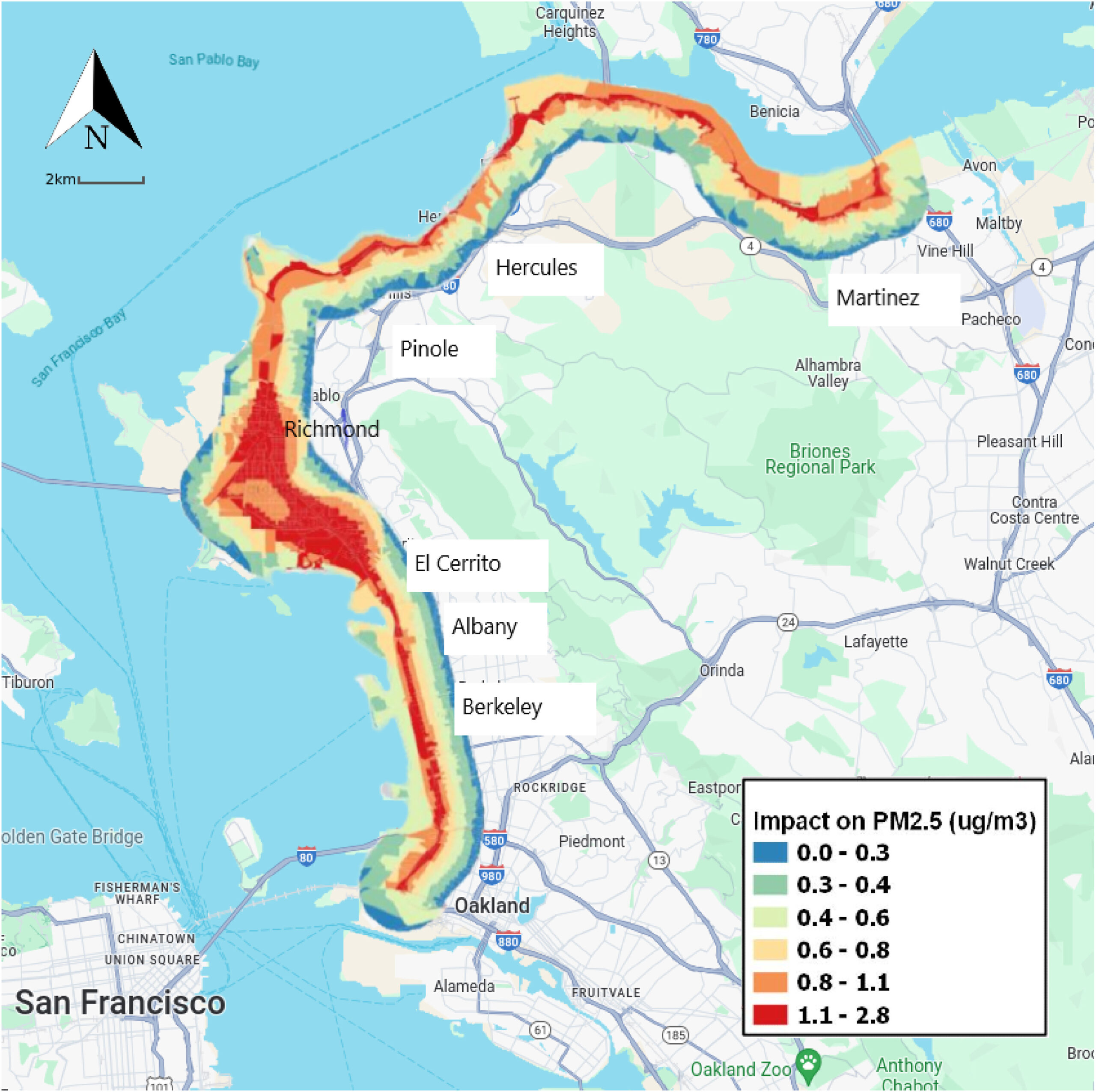
1) As you can see from this map, people of all classes would be hit by the toxic coal. But working-class communities would suffer the most. Workers are more than their jobs. They are parents whose children will be poisoned by coal. They are neighbors who will inhale toxic air and watch the people next door fall ill.
2) Our detractors tell us we have to choose between jobs and the climate, and we therefore must accept the consequences. But this terminal will create at most thousands of unhealthy, short-term jobs and a hundred permanent jobs in toxic workplaces. Some of our laboring brothers and sisters say, “Short-term unhealthy jobs are better than no jobs.” We hear them, we empathize with them, and therefore we are saying:
3) This is a “Yes to Healthy, Unionized Jobs” campaign as much as a No Coal campaign. Our coalition has been championing the redevelopment of the old Oakland Army Base, but in a way that will foster permanent, socially responsible employment. It is therefore crucial that many more unions and laborers join us because we can’t get that kind of development unless there is a mass movement of workers that puts pressure on local, state, and national governments to generate good jobs. This builds up to my next point:
4) The people who are behind this terminal – Trump and his oligarchs – are the same kind of people who bust unions throughout the country. They are also the ones who prevent any kind of legislation that would generate renewable energy jobs. In the last couple of years, bills that could have produced literally millions of green jobs in the US (with a heavy concentration in California) were killed due to their opposition. In other words, they are giving us (at best) thousands of unhealthy, short-term jobs with one hand, while they are taking away potentially millions of healthy, permanent jobs with their other hand.
5) This fight is also a matter of labor pride. The bosses want to build this terminal not just for the cash, which might be their primary motive, but also as an act of class vengeance. They always tell us that without them labor would be nothing. They create the jobs and they pay the wages, we are told. But the labor leadership in this campaign has shown that labor can coalesce with social movements and environmental justice communities to make big things happen. Whenever bosses see that kind of action, they are afraid for their fundamental privileges. That kind of victory shows that a world without oligarchs, a world where labor and communities self-consciously produce and control value, is possible. And therefore, they want to crush any living trace of such victories. Our win in 2016 is a cherished jewel of working-class memory. Ceding this turf to the oligarchs would mean abandoning our belief in a different world as much as abandoning our health and dignity.
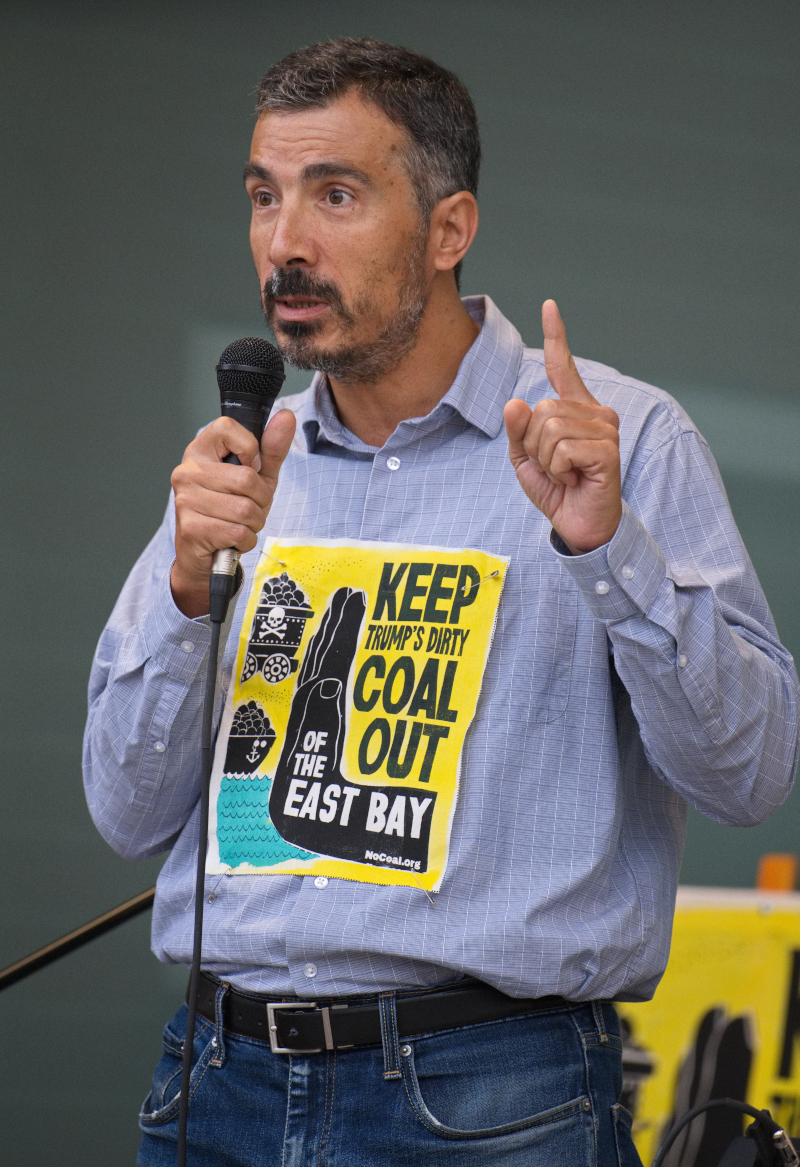
.stk-th4q7m9 {margin-bottom:15px !important;} @media screen and (min-width: 768px){.stk-096d817 {flex:var(--stk-flex-grow, 1) 1 calc(37.5% - var(--stk-column-gap, 0px) * 1 / 2 ) !important;}} @media screen and (min-width: 768px){.stk-0373019 {flex:var(--stk-flex-grow, 1) 1 calc(62.5% - var(--stk-column-gap, 0px) * 1 / 2 ) !important;}}Cihan Tuğal is a sociology professor at UC Berkeley and an organizer in East Bay DSA’s Climate Action Committee. He studies social movements, populism, capitalism, democracy, and religion and has a forthcoming book from Stanford University Press entitled The Social Roots of Autocratic Resilience. This piece is based on remarks Cihan made at the community rally of September 15, 2026, outside the Berkeley City Council meeting that adopted a resolution opposing the proposed Oakland coal depot. Photo credit: Leon Kunstenaar
.stk-q7i5evo {margin-bottom:12px !important;}Photo at top: Labor delegation led by Alameda Labor Council leader Josie Camacho speaks out against coal at Oakland City Council meeting in 2015 | Credit: Brooke Anderson
Berkeley Passes Resolution Against Toxic Coal Threat
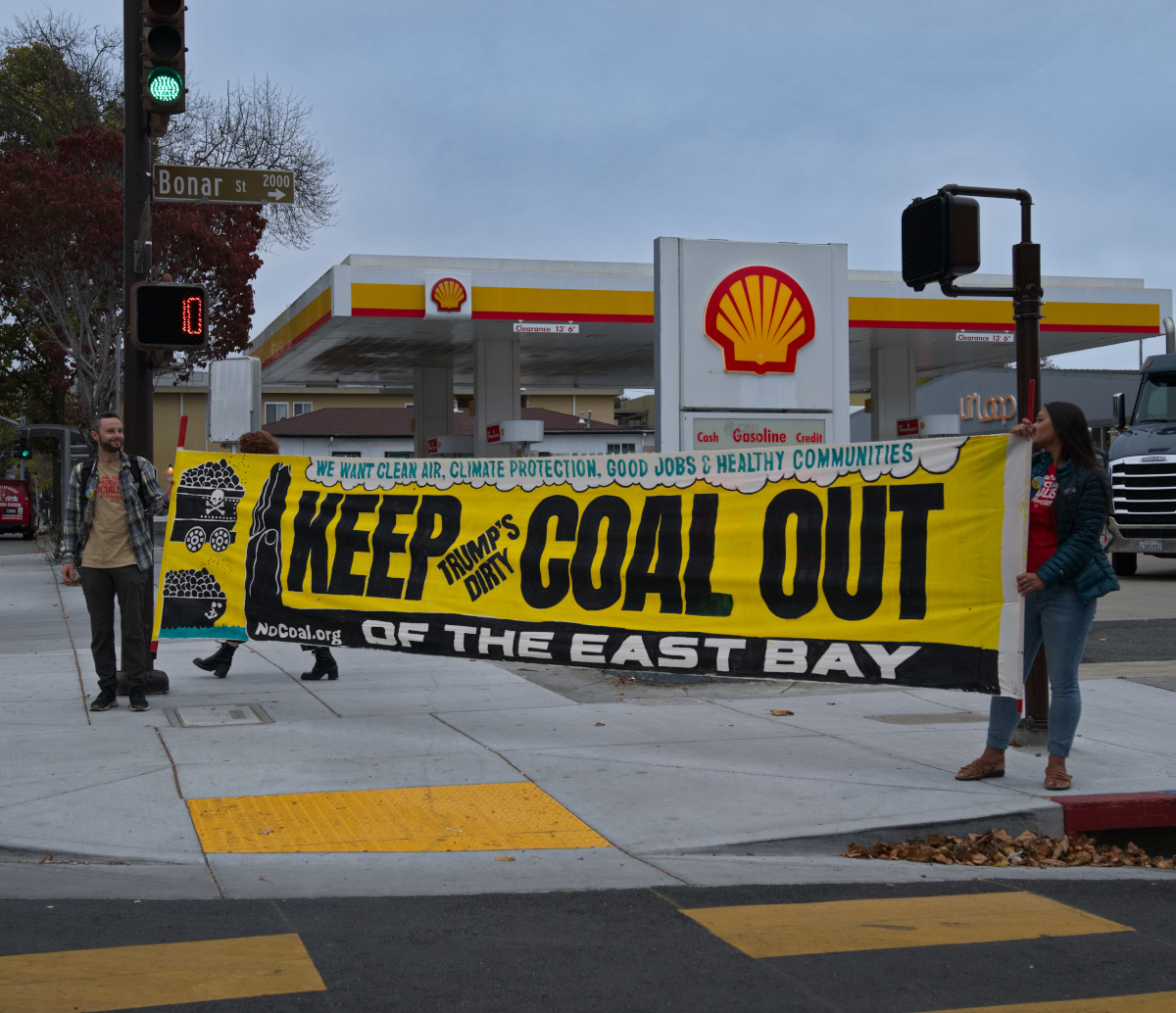
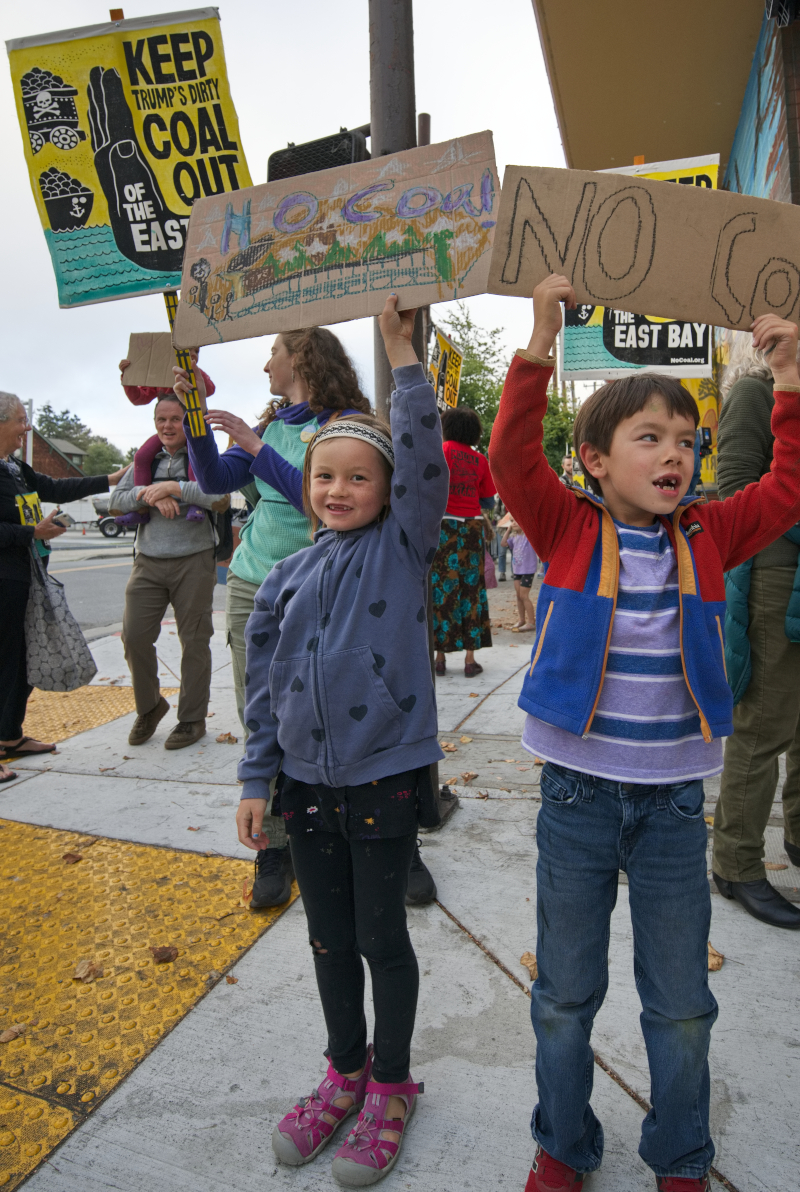
Last night, over 125 people rallied outside Berkeley City Council in support of a resolution opposing coal handling, storage, and transport in the Bay Area while dozens of No Coal advocates made their support known to the City Council with signs and comments.
The Berkeley City Council passed the resolution unanimously.
The resolution is a response to the deadly Trump-funded coal terminal planned in West Oakland. The resolution also calls for the Bay Area Air District to strictly regulate coal facilities, and affirms the City’s support of Assembly Bill 40, which requires environmental review for large coal projects. The resolution was sponsored by Council members Igor Tregub (Author), Rashi Kesarwani (Co-sponsor), and Terry Taplin (Co-sponsor) as well as by Berkeley mayor Adena Ishii.
“We live in the flatlands near the railroad tracks, freeways, refinery, and airport, constantly exposed to various pollutants,” said Ms. Margaret Gordon, a longtime environmental justice advocate and resident of West Oakland. “This proposed coal terminal is one more burden we should not have to suffer under. Homes along the tracks lack indoor air filtration and air conditioning to block out coal dust, posing a direct threat to our health.
“Our health is just as important as corporate profits. Unhoused individuals are especially vulnerable and exposed to pollutants, as they do not have a home to protect their lungs,” said Ms. Margaret. “No coal in the Bay Area!”
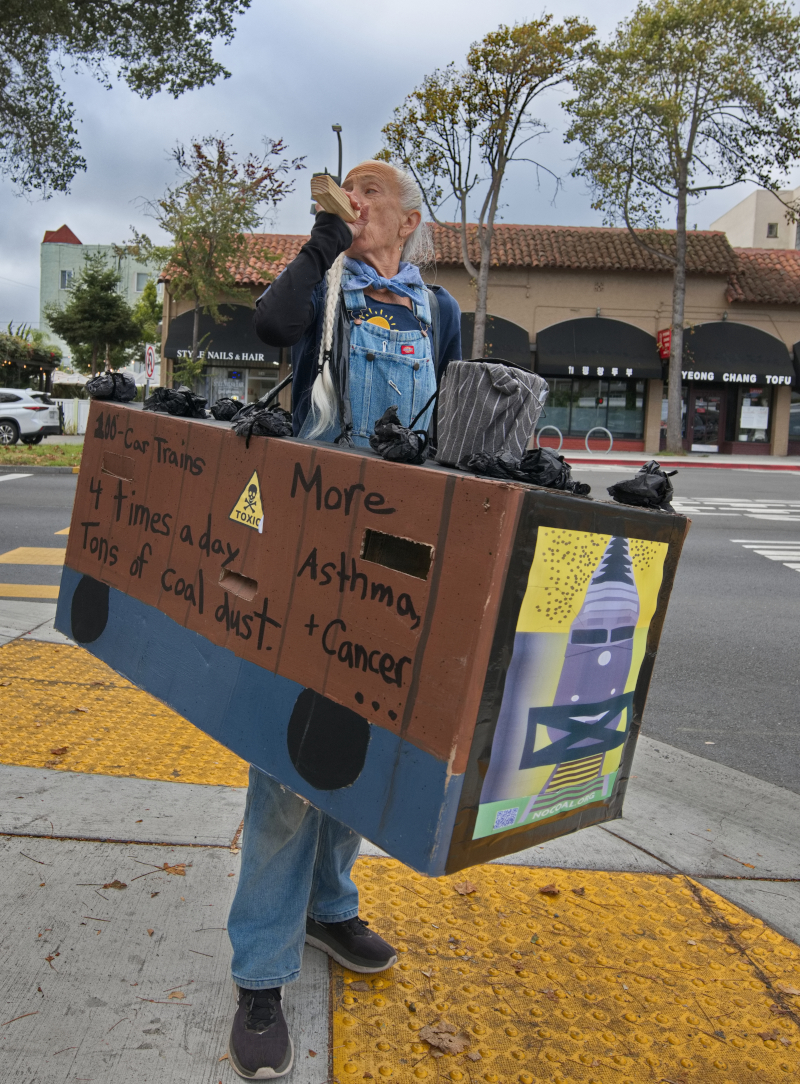
The rally was lively, defiant, and hopeful, with street theater performances including larger-than-life puppets blocking mock coal trains, chants and songs lead by Singing Resistance, and banners created at a community art build organized by “artivist” David Solnit.
“Living in Oakland, I am sick and tired of my community being ground zero for toxic pollution and environmental injustice,” said Berkeley Youth Vs. Apocalypse member Ashley Jahja. “Our health, our lives are not disposable. The fight against the coal terminal started in West Oakland but with recent mapping, is going to impact the entire Bay Area. Our fight is your fight, and we have to do whatever it takes to prevent the coal terminal from happening.”
“Berkeleyans are not about to let the East Bay become a ‘sacrifice zone’ so developers and the coal mining industry can poison the planet while they get even richer,” said Steve Masover, Berkeley resident and No Coal in Oakland organizer. “We’re here tonight because we’re determined to stop this calamity.”
“As a primary care physician, mom and community organizer who lives in West Berkeley, I could not be more opposed to the efforts to build a dirty coal terminal by the Bay Bridge,” said Ashley McClure, MD, the Executive Director of Climate Health Now. “My patients are already dealing with asthma, heart disease and dementia – all of which scientific evidence assures us would be made worse by the dirty soot of toxic coal dust (primarily fine particulate matter, or PM2.5) from coal trains smothering our communities. We care too much about the health of our families and communities to let the selfish profit motives of the billionaire class hawking dirty fossil energy move this ludicrous plan forward. This misanthropic dirty energy plan stops here.”
“These coal trains will pass a few hundred feet from places where my kids play soccer or attend summer arts camp,” said Megan Wachspress, Berkeley parent. “My kids will breathe the dust off these railcars while they’re moving, and kids in West Oakland will breath even more dust while the cars sit and are unloaded. I have a responsibility to my kids and to all the kids and families along these tracks to stop toxic coal dust from entering the East Bay.”
The resolution was proposed in response to the massively unpopular coal terminal planned in Oakland, which would flood Berkeley and other Bay Area cities with toxic coal pollution from mile-long coal trains. In June of this year, President Trump announced $75 million in funding for the terminal. Developer Phil Tagami aims to build a terminal to export coal carried by rail from Utah to Martinez to West Oakland, where he plans to load coal onto ships bound for Asian markets.
This resolution is part of a growing wave of resistance throughout the East Bay and statewide: The City of Richmond passed a similar resolution in July. Coalition members are organizing in other cities along the East Bay portion of the rail route to pass their own resolutions. The California State Legislature passed Assembly Member Mia Bonta’s AB40 last month. Governor Newsom is being urged by dozens of labor, faith, and environmental organizations, Supervisor Nikki Fortunato Bas, and countless Californians to sign it into law.
Rosa Parks Elementary School contingent, Photo Credit Leon Kunstenaar.
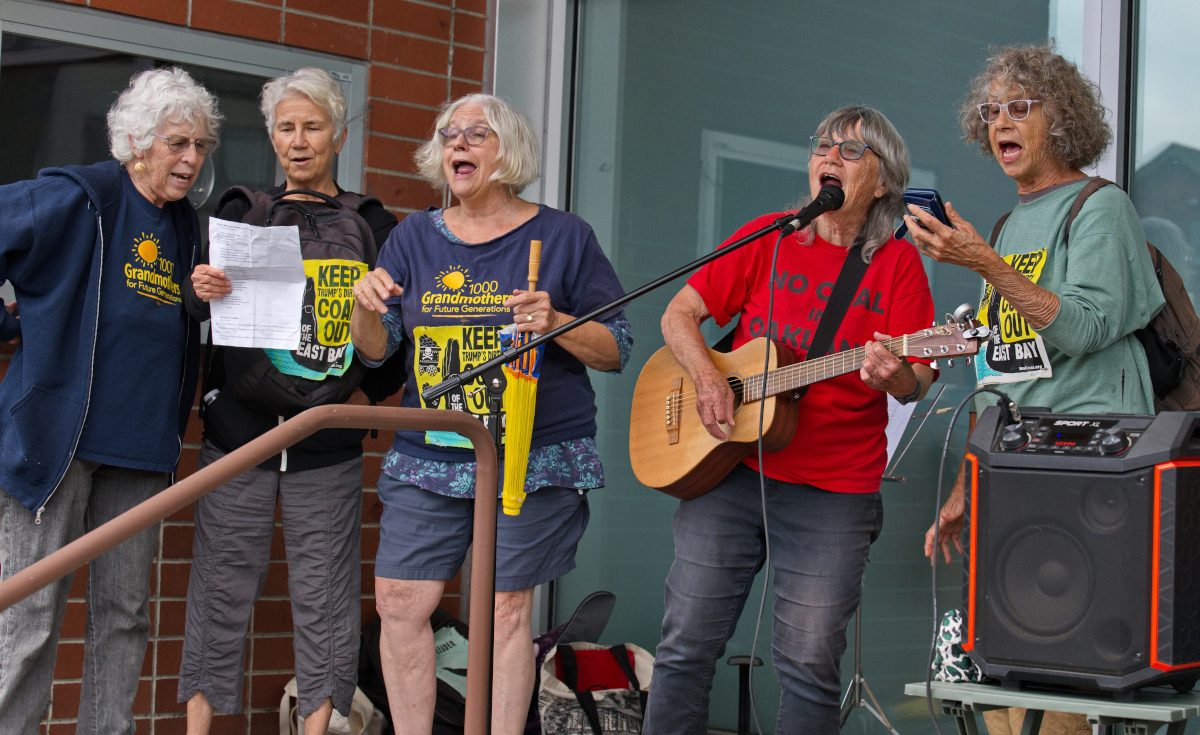
Singing Resistance, Photo Credit Leon Kunstenaar.
Labor speaker Cihan Tugal, Photo Credit Leon Kunstenaar.
Banner, Photo Credit Leon Kunstenaar.
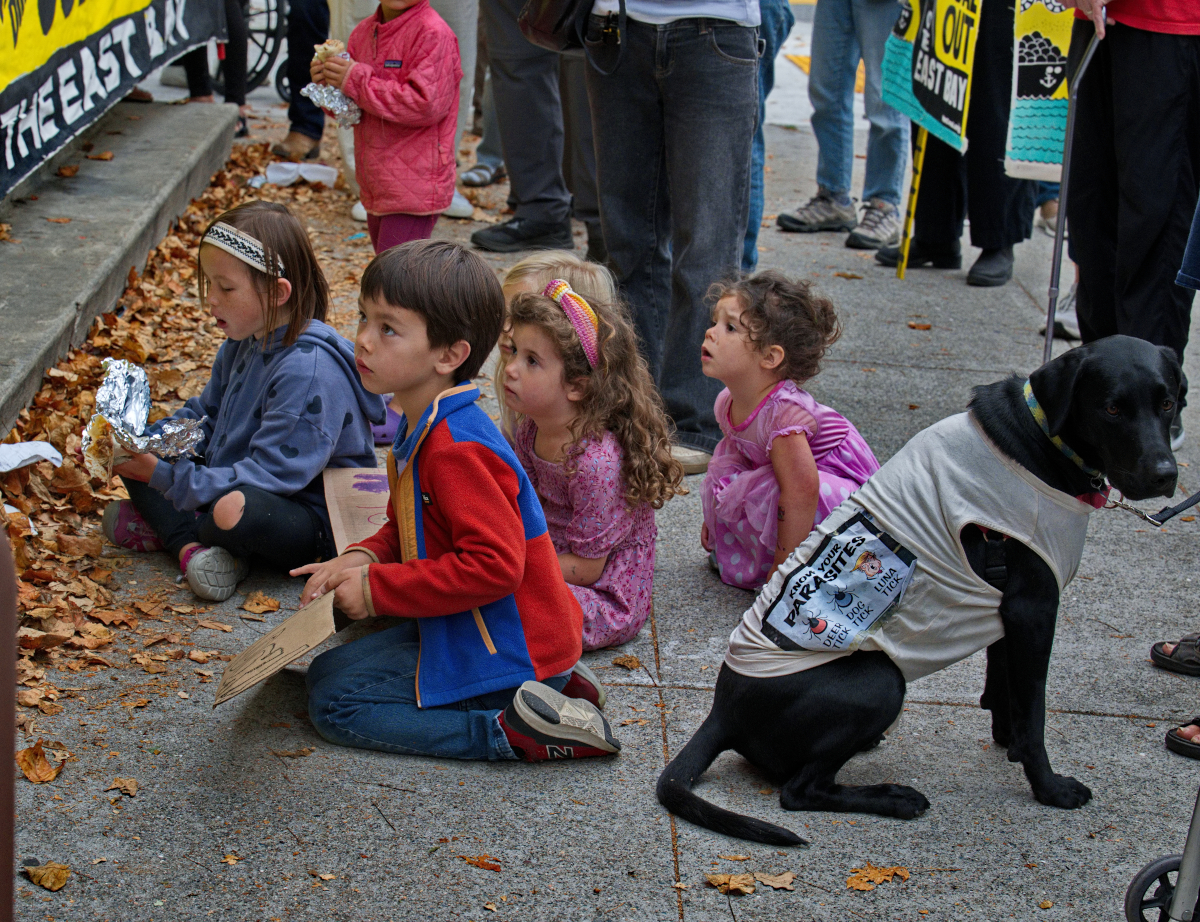
Kids against Coal, Photo Credit Leon Kunstenaar.
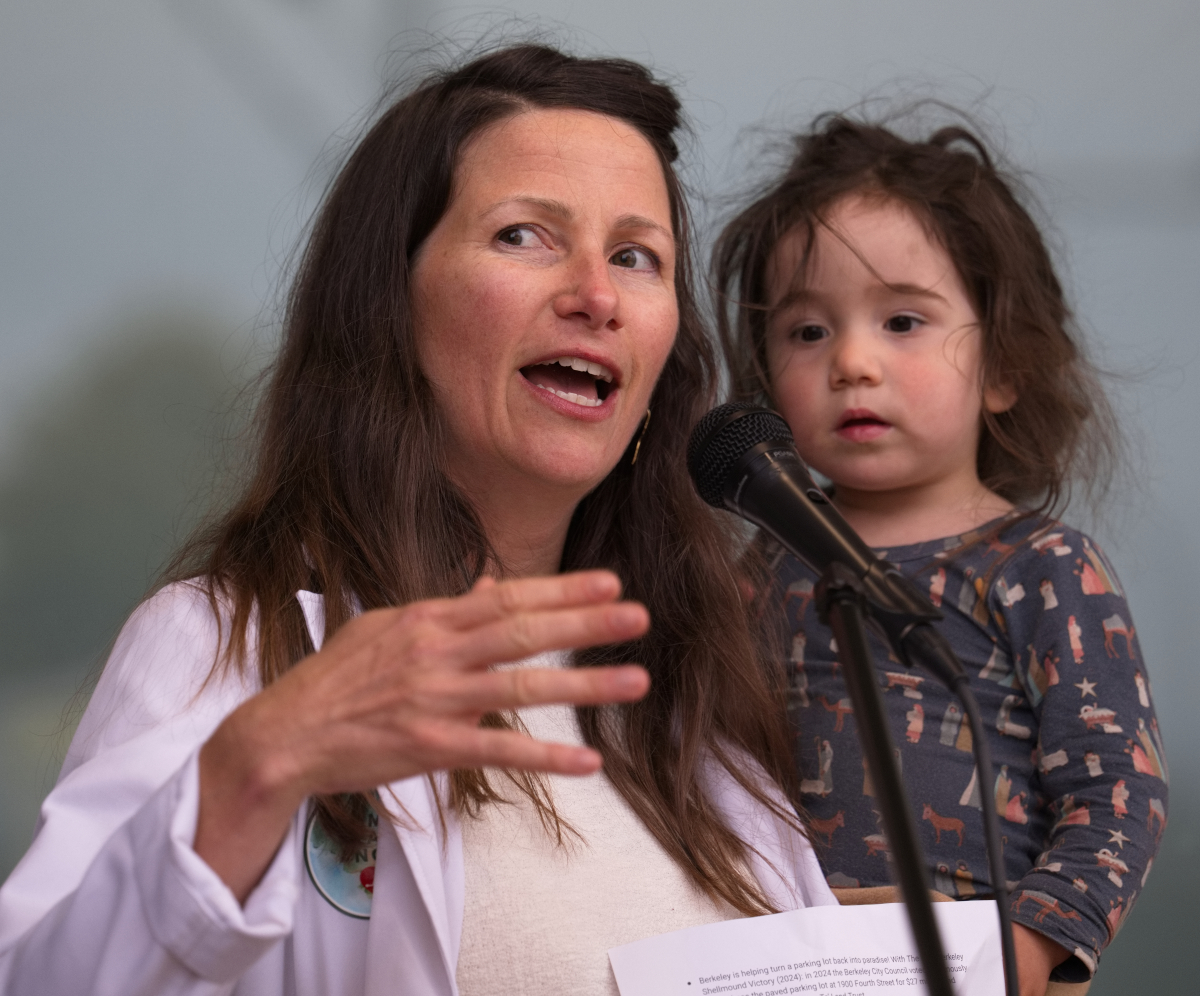
Berkeley Parent Sarah Berg at the mic, Photo Credit Leon Kunstenaar.
Coal Train (1000 Grandmothers), Photo Credit Leon Kunstenaar.
Images credit: Leon Kunstenaar
Supervisor Nikki Fortunato Bas urges Gov. Newsom to sign AB40 into law
Emphatic support for AB40, the Community First Coal Review Act, was conveyed to Governor Newsom by Alameda County Supervisor Nikki Fortunato Bas (District 5) in an eloquent and detailed letter dated September 9, 2026.
Supervisor Fortunato Bas represents a district that includes the West Gateway site where developers plan to build the proposed coal terminal, as well as the West Oakland neighborhoods adjacent to the site. District 5 also includes Emeryville, Berkeley, and Albany, three of the East Bay cities through which “unit trains” of 100 cars would pass if the coal terminal becomes operational. Uncovered coal cars would shed toxic coal dust in residential and commercial neighborhoods along the rail route, poisoning homes, businesses, schoolyards, parks, and sports fields.
The Governor has until September 30th to sign the bill, introduced by Assemblymember Mia Bonta (Oakland), into law. AB40 would also become law If Newsom neither signs nor vetoes the bill by the end of this month.
Supervisor Fortunato Bas’ letter begins:
On behalf of Alameda County District 5, I respectfully urge you to sign AB 40 (Bonta). This legislation is essential for safeguarding public health in West Oakland, West Berkeley, Emeryville, and other communities along rail corridors that already bear some of the worst cumulative pollution burdens in California.
If and when it becomes law, massive bulk coal facilities like the Oakland Bulk and Oversized Terminal (OBOT) proposed for the West Gateway would require a full Environmental Impact Report (EIR) before discretionary approval (permits) are issued for the project. No prior EIR accounted for the shipment of 10 million tons of coal annually through the facility, as detailed in a 15-page letter sent by Earthjustice Deputy Managing Attorney Colin O’Brien to the Bay Area Air District in July.
We urge readers to contact Governor Newsom in the coming days, urging him to sign AB40 into law. Earthjustice is providing a ready-to-send letter to the Governor urging his signature: please add your voice to this call if you haven’t already.
Photo credit: Brooke Anderson, November 2017: Nikki Fortunato Bas in Oakland’s Chinatown
In addition to the copy linked above, Supervisor Fortunato Bas’ letter is linked from the District 5 Media & Statements page.
Utah Study Blesses Investment in Oakland Coal Terminal But Leaves Key Questions Unanswered
After sitting on a 231-page “feasibility study” of a West Coast coal terminal for more than a month, the eight-county Rural Utah Infrastructure Coalition (RUIC) finally released the engineering and economic analysis on the Saturday of Labor Day weekend, just five days before a public hearing on RUIC”s proposal to invest $40-45 million of Utah public money in the Oakland export facility and another $10 million in a more distant facility in Longview, Washington.
In February of this year, RUIC commissioned Norda Stelo, a giant Canadian-based engineering firm, aided by Wood Mackenzie, a Scottish energy consultancy, “to identify replacement export capacity for Utah coal following the planned closure of the Levin-Richmond terminal at the end of 2026.” (1) The consultants were paid $488,000 to compare three possible locations: Oakland, Longview, and Guaymas, Mexico.
Guaymas was dismissed without much fanfare, and the competition between frontrunner Oakland and also-ran Longview served mainly as a distraction from the question barely addressed in the report: will the Oakland coal export terminal sink under the weight of economic, regulatory, and political risks. If Utah antes, will any other investors come to the table?
The answer is nowhere to be found in the report. The report gave the Oakland terminal project an overall weighted score of 2.85 on a scale of 1 to 5. The grading considered many detailed requirements where 1 indicates the facility does not meet the requirement and 5 indicates it fully meets the requirement. If 5 is an A and 4 is a B, an overall grade of 2.85 is a ho-hum C, not a strong argument for investment. Nonetheless, Norda Stelo recommends that RUIC invest approximately $43 million in Oakland.
The report brings new clarity to what developers have been up to since the project emerged from a decade of litigation in September 2025. Last Thursday, RUIC presented a vague overview of the plan to funding decision makers at Utah’s Community Impact Board and said they would be back as soon as October 1 to apply for the money, but, first, RUIC plans to hold a public hearing in Provo, Utah and online on Thursday, September 10.
As developers seek financial support from Utah for their private coal export scheme, the Norda Stelo report presents a mixture of revelations, questionable claims, and concessions to reality.
RevelationsThe developers have no intention of designing a state-of-the-art terminal that will prevent any leakage of coal dust. Coal will be stored in two 150,000-ton open air stockpiles (190), not in “[c]overed bulk material storage buildings” described in the Basis of Design and pictured in the conceptual drawings filed with the City in 2015 and 2018.
.stk-6kxoqxe .stk-img-figcaption{text-align:left !important;font-size:16px !important;line-height:1em !important;}@media screen and (max-width: 1023px){.stk-6kxoqxe .stk-img-figcaption{font-size:16px !important;}} This drawing was submitted to the City of Oakland in 2015 as part of OBOT’s Basis of Design. “Commodity A” was the euphemism for “coal” that the developers adopted when they were concealing their ongoing business relationship with a Utah-based coal mining company.The developers need to raise a lot more cash than they admit. Based on comparable coal terminals of similar throughput and material type, Norda Stelo estimates the cost to build the terminal at $430 to $625 million, not the developers’ cost estimate of $250 million. Norda Stelo notes, without comment, that the developer provided no basis for its estimate “beyond some budgetary vendor quotations.” (18)
If engineering got underway immediately, the terminal might take until 2031 to begin operations. “The overall project duration is estimated at approximately 53 months from the start of engineering to first cargo. As highlighted in Section 4, the OBOT proponent’s October 2028 first-cargo target is not consistent with this schedule.” Apparently, Donald Trump’s boast is false: “Starting this summer, the West Gateway project will break ground, and by summer 2028, over 12 million tons of clean beautiful coal per year will be shipped to countries all around the world.” The West Gateway project does not have a building permit, much less a shovel in the ground, and Norda Stelo estimates it will take more than double the President’s timeline to get a terminal up and running.
The “multi-commodity terminal” is no more; it’s all about coal. OBOT’s developers appear to be quietly ditching their oft-repeated (and contractual?) commitment to build a multi-commodity terminal. The only sharing of the terminal discussed by Norda Stelo is between two varieties of coal: Utah coal and Wyoming Powder River Basin coal. Wood Mackenzie provides a pro forma analysis of other commodities – copper, soda ash, and oil and gas – but serious interest in building a multi-commodity terminal is belied by the report’s sharp focus on coal.
Savage Companies, a large Utah-based logistics firm, has signed up to operate the terminal. Savage has contributed an “OBOT Terminal Project Design Basis” document to the Norda Stelo report along with drawings by Millcreek Engineering.
Delusions and questionable claims“A coal handling permit is reportedly in place” (19) There is no such thing as a “coal handling permit.” This is a good reminder of Norda Stelo’s warning that their report is based on whatever the developers fed them: “The evaluation of the two facilities is based on information provided by each facility proponent, supplemented by site visit observations and publicly available documentation. No independent verification or detailed condition assessment was performed by Norda Stelo as part of this study.” (8)
“No pending legislative or regulatory changes are identified.” (22) Based on Norda Stelo’s caveat, it is fair to read this as a statement about what Phil Tagami disclosed or failed to disclose to Norda Stelo. As widely reported, on June 15, 2026, six weeks before the Norda Stelo’s report was finalized, Assm. Mia Bonta introduced the Communities First Coal Review Act (AB40) which would require an Environmental Impact Report for any major new coal terminal. The California Legislature has overwhelmingly passed Bonta’s bill and it is awaiting signature on Gov. Newsom’s desk. Moreover, the Bay Area Air District has been in the process of revising its fugitive dust regulations for many months, including specifically those governing “bulk material handling and storage.” Both AB40 and the new Air District regulations may significantly impact the future of the project. Failure to capture these major developments calls into question the reliability of Norda Stelo’s assessment of regulatory risk.
“Oakland [Bulk & Oversized Terminal[ … has substantial public funding support.” (28) “Approximately USD 315 million in public funding has been identified (USD 75 million federal and approximately USD 240 million state).” (19) This is deeply misleading. The $242 million Transport Corridor Improvement Money grant to the City and Port of Oakland covered horizontal redevelopment of the 360-acre Oakland Army Base. It was spent long ago on a rail yard, roads, cleanup, soil compaction, new utilities, and the like. None of this government money was ever available to any of the private developers leasing land from the City or the Port for private benefit. Thus, Norda Stelo’s conclusion that the project has already lined up $315 million dollars of public money is nonsense. That leaves Donald Trump’s pledge to contribute $75 million under the Cold War era Defense Production Act. Trump’s diktat appears legally shaky given the lack of a nexus between shipments of Utah coal to Asia and a legitimate national defense interest.
Silences That Speak Louder Than WordsNo interest from private investors is mentioned. In 2015, the pitch to the CIB was done by Jeffrey Holt, an investment banker with Bank of Montreal who suggested that, if Utah would seed the project with $50 million of public money, pension funds could be persuaded to make $200 million of non-recourse loans to fund the project. Now, with as much as $625 million to be raised, the report that is supposed to convince the Community Impact Board to open Utah’s pursestrings provides no assurance that there will be any private investors prepared to close the enormous gap between what public sources might provide and the amount needed to get the project off the ground.
Wood Mackenzie’s economic analysis obscures the secular decline of the overseas coal market. The economic analysis consists of 116 densely packed presentation slides without a coherent narrative to tie them together. There is very little information or analysis of the long-term trends or country-by-country risks that may sink any coal export terminal built at this late point in the world’s transition away from coal.
The study does not show that the market for Utah coal exports “should be profitable for at least 20 years.” Neither does it “confirm” that a West Coast bulk commodities terminal is “a sound and prudent investment for Utah.” These representations by RUIC prior to its visit to the Community Impact Board last Thursday are not supported by the report.
Redactions cover up key facts. Utah law allows agencies to redact trade secrets and other confidential business information from public documents before releasing them, but some of RUIC’s redactions appear designed to cover up inconvenient facts. For example, the list of approvals that “may” be needed by the West Oakland terminal begins with a four-inch black stripe. (20) The developer may dispute one or more items on Norda Stelo’s list, but this does not make it a business secret entitled to be kept from disclosure. The answer to a simple question about what site preparation and demolition work would be required prior to construction is half-redacted. (33) Hardly a trade secret or confidential business information that could lead to competitive harm.
Concessions to reality“Significant community, permitting, environmental, and schedule risks have been identified” for the Oakland terminal. (27)
“Very strong opposition is documented from community and environmental organisations including No Coal in Oakland, Sierra Club, San Francisco Baykeeper and Earthjustice, with a demonstrated history of litigation and regulatory intervention. A letter dated 13 May was issued by No Coal in Oakland to the Coalition, Norda Stelo and Wood Mackenzie, stating a commitment to oppose the project by ‘every feasible means.'” (20)
The site remains constrained by its geometry. A loop track is the most efficient way to unload a mile-long train. The train pulls in from Utah, enters a loop, dumps its load a couple of cars at a time into a below-grade dumping station, and heads back to Utah without reconfiguration and consequent delay. Here’s the plan for Oakland:
“Railcar movements are based on switching and segmented handling of unit trains using a dedicated switching locomotive. Coal is delivered in 116-car unit trains and, for yard operations, trains are assumed to be broken into two 58-car segments and then further divided into 29-car cuts for unloading. Two parallel tracks are provided at the in-motion bottom-dump system, with one track designated for active dumping while the adjacent track is used for switching and train set-up.” (190)
Notably, there is no room for expansion to service other commodities that do not share the physical characteristics of coal, none of which are identified in the report. “[T]he limited site area provides little opportunity to accommodate additional commodity-specific storage or handling infrastructure.” (15)
Image at top: Aerial view of the Richmond-Level coal terminal, which will retire from coal shipment at the end of 2026. Image credit: SF Baykeeper.
Note: Up to page 28, the page numbers in the text are those shown at the bottom of each page of the Study Report. Higher page numbers refer to the page location within the PDF.
Why a West Oakland coal terminal matters to Berkeley
On Tuesday evening next week – September 15, 2026 – the Berkeley City Council will vote on the adoption of a resolution “in opposition to the handling, storage, and transport of coal and petroleum coke in the San Francisco Bay Region, urging stringent regulation of such facilities by the Bay Area Air District, and in support of Assembly Bill (AB) 40.” Starting at 6:00 pm outside the City Council meeting, the Keep Coal Out of the East Bay campaign will stage a rally and – we hope – a celebration of the resolution’s passage (event details here).
Join us!
Berkeley’s resolution is prompted by the threat of coal shipment through the proposed Oakland Bulk and Oversize Terminal (OBOT). Local developer Phil Tagami and his partners have been angling for more than a decade to build OBOT as a coal export terminal. The proposed terminal would be located at the foot of the Bay Bridge in West Oakland, near the toll plaza. President Trump and the State of Utah plan to contribute millions of dollars in public funds toward the (private) terminal’s construction. The proposed terminal would ship coal from Utah (and perhaps Wyoming) to buyers in Asia, most likely Japan and South Korea.
In July, the City of Richmond passed a resolution similar to the one on Berkeley’s City Council agenda next week. Other cities along the rail route are also being asked to weigh in against the proposed coal terminal.
But why would a coal export terminal in West Oakland be any of Berkeley’s business? Here are a few top-shelf reasons:
- There’s the existential and moral interest Berkeley has about mining and export to Asian markets of ten to twelve million tons per year of the dirtiest, most polluting fossil fuel: coal that would otherwise be left in the ground. Burning coal anywhere in the world in quantities developers propose to ship through West Oakland would generate over 25 million tons of CO2 emissions every year the terminal operates … adding to emissions humans must radically reduce in order to mitigate the evolving climate crisis.
- Then there’s the neighborly interest Berkeley has about what happens in Oakland. If a toxic, polluting coal terminal threatens to become operational in West Oakland, severely impacting the health of Berkeleyans’ neighbors, friends, and families, how could such a looming travesty not be a concern to the City and people of Berkeley?
- Additionally, there’s self-interest. Coal will not be magically teleported to West Oakland. It will be transported by multiple, daily, mile-long trains in uncovered coal cars. The most likely route those massive trains will take – spewing greasy, grimy, disease-inducing coal dust all along the way – hugs the East Bay shoreline from Martinez to Richmond to West Oakland … and cuts right through the City of Berkeley.
All in all, the proposed coal facility is a textbook example of an axiom central to Berkeleyans’ civic identity: think globally, act locally.
The image (map) at the top of this article suggests the nuts-and-bolts impact of multiple, mile-long coal trains passing through Berkeley every day. Zooming in on a map that illustrates a peer-reviewed study in the journal Environmental Research, shown in the lower left corner of the image above, it makes clear just who and what will be poisoned in Berkeley by coal dust shed from those trains.
- Schools and medical facilities, including Centro Vida Preschool, Ecole Bilingue, Rosa Parks Elementary School, and Kaiser Berkeley.
- Playgrounds and parks, including Adventure Playground, Aquatic Park, the Berkeley Marina, Cedar Rose Park, McLaughlin Eastshore Park, San Pablo Park, Shorebird Park, Strawberry Creek Park, and the Tom Bates Sports Complex.
- Places we live and shop for groceries and grow our own food, including Berkeley Bowl West, the Gill Tract Community Farm, University Village (where thousands of UC Berkeley students and their families live, and whose community garden is right next to the train tracks), and all homes within a half-mile or so of the train tracks.
- Businesses and commercial districts, including Ashby Lumber, Bayer, Berkeley Ironworks, the Fourth Street shopping district, Meyer Sound, and REI.
These are only partial lists. But they make clear that the proposed West Oakland coal terminal is of paramount interest to the City of Berkeley and all its residents … for all kinds of reasons.
That’s why next week’s City Council vote to adopt a No Coal resolution matters. A lot.
Please come out Tuesday evening, 6:00 to 8:00 pm, to rally while the City Council votes, and to celebrate the hoped-for passage of the resolution. The City Council meets at the BUSD Boardroom, at 1231 Addison St. between Bonar and Curtis (map). Event details can be found here.
The Fine Print I:
Disclaimer: The views expressed on this site are not the official position of the IWW (or even the IWW’s EUC) unless otherwise indicated and do not necessarily represent the views of anyone but the author’s, nor should it be assumed that any of these authors automatically support the IWW or endorse any of its positions.
Further: the inclusion of a link on our site (other than the link to the main IWW site) does not imply endorsement by or an alliance with the IWW. These sites have been chosen by our members due to their perceived relevance to the IWW EUC and are included here for informational purposes only. If you have any suggestions or comments on any of the links included (or not included) above, please contact us.
The Fine Print II:
Fair Use Notice: The material on this site is provided for educational and informational purposes. It may contain copyrighted material the use of which has not always been specifically authorized by the copyright owner. It is being made available in an effort to advance the understanding of scientific, environmental, economic, social justice and human rights issues etc.
It is believed that this constitutes a 'fair use' of any such copyrighted material as provided for in section 107 of the US Copyright Law. In accordance with Title 17 U.S.C. Section 107, the material on this site is distributed without profit to those who have an interest in using the included information for research and educational purposes. If you wish to use copyrighted material from this site for purposes of your own that go beyond 'fair use', you must obtain permission from the copyright owner. The information on this site does not constitute legal or technical advice.
 This site is not the official webpage of the Industrial Workers of the World.